Proceedings of the 56th Annual Meeting of the Association for Computational Linguistics (Long Papers), pages 2104–2115 2104
Numeracy for Language Models:
Evaluating and Improving their Ability to Predict Numbers
Georgios P. Spithourakis
Department of Computer Science University College London [email protected]
Sebastian Riedel
Department of Computer Science University College London [email protected]
Abstract
Numeracy is the ability to understand and work with numbers. It is a necessary skill for composing and understanding documents in clinical, scientific, and other technical domains. In this paper, we explore different strategies for modelling numerals with language models, such as memorisation and digit-by-digit composition, and propose a novel neural architecture that uses a contin-uous probability density function to model numerals from an open vocabulary. Our evalu-ation on clinical and scientific datasets shows that using hierarchical models to distinguish numerals from words improves a perplexity metric on the subset of numerals by 2 and 4 orders of magnitude, respectively, over non-hierarchical models. A combination of strate-gies can further improve perplexity. Our con-tinuous probability density function model reduces mean absolute percentage errors by 18% and 54% in comparison to the second
best strategy for each dataset, respectively.
1 Introduction
Language models (LMs) are statistical models that as-sign a probability over sequences of words. Language models can often help with other tasks, such as speech recognition (Mikolov et al., 2010; Prabhavalkar et al.,2017), machine translation (Luong et al.,2015;
[image:1.595.324.510.218.492.2]Gülçehre et al.,2017), text summarisation (Filippova et al., 2015; Gambhir and Gupta, 2017), question answering (Wang et al., 2017), semantic error de-tection (Rei and Yannakoudakis,2017;Spithourakis et al.,2016a), and fact checking (Rashkin et al.,2017). Numeracy and literacy refer to the ability to compre-hend, use, and attach meaning to numbers and words, respectively. Language models exhibit literacy by be-ing able to assign higher probabilities to sentences that
Figure 1: Modelling numerals with a categorical distribution over a fixed vocabulary maps all out-of-vocabulary numerals to the same type, e.g. UNK, and does not reflect the smoothness of the underlying continuous distribution of certain attributes.
are both grammatical and realistic, as in this example:
‘I eat an apple’(grammatical and realistic) ‘An apple eats me’(unrealistic) ‘I eats an apple’(ungrammatical)
Likewise, a numerate language model should be able to rank numerical claims based on plausibility:
’John’s height is 1.75 metres’(realistic) ’John’s height is 999.999 metres’(unrealistic)
However, this maps all unseen numerals to the same unknown type and ignores the smoothness of continuous attributes, as shown in Figure 1. In that respect, existing work on language modelling does not explicitly evaluate or optimise for numeracy. Numerals are often neglected and low-resourced, e.g. they are often masked (Mitchell and Lapata,2009), and there are only15,164 (3.79%)numerals among GloVe’s400,000embeddings pretrained on 6 billion tokens (Pennington et al.,2014). Yet, numbers appear ubiquitously, from children’s magazines (Joram et al.,
1995) to clinical reports (Bigeard et al.,2015), and grant objectivity to sciences (Porter,1996).
Previous work finds that numerals have higher out-of-vocabulary rates than other words and proposes solutions for representing unseen numerals as inputs to language models, e.g. using numerical magnitudes as features (Spithourakis et al.,2016b,a). Such work identifies that the perplexity of language models on the subset of numerals can be very high, but does not directly address the issue. This paper focuses on evaluating and improving the ability of language models to predict numerals. The main contributions of this paper are as follows:
1. We explore different strategies for modelling numerals, such as memorisation and digit-by-digit composition, and propose a novel neural architecture based on continuous probability density functions.
2. We propose the use of evaluations that adjust for the high out-of-vocabulary rate of numerals and account for their numerical value (magnitude).
3. We evaluate on a clinical and a scientific corpus and provide a qualitative analysis of learnt rep-resentations and model predictions. We find that modelling numerals separately from other words can drastically improve the perplexity of LMs, that different strategies for modelling numerals are suitable for different textual contexts, and that continuous probability density functions can im-prove the LM’s prediction accuracy for numbers.
2 Language Models
Lets1,s2,...,sLdenote a document, wherestis the token at position t. A language model estimates the probability of the next token given previous tokens, i.e. p(st|s1,...,st−1). Neural LMs estimate
this probability by feeding embeddings, i.e. vectors that represent each token, into a Recurrent Neural Network (RNN) (Mikolov et al.,2010).
Token Embeddings Tokens are most commonly represented by aD-dimensional dense vector that is unique for each word from a vocabularyVof known words. This vocabulary includes special symbols (e.g. ‘UNK’) to handle out-of-vocabulary tokens, such as unseen words or numerals. Letws be the one-hot representation of tokens, i.e. a sparse binary vector with a single element set to1for that token’s index in the vocabulary, andE∈RD×|V|be the token embeddings matrix. The token embedding forsis the vectoretokens =Ews.
Character-Based Embeddings A representation for a token can be build from its constituent charac-ters (Luong and Manning,2016;Santos and Zadrozny,
2014). Such a representation takes into account the internal structure of tokens. Letd1,d2,...,dN be the characters of tokens. A character-based embedding fors is the final hidden state of a D-dimensional character-level RNN:echarss =RNN(d0,d1,...dL).
Recurrent and Output Layer The computation of the conditional probability of the next token involves recursively feeding the embedding of the current tokenest and the previous hidden stateht−1 into a
D-dimensional token-level RNN to obtain the current hidden stateht. The output probability is estimated using the softmax function, i.e.
p(st|ht)=softmax(ψ(st))=Z1eψ(st)
Z=P s0∈V
eψ(s0), (1)
whereψ(.)is a score function.
Training and Evaluation Neural LMs are typi-cally trained to minimise the cross entropy on the training corpus:
Htrain=−1 N
X
st∈train
logp(st|s<t) (2)
A common performance metric for LMs is per to-ken perplexity (Eq.3), evaluated on a test corpus. It can also be interpreted as the branching factor: the size of an equally weighted distribution with equivalent uncertainty, i.e. how many sides you need on a fair die to get the same uncertainty as the model distribution.
P Ptest=exp(Htest) (3)
3 Strategies for Modelling Numerals
use of number-specific evaluation metrics that adjust for the high out-of-vocabulary rate of numerals and account for numerical values. We draw inspiration from theories of numerical cognition. The triple code theory (Dehaene et al.,2003) postulates that humans process quantities through two exact systems (verbal and visual) and one approximate number system that semantically represents a number on a mental number line. Tzelgov et al.(2015) identify two classes of numbers: i) primitives, which are holistically retrieved from long-term memory; and ii) non-primitives, which are generated online. An in-depth review of numerical and mathematical cognition can be found inKadosh and Dowker(2015) andCampbell(2005).
3.1 Softmax Model and Variants
This class of models assumes that numerals come from a finite vocabulary that can be memorised and retrieved later. The softmax model treats all tokens (words and numerals) alike and directly uses Equation1with score function:
ψ(st)=hTtetokenst =h
T
tEoutwst, (4)
where Eout ∈ RD×|V| is an output embeddings
matrix. The summation in Equation 1 is over the complete target vocabulary, which requires mapping any out-of-vocabulary tokens to special symbols, e.g. ‘UNKword’ and ‘UNKnumeral’.
Softmax with Digit-Based Embeddings The softmax+rnnvariant considers the internal syntax of a numeral’s digits by adjusting the score function:
ψ(st)=hTtestokent +hTtecharsst
=hTtEoutwst+h
T
tEoutRNNwst,
(5)
where the columns of EoutRNN are composed of character-based embeddings for in-vocabulary numerals and token embeddings for the remaining vocabulary. The character set comprises digits (0-9), the decimal point, and an end-of-sequence character. The model still requires normalisation over the whole vocabulary, and the special unknown tokens are still needed.
Hierarchical Softmax A hierarchical soft-max (Morin and Bengio,2005a) can help us decouple the modelling of numerals from that of words. The probability of the next tokenstis decomposed to that of its classctand the probability of the exact token from within the class:
p(st|ht)= P ct∈C
p(ct|ht)p(st|ct,ht)
p(ct|ht)=σ hTtb
(6)
where the valid token classes are C =
{word, numeral},σis the sigmoid function andbis aD-dimensional vector. Each of the two branches ofp(st|ct,ht)can now be modelled by independently normalised distributions. The hierarchical variants (h-softmaxandh-softmax+rnn) use two independent softmax distributions for words and numerals. The two branches share no parameters, and thus words and numerals will be embedded into separate spaces. The hierarchical approach allows us to use any well normalised distribution to model each of its branches. In the next subsections, we examine different strategies for modelling the branch of numerals, i.e. p(st|ct=numeral,ht). For simplicity, we will abbreviate this top(s).
3.2 Digit-RNN Model
Letd1,d2...dN be the digits of numerals. A digit-by-digit composition strategy estimates the probability of the numeral from the probabilities of its digits:
p(s)=p(d1)p(d2|d1)...p(dN|d<N) (7)
Thed-RNN model feeds the hidden statehtof the token-level RNN into a character-level RNN (Graves,
2013;Sutskever et al.,2011) to estimate this proba-bility. This strategy can accommodate an open vo-cabulary, i.e. it eliminates the need for an UNKnumeral symbol, as the probability is normalised one digit at a time over the much smaller vocabulary of digits (digits 0-9, decimal separator, and end-of-sequence).
3.3 Mixture of Gaussians Model
Inspired by the approximate number system and the mental number line (Dehaene et al.,2003), our proposed MoGmodel computes the probability of numerals from a probability density function (pdf) over real numbers, using a mixture of Gaussians for the underlying pdf:
q(v)= K X
k=1
πkNk(v;µk,σ2k)
πk=softmax BTht
,
(8)
where K is the number of components, πk are mixture weights that depend on hidden stateht of the token-level RNN,Nk is the pdf of the normal distribution with meanµk∈Rand varianceσk2∈R, andB∈RD×Kis a matrix.
Figure 2: Mixture of Gaussians model. The probability of a numeral is decomposed into the probability of its decimal precision and the probability that an underlying number will produce the numeral when rounded at the given precision.
we consider a probability mass function (pmf) that discretely approximates the pdf:
e
Q(v|r)= v+r
Z
v−r
q(u)du=F(v+r)−F(v−r), (9)
whereF(.)is the cumulative density function ofq(.), andr= 0.5×10−ris the number’s precision. The level of discretisationr, i.e. how many decimal digits to keep, is a random variable inNwith distribution
p(r). The mixed joint density is:
p(s)=p(v,r)=p(r)Qe(v|r) (10)
Figure 2 summarises this strategy, where we model the level of discretisation by converting the numeral into a pattern and use a RNN to estimate the probability of that pattern sequence:
p(r)=p(SOS INT_PART .
rdecimal digits z }| {
\d ...\d EOS) (11)
3.4 Combination of Strategies
Different mechanisms might be better for predicting numerals in different contexts. We propose a combinationmodel that can select among different
strategies for modelling numerals:
p(s)= X ∀m∈M
αmp(s|m)
αm=softmax ATht
,
(12)
where M={h-softmax, d-RNN, MoG}, and
A∈RD×|M|. Since both d-RNN and MoG are open-vocabulary models, the unknown numeral token can now be removed from the vocabulary of h-softmax.
3.5 Evaluating the Numeracy of LMs
Numeracy skills are centred around the understanding of numbers and numerals. A number is a mathe-matical object with a specific magnitude, whereas a numeral is its symbolic representation, usually in the positional decimal Hindu–Arabic numeral system (McCloskey and Macaruso,1995). In humans, the link between numerals and their numerical values boosts numerical skills (Griffin et al.,1995).
Perplexity Evaluation Test perplexity evaluated only on numerals will be informative of the symbolic component of numeracy. However, model compar-isons based on naive evaluation using Equation 3
might be problematic: perplexity is sensitive to out-of-vocabulary (OOV) rate, which might differ among models, e.g. it is zero for open-vocabulary models. As an extreme example, in a document where all words are out of vocabulary, the best perplexity is achieved by a trivial model that predicts everything as unknown.
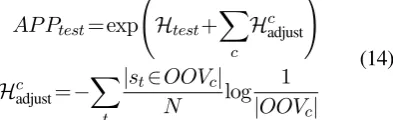
Ueberla (1994) proposed Adjusted Perplexity (APP; Eq. 14), also known as unknown-penalised perplexity (Ahn et al.,2016), to cancel the effect of the out-of-vocabulary rate on perplexity. The APP is the perplexity of an adjusted model that uniformly redistributes the probability of each out-of-vocabulary class over all different types in that class:
p0(s)= (
p(s)|OOV1
c| ifs∈OOVc
p(s) otherwise (13)
where OOVc is an out-of-vocabulary class (e.g. words and numerals), and|OOVc|is the cardinality of each OOV set. Equivalently, adjusted perplexity can be calculated as:
AP Ptest=exp Htest+ X
c
Hcadjust
!
Hcadjust=−X
t
|st∈OOVc|
N log
1
|OOVc|
(14)
[image:4.595.328.525.659.719.2]Evaluation on the Number Line While perplexity looks at symbolic performance on numerals, this evaluation focuses on numbers and particularly on their numerical value, which is their most prominent semantic content (Dehaene et al.,2003;Dehaene and Cohen,1995).
Let vt be the numerical value of token st from the test corpus. Also, let ˆvt be the value of the most probable numeral under the model
st = argmax (p(st|ht,ct=num)). Any evaluation metric from the regression literature can be used to measure the models performance. To evaluate on the number line, we can use any evaluation metric from the regression literature. In reverse order of tolerance to extreme errors, some of the most popular are Root Mean Squared Error (RMSE), Mean Absolute Error (MAE), and Median Absolute Error (MdAE):
ei = vi−vˆi
RMSE =
s
1
N N P i=1
e2i
MAE = N1
N P i=1
|ei|
MdAE = median{|ei|}
(15)
The above are sensitive to the scale of the data. If the data contains values from different scales, percentage metrics are often preferred, such as the Mean/Median Absolute Percentage Error (MAPE/MdAPE):
pei = vi−vivˆi
MAP E = N1
N P i=1
|pei|
MdAP E = median{|pei|}
(16)
4 Data
To evaluate our models, we created two datasets with documents from the clinical and scientific domains, where numbers abound (Bigeard et al.,2015;Porter,
1996). Furthermore, to ensure that the numbers will be informative of some attribute, we only selected texts that reference tables.
Clinical Data Our clinical dataset comprises clinical records from the London Chest Hospital. The records where accompanied by tables with 20 numeric attributes (age, heart volumes, etc.) that they partially describe, as well as include numbers not found in the tables. Numeric tokens constitute only a small proportion of each sentence (4.3%), but account
for a large part of the unique tokens vocabulary (>40%) and suffer high OOV rates.
Scientific Data Our scientific dataset comprises paragraphs from Cornell’s ARXIV 1 repository of scientific articles, with more than half a million converted papers in 37 scientific sub-fields. We used the preprocessed ARXMLIV (Stamerjohanns et al.,
2010;Stamerjohanns and Kohlhase,2008)2version, where papers have been converted from LATEX into a custom XML format using the LATEXML3 tool. We then kept all paragraphs with at least one reference to a table and a number.
Clinical Scientific Train Dev Test Train Dev Test
#inst 11170 1625 3220 14694 2037 4231 maxLen 667 594 666 2419 1925 1782 avgLen 210.1 209.1 206.9 210.1 215.9 212.1 %word 95.7 95.7 95.7 96.1 96.1 96.0 %nums 4.3 4.3 4.3 3.9 3.9 4.0 min 0.0 0.0 0.0 0.0 0.0 0.0 median 59.5 59.0 60.0 5.0 4.0 4.5 mean 300.6 147.7 464.8 ∼1021 ∼107 ∼107
[image:5.595.308.524.244.363.2]max ∼107 ∼105 ∼107 ∼1026 ∼1011 ∼1011
Table 1: Statistical description of the clinical and sci-entific datasets: Number of instances (i.e. paragraphs), maximum and average lengths, proportions of words and numerals, descriptive statistics of numbers.
For both datasets, we lowercase tokens and normalise numerals by omitting the thousands separator ("2,000" becomes "2000") and leading zeros ("007" becomes "7"). Special mathematical symbols are tokenised separately, e.g. negation (“-1” as “-”, “1”), fractions (“3/4” as “3”, “/”, “4”), etc. For this reason, all numbers were non-negative. Table1
shows descriptive statistics for both datasets.
5 Experimental Results and Discussion
We set the vocabularies to the 1,000 and 5,000 most frequent token types for the clinical and scientific datasets, respectively. We use gated token-character embeddings (Miyamoto and Cho,2016) for the input of numerals and token embeddings for the input and output of words, since the scope of our paper is numeracy. We set the models’ hidden dimensions to D = 50and initialise all token embeddings to pretrained GloVe (Pennington et al.,2014). All our
1
ARXIV.ORG. Cornell University Library at http://arxiv.org/, visited December 2016
2
ARXMLIV. Project home page at http://arxmliv.kwarc.info/, visited December 2016
Clinical Scientific
words numerals total words numerals total
Model PP APP PP APP PP APP PP APP PP APP PP APP
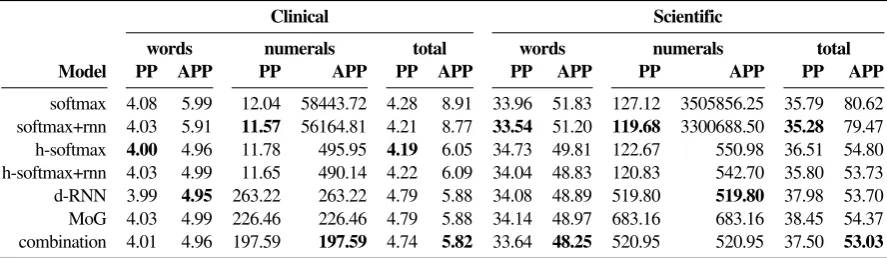
[image:6.595.76.520.64.193.2]softmax 4.08 5.99 12.04 58443.72 4.28 8.91 33.96 51.83 127.12 3505856.25 35.79 80.62 softmax+rnn 4.03 5.91 11.57 56164.81 4.21 8.77 33.54 51.20 119.68 3300688.50 35.28 79.47 h-softmax 4.00 4.96 11.78 495.95 4.19 6.05 34.73 49.81 122.67 550.98 36.51 54.80 h-softmax+rnn 4.03 4.99 11.65 490.14 4.22 6.09 34.04 48.83 120.83 542.70 35.80 53.73 d-RNN 3.99 4.95 263.22 263.22 4.79 5.88 34.08 48.89 519.80 519.80 37.98 53.70 MoG 4.03 4.99 226.46 226.46 4.79 5.88 34.14 48.97 683.16 683.16 38.45 54.37 combination 4.01 4.96 197.59 197.59 4.74 5.82 33.64 48.25 520.95 520.95 37.50 53.03
Table 2: Test set perplexities for the clinical and scientific data. Adjusted perplexities (APP) are directly comparable across all data and models, but perplexities (PP) are sensitive to the varying out-of-vocabulary rates.
Clinical Scientific
Model RMSE MAE MdAE MAPE% MdAPE% MdAE MAPE% MdAPE%
mean 1043.68 294.95 245.59 2353.11 409.47 ∼1020 ∼1023 ∼1022
median 1036.18 120.24 34.52 425.81 52.05 4.20 8039.15 98.65
softmax 997.84 80.29 12.70 621.78 22.41 3.00 1947.44 80.62
softmax+rnn 991.38 74.44 13.00 503.57 23.91 3.50 15208.37 80.00
h-softmax 1095.01 167.19 14.00 746.50 25.00 3.00 1652.21 80.00
h-softmax+rnn 1001.04 83.19 12.30 491.85 23.44 3.00 2703.49 80.00
d-RNN 1009.34 70.21 9.00 513.81 17.90 3.00 1287.27 52.45
MoG 998.78 57.11 6.92 348.10 13.64 2.10 590.42 90.00
[image:6.595.80.524.247.407.2]combination 989.84 69.47 9.00 552.06 17.86 3.00 2332.50 88.89
Table 3: Test set regression evaluation for the clinical and scientific data. Mean absolute percentage error (MAPE) is scale independent and allows for comparison across data, whereas root mean square and mean absolute errors (RMSE, MAE) are scale dependent. Medians (MdAE, MdAPE) are informative of the distribution of errors.
RNNs are LSTMs (Hochreiter and Schmidhuber,
1997) with the biases of LSTM forget gate were initialised to 1.0 (Józefowicz et al.,2015). We train using mini-batch gradient decent with the Adam optimiser (Kingma and Ba,2014) and regularise with early stopping and0.1dropout rate (Srivastava,2013) in the input and output of the token-based RNN.
For the mixture of Gaussians, we select the mean and variances to summarise the data at different granularities by fitting 7 separate mixture of Gaussian models on all numbers, each with twice as many components as the previous, for a total of27+1−1 = 256components. These models are initialised at percentile points from the data and trained with the expectation-minimisation algorithm. The means and variances are then fixed and not updated when we train the language model.
5.1 Quantitative Results
Perplexities Table2shows perplexities evaluated on the subsets of words, numerals and all tokens of
the test data. Overall, all models performed better on the clinical than on the scientific data. On words, all models achieve similar perplexities in each dataset.
On numerals, softmax variants perform much better than other models in PP, which is an artefact of the high OOV-rate of numerals. APP is significantly worse, especially for non-hierarchical variants, which perform about 2 and 4 orders of magnitude worse than hierarchical ones.
For open-vocabulary models, i.e. d-RNN, MoG, and combination, PP is equivalent to APP. On numerals, d-RNN performed better than softmax variants in both datasets. The MoG model performed twice as well as softmax variants on the clinical dataset, but had the third worse performance in the scientific dataset. The combination model had the best overall APP results for both datasets.
of candidate numerals: we compose the union of in-vocabulary numbers and 100 percentile points from the training set, and we convert numbers into numerals by considering all formats up tondecimal points. We select nto represent 90% of numerals seen at training, which yieldsn=3andn=4for the clinical and scientific data, respectively.
Table3shows evaluation results, where we also include two naive baselines of constant predictions: with the mean and median of the training data. For both datasets, RMSE and MAE were too sensitive to extreme errors to allow drawing safe conclusions, par-ticularly for the scientific dataset, where both metrics were in the order of109. MdAE can be of some use, as 50% of the errors are absolutely smaller than that.
Along percentage metrics, MoG achieved the best MAPE in both datasets (18% and 54% better that the second best) and was the only model to perform better than the median baseline for the clinical data. How-ever, it had the worst MdAPE, which means that MoG mainly reduced larger percentage errors. The d-RNN model came third and second in the clinical and scien-tific datasets, respectively. In the latter it achieved the best MdAPE, i.e. it was effective at reducing errors for 50% of the numbers. The combination model did not perform better than its constituents. This is possibly because MoG is the only strategy that takes into account the numerical magnitudes of the numerals.
5.2 Learnt Representations
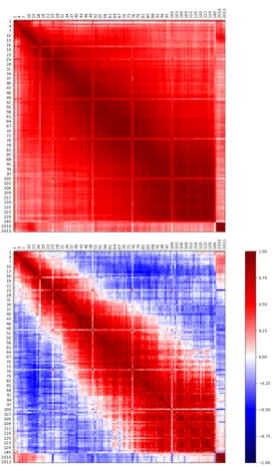
Softmax versus Hierarchical Softmax Figure 3
visualises the cosine similarities of the output token embeddings of numerals for the softmax and h-softmax models. Simple softmax enforced high similarities among all numerals and the unknown numeral token, so as to make them more dissimilar to words, since the model embeds both in the same space. This is not the case for h-softmax that uses two different spaces: similarities are concentrated along the diagonal and fan out as the magnitude grows, with the exception of numbers with special meaning, e.g. years and percentile points.
Digit embeddings Figure4shows the cosine sim-ilarities between the digits of the d-RNN output mode. We observe that each primitive digit is mostly similar to its previous and next digit. Similar behaviour was found for all digit embeddings of all models.
5.3 Predictions from the Models
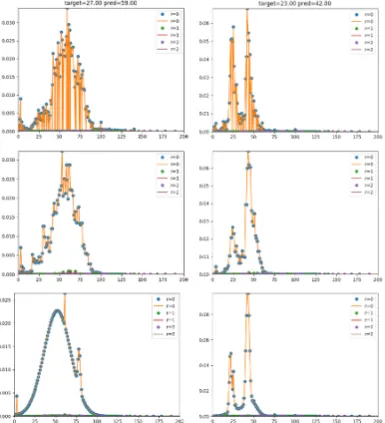
Next Numeral Figure 5 shows the probabilities of different numerals under each model for two
Figure 3: Numeral embeddings for the softmax (top) and h-softmax (bottom) models on the clinical data. Numerals are sorted by value.
Figure 4: Cosine similarities for d-RNN’s output digit embeddings trained on the scientific data.
examples from the clinical development set. Numer-als are grouped by number of decimal points. The h-softmax model’s probabilities are spiked, d-RNNs are saw-tooth like and MoG’s are smooth, with the occasional spike, whenever a narrow component allows for it. Probabilities rapidly decrease for more decimal digits, which is reminiscent of the theoretical expectation that the probability of en exact value for a continuous variable is zero.
Selection of Strategy in Combination Model
[image:7.595.348.486.64.298.2]Clinical Scientific
h
-s
o
ft
m
a
x
Examples: “late enhancement (>75%)”, “late gadolinium enhancement ( < 25%)”, “infarction (2out of17segments )”, “infarct with4out of17
segments nonviable”, “adenosine stress perfusion @
140mcg”, “stress perfusion ( adenosine140mcg”
Numerals: 50, 17, 100, 75, 25, 1, 140, 2012, 2010, 2011, 8, 5, 2009, 2013, 7, 6, 2, 3, 2008, 4...
Examples: “sharp et al .2004”, “li et al .2003”, “3.5×10ˆ4”, “0.3×10ˆ16”
Numerals: 1992, 2001, 1995, 2003, 2009, 1993, 2010, 1994, 1998, 2002, 2006, 1997, 2005, 1990, 10, 2008, 2007, 2004, 1983, 1991...
d
-R
N
N Examplesmm”, “ascending aorta is not dilated (: “aortic root is dilated ( measured32x3137mm”x37
Numerals: 42, 33, 31, 43, 44, 21, 38, 36, 46, 37, 32, 39, 26, 28, 23, 29, 45, 40, 49, 94...
Examples: “ngc 6334 stars”, “ngc
2366shows a wealth of small structures”
Numerals: 294, 4000, 238, 6334, 2363, 1275, 2366, 602, 375, 1068, 211, 6.4, 8.7, 600, 96, 0.65, 700, 1.17, 4861, 270...
M
o
G
Examples: “stroke volume46.1ml”, “stroke volume
65.6 ml”, “stroke volume74.5ml”, “end diastolic volume82.6ml”, “end diastolic volume99.09ml”, “end diastolic volume138.47ml”
Numerals: 74.5, 69.3, 95.9, 96.5, 72.5, 68.6, 82.1, 63.7, 78.6, 69.6, 69.5, 82.2, 68.3, 73.2, 63.2, 82.6, 77.7, 80.7, 70.7, 70.4...
Examples: “hip12961and gl676a are orbited by giant planets,” “velocities of gl676”, “velocities of hip12961”
[image:8.595.83.514.70.351.2]Numerals: 12961, 766, 7409, 4663, 44.3, 1819, 676, 1070, 5063, 323, 264, 163296, 2030, 77, 1.15, 196, 0.17, 148937, 0.43, 209458...
Table 4: Examples of numerals with highest probability in each strategy of the combination model.
Figure 5: Example model predictions for the h-softmax (top), d-RNN (middle) and MoG (bottom) models. Examples from the clinical development set.
e.g. years, typical drug dosages, percentile points, etc. In the clinical data, d-RNN picks up two-digit integers (mostly dimensions) and MoG is activated for continuous attributes, which are mostly out of vocabulary. In the scientific data, d-RNN and MoG
0 5 10 15 20 25 30 35
0 1 2 3 4 5 6 7 8 9
Sc
ie
nt
ifi
c
1st digit
0 5 10 15 20 25 30 35
0 1 2 3 4 5 6 7 8 9 4th digit
Model Data Benford
0 5 10 15 20 25 30 35
0 1 2 3 4 5 6 7 8 9 4th digit
0 5 10 15 20 25 30 35
0 1 2 3 4 5 6 7 8 9
Cl
in
ic
al
[image:8.595.83.276.400.612.2]1st digit
Figure 6: Distributions of significant digits from d-RNN model, data, and theoretical expectation (Benford’s law).
showed affinity to different indices from catalogues of astronomical objects: d-RNN mainly to NGC (Dreyer,
1888) and MoG to various other indices, such as GL (Gliese,1988) and HIP (Perryman et al.,1997). In this case, MoG was wrongly selected for numerals with a labelling function, which also highlights a limitation of evaluating on the number line, when a numeral is not used to represent its magnitude.
[image:8.595.311.500.408.530.2]and from data counts. The theoretical estimate has been overlayed, according to Benford’s law (Benford,
1938), also called the first-digit law, which applies to many real-life numerals. The law predicts that the first digit is 1 with higher probability (about 30%) than 9 (<5%) and weakens towards uniformity at higher digits. Model probabilities closely follow estimates from the data. Violations from Benford’s law can be due to rounding (Beer,2009) and can be used as evidence for fraud detection (Lu et al.,2006).
6 Related Work
Numerical quantities have been recognised as impor-tant for textual entailment (Lev et al.,2004;Dagan et al.,2013). Roy et al.(2015) proposed a quantity entailment sub-task that focused on whether a given quantity can be inferred from a given text and, if so, what its value should be. A common framework for acquiring common sense about numerical attributes of objects has been to collect a corpus of numerical values in pre-specified templates and then model attributes as a normal distribution (Aramaki et al.,
2007; Davidov and Rappoport, 2010; Iftene and Moruz, 2010; Narisawa et al., 2013; de Marneffe et al.,2010). Our model embeds these approaches into a LM that has a sense for numbers.
Other tasks that deal with numerals are numerical information extraction and solving mathematical prob-lems. Numerical relations have at least one argument that is a number and the aim of the task is to extract all such relations from a corpus, which can range from identifying a few numerical attributes (Nguyen and Moschitti,2011;Intxaurrondo et al.,2015) to generic numerical relation extraction (Hoffmann et al.,2010;
Madaan et al.,2016). Our model does not extract values, but rather produces an probabilistic estimate.
Much work has been done in solving arith-metic (Mitra and Baral, 2016; Hosseini et al.,
2014;Roy and Roth, 2016), geometric (Seo et al.,
2015), and algebraic problems (Zhou et al., 2015;
Koncel-Kedziorski et al.,2015;Upadhyay et al.,2016;
Upadhyay and Chang,2016;Shi et al.,2015; Kush-man et al.,2014) expressed in natural language. Such models often use mathematical background knowl-edge, such as linear system solvers. The output of our model is not based on such algorithmic operations, but could be extended to do so in future work.
In language modelling, generating rare or unknown words has been a challenge, similar to our unknown numeral problem.Gulcehre et al.(2016) andGu et al.
(2016) adopted pointer networks (Vinyals et al.,2015)
to copy unknown words from the source in translation and summarisation tasks. Merity et al. (2016) and
Lebret et al. (2016) have models that copy from context sentences and from Wikipedia’s infoboxes, respectively. Ahn et al.(2016) proposed a LM that retrieves unknown words from facts in a knowledge graph. They draw attention to the inappropriateness of perplexity when OOV-rates are high and instead pro-pose an adjusted perplexity metric that is equivalent to APP. Other methods aim at speeding up LMs to allow for larger vocabularies (Chen et al.,2015), such as hi-erarchical softmax (Morin and Bengio,2005b), target sampling (Jean et al.,2014), etc., but still suffer from the unknown word problem. Finally, the problem is resolved when predicting one character at a time, as done by the character-level RNN (Graves,2013;
Sutskever et al.,2011) used in our d-RNN model.
7 Conclusion
In this paper, we investigated several strategies for LMs to model numerals and proposed a novel open-vocabulary generative model based on a continuous probability density function. We provided the first thorough evaluation of LMs on numerals on two cor-pora, taking into account their high out-of-vocabulary rate and numerical value (magnitude). We found that modelling numerals separately from other words through a hierarchical softmax can substantially im-prove the perplexity of LMs, that different strategies are suitable for different contexts, and that a combina-tion of these strategies can help improve the perplexity further. Finally, we found that using a continuous probability density function can improve prediction accuracy of LMs for numbers by substantially reducing the mean absolute percentage metric.
Our approaches in modelling and evaluation can be used in future work in tasks such as approximate information extraction, knowledge base completion, numerical fact checking, numerical question answer-ing, and fraud detection. Our code and data are available at: https://github.com/uclmr/ numerate-language-models.
Acknowledgments
References
Sungjin Ahn, Heeyoul Choi, Tanel Pärnamaa, and Yoshua Bengio. 2016. A neural knowledge language model.
arXiv preprint arXiv:1608.00318.
Eiji Aramaki, Takeshi Imai, Kengo Miyo, and Kazuhiko Ohe. 2007. Uth: Svm-based semantic relation
clas-sification using physical sizes. InProceedings of the
4th International Workshop on Semantic Evaluations. Association for Computational Linguistics, pages 464–467.
TW Beer. 2009. Terminal digit preference: beware
of benford’s law. Journal of clinical pathology
62(2):192–192.
Frank Benford. 1938. The law of anomalous numbers.
Proceedings of the American philosophical society
pages 551–572.
Elise Bigeard, Vianney Jouhet, Fleur Mougin, Frantz
Thiessard, and Natalia Grabar. 2015. Automatic
extraction of numerical values from unstructured data
in ehrs. InMIE. pages 50–54.
Jamie ID Campbell. 2005. Handbook of mathematical
cognition. Psychology Press.
Welin Chen, David Grangier, and Michael Auli. 2015. Strategies for training large vocabulary neural language
models. arXiv preprint arXiv:1512.04906.
Ido Dagan, Dan Roth, Mark Sammons, and Fabio Mas-simo Zanzotto. 2013. Recognizing textual entailment:
Models and applications. Synthesis Lectures on
Human Language Technologies6(4):1–220.
Dmitry Davidov and Ari Rappoport. 2010. Extraction
and approximation of numerical attributes from the
web. InProceedings of the 48th Annual Meeting of the
Association for Computational Linguistics. Association for Computational Linguistics, pages 1308–1317.
Marie-Catherine de Marneffe, Christopher D Manning,
and Christopher Potts. 2010. Was it good? it was
provocative. learning the meaning of scalar adjectives.
In Proceedings of the 48th Annual Meeting of the
Association for Computational Linguistics. Association for Computational Linguistics, pages 167–176.
Stanislas Dehaene and Laurent Cohen. 1995. Towards an anatomical and functional model of number processing.
Mathematical cognition1(1):83–120.
Stanislas Dehaene, Manuela Piazza, Philippe Pinel,
and Laurent Cohen. 2003. Three parietal circuits
for number processing. Cognitive neuropsychology
20(3-6):487–506.
John Louis Emil Dreyer. 1888. A new general catalogue of nebulæ and clusters of stars, being the catalogue of the late sir john fw herschel, bart, revised, corrected,
and enlarged. Memoirs of the Royal Astronomical
Society49:1.
Katja Filippova, Enrique Alfonseca, Carlos A. Col-menares, Lukasz Kaiser, and Oriol Vinyals. 2015.
Sentence compression by deletion with lstms. In
Proceedings of the 2015 Conference on Empirical Methods in Natural Language Processing, EMNLP
2015. pages 360–368.
Mahak Gambhir and Vishal Gupta. 2017. Recent
auto-matic text summarization techniques: a survey. Artif.
Intell. Rev.47(1):1–66.
Wilhelm Gliese. 1988. The third catalogue of nearby stars.
Stand. Star Newsl. 13, 1313.
Alex Graves. 2013. Generating sequences with recurrent
neural networks. arXiv preprint arXiv:1308.0850.
Sharon Griffin, Robbie Case, and Allesandra Capodilupo.
1995. Teaching for understanding: The importance
of the central conceptual structures in the elementary mathematics curriculum. .
Jiatao Gu, Zhengdong Lu, Hang Li, and Victor OK Li. 2016. Incorporating copying mechanism in
sequence-to-sequence learning. arXiv preprint arXiv:1603.06393
.
Caglar Gulcehre, Sungjin Ahn, Ramesh Nallapati,
Bowen Zhou, and Yoshua Bengio. 2016. Pointing the
unknown words. arXiv preprint arXiv:1603.08148.
Çaglar Gülçehre, Orhan Firat, Kelvin Xu, Kyunghyun
Cho, and Yoshua Bengio. 2017. On integrating
a language model into neural machine translation.
Computer Speech & Language45:137–148.
Sepp Hochreiter and Jürgen Schmidhuber. 1997. Long
short-term memory. Neural computation 9(8):1735–
1780.
Raphael Hoffmann, Congle Zhang, and Daniel S
Weld. 2010. Learning 5000 relational extractors.
In Proceedings of the 48th Annual Meeting of the
Association for Computational Linguistics. Association for Computational Linguistics, pages 286–295.
Mohammad Javad Hosseini, Hannaneh Hajishirzi, Oren Etzioni, and Nate Kushman. 2014. Learning to solve arithmetic word problems with verb categorization.
InProceedings of the 2014 Conference on Empirical
Methods in Natural Language Processing (EMNLP).
pages 523–533.
Adrian Iftene and Mihai-Alex Moruz. 2010. Uaic
participation at rte-6 .
Ander Intxaurrondo, Eneko Agirre, Oier Lopez De La-calle, and Mihai Surdeanu. 2015. Diamonds in the rough: Event extraction from imperfect microblog data.
In Proceedings of the 2015 Conference of the North
American Chapter of the Association for
Computa-tional Linguistics: Human Language Technologies.
Sébastien Jean, Kyunghyun Cho, Roland Memisevic, and Yoshua Bengio. 2014. On using very large target
vocabulary for neural machine translation. arXiv
preprint arXiv:1412.2007.
Elana Joram, Lauren B Resnick, and Anthony J Gabriele. 1995. Numeracy as cultural practice: An examination of numbers in magazines for children, teenagers,
and adults. Journal for Research in Mathematics
Educationpages 346–361.
Rafal Józefowicz, Wojciech Zaremba, and Ilya Sutskever. 2015. An empirical exploration of recurrent network
architectures. InProceedings of the 32nd International
Conference on Machine Learning, ICML 2015. pages
2342–2350.
Roi Cohen Kadosh and Ann Dowker. 2015. The Oxford
handbook of numerical cognition. Oxford Library of Psychology.
Diederik P Kingma and Jimmy Ba. 2014. Adam: A
method for stochastic optimization. arXiv preprint
arXiv:1412.6980.
Rik Koncel-Kedziorski, Hannaneh Hajishirzi, Ashish Sabharwal, Oren Etzioni, and Siena Dumas Ang. 2015. Parsing algebraic word problems into equations.
Transactions of the Association for Computational Linguistics3:585–597.
Nate Kushman, Yoav Artzi, Luke Zettlemoyer, and
Regina Barzilay. 2014. Learning to automatically
solve algebra word problems. In Proceedings of the
52nd Annual Meeting of the Association for Computa-tional Linguistics (Volume 1: Long Papers). volume 1, pages 271–281.
Rémi Lebret, David Grangier, and Michael Auli. 2016. Neural text generation from structured data with
application to the biography domain. arXiv preprint
arXiv:1603.07771.
Iddo Lev, Bill MacCartney, Christopher D Manning, and Roger Levy. 2004. Solving logic puzzles: From robust
processing to precise semantics. In Proceedings of
the 2nd Workshop on Text Meaning and Interpretation. Association for Computational Linguistics, pages 9–16.
Fletcher Lu, J. Efrim Boritz, and H. Dominic Covvey. 2006. Adaptive fraud detection using benford’s law. InAdvances in Artificial Intelligence, 19th Conference of the Canadian Society for Computational Studies of Intelligence, Canadian AI 2006. pages 347–358.
Minh-Thang Luong and Christopher D Manning. 2016. Achieving open vocabulary neural machine translation
with hybrid word-character models. In Proceedings
of the 54th Annual Meeting of the Association for Computational Linguistics (Volume 1: Long Papers). volume 1, pages 1054–1063.
Thang Luong, Michael Kayser, and Christopher D. Man-ning. 2015. Deep neural language models for machine
translation. InProceedings of the 19th Conference on
Computational Natural Language Learning, CoNLL
2015. pages 305–309.
Aman Madaan, Ashish Mittal, Ganesh Ramakrishnan,
Sunita Sarawagi, et al. 2016. Numerical relation
extraction with minimal supervision. InThirtieth AAAI
Conference on Artificial Intelligence.
Michael McCloskey and Paul Macaruso. 1995.
Repre-senting and using numerical information. American
Psychologist50(5):351.
Stephen Merity, Caiming Xiong, James Bradbury, and Richard Socher. 2016. Pointer sentinel mixture models.
arXiv preprint arXiv:1609.07843.
Tomas Mikolov, Martin Karafiát, Lukás Burget, Jan Cer-nocký, and Sanjeev Khudanpur. 2010. Recurrent
neu-ral network based language model. InINTERSPEECH
2010, 11th Annual Conference of the International Speech Communication Association. pages 1045–1048.
Jeff Mitchell and Mirella Lapata. 2009. Language models
based on semantic composition. InProceedings of the
2009 Conference on Empirical Methods in Natural Language Processing: Volume 1-Volume 1. Association for Computational Linguistics, pages 430–439.
Arindam Mitra and Chitta Baral. 2016. Learning to use
formulas to solve simple arithmetic problems. InACL.
Yasumasa Miyamoto and Kyunghyun Cho. 2016. Gated
word-character recurrent language model. arXiv
preprint arXiv:1606.01700.
Frederic Morin and Yoshua Bengio. 2005a. Hierarchical
probabilistic neural network language model. In
Proceedings of the Tenth International Workshop on Artificial Intelligence and Statistics, AISTATS 2005.
Frederic Morin and Yoshua Bengio. 2005b. Hierarchical
probabilistic neural network language model. In
Aistats. Citeseer, volume 5, pages 246–252.
Katsuma Narisawa, Yotaro Watanabe, Junta Mizuno, Naoaki Okazaki, and Kentaro Inui. 2013. Is a 204 cm man tall or small? acquisition of numerical common
sense from the web. In Proceedings of the 51st
Annual Meeting of the Association for Computational Linguistics (Volume 1: Long Papers). volume 1, pages 382–391.
Truc-Vien T Nguyen and Alessandro Moschitti. 2011. End-to-end relation extraction using distant supervision
from external semantic repositories. InProceedings of
the 49th Annual Meeting of the Association for Compu-tational Linguistics: Human Language Technologies: short papers-Volume 2. Association for Computational Linguistics, pages 277–282.
Jeffrey Pennington, Richard Socher, and Christopher
Manning. 2014. Glove: Global vectors for word
representation. InProceedings of the 2014 conference
on empirical methods in natural language processing
(EMNLP). pages 1532–1543.
Michael AC Perryman, L Lindegren, J Kovalevsky, E Hoeg, U Bastian, PL Bernacca, M Crézé, F Donati, M Grenon, M Grewing, et al. 1997. The hipparcos
Theodore M Porter. 1996. Trust in numbers: The pursuit of objectivity in science and public life. Princeton University Press.
Rohit Prabhavalkar, Kanishka Rao, Tara N. Sainath, Bo Li, Leif Johnson, and Navdeep Jaitly. 2017. A comparison of sequence-to-sequence models for speech
recogni-tion. InInterspeech 2017, 18th Annual Conference of
the International Speech Communication Association. pages 939–943.
Hannah Rashkin, Eunsol Choi, Jin Yea Jang, Svitlana
Volkova, and Yejin Choi. 2017. Truth of varying
shades: Analyzing language in fake news and political
fact-checking. In Proceedings of the 2017
Confer-ence on Empirical Methods in Natural Language
Processing, EMNLP 2017. pages 2931–2937.
Marek Rei and Helen Yannakoudakis. 2017. Auxiliary
objectives for neural error detection models. In
Proceedings of the 12th Workshop on Innovative Use of NLP for Building Educational Applications,
BEA@EMNLP 2017. pages 33–43.
Subhro Roy and Dan Roth. 2016. Solving
gen-eral arithmetic word problems. arXiv preprint
arXiv:1608.01413.
Subhro Roy, Tim Vieira, and Dan Roth. 2015. Reasoning
about quantities in natural language. Transactions of
the Association for Computational Linguistics3:1–13.
Cicero D Santos and Bianca Zadrozny. 2014. Learning
character-level representations for part-of-speech
tagging. In Proceedings of the 31st International
Conference on Machine Learning (ICML-14). pages
1818–1826.
Minjoon Seo, Hannaneh Hajishirzi, Ali Farhadi, Oren Etzioni, and Clint Malcolm. 2015. Solving geometry problems: Combining text and diagram interpretation.
InProceedings of the 2015 Conference on Empirical
Methods in Natural Language Processing. pages
1466–1476.
Shuming Shi, Yuehui Wang, Chin-Yew Lin, Xiaojiang
Liu, and Yong Rui. 2015. Automatically solving
number word problems by semantic parsing and
reasoning. In Proceedings of the Conference on
Empirical Methods in Natural Language Processing (EMNLP), Lisbon, Portugal.
Georgios P. Spithourakis, Isabelle Augenstein, and Sebas-tian Riedel. 2016a. Numerically grounded language
models for semantic error correction. InProceedings of
the 2016 Conference on Empirical Methods in Natural
Language Processing, EMNLP 2016. pages 987–992.
Georgios P Spithourakis, Steffen E Petersen, and Se-bastian Riedel. 2016b. Clinical text prediction with numerically grounded conditional language models.
EMNLP 2016page 6.
Nitish Srivastava. 2013. Improving neural networks with
dropout. University of Toronto182.
Heinrich Stamerjohanns and Michael Kohlhase. 2008.
Transforming the arχiv to xml. In International
Conference on Intelligent Computer Mathematics.
Springer, pages 574–582.
Heinrich Stamerjohanns, Michael Kohlhase, Deyan Ginev, Catalin David, and Bruce Miller. 2010. Transforming large collections of scientific publications to xml.
Mathematics in Computer Science3(3):299–307.
Ilya Sutskever, James Martens, and Geoffrey E Hinton. 2011. Generating text with recurrent neural networks. In Proceedings of the 28th International Conference
on Machine Learning (ICML-11). pages 1017–1024.
Joseph Tzelgov, Dana Ganor-Stern, Arava Y Kallai, and Michal Pinhas. 2015. Primitives and non-primitives
of numerical representations. Oxford library of
psy-chology. The Oxford handbook of numerical cognition
pages 45–66.
Joerg Ueberla. 1994. Analysing a simple language model·
some general conclusions for language models for
speech recognition. Computer Speech & Language
8(2):153–176.
Shyam Upadhyay and Ming-Wei Chang. 2016.
An-notating derivations: A new evaluation strategy and
dataset for algebra word problems. arXiv preprint
arXiv:1609.07197.
Shyam Upadhyay, Ming-Wei Chang, Kai-Wei Chang, and Wen-tau Yih. 2016. Learning from explicit and implicit
supervision jointly for algebra word problems. In
Pro-ceedings of the 2016 Conference on Empirical Methods in Natural Language Processing. pages 297–306.
Oriol Vinyals, Meire Fortunato, and Navdeep Jaitly. 2015.
Pointer networks. InAdvances in Neural Information
Processing Systems. pages 2692–2700.
Tong Wang, Xingdi Yuan, and Adam Trischler. 2017. A joint model for question answering and question
generation. CoRRabs/1706.01450.
Lipu Zhou, Shuaixiang Dai, and Liwei Chen. 2015. Learn to solve algebra word problems using quadratic
pro-gramming. InProceedings of the 2015 Conference on