Learning Continuous Phrase Representations for
Translation Modeling
Jianfeng Gao Xiaodong He Wen-tau Yih Li Deng Microsoft Research
One Microsoft Way Redmond, WA 98052, USA
{jfgao,xiaohe,scottyih,deng}@microsoft.com
Abstract
This paper tackles the sparsity problem in estimating phrase translation probabilities by learning continuous phrase representa-tions, whose distributed nature enables the sharing of related phrases in their represen-tations. A pair of source and target phrases are projected into continuous-valued vec-tor representations in a low-dimensional latent space, where their translation score is computed by the distance between the pair in this new space. The projection is performed by a neural network whose weights are learned on parallel training data. Experimental evaluation has been performed on two WMT translation tasks. Our best result improves the performance of a state-of-the-art phrase-based statistical machine translation system trained on WMT 2012 French-English data by up to 1.3 BLEU points.
1
Introduction
The phrase translation model, also known as the
phrase table, is one of the core components of phrase-based statistical machine translation (SMT) systems. The most common method of construct-ing the phrase table takes a two-phase approach (Koehn et al. 2003). First, the bilingual phrase pairs are extracted heuristically from an automat-ically word-aligned training data. The second phase, which is the focus of this paper, is parame-ter estimation where each phrase pair is assigned with some scores that are estimated based on counting these phrases or their words using the same word-aligned training data.
Phrase-based SMT systems have achieved state-of-the-art performance largely due to the fact that long phrases, rather than single words, are
used as translation units so that useful context in-formation can be captured in selecting translations. However, longer phrases occur less often in train-ing data, leadtrain-ing to a severe data sparseness prob-lem in parameter estimation. There has been a plethora of research reported in the literature on improving parameter estimation for the phrase translation model (e.g., DeNero et al. 2006; Wuebker et al. 2010; He and Deng 2012; Gao and He 2013).
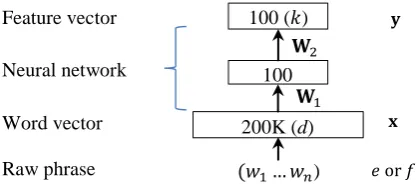
This paper revisits the problem of scoring a phrase translation pair by developing a Continu-ous-space Phrase Translation Model (CPTM). The translation score of a phrase pair in this model is computed as follows. First, we represent each phrase as a bag-of-words vector, called word vec-tor henceforth. We then project the word vector, in either the source language or the target lan-guage, into a respective continuous feature vector in a common low-dimensional space that is lan-guage independent. The projection is performed by a multi-layer neural network. The projected feature vector forms the continuous representa-tion of a phrase. Finally, the translation score of a source-target phrase pair is computed by the dis-tance between their feature vectors.
The main motivation behind the CPTM is to alleviate the data sparseness problem associated with the traditional counting-based methods by grouping phrases with a similar meaning across different languages. This style of grouping is made possible because of the distributed nature of the continuous-space representations for phrases. No such sharing was possible in the original sym-bolic space for representing words or phrases. In this model, semantically or grammatically related phrases, in both the source and the target lan-guages, would tend to have similar (close) feature vectors in the continuous space, guided by the training objective. Since the translation score is a smooth function of these feature vectors, a small
change in the features should only lead to a small change in the translation score.
The primary research task in developing the CPTM is learning the continuous representation of a phrase that is effective for SMT. Motivated by recent studies on continuous-space language models (e.g., Bengio et al. 2003; Mikolov et al. 2011; Schwenk et al., 2012), we use a neural net-work to project a word vector to a feature vector. Ideally, the projection would discover those latent features that are useful to differentiate good trans-lations from bad ones, for a given source phrase. However, there is no training data with explicit annotation on the quality of phrase translations. The phrase translation pairs are hidden in the par-allel source-target sentence pairs, which are used to train the traditional translation models. The quality of a phrase translation can only be judged implicitly through the translation quality of the sentences, as measured by BLEU, which contain the phrase pair. In order to overcome this chal-lenge and let the BLEU metric guide the projec-tion learning, we propose a new method to learn the parameters of a neural network. This new method, via the choice of an appropriate objective function in training, automatically forces the fea-ture vector of a source phrase to be closer to the feature vectors of its candidate translations. As a result, the BLEU score is improved when these translations are selected by an SMT decoder to produce final, sentence-level translations. The new learning method makes use of the L-BFGS algorithm and the expected BLEU as the objective function defined on N-best lists.
To the best of our knowledge, the CPTM pro-posed in this paper is the first continuous-space phrase translation model that makes use of joint representations of a phrase in the source language and its translation in the target language (to be de-tailed in Section 4) and that is shown to lead to significant improvement over a standard phrase-based SMT system (to be detailed in Section 6).
Like the traditional phrase translation model, the translation score of each bilingual phrase pair is modeled explicitly in our model. However, in-stead of estimating the phrase translation score on aligned parallel data, our model intends to capture the grammatical and semantic similarity between a source phrase and its paired target phrase by pro-jecting them into a common, continuous space that is language independent.
1 Niehues et al. (2011) use different translation units in order
to integrate the n-gram translation model into the phrase-based approach. However, it is not clear how a continuous
The rest of the paper is organized as follows. Section 2 reviews previous work. Section 3 re-views the log-linear model for phrase-based SMT and Sections 4 presents the CPTM. Section 5 de-scribes the way the model parameters are esti-mated, followed by the experimental results in Section 6. Finally, Section 7 concludes the paper.
2
Related Work
Representations of words or documents as contin-uous vectors have a long history. Most of the ear-lier latent semantic models for learning such vec-tors are designed for information retrieval (Deerwester et al. 1990; Hofmann 1999; Blei et al. 2003). In contrast, recent work on continuous space language models, which estimate the prob-ability of a word sequence in a continuous space (Bengio et al. 2003; Mikolov et al. 2010), have ad-vanced the state of the art in language modeling, outperforming the traditional n-gram model on speech recognition (Mikolov et al. 2012; Sunder-meyer et al. 2013) and machine translation (Mikolov 2012; Auli et al. 2013).
Because these models are developed for mono-lingual settings, word embedding from these mod-els is not directly applicable to translation. As a result, variants of such models for cross-lingual scenarios have been proposed so that words in dif-ferent languages are projected into the shared la-tent vector space (Dumais et al. 1997; Platt et al. 2010; Vinokourov et al. 2002; Yih et al. 2011; Gao et al. 2011; Huang et al. 2013; Zou et al. 2013). In principle, a phrase table can be derived using any of these cross-lingual models, although decoupling the derivation from the SMT training often results in suboptimal performance (e.g., measured in BLEU), as we will show in Section 6. Recently, there is growing interest in applying continuous-space models for translation. The most related to this study is the work of continu-ous space n-gram translation models (Schwenk et al. 2007; Schwenk 2012; Son et al. 2012), where the feed-forward neural network language model is extended to represent translation probabilities. However, these earlier studies focused on the n-gram translation models, where the translation probability of a phrase or a sentence is decom-posed as a product of n-gram probabilities as in a standard n-gram language model. Therefore, it is not clear how their approaches can be applied to the phrase translation model1, which is much more
widely used in modern SMT systems. In contrast, our model learns jointly the representations of a phrase in the source language as well as its trans-lation in the target language. The recurrent contin-uous translation models proposed by Kalchbren-ner and Blunsom (2013) also adopt the recurrent language model (Mikolov et al. 2010). But unlike the n-gram translation models above, they make no Markov assumptions about the dependency of the words in the target sentence. Continuous space models have also been used for generating trans-lations for new words (Mikolov et al. 2013a) and ITG reordering (Li et al. 2013).
There has been a lot of research on improving the phrase table in phrase-based SMT (Marcu and Wong 2002; Lamber and Banchs 2005; Denero et al. 2006; Wuebker et al. 2010; Zhang et al., 2011; He and Deng 2012; Gao and He 2013). Among them, (Gao and He 2013) is most relevant to the work described in this paper. They estimate phrase translation probabilities using a discrimi-native training method under the N-best reranking framework of SMT. In this study we use the same objective function to learn the continuous repre-sentations of phrases, integrating the strengths as-sociated with these earlier studies.
3
The Log-Linear Model for SMT
Phrase-based SMT is based on a log-linear model which requires learning a mapping between input
𝐹 ∈ ℱ to output 𝐸 ∈ ℰ. We are given
Training samples (𝐹𝑖, 𝐸𝑖) for 𝑖 = 1 … 𝑁,
where each source sentence 𝐹𝑖 is paired with
a reference translation in target language 𝐸𝑖; A procedure GEN to generate a list of N-best candidates GEN(𝐹𝑖) for an input 𝐹𝑖, where
GEN in this study is the baseline phrase-based SMT system, i.e., an in-house implementation of the Moses system (Koehn et al. 2007) that does not use the CPTM, and each 𝐸 ∈ GEN(𝐹𝑖) is labeled by the
sentence-level BLEU score (He and Deng 2012), denoted by sBleu(𝐸𝑖, 𝐸) , which
measures the quality of 𝐸 with respect to its reference translation 𝐸𝑖;
A vector of features 𝐡 ∈ ℝ𝑀 that maps each
(𝐹𝑖, 𝐸) to a vector of feature values2; and A parameter vector 𝛌 ∈ ℝ𝑀, which assigns a
real-valued weight to each feature.
2 Our baseline system uses a set of standard features
sug-gested in Koehn et al. (2007), which is also detailed in Sec-tion 6.
The components GEN(. ), 𝐡 and 𝛌 define a log-linear model that maps 𝐹𝑖 to an output sentence as
follows:
𝐸∗= argmax (𝐸,𝐴)∈GEN(𝐹𝑖)
𝛌T𝐡(𝐹
𝑖, 𝐸, 𝐴) (1)
which states that given 𝛌 and 𝐡, argmax returns the highest scoring translation 𝐸∗, maximizing over correspondences 𝐴. In phrase-based SMT, 𝐴
consists of a segmentation of the source and target sentences into phrases and an alignment between source and target phrases. Since computing the
argmax exactly is intractable, it is commonly performed approximatedly by beam search (Och and Ney 2004). Following Liang et al. (2006), we assume that every translation candidate is always coupled with a corresponding 𝐴, called the Viterbi derivation, generated by (1).
4
A Continuous-Space Phrase
Transla-tion Model (CPTM)
The architecture of the CPTM is shown in Figures 1 and 2, where for each pair of source and target phrases (𝑓𝑖, 𝑒𝑗) in a source-target sentence pair,
we first project them into feature vectors 𝐲𝑓𝑖 and
𝐲𝑒𝑗 in a latent, continuous space via a neural net-work with one hidden layer (as shown in Figure 2), and then compute the translation score,
score(𝑓𝑖, 𝑒𝑗), by the distance of their feature
vec-tors in that space.
We start with a bag-of-words representation of a phrase 𝐱 ∈ ℝ𝑑, where 𝐱 is a word vector and 𝑑
is the size of the vocabulary consisting of words in both source and target languages, which is set to 200K in our experiments. We then learn to pro-ject 𝐱 to a low-dimensional continuous space ℝ𝑘:
𝜙(𝐱): ℝ𝑑→ ℝ𝑘
The projection is performed using a fully con-nected neural network with one hidden layer and
tanh activation functions. Let 𝐖1 be the
projec-tion matrix from the input layer to the hidden layer and 𝐖2 the projection matrix from the hidden
layer to the output layer, we have
Figure 2. A neural network model for phrases giving rise to their continuous representations. The model with the same form is used for both source and target languages.
The translation score of a source phrase f and a target phrase e can be measured as the similarity (or distance) between their feature vectors. We choose the dot product as the similarity function3:
score(𝑓, 𝑒) ≡ sim𝛉(𝐱𝑓, 𝐱𝑒) = 𝐲𝑓T𝐲𝑒 (3)
According to (2), we see that the value of the scor-ing function is determined by the projection ma-trices 𝛉 = {𝐖1, 𝐖2}.
The CPTM of (2) and (3) can be incorporated into the log-linear model for SMT (1) by
3 In our experiments, we compare dot product and the cosine
similarity functions and find that the former works better for nonlinear multi-layer neural networks, and the latter works better for linear neural networks. For the sake of clarity, we choose dot product when we describe the CPTM and its train-ing in Sections 4 and 5, respectively.
4 The baseline SMT needs to be reasonably good in the
sense that the oracle BLEU score on the generated n-best
introducing a new feature ℎ𝑀+1 and a new feature
weight 𝜆𝑀+1. The new feature is defined as
ℎ𝑀+1(𝐹𝑖, 𝐸, 𝐴) = ∑(𝑓,𝑒 )∈𝐴sim𝛉(𝐱𝑓, 𝐱𝑒) (4)
Thus, the phrase-based SMT system, into which the CPTM is incorporated, is parameterized by
(𝛌, 𝛉), where 𝛌 is a vector of a handful of param-eters used in the log-linear model of (1), with one weight for each feature; and 𝛉 is the projection matrices used in the CPTM defined by (2) and (3). In our experiments we take three steps to learn
(𝛌, 𝛉):
1. We use a baseline phrase-based SMT sys-tem to generate for each source sentence in training data an N-best list of translation hy-potheses4.
2. We set 𝛌 to that of the baseline system and let 𝜆𝑀+1= 1, and optimize 𝛉 w.r.t. a loss
function on training data5.
3. We fix 𝛉, and optimize 𝛌 using MERT (Och 2003) to maximize BLEU on dev data.
In the next section, we will describe Step 2 in de-tail as it is directly related to the CPTM training.
lists needs to be significantly higher than that of the top-1 translations so that the CPTM can be effectively trained.
5 The initial value of 𝜆
𝑀+1 can also be tuned using the dev
set. However, we find in a pilot study that it is good enough to set it to 1 when the values of all the baseline feature weights, used in the log-linear model of (1), are properly nor-malized, such as by setting 𝜆𝑚= 𝜆𝑚/𝐶 for 𝑚 = 1 … 𝑀,
[image:4.595.86.496.73.251.2]where 𝐶 is the unnormalized weight value of the target lan-guage model.
Figure 1. The architecture of the CPTM, where the mapping from a phrase to its continuous repre-sentation is shown in Figure 2.
200K (d) 100 100 (𝑘)
(𝑤1… 𝑤𝑛) Word vector
Neural network Feature vector
𝐖1 𝐖2
𝐱 𝐲
Raw phrase 𝑒 or 𝑓
… (the process of) (machine translation) (consists of). . .
… (le processus de)
(traduction automatique) (consiste en). . .
𝑒𝑗−1 𝑒𝑗 𝑒𝑗+1
𝑓𝑖−1 𝑓𝑖 𝑓𝑖+1
𝐲𝑒𝑗
𝐲𝑓𝑖
𝑦𝑓(𝑘)
score(𝑓𝑖, 𝑒𝑗) = 𝐲𝑓T𝑖𝐲𝑒𝑗
Target phrases
Continuous representations of target phrases
Source phrases
Continuous representations of source phrases
[image:4.595.74.283.316.408.2]5
Training CPTM
This section describes the loss function we em-ploy with the CPTM and the algorithm to train the neural network weights.
We define the loss function ℒ(𝛉) as the nega-tive of the N-best list based expected BLEU, de-noted by xBleu(𝛉). In the reranking framework of SMT outlined in Section 3, xBleu(𝛉) over one training sample (𝐹𝑖, 𝐸𝑖) is defined as
xBleu(𝛉) = ∑𝐸∈GEN(𝐹𝑖)𝑃(𝐸|𝐹𝑖)sBleu(𝐸𝑖, 𝐸) (5)
where sBleu(𝐸𝑖, 𝐸) is the sentence-level BLEU
score, and 𝑃(𝐸|𝐹𝑖) is the translation probability
from 𝐹𝑖 to 𝐸 computed using softmax as
𝑃(𝐸|𝐹𝑖) =
exp(𝛾𝛌T𝐡(𝐹𝑖,𝐸,𝐴))
∑ exp(𝛾𝛌T𝐡(𝐹
𝑖,𝐸′,𝐴)) 𝐸′∈GEN(𝐹𝑖)
(6)
where 𝛌T𝐡 is the log-linear model of (1), which also includes the feature derived from the CPTM as defined by (4), and 𝛾 is a tuned smoothing fac-tor.
Let ℒ(𝛉) be a loss function which is differen-tiable w.r.t. the parameters of the CPTM, 𝛉. We can compute the gradient of the loss and learn 𝛉
using gradient-based numerical optimization al-gorithms, such as L-BFGS or stochastic gradient descent (SGD).
5.1
Computing the Gradient
Since the loss does not explicitly depend on 𝛉, we use the chain rule for differentiation:
𝜕ℒ(𝛉)
𝜕𝛉 = ∑
𝜕ℒ(𝛉) 𝜕sim𝛉(𝐱𝑓, 𝐱𝑒)
𝜕sim𝛉(𝐱𝑓, 𝐱𝑒)
𝜕𝛉
(𝑓,𝑒 )
= ∑ −𝛿(𝑓,𝑒)
𝜕sim𝛉(𝐱𝑓, 𝐱𝑒)
𝜕𝛉
(𝑓,𝑒 )
(7)
which takes the form of summation over all phrase pairs occurring either in a training sample (sto-chastic mode) or in the entire training data (batch mode). 𝛿(𝑓,𝑒) in (7) is known as the error term of
the phrase pair (𝑓, 𝑒), and is defined as
𝛿(𝑓,𝑒)= −
𝜕ℒ(𝛉)
𝜕sim𝛉(𝐱𝑓,𝐱𝑒) (8)
It describes how the overall loss changes with the translation score of the phrase pair (𝑓, 𝑒). We will leave the derivation of 𝛿(𝑓,𝑒) to Section 5.1.2, and
will first describe how the gradient of
sim𝛉(𝐱𝑓, 𝐱𝑒) w.r.t. 𝛉 is computed.
5.1.1
Computing 𝝏𝐬𝐢𝐦
𝛉(𝐱
𝒇, 𝐱
𝒆)/𝝏𝛉
Without loss of generality, we use the following notations to describe a neural network:
𝐖𝑙 is the projection matrix for the l-th layer
of the neural network;
𝐱 is the input word vector of a phrase;
𝐳𝑙 is the sum vector of the l-th layer; and
𝐲𝑙= 𝜎(𝐳𝑙) is the output vector of the l-th
layer, where 𝜎 is an activation function;
Thus, the CPTM defined by (2) and (3) can be rep-resented as
𝐳1= 𝐖 1T𝐱
𝐲1= 𝜎(𝐳1)
𝐳2= 𝐖 2T𝐲1
𝐲2= 𝜎(𝐳2)
sim𝛉(𝐱𝑓, 𝐱𝑒) = (𝐲𝑓2) T
𝐲𝑒2
The gradient of the matrix 𝐖2 which projects the
hidden vector to the output vector is computed as:
∂sim𝛉(𝐱𝑓, 𝐱𝑒)
∂𝐖2
=∂(𝐲𝑓
2)T
∂𝐖2
𝐲𝑒2+ (𝐲𝑓2) T∂𝐲𝑒2
∂𝐖2
= 𝐲𝑓1(𝐲𝑒2∘ 𝜎′(𝐳𝑓2)) T
+ 𝐲𝑒1(𝐲𝑓2∘ 𝜎′(𝐳𝑒2)) T
(9)
where ∘ is the element-wise multiplication (Hada-mard product). Applying the back propagation principle, the gradient of the projection matrix mapping the input vector to the hidden vector 𝐖1
is computed as
∂sim𝛉(𝐱𝑓, 𝐱𝑒)
∂𝐖1
= 𝐱𝑓(𝐖2(𝐲𝑒2∘ 𝜎′(𝐳𝑓2)) ∘ 𝜎′(𝐳𝑓1)) T
+𝐱𝑒(𝐖2(𝐲𝑓2∘ 𝜎′(𝐳𝑒2)) ∘ 𝜎′(𝐳𝑒1)) T
(10)
The derivation can be easily extended to a neural network with multiple hidden layers.
5.1.2
Computing 𝜹
(𝒇,𝒆)ℒ(𝛉) = −xBleu(𝛉) = −G(𝛉)
Z(𝛉) (11)
where
G(𝛉) = ∑ sBleu(𝐸, 𝐸𝐸 𝑖) exp(𝛌T𝐡(𝐹𝑖, 𝐸, 𝐴))
Z(𝛉) = ∑ exp(𝛌T𝐡(𝐹
𝑖, 𝐸, 𝐴))
𝐸
Combining (8) and (11), we have
𝛿(𝑓,𝑒)=
𝜕xBleu(𝛉) 𝜕sim𝛉(𝐱𝑓, 𝐱𝑒)
(12)
= 1
Z(𝛉)(
𝜕G(𝛉) 𝜕sim𝛉(𝐱𝑓, 𝐱𝑒)
− 𝜕Z(𝛉)
𝜕sim𝛉(𝐱𝑓, 𝐱𝑒)xBleu(𝛉))
Because 𝛉 is only relevant to ℎ𝑀+1 which is
de-fined in (4), we have
𝜕𝛌T𝐡(𝐹𝑖, 𝐸, 𝐴)
𝜕sim𝛉(𝐱𝑓, 𝐱𝑒)
= 𝜆𝑀+1
𝜕ℎ𝑀+1(𝐹𝑖, 𝐸, 𝐴)
𝜕sim𝛉(𝐱𝑓, 𝐱𝑒)
= 𝜆𝑀+1𝑁(𝑓, 𝑒; 𝐴) (13)
where 𝑁(𝑓, 𝑒; 𝐴) is the number of times the phrase pair (𝑓, 𝑒) occurs in 𝐴. Combining (12) and (13), we end up with the following equation
𝛿(𝑓,𝑒)
= ∑ U(𝛉, 𝐸)𝑃(𝐸|𝐹𝑖)𝜆𝑀+1𝑁(𝑓, 𝑒; 𝐴) (𝐸,𝐴)∈𝐺𝐸𝑁(𝐹𝑖)
where (14)
U(𝛉, 𝐸) = sBleu(𝐸𝑖, 𝐸) − xBleu(𝛉).
5.2
The Training Algorithm
In our experiments we train the parameters of the CPTM, 𝛉, using the L-BFGS optimizer described in Andrew and Gao (2007), together with the loss function described in (5). The gradient is com-puted as described in Sections 5.1. Although SGD has been advocated for neural network training due to its simplicity and its robustness to local minima (Bengio 2009), we find that in our task that the L-BFGS minimizes the loss in a desirable fashion empirically when iterating over the com-plete training data (batch mode). For example, the convergence of the algorithm was found to be smooth, despite the non-convexity in our loss. An-other merit of batch training is that the gradient over all training data can be computed efficiently. As shown in Section 5.1, computing
𝜕simθ(x𝑓, x𝑒)/𝜕θ requires large-scale matrix
multiplications, and is expensive for multi-layer neural networks. Eq. (7) suggests that
𝜕simθ(x𝑓, x𝑒)/𝜕θ and 𝛿(𝑓,𝑒) can be computed
separately, thus making the computation cost of the former term only depends on the number of phrase pairs in the phrase table, but not the size of training data. Therefore, the training method de-scribed here can be used on larger amounts of training data with little difficulty.
As described in Section 4, we take three steps to learn the parameters for both the log-linear model of SMT and the CPTM. While steps 1 and 3 can be easily parallelized on a computer cluster, the CPTM training is performed on a single ma-chine. For example, given a phrase table contain-ing 16M pairs and a 1M-sentence traincontain-ing set, it takes a couple of hours to generate the N-best lists on a cluster, and about 10 hours to train the CPTM on a Xeon E5-2670 2.60GHz machine.
For a non-convex problem, model initialization is important. In our experiments we always initial-ize 𝐖1 using a bilingual topic model trained on
parallel data (see detail in Section 6.2), and 𝐖2 as
an identity matrix. In principle, the loss function of (5) can be further regularized (e.g. by adding a term of 𝐿2 norm) to deal with overfitting.
How-ever, we did not find clear empirical advantage over the simpler early stop approach in a pilot study, which is adopted in the experiments in this paper.
6
Experiments
This section evaluates the CPTM presented on two translation tasks using WMT data sets. We first describe the data sets and baseline setup. Then we present experiments where we compare different versions of the CPTM and previous models.
6.1
Experimental Setup
Baseline. We experiment with an in-house phrase-based system similar to Moses (Koehn et al. 2007), where the translation candidates are scored by a set of common features including maximum likelihood estimates of source given target phrase mappings 𝑃𝑀𝐿𝐸(𝑒|𝑓) and vice versa
𝑃𝑀𝐿𝐸(𝑓|𝑒), as well as lexical weighting estimates
𝑃𝐿𝑊(𝑒|𝑓) and 𝑃𝐿𝑊(𝑓|𝑒), word and phrase
Evaluation. We test our models on two different data sets. First, we train an English to French sys-tem based on the data of WMT 2006 shared task (Koehn and Monz 2006). The parallel corpus in-cludes 688K sentence pairs of parliamentary pro-ceedings for training. The development set con-tains 2000 sentences, and the test set concon-tains other 2000 sentences, all from the official WMT 2006 shared task.
Second, we experiment with a French to Eng-lish system developed using 2.1M sentence pairs of training data, which amounts to 102M words, from the WMT 2012 campaign. The majority of the training data set is parliamentary proceedings except for 5M words which are newswire. We use the 2009 newswire data set, comprising 2525 sen-tences, as the development set. We evaluate on four newswire domain test sets from 2008, 2010 and 2011 as well as the 2010 system combination test set, containing 2034 to 3003 sentences.
In this study we perform a detailed empirical comparison using the WMT 2006 data set, and verify our best models and results using the larger WMT 2012 data set.
The metric used for evaluation is case insensi-tive BLEU score (Papineni et al. 2002). We also perform a significance test using the Wilcoxon signed rank test. Differences are considered statis-tically significant when the p-value is less than 0.05.
6.2
Results of the CPTM
Table 1 shows the results measured in BLEU eval-uated on the WMT 2006 data set, where Row 1 is the baseline system. Rows 2 to 4 are the systems enhanced by integrating different versions of the CPTM. Rows 5 to 7 present the results of previous models. Row 8 is our best system. Table 2 shows the main results on the WMT 2012 data set.
CPTM is the model described in Sections 4. As illustrated in Figure 2, the number of the nodes in the input layer is the vocabulary size 𝑑. Both the hidden layer and the output layer have 100 nodes6. That is, 𝐖1 is a 𝑑 × 100 matrix and 𝐖2 a 100 × 100 matrix. The result shows that CPTM leads to a substantial improvement over the baseline system with a statistically significant margin of 1.0 BLEU points as in Table 1.
We have developed a set of variants of CPTM to investigate two design choices we made in de-veloping the CPTM: (1) whether to use a linear
6 We can achieve slightly better results using more nodes in
the hidden and output layers, say 500 nodes. But the model
projection or a multi-layer nonlinear projection; and (2) whether to compute the phrase similarity using word-word similarities as suggested by e.g., the lexical weighting model (Koehn et al. 2003). We compare these variants on the WMT 2006 data set, as shown in Table 1.
CPTML (Row 3 in Table 1) uses a linear neural
network to project a word vector of a phrase 𝐱 to a feature vector 𝐲: 𝐲 ≡ 𝜙(𝐱) = 𝐖T𝐱,where 𝐖 is
a 𝑑 × 100 projection matrix. The translation score of a source phrase f and a target phrase e is measured as the similarity of their feature vectors. We choose cosine similarity because it works bet-ter than dot product for linear projection.
CPTMW (Row 4 in Table 1) computes the phrase
similarity using word-word similarity scores. This follows the common smoothing strategy of ad-dressing the data sparseness problem in modeling phrase translations, such as the lexical weighting model (Koehn et al. 2003) and the word factored n-gram translation model (Son et al. 2012). Let 𝑤
denote a word, and 𝑓 and 𝑒 the source and target phrases, respectively. We define
sim(𝑓, 𝑒) = 1
|𝑓|∑𝑤∈𝑓sim𝜏(𝑤, 𝑒) + 1
|𝑒|∑𝑤∈𝑒sim𝜏(𝑤, 𝑓)
where sim𝜏(𝑤, 𝑒) (or sim𝜏(𝑤, 𝑓)) is the
word-phrase similarity, and is defined as a smooth ap-proximation of the maximum function
sim𝜏(𝑤, 𝑒)
=∑ sim(𝑤, 𝑤
′) exp(𝜏sim(𝑤, 𝑤′)) 𝑤′∈𝑒
∑ exp(𝜏sim(𝑤, 𝑤′)) 𝑤′∈𝑒
training is too slow to perform a detailed study within a rea-sonable time. Therefore, all the models reported in this paper use 100 nodes.
# Systems WMT test2006
1 Baseline 33.06
2 CPTM 34.10α
3 CPTML 33.60αβ
4 CPTMW 33.25β
5 BLTMPR 33.15β
6 DPM 33.29β
7 MRFP 33.91α
[image:7.595.306.525.71.191.2]8 Comb (2 + 7) 34.39αβ
where sim𝜏(𝑤, 𝑒) (or sim𝜏(𝑤, 𝑓)) is the
word-phrase similarity, and is defined as a smooth ap-proximation of the maximum function
where 𝜏 is the tuned smoothing parameter. Similar to CPTM, CPTMW also uses a
nonlin-ear projection to map each word (not a phrase vec-tor as in CPTM) to a feature vector.
Two observations can be made by comparing CPTM in Row 2 to its variants in Table 1. First of all, it is more effective to model the phrase trans-lation directly than decomposing it into word-word translations in the CPTMs. Second, we see that the nonlinear projection is able to generate more effective features, leading to better results than the linear projection.
We also compare the best version of the CPTM i.e., CPTM, with three related models proposed previously. We start the discussion with the re-sults on the WMT 2006 data set in Table 1.
Rows 5 and 6 in Table 1 are two state-of-the-art latent semantic models that are originally trained on clicked query-document pairs (i.e., clickthrough data extracted from search logs) for query-document matching (Gao et al. 2011). To adopt these models for SMT, we view source-tar-get sentence pairs as clicked query-document pairs, and trained both models using the same methods as in Gao et al. (2011) on the parallel bi-lingual training data described earlier. Specifi-cally, BTLMPR is an extension to PLSA, and is
the best performer among different versions of the Bi-Lingual Topic Model (BLTM) described in Gao et al. (2011). BLTM with Posterior Regular-ization (BLTMPR) is trained on parallel training
data using the EM algorithm with a constraint en-forcing a source sentence and its paralleled target sentence to not only share the same prior topic dis-tribution, but to also have similar fractions of words assigned to each topic. We incorporated the model into the log-linear model for SMT (1) as
7 Gao and He (2013) reported results of MRF models with
different feature sets. We picked the MRF using phrase fea-tures only (MRFP) for comparison since we are mainly
inter-ested in phrase representation.
follows. First of all, the topic distribution of a source sentence 𝐹𝑖, denoted by 𝑃(𝑧|𝐹𝑖), is
in-duced from the learned topic-word distributions using EM. Then, each translation candidate 𝐸 in the N-best list GEN(𝐹𝑖) is scored as
𝑃(𝐸|𝐹𝑖) = ∏𝑤∈𝐸∑ 𝑃(𝑤|𝑧)𝑃(𝑧|𝐹𝑧 𝑖)
𝑃(𝐹𝑖|𝐸) can be similarly computed. Finally, the
logarithms of the two probabilities are incorpo-rated into the log-linear model of (1) as two addi-tional features. DPM is the Discriminative Projec-tion Model described in Gao et al. (2011), which is an extension of LSA. DPM uses a matrix to pro-ject a word vector of a sentence to a feature vector. The projection matrix is learned on parallel train-ing data ustrain-ing the S2Net algorithm (Yih et al. 2011). DPM can be incorporated into the log-lin-ear model for SMT (1) by introducing a new fea-ture ℎ𝑀+1 for each phrase pair, which is defined
as the cosine similarity of the phrases in the pro-ject space.
As we see from Table 1, both latent semantic models, although leading to some slight improve-ment over Baseline, are much less effective than
CPTM.
Finally, we compare the CPTM with the Mar-kov Random Field model using phrase features (MRFP in Tables 1 and 2), proposed by Gao and
He (2013)7, on both the WMT 2006 and WMT 2012 datasets. MRFp is a state-of-the-art large
scale discriminative training model that uses the same expected BLEU training criterion, which has proven to give superior performance across a range of MT tasks recently (He and Deng 2012, Setiawan and Zhou 2013, Gao and He 2013).
Unlike CPTM, MRFp is a linear model that
simply treats each phrase pair as a single feature. Therefore, although both are trained using the
# Systems dev news2011 news2010 news2008 newssyscomb2010
1 Baseline 23.58 25.24 24.35 20.36 24.14
2 MRFP 24.07α 26.00α 24.90 20.84α 25.05α
3 CPTM 24.12α 26.25α 25.05α 21.15αβ 24.91α
[image:8.595.74.525.80.149.2]4 Comb (2 + 3) 24.46αβ 26.56αβ 25.52αβ 21.64αβ 25.22α
same expected BLEU based objective function, CPTM and MRFp model the translation
relation-ship between two phrases from different angles. MRFp estimates one translation score for each
phrase pair explicitly without parameter sharing, while in CPTM, all phrases share the same neural network that projects raw phrases to the continu-ous space, providing a more smoothed estimation of the translation score for each phrase pair.
The results in Tables 1 and 2 show that CPTM outperforms MRFP on most of the test sets across
the two WMT data sets, but the difference be-tween them is often not significant. Our interpre-tation is that although CPTM provides a better smoothed estimation for low-frequent phrase pairs, which otherwise suffer the data sparsity is-sue, MRFp provides a more precise estimation for
those high-frequent phrase pairs. That is, CPTM and MRFp capture complementary information
for translation. We thus combine CPTM and MRFP (Comb in Tables 1 and 2) by incorporating
two features, each for one model, into the log-lin-ear model of SMT (1). We observe that for both translation tasks, accuracy improves by up to 0.8 BLEU over MRFP alone (e.g., on the news2008
test set in Table 2). The results confirm that CPTM captures complementary translation infor-mation to MRFp. Overall, we improve accuracy
by up to 1.3 BLEU over the baseline on both WMT data sets.
7
Conclusions
The work presented in this paper makes two major contributions. First, we develop a novel phrase translation model for SMT, where joint represen-tations are exploited of a phrase in the source lan-guage and of its translation in the target lanlan-guage, and where the translation score of the pair of source-target phrases are represented as the dis-tance between their feature vectors in a low-di-mensional, continuous space. The space is derived from the representations generated using a multi-layer neural network. Second, we present a new learning method to train the weights in the multi-layer neural network for the end-to-end BLEU metric directly. The training method is based on L-BFGS. We describe in detail how the gradient in closed form, as required for efficient optimiza-tion, is derived. The objective funcoptimiza-tion, which takes the form of the expected BLEU computed from N-best lists, is very different from the usual objective functions used in most existing architec-tures of neural networks, e.g., cross entropy (Hin-ton et al. 2012) or mean square error (Deng et al.
2012). We hence have provided details in the der-ivation of the gradient, which can serve as an ex-ample to guide the derivation of neural network learning with other non-standard objective func-tions in the future.
Our evaluation on two WMT data sets show that incorporating the continuous-space phrase translation model into the log-linear framework significantly improves the accuracy of a state-of-the-art phrase-based SMT system, leading to a gain up to 1.3 BLEU. Careful implementation of the L-BFGS optimization based on the BLEU-centric objective function, together with the asso-ciated closed-form gradient, is a key to the suc-cess.
A natural extension of this work is to expand the model and learning algorithm from shallow to deep neural networks. The deep models are ex-pected to produce more powerful and flexible se-mantic representations (e.g., Tur et al., 2012), and thus greater performance gain than what is pre-sented in this paper.
8
Acknowledgements
We thank Michael Auli for providing a dataset and for helpful discussions. We also thank the four anonymous reviewers for their comments.
References
Andrew, G. and Gao, J. 2007. Scalable training of L1-regularized log-linear models. In
ICML.
Auli, M., Galley, M., Quirk, C. and Zweig, G. 2013 Joint language and translation modeling with recurrent neural networks. In EMNLP. Bengio, Y. 2009. Learning deep architectures for
AI. Fundamental Trends Machine Learning, vol. 2, no. 1, pp. 1–127.
Bengio, Y., Duharme, R., Vincent, P., and Janvin, C. 2003. A neural probabilistic language model. JMLR, 3:1137-1155.
Blei, D. M., Ng, A. Y., and Jordan, M. J. 2003. Latent Dirichlet allocation. Journal of Ma-chine Learning Research, 3: 993-1022. Collobert, R., Weston, J., Bottou, L., Karlen, M.,
Kavukcuoglu, K., and Kuksa, P. 2011. Natural language processing (almost) from scratch.
Deerwester, S., Dumais, S. T., Furnas, G. W., Landauer, T., and Harshman, R. 1990. Index-ing by latent semantic analysis. Journal of the American Society for Information Science, 41(6): 391-407
DeNero, J., Gillick, D., Zhang, J., and Klein, D. 2006. Why generative phrase models underper-form surface heuristics. In Workshop on Statis-tical Machine Translation, pp. 31-38.
Deng, L., Yu, D., and Platt, J. 2012. Scalable stacking and learning for building deep archi-tectures. In ICASSP.
Diamantaras, K. I., and Kung, S. Y. 1996. Princi-ple Component Neural Networks: Theory and Applications. Wiley-Interscience.
Dumais S., Letsche T., Littman M. and Landauer T. 1997. Automatic cross-language retrieval us-ing latent semantic indexus-ing. In AAAI-97 Spring Symposium Series: Cross-Language Text and Speech Retrieval.
Ganchev, K., Graca, J., Gillenwater, J., and Taskar, B. 2010. Posterior regularization for structured latent variable models. Journal of Machine Learning Research, 11 (2010): 2001-2049.
Gao, J., and He, X. 2013. Training MRF-based translation models using gradient ascent. In
NAACL-HLT, pp. 450-459.
Gao, J., Toutanova, K., Yih., W-T. 2011. Click-through-based latent semantic models for web search. In SIGIR, pp. 675-684.
He, X., and Deng, L. 2012. Maximum expected bleu training of phrase and lexicon translation models. In ACL, pp. 292-301.
Hinton, G., and Salakhutdinov, R., 2010. Discov-ering Binary Codes for Documents by Learn-ing Deep Generative Models. Topics in Cogni-tive Science, pp. 1-18.
Hinton, G., Deng, L., Yu, D., Dahl, G., Mohamed, A., Jaitly, N., Senior, A., Vanhoucke, V., Ngu-yen, P., Sainath, T., and Kingsbury, B., 2012. Deep neural networks for acoustic modeling in speech recognition. IEEE Signal Processing Magazine, vol. 29, no. 6, pp. 82-97.
Hofmann, T. 1999. Probabilistic latent semantic indexing. In SIGIR, pp. 50-57.
Huang, P-S., He, X., Gao, J., Deng, L., Acero, A. and Heck, L. 2013. Learning deep structured se-mantic models for web search using click-through data. In CIKM.
Kalchbrenner, N. and Blunsom, P. 2013. Recur-rent continuous translation models. In EMNLP. Koehn, P., Hoang, H., Birch, A., Callison-Burch, C., Federico, M., Bertoldi, N., Cowan, B., Shen, W., Moran, C., Zens, R., Dyer, C., Bojar, O., Constantin, A., and Herbst, E. 2007. Moses: open source toolkit for statistical machine trans-lation. In ACL 2007, demonstration session. Koehn, P. and Monz, C. 2006. Manual and
auto-matic evaluation of machine translation be-tween European languages. In Workshop on Statistical Machine Translation, pp. 102-121. Koehn, P., Och, F., and Marcu, D. 2003.
Statisti-cal phrase-based translation. In HLT-NAACL, pp. 127-133.
Lambert, P. and Banchs, R. E. 2005. Data inferred multi-word expressions for statistical machine translation. In MT Summit X, Phuket, Thailand. Li, P., Liu, Y., and Sun, M. 2013. Recursive auto-encoders for ITG-based translation. In EMNLP. Liang,P., Bouchard-Cote,A., Klein, D. and Taskar, B. 2006. An end-to-end discriminative approach to machine translation. In COLING-ACL.
Marcu, D., and Wong, W. 2002. A phrase-based, joint probability model for statistical machine translation. In EMNLP.
Mikolov, T., Karafiat, M., Burget, L., Cernocky, J., and Khudanpur, S. 2010. Recurrent neural network based language model. In INTER-SPEECH, pp. 1045-1048.
Mikolov, T., Kombrink, S., Burget, L., Cernocky, J., and Khudanpur, S. 2011. Extensions of re-current neural network language model. In
ICASSP, pp. 5528-5531.
Mikolov, T. 2012. Statistical Language Model based on Neural Networks. Ph.D. thesis, Brno University of Technology.
Mikolov, T., Le, Q. V., and Sutskever, H. 2013a. Exploiting similarities among languages for machine translation. CoRR. 2013; abs/1309.4148.
Mikolov, T., Yih, W. and Zweig, G. 2013b. Lin-guistic Regularities in Continuous Space Word Representations. In NAACL-HLT.
Niehues J., Herrmann, T., Vogel, S., and Waibel, A. 2011. Wider context by using bilingual lan-guage models in machine translation.
Och, F. 2003. Minimum error rate training in sta-tistical machine translation. In ACL, pp. 160-167.
Och, F., and Ney, H. 2004. The alignment tem-plate approach to statistical machine translation.
Computational Linguistics, 29(1): 19-51. Papineni, K., Roukos, S., Ward, T., and Zhu W-J.
2002. BLEU: a method for automatic evaluation of machine translation. In ACL.
Platt, J., Toutanova, K., and Yih, W. 2010. Translingual Document Representations from Discriminative Projections. In EMNLP.
Rosti, A-V., Hang, B., Matsoukas, S., and Schwartz, R. S. 2011. Expected BLEU training for graphs: bbn system description for WMT system combination task. In Workshop on Sta-tistical Machine Translation.
Schwenk, H., Costa-Jussa, M. R. and Fonollosa, J. A. R. 2007. Smooth bilingual n-gram transla-tion. In EMNLP-CoNLL, pp. 430-438.
Schwenk, H. 2012. Continuous space translation models for phrase-based statistical machine translation. In COLING.
Schwenk, H., Rousseau, A., and Mohammed A. 2012. Large, pruned or continuous space lan-guage models on a GPU for statistical machine translation. In NAACL-HLT Workshop on the future of language modeling for HLT, pp. 11-19.
Setiawan, H. and Zhou, B., 2013. Discriminative training of 150 million translation parameters and its application to pruning. In NAACL. Socher, R., Huval, B., Manning, C., Ng, A., 2012.
Semantic Compositionality through Recursive Matrix-Vector Spaces. In EMNLP.
Socher, R., Lin, C., Ng, A. Y., and Manning, C. D. 2011. Parsing natural scenes and natural lan-guage with recursive neural networks. In ICML. Son, L. H., Allauzen, A., and Yvon, F. 2012.
Con-tinuous space translation models with neural networks. In NAACL-HLT, pp. 29-48.
Sundermeyer, M., Oparin, I., Gauvain, J-L. Freiberg, B., Schluter, R. and Ney, H. 2013. Comparison of feed forward and recurrent neu-ral network language models. In ICASSP, pp. 8430–8434.
Tur, G, Deng, L., Hakkani-Tur, D., and He, X., 2012. Towards deeper understanding: deep con-vex networks for semantic utterance classifica-tion. In ICASSP.
Vinokourov,A., Shawe-Taylor,J. and Cristia-nini,N. 2002. Inferring a semantic representa-tion of text via cross-language correlarepresenta-tion anal-ysis. In NIPS.
Weston, J., Bengio, S., and Usunier, N. 2011. Large scale image annotation: learning to rank with joint word-image embeddings. In IJCAI. Wuebker, J., Mauser, A., and Ney, H. 2010.
Train-ing phrase translation models with leavTrain-ing-one- leaving-one-out. In ACL, pp. 475-484.
Yih, W., Toutanova, K., Platt, J., and Meek, C. 2011. Learning discriminative projections for text similarity measures. In CoNLL.
Zhang, Y., Deng, L., He, X., and Acero, A. 2011. A novel decision function and the associated de-cision-feedback learning for speech translation. In ICASSP.
Zhila, A., Yih, W., Meek, C., Zweig, G. and Mikolov, T. 2013. Combining heterogeneous models for measuring relational similarity. In
NAACL-HLT.