Transition-based Dependency DAG Parsing Using Dynamic Oracles
Alper Tokg¨oz
Istanbul Technical University Department of Computer Engineering
Istanbul, Turkey [email protected]
G¨uls¸en Eryiˇgit Istanbul Technical University Department of Computer Engineering
Istanbul, Turkey
Abstract
In most of the dependency parsing stud-ies, dependency relations within a sen-tence are often presented as a tree struc-ture. Whilst the tree structure is suf-ficient to represent the surface relations, deep dependencies which may result to multi-headed relations require more gen-eral dependency structures, namely Di-rected Acyclic Graphs (DAGs). This study proposes a new dependency DAG parsing approach which uses a dynamic oracle within a shift-reduce transition-based parsing framework. Although there is still room for improvement on per-formance with more feature engineer-ing, we already obtain competitive perfor-mances compared to static oracles as a re-sult of our initial experiments conducted on the ITU-METU-Sabancı Turkish Tree-bank (IMST).
1 Introduction
Syntactic parsing is the process of determining the grammatical structure of a sentence as con-forming to the grammatical rules of the relevant natural language. The structure of the sentence is determined according to the grammar formal-ism that the parser is built upon. Phrase struc-ture parsers, also known as constituency parsers, parse a sentence by splitting it into its smaller constituents. On the other hand, in dependency parsers, the structure of the sentence is represented as dependency trees consisting of directed depen-dency links between a dependent and a head word. Data-driven dependency parsing frameworks have gained increasing popularity in recent years
and been used in a wide range of applications such as machine translation (Ding and Palmer, 2005), textual entailment (Yuret et al., 2013) and question answering (Xu et al., 2014). Most data-driven de-pendency parsers achieve state-of-the art parsing performances with a language agnostic approach on the different syntactic structures of different languages (Buchholz and Marsi, 2006). Mod-ern data-driven dependency parsers can be catego-rized into two groups: graph-based and transition-based parsers. Graph-transition-based parsers rely on the global optimization of models aiming to find span-ning trees over dependency graphs. On the other hand, transition-based parsers work basically with greedy local decisions that are deterministically selected by oracles, which are generic machine learning models trained to make decisions about the next transition action. In a recent study, Zhang and Nivre (2012) propose a new approach on transition-based parsing that aims to provide global learning instead of greedy local decisions.
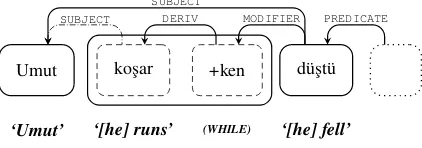
on more than one head token withSUBJECT re-lations: 1) the verb “kos¸mak” (to run) and 2) the verb “d¨us¸mek” (to fall). Adding a second rela-tion (emphasized with a dash-dotted line in the fig-ure) to the token ”Umut” breaks the condition that each token may have at most one head, and ren-ders existing dependency tree parsers incompati-ble for this setup. It is also worth mentioning that the deep dependencies in the IMST are not dis-criminated from surface dependencies by the use of different labels.
Umut kos¸ar +ken d¨us¸t¨u
‘Umut’ ‘[he] runs’ (WHILE) ‘[he] fell’
“Umut fell as [he was] running.” SUBJECT
[image:2.595.79.290.219.293.2]SUBJECT DERIV MODIFIER PREDICATE
Figure 1: Example for Turkish multi-head depen-dencies.
In this paper, for the first time in the litera-ture, we investigate the impact of using dynamic oracles for parsing multi-head dependency struc-tures by extending the approach of Goldberg and Nivre (2012). We provide comparisons with the replication of the basic shift-reduce DAG pars-ing algorithm of Sagae and Tsujii (2008) and a first time implementation of their proposed arc-eager parsing algorithm. The remainder of the pa-per first gives a background information about the topic, then introduces the DAG parsing framework and the proposed algorithms together with experi-ments and results.
2 Background
Although it is possible to discover the syntactic re-lations with a two stage model by first finding the regular surface dependencies and then finding the deep relations with post-processing as in Nivre et al. (2010), it is not always straightforward to de-cide which dependencies should be treated as sur-face relations or deep relations as in the case of Turkish. Thus, in this study, we focus on single stage models and aim to discover the entire set of relations in a single pass. McDonald and Pereira (2006) use graph-based algorithms for DAG pars-ing simply uspars-ing approximate interference in an
edge-factored dependency model starting from de-pendency trees. On the other hand, Sagae and Tsujii (2008) propose a transition-based counter-part for DAG parsing which made available for parsing multi-headed relations. They modified the existing shift-reduce bottom-up dependency pars-ing algorithm of Nivre and Nilsson (2005) to al-low multiple heads per token by the use of cycle removal and pseudo-projectivization as a prepro-cessing stage. They report higher performance scores on the Danish treebank compared to Mc-Donald and Pereira (2006).
A standard way of determining transition ac-tions in a shift-reduce dependency parser is us-ing static oracles. Durus-ing the trainus-ing stage, the learning instances for the oracle are prepared by the use of manually annotated gold-standard parse trees and the current parsing configuration. Dur-ing the parsDur-ing stage, the already trained oracle decides on the next transition operation. One of the problems with static oracles lays beneath the spurious ambiguity, which implies there might be more than one transition sequence for a given sen-tence and the sequence proposed by an oracle may not be the easiest to learn. The second problem oc-curs when the parser makes a parsing error which leads to a parser configuration from which the cor-rect parse tree is not derivable. The algorithm does not provide any solutions for dealing with the er-ror propagation caused by such situations. The idea of dynamic oracles introduced by Goldberg and Nivre (2012) rises for handling the aforemen-tioned handicaps of static oracles. Rather than re-turning a unique transition for a given configura-tion, a dynamic oracle returns a set of valid tran-sitions regarding the current configuration, which would allow the algorithm to explore non-optimal configurations during the training procedure. 3 Transition-Based Solutions for
Dependency DAG Parsing
Transition-based parsing frameworks consider the transition system to be an abstract machine that processes input sentences and produces corre-sponding parsing graphs. The tokens of the in-put sequence and the partially created dependency structures are kept within the following data struc-tures:
2. a stackσ which consists of the tokens being processed,
3. a setAof assigned dependency arcs.
The transition actions explained in the follow-ing subsections are basic stack and queue opera-tions that correspond to parsing acopera-tions marking dependency relations. The algorithm starts with a buffer β initialized with all tokens of a sentence preserving their sequence, and an empty stackσ. The parsing process finishes when there are no nodes left inβand only the artificial root inσ.
3.1 Basic shift-reduce parsing with multiple heads
The first algorithm that is capable of parsing DAG structures is the standard algorithm of Sagae and Tsujii (2008). The complete list of the transitions of this algorithm is as follows:
• Shift: Pops the first item of the buffer and pushes it onto the top of the stack.
• Left-Reduce: Pops the top two items of the stack, creates a left arc between them where the top item is assigned as the head of the item below, and pushes the head token back onto the stack.
• Right-Reduce: Pops the top two items of the stack, creates a right arc between them, where the item below is assigned as the head of the top item, and pushes the head token back onto the stack.
• Left-Attach: Creates a left arc between the top two items of the stack, where the top item is assigned as the head of the one below. The stack and the buffer remain unchanged.
• Right-Attach: Creates a right dependency arc between the two top items on the stack and assigns the top token as the dependent of the token below. As the second step, it pops the top of the stack and places it into the buffer
β.
3.2 Multi-Head Arc-Eager Parsing Algorithm
The second transition algorithm introduced but not implemented by Sagae and Tsujii (2008) is a vari-ation of the Arc-Eager algorithm of Nivre et al. (2007) and has the following transition operations:
• Shift: Pops the first item of the buffer and pushes it onto the top token of the stack.
• Left-Arc: Creates a left dependency arc be-tween the top token of the stack and the first token of the input buffer, where the first token in the buffer becomes the head and the one at the top of the stack becomes the dependent. It is also worth noticing that the stack and the input buffer remains unchanged.
• Right-Arc: Creates a right dependency arc between the top token of the stack and the first token on the input buffer, where the to-ken in the stack becomes the head, and the token which is in front of the buffer becomes the dependent. It is also worth noticing that the stack and the input buffer remains un-changed.
• Reduce: Pops the top item of the stack if and only if it was previously associated with at least one head.
3.3 Multi-Head Arc Eager Parsing with a Dynamic Oracle
In order to design a dynamic oracle with the ca-pability of parsing multi-head dependencies, we need an efficient method for computing the cost of each transition. To this end, we extend the dynamic oracle defined by Goldberg and Nivre (2012), considering DAG parsing arc-eager sys-tem of Sagae and Tsujii (2008). Extended arc-eager transition system will operate in the same way as previously defined in Section 3.2, within a dynamic oracle system whose cost function is de-fined with a transition operation, the current con-figuration c = (σ|s, b|β, A)1 and the gold parse of the sentence (Ggold). Differing from Goldberg and Nivre (2012), for ease of computation, we pre-fer marking transitions as zero cost or costly in-stead of computing the exact cost:
• Cost(LeftAttach, c, Ggold)Attachingstob with a left arc is costly, if there is a right arc betweensandb, or it is already attached with a left arc.
• Cost(RightAttach, c, Ggold)Attachingsto
bby creating right arc is costly, if there is a left arc betweensand b, or it is already at-tached with a right arc.
• Cost(Reduce, c, Ggold) Poppingsfrom the stack means it will be no longer possible to associate it with any head or dependent from bufferβ, therefore it is costly if it has heads or dependents in theβ.
• Cost(Shift, c, Ggold) Pushing b onto the stack means it will be no longer possible to associate it with any heads or dependents in stackσ, therefore it is costly if it has a head or dependent token in theσ.
Since left attach and right attach operations do not change the parser configuration (i.e. these op-erations cannot lead to a parser configuration from which the gold tree is not reachable), their cost is measured according to the validity of the attach-ment. The only difference of our multi-head vari-ant from the single head arc-eager transition sys-tem is that the left and right arc operations do not change the parser state. As such, it is essentially a relaxed version of the single-head system. There-fore, since the arc-decomposition property holds for the single-head system (as proven by Goldberg and Nivre (2013)), it also holds for our variant.
We use the same online training procedure (with the perceptron algorithm) as Goldberg and Nivre (2012) given in Algorithm 1.
Algorithm 1Online training with dynamic oracle
1: procedureTRAIN
2: w←0
3: forI ←1, ITERATIONSdo 4: c←cs(x)
5: forsentence xdo
6: whilecis not terminaldo 7: tp ←argmaxtw.Φ(c, t)
8: ZC ←
{t|o(t;c;Ggold) =true}
9: to←argmaxtZCw.Φ(c, t)
10: iftp 6∈ZCthen
11: w ← w + Φ(c, to) −
Φ(c, tp)
12: tn←NEXT(I, tp, ZC)
13: c←tn(c)
14: procedureNEXT(I, t, ZC) 15: ift∈ZC then
16: return t
17: else
18: RANDOM ELEMENT(ZC)
The proposed oracle will return a set of zero cost transition operations (denoted as ZC at line 8) where the costs are calculated according to the cost function defined above. Feature weights will be updated only if the perceptron model makes a transition prediction that does not belong to the zero cost transitions (lines 10 and 11). After that, the next transition operation is chosen by the func-tion NEXT, which returns the transifunc-tion that is pre-dicted by the model if it belongs to zero cost tran-sitions; if not, it returns a random transition which belongs to the zero cost transition set.
4 Experiments
In order to apply the specified DAG parsing al-gorithm to non-projective sentences, a pseudo-projective transformation operation is applied to the IMST. For that aim, we apply Head scheme2 described by Nivre (2005). Moreover, before the application of this pseudo-projective transforma-tion, the cyclic dependency paths are handled as described by Sagae and Tsujii (2008), by reversing the shortest arc within the cyclic dependency path until no cyclic path remains. 99.3% precision and 99.2% recall are acquired on IMST by applying the pseudo-projective transformation and detrans-formation operations. As a learning component, we follow the work of Sagae and Tsujii (2008) and use a Maximum Entropy model for the clas-sification with the greedy search algorithm. For the dynamic oracle experiment, we use an aver-aged perceptron algorithm iterating 15 times over the training data.
The following features are used in all of the ex-periments:
• The POS tag, lemma and morphological fea-tures of the top 3 tokens on the stack and the first 3 tokens in the buffer.
• The POS tag and dependency relations of the rightmost and leftmost modifiers of the top 2 items on the stack.
• The number of heads and dependents of the top item of the stack and the first item of the buffer.
• The dependency relations of the top of the stack.
• Whether the top 2 tokens on the stack have a dependency relation between them or not.
• Whether the top token of the stack and the first of the buffer have a dependency relation between them or not, and if so the direction and the type of the relation.
• Combination of the surface form of the top token of the stack and its number of left and right modifiers.
• Combination of the surface form of the first token of the buffer and its number of left and right modifiers.
• The surface forms and POS tags of heads of the top token of the stack and the first token of the buffer.
• The previous two parsing actions.
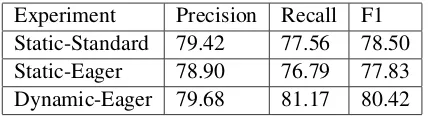
[image:5.595.75.289.428.487.2]For training and evaluation purposes, we use the IMST with ten-fold cross validation. Experiment results are given in Table 4.
Table 1: Unlabeled scores of experiments with using IMST.
Experiment Precision Recall F1 Static-Standard 79.42 77.56 78.50 Static-Eager 78.90 76.79 77.83 Dynamic-Eager 79.68 81.17 80.42
As shown in Table 4, the static arc-eager DAG implementation for Turkish performs slightly worse than the arc-standard algorithm. This is not surprising in the light of previous studies (Nivre, 2008; Eryi˘git et al., 2008) reporting that the arc standard algorithm performs better in tree parsing due to the smaller number of classes to be learned by the oracle. However, the proposed multi-head arc-eager algorithm with dynamic oracle (referred to as Dynamic-Eager) yields the best precision, re-call and F1 scores among the three experiments.3
In this study, although there is still room for improvement on performance with more feature engineering, we obtain better results on Turkish IMST treebank between static and dynamic ora-cles with our newly proposed method for parsing
3The difference of this model from the runner-up models are found to be statistically significant according to McNe-mar’s test (p <0.0001)
DAGs. This encourages us to test our system with different languages as future work with the expec-tation that the ameliorations will be much higher than the reported ones in the single-head scenario.
5 Conclusion and Future Works
In this paper, we experimented with three differ-ent transition-based algorithms for DAG parsing which eliminate the single-head constraint of tra-ditional algorithms and allows multi-head depen-dency relations to represent more complicated lin-guistic phenomena along with surface relations. We present the first results for arc-eager DAG parsing with static oracles and propose a new arc-eager DAG parsing algorithm using dynamic ora-cles. Our initial experiments conducted on Turkish pave the way for future research on the usage of the dynamic arc-eager DAG parsing for other lan-guages. For future work, we will first conduct ex-periments on how well the Dynamic-Eager algo-rithm performs on different treebanks, including multi-head dependencies (such as the Danish tree-bank (Kromann, 2003)). Secondly, we will con-duct experiments on previously described static-oracle parsing algorithms by using different clas-sifiers such as Support Vector Machines.
Acknowledgments
We hereby acknowledge that this study is part of a research project named ”Parsing Web 2.0 Sen-tences” that is supported by T ¨UB˙ITAK (Turkish Scientific and Technological Research Council) 1001 program (grant number 112E276) and part of the ICT COST Action IC 1207.
References
Sabine Buchholz and Erwin Marsi. 2006. Conll-x shared task on multilingual dependency parsing. In
Proceedings of the Tenth Conference on Computa-tional Natural Language Learning, pages 149–164. Association for Computational Linguistics.
Yuan Ding and Martha Palmer. 2005. Machine trans-lation using probabilistic synchronous dependency
insertion grammars. InProceedings of the 43rd
An-nual Meeting on Association for Computational Lin-guistics, pages 541–548. Association for Computa-tional Linguistics.
G¨uls¸en Eryi˘git, Joakim Nivre, and Kemal Oflazer.
2008. Dependency parsing of Turkish.
Yoav Goldberg and Joakim Nivre. 2012. A dynamic
oracle for arc-eager dependency parsing. In
COL-ING, pages 959–976.
Yoav Goldberg and Joakim Nivre. 2013. Training deterministic parsers with non-deterministic oracles.
Transactions of the association for Computational Linguistics, 1:403–414.
Matthias T Kromann. 2003. The danish dependency treebank and the underlying linguistic theory. In
Proc. of the Second Workshop on Treebanks and Lin-guistic Theories (TLT).
Ryan T McDonald and Fernando CN Pereira. 2006. Online learning of approximate dependency parsing algorithms. InEACL. Citeseer.
Joakim Nivre and Jens Nilsson. 2005.
Pseudo-projective dependency parsing. In Proceedings of
the 43rd Annual Meeting on Association for Compu-tational Linguistics, pages 99–106. Association for Computational Linguistics.
Joakim Nivre, Johan Hall, Jens Nilsson, Atanas Chanev, G¨ulsen Eryigit, Sandra K¨ubler, Svetoslav Marinov, and Erwin Marsi. 2007. Maltparser: A language-independent system for data-driven
de-pendency parsing. Natural Language Engineering,
13(02):95–135.
Joakim Nivre, Laura Rimell, Ryan McDonald, and Car-los Gomez-Rodriguez. 2010. Evaluation of
depen-dency parsers on unbounded dependencies. In
Pro-ceedings of the 23rd International Conference on Computational Linguistics, pages 833–841. Associ-ation for ComputAssoci-ational Linguistics.
Joakim Nivre. 2008. Algorithms for deterministic
in-cremental dependency parsing. Computational
Lin-guistics, 34(4):513–553.
Kenji Sagae and Jun’ichi Tsujii. 2008. Shift-reduce
dependency DAG parsing. In Proceedings of the
22nd International Conference on Computational Linguistics-Volume 1, pages 753–760. Association for Computational Linguistics.
Umut Sulubacak and G¨uls¸en Eryi˘git. 2015. A rede-fined Turkish dependency grammar and its imple-mentations: A new Turkish web treebank & the re-vised Turkish treebank. under review.
Kun Xu, Sheng Zhang, Yansong Feng, and Dongyan Zhao. 2014. Answering natural language questions
via phrasal semantic parsing. InNatural Language
Processing and Chinese Computing, pages 333–344. Springer.
Deniz Yuret, Laura Rimell, and Aydın Han. 2013.
Parser evaluation using textual entailments.
Lan-guage resources and evaluation, 47(3):639–659. Yue Zhang and Joakim Nivre. 2012. Analyzing
the effect of global learning and beam-search on
transition-based dependency parsing. In COLING