Proceedings of the 55th Annual Meeting of the Association for Computational Linguistics (Short Papers), pages 1–6 Vancouver, Canada, July 30 - August 4, 2017. c2017 Association for Computational Linguistics
Proceedings of the 55th Annual Meeting of the Association for Computational Linguistics (Short Papers), pages 1–6 Vancouver, Canada, July 30 - August 4, 2017. c2017 Association for Computational Linguistics
Classifying Temporal Relations by Bidirectional LSTM over Dependency
Paths
Fei Cheng and Yusuke Miyao
Research Center for Financial Smart Data National Institute of Informatics 2-1-2 Hitotsubashi, Chiyoda-ku, Tokyo, Japan
{fei-cheng, yusuke}@nii.ac.jp
Abstract
Temporal relation classification is becom-ing an active research field. Lots of meth-ods have been proposed, while most of them focus on extracting features from external resources. Less attention has been paid to a significant advance in a closely related task: relation extraction. In this work, we borrow a state-of-the-art method in relation extraction by adopting bidirectional long short-term memory (Bi-LSTM) along dependency paths (DP). We make a “common root” assumption to ex-tend DP representations of cross-sentence links. In the final comparison to two state-of-the-art systems on TimeBank-Dense, our model achieves comparable perfor-mance, without using external knowledge and manually annotated attributes of enti-ties (class, tense, polarity, etc.).
1 Introduction
Recently, the need for extracting temporal infor-mation from text is motivated rapidly by many NLP tasks such as: question answering (QA), in-formation extraction (IE), etc. Along with the TimeBank1 (Pustejovsky et al., 2003) and other temporal information annotated corpora, a se-ries of temporal evaluation challenges (TempEval-1,2,3) (Verhagen et al., 2009, 2010; UzZaman et al., 2012) are attracting growing research ef-forts.
Temporal relation classification is a task to iden-tify the pairs of temporal entities (events or tem-poral expressions) that have a temtem-poral link and classify the temporal relations between them. For instance, we show an event-event (E-E) link with ‘DURING’ type in (i), an event-time (E-T) link
1https://catalog.ldc.upenn.edu/LDC2006T08
with ‘INCLUDES’ type in(ii)and an event-DCT (document creation time, E-D) with ‘BEFORE’ type in(iii).
(i) There was nohintof trouble in the last con-versationbetween controllers and TWA pilot Steven Snyder.
(ii) In Washington today, the Federal Aviation Administration released air traffic control tapes.
(iii) The U.S. Navyhas27 ships in the maritime barricade of Iraq.
Marcu and Echihabi (2002) propose an ap-proach considering word-based pairs as useful fea-tures. The following researchers (Laokulrat et al.,
2013; Chambers et al., 2014; Mani et al., 2006;
D’Souza and Ng, 2013) focus on extracting lex-ical, syntactic or semantic information from var-ious external knowledge bases such as: Word-Net (Miller,1995) and VerbOcean (Chklovski and Pantel,2004). However, these feature based meth-ods rely on hand-crafted efforts and external re-sources. In addition, these works require the fea-tures of entity attributes (class, tense, polarity, etc.), which are manually annotated to achieve high performance. Consequently, they are hard to obtain in practical application scenarios.
In relation extraction, there is an explosion of the works done with the dependency path (DP) based methods, which employ various models along dependency paths (Bunescu and Mooney,
2005;Plank and Moschitti,2013). In recent years, the DP-based neural networks (Socher et al.,2011;
Xu et al., 2015a,b) show state-of-the-art perfor-mance, with less requirements on explicit features. Intuitively, the DP-based approaches have the po-tential to classify temporal relations.
Both relation extraction and temporal relation classification require the identification of
Figure 1: An example of the sentences with entity attributes annotated in TimeBank.
ship between entities in texts. However, temporal relation classification is more challenging, since it includes three different type of entities: ‘event’, ‘time expression’ and DCT. Cross-sentence links also add additional complexity into the task. Due to the outstanding performance of DP-based neu-ral networks revealed in relation extraction, we borrow this state-of-the-art approach to temporal relation classification.
In Section 2 of this paper, we review related work and introduce TimeBank-Dense. We dis-cuss the cross-sentence link problem and the ar-chitectures of our E-E, E-T and E-D classifiers in Section3. In Section4, the experiments are per-formed on TimeBank-Dense and we compare our model to the baseline and two state-of-the-art sys-tems. The final conclusion is made in Section5.
2 Background 2.1 Related Work
Current state-of-the-art temporal relation classi-fiers exploit a variety of features. Laokulrat et al.
(2013); Chambers et al. (2014) extract lexical and morphological features derived from Word-Net synsets. Mani et al. (2006); D’Souza and Ng(2013) incorporate semantic relations between verbs from VerbOcean as features. In addition, most of the systems include the entity attributes (Figure1) specified in TimeML2as basic features, which actually need heavy human annotations.
In this work, we push this work into a more practical level by using only word, part-of-speech (POS), dependency parsing information, without incorporating entity attributes, as well as any other external resources.
In relation extraction, Bunescu and Mooney
(2005) propose an observation that a relation can be captured by the shortest dependency path
2http://timeml.org/
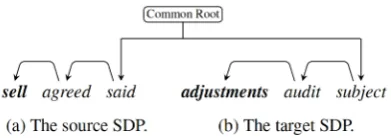
Figure 2: An example of the DP representation of a cross-sentence link between the two sentences in Figure1.
(SDP) between the two entities in the entire depen-dency graph. Plank and Moschitti (2013) extract syntactic and semantic information in a tree ker-nel. Following this line, researchers (Socher et al.,
2011;Xu et al., 2015a,b) achieve state-of-the-art performance by building various neural networks over dependency path.
Our system is similar to the work by Xu et al.
(2015b). They perform LSTM with max pooling separately on each feature channel along depen-dency path. In contrast, our system adopts bidi-rectional LSTM on the concatenation of feature embeddings.
2.2 TimeBank-Dense
In the original TimeBank, temporal links have been created on those pairs with semantic connec-tions, which led to a sparse annotation style. Cas-sidy et al.(2014)3 propose a mechanism to force annotators to create complete graphs over the enti-ties in neighboring sentences. Compared to 6,418 links in 183 TimeBank documents, TimeBank-Dense achieves greater density with 12,715 links in 36 documents.
We follow a similar experiment setting to the other two systems (Mirza and Tonelli, 2016;
as test data and the others as training data (15% of training data is split as validation data for early stopping).
3 The Proposed Method
3.1 Cross-sentence Dependency Paths
Intuitively, the dependency path based idea can be introduced into the temporal relation classifica-tion task. However, around 64% E-E, E-T links in TimeBank-Dense are with the ends in two neigh-boring sentences, called cross-sentence links.
A crucial obstacle is how to represent the depen-dency path of a cross-sentence link. In this work, we make a naive assumption that two neighbor-ing sentences share a “common root”. Therefore, a cross-sentence dependency path can be repre-sented as two shortest dependency path branches from the ends to the “common root”, as shown in Figure2.
Stanford CoreNLP4is used to parsing syntactic structures of sentences in this work.
3.2 Temporal Relation Classifiers
Long short-term memory (LSTM) (Hochreiter and Schmidhuber, 1997) is a natural choice for pro-cessing sequential dependency paths. As the re-versed order also takes useful information, a back-ward representation can be achieved by feed-ing LSTM with the same input in reverse. We adopt the concatenation of the forward and back-ward LSTMs outputs, referred to as bidirectional LSTM (Graves and Schmidhuber,2005).
Figure 3a shows the neural network architec-ture of our E-E, E-T classifier. Given an E-E or E-T temporal link, our system first generates two SDP branches: 1) the source entity to common root, 2) the target entity to common root. For each word along a SDP branch, concatenation of word, POS and dependency relation (DEP) em-beddings (word-level) is fed into Bi-LSTM. The forward and backward outputs of both source and target branches are all concatenated, and fed into a fully connected hidden units layer. The final Soft-max layer generates multi-class predictions. Since an E-D link contains single event SDP branch, our system applies a similar architecture, but with single branch Bi-LSTM with outputs fed into the penultimate hidden layer, as shown in Figure3b.
In this work, we use word2vec5(Mikolov et al., 4http://stanfordnlp.github.io/CoreNLP/
5https://code.google.com/archive/p/word2vec/
LINK type E-D E-E E-T
AFTER .493 .477 .350 BEFORE .552 .380 .311 SIMULTANEOUS - - -INCLUDES .305 .185 .254 IS INCLUDED .513 .296 .204 VAGUE .482 .656 .616
[image:3.595.322.514.61.173.2]Overall .491 .544 .480
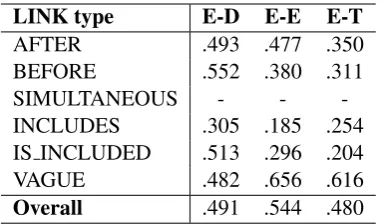
Table 1: The best sentence-level 5-fold CV per-formance (Micro-average Overall F1-score).
2013a,b) to train 200-dimensions word embed-dings on English Gigaword 4th edition with skip-gram model and other default settings. For ei-ther of POS or DEP, we adopt the 50-dimensions lookup table initialized randomly.
4 Experiments
4.1 Hyper-parameters and Cross-validation
The grid search exploring a full hyper-parameter space takes time for three classifiers (E-E, E-T and E-D). Empirically, we set each single LSTM out-put with the same dimensions (equal to 300) as the concatenation of word, POS, DEP embeddings. The hidden layer is set as 200-dimensions.
Our system adopts dependency paths as input, which means that the entities in the same sen-tences contain highly covered word sequence in-put. Simple cross-validation (CV) on links can not reflect the generalization ability of our model cor-rectly. We use a grouped 5-fold CV based on the source entity ids (document id + sentence id) of links. This schema can reduce bias separately in either the source SDP or the target SDP. Although document level CV can avoid this issue, it’s not feasible for TimeBank-Dense because it contains only 27 training documents.
Early stopping is used to save the best model based on the validation data. In each run of the 5-fold cross-validation, we split 80% of ‘original training’ as ‘tentative training’ and 20% as ‘ten-tative test’. 85% of ‘ten‘ten-tative training’ is used to learning and 15% is used for validation. We also adopt early stopping in the final system on the val-idation data (15% of ‘original training’). The pa-tience is set as 10.
(a) E-E, E-T classifier (b) E-D classifier
Figure 3: The DP-based Bi-LSTM temporal relation classifier.
Our Mirza Our Mirza
LINK type E-D E-D E-E E-E
AFTER .582 .466 .440 .430 BEFORE .634 .671 .460 .471
SIMULTA. - - -
-INCLUDES .056 .250 .025 .049
IS INCLUD. .595 .600 .170 .250
VAGUE .526 .502 .624 .613
[image:4.595.317.514.297.366.2]Overall .546 .534 .529 .519
Table 2: The detailed comparison of E-E and E-T against relation types toMirza and Tonelli(2016) (Micro-average Overall F1-score) on test data.
separately after the following layers: embeddings, LSTM, and hidden layer to investigate the impact of dropout on performance. Table1shows the best CV results recorded in tuning dropout. The hyper-parameter setting with the best CV performance is adopted in the final system.
4.2 Overall Performance
Recently,Mirza and Tonelli(2016) report state-of-the-art performance on TimeBank-Dense. They show the new attempt to mine the value of low-dimensions word embeddings by concatenating them with sparse traditional features. Their tra-ditional features include entity attributes, tempo-ral signals, semantic information of WordNet, etc., which means it’s a hard setting for challenging their performance. In Table2and3, ‘Mirza’ de-notes their system.
Table 2 shows the detailed comparison to
Systems E-D E-E E-T Overall
Baseline .471 .502 .437 .486 Proposed .546 .529 .471 .520
[image:4.595.75.288.297.428.2]Mirza .534 .519 .468 .512 CAEVO .553 .494 .494 .502
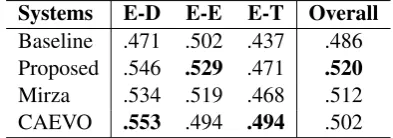
Table 3: The final comparison of E, T and E-D to the baseline and two state-of-the-art systems on test data.
their work. Our system achieves higher perfor-mance on ‘AFTER’, ‘VAGUE’, while lower on ‘BEFORE’, ‘INCLUDES’ (5% of all data) and ‘IS INCLUDED’ (4% of all data). It is likely that their rich traditional features help the classifiers to capture more minority-class links. On the whole, our system reaches better ‘Overall’ on both E-E and E-D. As their E-T classifier does not include word embeddings, the E-T results are not listed.
The final comparison is shown in Table3. An one-layer fully connected hidden units baseline (200-dimensions) with word, POS embeddings as input (without any dependency information) is provided. The significant out-performance of our proposed model over the baseline indicates the ef-fectiveness of the dependency path information and our Bi-LSTM in classifying temporal links. As a hybrid system, ‘CAEVO’ (Chambers et al.,
feature-based methods and performs slightly better in E-E and overall, compared to ‘CAE-EVO’. Our sys-tem shows the highest scores in E-E and overall among the four systems. In general, our system achieves comparable performance to two state-of-the-art systems, without using any hand-crafted features, rules, or external resources.
5 Conclusion
We borrow the idea of the dependency path based neural networks into temporal relation classifica-tion. A “common root” assumption adapts our model to cross-sentence links. Our model adopts bidirectional LSTM for capturing both forward and backward orders information. We observe the significant benefit of the DP-based Bi-LSTM model by comparing it to the baseline. Our model achieves comparable performance to two state-of-the-art systems without using any explicit features (class, tense, polarity, etc.) or external resources, which indicates that our model can capture such information automatically.
6 Acknowledgments
We thank the anonymous reviewers for the insight-ful comments.
References
Razvan Bunescu and Raymond Mooney. 2005. A
shortest path dependency kernel for relation ex-traction. In Proceedings of Human Language Technology Conference and Conference on Em-pirical Methods in Natural Language Processing. Association for Computational Linguistics, Van-couver, British Columbia, Canada, pages 724– 731. http://www.aclweb.org/anthology/H/H05/H05-1091.
Taylor Cassidy, Bill McDowell, Nathanael
Cham-bers, and Steven Bethard. 2014. An annotation
framework for dense event ordering. In Pro-ceedings of the 52nd Annual Meeting of the As-sociation for Computational Linguistics (Volume 2: Short Papers). Association for Computational Linguistics, Baltimore, Maryland, pages 501–506.
http://www.aclweb.org/anthology/P14-2082.
Nathanael Chambers, Taylor Cassidy, Bill McDowell,
and Steven Bethard. 2014. Dense event ordering
with a multi-pass architecture. Transactions of the Association for Computational Linguistics 2:273– 284. http://aclweb.org/anthology/Q/Q14/Q14-1022.pdf.
Timothy Chklovski and Patrick Pantel. 2004.
Ver-bocean: Mining the web for fine-grained
se-mantic verb relations. In Dekang Lin and
Dekai Wu, editors, Proceedings of EMNLP
2004. Association for Computational
Lin-guistics, Barcelona, Spain, pages 33–40.
https://www.aclweb.org/anthology/W/W04/W04-3205.pdf.
Jennifer D’Souza and Vincent Ng. 2013.
Classify-ing temporal relations with rich lClassify-inguistic knowl-edge. In Proceedings of the 2013 Confer-ence of the North American Chapter of the As-sociation for Computational Linguistics: Human Language Technologies. Association for Computa-tional Linguistics, Atlanta, Georgia, pages 918–927.
http://www.aclweb.org/anthology/N13-1112.
Alex Graves and J¨urgen Schmidhuber. 2005.
Framewise phoneme classification with bidi-rectional lstm and other neural network ar-chitectures. Neural Networks 18(5):602–610.
https://doi.org/10.1016/j.neunet.2005.06.042.
Sepp Hochreiter and J¨urgen
Schmidhu-ber. 1997. Long short-term memory.
Neural computation 9(8):1735–1780.
https://doi.org/10.1162/neco.1997.9.8.1735.
Natsuda Laokulrat, Makoto Miwa, Yoshimasa
Tsu-ruoka, and Takashi Chikayama. 2013. Uttime:
Tem-poral relation classification using deep syntactic fea-tures. In Second Joint Conference on Lexical and Computational Semantics (* SEM). volume 2, pages
88–92.
http://aclweb.org/anthology/S/S13/S13-2015.pdf.
Inderjeet Mani, Marc Verhagen, Ben Wellner, Chong Min Lee, and James Pustejovsky. 2006.
Machine learning of temporal relations. In Pro-ceedings of the 21st International Conference on Computational Linguistics and 44th Annual Meeting of the Association for Computational Linguistics. Association for Computational Lin-guistics, Sydney, Australia, pages 753–760.
https://doi.org/10.3115/1220175.1220270.
Daniel Marcu and Abdessamad Echihabi. 2002. An
unsupervised approach to recognizing discourse re-lations. In Proceedings of 40th Annual Meet-ing of the Association for Computational LMeet-inguis-
Linguis-tics. Association for Computational Linguistics,
Philadelphia, Pennsylvania, USA, pages 368–375.
https://doi.org/10.3115/1073083.1073145.
Tomas Mikolov, Kai Chen, Greg Corrado,
and Jeffrey Dean. 2013a. Efficient
es-timation of word representations in vec-tor space. arXiv preprint arXiv:1301.3781
http://arxiv.org/pdf/1301.3781v3.pdf.
Tomas Mikolov, Ilya Sutskever, Kai Chen, Greg S
Corrado, and Jeff Dean. 2013b. Distributed
representations of words and phrases and their compositionality. In Advances in neural in-formation processing systems. pages 3111–3119.
George A Miller. 1995.Wordnet: a lexical database for english. Communications of the ACM 38(11):39– 41.https://doi.org/10.1145/219717.219748.
Paramita Mirza and Sara Tonelli. 2016. On the
con-tribution of word embeddings to temporal relation classification. In Proceedings of COLING 2016, the 26th International Conference on Computational Linguistics: Technical Papers. The COLING 2016 Organizing Committee, Osaka, Japan, pages 2818–
2828.http://aclweb.org/anthology/C16-1265.
Barbara Plank and Alessandro Moschitti. 2013.
Em-bedding semantic similarity in tree kernels for do-main adaptation of relation extraction. In Pro-ceedings of the 51st Annual Meeting of the As-sociation for Computational Linguistics (Volume 1: Long Papers). Association for Computational Linguistics, Sofia, Bulgaria, pages 1498–1507.
http://www.aclweb.org/anthology/P13-1147.
James Pustejovsky, Patrick Hanks, Roser Sauri, An-drew See, Robert Gaizauskas, Andrea Setzer, Dragomir Radev, Beth Sundheim, David Day,
Lisa Ferro, et al. 2003. The timebank
cor-pus. InCorpus linguistics. volume 2003, page 40.
https://catalog.ldc.upenn.edu/LDC2006T08.
Richard Socher, Jeffrey Pennington, Eric H. Huang, Andrew Y. Ng, and Christopher D. Manning. 2011.
Semi-supervised recursive autoencoders for predict-ing sentiment distributions. InProceedings of the 2011 Conference on Empirical Methods in Natu-ral Language Processing. Association for Computa-tional Linguistics, Edinburgh, Scotland, UK., pages
151–161.
http://www.aclweb.org/anthology/D11-1014.
Nitish Srivastava, Geoffrey E Hinton, Alex Krizhevsky,
Ilya Sutskever, and Ruslan Salakhutdinov.
2014. Dropout: a simple way to prevent
neural networks from overfitting. Journal of Machine Learning Research 15(1):1929–1958.
http://jmlr.org/papers/v15/srivastava14a.html.
Naushad UzZaman, Hector Llorens, James Allen, Leon Derczynski, Marc Verhagen, and James
Pustejovsky. 2012. Tempeval-3:
Evaluat-ing events, time expressions, and temporal relations. arXiv preprint arXiv:1206.5333
http://aclweb.org/anthology/S/S13/S13-2001.pdf.
Marc Verhagen, Robert Gaizauskas, Frank Schilder, Mark Hepple, Jessica Moszkowicz, and James
Pustejovsky. 2009. The tempeval challenge:
identifying temporal relations in text. Lan-guage Resources and Evaluation 43(2):161–179.
https://doi.org/10.1007/s10579-009-9086-z.
Marc Verhagen, Roser Sauri, Tommaso Caselli, and
James Pustejovsky. 2010. Semeval-2010 task 13:
Tempeval-2. In Proceedings of the 5th interna-tional workshop on semantic evaluation. Associa-tion for ComputaAssocia-tional Linguistics, pages 57–62.
http://www.aclweb.org/anthology/S10-1010.
Kun Xu, Yansong Feng, Songfang Huang, and
Dongyan Zhao. 2015a. Semantic relation
clas-sification via convolutional neural networks with simple negative sampling. In Proceedings of the 2015 Conference on Empirical Methods in Natu-ral Language Processing. Association for Computa-tional Linguistics, Lisbon, Portugal, pages 536–540.
http://aclweb.org/anthology/D15-1062.
Yan Xu, Lili Mou, Ge Li, Yunchuan Chen, Hao
Peng, and Zhi Jin. 2015b. Classifying relations
via long short term memory networks along short-est dependency paths. In Proceedings of the 2015 Conference on Empirical Methods in Natural Lan-guage Processing. Association for Computational Linguistics, Lisbon, Portugal, pages 1785–1794.