224
Meta-Learning Improves Lifelong Relation Extraction
Abiola Obamuyide
Department of Computer Science University of Sheffield
Andreas Vlachos
Dept. of Computer Science and Technology University of Cambridge
Abstract
Most existing relation extraction models as-sume a fixed set of relations and are unable to adapt to exploit newly available supervision data to extract new relations. In order to al-leviate such problems, there is the need to de-velop approaches that make relation extraction models capable of continuous adaptation and learning. We investigate and present results for such an approach, based on a combination of ideas from lifelong learning and optimization-based meta-learning. We evaluate the pro-posed approach on two recent lifelong relation extraction benchmarks, and demonstrate that it markedly outperforms current state-of-the-art approaches.
1 Introduction
The majority of existing supervised relation ex-traction models can only extract a fixed set of re-lations which has been specified at training time. They are unable to detect an evolving set of novel relations observed after training without substan-tial retraining, which can be computationally ex-pensive and may lead to catastrophic forgetting of previously learned relations. Zero-shot relation extraction approaches (Rockt¨aschel et al., 2015;
Demeester et al., 2016; Levy et al., 2017; Oba-muyide and Vlachos,2018) can extract unseen re-lations, but at lower performance levels, and are unable to continually exploit newly available su-pervision to improve performance without consid-erable retraining. These limitations also extend to approaches to extracting relations in other lim-ited supervision settings, for instance in the one-shot setting (Obamuyide and Vlachos,2017). It is therefore desirable for relation extraction models to have the capability to learn continuously with-out catastrophic forgetting of previously learned relations. This would enable them exploit newly
available supervision to both identify novel rela-tions and improve performance without substan-tial retraining.
Recently,Wang et al.(2019) introduced an em-bedding alignment approach to enable continual learning for relation extraction models. They con-sider a setting with streaming tasks, where each task consists of a number of distinct relations, and proposed to align the representation of relation in-stances in the embedding space to enable contin-ual learning of new relations without forgetting knowledge from past relations. While they ob-tained promising results, a key weakness of the approach is that the use of an alignment model introduces additional parameters to already over-parameterized relation extraction models, which may in turn lead to an increase in the quantity of supervision required for training. In addition, the approach can only align embeddings between served relations, and does not have any explicit ob-jective that encourages the model to transfer and exploit knowledge gathered from previously ob-served relations to facilitate the efficient learning of yet to be observed relations.
In this work, we extend the work of Wang et al. (2019) by exploiting ideas from both life-long learning and meta-learning. We propose to consider lifelong relation extraction as a meta-learning challenge, to which the machinery of cur-rent optimization-based meta-learning algorithms can be applied. Unlike the use of a separate align-ment model as proposed inWang et al.(2019), the proposed approach does not introduce additional parameters. In addition, the proposed approach is more data efficient since it explicitly optimizes for the transfer of knowledge from past relations, while avoiding the catastrophic forgetting of pre-viously learned relations. Empirically, we evaluate on lifelong versions of the datasets byBordes et al.
con-siderable performance improvements over prior state-of-the-art approaches.
2 Background
Lifelong Learning In the lifelong learning set-ting, also referred to as continual learning (Ring,
1994; Thrun, 1996; Zhao and Schmidhuber,
1996), a modelfθ is presented with a sequence of
tasks{Tt}t=1,2,3..,T, one task per round, and the
goal is to learn model parameters {θt}t=1,2,3,..,T
with the best performance on the observed tasks. Each taskT can be a conventional supervised task with its own distinct train (Ttrain), development
(Tdev) and test (Ttest) splits. At each round t, the model is allowed to exploit knowledge gained from the previoust−1 tasks to enhance performance on the current task. In addition, the model is also allowed to have a small-sized buffer memory B, which can be used to store a limited amount of data from previously observed tasks. A prominent line of work in lifelong learning research is developing approaches that enable models learn new tasks without forgetting knowledge from previous tasks, i.e. avoiding catastrophic forgetting of old tasks (McCloskey and Cohen, 1989; Ratcliff, 1990; McClelland et al.,1995;French,1999). Approaches proposed to address this problem include memory-based approaches (Lopez-Paz and Ranzato, 2017;
Rebuffi et al., 2017; Chaudhry et al., 2019); parameter consolidation approaches (Kirkpatrick et al., 2017; Zenke et al., 2017); and dynamic model architecture approaches (Xiao et al.,2014;
Rusu et al.,2016;Fernando et al.,2017).
Meta-Learning Meta-learning, or learning to learn (Schmidhuber, 1987; Naik and Mam-mone, 1992; Thrun and Pratt, 1998), aims to develop algorithms that learn a generic knowledge of how to solve tasks from a given distribution of tasks, by generalizing from solving related tasks from that distribution. Given tasks T sampled from a distribution of tasks p(T), and a learner modelf(x;θ)parameterized byθ, gradient-based meta-learning methods, such as MAML (Finn et al., 2017), learn a prior initialization of the parameters of the model which, at meta-test time, can be quickly adapted to achieve good perfor-mance on a new task using a few steps of gradient descent. During adaptation to the new task, the model parameters θ are updated to task-specific
parametersθ0 with good performance on the task. Formally, the meta-learning algorithms optimize for the meta-objective:
min
θ ET ∼p(T)
LT θ0=
min
θ ET ∼p(T)[LT (U(DT;θ))] (1)
whereLT is the loss andDT is training data from taskT, andU is a fixed gradient descent learning rule, such as vanilla SGD. While these algorithms were proposed and evaluated in the context of few-shot learning, here we demonstrate their effective-ness when utilized in the lifelong learning setting for relation extraction, following similar intuition as recent work byFinn et al.(2019).
3 Meta-Learning for Lifelong Relation Extraction
It can be inferred from the previous section that a lot of lifelong learning research has focused on approaches to avoid catastrophic forgetting (i.e. negative backward transfer of knowledge) while recent meta-learning studies have focused on ef-fective approaches for positive forward transfer of knowledge (for few-shot tasks). Given the com-plementary strengths of the approaches from the two learning settings, we propose to embed meta-learning into the lifelong meta-learning process for rela-tion extracrela-tion.
While we can utilize the MAML algorithm to directly optimize the meta-objective in Equation
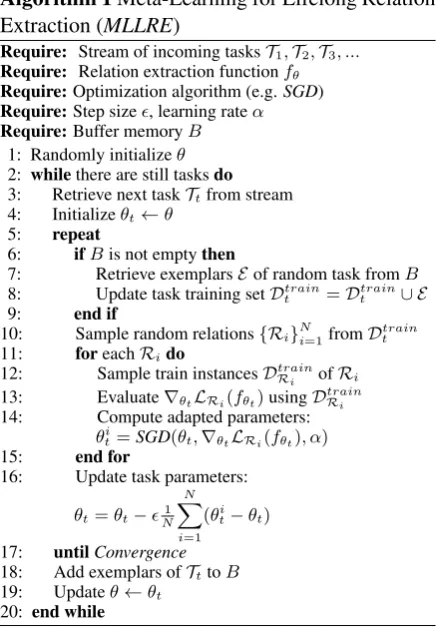
1 for our purpose, doing so requires the compu-tation of second-order derivatives, which can be computationally expensive. Nichol et al. (2018) proposed REPTILE, a first-order alternative to MAML, which uses only first-order derivatives. Similar to MAML, REPTILE works by repeatedly sampling tasks, training on those tasks and mov-ing the initialization towards the adapted weights on those tasks. Here we adopt the REPTILE al-gorithm for meta-learning. Our alal-gorithm for life-long relation extraction is illustrated in Algorithm
1.
We start by randomly initializing the parameters of the relation extraction model (thelearner) (line 1). Then, as new tasks arrive, we augment their training set with randomly sampled task exemplars from the buffer memory B (lines 2-9). We then sample a batch of relations from the augmented training set (line 10). Then for each sampled re-lation Ri, we sample a batch of supervision
in-stances Dtrain
We then obtain the adapted model parameters θit
on the relation by first computing the gradient of the training loss on the sampled relation instances (line 13) and backpropagating the gradients with a gradient-based optimization algorithm (such as
SGD orAdagrad (Duchi et al., 2011)) (line 14). At the end of the learning iteration, the adapted parameters on all sampled relations in the batch are averaged, and an update is made on the task parameters θt (line 16). This is done until
con-vergence on the current task, after which exem-plars of the current task are added to the buffer memory (line 18). Task exemplars are obtained by first clustering all training instances of the current task into 50 clusters using K-Means, then select-ing an instance from each cluster with a represen-tation closest to the cluster prototype. Finally, the model parameters are updated to the current task’s adapted parameters (line 19).
Algorithm 1Meta-Learning for Lifelong Relation Extraction (MLLRE)
Require: Stream of incoming tasksT1,T2,T3, ... Require: Relation extraction functionfθ Require:Optimization algorithm (e.g.SGD)
Require:Step size, learning rateα
Require:Buffer memoryB 1: Randomly initializeθ 2: whilethere are still tasksdo
3: Retrieve next taskTtfrom stream
4: Initializeθt←θ
5: repeat
6: ifBis not emptythen
7: Retrieve exemplarsEof random task fromB 8: Update task training setDtrain
t =Dttrain∪ E
9: end if
10: Sample random relations{Ri}Ni=1fromDtraint
11: foreachRido
12: Sample train instancesDtrain
Ri ofRi
13: Evaluate∇θtLRi(fθt)usingD
train
Ri
14: Compute adapted parameters: θti=SGD(θt,∇θtLRi(fθt), α)
15: end for
16: Update task parameters:
θt=θt−N1 N X
i=1
(θit−θt)
17: untilConvergence 18: Add exemplars ofTttoB
19: Updateθ←θt
20: end while
4 Relation Classification Model
In principle the learner model fθ could be any
gradient-optimized relation extraction model. In order to use the same number of parameters and ensure fair comparison toWang et al.(2019), we adopt as the relation extraction modelfθthe
Hier-Method FewRel SimpleQuestions
ACCw. ACCa. ACCw. ACCa.
Origin 0.189 0.208 0.632 0.569
GEM 0.492 0.598 0.841 0.796
AGEM 0.361 0.425 0.776 0.722
EWC 0.271 0.302 0.672 0.590
EA-EMR (Full) 0.566 0.673 0.878 0.824 EA-EMR (w/o Sel.) 0.564 0.674 0.857 0.812 EA-EMR (w/o Align.) 0.526 0.632 0.869 0.820
EMR 0.510 0.620 0.852 0.808
[image:3.595.72.291.340.655.2]MLLRE 0.602 0.741 0.880 0.842
Table 1: Accuracy on the test set of all tasksACCwhole (denoted ACCw.) and average accuracy on the test set of only observed tasksACCavg (denotedACCa.) on theLifelong FewRelandLifelong SimpleQuestions datasets. Best results are in bold. Except forMLLRE, results for other models are obtained fromWang et al.
(2019).
arachical Residual BiLSTM (HR-BiLSTM) model ofYu et al.(2017), which is the same model used byWang et al.(2019) for their experiments. The
HR-BILSTMis a relation classifier which accepts as input a sentence and a candidate relation, then utilizes two Bidirectional Long Short-Term Memory (Hochreiter and Schmidhuber, 1997;
Graves and Schmidhuber, 2005) (BiLSTM) units with shared parameters to process the Glove (Pennington et al.,2014) embeddings of words in the sentence and relation names, then selects the relation with the maximum cosine similarity to the sentence as its response.
Hyperparameters Apart from the hyperpa-rameters specific to meta-learning (such as the step size ), all other hyperparameters we use for the learner model are the same as used by
Wang et al.(2019). We also use the same buffer memory size (50) for each task. Note that the meta-learning algorithm uses SGD as the update rule (U), and does not add any additional trainable parameters to the learner model.
5 Experiments
5.1 Setup
(a)
[image:4.595.88.263.72.387.2](b)
Figure 1: Results obtained using 100 training instances for each task on (a)Lifelong FewReland (b)Lifelong SimpleQuestionsdatasets.
average result.
5.2 Datasets
We conduct experiments onLifelong FewRel and
Lifelong SimpleQuestions datasets, both intro-duced in Wang et al.(2019). Lifelong FewRelis derived from theFewRel(Han et al.,2018) dataset, by partitioning its 80 relations into 10 distinct clusters made up of 8 relations each, with each cluster serving as a task where a sentence must be labeled with the correct relation. The 8 rela-tions in each cluster were obtained by clustering the averaged Glove word embeddings of the rela-tion names in theFewReldataset. Each instance of the dataset contains a sentence, the relation it expresses and a set of randomly sampled negative relations. Lifelong SimpleQuestionswas similarly obtained from theSimpleQuestions(Bordes et al.,
2015) dataset, and is made up of 20 clusters of re-lations, with each cluster serving as a task.
(a)
[image:4.595.326.498.75.381.2](b)
Figure 2: Results obtained using 200 training instances for each task on (a)Lifelong FewReland (b)Lifelong SimpleQuestionsdatasets.
5.3 Evaluation Metrics
We report two measures,ACCwholeandACCavg,
both introduced inWang et al.(2019).ACCwhole
measures accuracy on the test set of all tasks and gives a balanced measure of model performance on both observed (seen) and unobserved (unseen) tasks, and is the primary metric we report for all experiments. We also reportACCavg, which
mea-sures the average accuracy on the test set of only observed (seen) tasks.
5.4 Results and Discussion
Full Supervision Results Table 1 gives both the ACCwhole and ACCavg results of our
Limited Supervision ResultsThe aim of our lim-ited supervision experiments is to compare the use of an alignment module as proposed byWang et al.
(2019) to using our approach when only limited supervision is available for all tasks. We com-pare three approaches, FullEA-EMR(which uses their alignment module), its variant without the alignment module (EA-EMR NoAlign) and our ap-proach (MLLRE). Figures 1(a) and 1(b) show re-sults obtained using 100 supervision instances for each task on Lifelong FewRel and Lifelong Sim-pleQuestions. Figures 2(a) and 2(b) show the cor-responding plots using 200 supervision instances for each task. From the figures, we observe that the use of a separate alignment model results in only minor gains when supervision for the tasks is limited, whereas the use of our approach leads to wide gains on both datasets.
In summary, because our approach explicitly encourages the model to learn to share and trans-fer knowledge between relations (by means of the meta-learning objective), the model is able to learn to exploit common structures across relations in different tasks to efficiently learn new relations over time. This leads to the performance improve-ments obtained by our approach.
6 Conclusion
We investigated the effectiveness of utilizing a gradient-based meta-learning algorithm within a lifelong learning setting to enable relation extrac-tion models that are able to learn continually. We show the effectiveness of this approach, both when provided full supervision for new tasks and when provided limited supervision for new tasks, and demonstrated that the proposed approach outper-formed current state-of-the-art approaches.
Acknowledgements
The authors acknowledge support from the EU H2020 SUMMA project (grant agreement number 688139).
References
Antoine Bordes, Nicolas Usunier, Sumit Chopra, and Jason Weston. 2015. Large-scale simple ques-tion answering with memory networks. CoRR, abs/1506.02075.
Arslan Chaudhry, MarcAurelio Ranzato, Marcus Rohrbach, and Mohamed Elhoseiny. 2019. Efficient
lifelong learning with a-gem. InInternational Con-ference on Learning Representations.
Thomas Demeester, Tim Rockt¨aschel, and Sebastian Riedel. 2016. Lifted Rule Injection for Relation Em-beddings. Proceedings of the 2016 Conference on Empirical Methods in Natural Language Processing (EMNLP), pages 1389–1399.
John Duchi, Elad Hazan, and Yoram Singer. 2011. Adaptive subgradient methods for online learning and stochastic optimization. Journal of Machine Learning Research, 12:2121–2159.
Chrisantha Fernando, Dylan Banarse, Charles Blun-dell, Yori Zwols, David Ha, Andrei A Rusu, Alexan-der Pritzel, and Daan Wierstra. 2017. Pathnet: Evo-lution channels gradient descent in super neural net-works. arXiv preprint arXiv:1701.08734.
Chelsea Finn, Pieter Abbeel, and Sergey Levine. 2017.
Model-agnostic meta-learning for fast adaptation of deep networks. In Proceedings of the 34th In-ternational Conference on Machine Learning, vol-ume 70 of Proceedings of Machine Learning Re-search, pages 1126–1135, International Convention Centre, Sydney, Australia.
Chelsea Finn, Aravind Rajeswaran, Sham Kakade, and Sergey Levine. 2019. Online meta-learning. In Pro-ceedings of the 36th International Conference on Machine Learning.
Robert M French. 1999. Catastrophic forgetting in connectionist networks. Trends in cognitive sci-ences, 3(4):128–135.
Alex Graves and J¨urgen Schmidhuber. 2005. Frame-wise phoneme classification with bidirectional LSTM networks. In Proceedings of the Interna-tional Joint Conference on Neural Networks, vol-ume 4, pages 2047–2052.
Xu Han, Hao Zhu, Pengfei Yu, Ziyun Wang, Maosong Sun, Yuan Yao, and Zhiyuan Liu. 2018. FewRel : A Large-Scale Supervised Few-Shot Relation Classifi-cation Dataset with State-of-the-Art Evaluation. In Emnlp, pages 4803–4809, Brussels, Belgium. Asso-ciation for Computational Linguistics.
Sepp Hochreiter and J¨urgen Schmidhuber. 1997.
Long Short-Term Memory. Neural Computation, 9(8):1735–1780.
James Kirkpatrick, Razvan Pascanu, Neil Rabinowitz, Joel Veness, Guillaume Desjardins, Andrei A Rusu, Kieran Milan, John Quan, Tiago Ramalho, Ag-nieszka Grabska-Barwinska, and Others. 2017. Overcoming catastrophic forgetting in neural net-works. Proceedings of the national academy of sci-ences, 114(13):3521–3526.
Learning (CoNLL 2017), pages 333–342, Vancou-ver, Canada. Association for Computational Lin-guistics.
David Lopez-Paz and Marc’Aurelio Ranzato. 2017. Gradient episodic memory for continual learning. InAdvances in Neural Information Processing Sys-tems.
James L McClelland, Bruce L McNaughton, and Ran-dall C O’reilly. 1995. Why there are complementary learning systems in the hippocampus and neocortex: insights from the successes and failures of connec-tionist models of learning and memory. Psychologi-cal review, 102(3):419.
Michael McCloskey and Neal J Cohen. 1989. Catas-trophic interference in connectionist networks: The sequential learning problem. In Psychology of learning and motivation, volume 24, pages 109– 165.
Devang K Naik and R J Mammone. 1992. Meta-neural networks that learn by learning. InProceedings of the International Joint Conference on Neural Net-works, volume 1, pages 437–442.
Alex Nichol, Joshua Achiam, and John Schulman. 2018. On first-order meta-learning algorithms. CoRR, abs/1803.02999.
Abiola Obamuyide and Andreas Vlachos. 2017. Con-textual pattern embeddings for one-shot relation ex-traction. InProceedings of the NeurIPS 2017 Work-shop on Automated Knowledge Base Construction (AKBC).
Abiola Obamuyide and Andreas Vlachos. 2018. Zero-shot relation classification as textual entailment. In Proceedings of the EMNLP 2018 Workshop on Fact Extraction and VERification (FEVER), pages 72–78, Brussels, Belgium. Association for Computational Linguistics.
Jeffrey Pennington, Richard Socher, and Christopher D Manning. 2014. GloVe: Global Vectors for Word Representation. InEmpirical Methods in Natural Language Processing (EMNLP), pages 1532–1543.
Roger Ratcliff. 1990. Connectionist models of recog-nition memory: constraints imposed by learning and forgetting functions. Psychological review, 97(2):285.
Sylvestre-Alvise Rebuffi, Alexander Kolesnikov, Georg Sperl, and Christoph H Lampert. 2017. icarl: Incremental classifier and representation learning. In Proceedings of the IEEE Conference on Computer Vision and Pattern Recognition, pages 2001–2010.
Mark Bishop Ring. 1994. Continual learning in rein-forcement environments. Ph.D. thesis, University of Texas at Austin Austin, Texas 78712.
Tim Rockt¨aschel, Sameer Singh, and Sebastian Riedel. 2015. Injecting Logical Background Knowledge into Embeddings for Relation Extraction. North American Association for Computational Linguis-tics, pages 1119–1129.
Andrei A Rusu, Neil C Rabinowitz, Guillaume Des-jardins, Hubert Soyer, James Kirkpatrick, Koray Kavukcuoglu, Razvan Pascanu, and Raia Hadsell. 2016. Progressive neural networks. arXiv preprint arXiv:1606.04671.
Jurgen Schmidhuber. 1987. Evolutionary principles in self-referential learning. On learning how to learn: The meta-meta-... hook.) Diploma thesis, Institut f. Informatik, Tech. Univ. Munich.
Sebastian Thrun. 1996. Is learning the n-th thing any easier than learning the first? InAdvances in neural information processing systems, pages 640–646.
Sebastian Thrun and Lorien Pratt. 1998. Learning to Learn: Introduction and Overview. InLearning to Learn, pages 3–17. Springer US, Boston, MA.
Hong Wang, Wenhan Xiong, Mo Yu, Xiaoxiao Guo, Shiyu Chang, and William Yang Wang. 2019. Sen-tence embedding alignment for lifelong relation ex-traction. InProceedings of the 2019 Conference of the North American Chapter of the Association for Computational Linguistics: Human Language Tech-nologies, Volume 1 (Long and Short Papers), pages 796–806, Minneapolis, Minnesota. Association for Computational Linguistics.
Tianjun Xiao, Jiaxing Zhang, Kuiyuan Yang, Yuxin Peng, and Zheng Zhang. 2014. Error-driven incre-mental learning in deep convolutional neural net-work for large-scale image classification. In Pro-ceedings of the 22nd ACM international conference on Multimedia, pages 177–186.
Mo Yu, Wenpeng Yin, Kazi Saidul Hasan, Cicero dos Santos, Bing Xiang, and Bowen Zhou. 2017. Im-proved neural relation detection for knowledge base question answering. InProceedings of the 55th An-nual Meeting of the Association for Computational Linguistics (Volume 1: Long Papers), pages 571– 581, Vancouver, Canada. Association for Computa-tional Linguistics.
Friedemann Zenke, Ben Poole, and Surya Ganguli. 2017. Continual Learning Through Synaptic Intel-ligence. In Proceedings of the 34th International Conference on Machine Learning, volume 70 of Proceedings of Machine Learning Research, pages 3987–3995, International Convention Centre, Syd-ney, Australia.