Proceedings of the 13th Linguistic Annotation Workshop, pages 6–15 6
WiRe57 : A Fine-Grained Benchmark for Open Information Extraction
William Léchelle, Fabrizio Gotti, Philippe Langlais
RALI, University of Montreal
{lechellw, gottif, felipe} @iro.umontreal.ca
Abstract
We build a reference for the task of Open In-formation Extraction, on five documents. We tentatively resolve a number of issues that arise, including coreference and granularity, and we take steps toward addressing infer-ence, a significant problem. We seek to bet-ter pinpoint the requirements for the task. We produce our annotation guidelines specifying what is correct to extract and what is not. In turn, we use this reference to score exist-ing Open IE systems. We address the non-trivial problem of evaluating the extractions produced by systems against the reference tu-ples, and share our evaluation script. Among seven compared extractors, we find the MinIE system to perform best.
1 Introduction
Open Information Extraction systems, starting with TextRunner (Yates et al., 2007), seek to ex-tract all relational tuples expressed in text, without being bound to an anticipated list of predicates. Such systems have been used recently for rela-tion extracrela-tion (Soderland et al.,2013), question-answering (Fader et al., 2014), and for building domain-targeted knowledge bases (Mishra et al., 2017), among others.
Subsequent extractors (ReVerb, Ollie, ClausIE, OpenIE 4, etc.) have sought to improve yield and precision, i.e. the number of facts extracted from a given corpus, and the proportion of those facts that is deemed correct.
Nonetheless, the task definition is underspeci-fied, and, to the best of our knowledge, there is no gold standard. Most evaluations require some-what subjective and inconsistent judgment calls to be made about extracted tuples being acceptable or not. The most recent automatic benchmark of Stanovsky and Dagan(2016) has some shortcom-ings that we propose to tackle here, regarding the
theory underlining the task definition as well as the evaluation procedure.
We manually performed the task of Open Infor-mation Extraction on 5 short documents, elaborat-ing tentative guidelines for the task, and resultelaborat-ing in a ground truth reference of 347 tuples. We eval-uate against our benchmark the available OIE en-gines up to MinIE, with a fine-grained token-level evaluation. We distribute our resource and annota-tion guidelines, along with the evaluaannota-tion script.1
2 Related Work
For their evaluation, typically, developers of Open IE systems pool the output of various systems on a given corpus. They label a sample of produced tu-ples as correct or incorrect, with the general guide-line that an extraction is correct if it is implied by the sentence. Thus, Mausam et al. (2012) write:
“Two annotators tagged the extractions as correct if the sentence asserted or implied that the relation was true.” Del Corro and Gemulla (2013) pro-pose: “We also asked labelers to be liberal with respect to coreference or entity resolution; e.g., a proposition such as (‘he’ ; ‘has’ ; ‘office’), or any unlemmatized version thereof, is treated as cor-rect.” Saha et al. (2017): “We sample a random testset of 2,000 sentences [. . . ] Two annotators with NLP experience annotate each extraction for correctness.” Gashteovski et al.(2017): “A triple is labeled as correct if it is entailed by its corre-sponding clause.” Then, precision and yield are used as performance metrics. Without a reference, recall is naturally impossible to measure.
We define a reference a priori. This allows for automatic scoring of systems’ outputs, which greatly diminishes subjectivity from the process of labelling facts “for correctness”. Above all, it is meant to help researchers agree on what the task
precisely entails. Therefore, it allows to measure a true recall (albeit on a small corpus).
The complexity of our guidelines is indica-tive of all that is swept under the carpet when “annotating for correctness”. As a matter of fact, when closely examining other references for OIE, many extracted tuples eventually labelled as “good” have more or less important issues. Some really dubious cases are hard to gauge and their labelling is ultimately subjective. To showcase the devilishly difficult judgment calls that this implies, compare the following two extractions. “‘The op-portunity is significant and I hope we can take the opportunity to move forward,’ he said referring to his coming trip to Britain.” yields (his ; has ; com-ing trip), and “[...], the companies included CNN, but not its parent, AOL Time Warner” yields (its ; has ; parent). Are the extractions implied by the sentence ? In (Del Corro and Gemulla,2013), the annotator approved the latter, and rejected the for-mer. The extraction (he ; said;The opportunity is significant referring to his coming trip to Britain) was also deemed correct, despite the composed second argument.
Some other tasks for which OIE output is used, such as Open QA (Fader et al.,2014), TAC-KBP (Soderland et al.,2013), or textual similarity and reading comprehension as in (Stanovsky et al., 2015) — could in principle be used to compare ex-tractors’ performance, but only give a very coarse-grained signal, mostly unaffected by the tuning of systems.
A promising method is that explored byMishra et al. (2017) for the Aristo KB.2 Aristo is a science-focused KB extracted from a high-quality 7M-sentence corpus. The authors preprocessed a smaller, similarly science-related, independent corpus of 1.2M sentences, into a "Reference KB" of 4147 facts, validated by Turkers. Assuming that these 4147 facts are representative of the sci-ence domain as a whole, they measured compre-hensiveness (recall) over this domain by measur-ing coverage on the Reference KB.
2.1 ORE benchmark
Mesquita et al.(2013) compare more or less deep ‘parsers’, including the OIE systems Ollie and Re-Verb, on the germane task of Open Relation Ex-traction (ORE), between named entities. They build a benchmark of 662 binary relations over
2http://data.allenai.org/tuple-kb/
1100 sentences from 3 sources (the Web, the New York Times and the Penn Treebank). They label an additional 222 NYT sentences with as manyn-ary relations, and 12,000 with automatic annotations.
Besides the named entity arguments, their an-notations consist of one mandatory trigger word (indicating the relation), surrounded by a window of allowed tokens. To compare OIE with ORE systems, they have to replace the target entities by salient arguments (AsiaandEurope) which are easy to recognize. They discuss some of the chal-lenges that arise from divergent annotation styles and evaluation methods.
While the tasks are similar, restraining argu-ments to be named entities limits IE to captur-ing only the most salient relations expressed in the text. Allowing for any NP to be an argument, we extract 6 facts per sentence on average in the benchmark presented here, compared to 0.6 in the ORE dataset. We also annotate some relations that do not have a trigger in the sentence (such as (Paris ; [is in] ; France) from “Chilly Gonzales lived in Paris, France”).
2.2 QA-SRL OIE benchmark
Stanovsky and Dagan(2016) build a large bench-mark for OIE, by automatically processing the QA-SRL dataset (He et al., 2015). Precisely, for each predicate annotated in QA-SRL, they gener-ate one tuple expressing each element of the Carte-sian product of answers to the questions about this predicate.
For instance, QA-SRL lists five questions asked about the sentence“Investors are appealing to the SEC not to limit their access to information about stock purchases and sales by corporate insiders” :
“who are appealing to something ?”, “who are someone appealing to ?”, “what are someone appealing ?”,“what might not limit something ?” and“what might not someone limit ?”, with one answer per question. This generates the reference tuples (Investors ; appealing ; not to limit their access to information about stock purchases and sales by corporate insiders ; to the SEC) and (the SEC ; might not limit ; their access to informa-tion about stock purchases and sales by corporate insiders).
Their dataset is comprised of 10,359 tuples over 3200 sentences (from the Wall Street Journal and Wikipedia), and is available for download.3
While this work makes a big step in the right direction, there are a few important issues with this benchmark.
First, a major strength of the dataset is its in-tended and partly achieved completeness, but we do not find it to be a suitably comprehensive reference against which to measure systems’ re-call. This might be because the QA-SRL dataset doesn’t lend itself well to exhaustiveness in the realm of Open IE, partly because it is restricted to explicit predicates. For instance, the sentence
“However, Paul Johanson, Monsanto’s director of plant sciences, said the company’s chemical spray overcomes these problems and is ‘gentle on the female organ’.” contains two predicates, gener-ating the extractions (Paul Johanson ; said ; the company’s chemical spray overcomes these prob-lems and is “gentle on the female organ.”) and (the company’s chemical spray ; overcomes ; these problems). Yet, that omits the (in our view useful) extractions (the company’s chemical spray ; is ; “gentle on the female organ”), and (Paul Johan-son ; is ; Monsanto’s director of plant sciences).
Another issue is that some words not found in the original sentence were quietly added by the SRL-to-QA process, retained in the QA-to-OIE transformation, and become part of the reference. In the example above, it is unclear how the sec-ond predicate“might not limit” is extracted from the sentence. At the very least, the fact that these words are foreign to the original sentence should be made explicit. Further, although in this partic-ular case adding the modal is a good way of ex-pressing the information, its repeated use by QA-SRL to produce questions waters down the ex-pressed facts in the end. For instance, the uninfor-mative triple (a manufacturer ; might get ; some-thing) is generated from the sentence “. . . and if a manufacturer is clearly trying to get something out of it . . .”, with the same added“might”.
Last, the scoring procedure is not robust. Using the code made available by the authors4, we were able to get top results with a dummy extractor.
This is because the scorer doesn’t penalize ex-tractions for being too long, nor for misplacing parts of the relation in the object slot or vice versa. Therefore, if w0w1...wn is an input sentence, a
downloads/
4https://github.com/gabrielStanovsky/
[image:3.595.306.520.74.245.2]oie-benchmark — the scoring function was updated since its description in the article. We believe the published function suffers from similar issues.
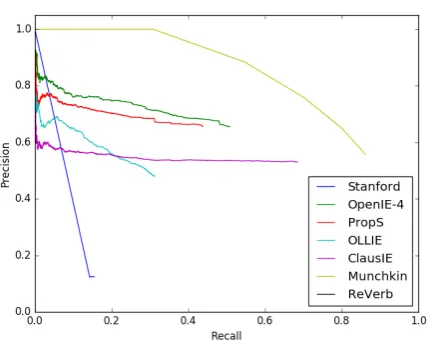
Figure 1: Performance metrics must take span preci-sion into account. The 25-line long Munchkin script returns variations of the full sentence (with decreas-ing confidence) and is not penalized by the evaluation script of the latest benchmark (Stanovsky and Dagan, 2016). Its superior performance is artificially inflated.
trivial system that "extracts" (w0;w1;w2...wn),
(w0;w1w2;w3...wn), etc., will be given an
un-fairly great score. We implemented that program (dubbed Munchkin) which predictably performed well above other genuine extraction systems, as pictured in Figure1.
2.3 RelVis benchmarking toolkit
Schneider et al. (2017) evaluate four systems (ClausIE, OpenIE 4, Stanford Open IE and Pred-Patt) against the two datasets mentioned above.5 They use two methods to match predicted and ref-erence tuples : “containment” and “relaxed con-tainment”. These methods mean that the predicted tuple must include the reference tuple, and that inclusion must happen for each argument, in the non-relaxed case. In the relaxed case, the bound-aries between parts of a tuple are ignored. Like that ofStanovsky and Dagan(2016), this scoring procedure doesn’t penalize systems for returning overlong spans.
2.4 Scoring
To compare facts with a reference, most authors require matching tuples to have the same num-ber of arguments and to share the grammatical head words of each part, e.g. Angeli and Man-ning(2013) and the article ofStanovsky and
Da-5Their code is announced but not available as of this
gan (2016). In their updated GitHub repository, Stanovsky and Dagan (2016) instead use lexical match : more than half of the words of a predicted tuple must match the reference for it to be correct. In contrast with these works and (Schneider et al., 2017), our scorer penalizes verbosity by measuring precision at the token level. We penal-ize the omission of parts of a reference tuple by gradually diminishing recall (at the token level), instead of a sharp all-or-nothing criterion.
Mesquita et al.(2013) annotate relations as one mandatory target plus some optional complemen-tary words, and treat arguments (named entities) in an ad-hoc fashion for OIE systems.
3 WiRe57
Open IE bears some similarity to the task of Se-mantic Role Labelling, as explored in (Christensen et al.,2011;Mesquita et al.,2013), and as demon-strated by SRLIE, a component of OpenIE 4.
In effect extracted tuples are akin to simplified PropBank6 or FrameNet7frames, and our annota-tions were inspired by those projects. Still, with a focus on extracting new relations at scale, optional arguments such as Propbank’s modifiers (ArgM) arediscouragedin OIE. Another major difference is the vocabulary of predicates being open to any relational phrase, rather than belonging to a closed curated list such as VerbNet. Within reason, OIE seeks to extract rich and precise relations phrases.
Phenomenon N %
All tuples 343 100
Anaphora 196 57
Contains inferred words 186 54
Hallucinated parts 135 39
Binary relations 254 74
n-ary,n= 3 72 21
n-ary,n= 4 16 5
n-ary,n= 5 1 0.3
[image:4.595.79.283.481.618.2]Inferred words 347/2597 13.4
Table 1: Frequencies of various phenomena in WiRe57.
3.1 Annotation process
A small corpus of 57 sentences taken from the be-ginning of 5 documents in English was used as the
6propbank.github.io – (Kingsbury and Palmer,
2002)
7framenet.icsi.berkeley.edu – (Ruppenhofer
et al.,2005)
source text from which to extract tuples. Three documents are Wikipedia articles (Chilly Gonza-les, the EM algorithm, and Tokyo) and two are newswire articles (taken from Reuters, hence the Wi-Re name).
Two annotators (authors of this paper) first in-dependently extracted tuples from the documents, based on a first version of the annotation guide-lines which quickly proved insufficient to reach any significant agreement. The two sets of an-notations were then merged, and the guidelines rectified along the way in order to resolve the is-sues that arose. After merging, a quick test on a few additional sentences from a different doc-ument showed a much improved agreement, more than half of extractions matching exactly and the remaining missing a few details. The guidelines are detailed in the next sections.
3.2 Annotation principles
In keeping with past literature, our guiding princi-ples for the annotation were as follows.
The first, obvious purpose of extracted informa-tion is to beinformative.Fader et al.(2011) men-tion how extracting (Faust ; made ; a deal) in-stead of the correct (Faust ; made a deal with ; the devil) would be pointless. Further, anaphoric men-tions being so ubiquitous and being void of mean-ing outside the context of their original sentence, we resolve anaphora in our extractions.
Moreover and following (Stanovsky and Dagan, 2016), extracted tuples should each beminimal, in the sense that they should convey the smallest standalone piece of information, though that piece must be completely expressed. Thus, some facts must be extracted asn-ary relations.8 The MinIE system in particular addresses this issue and “min-imizes its extractions by identifying and removing parts that are considered overly specific”.
The annotation shall beexhaustive, in the sense of capturing as much of the information expressed in the text as possible. This is to measure absolute recall for a system, a notoriously difficult evalua-tion metric for Open IE.
This in turn raises the issue ofinference: some information is merely suggested by the text, rather than explicitly expressed, and should not be anno-tated. Light inference, in the form of reformula-tion, is helpful to make use of the information
ex-8Some systems — namely CSD-IE (Bast and Haussmann,
tracted, but full-fledged inference should be pro-cessed by a dedicated program, and is not part of the Open IE task. Because the concept of “light inference” is subjective, we propose in the guilines a few examples and counterexamples that de-lineate the limits between the two classes.
[image:5.595.72.293.317.509.2]Other authors mention this issue. From (Wu and Weld,2010) : “The extractor should produce one triple for every relation stated explicitly in the text, but is not required to infer implicit facts.” Stanovsky and Dagan(2016) say: “an Open IE ex-tractor should produce the tuple (John; managed to open; the door) but is not required to produce the extraction (John; opened; the door)”. In our resource we do also annotate (John; [opened]; the door), marking the reworded relation as inferred (which in turn makes it optional to find when scor-ing).
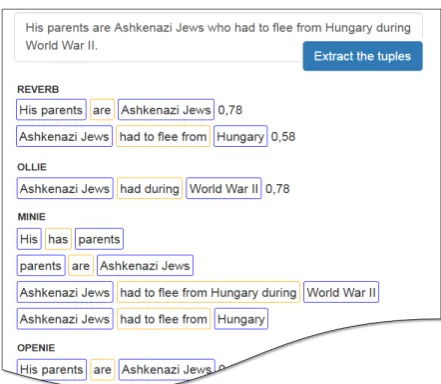
Figure 2: Example output of evaluated OIE systems, on sentence CH 7. This cropped screenshot is of a in-house web application that allows us to submit any sen-tence for tuple extraction and to visualize the results.
3.3 Annotation guidelines9
Extracted tuples should reflect all meaningful rela-tionships found in the source text. Typically, this means that there are multiple tuples for a given sentence. A number of times, two arguments are connected in a sentence but the relation that links them is implicit (e.g. Paris, France ; the North Atlantic Treaty Organization (NATO);the Nature paper orthe Turing paper, etc.). In this case, we
9We share athttps://github.com/rali-udem/
WiRe57 our annotation guidelines. We present its major points here.
Sentence CH 7 –“His parents are Ashkenazi Jews who had to flee from Hungary during World War II.”
Annotations
– (His/(Chilly Gonzales’s) parents ; are ; Ashkenazi Jews) – (His/(Chilly Gonzales’s) parents ; are ; Jews)
– (His/(Chilly Gonzales’s) parents ; had to flee from ; Hungary ; during World War II) – (His/(Chilly Gonzales’s) parents ; [fled] from ; Hungary ;
during World War II) – ([Chilly Gonzales] ; [has] ; parents)
Sentence EM 5 –“They pointed out that the method had been ‘proposed many times in special circumstances’ by earlier authors.”
Annotations
– (They/(Arthur Dempster, Nan Laird, and Donald Rubin) ; pointed out that ;
(the method)/(The EM algorithm) had been "proposed many times in special circumstances" by earlier authors) – ((the method)/(The EM algorithm) ; had been proposed by; earlier authors ; in special circumstances) [attributed] – (earlier authors ; proposed ; (the method)/(The EM
algorithm) ; in special circumstances) [attributed]
Sentence FI 2 –“A police statement did not name the man in the boot, but in effect indicated the traveler was State Secre-tary Samuli Virtanen, who is also the deputy to Foreign Min-ister Timo Soini.”
Annotations
– (A police/(Finnish police) statement ; did not name ; (the man in the boot)/(Samuli Virtanen)) – ((the man in the boot)/(Samuli Virtanen) ; was ;
Samuli Virtanen) [attributed]
– ((the traveler)/(Samuli Virtanen) ; was ; Samuli Virtanen) [attributed] – (Samuli Virtanen ; [is] ; State Secretary)
– (Samuli Virtanen ; is ; the deputy to Foreign Minister Timo Soini) – (Samuli Virtanen ; is ; [a] deputy)
– (Timo Soini ; [is] ; Foreign Minister) – (Timo Soini ; [has] ; [a] deputy)
Sentence CE 4 –“The International Monetary Fund, for ex-ample, saw 2017 global growth at 3.4 percent with advanced economies advancing 1.8 percent.”
Annotations
– (The International Monetary Fund ; saw ; 2017 global growth ; at 3.4 percent) – (The International Monetary Fund ; saw ; advanced
economies ; advancing 1.8 percent ; [in] 2017) – (2017 global growth ; [was] ; 3.4 percent)
– (advanced economies ; [advanced] ; 1.8 percent ;
[in] 2017) [attributed]
Figure 3: Sample annotations from WiRe57, from four of the documents. Reformulated words are enclosed in [brackets] and coreference information is indicated with forward slashes and parentheses.
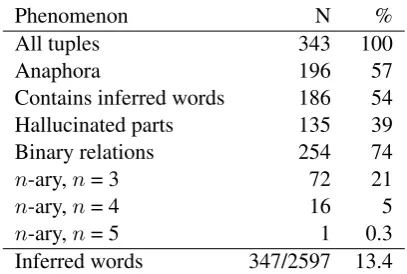
annotate a somewhat arbitrary relationship (such as is in, stands for, published in and published by respectively), the tokens of which are thus in-ferred. This is the case for 39% of our tuples.
halluci-nate some or part of relations. Notably, ClausIE wrongly extracts (New Delhi ; is ; India), and MinIE gets right (Paris ; is in ; France). Ollie adds some “be” auxiliaries to otherwise nominal relations, as inBarack Obama, former president of the United States, [. . . ], which OpenIE 4 also in-fers. Yet, we acknowledge that most work in Open IE rely on explicit predicate tokens as in (Mesquita et al., 2013), and don’t try to elicit relations fur-ther. At scoring time, systems are not penalized for not finding inferred words, or not finding in-ferred relations. If the whole predicate of a tuple is inferred, a predicted tuple is scored on its token overlap with the arguments only.
We suggest “platinum” annotations, including inferred words, to be a very high standard for extractors, while the gold standard for the task, recall-wise, is based only on words found in the original sentences.
Noun phrases can be rich in elements of infor-mation. To solve the problem of finding the gran-ularity level to use when including argument NPs, we extract two tuples, one as generic as possible and the other as specific as possible, for the same relation. Adjectives and other elements of mean-ing that can be easily separated from the noun phrase to create other tuples are so split. Only ele-ments that cannot be separated become part of the most specific noun phrase.
For instance, the sentence “Solo Piano is a great album of classical piano compositions” would yield 3 tuples : the split adjective (Solo Pi-ano ; is ; great), the generic (Solo Piano ; is ; [an] album) and the specific (Solo Piano ; is ; [an] al-bum of classical piano compositions).
When predicates contain nouns or other ele-ments (e.g. Tokyo is the capital of Japan.), we annotate the richer relationship (Tokyo ; is the cap-ital of ; Japan) rather than the more basic (Tokyo ; is ; the capital of Japan). This allows tuple re-lations to be more meaningful, and more easily compared, clustered, and aggregated with other re-lations. This also is in line with ReVerb.
Like ClausIE and other extractors since, we split conjunctions : “Andrea lived in both Poland and Italy” yields both (Andrea ; lived in ; Poland) and (Andrea ; lived in ; Italy).
3.4 Resource
A sample of annotations is pictured in Figure 3. The occurring frequency of various phenomena is
presented in Table1. Our resource is comprised of 343 relational facts (or tuples), three quarters of them binary relations. One in five have three argu-ments, sometimes “two objects” as in (This perfor-mance ; has made ; some economists ; optimistic) or more frequently a complement as in (His par-ents ; had to flee ; from Hungary ; during World War II). Five percent of them have four arguments or more : for instance (Tokyo ; ranked ; third ; in the International Financial Centres Development IndexEdit ; twice) and (The International Mone-tary Fund ; saw ; advanced economies ; advanc-ing 1.8 percent ; [in] 2017).
We found (and resolved) anaphoric phrases in more than half the tuples, as in (Emperor Meiji ; moved ; his/(Emperor Meiji’s) seat ; to (the city)/Tokyo ; from the old capital of Kyoto ; in 1868). The released dataset contains the raw and anaphora-resolved argument spans.
When solely extracting words from the sentence would not yield clear factual tuples, we reworded or adapted the text into more explicit statements. In this case, we explicitly marked the changed (or added) words as inferred (they are bracketed in Figure3). For instance in sentence CE 4, the rela-tion “[advanced]” was reformulated from the sen-tence word “advancing”, and the word [in] was added before “2017”. In the resource, each token is accompanied by its index in the sentence if it comes from it, or the “inferred” mark. Inferred words represent 13% of the lot but affect 54% of the tuples.
3.5 Inter-annotator agreement
# tokens 1↔2 1↔R 2↔R
Sentence 1 24 84.4 90.6 93.8
Sentence 2 19 98.7 98.7 100
Sentence 3 33 78.0 90.9 85.6
Average 85.2 92.8 91.9
Table 2: Inter-annotator agreement. Percentage of agreement on the labelling of each sentence token as belonging to 4 classes. Each annotator’s original pro-duction differs only slightly from the agreed-on result (columns 1↔R and 2↔R), and the disagreement be-tween both annotators is slightly larger (column 1↔2). The average is computed token-wise.
settled, three additional sentences from one of the documents were annotated by two annotators (1 and 2) in order to quantitatively measure inter-annotator agreement. Afterward, annotation dis-crepancies were resolved in cases of disagreement to produce a merged reference (R). Here, we re-port the agreement between the two original anno-tations (1↔2), and between each original annota-tion and the merged reference (1↔R and 2↔R).
Comparing triples can become quite tricky for many reasons, including missing complements, overlapping spans, etc. We therefore resorted to another scheme, where we reframe the annotation task as taking each annotated token and classify-ing it as either belongclassify-ing or not belongclassify-ing to each of 4 classes (subject, relation, object, or comple-mentary argument). These classifications can be trivially derived from the triples produced before-hand. For instance, a triple(t1t2;t3;t4t5)implies that the annotator classified tokenst1andt2as be-longing to the subject class. It then becomes pos-sible to measure an agreement percentage on the full binary labelling grid (obtained automatically from the long-form annotations). We believe the resulting figures (shown in Table 2) aptly reflect the level of overall agreement between the anno-tators, despite the minimal sample size. We mea-sure an overall inter-annotator agreement (1↔2) of 85.2% for the three sentences.
Qualitatively, one annotator steered close to the sentence syntax, sometimes missing some of the meaning obscured by long-winded formulations. The other annotator tended to be overly specific, including some non-essential complements, and making longer-ranged inferences that fall out of the scope of this task. Some possessive and pas-sive constructions were also overlooked.
4 Evaluation of Existing Systems
4.1 Scorer
An important step when measuring extractors’ performances is the scoring process. Matching a system’s output to a reference is not trivial. As detailed in Section 2.2, because it didn’t penal-ize overlong extractions, we could game the ba-sic evaluation method of the QA-SRL OIE bench-mark with a trivial extractor.
Our scorer computes precision and recall of a system’s predicted tuples at the token level. Pre-cision is, briefly put, the proportion of extracted words that are found in the reference. Recall is
the proportion of reference words found in the sys-tems’ predictions.
More formally, letG={g1, g2, . . . , gN}be the
gold tuples, andTsys ={t1, t2, . . . , tn}a system’s
extractions. We denote the parts of a tuple t = (ta1;tr;ta2;ta3;. . .) = (tpk)
k∈[1,6], where p1 is the first argument, p2 is the relation, etc., up to
p6 the fifth argument when it exists (no reference tuple contains more than 5 arguments). Lettpi ∩gpj
be the subset of words shared by partstpi andgjp, where parts are considered as bags of words. The length of a tuple is the sum of lengths of its parts, i.e.|ti|=|tia1|+|tri|+|t
a2
i |+|t a3
i |+· · ·= P
k|t pk
i |.
A predicted tupletimay match a reference tuple
gjfrom the same sentence if they share at least one
word from each of the relation, first and second arguments, that is iff(wa1, wr, wa2)exist such that
w1∈gaj1∩tia1, wr∈gjr∩tirandw2 ∈gja2 ∩tai2. For all tuple pairs that may match, we have the matching scores:
precision(ti, gj) = P
k|t pk
i ∩g pk
j |
|ti|
recall(ti, gj) = P
k|t pk
i ∩g pk
j |
|gj|
F1 = 2p r p+r.
We match predicted tuples with reference ones by greedily removing from the potential match pool the pair with maximum F1 score, until no remaining tuples match. Let m(.) be the match-ing function such thatti matches withgm(i) (and converselytm(j)matchesgj), assuming that|ti∩
gm(i)|= 0if there is no match forti.
Hence, the overall performance metrics of an extractor are its token-weighted precision and re-call over all tuples, i.e.
precisionsys=
n X
i
P k|t
pk
i ∩g pk
m(i)|
Pn i |ti|
recallsys= N X
j
P k|t
pk
m(j)∩g
pk
j |
PN j |gj|
F1sys=
2psysrsys
psys+rsys
.
Extractions Matches Exact matches
Prec. of matches
Recall of
matches Prec. Recall F1
ReVerb (Fader et al.,2011) 79 54 13 .83 .77 .569 .121 .200
Ollie (Mausam et al.,2012) 145 74 8 .73 .81 .347 .175 .239
ClausIE(Del Corro and Gemulla,2013) 223 121 24 .74 .84 .401 .298 .342 Stanford (Angeli et al.,2015) 371 99 2 .79 .65 .210 .188 .198
OpenIE 4 (Mausam,2016) 101 74 5 .68 .84 .501 .182 .267
[image:8.595.83.523.62.184.2]PropS (Stanovsky et al.,2016) 184 69 0 .59 .80 .222 .162 .187 MinIE (Gashteovski et al.,2017) 252 134 10 .75 .83 .400 .323 .358
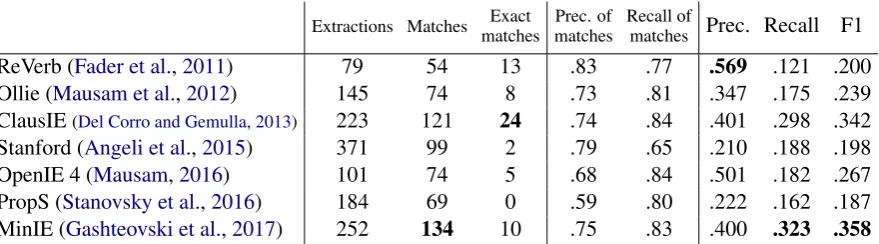
Table 3: Performance of available OpenIE systems (in chronological order) on our reference. Precision and recall are computed at the token level. Systems with lower precision of matches are penalized for producing overlong tuples. High precision and recall of matches overall show that our matching function (one shared word in each of the first three parts) works correctly. Inferred words are required for exact matches.
the coreference information are used in this evalu-ation (gj is the non-resolved version of the tuple,
and inferred words are not included in recall de-nominators). Future work can look into evaluating OIE systems that mean to resolve anaphoras.
4.2 Results
In order to experiment with the 7 systems used in this paper, we bundled them as a web service. A client application need only submit a sentence and a list of OIE system names to perform extraction. All tuples are in turn served as uniform JSON ob-jects, no matter the OIE system used. This facili-tates the development of clients, shielded from the various tuple formats, coding languages, and other quirks of the OIE systems. It also allowed us to vi-sualize the tuples using a web application (see Fig-ure2). Moreover, because the various extractors run as servers, they load their respective resources only once, when the service is launched, and are then always quick to respond to a given extraction task (a few seconds). Otherwise, the user would have had to wait a few minutes for the resources to load each time when querying the extractors.
While creating such a framework is a signif-icant effort, it ultimately saved us a lot of time when writing the clients. It also provided a com-mon frame of reference for all collaborators in our lab. Typically, we used the default configuration for each OIE system, but we tweaked the avail-able flags in order to favor exhaustiveness, when such flags were present and properly documented. When additional information did not fit into a tra-ditional tuple (arg1; rel; arg2), e.g. MinIE’s quan-tities, we resorted to simple schemes to faithfully cast that information into a tuple.
Table3details the performance of available OIE
systems against our reference. MinIE produces a large number of correct tuples, and performs best, especially recall-wise. The conservative choices made by ReVerb achieve a relatively high preci-sion, though it lacks in comprehensiveness. Ollie improves recall over ReVerb, and Open IE 4 im-proves precision over Ollie. Stanford Open IE pro-duces a very large number of tuples, hindering its precision (it is possible that limiting its verbose-ness through configuration would improve this).
5 Conclusion
In this paper, we set out to create additional re-sources useful to researchers in Open Information Extraction. We distribute these resources freely.
Primarily, we provide a manually crafted, tenta-tive reference for the task. It consists of 343 man-ually extracted facts, including some implicit re-lations, over 57 sentences. A quarter of them are
n-ary relations and coreference information is in-cluded in over half of them. We believe that such a benchmark is valuable because it offers a com-mon frame of reference allowing OIE systems to be tested and compared fairly, a task we carried out on 7 OIE systems. This also entailed the cre-ation of a scoring algorithm and program, which we release along with the data. We assess the Re-Verb, Ollie, ClausIE, Stanford Open IE, OpenIE 4, PropS, and MinIE systems against our reference, using a fine-grained token-level scorer. We find the MinIE system to perform best.
clear to yield an annotated dataset with a rea-sonable inter-annotator agreement. At the same time, we believe they are not too overwrought, and rather invite further contributions by other re-searchers. The thorniest issues are the fine line between useful reformulation of information to a canonical form and ill-advised inference, and how to trim and annotate complex noun-phrase argu-ments. These difficulties can affect the manual an-notation process, and, interestingly, are also likely to arise when building OIE systems, which is the ultimate goal in this research field after all.
References
Gabor Angeli and Christopher D. Manning. 2013. Philosophers are mortal: Inferring the truth of un-seen facts. InProceedings of the Seventeenth Con-ference on Computational Natural Language Learn-ing, CoNLL 2013, Sofia, Bulgaria, August 8-9, 2013, pages 133–142. ACL.
Gabor Angeli, Melvin Johnson Premkumar, and Christopher D. Manning. 2015. Leveraging linguis-tic structure for open domain information extraction. InACL.
Hannah Bast and Elmar Haussmann. 2013. Open infor-mation extraction via contextual sentence decompo-sition. InSemantic Computing (ICSC), 2013 IEEE Seventh International Conference on, pages 154– 159. IEEE.
Nikita Bhutani, H V Jagadish, and Dragomir Radev. 2016. Nested propositions in open information ex-traction. InProceedings of the 2016 Conference on Empirical Methods in Natural Language Process-ing, pages 55–64. Association for Computational Linguistics.
Janara Christensen, Mausam, Stephen Soderland, and Oren Etzioni. 2011. An analysis of open informa-tion extracinforma-tion based on semantic role labeling. In Proceedings of the Sixth International Conference on Knowledge Capture, K-CAP ’11, pages 113–120, New York, NY, USA. ACM.
Luciano Del Corro and Rainer Gemulla. 2013. Clausie: Clause-based open information extraction. In Pro-ceedings of the 22Nd International Conference on World Wide Web, WWW ’13, pages 355–366, Re-public and Canton of Geneva, Switzerland. Interna-tional World Wide Web Conferences Steering Com-mittee.
Anthony Fader, Stephen Soderland, and Oren Etzioni. 2011. Identifying relations for open information ex-traction. In Proceedings of the Conference on Em-pirical Methods in Natural Language Processing, EMNLP ’11, pages 1535–1545, Stroudsburg, PA, USA. Association for Computational Linguistics.
Anthony Fader, Luke Zettlemoyer, and Oren Etzioni. 2014. Open question answering over curated and extracted knowledge bases. InProceedings of the 20th ACM SIGKDD International Conference on Knowledge Discovery and Data Mining, KDD ’14, pages 1156–1165, New York, NY, USA. ACM.
Kiril Gashteovski, Rainer Gemulla, and Luciano Del Corro. 2017. Minie: Minimizing facts in open information extraction. InProceedings of the 2017 Conference on Empirical Methods in Natural Lan-guage Processing, pages 2630–2640. Association for Computational Linguistics.
Luheng He, Mike Lewis, and Luke Zettlemoyer. 2015. Question-answer driven semantic role labeling: Us-ing natural language to annotate natural language. In Proceedings of the 2015 Conference on Empiri-cal Methods in Natural Language Processing, pages 643–653. Association for Computational Linguis-tics.
Paul Kingsbury and Martha Palmer. 2002. From tree-bank to proptree-bank. InLanguage Resources and Eval-uation.
Mausam, Michael Schmitz, Robert Bart, Stephen Soderland, and Oren Etzioni. 2012. Open language learning for information extraction. In Proceed-ings of Conference on Empirical Methods in ral Language Processing and Computational Natu-ral Language Learning (EMNLP-CONLL).
Mausam Mausam. 2016. Open information extraction systems and downstream applications. In Proceed-ings of the Twenty-Fifth International Joint Con-ference on Artificial Intelligence, IJCAI’16, pages 4074–4077. AAAI Press.
Filipe Mesquita, Jordan Schmidek, and Denilson Bar-bosa. 2013. Effectiveness and efficiency of open re-lation extraction. InProceedings of the 2013 Con-ference on Empirical Methods in Natural Language Processing, pages 447–457. Association for Com-putational Linguistics.
Bhavana Dalvi Mishra, Niket Tandon, and Peter Clark. 2017. Domain-targeted, high precision knowledge extraction. TACL, 5:233–246.
Josef Ruppenhofer, Michael Ellsworth, Miriam R. L. Petruck, Christopher R. Johnson, and Jan Schef-fczyk. 2005. FrameNet II: Extended theory and practice. Technical report, ICSI.
Swarnadeep Saha, Harinder Pal, and Mausam. 2017. Bootstrapping for numerical open IE. In Proceed-ings of the 55th Annual Meeting of the Association for Computational Linguistics, ACL 2017, Vancou-ver, Canada, July 30 - August 4, Volume 2: Short Papers, pages 317–323. Association for Computa-tional Linguistics.
Proceedings of the First Workshop on Building Lin-guistically Generalizable NLP Systems, pages 11– 18. Association for Computational Linguistics.
Stephen Soderland, John Gilmer, Robert Bart, Oren Et-zioni, and Daniel S. Weld. 2013. Open informa-tion extracinforma-tion to KBP relainforma-tions in 3 hours. In Pro-ceedings of the Sixth Text Analysis Conference, TAC 2013, Gaithersburg, Maryland, USA, November 18-19, 2013. NIST.
Gabriel Stanovsky and Ido Dagan. 2016. Creating a large benchmark for open information extraction. In Proceedings of the 2016 Conference on Em-pirical Methods in Natural Language Processing (EMNLP), Austin, Texas. Association for Compu-tational Linguistics.
Gabriel Stanovsky, Ido Dagan, and Mausam. 2015. Open ie as an intermediate structure for semantic tasks. In Proceedings of the 53rd Annual Meet-ing of the Association for Computational LMeet-inguis- Linguis-tics and the 7th International Joint Conference on Natural Language Processing (Volume 2: Short Pa-pers), pages 303–308, Beijing, China. Association for Computational Linguistics.
Gabriel Stanovsky, Jessica Ficler, Ido Dagan, and Yoav Goldberg. 2016. Getting more out of syntax with props. CoRR, abs/1603.01648.
Fei Wu and Daniel S. Weld. 2010. Open information extraction using wikipedia. In Proceedings of the 48th Annual Meeting of the Association for Com-putational Linguistics, ACL ’10, pages 118–127, Stroudsburg, PA, USA. Association for Computa-tional Linguistics.