warwick.ac.uk/lib-publications
Original citation:Engelis, Nikolaos, Anastasaki, Athina, Whitfield, Richard, Jones, Glen R., Liarou,
Evelina, Nikolaou, Vasiliki, Nurumbetov, Gabit and Haddleton, David M. (2018) Sequence-controlled methacrylic multiblock copolymers : expanding the scope of sulfur-free
RAFT. Macromolecules, 51 (2). pp. 336-342. doi:10.1021/acs.macromol.7b01987
Permanent WRAP URL:
http://wrap.warwick.ac.uk/98079
Copyright and reuse:
The Warwick Research Archive Portal (WRAP) makes this work by researchers of the University of Warwick available open access under the following conditions. Copyright © and all moral rights to the version of the paper presented here belong to the individual author(s) and/or other copyright owners. To the extent reasonable and practicable the material made available in WRAP has been checked for eligibility before being made available.
Copies of full items can be used for personal research or study, educational, or not-for profit purposes without prior permission or charge. Provided that the authors, title and full bibliographic details are credited, a hyperlink and/or URL is given for the original metadata page and the content is not changed in any way.
Publisher’s statement:
“This document is the Accepted Manuscript version of a Published Work that appeared in final form in Macromolecules. copyright © American Chemical Society after peer review and technical editing by the publisher.
To access the final edited and published work
http://pubs.acs.org/page/policy/articlesonrequest/index.html .”
A note on versions:
The version presented here may differ from the published version or, version of record, if you wish to cite this item you are advised to consult the publisher’s version. Please see the ‘permanent WRAP URL above for details on accessing the published version and note that access may require a subscription.
Sequence-controlled methacrylic multiblock copolymers:
expanding the scope of sulfur-free RAFT
Nikolaos G. Engelis† , Athina Anastasaki*†,, Richard Whitfield , Glen R. Jones, Evelina Liarou, Vasiliki
Nikolaou, Gabit Nurumbetov and David M. Haddleton*
University of Warwick, Chemistry Department, Library road, CV4 7AL, Coventry, United Kingdom.
†These authors contributed equally to this work.
Abstract
Sulfur-free reversible addition fragmentation transfer polymerization (SF-RAFT) in emulsion
allows access to the synthesis of sequence-controlled methacrylic multiblock copolymers.
Herein, we expand the scope of sulfur-free RAFT emulsion polymerization by utilizing four
different macrochain transfer agents (mCTA) to mediate the synthesis of diblocks and
sequence-controlled methacrylic multiblock copolymers. Upon varying the reaction conditions
(e.g. altering the type of catalyst and catalyst concentration), poly(methyl methacrylate) (pMMA), poly(butyl methacrylate) (pBMA), poly(ethyl methacrylate) (pEMA) and poly(benzyl
methacrylate) (pBzMA) of a similar Mn (~ 4,300 g mol-1) were successfully synthesized via
catalytic chain transfer polymerization (CCTP) in emulsion. The capability of these mCTAs to
act as macroinitiators was investigated through the synthesis of “in situ” diblock copolymers demonstrating excellent control over the molar masses. Under optimized conditions, pEMA,
pBzMA and pBMA mCTAs were then employed for the synthesis of deca and hexablock
multiblock copolymers with varying degrees of polymerization (DPn=10-50 per block, Mn, total=7,000-55,000 g mol-1) yielding well-defined complex materials with controlled molecular
Introduction
Nature is capable of achieving a high level of sequence control in the synthesis of
natural polymers such as DNA and proteins. In contrast, synthetic chemists are currently far
away from replicating this precision.1 Solid-state peptide synthesis (Merrifield synthesis)
remains a benchmark towards this target providing a reliable method for the synthesis of
precisely controlled macromolecules.2 However, this strategy is time consuming, challenging
to scale up and is also limited to lower molar masses and as such alternative strategies have
also been explored. It is also noted that a distribution of masses within a polymeric material is
often the most desirable property. Single monomer insertion,3-6 tandem monomer addition and
modification,7, 8 kinetic control,9, 10 segregating templating,11, 12 selected reactivities,13
sequential growth on soluble polymer supports and discrete oligomers strategies have
successfully been developed although also suffer from related issues (e.g. limited to low molecular weight oligomers).14-18
In contrast, sequence-controlled multiblock copolymers obtained through controlled
polymerization strategies offer a scalable and faster alternative allowing access to higher
molecular weight materials with a wide range of functionalities.1, 11, 19, 20 Whittaker and
co-workers reported the first example of one pot sequence-controlled acrylic multiblocks via
Cu(0)-wire reversible deactivation radical polymerization (RDRP).21 The same group
subsequently expanded the scope to include the synthesis of higher molecular weight and star
sequence-controlled multiblock copolymers.22, 23 Subsequently, Haddleton, Junkers and
co-workers introduced sequence-controlled multiblocks mediated by a light-mediated copper
polymerization.24-26 Finally, a novel approach exploiting the disproportionation of CuBr/Me 6
-Tren in water was employed to confer control over the synthesis of acrylamide based
multiblock copolymers.27 Aside from copper, traditional reversible addition-fragmentation
transfer (RAFT) polymerization has been employed by Perrier and co-workers yielding an
impressive icosablock copolymer consisting of various acrylamides.28-31 Very fast reaction
propagation rate constant of acrylamides. However, all these approaches suffer from two main
limitations. The first one is their incapability to polymerize low kp monomer families such as
methacrylates; this monomer category exhibits much slower polymerization rates than
acrylamides or acrylics, and is susceptible to more side reactions.32-36 The second drawback
is that the final multiblock copolymers are often contaminated by either copper or sulphur
residues which can induce undesired odour and potential toxicity in the final materials and
thus require time-consuming and relatively expensive purification methods or
post-polymerization modification strategies. Other limitations of these techniques include
somewhat high dispersity values, significant side reactions when water is employed as the
reaction medium,37 slow polymerization rates and non-quantitative conversions throughout the
sequential monomer additions.38-40, 22
Recently, our group reported the sequence-controlled methacrylic multiblock
copolymers via a sulphur-free RAFT (SF-RAFT) emulsion polymerization strategy.41 CCTP in
emulsion was initially employed to synthesize poly(methyl methacrylate) (PMMA)
macromonomers/mCTAs bearing a vinyl group at the ω-terminus. This macromonomer was
subsequently used as a mCTA to mediate the controlled polymerization of methacrylates
thanks to the susceptibility of the vinyl ω-end group to undergo radical addition resulting in the
formation of a macromonomer-ended polymer radical which can undergo β-scission
(addition/fragmentation).42 The latter reaction leads to a tertiary radical generated via
fragmentation of the adduct product.43 Subsequently, a new macromonomer/mCTA is formed
through combination of the initial growing radical with the vinyl end group of the initial
macromonomer. Importantly, the newly formed vinyl terminated polymer can act as a CTA
following the same reaction mechanism. Thus, the combination of CCTP and sulfur-free RAFT
allowed access to the scalable synthesis of sequence-controlled methacrylic multiblock
copolymers while maintaining very fast polymerization rates (~ 2-3 h per block), quantitative
However, only pMMA of Mn ~ 2,000 g mol-1 was used as the macromonomer/mCTA in this
work.
Herein, we expand the scope of SF-RAFT emulsion polymerization by synthesizing
four different macromonomers with a terminal vinyl group, pMMA, pEMA, pBMA and pBzMA
of comparable Mn (~ 4,000 g mol-1) via CCTP. Their capability to act as efficient chain transfer
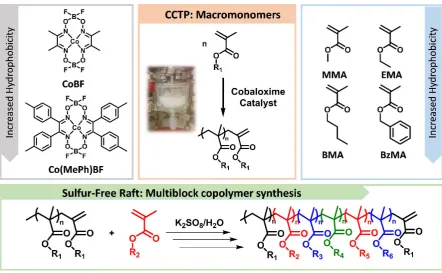
agents is investigated through the synthesis of diblocks and sequence-controlled multiblock
copolymers (Fig 1). Macromonomers of higher Mn are also be reported and compared with
[image:5.595.76.519.328.601.2]lower Mn analogues with the goal of revealing the potential and the limitations of this system.
Figure 1. Schematic diagram showing the concept of the synthesis of sequence-controlled
multiblock copolymers by the use of macromonomers as macro chain transfer agents (CTA).
Catalyst type and concentration are optimized as to provide macromonomers of the desired
Mn which subsequently serve as CTA in the free radical polymerization of methacrylic
Results and Discussion
Synthesis of macromonomers/macro chain transfer agents
Our initial target was to obtain various macromonomers of comparable Mn in order to
assess their capability to act as successful chain transfer agents. As previous studies focused
on Mn ~ 2,000 g mol-1 or even lower (e.g. dimers/trimers),45 we decided to target a constant
Mn of ~ 4,000 g mol-1 for all targeted macromonomers, namely pMMA, pEMA, pBMA and
pBzMA. In our recent publication, sequence-controlled methacrylic multiblock copolymers
using pMMA macromonomer (Mn ~ 2,000 g mol-1) were successfully demonstrated. In order
to achieve such low molecular weight pMMA, high concentrations of bis[(difluoroboryl)
dimethylglyoximato]cobalt(II) (CoBF) (104 ppm) were required.41 In agreement with our
previous report, all macromonomers were synthesized in a double-jacketed reactor (supplied
with a temperature detector and overhead stirrer) via CCTP emulsion polymerization. For the case of pMMA, lower concentration of CoBF was essential (42 ppm, Supplementary Table 1,
entry 1, Supplementary Fig 1) in order to achieve Mn ~ 4,300 g mol-1. The presence of the ω
-end group vinyl protons was confirmed by both 1H NMR and MALDI-ToF-MS (Supplementary
Fig 2), the latter showing a major polymer peak distribution identified as pMMA chains with a
proton α-chain end, thus confirming that initiation via H-transfer from CoIII complex is the
dominant mode of initiation, as suggested by the mechanism of CCTP (Supplementary Fig 3).
Under otherwise identical conditions (42 ppm of CoBF) the polymerization of EMA was then
attempted. However, a rather higher Mn was obtained (Mn ~ 7,000 g mol-1, Supplementary
Table 2, entry 1). In order to address this, higher concentrations of catalyst were investigated.
It was found that 65 ppm of CoBF allowed access to pEMA of Mn ~ 4,300 g mol-1
(Supplementary Table 1, entry 2, Supplementary Fig 4-5). These differences in catalyst
concentration required to achieve comparable molecular weights can be attributed to the
partition coefficient (mCo), which is equal to the ratio of the catalyst concentration in the
dispersed phase (monomer) to that in the aqueous phase (mCo = [Co]disp/[Co]aq) and differs for
transport of the catalyst between continuous and dispersed phase is required.47 Although
CoBF proved to be a very efficient catalyst for the polymerization of MMA and EMA, it is
insoluble in BMA and BzMA (in concentrations higher than 60 ppm). In order to circumvent
this, the more hydrophobic catalyst bis[(difluoroboryl) dimethylphenylglyoximato]cobalt(II)
(Co(MePh)BF) was used in place of CoBF (Figure 1). Under optimized conditions, pBMA and
pBzMA macromonomers (Supplementary Tables 3-4, Supplementary Fig 7, 9) of Mn ~ 4,200
g mol-1 and 4,400 g mol-1 were synthesized. For all macromonomers synthesized, 1H NMR
analysis confirmed full monomer conversion (>99%) and the existence of the vinyl group at
the ω-chain end. MALDI-ToF-MS also showed very high end group fidelity for all
macromonomers confirming the successful synthesis (Supplementary Fig 6, 8). Finally,
dynamic light scattering (DLS) was additionally employed showing that the particle size mainly
depends on the nature of the polymer targeted rather than the final Mn. It is noted, that latexes
generated upon the polymerization of BMA consisted of considerably smaller particles as
opposed to the other three monomers studied.
Synthesis of methacrylic diblock copolymers using PMMA, PEMA, PBMA and PBzMA
as macromonomers/macro chain transfer agents
After obtaining different macromonomers of comparable Mn the next step was to
assess their capability to mediate the polymerization of methacrylates. BMA was selected and
kinetics in the presence of pMMA were initially conducted targeting DPn=80 (monomer :
CTA=1:80). Samples were periodically taken from the reaction mixture and SEC showed a
gradual decrease of the dispersity from 1.55 (dispersity of pMMA macromonomer prior to BMA
addition) to Ð ~ 1.17 for the final diblock copolymer (Supplementary Table 5, Supplementary Fig 10). In a similar vein, pBMA macromonomer was also employed to polymerize BMA with
the kinetics exhibiting virtually identical behaviour and SEC showing a clear shift to higher
molecular weights and constantly decreasing dispersities (Supplementary Table 6,
Supplementary Fig 11). It is noted that although macromonomers of higher Mn than in previous
dispersity diblock copolymers were achieved. Having demonstrated a similar kinetic behaviour
for two different macromonomers, pEMA and pBzMA (Supplementary Table 7) were also
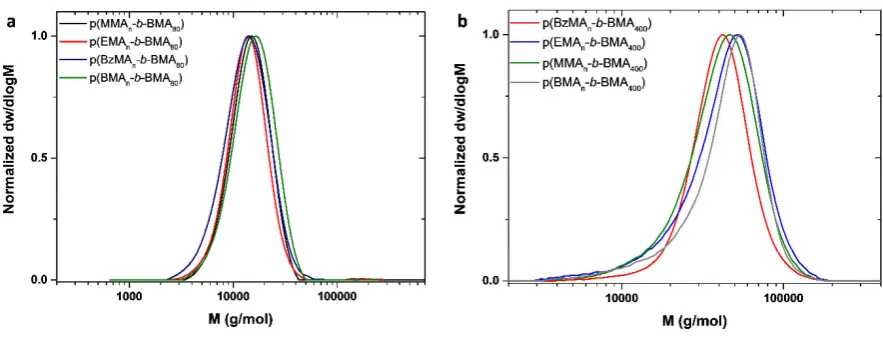
employed targeting DPn=80. All tested macromonomers were capable to successfully mediate
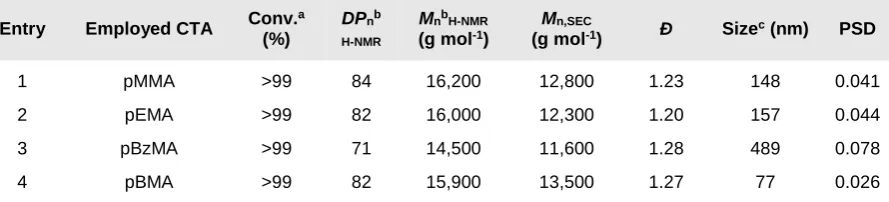
the polymerization of BMA yielding nearly identical diblock copolymers (Figure 2a) with low
dispersity values (<1.28) and reasonable agreement between theoretical and experimental
molar masses (Table 1). In particular, when pMMA and pEMA macromonomers were
employed, diblock copolymers with a final dispersity of 1.23 and 1.20 respectively were
obtained. For the case of pBMA and pBzMA slightly higher dispersities were achieved (Ð ~
1.27) (Table 1). To further probe the potential of the macromonomers in maintaining control
for higher molecular weights a more challenging diblock was targeted, aiming for DPn=400 of
BMA. Despite the higher targeted molecular weight, all macromonomers yielded
well-controlled polymers with dispersities as low as 1.17 and Mn ~ 60,000 g mol-1 (Figure 2b,
Supplementary Table 8). Thus, it was concluded that regardless the type of the
macromonomer used, SF-RAFT emulsion polymerization was unaffected allowing access to
well-defined diblock copolymers. Importantly, in all cases, full monomer conversion could be
achieved (>99%) suggesting that these macromonomers could be potentially used for more
complex targets such as sequence-controlled multiblock copolymers. It is also worth
mentioning that although deionized water was used for the aforementioned experiments, tap
water appeared to be equally efficient and no compromise over the dispersity or the control
over the polymerization was observed further highlighting the robustness of this system
[image:8.595.81.526.654.755.2](Supplementary Table 9, Supplementary Fig. 15).
Table 1. Synthesis and characterisation data for the diblock copolymers (DPn=80) synthesized
by the use of different CTAs
Entry Employed CTA Conv.
a
(%)
DPnb H-NMR
MnbH-NMR
(g mol-1)
Mn,SEC
(g mol-1) Ð Sizec (nm) PSD
1 pMMA >99 84 16,200 12,800 1.23 148 0.041
2 pEMA >99 82 16,000 12,300 1.20 157 0.044
3 pBzMA >99 71 14,500 11,600 1.28 489 0.078
[a]: Conversion was measured by diluting the polymer latex with a mixture of deuterated solvents
(chloroform/acetone=3/2) [b]: DPn and Mn by 1H-NMR were measured by dissolving the isolated polymer in
[image:9.595.76.518.267.436.2]deuterated chloroform [c]: Polymer particle size, expressed as hydrodynamic diameter, measured by DLS
Figure 2. a) SEC traces of molecular weight distributions for the diblock macromonomers formed by
different CTAs (DPn=80 BMA) b) SEC traces of molecular weight distributions for the diblock
macromonomers formed by different CTAs (DPn=400 BMA)
Synthesis of sequence-controlled methacrylic copolymers using pMMA, pEMA, pBMA
and pBzMA as macromonomers/chain transfer agents
The pBMA macromonomer (Mn=4,300 g mol-1, Ð ~ 1.91) was subsequently used as a
chain-transfer agent to facilitate the synthesis of multiblock copolymers, employing an initial
ratio of [CTA]:[monomer]:[initiator] = 1:10:0.03 and each block was designed to be DPn=10. It
is important to highlight that lower molecular weights were not targeted in order to limit the
proportion of missing blocks (percentage of defective chains) in the final multiblock copolymer,
completion of the monomer addition (BzMA) to the reaction mixture, the reaction was allowed
to proceed for one hour to ensure quantitative or near-quantitative conversion. Indeed, 1H
NMR spectroscopy confirmed very high conversion (>99%, Supplementary Fig 16) while SEC
showed a shift to higher molecular weights (Supplementary Fig 17). BMA was subsequently
added and when full conversion was reached a third monomer 2-ethylhexyl methacrylate
(EHMA) was then injected in the reaction mixture. This one pot sequential addition was
repeated ten times resulting in an undecablock copolymer (including the CTA) with Mn ~
20,200 g mol-1 and a final dispersity of 1.29 (Supplementary Tables 10-11). Throughout all the
monomer additions, the SEC distributions were monomodal, while 1H NMR indicated full
monomer conversion prior to the addition of the next block. Despite multiple chain extensions
control over the molecular weight was maintained throughout, highlighting the capacity of
pBMA to act as a very efficient chain transfer agents under sulfur-free RAFT emulsion
polymerization.
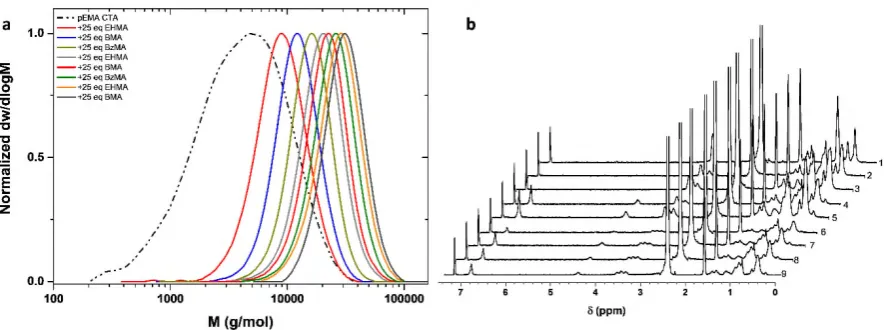
Figure 3. a) SEC traces of consecutive monomer additions for the preparation of the nonablock
copolymer (DPn=25 per block) utilizing pEMA macromonomer as CTA b) 1H-NMR spectra for
consecutive cycles during synthesis of the nonablock copolymer (values to the right indicate the
[image:10.595.78.523.447.612.2]Upon using pEMA (Mn=4,300 g mol-1, Ð ~ 1.9) as the macromonomer, a higher
targeted DPn was attempted (DPn=25 per block). Following addition of the first monomer, a
significant decrease in the dispersity was observed (Ð ~ 1.24) and the polymerization reached very high monomers conversions (>99%, Fig 3b) in less than two hours. After this time period,
a second monomer was added resulting in a further reduction on the dispersity (Ð ~ 1.20). The sequential inclusion of various monomers finally yielded a nonablock copolymer (including
the CTA) with a dispersity as low as 1.19 and a final Mn ~ 28,200 g mol-1 (Fig 3a,
Supplementary Tables 12-13). SEC confirmed complete shifts to higher molecular weights
throughout the monomer additions with the dispersity values being kept < 1.2 for the vast
majority of the monomer additions which is a remarkable achievement for such a complex
multiblock structure.
Finally, pBzMA was selected as the macromonomer (Mn=4,400 g mol-1, Ð ~ 1.78). As
high molecular weight multiblock copolymers could be of a potential interest for a wide range
of applications, including self-assembly in bulk and in solution, the technique was pushed to
reach its limits by targeting DPn=50 per block. Remarkably, and despite the increased size of
block, a well-defined octablock copolymer (or nonablock including the CTA) could be obtained
achieving Mn ~ 30,000 g mol-1 and a dispersity of 1.28 for the final multiblock copolymer
(Supplementary Tables 14-15, Supplementary Fig 18-19). From this data, it is apparent that
pBzMA can successfully mediate the synthesis of well-controlled multiblock copolymers.
Limitations of sulfur-free RAFT emulsion polymerization
We were also interested in exploring the limitations of this system. In our original
publication, pMMA of Mn ~2000 g mol-1 was employed and the dispersity was as low as ~1.12
after 4 monomer additions.41 In this work, we employed pMMA of higher M
n as CTA and as
such a pMMA of Mn of 11,700 g mol-1 was synthesized (Supplementary Table 16). However,
upon three monomer additions, a broad bimodal polymer peak distribution was observed by
(Supplementary Table 17, Supplementary Fig 20). Thus, pMMA of this Mn is not recommended
to be used as a CTA to facilitate the synthesis of multiblock copolymers. In order to further
confirm this limitation, two pBMA macromonomers were also compared. In the previous
section, pBMA of Mn ~ 4,300 g mol-1 was successfully synthesized and subsequently used as
CTA for the undecablock copolymer mentioned above. After four monomer additions the
dispersity of the pentablock copolymer was ~ 1.30 (Supplementary Table 11). However, when
a pBMA of a higher Mn (~ 7,200 g mol-1) was employed instead, after the same number of
additions a broader molecular weight distribution was observed (Ð ~ 1.45, Supplementary Fig 21, Supplementary Tables 18-19). Therefore, it is apparent that upon gradually increasing the
molecular weight of the CTA, a compromise of control over the molecular distribution takes
place as the number of chains with vinyl ω-end-group is reduced as a result of conventional
free radical termination events. Apart from MMA, EMA, BzMA and BMA, different types of
monomers were considered. Extremely hydrophobic monomers such as lauryl methacrylate
(LMA) or isobutyl methacrylate (iBMA) are known for not being able to be successfully applied
in emulsion polymerization.49 Nevertheless, the polymerization of iBMA (DP
n=80) in the
presence of a pMMA CTA produced a diblock copolymer with a dispersity broader than that
obtained when BMA was polymerized (1.26>1.23, Supplementary Tables 20, Supplementary
Fig 22). However, by SEC analysis, a shoulder towards lower molecular weight is evidenced.
Thus, such monomers are not ideal to polymerize under our current conditions. Moreover,
polymerization of trifluoroethyl methacrylate (TFEMA) was also attempted. Notably, due to the
low boiling point of this monomer (59 °C), the reaction took place at a temperature lower than
usually (55<80 °C). Although no phase separation was observed, SEC analysis suggests that
TFEMA did not polymerize as there was no clear shift on the SEC trace (Supplementary Fig
23, Supplementary Table 21). Although this appears to be the current limitation of this
approach, studies within the group are currently conducted aiming to allow access to the
synthesis of a broader range of materials. However, this will be the subject of a forthcoming
Conclusions
In summary, the scope of sequence-controlled methacrylic multiblock copolymers via
sulfur-free RAFT was expanded to include a range of chain transfer agents including pMMA,
pEMA, pBMA and pBzMA. The synthesis of the macromonomers was successful by either
changing the catalyst type and/or optimizing the catalyst concentration. Subsequently all
macromonomers were shown to efficiently catalyse the synthesis of sequence-controlled
methacrylic multiblock copolymers consisting of both lower and higher targeted degrees of
polymerization per block. Importantly, all multiblocks were synthesized in one pot via
sequential monomer additions achieving very high monomer conversions and narrow molar
mass distributions. In addition, both lower and higher Mn macromonomers were employed for
the synthesis of complex multiblocks with the lower Mn ones achieving much higher efficiency
thus highlighting the potential and the limitations of this system.
Acknowledgements Financial support from the University of Warwick (N.G.E., A.A., R.W., G.R.J., E.L.,
V.N. and G.N.), the Lubrizol Corporation (N.G.E., V.N. and G.R.J.) and Syngenta (R.W.) is gratefully
acknowledged. A.A. acknowledges the Global Marie Curie Fellowship (BINAMA 705041) for financial
support. Supporting Information The Supporting Information is available free of charge on the ACS
Publications website
This project has received funding from the European Union’s Horizon 2020 and innovation programme under the Marie Sklodowska-Curie grant agreement No 705041.
References
1. J.-F. Lutz, Polymer Chemistry, 2010, 1, 55-62.
3. S. Ida, T. Terashima, M. Ouchi and M. Sawamoto, Journal of the American Chemical Society, 2009, 131, 10808-10809.
4. M. Zamfir and J.-F. Lutz, Nature Communications, 2012, 3, 1138.
5. J. Vandenbergh, G. Reekmans, P. Adriaensens and T. Junkers, Chemical Science, 2015, 6, 5753-5761.
6. J. Vandenbergh, G. Reekmans, P. Adriaensens and T. Junkers, Chemical Communications, 2013, 49, 10358-10360.
7. K. Nakatani, Y. Ogura, Y. Koda, T. Terashima and M. Sawamoto, Journal of the American
Chemical Society, 2012, 134, 4373-4383.
8. S. Ida, M. Ouchi and M. Sawamoto, Journal of the American Chemical Society, 2010, 132, 14748-14750.
9. S. Pfeifer and J.-F. Lutz, Journal of the American Chemical Society, 2007, 129, 9542-9543. 10. Y. Guo, J. Zhang, P. Xie, X. Gao and Y. Luo, Polymer Chemistry, 2014, 5, 3363-3371. 11. N. Badi and J.-F. Lutz, Chemical Society Reviews, 2009, 38, 3383-3390.
12. R. McHale, J. P. Patterson, P. B. Zetterlund and R. K. O'Reilly, Nat Chem, 2012, 4, 491-497. 13. M. Minoda, M. Sawamoto and T. Higashimura, Macromolecules, 1990, 23, 4889-4895. 14. M. Ueda, Progress in polymer science, 1999, 24, 699-730.
15. E. Bayer and M. Mutter, 1972.
16. J. C. Barnes, D. J. C. Ehrlich, A. X. Gao, F. A. Leibfarth, Y. Jiang, E. Zhou, T. F. Jamison and J. A. Johnson, Nat Chem, 2015, 7, 810-815.
17. J. Lawrence, S.-H. Lee, A. Abdilla, M. D. Nothling, J. M. Ren, A. S. Knight, C. Fleischmann, Y. Li, A. S. Abrams, B. V. K. J. Schmidt, M. C. Hawker, L. A. Connal, A. J. McGrath, P. G. Clark, W. R. Gutekunst and C. J. Hawker, Journal of the American Chemical Society, 2016, 138, 6306-6310. 18. B. van Genabeek, B. F. M. de Waal, M. M. J. Gosens, L. M. Pitet, A. R. A. Palmans and E. W.
Meijer, Journal of the American Chemical Society, 2016, 138, 4210-4218. 19. J.-F. Lutz, M. Ouchi, D. R. Liu and M. Sawamoto, Science, 2013, 341.
20. M. Ouchi, N. Badi, J.-F. Lutz and M. Sawamoto, Nat Chem, 2011, 3, 917-924.
21. A. H. Soeriyadi, C. Boyer, F. Nyström, P. B. Zetterlund and M. R. Whittaker, Journal of the
American Chemical Society, 2011, 133, 11128-11131.
22. C. Boyer, A. H. Soeriyadi, P. B. Zetterlund and M. R. Whittaker, Macromolecules, 2011, 44, 8028-8033.
23. C. Boyer, A. Derveaux, P. B. Zetterlund and M. R. Whittaker, Polymer Chemistry, 2012, 3, 117-123.
24. A. Anastasaki, V. Nikolaou, G. S. Pappas, Q. Zhang, C. Wan, P. Wilson, T. P. Davis, M. R. Whittaker and D. M. Haddleton, Chemical Science, 2014, 5, 3536-3542.
25. A. Anastasaki, V. Nikolaou, N. W. McCaul, A. Simula, J. Godfrey, C. Waldron, P. Wilson, K. Kempe and D. M. Haddleton, Macromolecules, 2015, 48, 1404-1411.
26. Y.-M. Chuang, A. Ethirajan and T. Junkers, ACS Macro Letters, 2014, 3, 732-737.
27. F. Alsubaie, A. Anastasaki, P. Wilson and D. M. Haddleton, Polymer Chemistry, 2015, 6, 406-417.
28. G. Gody, T. Maschmeyer, P. B. Zetterlund and S. Perrier, Nat Commun, 2013, 4.
29. G. Gody, T. Maschmeyer, P. B. Zetterlund and S. Perrier, Macromolecules, 2014, 47, 639-649. 30. G. Gody, M. Danial, R. Barbey and S. Perrier, Polymer Chemistry, 2014.
31. G. Gody, T. Maschmeyer, P. B. Zetterlund and S. Perrier, Macromolecules, 2014, 47, 3451-3460.
32. A. P. Haehnel, M. Schneider-Baumann, K. U. Hiltebrandt, A. M. Misske and C. Barner-Kowollik,
Macromolecules, 2013, 46, 15-28.
33. J. M. Asua, S. Beuermann, M. Buback, P. Castignolles, B. Charleux, R. G. Gilbert, R. A. Hutchinson, J. R. Leiza, A. N. Nikitin, J.-P. Vairon and A. M. van Herk, Macromolecular
34. S. Beuermann, M. Buback, T. P. Davis, R. G. Gilbert, R. A. Hutchinson, A. Kajiwara, B. Klumperman and G. T. Russell, Macromolecular Chemistry and Physics, 2000, 201, 1355-1364. 35. S. Beuermann, M. Buback, T. P. Davis, R. G. Gilbert, R. A. Hutchinson, O. F. Olaj, G. T. Russell, J. Schweer and A. M. van Herk, Macromolecular Chemistry and Physics, 1997, 198, 1545-1560. 36. S. M. Chin, H. He, D. Konkolewicz and K. Matyjaszewski, Journal of Polymer Science Part A:
Polymer Chemistry, 2014, 52, 2548-2555.
37. F. Alsubaie, A. Anastasaki, P. Wilson and D. M. Haddleton, Polymer Chemistry, 2015, 6, 406-417.
38. A. Anastasaki, C. Waldron, P. Wilson, C. Boyer, P. B. Zetterlund, M. R. Whittaker and D. Haddleton, Acs Macro Letters, 2013, 2, 896-900.
39. A. Anastasaki, V. Nikolaou, G. S. Pappas, Q. Zhang, C. Wan, P. Wilson, T. P. Davis, M. R. Whittaker and D. M. Haddleton, Chemical Science, 2014.
40. A. Anastasaki, V. Nikolaou, N. W. McCaul, A. Simula, J. Godfrey, C. Waldron, P. Wilson, K. Kempe and D. M. Haddleton, Macromolecules, 2015, 48, 1404-1411.
41. N. G. Engelis, A. Anastasaki, G. Nurumbetov, N. P. Truong, V. Nikolaou, A. Shegiwal, M. R. Whittaker, T. P. Davis and D. M. Haddleton, Nat Chem, 2017, 9, 171-178.
42. D. M. Haddleton, D. R. Maloney and K. G. Suddaby, Macromolecules, 1996, 29, 481-483. 43. L. Hutson, J. Krstina, C. L. Moad, G. Moad, G. R. Morrow, A. Postma, E. Rizzardo and S. H.
Thang, Macromolecules, 2004, 37, 4441-4452.
44. A. Bakac and J. H. Espenson, Journal of the American Chemical Society, 1984, 106, 5197-5202. 45. C. L. Moad, G. Moad, E. Rizzardo and S. H. Thang, Macromolecules, 1996, 29, 7717-7726. 46. K. G. Suddaby, D. M. Haddleton, J. J. Hastings, S. N. Richards and J. P. O'Donnell,
Macromolecules, 1996, 29, 8083-8091.
47. J. P. A. Heuts and N. M. B. Smeets, Polymer Chemistry, 2011, 2, 2407-2423. 48. G. Gody, P. B. Zetterlund, S. Perrier and S. Harrisson, Nat Commun, 2016, 7.