© 2019, IRJET | Impact Factor value: 7.211 | ISO 9001:2008 Certified Journal
| Page 1423
STUDY & ANALYSIS OF SUBCONTRACTING PRACTICES IN
INFRASTRUCTURE PROJECT
Miss. Sanjivani Mule
1, Dr. A.K. Gupta
2, Prof. D.B. Desai
3,
1
PG Scholar, Department of Civil Engineering, J. J. Magdum College of Engineering, India
2
Dr. Department of Civil Engineering, D.Y. Patil College of engineering, India
3
Prof, Department of Civil Engineering, J. J. Magdum College of Engineering, India
---***---
Abstract -Using risk assessment in planning for infrastructure project has significant impact on project life cycle performance, especially construction phase, which contributes to the 80% of project’s total cost. Procurement of large infrastructure projects involves large amount of time and money spent to validate the appropriate risk assessment tools and techniques for successful project schedule and cost performance. This paper discuses and analyzes how qualitative and quantitative data, in highway construction projects, has been used in construction risk assessment and required action steps that should be considered for sustainable construction engineering and management practices. Further it also identifies the impact of transportation professional perception on the probability of project’s cost growth and/or schedule growth in highway projects. Cost growth statistical dependency correlations have been tested against program and project related quantitative and qualitative data.
1. INTRODUCTION
In planning for a sustainable infrastructure project, an initial effort should be allocated to identify climate conditions, energy source and costs, water source and costs, and environmental constraints and opportunities. On the other hand design and planning team should consider project’s goals and objectives that protect and improve sustainability of the community, the environment, and the region in addition to project economics-related objectives.
Over the past few years construction work has been increasing nun developed as well as developed countries. In developing countries, safety rule usually do not exist if they do, there nugatory authority is usually very weak in implementing such rules effectively. India is mainly agricultural based country but nowadays construction industry stands next to agriculture. Construction job is very risky jobs as compared to other in safety point of view because safety on construction site has been ignored by many construction industries especially where labour forces mainly important. The disturbing thing in construction work is mainly number of fatalities occurring. This is mainly due to lack of knowledge regarding work even the training or safety during the work. This lack of knowledge and safety leads to major and serious accidents. The risk of injuries in the construction industry is very high mainly because of the nature of the work carried out by different agencies employing largely unskilled workers. Due to increase in number of accident sand in juries report don construction projects, safety is becoming more important issue today in construction industry. Hence management of safety and emergency lays important role in construction industry. Construction accident scan be minimized by finding out root cause of accidents by the investigation techniques such as cause of accident sand human errors. In most of construction industry cause of accident is poor implementation of provisions which are made to avoided accidents. It is important to have safe construction site for the workers performing worker lasted the tasks.
Emergency and safety is relevant to all branches of industry, it is particularly important for the construction industry. It has always been a major issue as it is considered as among the most exposed sectors when it comes to occupational accidents. Although tremendous improvements have been made in health and safety performance in some countries, the construction industry continues to lag behind most other industries. This has been the experience within most countries. There laity is that the construction industry continually has injury and fatality statistics that make it one of the most dangerous industries in which to work predominantly in developing countries.
Therefore, it is essential for any construction project to have certain safety guidelines and procedure to be followed for site activities and to create awareness among the workers, site supervisor and engineers.
2. SIGNIFICANCE
© 2019, IRJET | Impact Factor value: 7.211 | ISO 9001:2008 Certified Journal
| Page 1424
make the best use of what subcontracting has to offer, whilst avoiding its pitfalls. An assessment of the extent and issues of subcontracting helps us understand how project management could enhance the performance of the projects and then the industry.
3. LITERATURE REVIEW
1.1
Peter F. Kaming, 1 Paul O. Olomolaiye,Et. Al, 2010.While conceding that the experience of project managers should not be discounted, labour outputs need not remain in the realm of guesswork; they can be determined through time study techniques. However, it would be quite expensive for each contractor to carry out separate time studies on different construction operations. A way out, as suggested by Olomolaiye and Ogunalana (1989) for Nigeria, would be for the Association of Contractors in Indonesia, or other interested bodies in Indonesia, to sponsor further research to establish output figures on various construction sites. The research should be done with particular reference to methods and equipments that have been found to have a significant influence on production outputs. There is a need for method studies and dissemination of research results, to both large and small firms, so that the most productive working methods can be adopted by all operatives, with resultant increases in output, without necessarily exerting more physical effort
1.2
M. Haseeb, Xinhai-Lu, ET. Al., 2011.The main objective of this study is the identification of factors of delay and their effects on the success and completion of project. The most common factor of delay are natural disaster in Pakistan like flood and earthquake and some others like financial and payment problems, improper planning, poor site management, insufficient experience, shortage of materials and equipment etc. This paper covers the delay factors and causes of delay and some suggestion for reducing these delays in large construction projects.
4. METHODOLOGY
1.1
Overview of Construction & Subcontracting DetailsMaximum value of a job awarded to a subcontractor does not exceed more than 25% of the contractor’s turnover. This is because we cannot trust all the subcontractors and they also cannot rely on us! As background, three main categories of subcontractors can generally be identified in the construction sector:
The aims of sub-contracting may include ensuring that work is done by the person most able and available to do it; involving project partners more closely in product development, thus increasing dissemination of the finished project; obtaining access to some distinctive or unique expertise; and hiring a service which needs to be somewhat distanced from the project, for example, evaluation. Clarity over the purpose of the sub-contract will greatly aid the defining and negotiating of the contract.
5. SUBCONTRACT MANAGEMENT
1) Specialized labour for particular construction tasks: Skilled craftspeople trained in the specific assembly perform the task correctly, enhancing the quality of the installation. They also complete the task efficiency, with the minimal amount of labour for the appropriate task.
2) Lower cost for subcontract work: As the labour for the subcontractor is specialized and only a narrow range of work is done, subcontractor costs are generally less. When utilizing subcontractors, the contractor has reduced overhead costs, as well as reduces labour and payroll costs.
3) Reduce risk for the contractor: Subcontracting work reduces several areas of risk rather than accomplishing it with the contractor’s own forces. The risk of labour productivity, where actual labor cost need to be less than or equal to he estimated labour cost, is eliminated for the contractor, the subcontractor now being held responsible. Other types of risk general contractors attempt to avoid by using subcontractors include:
Productivity and/or cost control, from the estimate to the project’s completion Lack of expertise in specialized area
© 2019, IRJET | Impact Factor value: 7.211 | ISO 9001:2008 Certified Journal
| Page 1425
Quality from lack of expertise or the right craftspeople Clean-up, warranties, and other general condition areas
6. RESULT AND DISCUSSION
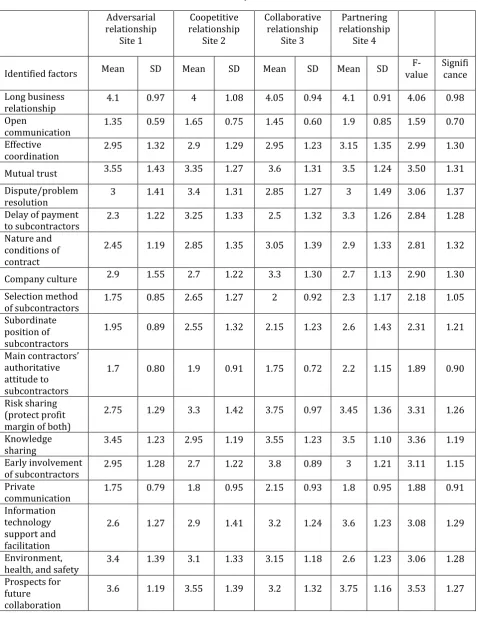
The results of the data analysis reveal that main contractor–subcontractor relationships are correlated with main contractor competitiveness. More significantly, the linear relationship between main contractor–subcontractor relationship Site and main contractor competitiveness illustrated in Fig. shows that the correlation degree becomes higher and higher as one progresses through the relationship clusters ranging from adversarial to partnering. Therefore, there is a need for further discussion on how main contractor competitiveness can be improved by maintaining collaborative and partnering relationships with subcontractors.
1.1
Advantages And Difficulties Of Maintaining Collaborative/Partnering RelationshipsMaintaining collaborative/partnering relationships with subcontractors brings both advantages and benefits to main contractors. Specifically, these collaborative/partnering subcontractors’ quotations are more competitive, accurate, and achievable based on their past experience, which means that there is no need for main contractors to waste time comprehensively reassessing their professional competences in the bidding process. Furthermore, they have better communication and coordination skills and are more self motivated in carrying out work on construction sites. Moreover, their work generally attains or exceeds the required level of professional workmanship; thus, less effort or fewer labour-hours are consumed to supervise their work. Besides, because of the long-term collaborative working relationship, they are more willing to offer mutually beneficial solutions at both the tender stage and subsequent subletting stage from a long-term point of view. These research findings are echoed by existing studies
1.2
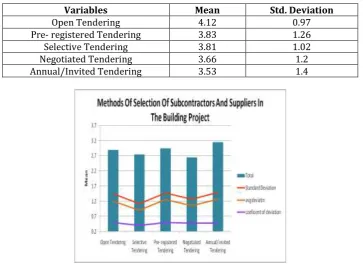
Methods Of Selection Of Subcontractors [image:3.595.117.481.480.745.2]Table1.1 below shows the various methods of selecting subcontractor and supplier. Open tendering were ranked highest by the respondent with an average mean of 4.12, Pre- registered tendering were the second highest with an average mean of 3.83, Negotiation tendering and invited tendering were ranked lowest with an average mean of 3.66 and 3.53 respectively.
Table 1: Methods of Selection of Subcontractors And Suppliers In The Building Project
Variables Mean Std. Deviation
Open Tendering 4.12 0.97
Pre- registered Tendering 3.83 1.26
Selective Tendering 3.81 1.02
Negotiated Tendering 3.66 1.2
Annual/Invited Tendering 3.53 1.4
© 2019, IRJET | Impact Factor value: 7.211 | ISO 9001:2008 Certified Journal
| Page 1426
1.3
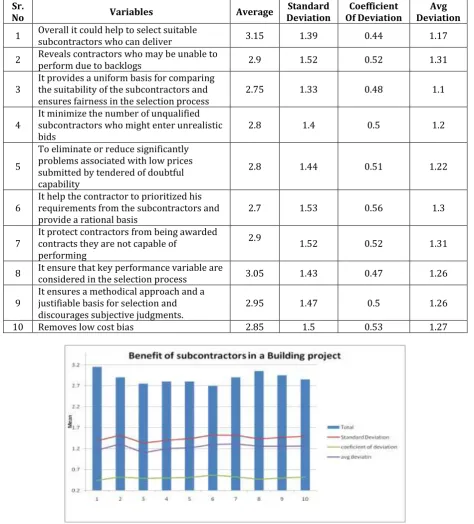
Benefits of subcontractors [image:4.595.62.537.209.734.2]Table 1.2 depicts benefit derived by main contractors from selection of subcontractors to carry out minor works. Ability to deliver were ranked most average highest by respondent with the mean score of 3.15, contractors who may be unable to perform due to backlogs were ranked second highest by the respondents, provides a uniform basis for comparing the suitability of the subcontractors and ensures fairness in the selection process and minimize the number of unqualified subcontractors who might enter unrealistic bids were ranked the same mean ranked of 2.8
Table 2: Benefit of Subcontractors in a building Project
Sr.
No Variables Average Deviation Standard Of Deviation Coefficient Deviation Avg 1 Overall it could help to select suitable subcontractors who can deliver 3.15 1.39 0.44 1.17
2 Reveals contractors who may be unable to perform due to backlogs 2.9 1.52 0.52 1.31
3 It provides a uniform basis for comparing the suitability of the subcontractors and
ensures fairness in the selection process 2.75 1.33 0.48 1.1
4 It minimize the number of unqualified subcontractors who might enter unrealistic
bids 2.8 1.4 0.5 1.2
5
To eliminate or reduce significantly problems associated with low prices submitted by tendered of doubtful capability
2.8 1.44 0.51 1.22
6 It help the contractor to prioritized his requirements from the subcontractors and
provide a rational basis 2.7 1.53 0.56 1.3
7 It protect contractors from being awarded contracts they are not capable of performing
2.9 1.52 0.52 1.31
8 It ensure that key performance variable are considered in the selection process 3.05 1.43 0.47 1.26
9 It ensures a methodical approach and a justifiable basis for selection and
discourages subjective judgments. 2.95 1.47 0.5 1.26
10 Removes low cost bias 2.85 1.5 0.53 1.27
© 2019, IRJET | Impact Factor value: 7.211 | ISO 9001:2008 Certified Journal
| Page 1427
1.4
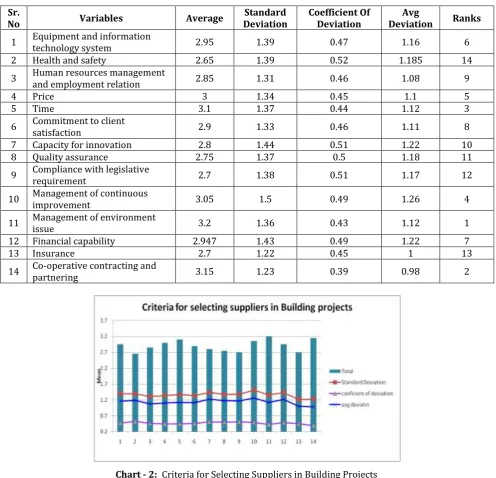
Criteria for suppliers selection [image:5.595.50.547.193.671.2]Table 1.3 depicts the level of agreement for selection of suppliers in a building project. The below table shows that most of the respondent agreed that equipment and information technology systems were the most optimum criteria for selection of suppliers with mean ranked 2.91, the level of agreement for Health and safety and Human resources management and employment relation were ranked equally by the respondents follow by price with the mean average of 3.05.
Table 3: C.riteria for Selecting Suppliers in Building Projects
Sr.
No Variables Average Deviation Standard Coefficient Of Deviation Deviation Avg Ranks 1 Equipment and information technology system 2.95 1.39 0.47 1.16 6
2 Health and safety 2.65 1.39 0.52 1.185 14
3 Human resources management and employment relation 2.85 1.31 0.46 1.08 9
4 Price 3 1.34 0.45 1.1 5
5 Time 3.1 1.37 0.44 1.12 3
6 Commitment to client satisfaction 2.9 1.33 0.46 1.11 8
7 Capacity for innovation 2.8 1.44 0.51 1.22 10
8 Quality assurance 2.75 1.37 0.5 1.18 11
9 Compliance with legislative requirement 2.7 1.38 0.51 1.17 12
10 Management of continuous improvement 3.05 1.5 0.49 1.26 4
11 Management of environment issue 3.2 1.36 0.43 1.12 1
12 Financial capability 2.947 1.43 0.49 1.22 7
13 Insurance 2.7 1.22 0.45 1 13
14 Co-operative contracting and partnering 3.15 1.23 0.39 0.98 2
Chart - 2: Criteria for Selecting Suppliers in Building Projects
1.5
Impact Of Main Contractor–Subcontractor Relationships On Main Contractors’ CompetitivenessProfitability
© 2019, IRJET | Impact Factor value: 7.211 | ISO 9001:2008 Certified Journal
| Page 1428
[image:6.595.60.539.134.766.2]variables that uses a monotonic function, and it is appropriate for both continuous and discrete variables, including ordinal variables.
Table 4: Analysis Results
Adversarial relationship Site 1 Coopetitive relationship Site 2 Collaborative relationship Site 3 Partnering relationship Site 4
Identified factors Mean SD Mean SD Mean SD Mean SD value F- Significance
Long business
relationship 4.1 0.97 4 1.08 4.05 0.94 4.1 0.91 4.06 0.98
Open
communication 1.35 0.59 1.65 0.75 1.45 0.60 1.9 0.85 1.59 0.70 Effective
coordination 2.95 1.32 2.9 1.29 2.95 1.23 3.15 1.35 2.99 1.30 Mutual trust 3.55 1.43 3.35 1.27 3.6 1.31 3.5 1.24 3.50 1.31 Dispute/problem
resolution 3 1.41 3.4 1.31 2.85 1.27 3 1.49 3.06 1.37
Delay of payment
to subcontractors 2.3 1.22 3.25 1.33 2.5 1.32 3.3 1.26 2.84 1.28 Nature and
conditions of contract
2.45 1.19 2.85 1.35 3.05 1.39 2.9 1.33 2.81 1.32
Company culture 2.9 1.55 2.7 1.22 3.3 1.30 2.7 1.13 2.90 1.30 Selection method
of subcontractors 1.75 0.85 2.65 1.27 2 0.92 2.3 1.17 2.18 1.05 Subordinate
position of subcontractors
1.95 0.89 2.55 1.32 2.15 1.23 2.6 1.43 2.31 1.21
Main contractors’ authoritative attitude to subcontractors
1.7 0.80 1.9 0.91 1.75 0.72 2.2 1.15 1.89 0.90
Risk sharing (protect profit margin of both)
2.75 1.29 3.3 1.42 3.75 0.97 3.45 1.36 3.31 1.26
Knowledge
sharing 3.45 1.23 2.95 1.19 3.55 1.23 3.5 1.10 3.36 1.19
Early involvement
of subcontractors 2.95 1.28 2.7 1.22 3.8 0.89 3 1.21 3.11 1.15 Private
communication 1.75 0.79 1.8 0.95 2.15 0.93 1.8 0.95 1.88 0.91 Information
technology support and facilitation
2.6 1.27 2.9 1.41 3.2 1.24 3.6 1.23 3.08 1.29
Environment,
health, and safety 3.4 1.39 3.1 1.33 3.15 1.18 2.6 1.23 3.06 1.28 Prospects for
future collaboration
© 2019, IRJET | Impact Factor value: 7.211 | ISO 9001:2008 Certified Journal
| Page 1429
Chart - 3: Adversarial Relationship
Chart - 4: Coopetitive Relationship
Chart - 5: Collaborative Relationship
© 2019, IRJET | Impact Factor value: 7.211 | ISO 9001:2008 Certified Journal
| Page 1430
7. CONCLUSIONS
The main findings of this research provide valuable references for local main contractors to have a better understanding of their relationship with subcontractors, leading to development of collaborative/partnering relationships with various subcontractors based on win-win principles.
1. There are four main factors in study the importance of sub-contracting in infrastructure project is adversarial relationship, coopetitive relationship, collaborative relationship and partnering relationship.
2. The maximum mean is 4.1 for long business relationship and SD is 3.4 for environment, health, and safety for adversarial relationship. The maximum mean is 4 for long business relationship and SD is 1.41 for information technology support and facilitation for coopetitive relationship.
3. The maximum mean is 4.05 for long business relationship and SD is 1.39 for nature and conditions of contract for collaborative relationship. The maximum mean is 4.1 for long business relationship and SD is 1.49 for dispute/problem resolution for partnering relationship.
4. The Overall it could help to select suitable subcontractors who can deliver is the Benefit of Subcontractors in a Building Project having average is 3.15 and standard deviation is 1.39. The minimum average is 2.7 and standard deviation is 1.53 for benefits is it help the contractor to prioritized his requirements from the subcontractors and provide a rational basis. 5. Criteria for Selecting Suppliers in Building Projects are Management of environment issue and the average is 3.05 and
standard deviation is 1.36. Minimum average criteria are Health and safety is 2.65 and standard deviation is 1.39
REFERENCES
[1] Abhijit N. Bhirud & Bhushan M. Revatkar, (2016), “Effective Implementation of ERP in Infrastructure Construction Industry”,
International Journal of Technical Research And Applications Vol. 4, Issue 2, Pp.No. 246-249.
[2] Alexandre Pinheiro De Barrosa, Celia Satiko Ishikiriyama, Peres Rafael Cordeiro, Simoes Gomes Carlos Francisco, (2015),
“Processes and Benefits of the Application of Information Technology In Supply Chain Management: An Analysis Of The Literature”, Procedia Computer Science, Vol. 55, Pp.No. 698 – 705.
[3] Cus-Babic Nenad, Rebolj Danijel, Nekrep-Perc Matiaz, Podbreznik Pete., (2014), “Supply-Chain Transparency within
Industrialized Construction Projects”, Computers in Industry, Vol. 65, Pp.No.345–353.
[4] Edum-Fotwe F.T., Thorpe A., Mccaffer R., (2001), “Information Procurement Practices Of Key Actors in Construction Supply
Chains”, European Journal of Purchasing & Supply Management, Vol. 7, Issue 7, Pp.No. 155-164.
[5] Haseeb M., Xinhai-Lu, Bibi Aneesa, Dyian Maloof-ud, Rabbani Wahab , (2011), “Problems of Projects and Effects of Delays in
the Construction Industry of Pakistan”, Vol.1, Issue 5, Pp.No. 41-50.
[6] Hammadi Shabbab Al and & M. Sadique Nawab, (2016),“Project Time Overruns in Saudi Arabian Con-Struction Industry”,
International Journal of Scientific & Engineering Research, Vol 7, Issue 2, pp – 555-560.
[7] Kang Moon Jung & Hwang Jongwoon, (2017), “Interactions among Inter-Organizational Measures for Green Supply Chain
Management”, Procedia Manufacturing, Vol. 8, Pp.No. 691 – 698,
[8] Kaming Peter F., Olomolaiye Paul O., Holt Gary D. & Harris Frank C. (2010), “Factors Influencing Construction Time And
Cost Overruns On High-Rise Projects In Indonesia”, Construction Management And Economics, Vol. 15, Pp.No. 83- 94.
[9] Kumar Prakash & Raj Piush, (2015), “Delay Analysis of Projects and Effects of Delays in the Mining/ Manufacturing
Industries”, Vol. 12, Issue 6, Pp.No. 61-71.
[10] Sadi A. Assaf, Member, ASCE, Mohammed AI-Khalil And Muhammad AI-Hazmi, (1995), “Causes Of Delay In Large Building
Construction Projects”, J. Management Engineering, Vol. 11, Issue 2, pp.No. 45-50.
[11] Sadi A. Assaf & Sadiq Al-Hejji, (2006), “Causes Of Delay in Large Construction Projects”, International Journal of Project
Management, Vol. 24, Pp.No. 349–357.
[12] Sepasgozar Samad M E, Razkenari Mohamad Ahmadzade & Barati Khalegh, (2015), “The Importance of New Technology
for Delay Mitigation in Construction Projects”, American Journal of Civil Engineering and Architecture, Vol. 3, Issue 1, Pp.No. 15-20.
[13] Xing Ke, Qian Wei & Zaman Atiq Uz, (2016), “Development of A Cloud-Based Platform for Footprint Assessment in Green