1 Title: Selective logging effects on ‘brown world’ faecal-detritus pathway in tropical forests: a
1
case study from Amazonia using dung beetles
2
3
Authors: Filipe França1, 2*, Júlio Louzada 1, 2, and Jos Barlow 1, 2, 3 4
1 Lancaster Environment Centre, Lancaster University, Bailrigg, Lancaster, LA1 4YQ, UK. 5
2 Departamento de Biologia, Universidade Federal de Lavras, Lavras-MG, 37200-000, Brazil. 6
3 Museu Paraense Emilio Goeldi, Av. Magalhães Barata, 376, Belém-PA, 66040-170, Brazil. 7
*Correspondence author: Filipe M. França ([email protected], +553538291923).
8
Departamento de Biologia, Setor de Ecologia, Universidade Federal de Lavras, Lavras-MG,
9
37200-000, Brazil.
2
Abstract:
11
While a significant effort has been made to understand how human activities influence
12
biodiversity, less attention has been given to the consequences of tropical forest disturbance on
13
belowground functional processes and its linkages with environmental drivers. Here, we
14
demonstrate how selective logging influenced dung beetle communities and two associated
15
ecological processes – namely, dung consumption and incidental soil bioturbation – in the
16
eastern Brazilian Amazon, using a robust before-and-after control-impact design. We tested
17
hypotheses about logging-induced changes on environmental condition (canopy cover, leaf
18
litter and soil texture), community metrics (e.g. dung beetle species richness and biomass) and
19
beetle-mediated faecal-detritus processing; and on the importance of the environment for beetle
20
communities and functional processes. We show that post-logging changes in canopy openness
21
do not necessarily mediate logging impacts on dung beetle diversity and biomass, which were
22
directly influenced by reduced impact logging (RIL) operations. Although neither
23
environmental condition (leaf litter or soil sand content) nor faecal consumption and incidental
24
soil bioturbation were directly affected by RIL, the relationships between environmental
25
condition and biological components were. By showing that selective logging alters the
26
linkages among belowground ecological processes and environmental drivers, we provide
27
support that logged forests can retain some important functioning processes, in particular faecal
28
consumption, even when the dung beetle diversity and biomass are impoverished. These results
29
provide support for the resistance of functional processes to logging-induced changes in
30
biodiversity.
31
Keywords: Amazon forest; brown world; dung beetle; dung removal; faecal-detritus pathway;
32
reduced-impact logging.
33
34
Abbreviations: 35
BACI: Before-and-After Control-Impact experimental design
36
DBH: Diameter at breast height
37
FSC: Forest Stewardship Council
38
FAO: Food and Agriculture Organization of the United Nations
39
GLM: Generalised Linear Model
40
RIL: Reduced-Impact Logging
41
3
1. Introduction
43
Forest degradation poses a major threat to natural forests and, because it takes place over much
44
larger spatial scales, can result in just as much biodiversity loss as deforestation (Barlow et al.,
45
2016). Millions of hectares of tropical forests have been allocated for timber production
46
(Guariguata et al., 2010) and selective logging is considered a primary driver of tropical forest
47
degradation (Gatti et al., 2015; Pearson et al., 2017). Given the increased global demand for
48
low-cost timber (Blaser et al., 2011), understanding the ecological consequences from logging
49
operations is a key challenge for reconciling timber production and tropical forest
50
conservation.
51
Despite progress made to comprehend the logging consequences on forest structure and
52
canopy (Asner et al., 2006, 2004b; Gatti et al., 2015), biodiversity (David P. Edwards et al.,
53
2014; Richardson and Peres, 2016), ecosystem values such as carbon stocks (Berenguer et al.,
54
2014; Griscom et al., 2017), soil characteristics (Negrete-Yankelevich et al., 2007) and other
55
environmental aspects of tropical forests (Osazuwa-Peters et al., 2015), the impact of logging
56
on important ecosystem processes remains underrepresented in the literature. This is important,
57
as the sustainability of selective logging could be strongly linked to the extent to which
58
affected forests can maintain the ecosystem processes found in pristine forests (D. P. Edwards
59
et al., 2014; Ewers et al., 2015). Moreover, where effort has been given to understand the
60
impacts of selective logging on biodiversity and ecosystem functioning, studies normally focus
61
on aboveground components and comparatively little is known about logging consequences on
62
belowground biodiversity and brown world ecological processes (but see Slade et al., 2011). In
63
particular, faecal-detritus interactions and decomposition processes are critically important in
64
terrestrial environments and form intricate connections between below and aboveground
sub-65
systems (Moore et al., 2004). Although these interactions do not necessarily involve direct
66
trophic interactions, their decline or loss are expected to instigate a downstream cascade of
4
impacts on ecosystem processes, with dramatic implications for both ‘green’ and ‘brown’
68
worlds (Wu et al., 2011).
69
Dung beetles (Coleoptera: Scarabaeinae) are a focal group of detritivores that are
70
frequently used in ecological research linking biodiversity to ecosystem functioning under
71
changing environmental conditions (e.g. Braga et al., 2013; Slade et al., 2011). Through dung
72
manipulation for feeding and nesting purposes (Hanski and Cambefort, 1991), dung beetles
73
play a vital role in facilitating the transfer of energy and matter through dung-based pathways
74
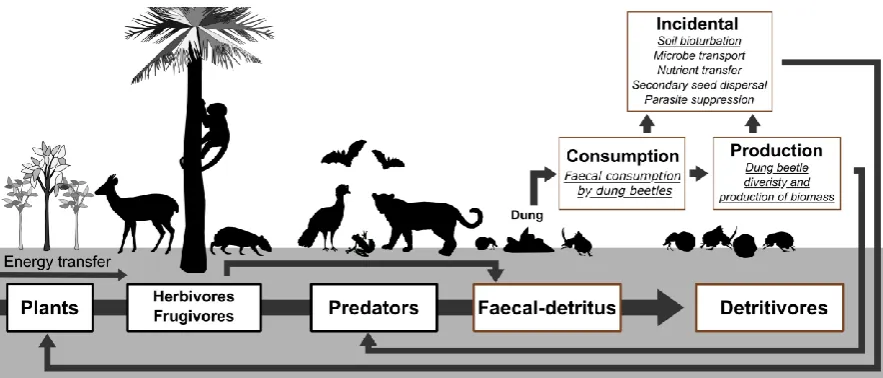
(Nichols and Gardner, 2011). They influence a range of specific detritus processes (Fig. 1),
75
such as faecal consumption and soil bioturbation (Nichols et al., 2007), dung beetle biomass
76
production for predators (Young, 2015), secondary seed dispersal (Griffiths et al., 2016, 2015)
77
and microbial transport across the soil-surface (Slade et al., 2016). Although previous
78
investigation has shown that impacts of human activities in tropical forests on dung beetles are
79
mediated by habitat type and via body-size-dependent responses (Nichols et al., 2013b),
80
conclusions were based on a space-for-time design which may underestimate the impacts from
81
human disturbance (França et al. 2016a). Moreover, despite evidence highlighting the
82
importance of environmental context to predict dung beetle-mediated ecological processes
83
within undisturbed forests (Griffiths et al., 2015), we are not aware of any empirical study
84
exploring the extent to which an anthropogenic forest disturbance, such as selective logging,
85
alters the importance of environmental drivers for dung beetle-mediated faecal-detritus
86
processes.
5 88
Figure 1. Dung beetle-mediated faecal detritus-pathway. The energy flow comes from Sun and
89
other key soil elements (e.g. N and P), being assimilated by plants. Plants are consumed by
90
herbivores and frugivorous, which in turn are consumed by predators. These animals, through
91
defecating, produce the resources for the faecal-detritus pathway. Dung beetles mediate many
92
incidental detritus-processing such as soil bioturbation, seed dispersal and nutrient transfer
93
from detritus to the soil, therefore providing a positive feedback for plants. They also consume
94
faeces directly, leading to secondary beetle biomass production, and are consumed by their
95
own predators. Processes investigated in this study are underlined.
96
In this paper, we address these gaps by using a BACI experimental design to explore the
97
impacts from selective logging in the eastern Brazilian Amazonia. Specifically, we examine (1)
98
how environmental conditions, dung beetle communities and associated ecological processes at
99
different stages of the dung-detrital pathway are affected by logging operations, and (2) how
100
potential logging-induced changes in environmental drivers are reflected in ecosystem
101
functional processes provided by dung beetles. We predict that forest disturbance induced by
102
selective logging (1) has negative consequences on forest structure (Asner et al., 2004a), dung
103
beetle communities and associated detrital processes (Slade et al., 2011); and (2) alters the
104
relative importance of the environmental context for dung beetle communities and associated
105
functional processes. We expect that, first because disturbance tends to alter both
106
environmental heterogeneity and diversity/productivity relationships (Cardinale et al., 2000).
107
Second, because previous research has shown that forest disturbance alters the importance of
108
habitat variables for arthropod communities (Oliver et al., 2000), and dung beetles and
109
associated ecological functions are greatly influenced by environmental context (Davis et al.,
110
2001; Griffiths et al., 2015). Our findings are not only important for understanding how forest
6
disturbance shapes environmental drivers and belowground ecosystem functioning in tropical
112
forests, but also provide new insights into the ecological value of selectively logged tropical
113
forests and how environmental context mediates the biological consequences of human
114
activities.
115
2. Material and methods
1162.1 Study site
117The study was carried out within a logging concession area of 1.7 Mha located in the state of
118
Pará in north-eastern Brazilian Amazonia (0°53S, 52°W; Appendix A, Fig. A1). This area
119
comprises a mosaic of Eucalyptus plantations and regenerating secondary forests embedded
120
within a large matrix of evergreen dense tropical rainforest (Souza, 2009) subjected to low
121
levels of disturbance (Barlow et al., 2010; Parry et al., 2009). This region is within the
122
equatorial/tropical rainforest climate (Af, Köppen’s classification), with annual rainfall and
123
average temperature of 2,115 mm and 26ºC, respectively (Souza, 2009).
124
This logging concession is certified by the Forest Stewardship Council (FSC) and
125
follows the FAO model code with reduced-impact logging (RIL) on a 30-year rotation (FSC,
126
2014). Main activities under RIL include pre-harvest mapping, measurement and identification
127
of all commercially viable trees with DBH ≥ 45cm within 10 ha (250 x 400 m) logging
128
management units planned to be logged with a specific logging intensity (m3 ha-1). Moreover, 129
harvest incorporates methods that aim to minimize residual stand damage, such as vine cutting,
130
directional felling, and planning of roads, skid trails and log decks (Dykstra and Heinrich,
131
1996).
132
2.2 Experimental design
133We used the company’s pre-harvest inventory to select 34 management units (hereafter sample
134
units). These included 29 ‘logging’ units destined to be logged along a gradient of planned
7
logging intensities and five ‘control’ units that would not be logged during the course of the
136
study. The five unlogged control units were the same size as the logging units (Appendix A,
137
Fig. A1), and were located approximately 6.5 km from the closest logging units to ensure
138
sampling independence and to avoid any spillover effects from harvesting operations (Block et
139
al., 2001). Importantly, control units held a dung beetle community representative of
140
undisturbed primary forests in our study region (França et al. 2016a).
141
We sampled environmental variables, dung beetles and their associated detritus
142
processes twice within each sample unit: the pre-logging survey occurred between June and
143
July 2012, a few weeks before logging operations began. The post-logging dung beetle survey
144
took place in 2013, approximately 10 months after logging activities ended. It also occurred in
145
June and July, to minimize possible seasonal effects. RIL operations started in July and ended
146
in September 2012; logging intensity ranged from 0 to 50.3 m3 ha-1 of timber (or 0 to 7.9 trees
147
ha-1) that was eventually extracted within our sample units (see França et al. 2016b for logging 148
intensity details). All data were sampled at exactly the same locations and following the same
149
methods in both surveys. Sampling locations were relocated based on marking tape, or by GPS
150
when disturbance from logging activities meant this could not be found.
151
2.3 Environmental drivers of ecosystem processes
152To evaluate whether selective logging would lead to changes in forest structure and the relative
153
importance of environmental variables for dung beetle-mediated processes (first and second
154
questions, respectively) we assessed the canopy openness, leaf litter weight and soil texture at
155
the same locations the dung beetles were sampled at each of the pre- and post-logging surveys
156
(Appendix A, Fig. A2).
157
Canopy openness was quantified by taking hemispherical photographs with a Nikon 158
FC-E8 fisheye lens attached to a Nikon D40 camera levelled ~1.20 meter from the ground.
159
Photographs were taken when the sky was overcast or in the early morning and late afternoon
8
using optimum exposure for each site (Zhang et al., 2005). The Gap Light Analyser software
161
(GLA version 2.0; Frazer et al., 1999) was used to estimate the ‘canopy openness %’ factor,
162
which represents the ratio of the total amount of open space to the total area of the
163
hemispherical photograph (Frazer et al., 1999). This approach has been widely used to account
164
for the canopy openness (Medjibe et al., 2014; Niemczyk et al., 2015; Silveira et al., 2010). In
165
addition, leaf litter was collected from the forest floor within a 25×25 cm square randomly
166
placed ~1 m from each pitfall trap (Appendix B, Fig. B1). We used a Shimatzu AY220 balance
167
scale (Shimadzu Corporation, Kyoto, Japan) accurate to within ±0.001g to obtain the leaf litter
168
weight after drying it at 60 °C for 96-h. For analysis purpose and to get an aggregate value,
169
canopy openness and leaf litter metrics were the averages among the six samples taken within
170
each of the sample units. Lastly, we also took a soil sample (~10 cm depth) at the six trap
171
locations, forming a composite soil sample to represent the soil texture (clay, silt and coarse
172
sand fractions) within the sample units at each survey. Granulometric analyses were conducted
173
in the soil laboratory of Jari Celulose S.A. In the same way as previous dung beetle-research,
174
we also considered the sand proportion as our soil texture measure (Gries et al., 2012; Griffiths
175
et al., 2015).
176
2.4 Detritivore communities and faecal-detritus processes
177We addressed our research questions by exploring the logging impacts on dung beetle
178
communities, assessed by using the relative dung beetle species richness and biomass, which
179
were considered as a proxy of the production available for dung beetle predators (Young,
180
2015); and two processes associated with the faecal-detritus pathway (Fig. 1): (1) faecal
181
consumption and (2) incidental detrital processes, evaluated by sampling the dung
beetle-182
mediated faecal removal and soil bioturbation, respectively.
183
2.4.1 Faecal consumption and incidental soil bioturbation
9
The day before dung beetles were sampled, we established two circular, 1-m diameter
185
mesocosm arenas (Braga et al., 2013), spaced 100 m apart, and located at least 75 m from the
186
edge of the sample units (Appendix A, Fig. A2). Each mesocosm was delimited by a
nylon-187
mesh fence (~15 cm tall) held by bamboo sticks (Appendix A, Fig. A3). To facilitate the
188
evaluation of these processes, we cleared the soil surface of any leaf litter and vegetation
189
before placing a single 200-g experimental faecal deposit (4:1 pig to human ratio following
190
Marsh et al., 2013) at the centre of each mesocosm (Braga et al., 2013, 2012).
191
This mesocosm design allows dung beetles to freely enter the arena, and perform their
192
feeding and nesting activities that result in further underground relocation of faecal resources
193
while limiting the horizontal dung removal of brood balls by roller species to the contained
194
area (~0.785 m2). After 24-h exposure period to the dung beetle communities, we weighed the
195
remaining dung (when present) and calculated the faecal consumptions rates. This 24-h period
196
of exposition was the same as previous studies following this protocol (Braga et al., 2013,
197
2012; Nichols et al., 2013b) and was chosen based on known movements of dung beetles
198
(Silva and Hernández, 2015) to avoid the risk of beetles from outside the unit perform the
199
faecal-detritus processes measured within the mesocosm. A parallel humidity control
200
experiment was set aside each arena (Appendix A, Fig. A3). Thus, changes in humidity of each
201
experimental faecal deposit were considered to calculate the faecal consumption rates (see
202
Appendix B for details). To quantify the incidental soil bioturbation rates as consequence of
203
excavations by dung beetles, we collected the loose soil clearly found above the soil surface
204
and weighed it after drying it at 60 οC for a week (Braga et al., 2013, 2012). We pooled the
205
data from the two arenas to get an aggregate value of dung beetle-mediated functional
206
processes for each sample unit.
207
2.4.2 Detritivore biomass and richness
10
We sampled dung beetles by using six standardized baited pitfall traps (19 cm diameter and 11
209
cm deep) spaced 100 meters apart in a 2x3 rectangular grid within each sample unit (Appendix
210
A, Fig. A2B). This trap spacing helped ensure independence between them (Silva & Hernández
211
2015) as well as an even spatial coverage of each sample unit. Traps were buried with their
212
opening at ground level, containing approximately 250 ml of a saline solution and a small
bait-213
container with ~35 g of fresh dung (4:1 pig to human ratio, Marsh et al. 2013). Data from the
214
six pitfall traps in each sample unit were pooled to get an aggregate value and improve
215
representation.
216
We restricted our sample window to 24 hours in each collection period, as short sample
217
periods are known to be efficient at attracting a representative sample of the local beetle
218
community (Braga et al., 2013; Estrada and Coates-Estrada, 2002). Moreover, longer sample
219
periods would have increased the probability of attracting dung beetles from outside of the
220
sample units (Silva and Hernández, 2015), and therefore from units with different
221
environmental conditions. In addition, evidence from data collected in the same region
222
suggests 24-h sampling periods as good predictor of community metrics from longer sampling
223
durations (França et al. 2016a).
224
All trapped dung beetles were dried and transported to the laboratory where they were
225
identified to species, or morphospecies where the former was not possible. We assessed the dry
226
mean body mass for each species by weighing up to 15 individuals using a Shimatzu AY220 227
balance (Shimadzu Corporation, Kyoto, Japan) accurate to within ±0.001g. Beetle biomass
228
was estimated by summing all inferred body masses from each sample. Voucher specimens
229
were added to the collection of Neotropical Scarabaeinae in the Insect Ecology and
230
Conservation Laboratory, Universidade Federal de Lavras, Lavras, Brazil; and in the
231
Entomological Section of the Zoology collection of Universidade Federal de Mato Grosso,
232
Cuiabá, Brazil.
11
2.5 Statistical analyses
234
All statistical analyses were performed within the R computing environment (R Core Team,
235
2017). We addressed our first question by using generalised linear models (GLMs) with a
236
logarithmic link function (Zuur et al., 2009) in the glm() routine (stats package, R Core Team,
237
2017). We ran an independent GLM followed by a two-way ANOVA to assess the influence of
238
the explanatory variables “survey” (two levels: pre- and post-logging), “treatment” (two levels:
239
control and logging sites), and the interaction “survey × treatment” on the environmental
240
metrics (canopy openness, leaf litter weight, and soil sand proportion) and dung
beetle-241
mediated detritus processes (species richness, biomass, and rates of faecal consumption and
242
soil bioturbation). Post hoc pairwise t-tests with non-pooled standard deviations were used
243
when both “survey” and “treatment” significantly affected the response variables. A
quasi-244
binomial error structure was used for proportion data (canopy openness and soil sand
245
proportion); and quasi-Poisson error structure was used for overdispersed count data (leaf litter
246
weight, beetle biomass, and rates of dung removal and soil bioturbation) (Crawley, 2002).
247
Spatial autocorrelation within our dataset was assessed by performing Pearson-based Mantel
248
tests (Legendre and Legendre, 1998) with 1000 permutations (mantel routine, vegan package,
249
Oksanen et al. 2015). Mantel tests were made separately for dung beetle species richness and
250
biomass from each survey, allowing us to examine whether spatial correlation existed on both
251
sets of analysis (Appendix B).
252
Because we also sought to examine how potential logging-induced changes on
253
environmental drivers influence those on beetle-mediated detrital processes (second question),
254
we used a hierarchical partitioning (HP) analysis (Chevan and Sutherland, 1991) to compare
255
the relative and independent importance of our three environmental variables on the dung
256
beetle richness, biomass, and rates of faecal consumption and incidental soil bioturbation. HP
257
is a multi-regression technique in which all possible linear models are jointly considered to
12
identify the most likely predictors while minimizing the influence of multicollinearity and
259
providing the independent contribution of each predictor (Chevan and Sutherland, 1991).
260
Competing models were evaluated based on R2 goodness of fit statistic, which allowed us to 261
interpret the independent effects as proportion of explained variance. Significance (α = 0.05) of
262
independent effects of each predictor was calculated using a randomization test with 1000
263
iterations (Mac Nally, 2002; Walsh and Nally, 2013).
264
We analysed each response variable separately at each survey (pre and post-logging) to
265
evaluate whether these faecal-detritus processes are influenced by similar drivers after logging
266
operations. Gaussian distributions were tested using the Shapiro-Wilk normality test through
267
the Shapiro.test() function (stats package, Patrick Royston 1995). Hierarchical partitioning and
268
further randomization-significance tests were executed using the hier.part package (Walsh and
269
Nally, 2013). Table C1 (Appendix C) demonstrates the data used for GLM’s and HP analyses.
270
3. Results
271The canopy openness was the only environmental aspect changing between surveys (two-way
272
ANOVA: survey × treatment F1, 64 = 1.4, p = 0.230; treatment F1, 65 = 3.7, p = 0.058; survey F1, 273
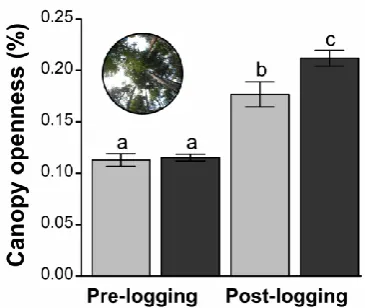
66 = 174.2, p < 0.001), and increased significantly in logged forests (t-test, P-values ≤ 0.02; Fig. 274
2).
275
[image:12.595.206.389.563.717.2]276
Figure 2. Canopy openness changes between control (light grey bars) and logging sites (dark
277
grey bars) at surveys performed before (left bars in the panels) and after selective-logging
13
(right bars in the panels). Means ± standard deviation (SD) followed by the same letter indicate
279
post hoc zero difference at 5%.
280
We also found negative logging impacts on dung beetle richness (two-way ANOVA:
281
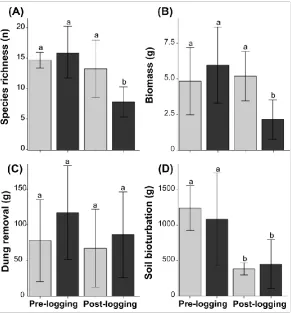
survey × treatment F1, 64 = 7.8, p = 0.006; treatment F1, 65 = 3.2, p = 0.078; survey F1, 66 = 70.4, 282
p < 0.001; Fig. 3A) and biomass (two-way ANOVA: survey × treatment F1, 64 = 11.4, p = 283
0.001; treatment F1, 65 = 1.7, p = 0.19; survey F1, 66 = 41.8, p < 0.001; Fig. 3B), which reduced 284
up to 50% at logged forests (Fig 3A-B). However, while soil bioturbation decreased at both
285
control and logged sites in the second survey (two-way ANOVA: survey × treatment F1, 64 = 286
0.3, p = 0.53; treatment F1, 65 = 0.07, p = 0.78; survey F1, 66 = 35.23, p < 0.001; Fig. 3D), no 287
significant direct logging impacts were found on dung beetle-mediated faecal consumption
288
(two-way ANOVA: survey × treatment F1, 64 = 0.1, p = 0.750; treatment F1, 65 = 1.8, p = 0.173; 289
survey F1, 66 = 3.4, p = 0.069; Fig. 3C). Importantly, although a very weak spatial 290
autocorrelation was found in the pre-logging dung beetle richness and biomass (r = 0.18 and r
291
= 0.12, respectively; all P-values ≤ 0.03), these metrics were not spatially structured in the
292
post-logging survey (r = -0.41 and r = -0.42, respectively; all P-values = 0.999), even when the
293
control units were excluded from analysis (Appendix B).
14 295
Figure 3. Dung beetle species richness (A), biomass (B), and rates of dung removal (C) and
296
incidental soil bioturbation (D) sampled in control (light grey bars) and logging sites (dark grey
297
bars) at surveys performed before (left bars in the panels) and after selective-logging (right
298
bars). Means ± standard deviation (SD) followed by the same letter indicate post hoc zero
299
difference at 5%.
300
Relating faecal-detritus pathways to environmental conditions before and after logging
301
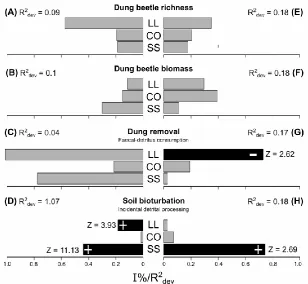
Hierarchical partitioning and randomization tests revealed no environmental influence on the
302
variation of dung beetle species richness or biomass in either the pre- or post-logging
303
assessment (Fig. 4). However, faecal consumption was negatively associated with leaf litter
304
volume after logging operations (Fig. 4G). Leaf litter also had a positive association with
pre-305
logging soil bioturbation rates, and this incidental detrital processing was positively related to
306
the sand proportion in both pre- and post-logging surveys (Fig. 4D-H). Table C2 (Appendix C)
307
show results of independent and joint effects of predictor variables for each faecal-detritus
308
process performed by dung beetles.
15 310
Figure 4.Distribution of the percentage of the independent effects of different predictors on
311
dung beetle-mediated faecal detritus-processes. Left panels show pre-logging results (A-D) and
312
right panels the post-logging ones (E-H). The x-axis shows the percentage of the independent
313
effects (I %) divided by the total explained variance of the complete model (R2
dev). LL = leaf 314
litter weight (g), CO = canopy openness (%) and SS = Soil sandy (%). Black bars represent
315
significant effects (α = 0.05) as determined by the randomization test. Z-scores for the
316
generated distribution of randomized I’s (I value = the independent contribution towards
317
explained variance in a multivariate dataset) and an indication of statistical significance are
318
calculated as (observed – mean(randomizations))/SD(randomizations), and statistical
319
significance is based on the upper 0.95 confident limit (Z ≥ 1.65). Pearson’s (ρ) positive or
320
negative relationships are shown by + or ‒, respectively. R2
dev (displayed in parenthesis beside 321
each capital letter) is the total deviance explained by a generalized linear model including all
322
the predictors considered for each faecal-detritus pathway response.
323
4. DISCUSSION
324Understanding how anthropogenic disturbances alter natural environments – and thereby
325
biodiversity and ecological functioning – is a question at the core of the current biodiversity
326
crisis (Laurance, 2007). In this research, we used observations on natural dung beetle
327
communities and associated ecological processes to explore the selective logging consequences
328
on beetle-mediated detritus processes in tropical forests. While we demonstrate that RIL
329
operations in the eastern Amazon negatively impacted dung beetle richness and biomass, we
[image:15.595.144.453.62.346.2]16
also found support about the resistance of functional processes to logging-induced changes in
331
biodiversity (Ewers et al., 2015). Lastly, logging-induced forest canopy changes were not the
332
major drivers of beetle richness and biomass in either pre- or post-logging forests, although the
333
importance of leaf litter and soil texture for other beetle-mediated processes was altered after
334
RIL operations. Below, we discuss each finding in turn, before turning to the general
335
implications for reconciling timber trade and tropical forest conservation.
336
4.1 Selectively logged forests can retain belowground functional
337processes
338Our findings give support to previous research suggesting that functional processes operating
339
in tropical forests remain substantially resistant to forest degradation caused by logging (Ewers
340
et al., 2015). The maintenance of faecal consumption rates at logged forests occurred despite
341
the large losses in dung beetle richness and biomass, considered as key drivers for the dung
342
beetle-mediated ecological processes (Gregory et al., 2015; Nichols et al., 2013a). While
343
providing support that spatial autocorrelation in species diversity may change with disturbance
344
(Biswas et al., 2017), such logging-induced beetle and biomass losses were supported by
345
Mantel test results demonstrating that these post-logging patterns were driven by RIL
346
operations and not by spatial autocorrelation. Although faecal consumption did not change
347
among treatments, we surprisingly found soil bioturbation rates decreasing at both control and
348
logged sites in the post-logging survey (Fig. 3D). Such decoupled responses, both between
349
distinct dung beetle detrital processes and with their community metrics (e.g. species richness
350
and biomass), to forest degradation have been shown in tropical regions (Braga et al., 2013;
351
Nichols et al., 2013b), and might result from the fact that other taxa are able to perform faecal
352
consumption without removing as much soil to the surface as dung beetles. For example, ants,
353
termites, earthworms and micro-decomposers have been previously recorded participating in
354
faecal consumption (Dangles et al., 2012; Slade et al., 2016; Wu et al., 2011), and are likely to
17
buffer the functional consequences of dung beetle species and biomass losses in detritus
food-356
webs present within logged forests. Regardless of the factors giving rise to it, our research
357
provides empirical evidence that logged forests managed through RIL techniques can retain
358
part of the belowground ecological processes operating in pristine forests (D. P. Edwards et al.,
359
2014), even when invertebrate communities are largely affected (Ewers et al., 2015). Although
360
dung beetles are good predictors of responses of many other taxa (Barlow et al., 2016; F. A.
361
Edwards et al., 2014; Gardner et al., 2008a), we stress that using ecological processes mediated
362
by one taxa is not enough to argue that the patterns found here will occur everywhere and for
363
all taxa. Further logging research should be targeted across a broader sample of regions, taxa
364
and functional processes.
365
4.2 Selective logging alters linkages between environmental and
366functional components in tropical forests
367Evidence that forest degradation can change the environmental importance for decomposition
368
processes are underexplored in the literature. In particular, our study shows that logging
369
operations in the Brazilian eastern Amazon altered the occurrence, direction and strength of
370
linkages between environmental condition (leaf litter and soil texture) and the dung
beetle-371
mediated faecal consumption and soil bioturbation (Fig. 4). The positive influence that leaf
372
litter has on soil chemistry and quality (Nyeko, 2009; Uriarte et al., 2015) may explain its
373
interaction with pre-logging soil bioturbation rates; whereas, in the post-logging survey, leaf
374
litter effects on roller dung beetles (as suggested by Nichols et al., 2013a) is a likely reason for
375
its negative association with faecal consumption. These roller species usually roll their brood
376
balls away from the faecal deposit before burial beneath the soil (Hanski and Cambefort,
377
1991), a behaviour that may be hampered by the excess of leaf litter resulting from logged
378
trees. Lastly, it is very likely that sandy soil properties, such as pore space and reduced
379
cohesion, facilitate dung beetles to move larger amounts of earth to the soil surface when
18
building nesting tunnels (Griffiths et al., 2015; Marshall et al., 1996); which is a potential
381
explanation for its positive effects on pre- and post-logging soil bioturbation rates.
382
Two intriguing results we found in this research are (1) the increased canopy openness
383
at both control and logged sites in the second survey, and (2) the post-logging changes in dung
384
beetle richness and biomass occurring apart from the significant logging effects on canopy
385
openness (Fig. 2 and 3A-B). First, while the increased canopy opening within our control sites
386
is likely related to the natural heterogenity and variation in canopy dynamics of Amazonian
387
forests, mainly responding to seasonal changes in water availability and solar radiation (Jones
388
et al., 2014), the significantly greater canopy openness found in logged sites reflects
well-389
known logging impacts on tropical forest canopies (Asner et al., 2006; Yamada et al., 2014).
390
Secondly, our results contrast markedly with the consensus reported by previous research
391
showing dung beetle responses to more severe forms of forest disturbance being majorly driven
392
by changes in forest structure (Hosaka et al., 2014; Nyeko, 2009). As selective logging is
393
known to cause sublethal and direct impacts on dung beetle communities (Slade et al. 2011,
394
Bicknell et al. 2014, França et al. 2016a, 2016b), we presume these findings reflect the
395
limitations of canopy openness as a measure of changes in forest structure, and the lower
396
intensity of RIL assessed in our research. Hemispherical photos taken 10 months after
397
disturbance inevitably capture both the state of the upper canopy and the regeneration in the
398
understorey, with the latter often obscuring the former. Moreover, the absence of
399
environmental influence on dung beetle communities within logged forests have also been
400
previously reported (Slade et al., 2011), which further outlines the difficulty of measuring
401
appropriate environmental metrics to assess the impacts of human activities on tropical
402
biodiversity (Gardner et al., 2008b; Oliveira et al., 2017).
403
19
This investigation addressed to better understand the role that environmental conditions have in
405
mediating the logging impacts on belowground functional processes. We found no support that
406
our measures of canopy openness mediated dung beetle responses to logging, but we provide
407
evidence that forest disturbances may alter the environmental importance for ecosystem
408
functioning in tropical forests. While the dung beetle patterns reported here highlight the
409
importance of within-forest disturbance (Barlow et al., 2016) and the irreplaceable role that
410
pristine forests have to retain tropical biodiversity (Gibson et al., 2011), we demonstrate that
411
carefully managed and certified selectively logged forests nevertheless can retain ecosystem
412
processes such as detrital consumption and soil bioturbation (D. P. Edwards et al., 2014; Ewers
413
et al., 2015).
414
Acknowledgements: We are grateful to Jari Forestal for logistical support. We thank our field
415
assistants Edivar Correa, Jucelino Alves e Maria Orlandina. We are grateful to Fernando Z.
416
Vaz-de-Mello and Amanda P. de Arcanjo for helping in the dung beetle identification. This
417
research was supported by grants from MCTI/CNPq/FAPs [No. 34/2012], CNPq-PELD site 23
418
[403811/2012-0]. F.F. is NERC-funded [NE/P004512/1] and was awarded by CAPES
419
[BEX5528/13-5] and CNPq [383744/2015-6] grants during the research. J.B. was supported by
420
CNPq [400640/2012-0].
421
Supplementary material:
422
Additional supplementary material may be found in the online version of this article:
423
Appendix A. Supplementary figures.
424
Appendix B. Supplementary experimental procedures.
425
Appendix C. Supplementary tables.
426 427
LITERATURE CITED
428
Asner, G.P., Broadbent, E.N., Oliveira, P.J.C., Keller, M., Knapp, D.E., Silva, J.N.M., 2006.
429
Condition and fate of logged forests in the Brazilian Amazon. Proc. Natl. Acad. Sci. U.
430
S. A. 103, 12947–12950. doi:10.1073/pnas.0604093103
431
Asner, G.P., Keller, M., Pereira, Jr, R., Zweede, J.C., Silva, J.N.M., 2004a. Canopy damage
432
and recovery after selective logging in Amazonia: Field and stellite studies. Ecol. Appl.
433
14, 280–298. doi:10.1890/01-6019
20
Asner, G.P., Keller, M., Silva, J.N.M., 2004b. Spatial and temporal dynamics of forest canopy
435
gaps following selective logging in the eastern Amazon. Glob. Chang. Biol. 10, 765–783.
436
doi:10.1111/j.1529-8817.2003.00756.x
437
Barlow, J., Lennox, G.D., Ferreira, J., Berenguer, E., Lees, A.C., Nally, R. Mac, Thomson,
438
J.R., Ferraz, S.F. de B., Louzada, J., Oliveira, V.H.F., Parry, L., Ribeiro de Castro Solar,
439
R., Vieira, I.C.G., Aragão, L.E.O.C., Begotti, R.A., Braga, R.F., Cardoso, T.M., Jr, R.C.
440
de O., Souza Jr, C.M., Moura, N.G., Nunes, S.S., Siqueira, J.V., Pardini, R., Silveira,
441
J.M., Vaz-de-Mello, F.Z., Veiga, R.C.S., Venturieri, A., Gardner, T.A., 2016.
442
Anthropogenic disturbance in tropical forests can double biodiversity loss from
443
deforestation. Nature 535, 144–147. doi:10.1038/nature18326
444
Barlow, J., Louzada, J., Parry, L., Hernández, M.I.M., Hawes, J., Peres, C.A., Vaz-de-Mello,
445
F.Z., Gardner, T.A., 2010. Improving the design and management of forest strips in
446
human-dominated tropical landscapes: A field test on Amazonian dung beetles. J. Appl.
447
Ecol. 47, 779–788. doi:10.1111/j.1365-2664.2010.01825.x
448
Berenguer, E., Ferreira, J., Gardner, T.A., Aragão, L.E.O.C., De Camargo, P.B., Cerri, C.E.,
449
Durigan, M., Oliveira, R.C. De, Vieira, I.C.G., Barlow, J., 2014. A large-scale field
450
assessment of carbon stocks in human-modified tropical forests. Glob. Chang. Biol.
451
2005, 1–14. doi:10.1111/gcb.12627
452
Bicknell, J.E., Phelps, S.P., Davies, R.G., Mann, D.J., Struebig, M.J., Davies, Z.G., 2014.
453
Dung beetles as indicators for rapid impact assessments: Evaluating best practice forestry
454
in the neotropics. Ecol. Indic. 43, 154–161. doi:10.1016/j.ecolind.2014.02.030
455
Bicknell, J.E., Struebig, M.J., Davies, Z.G., 2015. Reconciling timber extraction with
456
biodiversity conservation in tropical forests using reduced-impact logging. J. Appl. Ecol.
457
52, 379–388. doi:10.1111/1365-2664.12391
458
Blaser, J., Sarre, A., Poore, D., Johnson, S., 2011. Status of Tropical Forest Maganement 2011,
459
International Tropical Timber Organization. International Tropical Timber Organization,
460
Yokohama, Japan.
461
Block, W.M., Franklin, A.B., Ward-Jr., J.P., Ganey, J.L., White, G.C., 2001. Design and
462
implementation of monitoring studies to evaluate the success of ecological restoration on
463
wildlife. Restor. Ecol. 9, 293–303. doi:10.1046/j.1526-100X.2001.009003293.x
464
Braga, R.F., Korasaki, V., Andresen, E., Louzada, J., 2013. Dung Beetle Community and
465
Functions along a Habitat-Disturbance Gradient in the Amazon: A Rapid Assessment of
466
Ecological Functions Associated to Biodiversity. PLoS One 8, e57786.
467
doi:10.1371/journal.pone.0057786
21
Braga, R.F., Korasaki, V., Audino, L.D., Louzada, J., 2012. Are Dung Beetles Driving
Dung-469
Fly Abundance in Traditional Agricultural Areas in the Amazon? Ecosystems 15, 1173–
470
1181. doi:10.1007/s10021-012-9576-5
471
Chevan, A., Sutherland, M., 1991. Hierarchical Partitioning. Am. Stat. 25, 90–96.
472
Crawley, M.J., 2002. Statistical Computing: An Introduction to Data Analysis using S-Plus.
473
John Wiley & Sons, Ltd, London.
474
Dangles, O., Carpio, C., Woodward, G., 2012. Size-dependent species removal impairs
475
ecosystem functioning in a large-scale tropical field experiment. Ecology 93, 2615–2625.
476
doi:10.1890/12-0510.1
477
Davis, A.J., Holloway, J.D., Huijbregts, H., Krikken, J., Ashley, H., Sutton, S.L., Huijbregtst,
478
H., Davis, J., Hollowayt, J.D., 2001. Dung beetles as indicators of change in the Forests
479
of Northern Borneo. J. Anim. Ecol. 38, 593–616.
480
Dykstra, D., Heinrich, R., 1996. FAO Model Code of Forest Harvesting Practice. Food and
481
Agriculture Organization of the United Nations, Rome.
482
Edwards, D.P., Magrach, A., Woodcock, P., Ji, Y., Lim, N.T.-L., Edwards, F.A., Larsen, T.H.,
483
Hsu, W.W., Benedick, S., Khen, C.V., Chung, A.Y.C., Reynolds, G., Fisher, B.,
484
Laurance, W.F., Wilcove, D.S., Hamer, K.C., Yu, D.W., 2014. Selective-logging and oil
485
palm: multitaxon impacts, biodiversity indicators, and trade-offs for conservation
486
planning. Ecol. Appl. 24, 2029–2049. doi:10.1890/14-0010.1
487
Edwards, D.P., Tobias, J.A., Sheil, D., Meijaard, E., Laurance, W.F., 2014. Maintaining
488
ecosystem function and services in logged tropical forests. Trends Ecol. Evol. 29, 511–
489
520. doi:10.1016/j.tree.2014.07.003
490
Edwards, D.P., Woodcock, P., Edwards, F.A., Larsen, T.H., Hsu, W.W., Benedick, S.,
491
Wilcove, D.S., 2012. Reduced-impact logging and biodiversity conservation: a case
492
study from Borneo. Ecol. Appl. 22, 561–571. doi:10.1890/11-1362.1
493
Edwards, F.A., Edwards, D.P., Larsen, T.H., Hsu, W.W., Benedick, S., Chung, A., Vun Khen,
494
C., Wilcove, D.S., Hamer, K.C., 2014. Does logging and forest conversion to oil palm
495
agriculture alter functional diversity in a biodiversity hotspot? Anim. Conserv. 17, 163–
496
173. doi:10.1111/acv.12074
497
Estrada, A., Coates-Estrada, R., 2002. Dung beetles in continuous forest, forest fragments and
498
in an agricultural mosaic habitat island at Los Tuxtlas, Mexico. Biodivers. Conserv. 11,
499
1903–1918.
500
Ewers, R.M., Boyle, M.J.W., Gleave, R.A., Plowman, N.S., Benedick, S., Bernard, H., Bishop,
501
T.R., Bakhtiar, E.Y., Chey, V.K., Chung, A.Y.C., Davies, R.G., Edwards, D.P.,
22
Eggleton, P., Fayle, T.M., Hardwick, S.R., Homathevi, R., Kitching, R.L., Khoo, M.S.,
503
Luke, S.H., March, J.J., Nilus, R., Pfeifer, M., Rao, S. V, Sharp, A.C., Snaddon, J.L.,
504
Stork, N.E., Struebig, M.J., Wearn, O.R., Yusah, K.M., Turner, E.C., 2015. Logging cuts
505
the functional importance of invertebrates in tropical rainforest. Nat. Commun. 6, 6836.
506
doi:10.1038/ncomms7836
507
Forest Stwardship Council, 2014. FSC [WWW Document]. URL https://us.fsc.org/ (accessed
508
4.29.14).
509
França, F., Barlow, J., Araújo, B., Louzada, J., 2016c. Does selective logging stress tropical
510
forest invertebrates? Using fat stores to examine sublethal responses in dung beetles.
511
Ecol. Evol. 6, 8526–8533. doi:10.1002/ece3.2488
512
França, F., Louzada, J., Korasaki, V., Griffiths, H., Silveira, J., Barlow, J., 2016b. Data from:
513
Do space-for-time assessments underestimate the impacts of logging on tropical
514
biodiversity? An Amazonian case study using dung beetles. Dryad Digit. Repos.
515
doi:10.5061/dryad.1536g
516
França, F., Louzada, J., Korasaki, V., Griffiths, H., Silveira, J.M., Barlow, J., 2016a. Do
space-517
for-time assessments underestimate the impacts of logging on tropical biodiversity? An
518
Amazonian case study using dung beetles. J. Appl. Ecol. doi:10.1111/1365-2664.12657
519
Frazer, G., Canham, C., Lertzman, K., 1999. Gap Light Analyzer (GLA), Version 2.0: Imaging
520
software to extract canopy structure and gap light transmission indices from true-colour
521
fisheye photographs, users manual and program documentation. Program 36.
522
doi:citeulike-article-id:4887176
523
Gardner, T.A., Barlow, J., Araujo, I.S., Ávila-Pires, T.C., Bonaldo, A.B., Costa, J.E., Esposito,
524
M.C., Ferreira, L. V., Hawes, J., Hernandez, M.I.M., Hoogmoed, M.S., Leite, R.N.,
Lo-525
Man-Hung, N.F., Malcolm, J.R., Martins, M.B., Mestre, L.A.M., Miranda-Santos, R.,
526
Overal, W.L., Parry, L., Peters, S.L., Ribeiro, M.A., Da Silva, M.N.F., Da Silva Motta,
527
C., Peres, C.A., 2008a. The cost-effectiveness of biodiversity surveys in tropical forests.
528
Ecol. Lett. 11, 139–150. doi:10.1111/j.1461-0248.2007.01133.x
529
Gardner, T.A., Hernández, M.I.M., Barlow, J., Peres, C.A., 2008b. Understanding the
530
biodiversity consequences of habitat change: The value of secondary and plantation
531
forests for neotropical dung beetles. J. Appl. Ecol. 45, 883–893.
doi:10.1111/j.1365-532
2664.2008.01454.x
533
Gatti, R.C., Castaldi, S., Lindsell, J.A., Coomes, D.A., Marchetti, M., Maesano, M., Di Paola,
534
A., Paparella, F., Valentini, R., 2015. The impact of selective logging and clearcutting on
23
forest structure, tree diversity and above-ground biomass of African tropical forests.
536
Ecol. Res. 30, 119–132. doi:10.1007/s11284-014-1217-3
537
Gibson, L., Lee, T.M., Koh, L.P., Brook, B.W., Gardner, T.A., Barlow, J., Peres, C.A.,
538
Bradshaw, C.J.A., Laurance, W.F., Lovejoy, T.E., Sodhi, N.S., 2011. Primary forests are
539
irreplaceable for sustaining tropical biodiversity. Nature 478, 378–381.
540
doi:10.1038/nature10425
541
Gregory, N., Gómez, A., Oliveira, T.M.F. de S., Nichols, E., 2015. Big dung beetles dig
542
deeper: trait-based consequences for faecal parasite transmission. Int. J. Parasitol. 45,
543
101–105. doi:10.1016/j.ijpara.2014.10.006
544
Gries, R., Louzada, J., Almeida, S., Macedo, R., Barlow, J., 2012. Evaluating the impacts and
545
conservation value of exotic and native tree afforestation in Cerrado grasslands using
546
dung beetles. Insect Conserv. Divers. 5, 175–185. doi:10.1111/j.1752-4598.2011.00145.x
547
Griffiths, H.M., Louzada, J., Bardgett, R.D., Barlow, J., 2016. Assessing the Importance of
548
Intraspecific Variability in Dung Beetle Functional Traits. PLoS One 11, e0145598.
549
doi:10.1371/journal.pone.0145598
550
Griffiths, H.M., Louzada, J., Bardgett, R.D., Beiroz, W., França, F., Tregidgo, D., Barlow, J.,
551
2015. Biodiversity and environmental context predict dung beetle-mediated seed
552
dispersal in a tropical forest field experiment. Ecology 96, 1607–1619.
doi:10.1890/14-553
1211.1
554
Griscom, B.W., Goodman, R.C., Burivalova, Z., Putz, F.E., 2017. Carbon and Biodiversity
555
Impacts of Intensive Versus Extensive Tropical Forestry. Conserv. Lett. 1–16.
556
doi:10.1111/conl.12362
557
Guariguata, M.R., García-Fernández, C., Sheil, D., Nasi, R., Herrero-Jáuregui, C., Cronkleton,
558
P., Ingram, V., 2010. Compatibility of timber and non-timber forest product management
559
in natural tropical forests: Perspectives, challenges, and opportunities. For. Ecol.
560
Manage. 259, 237–245. doi:10.1016/j.foreco.2009.11.013
561
Hanski, I., Cambefort, Y., 1991. Dung Beetle Ecology. Princeton University Press, New
562
Jersey.
563
Hosaka, T., Niino, M., Kon, M., Ochi, T., Yamada, T., Fletcher, C., Okuda, T., 2014. Impacts
564
of Small-scale Clearings due to Selective logging on Dung Beetle Communities.
565
Biotropica 46, 720–731.
566
Jones, M.O., Kimball, J.S., Nemani, R.R., 2014. Asynchronous Amazon forest canopy
567
phenology indicates adaptation to both water and light availability. Environ. Res. Lett. 9,
568
124021. doi:10.1088/1748-9326/9/12/124021
24
Kissinger, G., Herold, M., De Sy, V., 2012. Drivers of Deforestation and Forest Degradation:
570
A Synthesis Report for REDD+ Policymakers. Vancouver, Canada.
571
Laurance, W.F., 2007. Have we overstated the tropical biodiversity crisis? Trends Ecol. Evol.
572
22, 65–70. doi:10.1016/j.tree.2006.09.014
573
Legendre, P., Legendre, L.F.J., 1998. Numerical Ecology, 2nd ed. Elsevier Science BV,
574
Amsterdam.
575
Mac Nally, R., 2002. Multiple regression and inference in ecology and conservation biology:
576
further comments on identifying important predictor variables. Biodivers. Conserv. 11,
577
1397–1401. doi:10.1023/A:1016250716679
578
Marsh, C.J., Louzada, J., Beiroz, W., Ewers, R.M., 2013. Optimising Bait for Pitfall Trapping
579
of Amazonian Dung Beetles (Coleoptera: Scarabaeinae). PLoS One 8, e73147.
580
doi:10.1371/journal.pone.0073147
581
Marshall, T.J., Holmes, J.W., Rose, C.W., 1996. Soil Physics, Third. ed. Cambridge University
582
Press.
583
Medjibe, V.P., Poulsen, J.R., Clark, C.J., Mbani, O.A., 2014. Natural regeneration of selected
584
timber species in the Republic of Congo. Afr. J. Ecol. 52, 552–563.
585
doi:10.1111/aje.12167
586
Merry, F., Soares-Filho, B., Nepstad, D., Amacher, G., Rodrigues, H., 2009. Balancing
587
Conservation and Economic Sustainability: The Future of the Amazon Timber Industry.
588
Environ. Manage. 44, 395–407. doi:10.1007/s00267-009-9337-1
589
Moore, J.C., Berlow, E.L., Coleman, D.C., Ruiter, P.C., Dong, Q., Hastings, A., Johnson, N.C.,
590
McCann, K.S., Melville, K., Morin, P.J., Nadelhoffer, K., Rosemond, A.D., Post, D.M.,
591
Sabo, J.L., Scow, K.M., Vanni, M.J., Wall, D.H., 2004. Detritus, trophic dynamics and
592
biodiversity. Ecol. Lett. 7, 584–600. doi:10.1111/j.1461-0248.2004.00606.x
593
Negrete-Yankelevich, S., Fragoso, C., Newton, A.C., Heal, O.W., 2007. Successional changes
594
in soil, litter and macroinvertebrate parameters following selective logging in a Mexican
595
Cloud Forest. Appl. Soil Ecol. 35, 340–355. doi:10.1016/j.apsoil.2006.07.006
596
Nichols, E., Gardner, T.A., 2011. Ecology and Evolution of Dung Beetles, Ecology and
597
Evolution of Dung Beetles. John Wiley & Sons, Ltd, Chichester, UK.
598
doi:10.1002/9781444342000
599
Nichols, E., Larsen, T., Spector, S., Davis, A.L., Escobar, F., Favila, M., Vulinec, K., 2007.
600
Global dung beetle response to tropical forest modification and fragmentation: A
601
quantitative literature review and meta-analysis. Biol. Conserv. 137, 1–19.
602
doi:10.1016/j.biocon.2007.01.023
25
Nichols, E., Uriarte, M., Bunker, D.E., Favila, M.E., Slade, E.M., Vulinec, K., Larsen, T.H.,
604
Vaz-de-Mello, F.Z., Louzada, J.N.C., Naeem, S., Spector, S.H., 2013a. Trait-dependent
605
response of dung beetle populations to tropical forest conversion at local and regional
606
scales. Ecology 94, 180–189. doi:10.1890/12-0251.1
607
Nichols, E., Uriarte, M., Peres, C.A., Louzada, J., Braga, R.F., Schiffler, G., Endo, W.,
608
Spector, S.H., 2013b. Human-Induced Trophic Cascades along the Fecal Detritus
609
Pathway. PLoS One 8, e75819. doi:10.1371/journal.pone.0075819
610
Niemczyk, M., Żółciak, A., Piotr, W., 2015. The influence of stand canopy openness on the
611
growth of common yew (Taxus baccata L.). For. Res. Pap. 76, 42–48.
doi:10.1515/frp-612
2015-0004
613
Nyeko, P., 2009. Dung Beetle Assemblages and Seasonality in Primary Forest and Forest
614
Fragments on Agricultural Landscapes in Budongo, Uganda. Biotropica 41, 476–484.
615
doi:10.1111/j.1744-7429.2009.00499.x
616
Oksanen, J., Blanchet, F.G., Kindt, R., Legendre, P., Minchin, P.R., O’Hara, R.B., Simpson,
617
G., Solymos, P., Stevens, M.H.H., Wagner, H., 2015. vegan: Community Ecology
618
Package. R Packag. version 2.3-0.
619
Oliveira, V.H.F., Barlow, J., Gardner, T., Louzada, J., 2017. Are we selecting appropriate
620
metrics to assess human impacts on biodiversity? Basic Appl. Ecol.
621
doi:10.1016/j.baae.2017.03.002
622
Oliver, I., Mac Nally, R., York, A., 2000. Identifying performance indicators of the effects of
623
forest management on ground-active arthropod biodiversity using hierarchical
624
partitioning and partial canonical correspondence analysis. For. Ecol. Manage. 139, 21–
625
40. doi:10.1016/S0378-1127(99)00343-6
626
Osazuwa-Peters, O.L., Chapman, C.A., Zanne, A.E., 2015. Selective logging : does the imprint
627
remain on tree structure and composition after 45 years? Conserv. Physiol. 3, cov012.
628
doi:10.1093/conphys/cov012.Introduction
629
Parry, L., Barlow, J., Peres, C.A., 2009. Allocation of hunting effort by Amazonian
630
smallholders: Implications for conserving wildlife in mixed-use landscapes. Biol.
631
Conserv. 142, 1777–1786. doi:10.1016/j.biocon.2009.03.018
632
Patrick Royston, 1995. Remark AS R94: A remark on Algorithm AS 181: The W test for
633
normality. Appl. Stat. 44, 547–551.
634
Pearson, T.R.H., Brown, S., Murray, L., Sidman, G., 2017. Greenhouse gas emissions from
635
tropical forest degradation: an underestimated source. Carbon Balance Manag. 12, 3.
636
doi:10.1186/s13021-017-0072-2
26
R Core Team, 2017. R: A language and environment for statistical computing. R Found. Stat.
638
Comput. Vienna, Austria.
639
Richardson, V.A., Peres, C.A., 2016. Temporal Decay in Timber Species Composition and
640
Value in Amazonian Logging Concessions. PLoS One 11, e0159035.
641
doi:10.1371/journal.pone.0159035
642
Silva, P.G. Da, Hernández, M.I.M., 2015. Spatial Patterns of Movement of Dung Beetle
643
Species in a Tropical Forest Suggest a New Trap Spacing for Dung Beetle Biodiversity
644
Studies. PLoS One 10, e0126112. doi:10.1371/journal.pone.0126112
645
Silveira, J.M., Barlow, J., Louzada, J., Moutinho, P., 2010. Factors Affecting the Abundance of
646
Leaf-Litter Arthropods in Unburned and Thrice-Burned Seasonally-Dry Amazonian
647
Forests. PLoS One 5, e12877. doi:10.1371/journal.pone.0012877
648
Slade, E.M., Mann, D.J., Lewis, O.T., 2011. Biodiversity and ecosystem function of tropical
649
forest dung beetles under contrasting logging regimes. Biol. Conserv. 144, 166–174.
650
doi:10.1016/j.biocon.2010.08.011
651
Slade, E.M., Roslin, T., Santalahti, M., Bell, T., 2016. Disentangling the “brown world”
faecal-652
detritus interaction web: dung beetle effects on soil microbial properties. Oikos 125,
653
629–635. doi:10.1111/oik.02640
654
Souza, V.R.D., 2009. Avaliação do manejo florestal das Plantações da Jari Celulose S. A. na
655
região de Almerim, Estado do Pará - Brasil.
656
Uriarte, M., Turner, B.L., Thompson, J., Zimmerman, J.K., 2015. Linking Spatial Patterns of
657
Leaf Litterfall and Soil Nutrients in a Tropical Forest: a Neighborhood Approach. Ecol.
658
Appl. 25, 150313143409001. doi:10.1890/15-0112.1
659
Walsh, C., Nally, R.M., 2013. Package “hier.part.”
660
Wu, X., Duffy, J.E., Reich, P.B., Sun, S., 2011. A brown-world cascade in the dung
661
decomposer food web of an alpine meadow: effects of predator interactions and
662
warming. Ecol. Monogr. 81, 313–328. doi:10.1890/10-0808.1
663
Yamada, T., Yoshioka, A., Hashim, M., Liang, N., Okuda, T., 2014. Spatial and temporal
664
variations in the light environment in a primary and selectively logged forest long after
665
logging in Peninsular Malaysia. Trees-Structure Funct. 28, 1355–1365.
666
doi:10.1007/s00468-014-1040-z
667
Young, O.P., 2015. Predation on dung beetles (Coleoptera : Scarabaeidae): A literature review.
668
Trans. Am. Entomol. Soc. 141, 111–155.
27
Zhang, Y., Chen, J.M., Miller, J.R., 2005. Determining digital hemispherical photograph
670
exposure for leaf area index estimation. Agric. For. Meteorol. 133, 166–181.
671
doi:http://dx.doi.org/10.1016/j.agrformet.2005.09.009
672
Zuur, A.F., Ieno, E.N., Walker, N., Saveliev, A.A., Smith, G.M., 2009. Mixed effects models
673
and extensions in ecology with R, Statistics for Biology and Health. Springer New York,
674
New York, NY. doi:10.1007/978-0-387-87458-6