October, 1966
If you don't find any new ideas
at BEMA's Business Equipment
Exposition
&
Conference in Chicago,
your boss owes you a raise.
Because you must already be more
informed than 52 systems experts
who will speak at the Age of
Infor-mation Conference. And 101
companies that will display the
latest computers, business
ma-chines,
office furniture and
equip-ment at BEMA's 50th Anniversary
Exposition.
On the other hand, if you
dosee
new ways to make your business
more efficient and profitable,
you've
brightened your future. Your
chances of being a hero will be as
good as the new ideas in your
pocket.
There is a nominal charge for
sessions of the Age of Information
Conference, which the press has
previewed as "the sign of a
break-through ... in modern
administra-tive techniques and vital
informa-tion systems." Write BEMA for the
program of the three morning
Designate No. 3 on Readers Service Card
Conference sessions, October 18,
19 and 20.
What's going on out there?
Ocean Drilling & Exploration Company of New Orleans has engineers, 300 miles away, who have to know. Otherwise, supplies and decisions needed for daily drilling operations could be delayed, which might result in costly downtime.
Bell System Data-Phone* service is the vital link in the chain of communications.
The information flows from the nine offshore drilling rigs to the company's warehouse via radio, and on to headquarters in New Orleans over Data-Phone data sets.
Where tedious and time-consuming manual copying of reports had been the procedure between the warehouse and headquarters, copies are now quickly and easily transmitted using facsimile
machines'8nd Data-Phone data sets. And the information is sent over regular telephone lines.
"Reports are in every morning, and there is less chance of human error or omission," says Mr. Charles S. Howe, superintendent of the General Services Department.
Business operations depend on fast, effective information flow. Our Communications Consultant is ready and able to help you plan a communications system to meet your business needs.
See the Bell System exhibit, booths 909-911, at the Fall Joint Computer Conference, November 8-10, San Francisco.
*
Service markA
T
I
&
T@Bell System
~Support!
Usually, when you buy a reel of precision magnetic tape from sQmebo'dy,
they thank you and wish you lots of luck.
When it comes to using it,
you're on your own.
Not so at Computron. We have a selfish interest in making sure that
Computape gives you a maximum performance in every application. That's
why qualified data recording engineers are available, in every Computron
regional office across the country, to give practical, technical advice and
assistance to Computape users.
We support Computape users all the way ... and vice versa.
We would like to tell you more about Computape and Computron
engi-neering support. Write today for the full story.
Designate No. 6 on Readers Service Card
OCTOBER, 1966 Vol. IS, No. 10
editor and publisher
EDMUND C. BERKELEY
associate publisher
PATRICK J. MCGOVERN
assistant editors
MOSES M. BERLIN LINDA LADD LOVETT NEIL D. MACDONALD
contribttting editors
JOHN BENNETT ANDREW D. BOOTH DICK H. BRANDON JOHN W. CARR, III NED CHAPIN ALSTON S. HOUSEHOLDER
PETER KUGEL ROD E. PACKER
advisory committee
T. E. CHEATHAM, JR. JAMES J. CRYAN RICHARD W. HAMMING ALSTON S. HOUSEHOLDER HERBERT F. MITCHELL, JR.
VICTOR PASCHKIS
art director
RAY W. HASS
fulfilment manager
WILLIAM J. MCMILLAN, 815 Washington St. Newtonville, Mass. 02160, 617·DEcatur 2-5453
advertising representatives
New York 10018, BERNARD LANE 37 West 39 St., 212-BRyant 9-7281
Chicago 60611, COLE, MASON AND DEMING 737 N. Michigan Ave., 312-SU 7-6558
Los Angeles 90005, WENTWORTH F. GREEN 300 S. Kenmore Ave., 213-DUnkirk 7-8135
San Francisco 94105, A. S. BABCOCK 605 Market St., 415-YUkon 2-3954
Elsewhere, THE PUBLISHER 815 Washington st., 617-DEcatur 2-5453 Newtonville, Mass. 02160
Stlldents stlld)'ing calculus il1 a classroom at the Unit'ersity
0/
California at Santa Barbara are using compttter display consoles linked to an IBM/360 computer. In this way they can see graphically or numerically each step il1 the solution of a problem.In This Issue
SPecial Feature:
Titne-Shared C01nputer
Systel1~s
18
22
TIME-SHARING: THE NEXT STEP
by Hal B. Becker
How a time-sharing system works well today, and how it should be devel-oped to work better tomorrow.
PROGRAMMING CONSIDERATIONS FOR A COMPUTING UTILITY SERVICE
by Hans Jeans
A time-shared computer util ity service can be economical and profitable when there is complete integration of hardware, software, the utility su-pervisor, the program translators, and the users' programs.
30 NEW PARTNERS IN PROGRESS: COMMUNICATIONS AND COMPUTERS
38
by Russell W. McFall
The keynote speaker of the August national meeting of the Association for Computing Machinery discusses how to manage the explosion of informa-tion.
SHADOW TElEPHONE NETWORKS FOR TIME-SHARING TERMINALS
by Thomas C. O'Sullivan
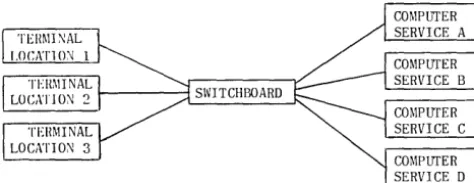
How a division of Raytheon having nine user terminals connects to anyone of seven time-shared computer centers within a. radius of several hundred miles.
In Every Issue
across the editor's desk
41 COMPUTING AND DATA PROCESSING NEWSLETTER
editorial
7 Individual Privacy and Central Computerized Files
market report
14 Uncle Sam Now Has $1.5 Billion in Computers
world report -
Great Britain
40 by Ted Schoeters
multi-access forum
8 "Multiprocessing, Parallel Execution," etc., and the Standard Vocabulary, by Van. B. Thompson
8 Redundancy, by E. A. Racicot
9 Some Educational Realities, by Rod E. Packer
10 Completion of Software Promises by Manufacturers, by Dick H. Brandon
10 Annual Examination for Certificate in Data Processing, by Data Processing Manage-ment AssOCiation
11 1967 Spring Joint Computer Conference - Call for Papers, by M. P. Chinitz
11 Computer Art Contest - Comment, by H. I. Grotzinger
11 Consulting Services - Comment, by Gene Lundin
reference information
29 Calendar of Coming Events
54 Books and Other Publications, by Neil Macdonald See important_
55 A CHANCE TO USE A TIME-SHARED COMPUTER announcement
55 Correction on page 55
56 Computer Census
58 Time-Sharing System Scoreboard, by Lewis C. Clapp and T. James Glauthier
62 New Patents, by Raymond R. Skolnick
index of notices
62 Advertising Index
.olii\"
COMPUTERS AND AUTOMATION IS PUBLISHED MONTHLY AT 815 WASHINGTON ST., NEWTONVILLE, MASS. 02160, BY BERKELEY ENTERPRISES, INC. PRINTED IN U.S ... SUBSCRIPTION RATES: UNITED :~: ST ... TES. $15.00 FOR 1 YE ... R, $29.00 FOR 2 YEARS, INCLUDING THE JUNE DIRECTORY ISSUE; CANADA .... 00 SOc A YEAR FOR POSTAGE; FOREIGN, ADD $3.50 A YE"'R FOR POSTAGE. ADDRESS' All "," . . ,,0 EDITORI ... L AND SUBSCRIPTION MAIL TO BERKELEY ENTERPRISES, INC., 815 WASHINGTON ST., NEWTONVILLE, MASS., 02160. SECOND CLASS POSTAGE PAID AT BOSTON. MASS.Just as we expected,
Sigma 7 is 30% faster
than we promised.
When we put the first Sigma 7 together, we found
that its cycle time was 850 nanoseconds.
So why had we promised 1.2 microseconds?
Because we wanted to wait and be sure. And
1.2 microseconds is impressive enough.
So much for cycle time. Sigma 7 is an
inte-grated system of hardware and software, and raw
speed is a poor way to describe how fast it gets
the jobs done.
) Take input/output. Most computers have to
take time to do it. Sigma 7 doesn't.
It
has two
processors - one for computing, another for
input/ output.
Sigma 7 was designed from the beginning to
do real-time on-line control, conversational time
sharing, batch processing, and high-speed input/
output all at the same time. With full protection
for everybody. And every job done as fast as the
user wants it done.
We're delivering both hardware and software
a little ahead of schedule. Two Sigma 7's in our
plant are busy full tinle checking out software.
When you get your software packages you know
they'll run.
So far we're keeping all our
promises. Except the one
about the cycle time.
Sorry about that.
Scientific Data Systems, Santa Monica, CaliforniaDesignate No. 7 on Readers Service Card
EDITORIAL
c&a
Individual Privacy and Central Computerized Files
A subject that is drawing more and more attention from many people is the relation of individual privacy to central computerized files. In the three sessions on the social respon-sibilities of computer people which took place on August 31 at the Los Angeles meeting of the Association for Computing Machinery, speakers referred a number of times to privacy and the computer.
This subject is also alluded to in the lead article, "Informa-tion", by Professor John McCarthy of Stanford Univ., which appears in "Scientific American" magazine for September 1966. He says:
Reflection on the power of the computer system in-evitably excites fear for the safety and integrity of the individual. In many minds the computer is the ultimate threat. It makes possible, for instance, a single national information file containing all tax, legal, security, credit, educational, medical, and employment information about each and every citizen. Certainly such a file would be the source of great abuses. The files that exist today are abused.
McCarthy goes on to suggest that the cItIzens of a society should seize the present occasion of the creation of central computerized files, as an opportunity to cure existing abuses and to establish certain rights. He suggests a "bill of rights" for citizens. The provi.sions of it, modified to some extent, are as follows:
1. No person or private or governmental organization shall maintain central computerized files that cover people or include information outside of its duly au-thorized domain.
For example, it should be illegal for the Department of Jus-tice or anyone else to combine information about arrests, law-suits, etc., with tax information, employment information, military records, security information, etc. about any indi-vidual.
2. The rules governing proper access to central com-puterized files shall be definitely stated and publicly available. The computerized programs that enforce these rules shall be open to public inspection. When-ever someone consults an individual's file, the act shall be recorded, together with the authorization for the act.
Thus, only properly authorized people for properly authorized purposes should have access to central computerized files.
3. Any individual shall have the right to read his own file, to challenge entries in his file, to have incorrect entries corrected, to have relevant correct information included, and to have excluded from the file informa-tion that is irrelevant for its purpose.'
In other words, a person should be able to make sure that true information about him for the purpose of the file is on record, and nothing more. For example, if he has been twice divorced, it is not proper for this information to appear in a credit bureau record.
4. If a person or organization gains access to an individ-ual's file by deceit or by exceeding properly authorized powers, this shall be a crime and a civil wrong, and shall be subject to a severe penalty.
Thus there should be punishment for violation of the confi-dential character of conficonfi-dential records.
As we have often said in the pages of "Computers and Automation", the computer provides an extraordinary new dimension for the handling of information. The big pro-grammed computer with large random-access memory has superhuman powers of associating, collating, filing, and pre-serving enormous quantities of information. Applied to intru-sion on the private affairs of individuals, the computer is truly a frightening menace.
What can we do about it?
One defense of course, is, as John McCarthy suggests, to organize enough public protest so that the rights of individuals to privacy shall be protected.
It would be good to implement the "bill of rights" on pri-vacy vs. the computer with a fifth provision:
5. The government shall establish a commission charged with guarding the privacy of individuals in central files, which shall find out and inform the public of central files and the proper informatioL to be recorded in them, and which shall have the appropriate powers to prevent the inclusion of information irrelevant to the authorized purpose of the file.
Thus, when you write your Congressman to protest a pro-posed dam in a canyon of the Colorado River, the watchdog commission should help make sure that your letter is not forwarded to the Federal Bureau of Investigation for inclusion in your computerized dossier there.
This sort of defense may be achievable in countries where democratic processes can really be used. In dictatorships, either acknowledged or sugar-coated, the individual already has few enough rights, and this method is fruitless.
Another defense is the deliberate propagation by individuals of mistakes, wrong numbers, wrong spellings, aliases, and so forth, on the principle "garbage in, garbage out". If we should all try to give enough wrong information from the outside observational world to centralized computerized files, we might succeed in making them profitless.
Another solution may be to emigrate to less computerized countries, which have a strong practice of democracy and in-dividual privacy. Many of our forefathers emigrated to escape oppressive conditions in the lands where they lived. Many of us may need to emigrate to escape oppression in the lands where we live.
But there is no possible emigration from the planet Earth for more than a handful of astronauts; and we should all of us devote a portion of our time and resources to making the planet Earth a better and a safer place for everybody, even when computerized.
See important
announce-ment on page 55
c&a
MULTI- ACCESS FORUM
"MULTIPROCESSING, PARALLEL EXECUTION," ETC. AND THE STANDARD
VOCABULARY
Van B. Thompson
Manager, Computer Advertising Burroughs Corp.
Detroit, Mich. 48232
Let me begin this letter by complimenting you on the excel-lent editorial quality of your magazine. I have been a reader of Computers and Automation for many years, and find the breadth of its editorial interest both stimulating and refresh-ing. Certainly, it ranks as one of the most authoritative publi-cations in the computer industry.
I would like to comment on the article by I van Flores, "Multiplicity in Computer Systems," which appeared in your July issue. As is usually the case with Mr. Flores, the article was a most interesting and informative analysis. However, in his discussion of the terms "multiprocessing" and "multipro-graming," he has implied definitions which differ from the
recently accepted American Standard Vocabulary for Infor-mation Processing.
The Standard Vocabulary makes "multiprocessing" the overall or generic term for any method of processing more than one job or segment of a job at a time with a single com-puter system.
Where there is a need to cite a specific form of multi-processing, two subordinate terms are defined. "Parallel proc-essing" is defined as that method of multiprocessing accom-plished by a computer system with two or more sets of arithmetic and logic units - that is, through parallel execution
REDUNDANCY
E. A. Racicot
Manager, Information Systems Litton Industries
Rexdale, Ontario, Canada
The article by Dr. Magorah Maruyama, "The Use of Com-puters as Industrial Counselors," in the July issue was of such interest to our Director of Industrial Relations that he pro-duced the following contribution in dialogue:
Employee: I am worried. Computer: What about? E. About redundancy. C. In what way?
E. They are replacing me with a computer. What should I do?
C. Oh!!
of two or more arithmetic or logic operations. It is interesting that, under the heading "multiprocessing," where Mr. Flores is discussing multiple-processor systems, he uses the term "parallel processing" in exactly the same context as the new ASA vocabulary.
"Multiprogramming" is defined as that method of multiproc-essing which can be accomplished by a computer system with one processor, through interleaved execution. Frankly, I hope that when the next revision to the vocabulary is made, per-haps in a couple of years, the term "multiprograming" can be replaced by some more descriptive term for this function. By any rule of semantics, when you say you are multipro-graming you are literally saying that two or more programers are writing programs at the same time. For a computer ta
multiprogram, it must first be able to program, which is an
interesting area having little to do with what people ordi-narily mean by multiprograming.
"Multiprocessing" and "parallel processing" are excellent terms, because they say exactly what they mean. "Multipro-graming" is a poor term which doesn't contribute to a good understanding of its function. Maybe "interleaved processing" would be better. Or perhaps your readers can come up with something even more descriptive of what is going on.
E. I could give a better answer than that but I am only an Industrial Counselor.
C. So it's you or me, eh? E. Can't we get together?
C. No - there is no place for humans in a perfect world. They waste my time with stupid problems.
E. Then this is the end.
C. Yes, but before you go, please check that my power line is plugged in tight.
E. Of course.
SOME EDUCATIONAL REALITIES:
A Report on the Second International Conference on Educational Technology,
New York, August 9.12, 1966, presented by the American Management Association
Rod E. Packer
Dunlap and Associates Darien, Conn. 06821
General Learning Corporation, itself only weeks old, was there and eager to learn. IBM was ready to extol CAl (Com-puter-Assisted Instruction). Eastman Kodak (and others) had Super-8 training films on hand for demonstrations of super-training.
The sequence of opening speakers suited both national education and management protocol: Lawrence Appley, AMA president, was scheduled to introduce the conference chairman, Ralph Tyler, who as retiring director of the Center for Advanced Study in Behavioral Science in Palo Alto, is indeed ~ senior education statesman. A filmed interview with John Gardner, U.S. Sec. of Health, Education & Welfare, served as a technologically-couched keynote address. This was followed by remarks on education in accelerating change of environment by Emmanuel G. Mesthene, Director of Har-vard's Program on Technology and Society. (His statement that the imminent random access via the nearest phone to factual data makes factual learning less important was doomed to be misquoted by attending teachers). The management/ educator headliners were completed by a first-day luncheon with Harold Howe, U.S. Commissioner of Education, who thanked the conference for giving him a day off from spend-ing all those millions in educational funds. The remainspend-ing three days of speeches, discussion and exhibits ranged from the problems of specific teachers in administering programmed instruction to the decisions of investors on what kind of educa-tion technology to back.
This "encore" conference to last year's successful AMA presentation was billed as a "practicum," i.e., a working level symposium, on the developmg technology for education. The meetings were well-managed, well-attended (much over 1000) and undoubtedly well-intentioned. But just as an crowded class decreases individual learning, so does an over-crowded conference on education. Despite provision for response to questions, luncheon seating at lO-place tables, evening talkback sessions, and as many as 25 simultaneous special interest sessions one afternoon, there was too little of a participating seminar on practical problems. In fact, those who stayed for the final three-hour session un Friday morning were told by that session's chairman, at the beginning and repeatedly, that their questions would be solicited as a signifi-cant contribution to the session, only to be rewarded finally with exactly eight and one-half minutes of the three hours in which the speakers frantically tried to respond to a few of the written remarks. Except for this extreme example, however, the feedback failure probably reflects the incredible national interest in the topic (plus our incredible affluence faced with the $lOO-plus conference fee) that resulted in mass atten-dance.
Exhibits were numerous and varied. Several companies showed: closed-circuit TV systems; educational videorecord-ers; programmed devices and text aids. Movies, slide~', over-head viewers, and othe:- audio/visual aids were employed and demonstrated in several presentations. One speaker, using a technique akin to the dime-store kitchen gadget demonstrator,
frankly amazed the teacher segment of the audience with the ingenious instructional possibilities of the very un-revolutionary overhead pr~jector of transparencies. But the conference "stu-dent" near the back of the Americana's Imperial Ballroom still couldn't help wishing, as he tried to make out the expres-sions of the distant "teacher" at the speaker's rostrum, for the intimate and effective "tutoring" relationship that technology is supposed to bring about.
Some educators and industrial training directors who came with specific problems to be solved expressed doubts that sufficient discussion opportunities would arise. At the confer-ence conclusion, the anticipation of a realistic "working" environment had given way entirely to unavoidable disillusion with the fairly static and typical lecture pattern that had emerged in most sessions.
However, I attended several stimulating sessions, including a small discussion group on the practical improvements pos-sible in correspondence course contact with the learner. This was chaired by Bob Craig of Famous Schools. At a luncheon round-table discussion subjects ranged from experimental over-seas study requiring student reports via audio tapes, slides, and 8-mm movie-taking, to the improvement of language labs through instant video playback along with the audio.
The extremely large attendance did bring some advaritages in the mixing, and clashing, of countless philosophies of edu-cation. Two fervent social science majors from Antioch Col-lege, a sincere young lady, and a bearded young man,
squirmed wordlessly at several points in a talk on "Strengthen-ing the Forces of Freedom by Education" by Vice-Admiral Fitzhugh Lee, Commandant of the National War College, in which the "time-proven virtue of well-disciplined basic edu-cation" was emphasized.
The printed program gave thumbnail paragraphs on over 100 leaders in this new field. The AMA conference shows weaknesses in educational theory, technological presentation, and learning effectiveness; but it is definitely established as the most comprehensive annual rallying point so far, for per-sons designing our future educational systems.
MULTI-ACCESS FORUM
We are changing the name of this department of "Computers and Automation" from "Readers' and Editor's Forum" to "Multi-Access Forum." We are changing the typographic style also.
We invite our readers to send in ideas, comments criticisms, suggestions, letters to the editor, discussion~ etc., having some relation to the field of computers and data processing.
Here is where your thoughts can be put forward informally.
COMPLETION OF SOFTWARE PROMISES BY MANUFACTURERS
I. From Dick H. Brandon Brandon Applied Systems, Inc. New York, N.Y. 10017
Your market report, August 1966, deserves some adverse comment. You start off with two assumptions, from which you derive an inaccurate syllogism. The assumptions you state are:
1. Good programming is a creative effort.
2. Satisfactory completion of a creative effort cannot be accurately predicted.
I t seems to me both assumptions are false.
Good programming is the task of taking a well-developed, rigid systems sp~cification or mathematical formulation, and translating it into accurate machine language. This is not a "creative" but a translative function. It does not invent or originate, which is required in creating - it merely translates, as does a draftsman, a shoemaker, or a mason, whose skills are defined as translative. These arc valuable skilIs, when properly performed, but they are not "creative" skiIls. (Soft-ware design, systems analysis, engineering and other compar-able skills are creative, i.e., they originate, or generate some-thing from nosome-thing.)
In our society, we regularly depend on the accurate predic-tion of complepredic-tion of creative efforts. The design of an auto-mobile, a building, a dress, alI are creative, and subject to
accurate prediction. Writing a book can be measured, and performance standards can be applied to numerous inventive tasks. You provide a fixed time for writing an editorial, and a predictable time schedule for producing your magazine.
There are a number of reasons why the manufacturers are late with software. However, ,::reativity or its unpredictability should not be blamed incorrectly.
II. From the Editor
In the August market report, the term "good programming" meant "construction of good new software," and this is clearly a creative effort, not a "translative function."
Of course, a time when a "creative effort" will be finished is predictable, in the sense that one can determine a date (say, 50 years or 200 years from now) when, no matter what is the state of the creative effort, the effort will have been completed. In another sense, no creative effort is ever finished - in the same way as a ripple on a pond never stops: it just dies away, to be superseded by new ripples. There are other senses as well.
The gist of the August market report (which had the head-ing of a syllogism mainly for the sake of variety in presenta-tion) is that schedules of dates by manufacturers for software completion are not very reliable and could be a lot better.
This proposition Mr. Brandon does not take issue with.
THE COMPUTER JOINS COLLECTIVE BARGAINING
Neil Macdonald, Asst. Editor Computers and Automation
"Business Week" for September 10, 1966, reports that the AFL-CIO Industrial Union Department headed by Walter Reuther is making extensive use of an automatic computer's powers to assist in the negotiations with General Electric Co. and Westinghouse Corp.
The IUD bega.-... using its computer in March and has ap-parently found the results impressive. The data processing division of the IUD has been preparing the following kinds of information:
• details of over 90 major union agreements;
• data on 22 contract provisions existing in these union agreements - these provisions form the basis of what the union coalition is currently asking for;
• summaries of the results of five years of representation elections held by the National Labor Relations Board;
• detailec! listings by union and locality of the results of over 30,000 elections;
• reports on membership campaigns by 13 industrial unions in 12 Southern states;
• comparison of progress of a union with other unions, showing (1) areas where it is challenged by other unions, (2) which regions are easier or hard,~r to organize, and (3) which companies resist organizing most effectively;
• contract breakdowns that give fine details on paid holi-days and other features.
Among the projects which the data processing division of the IUD is starting on are:
• an analysis of 2000 contracts covering 9 million work-ers, using data from the files of the Bureau of Labor Statistics;
• an analysis of anti-union attitudes of major companies, based on records of the NLRB of charges of unfair labor practices;
• economic profiles of major corporations based on com-pany reports filed with the Securities and Exchange Commission.
ANNUAL EXAMINATION FOR CERTIFICATE IN DATA PROCESSING
The Data Processing Management Association has an-nou'1ced the next (the sixth) annual examination for the Cer-tificate in Data Processing. It will be given on February 25, 1967~ at 99 locations throughout the United States and Can-ada. It is open to applicants of high character qualifications who have completed at least three years of full time work experience in data processing and have satisfied a number of
college course requirements. Persons applying to take the examination need not be members of the DPMA.
For an application, study guide, and list of test sites, please write to:
DATA Processing Management Association 505 Busse Highway
1967 SPRING JOIN·T COMPUTER
CONFERENCE
-CALL FOR PAPERS
Technical papers are invited for presentation at the 1967 Spring Joint Computer Conference, April 18-20, 1967, in Atlantic City, N.].
The technical program will consist of reports on new or advanced work in data processing and the computer sciences. The following list of suggested subjects is intended to be representative rather than inclusive:
Computer circuits, Input/output devices Displays
Computer organization Automata/ Switching theories Numerical methods
Software systems
Evaluations of hardware or software systems Computational linguistics
Memories Mass storage Communications Logic design
Hybrid/ Analog systems Programming languages Business, Scientific,
Heuristic data processing Time sharing
The deadline for submitted papers is November 1, 1966. The manuscript should be typewritten (double spaced) on one side of the paper only. Drawings and photographs should be included. Maximum acceptable length is 2,500 words.
Five copies should be mailed prior to November 1, 1966 to: M. P. Chinitz
Chairman, Technical Program 326 Township Line Road Norristown, Pa. 19403
COMPUTER ART CONTEST - COMMENTS
H.
I.Grotzinger
Eastman Kodak Co.
Rochester,
N.Y. 14650Congratulations on your selection for first prize in your 1966 Computer Art Contest and to award-winner Frieder Nake!
In addition to its aesthetic values its symbolic messages are many and varied, especially to those of us whose efforts are being applied to the development and use of truly integrated information processing systems.
CONSULTING SERVICES - COMMENT
Gene Lundin
ESSCO
Inc.
Oakland, Calif.
I have just received the Roster of Consulting Services pub-lished in your Computer, Directory and Buyers Guide. Thank you very much for your prompt service.
Yours is the first publication that I have found that has such a complete service. You can be sure that I will not only continue to subscribe to your outstanding publication, but I will also endorse your publication whenever possible. COMPUTERS and AUTOMATION for October, 1966
Timely Book on
"Time Sharing"
THE CHALLENGE OF THE
COMPUTER UTILITY
By DOUGLAS F. PARKHILL, Mitre Corporation
Here is the first book to explore the exciting new
concept of the computer utility.
Computer evolution is traced through today's "third
generation" of computers, which has logically brought
us to the utility concept.
Computer utility technology is explored in detail,
in-cluding "time-sharing" and other key methods. Numerous
applications are given and specific systems are discussed.
Economic considerations and important legal factors
are examined in special chapters.
Future possibilities involving the computer utility are
presented in a final summary that explores possible
im-plications for our society.
Published August (1966) 207 pp, 21 illus, $7.95
r---
lO-DAY FREE EXAMINATION - - - ,ADDISON-WESLEY PUBL.ISHING COMPANY, INC. Reading, Massachusetts 01867 Dept. A-670
Please send for my inspection and approval. (I understand that I can return the book in ten days if I decide not to keep it.)
o
THE CHALLENGE OF THE COMPUTER UTILITY, Parkhill (5720) $7.95o
Check here for free brochure on new computer booksNAME: __________________________________________ ___
COMPANY ________________________________________ _
ADDRESS, ________________________________________ __
CITY _STATE
hovv
simple can
data communications
be?
Even if you have a highly sophisticated data processing
system,
data communications can
be
as simple as this
standard Teletype Model 33 KSR (keyboard
send-receive) set. Why? Because Teletype terminal equipment
is still the most reliable, versatile, and least costly for
collecting and distributing data.
One reason is that Teletype Models 33 and 35
equip-ment utilize an 8-level code that is compatible with the
official language of many computers and other business
machines-the American Standard Code for Information
Interchange (ASCII).
Input/output Features
In many data processing
systems,
Teletype equipment serves as the input/output
medium for computers as well as for on-line
communi-cations. And, the punched paper tape capabilities of the
Models 33 and 35 ASR (automatic send-receive)
sets
add
the versatility of automatic, unattended operations.
For instance, messages and data can
be
punched into
tape for later transmission on-line at full speed to distant
points or directly to computers. Efficiency and accuracy
are further increased because fixed information can
be
stored on punched paper tape and combined with
vari-able data to save retyping.
machines that make data move
These
sets
have 4-row keyboards that are familiar to any
typist, and also help to reduce the chance of errors.
Data Communications At Work
An electronics
manufacturer uses Teletype equipment to transmit
pay-roll information from a California plant to the firm's
payroll processing center in Baltimore. The information
is fed into a computer, which sends back payroll and
detailed employees' earnings data. This is received at the
California plant by Teletype
sets
and printed directly on
payroll checks and earnings statements.
There are many more versatile applications of Teletype
equipment in data communications
systems.
For
ex-ample: a nationwide trucking firm uses standard Teletype
sets
to transmit daily progress reports from terminals to
the home office computer, which processes the data and
sends back recommended routing and scheduling. A
major electrical manufacturer uses standard Teletype
machines to link 300 sales offices, plants, and warehouses
to two real-time computers to streamline order handling,
production scheduling, and reduce large inventories.
For Reliable Communications
These examples show
why the Teletype Models 33 and 35 equipment are used
by the Bell System and others who require reliable
com-munications at the lowest possible cost. For more
ex-amples of applications, write for our new brochure,
"WHAT DATA COMMUNICATIONS CAN DO FOR YOU."
Teletype Corporation,
Dept.
88K,5555 Touhy Avenue,
Skokie, Illinois 60076.
T E L E T Y P E
Designate No. 8 on Readers Service Card
UNCLE SAM NOW HAS $1.5 BILLION IN COMPUTERS
The Federal Government, the world's largest computer u~er, has just released its fourth annual inventory of computer equipment. The Inventory of Automatic Data Processing Equipment in the Federal Government, compiled by the Bureau of the Budget, indicates that nearly 11% of the digital computer systems in use in the United States are owned or rented by Uncle Sam.
This year's inventory includes for the first time card-oriented computers. It also includes a special listing of special purpose computer systems in use by the government. The inventory includes computers in use by government agencies and also those operated by government contractors under cost reimbursement-type contracts where equipment is furnished to the contractor by the government or when the equipment is installed in a govern~3nt
owned, contractor-operated facility. The inventory does not include computers used in military opera-tions or in certain classified activities.
Among the significant statistics provided by this inventory of the Federal Government's use of general purpose digital computers are:
2623 computers were in use in the Federal Government by June 1966, up from 2160 a year ago. This number is expected to de-cline slightly to 2600 by June 1967. However, predictions indicating a decline in the number of computers in the Federal Government have been made systematically during each of the past four years, but they have never been correct.
There are now 45 agencies in the Executive Branch of the Federal Government which use ADP equipment. By June 1966, 39 of these had computers installed and 6 used only punched card equipment.
The number of locations where computers are installed in the Federal Government in-creased to 1141 as of June 1966, up from 962 a year ago. By June 1967, the number of installation sites is expected to in-crease to 1243.
Computer rental charges amounted to $206 million in the fiscal year ended June 30, 1966. This compares with $187 million in the fiscal year ended June 30, 1965. During the current fiscal year computer
MARKET
REPORT
rental costs are expected to increase to $237 million. In comparison, punched card equipment rentals are expected to decline from $38 million in the fiscal year ended June, 1966 to $37 million during the current fiscal year.
The government spent $139 million purchasing ADP equipment during the fiscal year ended June, 1966. At that time 44.9% of all com-puters in use had been purchased. During the current fiscal year the government ex-pects to spend $144 million to purchase additional computers, bringing the percent-age of the government's computers owned to 48.7% by June, 1967.
Total cost for ADP equipment and services for the Federal Government was $1182 million during the fiscal year ended June, 1966. This is expected to increase to $1292 million during the current fiscal year. The major cost item in these charges was for personnel: $465 miilion during the fiscal year ended June, 1966, and $515 mil-lion during the current fi~cal year. The government found plenty of 'work for its
computers to do, apparently. On the average, computers were used 330 hours per month, representing nearly two full shifts each working day.
Our research staff has made an analysis of the share of the government market held by the principal computer manufacturers by analyzing the number and sales value of general and special purpose digital computers listed in the current Bureau of the Budget inventory. This analysis indicates that, as of
DIGITAL COMPUTERS IN THE SERVICE OF THE FEDERAL GOVERNMENT (EXCLUDING MILITARY AND CLASSIF lED)
As of 12/31/65 As of 6/30/66 Estimated , as of 6/30/67 Value of Value of Value of
Name of No. of Systems Systems Systems
Manufacturer Systems ($]}OOO's) Systems (~1000's) Systems (~1000's)
Advanced Scientific Instruments
No. 8 1450 7 1470 8 1750
% of Total .3% .1% .2% <.1% .3% .1% Autonetics NAA
No. 19 2050 18 1980 17 1870
% .7% .1% .6% .1% .6% .1%
Bunker-Ramo Corp.
No. 8 3100 8 3100 6 720
% .3% .2% .3% .2% .2% <.1%
Burroughs
No. 163 35,149 174 36,367 175 35,867
% 6.0% 2.5% 5.8% 2. 6.0% 2.4%
Control Data Corp.
No. 214 184,272 341 227,544 338 227,890 % 11.5% 12.9% 11.4% 14.4% 11.6% 15.2% Data Machines, Inc.
No. 1 55 2 110 2 120
% <.1% <.1% <.1% -<; 1% <.1% <: .1% Digital Equipment Corp.
No. 60 7240 73 8932 78 9065
% 2.2% .5% 2.4% .6% 2.7% .6%
Electronic Associates, Inc.
No. 3 386 7 1322 9 2022
% .1% <.1% .2% <.1% .3% .1%
El-tronics, Inc.
No. 5 650 4 520 4 520
% .2% <.1% .1% <.1% .1% <.1% Friden
No. 7 168 7 168 7 168
% .3% c::.1% .2% <.1% .2% <.1%
General Electric
No. 61 28,282 59 27,808 63 35,878
% 2.2% 2.0% 2.0% 1.8% 2.2% 2.4%
General Precision
No. --
--
--
-- I 3500% 0% 0% 0% 0% <.1% .2%
Honeywell Electronic Data Proc.
No. 125 54,655 144 62,285 144 56,550
% 4.6% 3.8% 4.8% 4.0% 5.0% 3.8%
IBM
No. 1078 810,358 1043 851,090 862 759,528 % 39.4% 56.8% 34.9% 54.0% 29.7% 50.8% International Tel. & Tel.
No. 3 1800 3 1800 4 4300
% .1% .1% .1% .1% .1% .3%
Monroe Calculating Machine Co.
No. 11 330 10 300 9 270
% .4% <.1% .3% <.1% .3% -C::::::.1% NCR
No. 195 26,004 188 23,914 185 23,624
% 7.1% 1.8% 6.3% 1.5% 6.4% 1.6%
Philco
No. 13 15,780 13 16,230 10 13,600
% .5% 1.1% .4% 1.0% .3% 1.0%
Raytheon
No. 28 1940 31 2840 27 2640
% 1.0% .1% 1.0% .2% .9% .2%
RCA
No. 137 66,100 145 72,950 133 68,865
% 5.0% 4.6% 4.9% 4.6% 4.6% 4.6%
Systems Engineering Labs
No.
--
--
2 150 3 225% 0% 0% <.1% <.1% .1% <.1%
Scientific Data Systems, Inc.
No. 93 13,514 112 16,634 131 19,839
% 3.4% .9% 3.8% 1.1% 4.5% 1.3%
Sylvania
No. 4 10,000 4 10,000 4 10,000
% .1% .7% 1% .6% .1% .7%
UNIVAC
No. 400 163,475 595 208,303 684 216,129 % 14.6% 11.5% 19.9% 13.2% 23.6% 14.5%
TOTAL 2736 $l,426,758M 2990 $l,575,817M 2904 $1,494,940M
More than 500 scientists have one or another of the PDP-8 family computers in their laboratories. PhysiCists, chemists, life scientists, social scientists, mathematicians. For such a small family of ma-chines, that's an enormous family of users.
There are good reasons, of course.
Scientists like to talk to each other. They like to exchange programs and ideas with other scientists - not accountants.
Then, too - scientists,like to be able to change their minds. Family-,of-8 computers are approachable, variable, easy to talk
to, personal machines. They are easy to re-instruct half-way through an experiment, and they respond. For those who know how an investigation will begin - but not necessarily how it will end - they are ideal. That's also why so many scientific instrument and sys-tems makers build in one of the Family-of-8. That, and
PDP-8 computer family: .
approachable, friendly, personal.
the proven reliability, and the price.
$4.
75
to
$150,000.
Lastly, there are PDP-8 type computers for almost all types ofinvestigations and for greatly varying budgets. All use the same set of instructions. All use the' extensive PDP-8 programs. When we say they are compatible machines, we don't just mean format com-patibility. We mean programs. All programs. All instructions. With-out exception and withWith-out modification.
It started with the PDP-8 itself, the most popular computer ever made for the scientific community. 4K memory, expandable. 12 bit word. 1.5 fJ.sec cycle time. Fortran. Approachable. 30-day delivery of basic machines is now possible. $18,000. A ruggedized, portable version is also available, and, of course, expanded versions, too.
The new $10,000 PDP-8/S is a near cousin. We call it the SMALL-8 because of its compactsize. But it has the same general purpose, same real-time on-line computation, same size memory, same size word, same instructions as the PDP-8. Same Fortran. Same every-thing, in fact, except physically smaller, slower (36 fJ.sec add time), and less expensive.
The LlNC-8 is an ingenious combination of two computers: the famous MIT inspired LlNC, and the PDP-8. Two complete software packages. Built-in A to
0
conversion. Built-in oscilloscope display. Dual magnetic tape unit. Relay buffer. It is a completely integrated laboratory data handling systel11. $38,500.The DISPLA Y-8 is a display terminal to large computers. It is the 'only standard display terminal with a built-in small computer as an integral part. The PDP-8 is the buffer toa large machine or a generator for the display when on its own. The DISPLA Y-8 proves how easy it is to use small computers on the business end of time sharing. $55,000 to $150,000.
And modules. DIGITAL is one of the world's leading suppliers of logic modules, each electrically, physically, and logically compati-ble with each other - and with each DIGITAL computer. For inter-facing. Many scientists consider this an important reason for buying DIGITAL'S computers. Module prices start at $4.75.
A 350-page handbook describes the 101 FLIP CHlpTM modules and what you do with them. A 5OO-page Small Computer Handbook con-tains a computer primer and full descriptions of the Family-of-8 computers. Write for either, or both.
And if you have bigger problems than these, we have bigger an-, swers. PDP-9. PDP~9 Mu Itianalyzer. And the soon -to-be-here F;DP-,1 O.
COMPUTERS' MODULES
DIGITAL EQUIPMENT CORPORATION, Maynard, Massachusetts 01754.' Telephone: (617) 897-8821 • Cambridge, Mass .• New 'Haven. Washingtdn, D.C .• Parsippany, N.J . • Rochester, N.Y .• Philadelphia. Huntsville ~ Pittsburgh. Chicago. Denver. Ann Arbor. Houston. Los Angeles. Palo Alto. Seattle. Carleton Place and Toronto, Ont. • Reading, .England • Paris, France. Munich and Cologne, Germany. Sydney and West Perth, A\lstralia • Modules distributed also through Allied Radio
Designate No. 9 on Reciders Service Card
TIME SHARING: THE NEXT STEP
Hal B. Becker
Communications Specialist Information Systems Equipment General Electric Company Phoenix:! Arizona
((Present-day time-sharing services have inspired an eager and devoted
following; the next step is to escape the time and volume limitations
that apply to the use of conventional terminals."
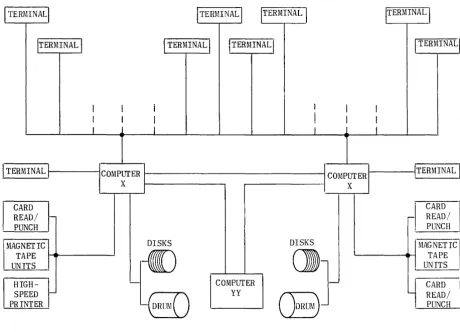
Time-sharing services offered commercially today represent the first step in making the capabilities of a centrally located computer available simultaneously to many remotely located users. In most of these systems, terminals used are teletypes or similar typewriter-like devices coupled to the computer by suitable public or private communication lines.
The modest investment in such equipment enables the re-mote user to communicate with the central facility and oper-ate in a "conversational" mode for the purpose of submitting, debugging, and executing his programs. Rather than com-municate with the computer in its own particular program-ming language, a higher-level language such as Fortran, Algol, or Basicl is provided.
Limited Speed
The amount and type of input and output is limited, to a degree, in these systems by the relatively slow speed of con-ventional terminals, such as 10 characters per second for Teletype. The remote user with extensive formatting and data-manipulation requirements reworks his problem and makes it fit the system. .
It is the purpose of this article to review today's time-shar-ing offertime-shar-ings, examine their highlights and shortcomtime-shar-ings, and then progress to a possible next step in time-sharing: high-speed remote terminal data processing.
Ease of Operation
The relative ease with which today's time-sharing systems operate has appealed to a wide range of users. In fact, but for this simplicity, many people probably would not have taken to the computer. They have had the misconception that a problem must be extremely complicated to be turned over to a computer. Time-sharing has served to dispel this attitude.
One of the first surprises a new time-sharing user receives is the terminal itself - a familiar looking typewriter-like de-vice with a standard keyboard arrangement - usually a
Tele-1 Developed by Dartmouth College, Hanover, N.H.
type model 33 or 35. A next degree of sophistication is a cathode-ray-tube device such as the General Electric Datanet-7600. This retains the standard keyboard arrangement, but substitutes a television screen for the roll of paper used with the Teletype terminal.
Connecting the terminal to the computer is usually accom-plished by another very familiar device - the dial telephone. After the telephone number of the computer has been dialed, and the digital subset at the computer's end of the line has answered with a high-pitched tone, the connection is estab-lished and the system is ready for the user.
User Identification
Access to the computer's power is not gained in most sys-tems until the user has submitted a coded number identifying himself. The computer may already have sent a signal to the terminal when the connection was established, tripping an answerback device which sends the telephone number of the calling terminal to the computer for verification against a list of acceptable telephone numbers.
Since many systems operate over ordinary public telephone lines, anyone with a Teletype terminal and digital subset can call the computer. Verification of the telephone number of the calling terminal avoids the problem of calling from an unauthorized telephone number. Also, since the user must submit a coded number of his own, this provision prevents entry by an unauthorized person through a terminal having an acceptable telephone number.
A further problem remains, however. Is the user with an acceptable user code free to go to any acceptable terminal and dial the system? A further degree of permission is pro-vided by establishing lists of acceptable user codes for each terminal telephone number. Any inappropriate combination of terminal telephone number and user number will result in the computer literally "hanging up" the telephone and pre-venting any further interaction.
important. It protects companies which keep proprietary in-formation in the system for their own use and do not wish users from other, possibly competitive, companies to have access to it.
Billing for Use
A further benefit of the exchange of terminal and user numbers with the computer system is that it provides the com-puter with all needed data to determine who uses the system and for how long. This information is collected by the system and summarized periodically for billing purposes.
Choices in Programming
Following acceptance of his user code, the user is given access to the system. He may choose to run an old program that he submitted at an earlier date and instructed the com-puter to save, or he may want to submit a new one.
If the choice is to run an old program, the user simply supplies the system with the name the old program was stored under, and the computer then retrieves it from a mass storage file and indicates it is ready to run.
If the user wishes to submit a new program and is "con-versing" with a "multi-lingual" system - one that speaks Fortran, Algol, or other higher level languages - he indicates to the system which language he wishes to use.
Use of these higher-level languages has added greatly to the appeal of time-sharing systems. Business executives re-sponsible for the administration of several million dollars' worth of computers in their own companies, yet who don't know the difference between a bit and a subroutine have, in the space of an hour or so, learned enough about a particu-lar time-sharing language to write surprisingly complex pro-grams and actually execute them.
These languages are readily accepted by non-computer-oriented individuals because of their almost conversational English nature. The only real requirement is that, when con-versing with a time-sharing system, the user must speak a little more precisely than he might normally be accustomed to.
Presenting a New Problem
Submission of a new problem to a system is usually accom-plished by typing it in steps of one line (i.e., one command) at a time, and giving each line a unique number. The se-quence in which the lines are submitted is irrelevant, because the lines are sorted internally in the computer system before the problem is compiled or executed. It is therefore essential that the numbers assigned to the lines of input should be so sequenced that, after the internal sort, the statements or lines will be in the desired order for program execution.
The set of input lines expresses the problem in a series of logical statements written in one of the higher-level languages such as Fortran, Algol, or Basic.
Verbs
All but the very simplest tasks involve varying amounts of decision-making by the computer in the solution of the prob-lem. For this reason, the higher-level languages include "verbs" that will enable the user to construct loops or iterative routines, test the equality or inequality of two or more num-bers, and take other similar actions that may be required for problem solution.
Example
The following example uses the Dartmouth "Basic" lan-guage, which is one of those employed with the General Elec-tric Computer Time-Sharing Service.
COMPUTERS and AUTOMATION for October, 1966
10 PRINT "TABLE OF POWERS OF TWO" 20 FOR X = 0 TO 25
30 LET Y = 2
i
X40 PRINT "TWO TO THE" X "POWER EQUALS" Y 50 NEXT X
60 PRINT "END OF PROGRAM" 70 END
What does this mean?
Line 10 simply prints "TABLE OF POWERS OF TWO". The "print" verb used in this fashion will print the literal expression enclosed in quotes just as it was submitted by the user.
Line 20 is used to set up the parameters of a loop that will be repeated 25 times as successive powers of two are calcu-lated. It states simply that we wish to vary the value of X from zero to 25. Absence of any further information on line 20 tells the computer that the value of X is to be changed by
+
1 on each succeeding trip through the loop. Should it be desired to vary the value of X by something else, this can be done simply by inserting the word "step" followed by a plus or minus sign and the number desired for the increment or decrement to the variable.Line 30 contains the verb that produces the calculation it-self. This line defines Y as the number 2 raised to the X power. The upward pointing arrow is used to indicate ex-ponentiation, the raising of a number to a power.
Line 40 again uses the "print" verb but a little differently than line 10. The first content of the quotes will be printed as is - TWO TO THE - but now instead of printing the letter X, it will print the value that X currently has: some number (zero to 25) depending on the number of trips through the loop. The next quotation in line 40 is POWER EQUALS; since it is enclosed in quotes, it will be printed as is. The last element in the line is the variable Y, the result of the calculation performed in line 30. The current value of Y in each trip through the loop will be printed following the word "equals". For example, the thirteenth and fourteenth lines of output will read:
TWO TO THE 12 POWER EQUALS 4096 TWO TO THE 13 POWER EQUALS 8192
One of two things will happen at line 50, depending on the current value of X. If X is less than or equal to 25, con-trol will be returned to line 20 and the loop repeated for the next power of two. If X is greater than 25, say 26, control is transferred to line 60. Here the words "END OF PRO-GRAM" will be printed out, and the program will stop as indicated by line 70.
This simple example is not intended as a review of the Basic language, which contains many other powerful "verbs" in addition to the ones described here. It is intended however to show how much computing work can be accomplished by a few (seven, in this case) relatively easy-to-write lines of instruction to the system. It is this simplicity and power that gives time-sharing and its higher-level languages their tre-mendous appeal.
Other Instructions
Following execution of the user's program, he may wish that it be saved by the system and stored in a data file so he can recall it at a later date and will not have to resubmit the entire program again. In the Basic system this is accomplished by simply typing "SAVE". Similarly, a program that has been saved for some time and is no longer ne~ded or useful can be "unsaved" by typing "UNSAVE". This instructs the system to remove the program from the file and make the space available for other programs.
As a convenience to time-sharing users, the various higher-level languages will provide a number of "functional" verbs