Reliable Computing Service in Massive-scale
Systems through Rapid Low-cost Failover
Renyu Yang,
Member IEEE
, Yang Zhang, Peter Garraghan, Yihui Feng, Jin Ouyang,
Jie Xu,
Member IEEE
, Zhuo Zhang, Chao Li
Abstract—Large-scale distributed systems deployed as Cloud datacenters are capable of provisioning service to consumers with diverse business requirements. Providers face pressure to provision uninterrupted reliable services while reducing operational costs due to significant software and hardware failures. A widely adopted means to achieve such a goal is using redundant system components to implement user-transparent failover, yet its effectiveness must be balanced carefully without incurring heavy overhead when deployed – an important practical consideration for complex large-scale systems. Failover techniques developed for Cloud systems often suffer serious limitations, including mandatory restart leading to poor cost-effectiveness, as well as solely focusing on crash failures, omitting other important types, such as timing failures and simultaneous failures. This paper addresses these limitations by presenting a new approach to user-transparent failover for massive-scale systems. The approach uses soft-state inference to achieve rapid failure recovery and avoid unnecessary restart, with minimal system resource overhead. It also copes with different failures, including correlated and simultaneous events. The proposed approach was implemented, deployed and evaluated within Fuxi system, the underlying resource management system used within Alibaba Cloud. Results demonstrate that our approach tolerates complex failure scenarios while incurring at worst 228.5 microsecond instance overhead with 1.71% additional CPU usage.
Index Terms—Cloud Computing, Resource Management, Reliability, Services, Failover.
F
1
I
NTRODUCTIONL
ARGE-scale distributed systems deployed as Cloud datacenters are composed of thousands of heteroge-neous server nodes capable of provisioning a wide variety of services to consumers with diverse business requirements [1]. Datacenters continue to see increased uptake, represent-ed by a 69% increase of Cloud datacenter traffic to over 5.3 Zettabytes, with over 118 million workloads deployed in 2014 [2]. The core aspect of such system operation is the resource manager, responsible for assigning available re-sources to application requests. Modern resource managers including those in Mesos [3], YARN [4] and Fuxi [5] are used to provision and schedule tens of millions of services daily and are critical for commercial, personal and research pursuits.Dependability is a key concern for Cloud resource man-agers due to increasingly common failures which are now the norm rather than the exception caused by the enlarged system scale and complexity [6] [7] [8], different workload characteristics, and plethora of faults types that can activate. Failures within a resource manager have the potential to cause significant economic consequences to Cloud providers due to loss of service to consumers [9], and could affect services provisioned to millions globally in the event of
• Renyu Yang is with Beihang University, Beijing, China (Email: [email protected]).
• Peter Garraghan and Jie Xu are with University of Leeds (Email: {p.m.garraghan,j.xu}@leeds.ac.uk).
• Yang Zhang, Yihui Feng, Jin Ouyang, Zhuo Zhang, and Chao Li are with Alibaba Cloud Inc. (Email: {xingbao.zy, yihui.feng,jin.oyj, zhuo.zhang, chao.li}@alibaba-inc.com)
• Peter Garraghan is the corresponding author.
Manuscript received Jun 10, 2015; revised Dec 31, 2015; accepted Mar 3, 2016.
catastrophic failures. In this context, fault tolerance is often an effective means in enhancing the reliability of Cloud systems. It can be implemented through a variety of tech-niques, including diversity of data and design, recovery blocks [10] and checkpointing [11]. Within the context of Cloud resource managers, such techniques are required to effectively scale to thousands of servers, with acceptable overhead and impact to system performance. The latter is achieved through user-transparent failover, which is de-fined as a technique to recover a service without noticeable changes to the provisioned service perceived by consumers [12].
correlation among faulty components are obviously inap-propriate for addressing simultaneous component failures. Given the frequency of simultaneous component failures in modern datacenters, as reported in [17] [18], there is an urgent need for innovative methods specifically designed for handling them. Finally, although many fault-tolerant approaches are proposed by academic researchers, they are often limited to small-scale experimentations [19] [20] [21] and simulation [22] [23], resulting in difficulties in validat-ing their effectiveness and understandvalidat-ing their operational constraints and intricacies at scale.
This paper describes a novel autonomous fault-tolerant technique for user-transparent failover in massive-scale Cloud systems. Our approach is composed by a hybrid checkpoint recovery technique that uses a combination of light-weight hard-state and soft-state inference. Specifically, failed components can leverage inferred states from inter-acting components for recovery. This approach allows for demonstrably low-cost checkpoint recovery of components and services, capable of tolerating simultaneous failures of system components, including both crash-stop and timing failures. Through soft-state inference and resource reser-vation, we can achieve minimized running worker evic-tion and maximized fault coverage under different fail-ure combinations. The experimental results show that only microsecond- level additional overhead is imposed during failover for task execution time with a minor increment to system CPU utilization. Component recovery adds at worst minute-level overhead under both single and simul-taneous component failure scenarios. Our approach has been integrated into Fuxi system [5]; a two-level resource management and job scheduling system used in Alibaba Cloud Inc. The technique is deployed within a production Cloud datacenter comprising of over 5,000 servers and 42 millions submitted tasks, and is currently used by Alibaba to handle Internet-scale workloads. The main contributions of the paper can be summarized as follow:
• Design of soft-state inference for component recovery:
We present the philosophy and architecture of a novel approach for component failure recovery that collects and exploits states collected from neighbouring components instead of solely relying on hard-state periodically col-lected from dedicated backup systems.
• Comprehensive solutions to various failure scenarios in modern large-scale systems:Our work investigates vari-ous failure scenarios in detail which are typical in large-scale distributed systems, as well as provides solutions to practical failover for both single and simultaneous com-ponent failures, such as crash-stop and timing failures, in order to increase the failure coverage of the whole system.
• Reduced worker eviction based on state inference and resource reservation:The failure in a master or an agent does not result in automatically its fault-free workers to be evicted. We use state-inference to identify late-timing or inaccessible agents, reducing the overhead of checkpointing, so as to reserve more assigned resources for running workers.
The rest of this paper is organized as follows: Section 2 firstly introduces the challenges and motivation; Section 3 outlines our design philosophies based on the proposed
soft-state inference; Section 4 details the proposed com-ponent failover mechanism and system implementation; Section 5 presents the system evaluation; Section 6 discusses related work; Section 7 discusses the conclusions of this work and future research directions.
2
M
OTIVATIONAn important decision when constructing fault-tolerant sys-tems is to define the fault and failure coverage required to provide correct service. This allows for deployed techniques to achieve the maximum effectiveness of fault tolerance, giv-en the developmgiv-ental and operational resources available. Internet-scale systems are typically composed by hundreds of thousands to millions of heterogeneous and interacting components (e.g. the resource manager, service framework, and computational applications), leading to the manifesta-tion of different types of faults. Faults may occur simultane-ously and in any aspect of system operations ranging from application to hardware, and may have a wide variety of causes, including insufficient memory (OOM), overweight system utilization, performance interference, network con-gestion, server faults (e.g. disk, middleware software), and applications crash or hanging etc [8].
Crash-stop and timing failures are quite predominant in Cloud datacenters [16], resulting in the loss of dependability for provisioned services, as well as noticeable performance degradation. Failures in the critical components, e.g. the Cloud resource manager, significantly affect the reliability of all the services running on the infrastructure. In recent years such events have been reported to cost Cloud providers within the realm of millions of dollars [24]. It is imperative to identify susceptible components and deploy fault-tolerant techniques in order to mitigate the negative impacts.
Apart from the simple re-start of tasks, there are some established methods for software fault tolerance such as re-covery blocks [10], version Programming (NVP) [25], N-self checking programming [26]. Replication is also widely-used, where identical copies of a component are deployed within the system. A replica will become the primary component in the event of component failure through hot, warm, or cold standby [27] [28]. However, it is practical-ly infeasible to apppractical-ly a replication-based method to each component within a system composed of millions of com-ponents and jobs (each composed of thousands of executing tasks). This is due to the significant resource cost incurred, an issue which is further debilitating in periods of compute resource scarcity within the system.
time (hour) 0 3 6 9 12 15 18 21 24
Fuxi Master Hard State Size (GB)
1 1.2 1.4 1.6
(a) Hardstate Checkpoint Size
hard state size (GB)1.25 1.35 1.45 1.55
Percentage of hard state size 0 20 40 60 80 100
[image:3.612.54.288.47.150.2](b) Hardstate Size CDF
Fig. 1. Snapshot state size for hard state checkpointing over 24 hours in a production cluster
takes on average 681ms. In particular, all checkpoints have to be updated fully each time to avoid incorrect state restore and execution, leading to a large number of frequent data transmissions and writes to the permanent store. In fact, although the recovery time from a snapshot is 3.89s on average, the resource manager cannot handle any request during the process of performing snapshots due to state locking. This is unacceptable in practice because modern large-scale distributed applications typically have a require-ment for their requests to be handled within milliseconds [5]. When a system operates in the absence of failures, this approach is particularly inefficient and infeasible.
In order to address the issues we have discussed so far, we present a novel approach in this paper that uses soft-state inference to reduce the overhead of checkpointing, i.e. saving only the minimum amount of hard states into a disk. This is particularly desirable for large-scale distributed systems. Component recovery takes time but our solution offers reasonably rapid recovery with the options of cus-tomisable operations of state inference when needed. Our approach also addresses various failure scenarios in a large-scale system, with the aim to increase its failure coverage and overall dependability.
3
R
ELIABILITYD
ESIGN FORM
ASSIVES
CALE 3.1 Massive-scale System Case:Fuxi SystemBefore presenting our proposed failover approach, it is important to understand the types of components within a large-scale distributed system. To facilitate this, we provide a high-level discussion of the Fuxi system - a resource management and job execution system deployed within Alibaba. Fuxi follows a master-slave architecture composed by three components: the central resource manager (Fuxi Master), the node agent manager (FAgent) per node and application manager (Application Master or AppMaster) per application.
Similar to terminologies in Yarn [4], an application is defined as a single job in the classical sense of Map-Reduce, DAG (Directed Acyclic Graph) or Spark job etc. The AppMaster is responsible for each application-specific execution logic. Different computation frameworks can be implemented on top of Fuxi system and such applications are submitted into the cluster via a client (see step 1 in Figure 2). In Fuxi,FuxiJob(Job for short) is a typical application and each job is composed of running tasks which constitute a DAG. Each node within a DAG represents a task and the edge depicts the pipeline and the data shuffle between two consecutive tasks. Atask is divided into parallel instances
where each individual task instance (the basic logic unit of computation) is executed within an isolated container
worker. Tasks are under the control of the AppMaster, which is responsible for application specific task division, resource request and subsequent task execution.
Fuxi Master is responsible for negotiation between the resource requests from AppMasters, and the available re-sources within the infrastructure. Due to the dynamicity of workload requirements and resource utilization levels within the infrastructure, Fuxi has been implemented to collect resource request and free resource reclaim informa-tion incrementally in order to perform fair and efficient resource allocation. In the occurrence of a specific resource being no longer required by an AppMaster due to the completion of the current execution phase, Fuxi Master is responsible for revoking and rescheduling these resources to another application in a timely manner. After resource requests proposed by different AppMaster are decided, the scheduling responses containing assigned resources will be delivered to each AppMaster. AppMaster can use these resources to determine the concrete computation plan with the specified guaranteed resources. FAgent will then launch requisite computation processes according to this plan.
The Fuxi Agent (FAgent) is an agent that runs on each individual node, and serves two purposes: a) collect infor-mation and status of both available and occupied resources periodically and report them to the Fuxi Master for further resource scheduling decisions; b) ensure that application processes are executed normally within the nodes. The latter is made possible through the aid of the process launch, monitor, and isolation etc. It is noteworthy that for the security control, FAgent launches a worker only when it receives the same amount of granted resource from Fuxi Master and the execution plan from AppMaster.
Figure 2 illustrates how the components above interact with each other: (1)Application Submission: A consumer first submits a request to the Fuxi Master to launch an application (i.e. a MapReduce job) via a job description containing data, detailing the application type, package lo-cation and applilo-cation-specific information; (2)AppMaster Launching: Fuxi Master locates an FAgent with sufficient resources for the AppMaster to launch on, and requests the FAgent to start communication with the AppMaster. Once this communication is established, the AppMaster retrieves the application description and determines the resources requires for the different stages of job execution, including appropriate parallelism, the level of granularity required for allocation and preferred locality of workers etc; (3)
Fuxi Master
FuxiAgent
Worker
FuxiAgent
App Master
Worker
FuxiAgent
App Master
Worker
Worker Worker
App Master
Client
Cluster node m1 Cluster node m2 Cluster node m3
submission
create an AM
lau nch AM
responds granted resources to AM and FAgents
work plan to FAgentList
start worker and instance execution
resource requests
[image:4.612.128.487.44.208.2]start worker and instance execution
Fig. 2. An overview of Fuxi components and the life-cycle of a job submission, resource request, request handling, and worker execution.
Fuxi Master
FAgent Application Master
Utilized and available resources
Permi tted
res our
ces Requested resources for applications Al
loca ted r
esources
Execution worker list
Instance status, planned worker resource allocation
Fig. 3. Soft-state inference applied to Fuxi system components.
restart them in the event of crash failures. Once the worker has finished execution or is no longer needed, the App-Master makes an incremental request to return resources. More details about Fuxi system (operational details and scheduling performance evaluations) can be found in [5].
It is worth emphasizing that this described architecture is applicable to most two-level schedulers. The Fuxi Master, FAgent, AppMaster in our architecture can be implemented as RM, NM and AM in Yarn, and also can be fulfilled as Mesos Master, Mesos Slave, and Framework Scheduler respectively. Therefore, the proposed techniques for compo-nent failover in this paper can be directly applicable within other systems.
3.2 Soft State Inference: Basic Concepts
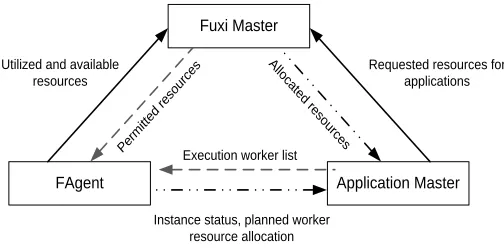
In order to tackle the failover problem at scale, we leverage ahybridapproach for state recovery in order to achieve low-cost component failover. This includes using minimizedhard statesuch as meta-data and information persistently stored within a node locally, distributed file system or distributed coordination service [29] [30]. Furthermore, we present for the first time the concept of recovering failed component state via soft state inference where soft-state is defined as state data that contains run-time component status, not persistently or deliberately stored for purposes of periodical checkpointing. The fundamental concept of soft-state infer-ence (see Figure 3), is that failed components within the system are capable of recovering their states by collecting data which is currently being used by other components
within the system. In essence, we leverage the distributed memory to store each component states which can constitute the overall system states.
Consequently, this mechanism is able to reduce the checkpointing overhead (discussed in Section 2) with min-imal additional overhead from collecting distributed soft states. For example, when Fuxi Master fails, it is able to re-cover the allocated resources from Fuxi Agents whose main function is to launch workers according to granted resource while monitoring the resource status within a physical node. Another aspect of resource soft states is waiting requests, which can be obtained from running AppMasters. Recovery of other components is similar to this process and the arrow in Figure 3 represents the direction of main required states collection of each component.
[image:4.612.50.302.249.374.2]worker initialization and execution are directly controlled by FAgent. These assumptions are widely utilized in all inference-based fault-tolerant techniques.
3.3 Design Considerations for Effective Failover
To maximize service reliability whilst minimizing detri-mental effects to service performance within large-scale systems, we extend Fuxi with Fuxi-FT; containing several fault-tolerant techniques in conjunction with inference to illustrate a feasible design and implementation towards reliable service execution for effective computing systems at scale.
(1) Minimized Worker Eviction: From our experience in massive-scale systems, resource overhead since eviction, and re-computation of non-faulty workers produces a sub-stantial amount of waste as studied in [18] [31]. In addition, long-services are disproportionally affected due to restarting worker execution, leading to suffered QoS. Such behavior results in increased strain on the resource manager, which has to handle more requests and reschedule workers onto nodes, causing reduced component performance as well as increased failure probability. As a result, the first considera-tion and objective of our approach is[C2:] reduced worker eviction by resource reservation. This is achieved through loose-coupling master or agent behavior from its respective workers during execution. Specifically, this entails that fail-ure occurrence of a master or agent does not result in its non-faulty workers to be automatically evicted. For example, to tolerate timing failures, Fuxi Master will attempt to preserve the assigned resource for running workers as if timing-out FAgents or AppMasters are still executing rather than directly evicting and re-scheduling them. In this manner, such faults will have minimal interference with consumers perceived reliability.
(2) Customized Recovery Time Cost with Degraded Service Level: As mentioned previously, the additional overhead cost is mainly dependent on the collection and re-quired boundary of state information completeness. Incom-plete information might appear due to timing-out compo-nents unable to contribute their states in time. The collection time also closely depends on cluster scale, application num-ber, and application-specified configurations. For instance, increased application number signifies a larger amount of states to collect and the requisite time. On one hand, longer waiting time can potentially lead to the mitigation of soft states incompletion, but resulting in extra end-to-end re-covery time. On the other hand, insufficient collection time leads to incomplete states and subsequent degraded service level (such as job extended running time due to worker eviction). Thus, it is necessary for cluster administrators to estimate and customize the information aggregation time,
[C3:] allowing possible tradeoffs between recovery cost and various levels of degraded service.
(3) Comprehensive Coverage of Faults and Handling:
Components within the Cloud resource manager are likely to experience different types of faults ranging from crash-stop to late timing failure, as well as have different un-derlying root causes. As multiple components tend to fail simultaneously and also exhibit correlation, we intend to achieve[C4:] maximized fault coverage from both faults
[image:5.612.313.560.223.335.2]mode and fault handling coverage respectively. Firstly, our approach must be designed to tolerate such occurrences due to the significant detrimental impact to service reliability and performance. This is achieved through expressing si-multaneous component failures as unique failover scenarios compared to single components. Secondly, we divide our approach into separate subsections with the precise means to do so dependent on a given failure scenario. For example, within the context of Fuxi, the Fuxi Master is a more critical component compared to that of AppMaster, requiring differ-ent techniques and precise engineering practices compared to other components when performing state recovery.
TABLE 1
Basic state terms when performing component failover.
Terms Descriptions
ResCap
The capacity or amount of resources that has been admitted to a FAgent and can be used to launch tasks.
FMFullAsgnedResToAM Resources that have been assigned to corresponding AppMasters. FMFullResCapToFA All ResCaps to a specified FAgent
AMFullReqResFromFM Resources that the application still requests and waits for allocation from Fuxi Master.
AMFullAsgnedResFromFM Assigned resource to a specific AppMaster that it uses to execute tasks.
FAgentFullCapFromFM Permitted resource to a specific FAgent that it uses to launch tasks.
4
C
OMPONENTF
AILOVERM
ECHANISM4.1 Single Component Failover Mechanism
In this section we discuss in detail the failover process for single component failure scenario.
4.1.1 Fuxi Master Failover
In the scenario of a failure within the central resource manager Fuxi Master, a three-replica scheme is deployed composed by a primary component and non-active replicas on warm standby (i.e. the replica is deployed and connected to the system, yet does not actively mirror operations per-formed by the Fuxi Master). The primary and replica Fuxi Master are typically deployed on separate physical nodes. In the event of failure within the primary Fuxi Master, the standby master will take over all its functionalities.
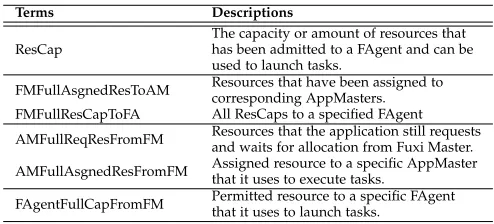
resource bitmap from AppMasters by AMFullAsgnedRes-FromFM, due to the equivalent information provisioned by
FAgentFullCapFromFMwhich has higher DoC[C1].
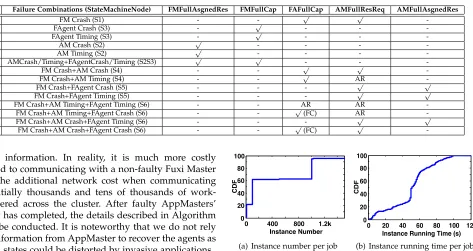
In summarization, the whole failover consists of two phases – (1) information aggregation: Fuxi Master collects the necessary information from both hard and soft state; (2) recovery phase: it repopulates the global resource allo-cation and utilized resources based on aggregated states. According to[C3], we configure the time as 60 seconds for cluster of thousands of machines according to our practical experiences.
4.1.2 FAgent Failover
The FAgent has two different counterplans for performing failover in the event of crash-stop and late timing failures respectively. For crash-stop failures, the FAgent collects soft-state from monitoring data of currently executing instances in real-time and then requests a full worker list from each corresponding AppMaster. This is particularly effective as the FAgent itself does not need to contain any persistent data pertaining to the current node and worker status. FAgent then collects soft-state of permitted resources ( FM-FullResCapToFA) from Fuxi Master before finally completing failover. Additionally, the granted resource is restored from the local checkpoint when Fuxi Master could not provide the information due to a simultaneous failover (see Section 4.2). Due to higher probability of a local checkpointing containing invalid state, it it preferable restore state using information contained within the Fuxi Master if possible.
When performing failover for late timing failures that can cause large amounts non-faulty worker eviction, Fuxi Master will hold the allocated resources for all workers within the node where FAgent fails for a definitive period of time. Meanwhile, the Fuxi Master will send a list of failed FAgents to affected AppMasters, allowing them to reserve the necessary resources until the FAgent recovers.
4.1.3 AppMaster Failover
In the event of crash-stop failures, the AppMaster will restart on the same node, or will be rescheduled to another node in the event of a hardware fault. It is worth noting that failure of the AppMaster does not cause its related workers to terminate (which is advantageous for long run-ning workers that are nearing completion). The AppMaster will recover the hard states from a snapshot including task execution and internal data structures from the distributed file system, enabling reconstruction of the task topology and data shuffle and pipeline between tasks. Events such as task instance terminations or failures recorded by application logs are also leveraged as hard state. During its recovery, soft-state is collected: Fuxi Master will concurrently syn-chronize the allocated resources (FMFullAsgnedResToAM) to the failed AppMaster whilst FAgents report current work-ers’ status, as well as all worker computation plans sent from the application before. If a worker has been completed within the component recovery time period, the AppMaster will identify the worker from the record logs and return these resources to Fuxi Master.
For late timing failures, the AppMaster will be marked as timed out by the Fuxi Master after a configured period of time, resulting in rescheduling onto a new physical node
[image:6.612.314.560.132.286.2]based on FMFullAsgnedResToAM information it holds. In practice, the timeout upper bound could be set as infinite, indicating that the Fuxi Master will wait until the App-Master has recovered. All relevant terms used in the above approaches are summarized in Table 1.
TABLE 2 Algorithm Variables
Variables in FuxiMaster Formalized Description Total FAgent number n
Total AM number m
FAgents set with states A={A1, A2. . . , An}
Granted resource to FAgents Grt=
Grt11 . . . Grt1m
. .
. . .. ...
Grtn1 . . . Grtnm
Resource onithagent tojthapp Grt ij
All Resource tojthapp Grt∗j
AppMasters set with states AM={AM1, . . . , AMm}
AppMaster Requested res in FM Req= [Req1, . . . , Reqm]T
ReqRes on agents ofithapp Req
i= [r1, . . . , rn]
AppMaster Assigned res in FM Asgn= [Asgn1, . . . , Asgnm]T
AssignedRes on agents ofithapp Asgn
i= [a1, . . . , an]
ScheduleUnit (SU) ofithapp SUi= (Asgni, Reqi, Conf ig)
Algorithm 1: Faulty FAgent Recovery, Inference-based De-tection and Resource Reservation
1: Rebooting FAgents setA0andA0⊂A
2: foreachA0iinA0 do 3: Ai←A0
i∪(F AF ullCapF romF M+ checkpoint∆c)
4: end for
5: F uxiM asterstarts failover()
6: foreachAMiinAM do
7: Asgni←updateAssignedRes(AMi)
8: Reqi←updateRequestedRes(AMi)
9: SUi←SUi∪(Asgni, Reqi, Conf ig)
10: end for
11: D=AsgnT−Grt
12: Timeing-out FAgent setAt←∅ 13: foreachD∗jinDdo
14: if||D∗j||0== 0 then
15: At←Aj
16: end if 17: end for
18: F uxiM asterreserves resource onAt
19: F uxiM astersends the listAtto eachAMiinAM
4.2 Multiple Simultaneous Component Failover
With the increased complexity and scale of computing envi-ronments, it will undoubtedly lead to more timing failures and simultaneous fault conditions among multiple compo-nents. Therefore, we design and implement an exception handling mechanism to cope with these failures. We focus on explaining the failure combinations in which Fuxi Master fails, as the non-faulty Fuxi Master could be easily used to facilitate the recovery of any other faulty components rapidly and these can be deduced to single failover cases discussed in Section 4.1.
4.2.1 Fuxi Master and FAgent Failures
collect state provided by the FAgent. To solve this problem, we perform a light snapshot ofFAgentFullCapFromFM. The incremental checkpointing(∆c) is performed once there is a state change within the permitted resources. Consequently, all FAgents are capable of recovering prior to the reboot of Fuxi Master’s recovery phase.
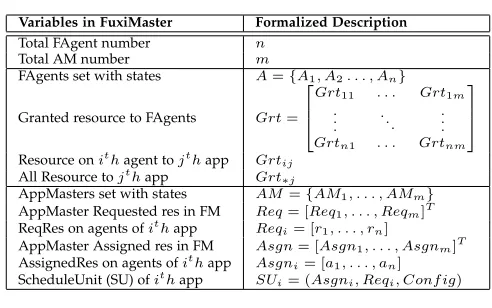
As shown in Table 2 and Algorithm 1, once Fuxi Master commences failover, it first differentiates between inaccessible/timed-out agents and normal agents by ag-gregatingAMFullReqResFromFMfrom Applications Masters and FAgentFullCapFromFM from non-faulty FAgents. This process identifies FAgents which do not recover before completing Fuxi Master failover (line 10-16). We use this state-inference to identify late-timing FAgents instead of frequent checkpoint. This is due to heartbeats and statuses of thousands of agents often change dynamically, resulting in large amount of updating overheads when conducting snapshots. Afterwards, Fuxi Master will reserve the corre-sponding resources for the running workers on the machine experiencing faulty behavior in accordance to[C2]until the FAgents reconnect to the cluster within a configured time period. Meanwhile, a message containing a timeout agent list is sent to all non-faulty AppMasters. The AppMaster then reserves and retains the resource as if the agents are non-faulty. If FAgents are unable to reconnect before a pdefined time threshold, the AppMaster can choose to re-claim the resource from workers by evicting them. In reality, different AppMasters have different policies. For example, a long-running service master tends to wait for the faulty agents to reconnect, attempting to keep workers running as long as possible. However, the AppMaster for short jobs might tend to reclaim the resource and evict workers more rapidly. If FAgent recovers prior to the time threshold, it sends a heartbeat message to the Fuxi Master to report the resource availability.
Algorithm 2: Faulty AM Resource Recovery and Inference-based Resource Reservation in Multi-Component Failures
1: restarted AM set:AM0⊂AM
2: foreachAM0
iinAM0 do
3: AMi←its running workers 4: end for
5: metaAM←AM lightweight checkpoint
6: T imeoutAM ←metaAM−AM
7: foreachAM t0iinT imeoutAM do
8: F uxiM astercreate aM ockSUfor resource reservation
9: M ockSU←synthesize(GrtT
∗i, Def aultReq)
10: SUi←SUi∪M ockSU
11: end for
12: F uxiM asterstarts failover() and collectsAMruntime info
13: re-connected AM set:AM00⊂AM
14: foreachAM00
j inAM00 do
15: F uxiM asterremovesM ockSUand update states withAMj00
16: Asgni←updateAssignedRes(AMj00)
17: Reqi←updateRequestedRes(AMj00)
18: SUi←SUi∪(Asgni, Reqi, Conf ig)
19: end for
4.2.2 Fuxi Master and AppMaster Failures
In general, AppMaster failover is much more light weight and simplistic compared to the Fuxi Master. As a result, it is typically possible to complete AppMaster failover prior to the Fuxi Master commencing failover. As there is no information provided from the Fuxi Master, the AppMaster
FM
Checkpoint Identify
timeout AMs Detecttimeout Fagents Removemocked units
AM1
FA1 AM2
[image:7.612.317.557.43.184.2]FA2 FA3
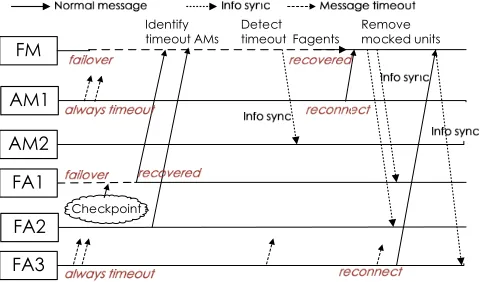
Fig. 4. Failover workflow for Fuxi Master crash, AppMaster timing failure, and FAgent crash or timing failure. In this example, FAgent 1 (FA1) crashes while FA3 experiences a timeout during Fuxi Master failover.
instead uses the status of related workers according to
[C1] in order to restore assigned resource state (see Algo-rithm 2 line 2-4). After the collection phase, Fuxi Master will compare the collected application information with the checkpoint file recording the metadata of applications before rebooting. Fuxi Master is thus able to identify applications that have not reported back and then creates synthesized Schedule Units (MockSU) according to the corresponding granted resource amount from FAgents (line 8). Schedule Unit(SU) is defined as a data tuple (Asgni, Reqi, conf ig)
insideithAppMaster representing requesting and assigned
resource, and other metadata such as priority, quota group etc. SU synthesis could be done based on our pre-condition that the resources granted to running workers on different FAgents can act as surrogates to the amount of allocated resources. Additionally, the MockSU is used to reserve the allocated resource and can not be preempted by design.
Consequently, these SUs assist with synthesizing the o-riginal states of the scheduler, minimizing the occurrence of worker eviction due to application late-time failure caused by timeout during Fuxi Master failover. Afterwards, if the AppMaster reconnects to the system, the Fuxi Master will substitute the MockSU with the real run-time values. If not, Fuxi Master will remove all pertaining SUs and reclaim allocated resources.
4.2.3 Full Component Failure Combinations
It is possible for all types of components to experience failure within a failover period. In order to achieve full fault coverage[C4], we characterize this type of faiure scenario as: Fuxi Master crashes and reboots, with FAgent failing (crash or timing failure) during which (1) AppMaster crashes; or (2) AppMaster timing-out.
TABLE 3
Soft-state information required for each failure scenario. AR = After Reconnect, FC = From Checkpoint
No. Failure Combinations (StateMachineNode) FMFullAsgnedRes FMFullCap FAFullCap AMFullResReq AMFullAsgnedRes
1 FM Crash (S1) - - √ √
-2 FAgent Crash (S3) - √ - -
-3 FAgent Timing (S3) - √ - -
-4 AM Crash (S2) √ - - -
-5 AM Timing (S2) √ - - -
-6 AMCrash/Timing+FAgentCrash/Timing (S2S3) √ √ - -
-7 FM Crash+AM Crash (S4) - - √ √
-8 FM Crash+AM Timing (S4) - - √ AR
-9 FM Crash+FAgent Crash (S5) - - - √ √
10 FM Crash+FAgent Timing (S5) - - - √ √
11 FM Crash+AM Timing+FAgent Timing (S6) - - AR AR
-12 FM Crash+AM Timing+FAgent Crash (S6) - - √(FC) AR
-13 FM Crash+AM Crash+FAgent Timing (S6) - - - √ √
14 FM Crash+AM Crash+FAgent Crash (S6) - - √(FC) √
-resource information. In reality, it is much more costly compared to communicating with a non-faulty Fuxi Master due to the additional network cost when communicating to potentially thousands and tens of thousands of work-ers scattered across the cluster. After faulty AppMastwork-ers’ recovery has completed, the details described in Algorithm 1 could be conducted. It is noteworthy that we do not rely on the information from AppMaster to recover the agents as assigned states could be distorted by invasive applications.
Furthermore, we describe the other scenario where App-Master is experiencing timing failure as depicted in the failover workflow Figure 4. Firstly, Algorithm 2 is per-formed to deal with faulty AppMasters. Apparently, there is a high dependency with the number of the active FA-gents during these resource occupations as the synthesis is conducted primarily based on FAgents’FAFullCapFromFM. Therefore, Fuxi Master will attempt to restore the granted resource to ith application (Grt
∗i) as much as possible.
For example, in Figure 4 the granted resource on FA3 will be temporarily missing as no granted resource information can be provided by the timing-out FAgents. Despite this, workers are able to run as plan without any impact. At the same time, steps described in Algorithm 1 will be conducted to preserve the scheduling resources on faulty FAgents.
Table 3 summarizes the necessary message and required soft-state during the synchronization under different ex-ception scenarios. To capture and characterize all types of simultaneous failures, we leverage the Finite-State Machine (FSM) to describe each failure type and the relationship among different types. In particular, each combination cor-responds to a state in FSM. For the description clarification, we merge analogous states together and the state transitions are illustrated in Figure 5.
4.2.4 System Implementation Using FSM
To apply the proposed mechanism into a production re-source manager, we have developed a fault-tolerant man-agement layer (Fuxi-FT) within Fuxi System and modified the corresponding module to support the proposed failover approach and component interaction message protocol. Components collect and propagate required information collaboratively and suitably by message delivery and re-sponse to perform inference-based resource reservation and rapid component failover.
In Fuxi-FT,EventSensorcan identify which type of event currently is active, based on the combined information of
0 400 800 1.2k
0 20 40 60 80 100
Instance Number
CDF
(a) Instance number per job
0 20 40 60 80 100 120
0 20 40 60 80 100
Instance Running Time (s)
CDF
(b) Instance running time per job
Fig. 6. Workload profiling from one of Alibaba production systems
heartbeat, system status, health checker etc. The incoming event will be registered into a global bulletin board and instantly enqueued into EventDispatcher, waiting for fault handling. In fact, the dispatcher is responsible for identify-ing the fault type of the state, and routidentify-ing the fault handlidentify-ing request to relevant handlers. In Fuxi-FT, each handler is im-plemented and applied in hot-plugging manner. The tech-niques discussed above are used to handle different scenar-ios accordingly. For example, once the ceasing of periodical FAgent heartbeat is detected,FAgentTimingFailureevent will be generated. The dispatcher will trigger the corresponding FAgent recovery process (discussed in Section 4.2.1) upon receiving the event. After the failover process completes, the current state will be transit into the subsequent state according to the FSM depicted in Figure 5.
The proposed approach can be easily integrated into other two-level scheduler such as Mesos and Yarn system etc. In reality, there are no fundamental difference between basic concepts, architectural design etc., resulting in a direct mapping relationship among them. For example, Fuxi Mas-ter and FAgent correspond to the RM and the NM in Yarn. Therefore, soft states could be interchanged and propagated by suitably piggy-backing on the RM and NM heartbeats. The RM could also be changed adaptively to satisfy the AM transparent failover functionalities.
5
S
YSTEME
VALUATION5.1 Evaluation Setup
S0 FM Faults S1
S2 AM Faults
S3 FA Faults
S6
S4 FA Failover S5
AM Failover
FA Faults AM Failover
FM Failover AM Faults
FA Failover
FM Failover
FM Failover
AM Faults
FA Faults
AM Failover
FM Faults FA Failover
[image:9.612.95.521.45.196.2]FM Faults
Fig. 5. Fuxi-FT Finite-state machine (FSM): Nodes represent simplified system failure states. S0 is the normal system state and S6 describes a system state where multiple and simultaneous failures occur. Each edge represents a failure event in solid line or a failover process in dashed line.
a large-scale cluster under a number of different failure scenarios and deployed failover techniques.
Before presenting experiments, we conduct workload profiling from a production system which consists of over 2,400 machines. According to Figure 6, roughly 20%, 45% and 35% of all jobs contains 10, 100 and 1,000 instances, re-spectively. In addition, the average running time is approx-imately 50 seconds. Thus, we submit these small, medium and large jobs according to the above proportion with each instance executing for 50 seconds and requesting 0.5 CPU cores and 1 GB memory. 4,000 jobs were submitted onto a cluster comprising 300 nodes, while keeping the number of active jobs approximately 2,000 (i.e. Once a job has completed execution, an additional job is submitted onto a node). Each physical node contains 82GB memory, and 23 cores for CPU, and each AppMaster process consumes 100MB memory. Additionally, the types of fault-injection selected for the experiments are crash faults of software and interrupt faults (transient time-out). Each of these experiments are separated into two categories for single component and multiple component failure scenarios. For the former, for every fault injection, either the Fuxi Master, or 5% of the total AppMasters, or 5% of FAgents will be stochastically selected to fail. For the latter, the Fuxi Master and 5% of other components(AppMasters or FAgents) will experience simultaneous failure. In reality, as studied in [17], failures occur much less frequently than specified injection interval, and also affect less component that the specified component failure proportion. Each experiment case also included a different deployment for failover for both Fuxi Master(FM) and AppMaster(AM) as shown in Table 4. They were divided into no failover technique deployed (NoFO), FM failover with no AM failover (FMFO), AM failover with no FM failover (AMFO) and finally our approach which allows all components to failover (Fuxi–FT).
Faults were injected every 300s by sending a light-weight command to terminate/interrupt the execution of specific components. Each experiment observation period is defined as the completion of all submitted jobs into the cluster, and the following metrics of interest were collected for study: (1) Job Performance: impact on job execution, job end to end span-time, instance eviction etc; (2) Component Recovery Time: time required to perform failover; (3) Cluster Resource
Utilization: entire cluster utilization and scheduling perfor-mance.
TABLE 4
Experiment cases for failover effectiveness
No Faults (Baseline) Our approach(Fuxi-FT)
Fault Injection (single component & concurrent multiple component faults)
Our approach(Fuxi-FT)
FM failover; no AM failover (FMFO) no FM failover, AM failover (AMFO) no FM failover; no AM failover (NoFO)
5.2 Fuxi-FT Component Failover Evaluation
5.2.1 Job Execution Results
Table 5 shows the number of jobs submitted and the to-tal number of unique instances for each experiment. It is observable that all jobs are able to successfully complete and that 2,115 and 2,101 instances (approximately 0.13% of all tasks) are re-scheduled under single component and simultaneous failure injection, respectively. Furthermore, we can observe a minimal increment in the instance exe-cution overhead, increasing by 7.79 microseconds (6.4%) on average between the baseline and the single fault-injection job execution. In contrast, the overhead of instance execu-tion for simultaneous fault-injecexecu-tion is substantially larger, increasing by 228.5 microseconds (200.5%).
The overhead within the baseline experiment of 113.97 microseconds is due to process initialization and network communication establishment with FAgent and correspond-ing AppMasters, while the enlarged overhead in the fault-injection experiments is due to the failed components re-quiring to perform state recovery, occupying more handling and scheduling time for routine instance management. In addition, updating instance status can be delayed due to the extra CPU cycles that are required to finish the holistic computation. The phenomenon is aggravated when simulta-neous faults are injected. Despite this, it is worth noting that this additional overhead is substantially smaller compared to an instance’s execution time.
5.2.2 Cluster Utilization
TABLE 5
Statistical properties of job and task execution for Fuxi-FT under different failure scenarios.
No Faults (baseline) Fuxi-FT with single componentfault injection multiple component fault injectionFuxi-FT with simultaneous
Job Category Job Category Job Category
Small Medium Large Total Small Medium Large Total Small Medium Large Total
Submitted 807 1789 1404 4000 812 1806 1382 4000 803 1807 1390 4000
Completed 807 1789 1404 4000 812 1806 1382 4000 803 1807 1390 4000
Failed 0 0 0 0 0 0 0 0 0 0 0 0
Instance Category Instance Category Instance Category
Submitted 8070 178900 1404000 1590970 8120 180600 1382000 1570720 8030 180700 1390000 1578730 Completed 8070 178900 1404000 1590970 8120 180600 1382000 1570720 8030 180700 1390000 1578730
Rescheduled 0 0 0 0 10 258 1847 2115 17 148 1936 2101
Resched Ratio 0 0 0 0 0.12% 0.14% 0.13% 0.13% 0.21% 0.08% 0.14% 0.13%
Overhead (us) 119.91 112.96 113.42 113.97 121.53 121.72 121.58 121.76 341.49 341.93 341.44 342.37
Execution time(s)
CPU
Util
iz
a
tion
(%)
(a) CPU usr
Execution time(s)
Me
m Utili
za
tion
(kb
s)
(b) Mem utilization
Execution time(s)
Disk
Utiliz
a
tion
(%)
(c) Disk utilization
Execution time(s)
T
CP Es
tablishmen
t
(d) Network utilization
Fig. 7. Average cluster resource utilization of no fault and fault-injection with Fuxi-FT. (a) CPU utilization, (b) memory utilization, (c) disk utiliza-tion, (d) network utilization.
[image:10.612.55.516.64.404.2]utilization and TCP Establishment between the two experi-ments demonstrated statistically at less than 1% difference, and presented visually in Figure 7(b-d). This is because when component failover commences, the transmitted soft-state amount to required component is approximately e-quivalent to routine message communication amongst dis-tributed components. In fact, these components send heart-beats to each other, and synchronize the full knowledge and information periodically in typical operation. The periodic synchronization is the fundamental safeguard for the pro-posed failover mechanism. Moreover, we observe that in the presence of faults, the cluster utilization of CPU increases by 1.71% representing an average disparity of 46.56% between the baseline and fault-injection experiments. This is because the failover mechanisms are required to perform computa-tion to collect and transmit states in order to perform state inference recovery. We also observe from Table 6 that the request handling performance is not negatively impacted by our proposed approach and the average scheduling per-formance can be maintained during the soft-state inference. This is a significant improvement compared to the pure hard-state recovery we discussed in Section 2.
TABLE 6
Statistical properties of cluster resource utilization and scheduling performance to handle resource requests.
Baseline Fault-Injection Difference Resource Avg St. Dev Avg St. Dev Avg Diff
CPU(%) 3.67 0.59 5.38 2.15 46.56%
Mem(KB) 99168 15.18 99179 16.70 0.01%
Disk(%) 14.07 3.03 14.20 2.30 0.96%
TCP est(times) 401747 83453.04 411846 70529.68 2.51% ReqHandle(ms) 0.884 0.56 0.886 0.571 0.23%
5.2.3 Component Recovery Time
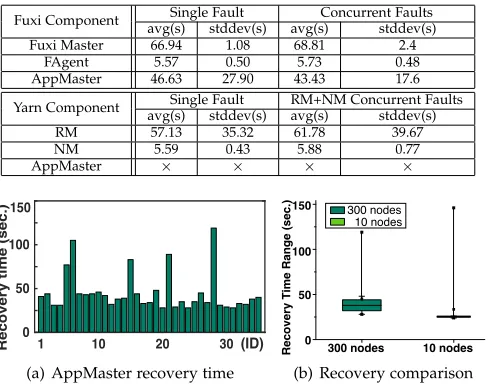
As illustrated in Table 7, Fuxi components exhibit different recovery times. In single fault injection experiments, Fuxi Master and FAgent recover on average within 66.9 seconds and 5.6 seconds, respectively, as well as exhibit stable re-covery times indicated by a Coefficient of Variation(CoV) smaller than 0.1. FAgent recovery time is relatively short, as it requires minimal soft-state collection from other compo-nents within the cluster as described in Section 4.1, and up-on recovery will collect mup-onitoring data from the physical node it is executing. On the other hand, the recovery time of Fuxi Master is considerably longer, which is due to its pre-configuration within the cluster. In our experiment, Fuxi Master is configured with a waiting period of 60 seconds, with best efforts for all FAgents and AppMasters to report their status and collated data, indicating that the active Fuxi Master is capable of failover within 7 seconds. This result indicates that the recovery time could be reduced considerably if alterations are made to the waiting time for information aggregation phase, and the detailed customized configurations are disucussed in Section 3.3. Furthermore, we also observe that simultaneous fault injection scenarios share a similar recovery time with single fault behavior, at 68.81 seconds and 5.71 seconds on average for Fuxi Master and FAgent respectively. It demonstrates that our approach will not incur extra overhead while providing transparent fault handling in terms of component recovery time. Compared to the pure hard-state recovery, soft state inference does take time. Nevertheless, the recovery could still complete within seconds-level with the same failover effects, thereby being soundly accepted.
TABLE 7
Component recovery time under different failure scenarios and the comparison between Fuxi-FT and Yarn
Fuxi Component Single Fault Concurrent Faults avg(s) stddev(s) avg(s) stddev(s)
Fuxi Master 66.94 1.08 68.81 2.4
FAgent 5.57 0.50 5.73 0.48
AppMaster 46.63 27.90 43.43 17.6
Yarn Component Single Fault RM+NM Concurrent Faults avg(s) stddev(s) avg(s) stddev(s)
RM 57.13 35.32 61.78 39.67
NM 5.59 0.43 5.88 0.77
AppMaster × × × ×
1 10 20 30
Recovery time (sec.) 0 50 100 150
(ID)
(a) AppMaster recovery time
150
0 50 100
Recovery T
ime Range (sec.)
300 nodes 10 nodes
300 nodes 10 nodes
(b) Recovery comparison
Fig. 8. (a) AppMaster recovery time under single component fault in-jection experiments; (b) Recovery time comparison using box-plot with 25th,75th percentile, min, max
additional complexity in synchronizing those worker data. This behavior is exemplified when comparing AppMaster recovery time within a smaller cluster consisting of 10 nodes and 400 jobs as shown in Figure 8(b), resulting in an average recovery time of 33.4 seconds (19.7% increase) under fault-injection. Such a result indicates that the locality of workers within physical nodes contributes to the extra recovery time.
5.3 Recovery Effects Using Yarn
To make a more comprehensive comparison, we conduc-t similar experimenconduc-ts using Yarn wiconduc-th same clusconduc-ter and same job submission configurations. The experimental re-sults show that all jobs will fail if AppMaster and other components fail at the same time. In fact, Yarn does not support the case that AppMaster failovers during Resource-Manager(RM) and NodeManager(NM) fail simultaneously. The recovery effects are shown in Table 7. The NM recovery time in single fault injection is 5.59 seconds on average and will have a slight increase to 5.88 seconds if RM fails simultaneously, reflecting similar recovery times compared to FAgent. It is worth mentioning that we find drastic fluctu-ation in recovery performance for RM between 21.4 seconds to 91.6 seconds. This huge variation is attributed to not using a configurable wait-time to collect states at the begining of RM recovery. In some scenarios where an active AM states fail to re-sync with RM, RM has to wait for a relatively long time, resulting in a very slow component recovery. This design is also strongly related to the submitted job number. The more jobs submitted, the higher probability of recovery extension will be. In fact, we regard the Yarn’s strategy as a more common mechanism that does not support AM failover, and will have a more detailed comparisons in next subsection.
5.4 Comparison among Different Failover Mechanisms
In this section, we inject simultaneous faults under four system failover techniques described in Table 4 in order to
study and compare job executions, end-to-end job comple-tion time (JCT) under simultaneous fault injeccomple-tion scenario. As shown in Table 8, Fuxi-FT can guarantee comple-tion of all jobs under both single and simultaneous fault injections. During job executions, all task instances can obtain the requested resource and finally finish computa-tion despite a small proporcomputa-tion of re-scheduled instances. Moreover, there is merely a negligible change of resched-uled instances between the single and multiple injection experiments. This is because in our approach, Fuxi Master attempts to retain already assigned resources by preserving temporarily resources from failed components. A number of AppMasters with a pre-defined upper-bound for timeout will hold respective resources without evicting any running workers. Beyond the threshold, AppMasters will reclaim the resources to Fuxi Master, and then request for new resources re-scheduling when facing with timing failures mentioned in Section 4. Such results demonstrate that all jobs will complete execution using our proposed approach in Fuxi-FT. In reality, faults which cause 5% of components to fail occur much more infrequently than every 300 sec-onds as observed in [17], as specified in the fault-injection experiment. The conducted experiments demonstrate that even under aggressive fault-injection, it is still possible to provision reliable services to consumers.
Additionally, it is also observable that if AppMaster is unable to automatically failover, a large number of running jobs fail, causing a significant amount of computation waste and extension to job completion time holistically within the system. In fact, 8.33% jobs eventually fail while only 92.16% task instances finish as plan. Although the rescheduled instance ratio appears to be reduced due to many direct interruptions after job failure, the large proportion of killed job is a severe threat to reliable services provisioning.
We also conduct experiments to switch off the capability for the central scheduler (Fuxi Master) for fault recovery but allow AppMasters to failover independently. In this scenario, the crash-stop failure on Fuxi Master will lead to eviction of all running non-faulty workers. Consequently, all running task instances have to be resubmitted and wait for rescheduling. The AppMaster will also be rescheduled to another location after the Fuxi Master revives. As illustrated from Table 8, the rescheduled instance number are approx-imately 3x greater times than Fuxi-FT. Indeed, over 4,000 extra rescheduled instances are just incurred by the absence of Fuxi Master effective failover. All comparable results are demonstrated in Figure 9 in terms of completed job number, instance completion ratio and the corresponding rescheduled instance proportion discussed above.
TABLE 8
Statistical properties of job and task execution within failover approaches for different failure scenarios
Single Component Fault Simultaneous Component Fault
Fuxi-FT Fuxi-FT FMFO AMFO NoFO
Job Category
Submitted 4000 4000 4000 4000 4000
Completed 4000 4000 3667 3978 0
Failed(%) 0 0 333(8.33%) 22(0.55%) 4000(100%)
Instance Category
Submitted 1570720 1578730 1575400 1589170 1572450
Completed(in submitted %) 1570720(100%) 1578730(100%) 1451830(92.16%) 1580490(99.45%) 0 Rescheduled(in Completed%) 2115(0.135%) 2121(0.134%) 757(0.052%) 6678(0.423%) 1572450(100%)
Fuxi-FT Fuxi-FT FMFO AMFO Completed job number 0
2000 4000
(a) Completed job number
Fuxi-FT Fuxi-FT FMFO AMFO
Completed instance ratio 0
0.2 0.4 0.6 0.8 1.0
(b) Completed instance ratio
Fuxi-FT Fuxi-FT FMFO AMFO
Rescheduled instance ratio 0
0.2 0.4 0.6 0.8
1.0 Single fault
Multiple faults
[image:12.612.349.523.314.442.2](c) Rescheduled instance ratio (unit: %)
Fig. 9. Under the multiple concurrent component fault injections, (a) completed job number comparison (b) completed instance ratio within the submitted instances. (c) rescheduled instance ratio within the completed instances.
fair scheduling). Other jobs have to wait for resources until the resource is reclaimed from running tasks.
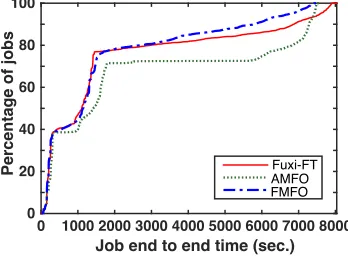
In general, the job execution time in AMFO is greater than FMFO and the proposed Fuxi-FT as a large number of task evictions and re-schedulings occur after the Fuxi Master crash-stop failure. All these computations have to be restarted from the very beginning, resulting in serious execution delays. As for jobs in FMFO, the completion time distribution of approximately 80% jobs almost coincides with Fuxi-FT jobs. However, waiting jobs could obtain the resource much faster than Fuxi-FT jobs. The reason for this observation is due to the large amount of resource revoked from the failed jobs and these resources could be instantly utilized by the waiting instances, thereby shortening the holistic completion time.
Without autonomous failure recovery techniques, no jobs and its tasks can tolerate and recover from component failure. As shown in Table 8, any running worker will be killed upon any master failure. Even more debilitating, the worker which runs the master will also be killed, resulting in all instance eventual failures. In general, these catastrophes are very atypical as the adopted fault injection scenario is so harsh that few probabilities exist in real-life systems. However, increasingly complicated scenarios and urgen-t problems in Inurgen-terneurgen-t-scale sysurgen-tems subsurgen-tanurgen-tially inspire both engineering and academic aspects to impel the rapid improvement of fault-tolerance techniques.
6
R
ELATEDW
ORKFault-tolerance in resource management has been studied for many years within different distributed systems and could be coarsely divided into categories: forward-based recovery and backward-based recovery [16], both of which adopt the redundancy to mask residual design faults of soft-ware programs. Forward recovery produces correct results through continuation of normal processing and a classical approach is the N-version programming scheme (NVP) [25]
Job end to end time (sec.)
0 1000 2000 3000 4000 5000 6000 7000 8000
Percentage of jobs
0 20 40 60 80 100
Fuxi-FT FMFOAMFO
Fig. 10. CDF of job completion time under different failover techniques.
which is actually a n-modular redundancy. However, the main limitation is that it is highly application dependent. In comparison, backward recovery make the process restarted according to the last saved states upon failures. In fact, in order to achieve this, checkpointing involves occasionally saving the state of a process in stable storage during normal execution. This can thus reduce the amount of lost work. Checkpointing and recovery is mainly intended to tolerate transient hardware failures, where the application is restart-ed upon repair of a hardware unit after failure and is also used as a backward error recovery technique for handling intermittent software faults.
tasks. In fact, the resource requests and allocations of these tasks are determined in advance and will not change during its life-cycle. The number of tasks is also not large com-pared with available resources, making sufficient resources to conduct redundant checkpointing. VM-based snapshot [36] [39] [40] focuses on the de-duplication and recovery for the large amount of memory and disk states in runtime. In general, above systems achieve effective resource schedul-ing and management by large backlogs of pendschedul-ing work – an assumption which cannot be adhere to the on-demand access required for Cloud computing. Considering the large cost for millions of running tasks, it is infeasible to conduct them in Internet-scale systems.
Furthermore, we mainly focus on the most relevant approaches within the context of large-scale distributed systems. There have been a number of studies that analyze Cloud datacenters tracelogs [41] [42] [43] [44] exemplifying the degree of inherit heterogeneity of workload and server architectures within the system environment. Furthermore, [17] demonstrates the frequency and manifestation of fail-ures, while [45] studies task re-computation waste per serv-er and [31] quantifies produced enserv-ergy waste.
YARN [4] adopts a request-based resource allocation scheme. Similar to Fuxi, Yarn has the similar component: Resource Manager(RM), Application Master(AM) and Node Manager(NM). RM only recently becomes fault-tolerant s-ince Hadoop 2.6 [14] [15]. In particular, the works could be preserved when the RM and NM restarts. RM repopulates running states by taking advantage of the container statuses sent from all NMs and pending requests resent from AMs. As for the NM, the NM currently stores all necessary states to a local state-store as it processes container-management requests. When the NM restarts, it recovers by loading state for various subsystems. However, even though the contin-uation of containers without restart, the current protocol in RM does not support AM failover. In fact, although the NM reports real-time failure statuses of AMs to RM, RM revokes the pertaining resources without reserving the allocated resources to affected AMs. Moreover, containers on timing-out NM which comes in late during the RM restart will also be killed. Due to these limitations, only RM and NM crash simultaneous failure could be covered by Yarn. In com-parison, this paper systematically describes comprehensive solutions and achieve a full coverage of simultaneous failure scenarios of all components, and they could be applied into any massive-scale resource management system.
Mesos [3] provides an offer-based mechanism in which the primary master is responsible for assigning resources to each computing framework. Of relevance to this work, while the mechanism deploys a warm-standby failover mechanism, the architecture does not include fault-tolerant schemes that can be applied to applications running within system nodes, leaving such responsibility to individual con-sumers. Our approach provides a full-components failover solution for all sorts of fault combinations.
Borg [37] is the cluster management system with-in Google. The central Borgmaster gathers resource-availability information from nodes, accepts applications resource requests, and matches one to the other. Borg uses techniques such as replication and persistent state storing to deal with faults including task preemption and reallocation,
machine failure or shutdown etc. In order to improve the availability, Borg primarily focuses on how to cope with machine-level hardware breakdowns. However, the infor-mation on failure treatment is extremely limited, with only brief examples of practical experience described. Addition-ally, the scarcity of any experimental evaluation make it difficult for researcher to analyze and compare with their methods. Borg might take occasional (full state) checkpoints when appropriate. By contrast, we present an approach for rapidly low-cost failover, in which light-weighted check-points ensure much lower overheads of hard state storing (than full state saving) and soft-state inference facilitates the state re-construction. We also describe how to avoid running workers suffering from simultaneous faults combinations with a comprehensive faults coverage. In terms of recovery efficiency, Borg briefly states the failing-over takes about 10s, but can takes up to a minute in a big cluster. In our paper, our approach is able to complete a recovery (using re-constructed full state) within seconds but less than a minute. Fuxi-FT can also perform much quicker failover (using incomplete state) when a degraded service level is acceptable.
Sparrow [46] adopts randomized-sampling based decen-tralized schedulers and aims to process short jobs. Frame-works that use the failed scheduler have to detect the failure and connect to a backup scheduler themselves. Due to no state persisted to disks, the in-progress jobs have to be restarted. Apollo [13] uses distributed schedulers to achieve scheduling scalability. However, it marks the job failed and all running tasks in the queue will be evicted once the node agent failovers. All these motivates us to design and implement full component failures recovery approaches.
7
C
ONCLUSIONSIn this paper, we have presented a novel approach for imple-menting fault tolerance in large-scale Cloud datacenters by means of rapid user-transparent failover. Effective recovery of system components is achieved through a combination of hard state backup and soft-state inference, thereby reducing the recovery overhead significantly. Our design and archi-tecture also take into account the scale and complexity of a Cloud datacenter and cope with different types of failure and failover scenarios. The method has been deployed and validated by Alibaba in their live production environment under different failure scenarios. The main conclusions from our research are summarized as follows:
State-based failure recovery is typically expensive and costly in large-scale distributed systems.We have demonstrated that the combined use of hard state and soft-state inference is in fact an effective and efficient means to achieve failover in such systems. The recovery overhead to instance execution time in our system is limited within 7 microseconds and 228.5 microseconds in the presence of single and simultaneous component failures respectively, with a minimal increment to system CPU utilization.