2-[(4-Bromobenzylidene)amino]ethanol
Vashen Moodley and Werner E. Van Zyl*
School of Chemistry and Physics, University of KwaZulu-Natal, Westville Campus, Private Bag X54001, Durban 4000, South Africa
Correspondence e-mail: [email protected]
Received 18 October 2012; accepted 23 November 2012
Key indicators: single-crystal X-ray study;T= 173 K; mean(C–C) = 0.005 A˚; Rfactor = 0.025;wRfactor = 0.059; data-to-parameter ratio = 14.6.
In the crystal structure of the title compound, C9H10BrNO, molecules are linked via O—H N hydrogen bonds of a moderate strength between the hydroxy groups and the imine N atoms. These hydrogen bonds, as well as the planes of the bromophenyl rings, are situated in alternating planes parallel to (013) and (013). In addition, there are weak C—H interactions in the structure.
Related literature
For previous work on the preparation of imine-based ligands, by our group, see: Williamset al.(2007). For related structures and their preparation, see: Elslageret al.(1956); Vennilaet al. (2010); Jafarpouret al.(2011). For imines, see: Morrisonet al. (1987); Tidwell (2007) and for their biological activity, see: Solomon & Lowery (1993); Fioravanti et al. (1995); Malli-karjun & Sangamesh (1997); Samadhiya & Halve (2001); Gerdemannet al.(2002); Veverkova´ & Toma (2008); Khanet al. (2009). For classification of hydrogen bonds, see: Gilli & Gilli (2009).
Experimental
Crystal data
C9H10BrNO
Mr= 228.09
Monoclinic,Cc a= 22.349 (4) A˚
b= 6.0328 (10) A˚
c= 7.3673 (12) A˚
= 107.980 (3)
V= 944.8 (3) A˚3
Z= 4
MoKradiation
= 4.30 mm1
T= 173 K
0.360.150.02 mm
Data collection
Bruker Kappa DUO APEXII diffractometer
Absorption correction: multi-scan (SADABS; Sheldrick, 2008a)
Tmin= 0.305,Tmax= 0.919
1651 independent reflections Rint= 0.035
Refinement
R[F2> 2(F2)] = 0.025
wR(F2) = 0.059
S= 1.00 1651 reflections 113 parameters 1 restraint
H atoms treated by a mixture of independent and constrained refinement
max= 0.71 e A˚ 3 min=0.45 e A˚ 3
Absolute structure: Flack (1983), 788 Friedel pairs
Flack parameter: 0.022 (12)
Table 1
Hydrogen-bond geometry (A˚ ,). Cg1 is the centroid of the C1–C6 ring.
D—H A D—H H A D A D—H A
O1—H1 N1i 0.97 (3) 1.83 (3) 2.791 (4) 172 (4) C2—H2 Cg1ii
0.95 2.83 3.58 (3) 137 C5—H5 Cg1iii
0.95 2.79 3.512 (3) 134
Symmetry codes: (i)x;yþ1;zþ1
2; (ii)x;yþ1;z 1
2; (iii)x;yþ2;zþ 1 2.
Data collection:APEX2(Bruker, 2006); cell refinement:SAINT
(Bruker, 2006); data reduction:SAINT; program(s) used to solve structure:SHELXS97(Sheldrick, 2008b); program(s) used to refine structure: SHELXL97 (Sheldrick, 2008b); molecular graphics:
ORTEP-3(Farrugia, 2012); software used to prepare material for publication:SHELXL97.
The authors thank the National Research Foundation (NRF) and UKZN for financial support.
Supplementary data and figures for this paper are available from the IUCr electronic archives (Reference: FB2276).
References
Bruker (2006).APEX2andSAINT. Bruker AXS Inc., Madison, Wisconsin, USA.
Elslager, E. F., Benton, E. L., Short, F. W. & Tendick, F. H. (1956).J. Am. Chem. Soc.78, 3453–3457.
Farrugia, L. J. (2012).J. Appl. Cryst.45, 849–854.
Fioravanti, R., Biava, M., Porretta, G. C., Landolfi, C., Simonetti, N., Villa, A., Conte, E. & Porta-Puglia, A. (1995).Eur. J. Med. Chem.30, 123–132. Flack, H. D. (1983).Acta Cryst.A39, 876–881.
Gerdemann, C., Eicken, C. & Krebs, B. (2002).Acc. Chem. Res.35, 183–191. Gilli, G. & Gilli, P. (2009).The Nature of the Hydrogen Bond, p. 61. New York:
Oxford University Press Inc.
Jafarpour, M., Rezaeifard, A., Gazkar, S. & Danehchin, M. (2011).Transition Met. Chem.36, 685–690.
Khan, K. M., Khan, M., Ali, M., Taha, M., Rasheed, S., Perveen, S. & Choudhary, M. I. (2009).Bioorg. Med. Chem.17, 7795–7801.
Mallikarjun, S. Y. & Sangamesh, A. P. (1997).Transition Met. Chem.22, 220– 224.
Morrison, R. T. & Boyd, R. N. (1987).Organic Chemistry, 5th ed., pp. 945–946. Boston: Allyn and Bacon Inc.
Samadhiya, S. & Halve, A. (2001).Orient. J. Chem.17, 119–122. Sheldrick, G. M. (2008a).SADABS. University of Go¨ttingen, Germany. Sheldrick, G. M. (2008b).Acta Cryst.A64, 112–122.
Solomon, E. I. & Lowery, M. D. (1993).Science,259, 1575–1581. Tidwell, T. T. (2007).Angew. Chem. Int. Ed.46, 2–7.
Vennila, J. P., Thiruvadigal, D. J., Kavitha, H. P., Gunasekaran, B. & Manivannan, V. (2010).Acta Cryst.E66, o316.
Veverkova´, E. & Toma, Sˇ. (2008).Chem. Pap.62, 334–338.
Williams, D. B. G., Traut, T., Kriel, F. H. & Van Zyl, W. E. (2007).Inorg. Chem. Commun.10, 538–542.
Structure Reports
Online
supporting information
Acta Cryst. (2012). E68, o3477 [doi:10.1107/S1600536812048155]
2-[(4-Bromobenzylidene)amino]ethanol
Vashen Moodley and Werner E. Van Zyl
S1. Comment
The title compound, 2-(4-bromobenzylideneamino)ethanol, was prepared and crystallized during our ongoing research on
nitrogen-based ligands (Williams et al., 2007). The molecule belongs to the class of compounds known as the Schiff
bases (Tidwell, 2007). The primary feature of all the Schiff bases is presence of a functional group that includes a
carbon-nitrogen double bond, known as the imine group. The imine's carbon-nitrogen atom can be connected to a hydrogen atom, or aryl
or alkyl groups (Jafarpour et al., 2011). In cases where the hydrogen atom is bonded to the nitrogen atom, i. e. RCH═NH,
the imine is an unstable chemical species (an intermediate) because it is prone to decomposition (through reaction with
oxygen or moisture in air). This intermediate is formed during the reaction between an aldehyde and ammonia that leads
to direct conversion into the amine product by a process called reductive amination (Morrison et al., 1987). In cases
where an aryl- or alkyl group (as is the case in the present study) is bonded to the nitrogen atom, i. e. R C═NR, the imine
shows a significant improvement in stability and the compound can be isolated. In the present study, the alkyl group with
a stabilizing effect (specifically, an ethyl group) is bonded to the nitrogen atom while the ethyl group also contains a
hydroxyl moiety.
The Schiff bases have a number of useful applications such as their use as ligands in coordination chemistry and their
role in forming supramolecular metallocycles and metallocages. In addition, the aryl Schiff bases, such as the title
compound, are also commonly synthesized for pharmaceutical objectives or used in the synthesis of biologically useful
compounds. These biological compounds include a range of applications in fungal, inflammatory, HIV,
anti-bacterial, herbicidal, and anti-cancer activities (Khan et al., 2009; Gerdemann et al., 2002; Samadhiya & Halve, 2001;
Mallikarjun & Sangamesh, 1997; Fioravanti et al., 1995; Solomon & Lowery, 1993).
As a result of importance of the Schiff bases outlined above, new synthesis methods are being developed in order to
obtain better yields at lower cost (Veverková & Toma, 2008).
The most commonly used procedure for the synthesis of the Schiff base compounds involves condensation of an amine
with an aldehyde (Elslager et al., 1956). This was also the procedure that we have used in the present study. We have
synthesized the title molecule with goal to use it as a ligand in metal complexation. As a result, we wanted to discover its
3-dimensional spatial arrangement in the solid-state so that we can determine whether appropriate binding sites through
donor N and O atoms on the title compound has the potential to bind to a metal center. This hypothesis needs to be tested
with future experimentation.
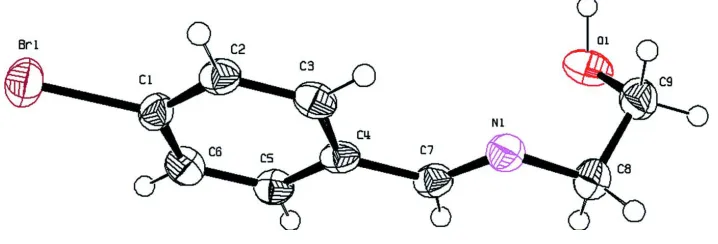
The basic structural features of the title structure (Fig. 1) agrees well with the geometric parameters of similar
previously synthesized structures such as (E)-4-[(4-bromobenzylidene)amino]-phenol (Vennila et al., 2010). The C-Br
bond distance in the title compound is 1.900 (3) Å, which is in agreement with the related value of 1.894 (2) Å (Vennila
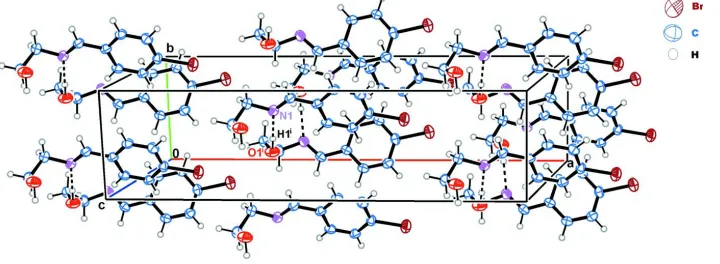
et al., 2010). The packing of the molecules is shown in Figs. 2 and 3. Fig 3 shows the O-H···N hydrogen bonds of a
moderate strength (Gilli & Gilli, 2009; Table 1) between the hydroxyls and the imine N atoms. The hydrogen bonds as
are weak C-H···π-electron ring interactions in the structure (Table 1).
S2. Experimental
To a solution of 4-bromobenzaldehyde (2.031 g, 0.011 mol) in dry toluene (40 ml), ethanolamine (0.671 g, 0.011 mol),
also dissolved in dry toluene (40 ml), was added dropwise in intervals of 30 minutes while stirring the formed
suspension. The reaction mixture was stirred under ambient conditions for further 2 hrs, and then refluxed at 120 °C for 3
hrs. The water was removed by distillation in a Dean-Stark distillation receiver and the toluene was removed in vacuo.
Upon cooling of the reaction mixture, the material precipitated. The viscous matter was dissolved in 20 ml of
dichloro-methane. The solution was then filtered through Celite (diatomaceous earth, a filter-aid) and dried over anhydrous
magnesium sulfate to remove traces of water. Large, platelike colourless crystals with dimensions 0.36×0.15×0.02 mm
and a hexagonal shape were grown from 200 mg of powder sample through slow diffusion of hexane solvent layered on
top of dichloromethane solution. Yield: 1.516 g (60.4%); M.p. 81 - 82°C. 1H NMR: δ (p.p.m.): 3.69 (2H, t, J = 4.85 Hz,
CH2OH), 3.86 (2H, d, J = 5.06 Hz, CH2-N), 7.51 (4H, dd, J = 6.24 Hz, 8.81 aryl-H), 8.61 (1H, s, CH═N). 13C NMR: δ
(p.p.m.): 62.119 (CH2OH), 63.331 (N—CH2), 125.314 (C-aryl) 129.607 (C-aryl), 131.860 (C-aryl), 134.629 (C-aryl),
162.009 (C═N).
S3. Refinement
The hydrogen atoms were identified in the difference electron density map, after which the aryl and methyl H atoms were
situated into idealized positions and constrained to ride on their parent atoms, with C···H = 0.95 and 0.98 Å, respectively.
Uiso(Haryl) = 1.2×UeqCaryl and Uiso(Hmethyl) = 1.5×UeqCmethyl. The methyl groups were refined as rigid rotors in order to fit to
the electron density. The positional parameters of the primary and the secondary amine H atoms were freely refined while
their displacement parameters were constrained as 1.2 multiples of their carrier atoms. 788 Friedel pairs have been
[image:3.610.127.486.434.556.2]measured.
Figure 1
Figure 2
The crystal packing of the title compound as seen approximately along the b axis.
Figure 3
The crystal structure of the title compound with the hydrogen bonds (Tab. 1) indicated as dashed lines. The structure is
approximately viewed along the c axis. Symmetry code: (i) x, -y + 1, z + 1/2.
2-[(4-Bromobenzylidene)amino]ethanol
Crystal data
C9H10BrNO
Mr = 228.09 Monoclinic, Cc Hall symbol: C -2yc a = 22.349 (4) Å b = 6.0328 (10) Å c = 7.3673 (12) Å β = 107.980 (3)° V = 944.8 (3) Å3
Z = 4
F(000) = 456 Dx = 1.604 Mg m−3
Mo Kα radiation, λ = 0.71073 Å Cell parameters from 3713 reflections θ = 3.5–25.3°
µ = 4.30 mm−1
T = 173 K Plate, colourless 0.36 × 0.15 × 0.02 mm
Data collection
Bruker Kappa DUO APEXII diffractometer
Radiation source: fine-focus sealed tube
[image:4.610.130.490.302.434.2](SADABS; Sheldrick, 2008a) Tmin = 0.305, Tmax = 0.919 3713 measured reflections 1651 independent reflections 1550 reflections with I > 2σ(I)
θmax = 25.3°, θmin = 3.5°
h = −24→26 k = −7→7 l = −8→8
Refinement
Refinement on F2 Least-squares matrix: full R[F2 > 2σ(F2)] = 0.025
wR(F2) = 0.059
S = 1.00 1651 reflections 113 parameters 1 restraint 37 constraints
Primary atom site location: structure-invariant direct methods
Secondary atom site location: difference Fourier map
Hydrogen site location: difference Fourier map H atoms treated by a mixture of independent
and constrained refinement w = 1/[σ2(F
o2) + (0.0174P)2] where P = (Fo2 + 2Fc2)/3 (Δ/σ)max < 0.001
Δρmax = 0.71 e Å−3 Δρmin = −0.45 e Å−3
Absolute structure: Flack (1983), 788 Friedel pairs
Absolute structure parameter: 0.022 (12)
Special details
Geometry. All e.s.d.'s (except the e.s.d. in the dihedral angle between two l.s. planes) are estimated using the full covariance matrix. The cell e.s.d.'s are taken into account individually in the estimation of e.s.d.'s in distances, angles and torsion angles; correlations between e.s.d.'s in cell parameters are only used when they are defined by crystal symmetry. An approximate (isotropic) treatment of cell e.s.d.'s is used for estimating e.s.d.'s involving l.s. planes.
Refinement. Refinement of F2 against ALL reflections. The weighted R-factor wR and goodness of fit S are based on F2, conventional R-factors R are based on F, with F set to zero for negative F2. The threshold expression of F2 > σ(F2) is used only for calculating R-factors(gt) etc. and is not relevant to the choice of reflections for refinement. R-factors based on F2 are statistically about twice as large as those based on F, and R- factors based on ALL data will be even larger.
Fractional atomic coordinates and isotropic or equivalent isotropic displacement parameters (Å2)
x y z Uiso*/Ueq
Br1 0.682260 (18) 0.64650 (5) 0.71855 (2) 0.04348 (12)
O1 0.34787 (17) 0.6979 (5) 1.1065 (4) 0.0461 (7)
H1 0.359 (2) 0.554 (4) 1.165 (7) 0.069*
N1 0.37448 (13) 0.7338 (5) 0.7440 (4) 0.0352 (7)
C1 0.60169 (15) 0.7091 (5) 0.7424 (4) 0.0304 (7)
C2 0.55354 (15) 0.5562 (6) 0.6774 (4) 0.0302 (7)
H2 0.5610 0.4194 0.6244 0.036*
C3 0.49499 (17) 0.6038 (5) 0.6903 (5) 0.0315 (7)
H3 0.4620 0.4989 0.6463 0.038*
C4 0.48338 (18) 0.8054 (6) 0.7676 (5) 0.0287 (8)
C5 0.53236 (16) 0.9557 (6) 0.8318 (4) 0.0315 (7)
H5 0.5249 1.0929 0.8844 0.038*
C6 0.59188 (17) 0.9099 (6) 0.8208 (5) 0.0347 (8)
H6 0.6252 1.0134 0.8658 0.042*
C7 0.42189 (16) 0.8625 (5) 0.7886 (5) 0.0310 (7)
H7 0.4173 1.0043 0.8386 0.037*
H8A 0.2815 0.8034 0.6578 0.046*
H8B 0.3220 0.9656 0.8224 0.046*
C9 0.30217 (18) 0.6660 (6) 0.9269 (6) 0.0404 (8)
H9A 0.2600 0.7043 0.9354 0.048*
H9B 0.3016 0.5083 0.8893 0.048*
Atomic displacement parameters (Å2)
U11 U22 U33 U12 U13 U23
Br1 0.03404 (18) 0.0539 (2) 0.04599 (18) 0.0060 (3) 0.01748 (12) 0.0006 (3)
O1 0.067 (2) 0.0296 (13) 0.0442 (18) −0.0032 (15) 0.0204 (15) −0.0002 (12)
N1 0.0358 (17) 0.0331 (16) 0.0399 (16) 0.0043 (13) 0.0164 (12) 0.0035 (13)
C1 0.0268 (18) 0.0386 (18) 0.0265 (16) 0.0057 (14) 0.0093 (13) 0.0052 (14)
C2 0.0363 (19) 0.0256 (16) 0.0297 (16) 0.0036 (14) 0.0114 (14) 0.0000 (14)
C3 0.040 (2) 0.0247 (16) 0.0302 (16) −0.0039 (14) 0.0115 (14) −0.0020 (13)
C4 0.038 (2) 0.0261 (16) 0.0236 (17) 0.0054 (16) 0.0112 (15) 0.0020 (13)
C5 0.039 (2) 0.0265 (18) 0.0300 (17) 0.0017 (15) 0.0117 (14) −0.0028 (15)
C6 0.037 (2) 0.0335 (17) 0.0329 (17) −0.0057 (15) 0.0094 (14) −0.0030 (15)
C7 0.0360 (19) 0.0284 (17) 0.0301 (16) 0.0067 (14) 0.0125 (14) 0.0021 (13)
C8 0.0314 (19) 0.0397 (18) 0.047 (2) 0.0041 (15) 0.0153 (15) 0.0024 (16)
C9 0.036 (2) 0.0363 (18) 0.054 (2) 0.0014 (15) 0.0212 (17) −0.0019 (17)
Geometric parameters (Å, º)
Br1—C1 1.900 (3) C4—C5 1.387 (5)
O1—C9 1.413 (5) C4—C7 1.471 (5)
O1—H1 0.968 (5) C5—C6 1.385 (5)
N1—C7 1.272 (4) C5—H5 0.9500
N1—C8 1.461 (4) C6—H6 0.9500
C1—C2 1.386 (5) C7—H7 0.9500
C1—C6 1.388 (5) C8—C9 1.510 (5)
C2—C3 1.371 (5) C8—H8A 0.9900
C2—H2 0.9500 C8—H8B 0.9900
C3—C4 1.401 (5) C9—H9A 0.9900
C3—H3 0.9500 C9—H9B 0.9900
C9—O1—H1 108 (3) C5—C6—H6 120.8
C7—N1—C8 118.2 (3) C1—C6—H6 120.8
C2—C1—C6 121.3 (3) N1—C7—C4 124.1 (3)
C2—C1—Br1 119.5 (3) N1—C7—H7 117.9
C6—C1—Br1 119.2 (3) C4—C7—H7 117.9
C3—C2—C1 119.5 (3) N1—C8—C9 110.2 (3)
C3—C2—H2 120.2 N1—C8—H8A 109.6
C1—C2—H2 120.2 C9—C8—H8A 109.6
C2—C3—C4 120.7 (3) N1—C8—H8B 109.6
C2—C3—H3 119.7 C9—C8—H8B 109.6
C4—C3—H3 119.7 H8A—C8—H8B 108.1
C3—C4—C7 122.8 (3) C8—C9—H9A 109.6
C6—C5—C4 121.4 (3) O1—C9—H9B 109.6
C6—C5—H5 119.3 C8—C9—H9B 109.6
C4—C5—H5 119.3 H9A—C9—H9B 108.1
C5—C6—C1 118.5 (3)
C6—C1—C2—C3 0.1 (5) C2—C1—C6—C5 −0.5 (5)
Br1—C1—C2—C3 −178.4 (2) Br1—C1—C6—C5 178.1 (2)
C1—C2—C3—C4 0.2 (5) C8—N1—C7—C4 178.1 (3)
C2—C3—C4—C5 −0.3 (5) C5—C4—C7—N1 −176.3 (3)
C2—C3—C4—C7 −178.6 (3) C3—C4—C7—N1 1.9 (5)
C3—C4—C5—C6 0.0 (5) C7—N1—C8—C9 −115.0 (4)
C7—C4—C5—C6 178.3 (3) N1—C8—C9—O1 67.6 (4)
C4—C5—C6—C1 0.4 (5)
Hydrogen-bond geometry (Å, º)
Cg1 is the centroid of the C1–C6 ring.
D—H···A D—H H···A D···A D—H···A
O1—H1···N1i 0.97 (3) 1.83 (3) 2.791 (4) 172 (4)
C2—H2···Cg1ii 0.95 2.83 3.58 (3) 137
C5—H5···Cg1iii 0.95 2.79 3.512 (3) 134