Proceedings of the Second Workshop on Subword/Character LEvel Models, pages 38–48
Subword-level Composition Functions for Learning Word Embeddings
Bofang Li1,Aleksandr Drozd2,Tao Liu3, andXiaoyong Du4
1,2School of Computing, Department of Mathematical and Computing Science, Tokyo Institute of Technology, Tokyo, Japan
1,3,4School of Information, Renmin University of China, Beijing, China
1,3,4Key laboratory of Data Engineering and Knowledge Engineering, MOE, Beijing, China 1[email protected]
2[email protected] 3[email protected] 4[email protected]
Abstract
Subword-level information is crucial for cap-turing the meaning and morphology of words, especially for out-of-vocabulary entries. We propose CNN- and RNN-based subword-level composition functions for learning word em-beddings, and systematically compare them with popular word-level and subword-level models (Skip-Gram and FastText). Addition-ally, we propose a hybrid training scheme in which a pure subword-level model is trained jointly with a conventional word-level embed-ding model based on lookup-tables. This in-creases the fitness of all types of subword-level word embeddings; the word-subword-level em-beddings can be discarded after training, leav-ing only compact subword-level representa-tion with much smaller data volume. We evaluate these embeddings on a set of intrin-sic and extrinintrin-sic tasks, showing that subword-level models have advantage on tasks related to morphology and datasets with high OOV rate, and can be combined with other types of embeddings.
1 Introduction
Word embeddings are used in many natural lan-guage processing tasks (Collobert et al., 2011;
Socher et al., 2013; Kim, 2014). In word em-bedding models, words are mapped or “embed-ded” into low-dimensional real-valued vectors. Such mapping is based, implicitly or explicitly, on word co-occurrence statistics (Levy and Goldberg,
2014b).
Naturally, frequent words provide a better rep-resentation of their distributional properties; thus
the quality of word embeddings is in direct rela-tion to the frequency of words (Drozd et al.,2015). However, even in large corpora, most words oc-cur very few times. For example,Baroni (2009) shows that the words occurring 3 times or less constitute almost 70% of the vocabulary. Conse-quently, most of the in-vocabulary words (for a given task/corpora) have to be discarded or em-bedded into low-quality vectors. Therefore, word-level models suffer from data sparsity.
Another issue with word-level models is that they do not make use of morphological infor-mation. Different forms of the same word are treated as completely unrelated entities. For ex-ample, as shown in Section 4.2, we find that the word “physicist” and “physicists” are not close to each other in a well-know word embedding model Skip-Gram (Mikolov et al.,2013).
These two issues are addressed by the emerging methodology of subword-level representations, as discussed in Section2. The most notable example of such representations is FastText (Bojanowski et al., 2017). It represents each word as a bag-of-character n-grams. Representations for charac-ter n-grams, once they are learned, can be com-bined (via simple summation) to represent out-of-vocabulary (OOV) words.
This paper contributes to the discussion of com-position functions for constructing subword-level embeddings and their evaluation. We propose and evaluate several models (including convolu-tional and recurrent neural networks) that can em-bed arbitrary character sequences into vectors. Our models do not rely on any external resource. We also propose a hybrid training scheme, which
makes these neural networks directly integrated into Skip-Gram model. We train two sets of word embeddings simultaneously: one is from a lookup table as in traditional Skip-Gram, and another is from convolutional or recurrent neural network. The former is better at capturing semantic similar-ity. The latter is more focused on morphology and can learn embeddings for OOV words. We con-duct experiments on five tasks, and compare our models with original Skip-Gram and the state-of-the-art performer FastText.
2 Related Work
2.1 Morphology-based Models
Morphology has long been considered as an im-portant feature for word representations. For ex-ample, Lazaridou et al. (2013) investigate sev-eral algebraic composition functions (e.g. addition or multiplication) for morphologically complex words, which generate better representations com-pared to traditional distributional semantic mod-els. Luong et al. (2013) train a recursive neural network for morphological composition, and show its effectiveness on (rare) word similarity task.
Qiu et al.(2014) propose Morpheme CBOWs for word similarity and word analogy tasks, which im-proves on CBOW model (Mikolov et al., 2013) by learning morphology embeddings and word embeddings simultaneously. Alexandrescu and Kirchhoff(2006) take morphological tags as fea-tures (one-hot representation) for training a lan-guage model, which reduce the perplexity on rare word language modeling scenarios.
For both language modeling and machine trans-lation tasks, LBL++ Botha and Blunsom (2014) show the effectiveness of summing morphology vectors in log-bilinear model (Mnih and Hinton,
2007) on 6 morphologically rich languages. Sim-ilarly, Morph-LBL (Cotterell and Sch¨utze,2015) improves on LBL model by predicting both con-text words and words’ morphological tags in a semi-supervised fashion, which outperforms both Word2Vec and LBL on German morphological analysis.
However, all the above models rely on prior morphological knowledge, which is obtained by morphology analysis tools such as Morfessor (Creutz and Lagus, 2007), or an annotated mor-phology corpus such as CELEX (Baayen et al.,
1995) and TIGER (Brants et al.,2004).
2.2 Subword-level Word Embeddings
Another line of work is focused on end-to-end word embedding learning based on subword-level information. FastText (Bojanowski et al., 2017) is probably the most influential and effective re-cent model. It represents each word as a bag-of-character n-grams. The models proposed in this paper are conceptually derived from FastText, i.e. we also operate on character n-grams level and predict context words from the target word, as in Skip-Gram approach.
Similarly to our proposed RNN, Cao and Rei
(2016) train a bi-directional LSTM based on sub-word information. Instead of using character ngrams, their model feeds the word’s prefixes and suffixes into each direction of LSTM respectively. This model is mainly designed to solve morpho-logical boundary recovery task, it performs com-parably with dedicated morphological analyzers.
Pinter et al. (2017) also utilize BiLSTM to con-struct word embeddings. However, their model re-lies on pre-trained word embeddings by minimiz-ing the squared Euclidean distance. In contrast, our proposed RNN requires only a plain text cor-pus.
2.3 Other Subword-level Models
There are also various task-specific NLP models that utilize character-level information for train-ing deep neural networks in an end-to-end fash-ion. They often surpass the word-level baselines on language modeling (Mikolov et al.,2012;Sperr et al., 2013;Bojanowski et al.,2015;Kim et al.,
2016), part-of-speech tagging (Ling et al., 2015;
dos Santos and Zadrozny, 2014), text classifica-tion (Zhang et al.,2015), and machine translation (Sennrich et al.,2016;Luong and Manning,2016), etc. However, these models do not produce repre-sentations that could be used in other tasks.
3 Models
3.1 Skip-Gram
Due to its popularity, simplicity, and state-of-the-art performance on a range of linguistic tasks, Skip-Gram (Mikolov et al.,2013) has been widely used as baseline in the word embedding literature (Levy and Goldberg,2014a;Faruqui et al.,2015;
word 3 word 2
word 1
contextual word
c) Convolutional Neural Network full connected layer
flatten
max pooling
1D convolution
char 1 char 2 char 3 char 4 char 5
target word characters or character ngrams
lookup table (character vectors)
lookup table (word vectors )
hybrid training schema (optional)
sum
char 1 char 2 char 3 char 4 char 5
word 3 word 2
word 1
contextual word
c) Recurrent Neural Network characters or character ngrams
lookup table (word vectors )
hybrid training schema (optional)
sum
target word Bi-direction
LSTM
sum target word
lookup table (word vectors )
word 3 word 2
word 1
contextual word
a) Skip-Gram
b) FastText target word characters or character ngrams
char 1 char 2 char 3 char 4 char 5
lookup table (character vectors)
lookup table (word vectors )
hybrid training schema (optional)
sum word 3 word 2
word 1
contextual word
sum
[image:3.595.88.519.72.471.2]lookup table (character vectors)
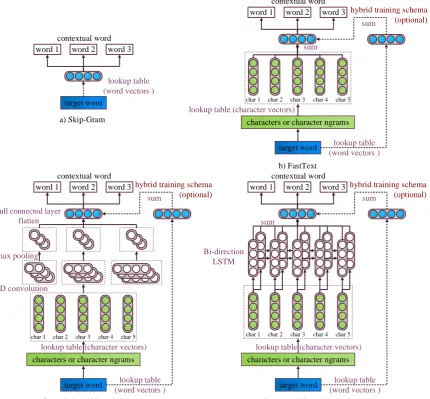
Figure 1: Illustration of original Skip-Gram and subword-level models.
W, C ∈ R|V|∗N, namely word vectors and
con-textual word vectors. N is the dimension of vec-tors. Given a training corpus, Skip-Gram iterates through all wordswand their contextsc, and max-imizes the objective functionp(c|w~), which is de-fined as:
logσ(w~·~c) +
K
X
k=1
Eci∼Nw,c[logσ(−w~ ·~ci)]
(1)
where σ is the sigmoid function. w~ ∈ W and ~c∈Care the vectors for wordwand contextc re-spectively. K is the negative sampling size. Nw,c
is the negative example that sampled from the vo-cabularyV. The negative sampling probability is empirically defined as the unigram probability of
a word raised to the power of3/4.
3.2 Utilizing Subword Information
In order to make use of subword information, we first generalize the objective function of Skip-Gram by replacing word vectorw~ with a compo-sition function f(w). f(w) takes word w as an input and outputs a vector of lengthN. Overall, the objective function of generalized Skip-Gram is defined as:
p(c|f(w)) = logσ(f(w)·~c)
+
K
X
k=1
Eci∼Nw,c[logσ(−f(w)·c~i)]
(2)
f(w) is simply a lookup table, which projects word w to its corresponding vector w~ in the ta-ble. Depending on the definition,f(w)could also take the subword information ofwinto considera-tion. Naturally, composition functions, especially neural networks, can be considered.
3.2.1 A Hybrid Training scheme for Subword-level Models
Intuitively, compared to Skip-Gram, subword-level models should be better suited for capturing morphology instead of similarity. In order to take advantage of both representations, we incorporate Skip-Gram into subword-level models. Formally, in our hybrid training scheme we define the objec-tive function of subword-level models as:
p(c|w~ +f(w)) (3)
In this case, each word will have two embed-dings: one from the lookup table (the same as Skip-Gram), and another from the composition function f. These two types of embeddings are learned simultaneously. We denote the embed-ding model from the word-level lookup table as Modelword, and the one from composition
func-tion as Modelsubword. As a baseline we
addition-ally train embeddings using only subword-level composition function; these models will be re-ferred to as Modelvanilla.
3.2.2 FastText (Summation)
Probably the most simple and intuitive way of uti-lizing subword information is to sum all vectors of characters and character ngrams belonging to a word (Figure 1-b), which is pioneered by Bo-janowski et al.(2017). Formally, the composition function is defined asf(w) = Pg∈Gw~g, whereg is the charactern-gram, and~g is its correspond-ing n-gram vector with length N. Gw is the set
of character n-grams for word w. For example, when n = 3, Gw for word “bigger” is defined
as<bi, big, igg, gge, ger, er>. The angle brackets are padding at the start and end of the word.
Note that the original FastText (FastTextvanilla)
does not have the hybrid training scheme. As later shown in our experiments, FastTextword
from the hybrid training scheme works better than FastTextvanillain some semantic relatedness
datasets. Moreover, hybrid training scheme is es-sential for other types of composition functions.
For fair comparison, in the following models, we use the same padding and the same length of charactern-grams’ vector.
3.2.3 Convolutional Neural Network
Despite its simplicity and efficiency, there is no clear evidence that simple summation as in Fast-Text is the best choice for composing subword in-formation.
This paper investigate two neural network. We first consider the Convolutional Neural Network (CNN) as composition functionf(w). CNN (
Le-Cun,1998) is able to capture local features auto-matically, and has been applied to a wide range of NLP tasks (Kim et al.,2016;Zhang et al., 2015;
Luong and Manning,2016).
The CNN architecture introduced in this paper is inspired by the model used for language model-ing inKim et al.(2016). As illustrated in Figure1 -c, similarly to FastText, the vectors of characters are first extracted from a lookup table. Those vec-tors form a matrix with size N ∗L, where L is the number of characters. The 1D convolution fil-ters are used to extract local features. We apply 1D convolutions of size ranging from 1 to 7 in parallel, perform max-pooling and concatenate the output. Each of the convolutions uses200filters. The output of this model is a fully-connected layer with the number of units corresponding to the de-sired size of embeddings. The resulting vector is used for predicting contextual words using nega-tive sampling, the same as the neganega-tive sampling in Skip-Gram.
3.2.4 Recurrent Neural Network
Skip-Gram FastTextsubword RNNsubword CNNsubword
geneticists cosmologists musicologists classicists psychologistsphysiologist protistsphysicians
logicians historians biophysicistphysicians trombonists pharmacists cryonicistsphysician
humanists geographers physicalism physicist aerodynamicistsphysiocrats artistsphysicality
[image:5.595.73.527.62.145.2]zoologists philosophers mathematicians publicists physicistmicroeconomists physiocratspublicists astrologers astronomers ethicists eugenicists physicality physicians physics physicist
Table 1: Illustration of the top-10 most similar words of target word “physicists”.
4 Experiments
4.1 Implementation Details
We implemented all models described in section
3 using Chainer deep learning framework (Tokui et al.,2015). Since the proposed CNN and RNN architectures significantly increase computational requirements for training, we choose a relatively small TEXT81 corpus for this evaluation. This
corpus contains the first 109 bytes of the English
Wikipedia dump from Mar. 3, 2006. The word embedding size N is set to300. The batch size is fixed to 1000. The negative sampling size is set to5, and the window size is set to2. Follow-ing Chainer’s original word2vec implementation, we use Adam (Kingma and Ba,2014) as the opti-mization function. Words which appear fewer than five times are directly discarded, which results in vocabulary size of 71290. For character ngrams, we follow the FastText’s best configuration and use 5-grams for FastText. We also discard char-acter ngrams which appear fewer than five times, which results in character ngrams vocabulary size of143207. Word embedding models are trained for5epochs on Nvidia Tesla K80 or P100 GPU.
We also download the state-of-the-art FastText embeddings (denoted as FastTextexternal)2, which
are trained on a much larger full Wikipedia corpus. Note that since CNN and RNN require approxi-mate45and65days of training on K80, we didn’t train on this corpus.
For the fair comparison, we ensure that all em-beddings used in evaluations use exactly same vo-cabulary. Unlike most of the benchmarks, where only embeddings of encountered words affect re-sulting accuracy, analogical reasoning benchmark is sensitive to the entire vocabulary in terms of size and embeddings of individual words. For
exam-1http://mattmahoney.net/dc/textdata.
html
2https://github.com/facebookresearch/
fastText
ple it is hard to make a mistake when looking for ”Paris” as the pair for ”France” if the whole vocab-ulary contains only these two words. Furthermore, accuracy depends on how close the target word is to the source words (Rogers et al., 2017), which could also be affected by a larger vocabulary.
This issue is especially pronounced for embed-dings with dynamic vocabulary, such as subword-level models evaluated in this study. In our pi-lot experiments, models with large vocabulary like FastTextexternal result in poor performance
on word analogy tasks since large vocabulary in-creases the number of options.
Skip-Gram FastTextvanilla FastTextexternal
85.6M 171.9M 8493.6M
CNNvanilla RNNvanilla
7.5M 19.1M
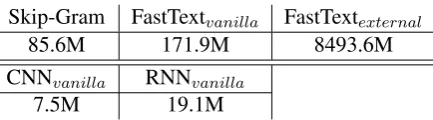
Table 2: Memory footprint of different models (For Skip-Gram and FastText, it will increase on larger vocabulary. For CNN- and RNN-based models, it is constant.
Note that the sizes of these models are different, as shown in Table2. Due to the large number of character ngrams, FastText requires the most data among these models, while CNN needs only a few megabytes of data.
4.2 Qualitative Analysis
Before looking into the performance of mod-els on specific tasks, we first conduct qualita-tive analysis. We choose several target words and analyze their nearest neighbors in Skip-Gram, FastTextsubword, CNNsubword, and RNNsubword.
[image:5.595.310.527.380.440.2]Model Rare WS WS SimWord SimilarityMEN Mech BATSWord Analogy Google Words sem. rel. 999 Turk inf. der. enc. lex. sem. syn. Skip-Gram .059 .658 .586 .285 .555 .577 .652 .096 .280 .098 .427 .534 FastTextword .065 .708 .619 .285 .610 .596 .622 .102 .274 .078 .424 .530
CNNword .058 .670 .584 .245 .554 .584 .628 .108 .250 .074 .416 .489
LSTMword .063 .697 .623 .284 .600 .599 .666 .134 .264 .080 .427 .597
Concatword .712 .184 .316 .130 .492 .649
FastTextsubword .085 .707 .566 .273 .620 .582 .790 .580 .290 .082 .374 .812
CNNsubword .051 .581 .417 .190 .478 .509 .758 .682 .076 .028 .019 .789
RNNsubword .063 .664 .532 .282 .566 .579 .798 .672 .114 .028 .061 .786
Concatsubword .846 .696 .326 .078 .290 .914
FastTextword+subword .792 .578 .350 .104 .439 .856
CNNword+subword .832 .638 .242 .084 .160 .859
RNNword+subword .832 .606 .244 .086 .240 .875
FastTextsubword+OOV .344 .715 .575 .277 .619 .599 .842 .824 .254 .096 .340 .776
CNNsubword+OOV .234 .564 .409 .224 .490 .497 .880 .948 .094 .044 .023 .786
RNNsubword+OOV .299 .670 .540 .286 .566 .587 .908 .906 .134 .040 .061 .796
Concatsubword+OOV .962 .960 .328 .116 .298 .917
FastTextvanilla+OOV .348 .717 .579 .283 .630 .624 .840 .834 .252 .116 .347 .799
CNNvanilla+OOV .212 .535 .400 .185 .474 .556 .874 .918 .104 .042 .015 .773
RNNvanilla+OOV .273 .638 .542 .250 .576 .568 .856 .866 .112 .034 .050 .748
Concatvanilla+OOV .958 .958 .314 .126 .275 .895
FastTextexternal .096 .674 .604 .332 .600 .574 .746 .446 .528 .194 .779 .872
[image:6.595.73.526.61.404.2]FastTextexternal+OOV .431 .682 .607 .341 .600 .587 .834 .672 .562 .214 .798 .879
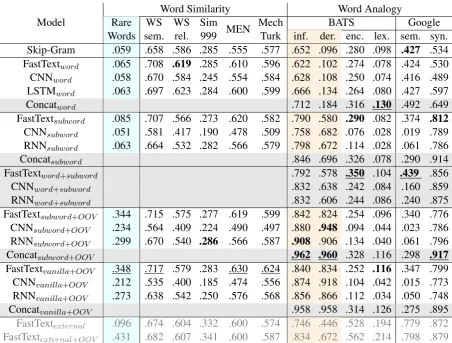
Table 3: Results on word similarity and word analogy datasets. For hybrid training scheme, we denote the embeddings that come from word vector lookup table as “Modelword”, and the embeddings which
come from the composition function as “Modelsubword”. We denote the vanilla (non-hybrid) models as
“Modelvanilla”. The “FastTextexternal” is the public available FastText embeddings, which are trained
on the full Wikipedia corpus. We also test the version where OOV words are expanded, and denote as “Model+OOV”. Model combinations are denoted as gray rows , and best results among them are marked bold. Rare words dataset in blue column have 43.3% OOV rate, while other word similarity datasets have maximum 4.6% OOV rate. Morphology related categories are denoted as almond columns . The results of model combination for word similarity task are simply the average of results from each single models, which are not listed in this table.
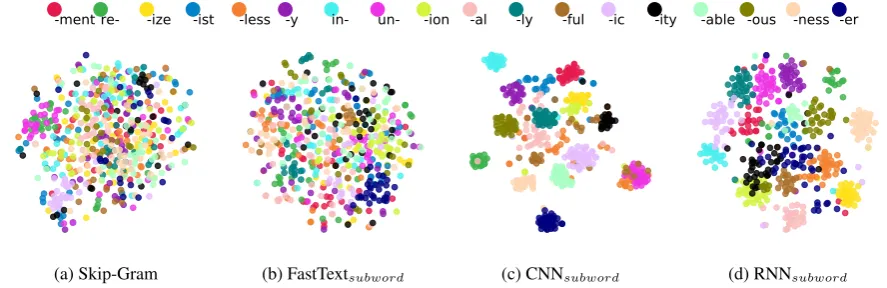
Skip-Gram. Moreover, subword models tend to cluster words with the same morphology form (af-fix) together, especially for RNN and CNN.
4.3 Quantitative Analysis 4.3.1 Word Similarity
Word similarity task aims at producing semantic similarity scores of word pairs, which are com-pared with the human scores using Spearman’s correlation. The cosine distance is used for gen-erating similarity scores between two word vec-tors. In order to test the effectiveness of captur-ing word similarity for rare word, we choose the
Rare Words dataset (Luong et al.,2013). For sys-tematical comparison, we also test our models on the WordSim353 (WS) (Finkelstein et al., 2001) dataset, divided into similarity (sem.) and related-ness (rel.) categories (Zesch et al., 2008; Agirre et al., 2009), Sim 999 dataset (Hill et al., 2016), MEN dataset (Bruni et al.,2012), and Mech Turk dataset (Radinsky et al.,2011).
Table 3 shows that on word similarity tasks FastText models perform the best in all datasets except Sim 999. CNNsubword and RNNsubword
-ment re- -ize -ist -less -y in- un- -ion -al -ly -ful -ic -ity -able -ous -ness -er
[image:7.595.75.519.68.212.2](a) Skip-Gram (b) FastTextsubword (c) CNNsubword (d) RNNsubword Figure 3: Visualization of learned word embeddings, each dot represents a word, different colors represent different affixes.
However, compared to Skip-Gram, CNNword and
RNNword (the versions with word vector lookup
table) achieve comparable or even better results. Their word vector lookup tables in these models are affected by the composition function, which results in better performance.
Note that the Rare Words dataset has 43.3% of words which are OOV. In this dataset, the vocab-ulary expanded models (FastTextsubword+OOV,
CNNsubword+OOV, and RNNsubword+OOV)
per-form a lot better than others. This highlights the necessity of expanding vocabulary and the effec-tiveness of subword-level models.
4.3.2 Word Analogy
The word analogy task aims at answering ques-tions generalize as “a is to a’ as b is to ?”, such as “London is to Britain as Tokyo is to Japan”. We follow the evaluation protocol byDrozd et al.
(2016) who proposed the LRCos method of solv-ing word analogies, which significantly improves on the traditional vector offset method. We use Google analogy dataset (Mikolov et al., 2013) along with a much bigger and balanced BATS analogy dataset (Gladkova et al.,2016).
On word analogy datasets (Table 3), the in-flectional and derivational morphology categories demonstrate the effectiveness of subword-level word models. It is especially obvious on deriva-tion morphology category, where Skip-Gram only achieves 9.6% accuracy and subword-level mod-els achieve minimal 57.8% accuracy (excluding the lookup table versions). Furthermore, when the vocabulary is expanded, the minimal accuracy of subword-level models reaches 82.4%.
Morphology-related analogy questions also benefit a lot from the model combination.
No-tably, Concatsubowrd+OOV achieves an accuracy
of 96.2% and 96.0% on inflection and derivation morphology, which is by far the highest accuracies on this two categories. We also observe that CNN is less sensitive to semantic word analogy, while performing the best on derivational word analogy.
4.3.3 Affix Prediction
In this section we test the ability of subword-level embeddings to predict what affix is present in a morphologically complex word. We use the dataset gathered by (Lazaridou et al., 2013), which contains 6549 stems and derived word pairs, such as “name”-“rename” and “sparse”-“sparsity”. There are 18 affixes, such as “re-” and “-ity”, and the task is to predict which one is present in a given word. We use the embeddings of derived words as input, and feed them to a lo-gistic regression classifier for predicting their af-fixes. The accuracy, recall, andF1-score are used
for measurement. We also followLazaridou et al.
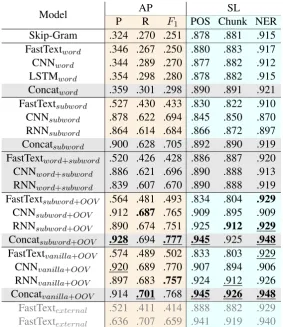
(2013) in using the default training/test data split. Figure3shows a t-SNE projection of the words with different affixes in the dataset. It is clear that both CNN and RNN are able to distinguish differ-ent derivation types, with the advantage of the for-mer. This also confirms the good performance of CNN on derivational analogy task. Note that Fast-Text does not fare much better than Skip-Gram, although it is a subword-level model. This par-tially explains its low accuracy compared to other subword-level models on morphological analogy categories.
Model AP SL
P R F1 POS Chunk NER
Skip-Gram .324 .270 .251 .878 .881 .915 FastTextword .346 .267 .250 .880 .883 .917
CNNword .344 .289 .270 .877 .882 .912
LSTMword .354 .298 .280 .878 .882 .915
Concatword .359 .301 .298 .890 .891 .921
FastTextsubword .527 .430 .433 .830 .822 .910
CNNsubword .878 .622 .694 .845 .850 .870
RNNsubword .864 .614 .684 .866 .872 .897
Concatsubword .900 .628 .705 .892 .890 .919
FastTextword+subword .520 .426 .428 .886 .887 .920
CNNword+subword .886 .621 .696 .890 .888 .913
RNNword+subword .839 .607 .670 .890 .888 .919
FastTextsubword+OOV .564 .481 .493 .834 .804 .929
CNNsubword+OOV .912 .687 .765 .909 .895 .909
RNNsubword+OOV .890 .674 .751 .925 .912 .929
Concatsubword+OOV .928 .694 .777 .945 .925 .948
FastTextvanilla+OOV .574 .489 .502 .833 .803 .929
CNNvanilla+OOV .920 .689 .770 .907 .894 .906
RNNvanilla+OOV .897 .683 .757 .924 .912 .926
Concatvanilla+OOV .914 .701 .768 .945 .926 .948
FastTextexternal .521 .411 .414 .888 .882 .929
[image:8.595.157.441.61.389.2]FastTextexternal .636 .707 .659 .941 .919 .940
Table 4: Results on affix prediction (AP) and sequence labeling (SL) tasks. Sequence labeling tasks have 16.5%, 27.1%, 28.5% OOV rate respectively.
the best among all the other models.
4.3.4 Sequence Labeling
Sequence labeling task consists in assigning labels to elements of texts. We evaluate word embedding models on Part-of-Speech Tagging (POS), Chunk-ing3 and Named Entity Recognition (NER) tasks 4. Following the evaluation protocol used inKiros et al.(2015);Li et al.(2017), we restrict the pre-dicting model to Logistic Regression Classifier5.
The classifier’s input for predicting the label of wordwiis simply the concatenation of word
vec-torsw~i−2,w~i−1,w~i,w~i+1,w~i+2. This ensures that
the quality of the embedding models is directly evaluated, and their strengths and weaknesses are easily observed.
Subword-level models on sequence labeling tasks clearly demonstrate the effectiveness of ex-panding OOV words. As shown in Table 4, 3CoNLL 2000 shared task http://www.cnts.ua.
ac.be/conll2000/chunking
4CoNLL 2003 shared task http://www.cnts.ua.
ac.be/conll2003/ner
5http://scikit-learn.org/
expanding vocabulary boosts the performance by a large margin. For example, on NER task, FastTextsubword+OOV, CNNsubword+OOV,
and RNNsubword+OOV achieve 1.9%, 2.1%, 3.2%
absolute gains over the versions of the same mod-els without expanded vocabulary.
4.3.5 Text Classification
For text classification task, we choose the movie review sentiment (MR) (Pang and Lee,
2005), customer product reviews (CR) (Nakagawa et al.,2010), subjectivity/objectivity classification (SUBJ) (Pang and Lee,2004), and IMDB movie review (IMDB) (Maas et al.,2011) datasets. The classification is performed by Logistic Regression Classifier. The input of this classifier is the sum of word embeddings that belonging to the text.
ofLi et al. (2017), who showed that Skip-Gram, CBOW, and GloVe trained with different context types perform similarly on text classification task.
5 Discussion
The evaluation showed that despite being trained on a relatively small corpus, CNN- and RNN-based (model-RNN-based) approaches outperform con-ventional (trained on word-level) embeddings as well as FastText embeddings, which are claimed to better capture morphological information ( Bo-janowski et al.,2017). In some cases, the perfor-mance of model-based embeddings is even higher than that of FastText embeddings that were trained on much larger corpus.
Moreover, such performance is achieved with very compact representations: it is possible to gen-erate an embedding for any given word on demand with only network weights, and these weights re-quire an order of mere kilobytes of data (Table2). Naturally, these compact representations do not have enough capacity to capture semantic infor-mation well. However, besides merely indicat-ing a possibility for improvement/limitations of more “heavy-weight” models (like original Skip-Gram or FastText), model-based embeddings can be used together with other approaches to improve their sensitivity to morphological information.
One such approach is to combine embed-dings from different models after training, as demonstrated in our experiments (“concat” lines in Table 3). Simple concatenation of lookup-table-based and model-based embeddings main-tain high accuracy on morphology-related bench-marks, while elevating performance on semantic tasks to comparable level.
Additionally, subword-level models can be trained jointly with models based on lookup-tables, which improves their performance on dif-ferent tasks. After training, either part can be used independently or jointly (e.g. by concatenation) in down-stream tasks.
6 Conclusion
We have implemented and evaluated several types of composition functions for subword-level ele-ments (characters and character n-grams) in the context of training word embeddings in Skip-Gram-like model.
We have shown that morphological information can be captured efficiently by extremely compact
Model MR CR SUBJ IMDBText Classification Skip-Gram .688 .765 .881 .797 FastTextword .690 .756 .878 .796
CNNword .690 .764 .876 .796
LSTMword .687 .752 .881 .794
FastTextsubword .691 .758 .867 .798
CNNsubword .670 .759 .857 .784
RNNsubword .689 .758 .872 .796
FastTextsubword+OOV .693 .759 .869 .797
CNNsubword+OOV .675 .763 .858 .785
RNNsubword+OOV .692 .760 .872 .795
FastTextword+subword .693 .759 .869 .797
CNNword+subword .675 .763 .858 .785
[image:9.595.316.517.62.214.2]RNNword+subword .692 .760 .872 .795
Table 5: Results on text classification datasets.
models. Embeddings generated dynamically from just a few megabytes of parameters significantly outperform conventional (word2vec and FastText) models on morphology related tasks. Addition-ally, this indicates the vast limitation of the ability of conventional models to capture morphological information.
To model both morphological and semantic in-formation, we propose two methods for combining strength of compact subword-level- and lookup-table based models: merging trained embeddings and training jointly. The resulting embeddings achieved high accuracy on a range of benchmarks and are particularly promising for datasets with high OOV rate.
The source code of those models, along with the pretrained word embeddings, has been integrated into an open-source project, and will be publicly available.
Acknowledgments
This work was partially supported by JSPS KAK-ENHI Grant No. JP17K12739, JST CREST Grant No. JPMJCR1687 and National Natural Science Foundation of China Grant No.61472428.
References
Eneko Agirre, Enrique Alfonseca, Keith Hall, Jana Kravalova, Marius Pas¸ca, and Aitor Soroa. 2009. A study on similarity and relatedness using distribu-tional and wordnet-based approaches. In NAACL, pages 19–27. Association for Computational Lin-guistics.
R Harald Baayen, Richard Piepenbrock, and Leon Gu-likers. 1995. The celex lexical database (release 2). Distributed by the Linguistic Data Consortium, Uni-versity of Pennsylvania.
Marco Baroni. 2009. Distributions in text.
Piotr Bojanowski, Edouard Grave, Armand Joulin, and Tomas Mikolov. 2017. Enriching word vectors with subword information. Transactions of the Associa-tion for ComputaAssocia-tional Linguistics, 5:135–146.
Piotr Bojanowski, Armand Joulin, and Tomas Mikolov. 2015. Alternative structures for character-level rnns. CoRR, abs/1511.06303.
Jan A. Botha and Phil Blunsom. 2014. Compositional morphology for word representations and language modelling. InICML.
Sabine Brants, Stefanie Dipper, Peter Eisenberg, Sil-via Hansen-Schirra, Esther K¨onig, Wolfgang Lezius, Christian Rohrer, George Smith, and Hans Uszkor-eit. 2004. Tiger: Linguistic interpretation of a ger-man corpus. Research on language and computa-tion, 2(4):597–620.
Elia Bruni, Gemma Boleda, Marco Baroni, and Nam-Khanh Tran. 2012. Distributional semantics in tech-nicolor. In ACL, pages 136–145. Association for Computational Linguistics.
Kris Cao and Marek Rei. 2016. A joint model for word embedding and word morphology. ACL 2016, page 18.
Ronan Collobert, Jason Weston, L´eon Bottou, Michael Karlen, Koray Kavukcuoglu, and Pavel Kuksa. 2011. Natural language processing (almost) from scratch. The Journal of Machine Learning Re-search, 12:2493–2537.
Ryan Cotterell and Hinrich Sch¨utze. 2015. Morpho-logical word-embeddings. In HLT-NAACL, pages 1287–1292.
Mathias Creutz and Krista Lagus. 2007. Unsupervised models for morpheme segmentation and morphol-ogy learning. ACM Transactions on Speech and Language Processing (TSLP), 4(1):3.
Aleksandr Drozd, Anna Gladkova, and Satoshi Mat-suoka. 2015. Discovering aspectual classes of rus-sian verbs in untagged large corpora. In2015 IEEE International Conference on Data Science and Data Intensive Systems, pages 61–68.
Aleksandr Drozd, Anna Gladkova, and Satoshi Mat-suoka. 2016. Word embeddings, analogies, and ma-chine learning: Beyond king - man + woman = queen. InCOLING.
Manaal Faruqui, Jesse Dodge, Sujay Kumar Jauhar, Chris Dyer, Eduard Hovy, and Noah A Smith. 2015. Retrofitting word vectors to semantic lexicons. In Proceedings of the 2015 Conference of the North
American Chapter of the Association for Computa-tional Linguistics: Human Language Technologies, pages 1606–1615.
Lev Finkelstein, Evgeniy Gabrilovich, Yossi Matias, Ehud Rivlin, Zach Solan, Gadi Wolfman, and Ey-tan Ruppin. 2001. Placing search in context: The concept revisited. InWWW, pages 406–414. ACM. Anna Gladkova, Aleksandr Drozd, and Satoshi
Mat-suoka. 2016. Analogy-based detection of morpho-logical and semantic relations with word embed-dings: What works and what doesn’t. In NAACL-HLT, pages 8–15.
Felix Hill, Roi Reichart, and Anna Korhonen. 2016. Simlex-999: Evaluating semantic models with (gen-uine) similarity estimation. Computational Linguis-tics.
Sepp Hochreiter and J¨urgen Schmidhuber. 1997. Long short-term memory. Neural computation, 9(8):1735–1780.
Yoon Kim. 2014. Convolutional neural networks for sentence classification. In EMNLP, pages 1746– 1751.
Yoon Kim, Yacine Jernite, David A Sontag, and Alexander M. Rush. 2016. Character-aware neural language models.
Diederik P Kingma and Jimmy Ba. 2014. Adam: A method for stochastic optimization. arXiv preprint arXiv:1412.6980.
Ryan Kiros, Yukun Zhu, Ruslan Salakhutdinov, Richard S Zemel, Antonio Torralba, Raquel Urta-sun, and Sanja Fidler. 2015. Skip-thought vectors. InNIPS, pages 3294–3302.
Angeliki Lazaridou, Marco Marelli, Roberto Zampar-elli, and Marco Baroni. 2013. Compositional-ly derived representations of morphologically complex words in distributional semantics. InACL (1), pages 1517–1526.
Yann LeCun. 1998. Gradient-based learning applied to document recognition.
Omer Levy and Yoav Goldberg. 2014a. Dependency-based word embeddings. InACL, pages 302–308. Omer Levy and Yoav Goldberg. 2014b. Linguistic
reg-ularities in sparse and explicit word representations. InCoNLL, pages 171–180.
Bofang Li, Tao Liu, Zhe Zhao, Buzhou Tang, Alek-sandr Drozd, Anna Rogers, and Xiaoyong Du. 2017. Investigating Different Syntactic Context Types and Context Representations for Learning Word Embed-dings. InEMNLP, pages 2411–2421.
Minh-Thang Luong and Christopher D. Manning. 2016. Achieving open vocabulary neural ma-chine translation with hybrid word-character mod-els. CoRR, abs/1604.00788.
Thang Luong, Richard Socher, and Christopher D Manning. 2013. Better word representations with recursive neural networks for morphology. In CoNLL, pages 104–113.
Andrew L. Maas, Raymond E. Daly, Peter T. Pham, Dan Huang, Andrew Y. Ng, and Christopher Potts. 2011. Learning word vectors for sentiment analysis. InACL, pages 142–150.
Tomas Mikolov, Ilya Sutskever, Kai Chen, Gregory S. Corrado, and Jeffrey Dean. 2013. Distributed repre-sentations of words and phrases and their composi-tionality. InNIPS, pages 3111–3119.
Tom´aˇs Mikolov, Ilya Sutskever, Anoop Deoras, Hai-Son Le, Stefan Kombrink, and Jan Cernocky. 2012. Subword language modeling with neu-ral networks. preprint (http://www. fit. vutbr. cz/imikolov/rnnlm/char. pdf).
Andriy Mnih and Geoffrey E. Hinton. 2007. Three new graphical models for statistical language modelling. InICML, pages 641–648.
Tetsuji Nakagawa, Kentaro Inui, and Sadao Kurohashi. 2010. Dependency tree-based sentiment classifica-tion using crfs with hidden variables. In NAACL, pages 786–794. Association for Computational Lin-guistics.
Bo Pang and Lillian Lee. 2004. A sentimental edu-cation: Sentiment analysis using subjectivity sum-marization based on minimum cuts. InACL, pages 271–278. Association for Computational Linguis-tics.
Bo Pang and Lillian Lee. 2005. Seeing stars: Exploit-ing class relationships for sentiment categorization with respect to rating scales. In ACL, pages 115– 124. Association for Computational Linguistics. Yuval Pinter, Robert Guthrie, and Jacob Eisenstein.
2017. Mimicking word embeddings using subword rnns. InEMNLP.
Siyu Qiu, Qing Cui, Jiang Bian, Bin Gao, and Tie-Yan Liu. 2014. Co-learning of word representations and morpheme representations. InCOLING, pages 141– 150.
Kira Radinsky, Eugene Agichtein, Evgeniy Gabrilovich, and Shaul Markovitch. 2011. A word at a time: computing word relatedness using temporal semantic analysis. In WWW, pages 337–346. ACM.
Anna Rogers, Aleksandr Drozd, and Bofang Li. 2017. The (Too Many) Problems of Analogical Reasoning with Word Vectors. InProceedings of the 6th Joint Conference on Lexical and Computational Seman-tics (* SEM 2017), pages 135–148.
Cicero Nogueira dos Santos and Bianca Zadrozny. 2014. Learning character-level representations for part-of-speech tagging. InICML.
Mike Schuster and Kuldip K. Paliwal. 1997. Bidirec-tional recurrent neural networks. IEEE Trans. Sig-nal Processing, 45(11):2673–2681.
Rico Sennrich, Barry Haddow, and Alexandra Birch. 2016. Neural machine translation of rare words with subword units. CoRR, abs/1508.07909.
Richard Socher, Alex Perelygin, Jean Y Wu, Jason Chuang, Christopher D Manning, Andrew Y Ng, and Christopher Potts. 2013. Recursive deep models for semantic compositionality over a sentiment tree-bank. InEMNLP, volume 1631, page 1642. Cite-seer.
Henning Sperr, Jan Niehues, and Alex Waibel. 2013. Letter n-gram-based input encoding for continuous space language models. InProceedings of the Work-shop on Continuous Vector Space Models and their Compositionality, pages 30–39.
Seiya Tokui, Kenta Oono, Shohei Hido, and Justin Clayton. 2015. Chainer: a next-generation open source framework for deep learning. InProceedings of workshop on machine learning systems (Learn-ingSys) in the twenty-ninth annual conference on neural information processing systems (NIPS), vol-ume 5.
Torsten Zesch, Christof M¨uller, and Iryna Gurevych. 2008. Using wiktionary for computing semantic re-latedness. InAAAI, volume 8, pages 861–866.
Xiang Zhang, Junbo Zhao, and Yann LeCun. 2015. Character-level convolutional networks for text clas-sification. InNIPS, pages 649–657.