68
Contextualized Representations for Low-resource Utterance Tagging
Bhargavi Paranjape
Carnegie Mellon University
Graham Neubig
Carnegie Mellon University
Abstract
Utterance-level analysis of the speaker’s inten-tions and emointen-tions is a core task in conversa-tional understanding. Depending on the end objective of the conversational understanding task, different categorical dialog-act or affect labels are expertly designed to cover specific aspects of the speakers’ intentions or emotions respectively. Accurately annotating with these labels requires a high level of human exper-tise, and thus applying this process to a large conversation corpus or new domains is pro-hibitively expensive. The resulting paucity of data limits the use of sophisticated neural mod-els. In this paper, we tackle these limitations by performing unsupervised training of utter-ance representations from a large corpus of spontaneous dialogue data. Models initialized with these representations achieve competi-tive performance on utterance-level dialogue-act recognition and emotion classification, es-pecially in low-resource settings encountered when analyzing conversations in new domains.
1 Introduction
Spontaneous human conversations have been col-lected in different domains to support research in data-driven dialogue systems (Serban et al.,2015), affective computing (Zadeh et al., 2018; Busso et al.,2008;Park et al.,2014), clinical psychology (Althoff et al.,2016) and tutoring systems (Sinha et al.,2015). These conversations are analyzed by segmenting transcriptions into each speaker’s utter-ances (Traum and Heeman,1996), which are often labeled with different types of information. The exact type of label to be used depends on the down-stream task or research questions to be answered, and thus the tagging paradigms are varied and nu-merous. For example, the speaker’s intention can be specified using a dialogue acts (DAs) or speech acts (Searle and Searle,1969), which capture the pragmatic or semantic function of the utterance.
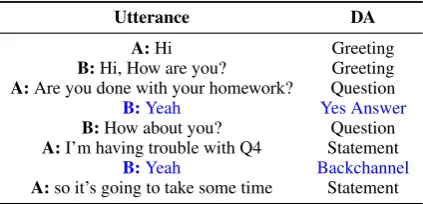
Utterance DA
A:Hi Greeting
B:Hi, How are you? Greeting A:Are you done with your homework? Question B:Yeah Yes Answer
B:How about you? Question A:I’m having trouble with Q4 Statement B:Yeah Backchannel
[image:1.595.308.520.222.324.2]A:so it’s going to take some time Statement
Table 1: Snippets of conversation with dialogue act tags. “Yeah” is tagged differently in different contexts.
Utterances may also be tagged with traits such as sentiment, emotion and valence labels (Busso et al., 2008;Zadeh et al.,2018), speaker persuasiveness (Park et al.,2014), speaker dominance(Busso et al., 2008) and other characteristics at the utterance and conversational level.
While these labels vary greatly, one constant is that they are often ambiguous and context-dependent (Table1), making it challenging for hu-mans to annotate efficiently and accurately. Thus, curating large corpora is labor-intensive, and we are always faced with a paucity of data in new domains and labeling paradigms of interest.
Moreover, the label assigned to an utterance de-pends on the current state of the dialogue (Stone, 2005) and prediction of an utterance’s label bene-fits from referring to other utterances in context and their labels (Jaiswal et al.,2019). Deep learning models like RNNs and CNNs have proven effec-tive tools to encode neighbouring utterances (Chen et al.,2018;Liu et al.,2017;Blunsom and Kalch-brenner, 2013; Bothe et al., 2018; Kumar et al., 2017). However such models rely on large anno-tated corpora that are prohibitively expensive to procure, especially for niche domains.
ex-ample,Melamud et al.(2016);Peters et al.(2018); Devlin et al.(2018) use language modeling as an unsupervised task to learn word embeddings in con-text, and demonstrate remarkable improvements on a number of downstream NLP tasks. However, these methods learn representations for individual words, whereas for dialog analysis tasks, we need representations forutterancesin the context of the entire dialog.
In this paper, we adapt the technique of learning contextualized representations using unsupervised pretraining to learn representations for utterances in the context of the dialogue. We first introduce a general model architecture consisting of a to-ken, utterance, and conversation encoder. We then present a method to efficiently train this model by predicting thebag-of-wordvectors of previous and next utterances over a large heterogeneous corpus of spoken dialogue transcripts. We quantify the effectiveness of learnt contextual utterance repre-sentations on two downstream utterance-labeling tasks: DA tagging and emotion recognition. We obtain competitive performance on two popular DA tagging tasks (SwitchBoard and ICSI Meeting Recorder) and an emotion labeling task (IEMO-CAP). Particularly, we observe significant improve-ments over training complex utterance tagging models from scratch for simulated low-resource settings for these tasks as well as for considerably smaller DA datasets such as LEGO and Map Task.
2 Methodology
We consider a large collection of conversations, where each conversationCis an ordered list ofN utterancesC={ui, u2, ..., uN}and each utterance
is a list of tokens,ui ={w1, w2, ...w|ui|}.
Conver-sations may also have labels for every utterance: Y ={y1, y2, ..., yN}where eachyi ∈ T, a finite
set of labels expertly defined for a domain.
2.1 Unsupervised Pretraining
Contextualized Utterance Representations
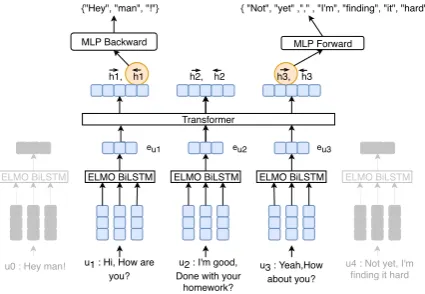
We adopt a hierarchical encoder model consisting of a token encoder, an utterance encoder and a conversation encoder, followed by an output layer. The token encoder layer ENCtok encodes
every token wj in utterance ui into a fixed-size
embedding etokwj, while the utterance encoder ENCuttencodes token embeddings of an utterance
ui into a fixed-sized utterance representationeuttui .
For our specific instantiation, we combine both
en-u1 : Hi, How are
you? u3 : Yeah,Howabout you? Transformer
ELMO BiLSTM ELMO BiLSTM ELMO BiLSTM ELMO BiLSTM
h2, h2
{ "Not", "yet" ,"," , "I'm", "finding", "it", "hard"}
MLP Forward
u4 : Not yet, I'm finding it hard
u2 : I'm good, Done with your
homework?
ELMO BiLSTM
u0 : Hey man!
{"Hey", "man", "!"}
MLP Backward
h1, h1 h3, h3
[image:2.595.309.522.64.211.2]eu1 eu2 eu3
Figure 1: Hierarchical conversation encoder model
coders: we use the pretrained ELMo (Peters et al., 2018) model to encode the sequence of tokens in an utterance ui and take the final state of the
forward and backward LSTMs (concatenated) as our utterance representationeuttui , i= 1,2, ..., N. We specifically choose ELMo because it is a strong general-purpose encoder and its character-based representations may be more robust to noise and OOV words in spontaneous conversations. This is followed by a conversation encoder ENCconv, which further converts this sequence of
context-independent representations of utterances to a context-dependent sequence of utterance rep-resentations. For ENCconv, we use an architecture
identical to the decoder variant of the Transformer (Vaswani et al., 2017) with N = 2 layers. We specifically choose the self-attentional Transformer for this purpose, as it is efficient to train, can easily capture long-distance dependencies over the entire conversation, and empirically outperformed other architectures such as LSTMs in preliminary experiments. The outputs,hui, i = 1,2, ..., N,
of this hierarchical encoder of Figure1can be used as contextualized representations for utterances.
Predicting Utterance Bag-of-words In order to
learn contextualized representations, the hierarchi-cal encoder is trained to predict the bag-of-words of the previous and next utterances in the conver-sation using these representations. This training is done in the forward and backward direction respectively by allowing the self-attention layer of the transformer to only attend to earlier posi-tions and later posiposi-tions in the utterance sequence respectively (Figure 1). Hence, we learn con-textual utterance embeddings in both directions: ←−
hui,
−→
hui; i = 1,2, ..., N. We use an MLP
Corpus # Utterances # Tokens
SwitchBoard 460K 3M
Meeting Recorder 105K 11K
CALLHOME 27K 1M
AMI Meeting Corpus 150K 1M
[image:3.595.72.296.364.541.2]BNC 1M 10M
Table 2: List of dialogue corpora for pretraining con-textualized utterance representations
hui to predict the set of words in the neighboring
utterance.ui−1is reconstructed from ←−
hui andui+1
from−→hui. We use binary cross entropy (BCE) loss,
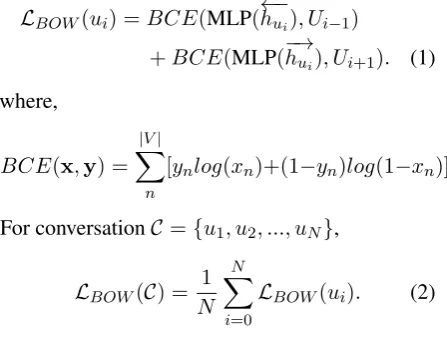
where the target is a vocabulary-sized binary vector with words present in the utterance marked 1 and others 0. Notably this formulation reduces training time by relaxing word-order in the reconstruction loss, unlike other methods that predict words in or-der for surrounding utterances (Kiros et al.,2015). For utterancesui−1andui+1with vocabulary vec-torsUi−1 and Ui+1 ∈ {0,1}|V|respectively, the bag-of-wordloss for utteranceuiis given by:
LBOW(ui) =BCE(MLP(
←−
hui), Ui−1)
+BCE(MLP(−→hui), Ui+1). (1)
where,
BCE(x,y) =
|V|
X
n
[ynlog(xn)+(1−yn)log(1−xn)]
For conversationC={u1, u2, ..., uN},
LBOW(C) =
1
N
N
X
i=0
LBOW(ui). (2)
2.2 Utterance Tagging
Once we have learned contextualized utterance rep-resentations, we can use them to predict the se-quence of labels Y = {y1, y2, ..., yN}, such as
dialogue acts, for utterances in the conversation. In this work we use a linear-chain conditional random field (Lafferty et al.,2001) as used in previous state-of-the-art models for DA tagging (Kumar et al., 2017;Chen et al.,2018) to predict one of the|T | tags for eachui, where the utterance is represented
as the concatenation of the forward and backward contextualized vectors:←−hui,
−→ hui.
3 Experiments
Pretraining Datasets and Hyperparameters
We train contextualized utterance representations
on transcriptions of spontaneous human-human conversation corpora (Serban et al., 2015). We choose the corpora presented in Table2 for this work. A majority of the conversations are dia-logues, and utterances across all corpora are 10 words long on average. However, the chosen cor-pora have conversations of widely varying lengths (no. of utterances/conversation). For computa-tion/memory efficiency, and also because more dis-tant utterances likely have diminishing influence on discourse modeling, we divide each conversa-tion into conversaconversa-tional snippets of length641by moving a 64-length window over the conversation with stride1and train the bag-of-word loss on each snippet thus obtained. For the conversational en-coder, we use 2 layers of the transformer with 8 attention heads of 64 dimensions each. All feed-forward networks use 2 layers with hidden size of 512. For training and fine-tuning, we use the Adam (Kingma and Ba,2014) with learning rate 0.0001.
Tasks We evaluate performance of our model on
these utterance-level tagging tasks:
SwDA, the Switchboard Dialogue Act Corpus, annotates 1,155 telephonic conversations (224K utterances) with one of the 42 DAs in the DAMSL (Jurafsky,1997) taxonomy.
MRDA, the ICSI Meeting Recorder Dialogue Act corpus annotates 75 multi-party meetings (105K ut-terances) with DAs according to 5 domain-specific tags (Dhillon et al.,2004).
IEMOCAP, an emotion recognition dataset of 12 hours of dyadic improvisations or scripted sce-narios, with eight categorical emotion labels (Park et al.,2014) (10K utterances).
LEGO, a subset (14K utterances) of the Lets Go bus-information dialogue system corpus (Raux et al.,2006) annotated with the ISO 24617-2 stan-dard for conversation functions of task by (Ribeiro et al.,2016).
Map Task, (Carletta et al.,1997;Anderson et al., 1991) is 18 hrs of dialogue where speakers collabo-rate to complete a map (5K utterances).
To simulate low-resource settings for the larger datasets like SWDA and MRDA, we experiment with different sizes of the training datasets and eval-uate on the standard test set for these. For LEGO and MapTask, we use 10-fold cross validation.
Experimental Settings We use four different
ex-perimental settings to measure the efficacy of our
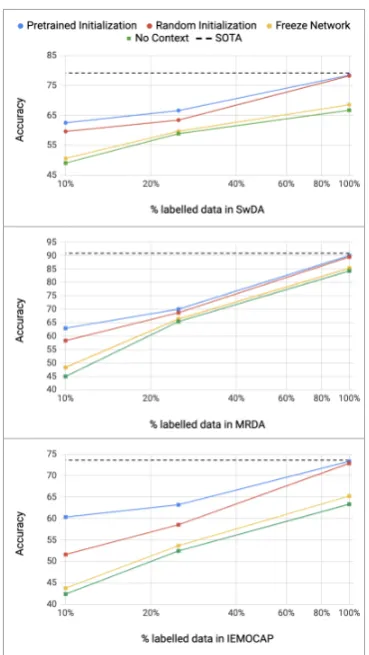
Figure 2: Performance by training data sizes. SOTA: comparable state-of-the-art model trained on tagging task for entire dataset.
pretrained utterance representations :No Context -With no conversational encoder (i.e. independently encoding every utterance using ELMo);Random Initialization- with the conversational encoder ran-domly initialized and trained on only the down-stream tagging task;Freeze Network- the conver-sational encoder initialized using the model pre-trained on our bag-of-word objective and kept fixed for downstream task; Pre-trained Initialization -the initialized conversation encoder fine-tuned on the downstream task. These settings are used to isolate the gains from using (1) contextualized rep-resentations, (2) pretraining them and then (3) fine-tuning them on the downstream task.
4 Result and Discussion
We observe that using pretrained utterance repre-sentations shows improved performance over ran-dom initialization and is competitive with exist-ing state-of-the-art works byKumar et al.(2017) for SwDA and MRDA, andPoria et al.(2017) for IEMOCAP that use similar hierarchical
architec-DA Category % Increase Example in accuracy
Agree/Accept 43 That’s exactly it.
Summarize/ Oh, you mean you
Reformulate 180 switched schools.. Statement-Opinion 55 I think it’s great.
Yes-Answer 33 Yes
Hold before answer
or agreement 300 I’m drawing a blank
Table 3: SwDA DA categories that improve using pre-trained utterance embeddings with % improvements in accuracy over other experimental settings.
DA Corpus Pretrained Random SOTA
LEGO 93.70 92.98 88.75
Map Task 79.34 77.91 72.50
Table 4: Results on LEGO and Map Task
tures but are only trained on the task (Random initialization setting). From Figure2, we observe that the pretraining-based initialization is especially helpful when the amount of training data is signifi-cantly reduced for SWDA, MRDA and IEMOCAP, over other experimental settings. The improved performance of the random initialization setting over fixing the pretrained conversational encoder parameters underscores the need to fine-tune for downstream tasks. Our pretrained model also out-performs random initialization and existing best results (Ribeiro et al.,2015;Sridhar et al.,2009) for truly low-resource datasets like LEGO and Map Task, as shown in Table4. We also analyze the gain in accuracy by dialogue act category for the pre-trained model over other experimental settings. We find that the pretrained model shows improvements in the categories listed in Table3over random ini-tialization. These acts typically requires models to keep track of longer contexts than other DAs like questions and back-channels. Dialogue examples in Table5further illustrate this.
5 Conclusion
Utterance Gold Pre-trained Random No Context
B: where are you going to move to? Wh-Question Wh-Question Wh-Question Yes-No-Q
A: Uh, Maryland. Statement Statement Statement Hedge
B: Oh, are you? Backchannel Backchannel Backchannel Yes-No-Q
question question question
A: Uh-huh. Yes answers Yes answers Yes answers Backchannel
B: Do you have friends there? Yes-No-Q Yes-No-Q Yes-No-Q Yes-No-Q
B: or, Abandoned Abandoned Abandoned Uninterpret.
A: My fiancee is down therehlaughteri. Statement Statement Statement Statement
B: Oh, I see. Resp. Ack Resp. Ack Resp. Ack Resp. Ack
B: So, does he work for Yes-No-Q Yes-No-Q Yes-No-Q Yes-No-Q
a company down there?
A: Yeah, Yes answers Yes answers Yes answers Yes answers
A: he works for the government. Statement Statement Statement Statement
B: Oh, I see. Resp. Ack Resp. Ack Resp. Ack Resp. Ack
B: Oh, the big company. Summarize/ Summarize/ Statement Statement
reformulate reformulate
A: Yeah Agree/Accept Yes Answer Yes Answer Yes Answer
A: and I said no, I’m just twenty-three, Statement Statement Statement Statement
B: Uh-huh. Backchannel Backchannel Backchannel Abandoned
A: you know, because I don’t think of Statement Statement Statement Statement myself as needing to have children
A: but the first thing he says is, well, Statement Statement Statement Statement don’t you miss that part of your life.
A: And I just, Abandoned Abandoned Abandoned Uninterpret.
A: my, my mind just went, Statement Statement Statement Statement B: You didn’t know what Collaborative Collaborative Statement Statement you’re going to be missing. Completion Completion
A: I went, what. Statement Statement Statement Statement
[image:5.595.78.547.67.489.2]B:hLaughteri. Non-verbal Non-verbal Non-verbal Non-verbal
Table 5: Dialogue Examples from SwitchBoard with dialogue acts as labelled under different experimental settings. The pre-trained network performs better on categories like Summarizing and Collaborative Completion
Acknowledgments
We thank the reviewers for their insightful com-ments. This work was supported by the National Institute of Health (NIH) grant no. R01MH096951-08.
References
Tim Althoff, Kevin Clark, and Jure Leskovec. 2016. Large-scale analysis of counseling conversations: An application of natural language processing to mental health. Transactions of the Association for Computational Linguistics, 4:463–476.
Anne H Anderson, Miles Bader, Ellen Gurman Bard, Elizabeth Boyle, Gwyneth Doherty, Simon Garrod, Stephen Isard, Jacqueline Kowtko, Jan McAllister,
Jim Miller, et al. 1991. The hcrc map task corpus.
Language and speech, 34(4):351–366.
Phil Blunsom and Nal Kalchbrenner. 2013. Recurrent convolutional neural networks for discourse compo-sitionality. InProceedings of the 2013 Workshop on Continuous Vector Space Models and their Composi-tionality. Proceedings of the 2013 Workshop on Con-tinuous Vector Space Models and their .
Chandrakant Bothe, Cornelius Weber, Sven Magg, and Stefan Wermter. 2018. A context-based approach for dialogue act recognition using simple recurrent neural networks. arXiv preprint arXiv:1805.06280.
Jean Carletta, Amy Isard, Stephen Isard, Jacqueline C Kowtko, Gwyneth Doherty-Sneddon, and Anne H Anderson. 1997. The reliability of a dialogue struc-ture coding scheme. Computational Linguistics.
Zheqian Chen, Rongqin Yang, Zhou Zhao, Deng Cai, and Xiaofei He. 2018. Dialogue act recognition via crf-attentive structured network. In The 41st Inter-national ACM SIGIR Conference on Research & De-velopment in Information Retrieval, pages 225–234. ACM.
Jacob Devlin, Ming-Wei Chang, Kenton Lee, and Kristina Toutanova. 2018. Bert: Pre-training of deep bidirectional transformers for language understand-ing. arXiv preprint arXiv:1810.04805.
Rajdip Dhillon, Sonali Bhagat, Hannah Carvey, and Elizabeth Shriberg. 2004. Meeting recorder project: Dialog act labeling guide.
Mimansa Jaiswal, Zakaria Aldeneh, Cristian-Paul Bara, Yuanhang Luo, Mihai Burzo, Rada Mihalcea, and Emily Mower Provost. 2019. Muse-ing on the im-pact of utterance ordering on crowdsourced emotion annotations.arXiv preprint arXiv:1903.11672.
Dan Jurafsky. 1997. Switchboard swbd-damsl shallow-discourse-function annotation coders manual. Insti-tute of Cognitive Science Technical Report.
Diederik P Kingma and Jimmy Ba. 2014. Adam: A method for stochastic optimization. arXiv preprint arXiv:1412.6980.
Ryan Kiros, Yukun Zhu, Ruslan R Salakhutdinov, Richard Zemel, Raquel Urtasun, Antonio Torralba, and Sanja Fidler. 2015. Skip-thought vectors. In
Advances in neural information processing systems, pages 3294–3302.
Harshit Kumar, Arvind Agarwal, Riddhiman Dasgupta, Sachindra Joshi, and Arun Kumar. 2017. Dialogue act sequence labeling using hierarchical encoder with crf.arXiv preprint arXiv:1709.04250.
John D. Lafferty, Andrew McCallum, and Fernando C. N. Pereira. 2001. Conditional random fields: Probabilistic models for segmenting and labeling se-quence data. InProceedings of the Eighteenth
Inter-national Conference on Machine Learning, ICML
’01, pages 282–289, San Francisco, CA, USA. Mor-gan Kaufmann Publishers Inc.
Yang Liu, Kun Han, Zhao Tan, and Yun Lei. 2017. Us-ing context information for dialog act classification in dnn framework. InProceedings of the 2017 Con-ference on Empirical Methods in Natural Language
Processing, pages 2170–2178.
Oren Melamud, Jacob Goldberger, and Ido Dagan. 2016. context2vec: Learning generic context em-bedding with bidirectional lstm. In Proceedings of The 20th SIGNLL Conference on Computational
Natural Language Learning, pages 51–61, Berlin,
Germany. Association for Computational Linguis-tics.
Sunghyun Park, Han Suk Shim, Moitreya Chatterjee, Kenji Sagae, and Louis-Philippe Morency. 2014.
Computational Analysis of Persuasiveness in Social Multimedia: A Novel Dataset and Multimodal Pre-diction Approach. In Proceedings of the 16th
In-ternational Conference on Multimodal Interaction,
pages 50–57. ACM Press.
Matthew Peters, Mark Neumann, Mohit Iyyer, Matt Gardner, Christopher Clark, Kenton Lee, and Luke Zettlemoyer. 2018. Deep contextualized word repre-sentations. InProceedings of the 2018 Conference of the North American Chapter of the Association for Computational Linguistics: Human Language
Technologies, Volume 1 (Long Papers), volume 1,
pages 2227–2237.
Soujanya Poria, Erik Cambria, Devamanyu Hazarika, Navonil Majumder, Amir Zadeh, and Louis-Philippe Morency. 2017. Context-dependent sentiment anal-ysis in user-generated videos. InProceedings of the 55th Annual Meeting of the Association for Compu-tational Linguistics (Volume 1: Long Papers), vol-ume 1, pages 873–883.
Antoine Raux, Dan Bohus, Brian Langner, Alan W Black, and Maxine Eskenazi. 2006. Doing research on a deployed spoken dialogue system: One year of let’s go! experience. InNinth International
Confer-ence on Spoken Language Processing.
Eug´enio Ribeiro, Ricardo Ribeiro, and David Martins de Matos. 2015. The influence of context on dialog act recognition. arXiv preprint arXiv:1506.00839.
Eug´enio Ribeiro, Ricardo Ribeiro, and David Martins de Matos. 2016. Mapping the dialog act annotations of the lego corpus into the communicative functions of iso 24617-2. arXiv preprint arXiv:1612.01404.
John R Searle and John Rogers Searle. 1969. Speech acts: An essay in the philosophy of language, vol-ume 626. Cambridge university press.
Iulian Vlad Serban, Ryan Lowe, Peter Henderson, Lau-rent Charlin, and Joelle Pineau. 2015. A survey of available corpora for building data-driven dialogue systems. arXiv preprint arXiv:1512.05742.
Tanmay Sinha, Ran Zhao, and Justine Cassell. 2015. Exploring socio-cognitive effects of conversational strategy congruence in peer tutoring. InProceedings of the 1st Workshop on Modeling INTERPERsonal
SynchrONy And infLuence, pages 5–12. ACM.
Vivek Kumar Rangarajan Sridhar, Srinivas Bangalore, and Shrikanth Narayanan. 2009. Combining lexi-cal, syntactic and prosodic cues for improved online dialog act tagging. Computer Speech & Language, 23(4):407–422.
David R Traum and Peter A Heeman. 1996. Utterance units in spoken dialogue. InWorkshop on Dialogue
Processing in Spoken Language Systems, pages 125–
140. Springer.
Ashish Vaswani, Noam Shazeer, Niki Parmar, Jakob Uszkoreit, Llion Jones, Aidan N Gomez, Łukasz Kaiser, and Illia Polosukhin. 2017. Attention is all you need. InAdvances in Neural Information Pro-cessing Systems, pages 5998–6008.
AmirAli Bagher Zadeh, Paul Pu Liang, Soujanya Po-ria, Erik CambPo-ria, and Louis-Philippe Morency. 2018. Multimodal language analysis in the wild: Cmu-mosei dataset and interpretable dynamic fu-sion graph. InProceedings of the 56th Annual Meet-ing of the Association for Computational LMeet-inguistics
(Volume 1: Long Papers), volume 1, pages 2236–