Structured Prediction with Output Embeddings
for Semantic Image Annotation
Ariadna Quattoni1, Arnau Ramisa2, Pranava Swaroop Madhyastha3
Edgar Simo-Serra4,Francesc Moreno-Noguer2
1Xerox Research Center Europe,[email protected]
2Institut de Rob`otica i Inform`atica Industrial (CSIC-UPC),{aramisa,fmoreno}@iri.upc.edu 3TALP Research Center, Universitat Polit`ecnica de Catalunya,[email protected]
4Waseda University,[email protected]
Abstract
We address the task of annotating images with semantic tuples. Solving this problem requires an algorithm able to deal with hundreds of classes for each argument of the tuple. In such contexts, data sparsity becomes a key challenge. We propose handling this spar-sity by incorporating feature representations of both the inputs (images) and outputs (ar-gument classes) into a factorized log-linear model.
1 Introduction
Many important problems in machine learning can be framed as structured prediction tasks where the goal is to learn functions that map inputs to struc-tured outputs such as sequences, trees or general graphs. A wide range of applications involve learn-ing over large state spaces, e.g., if the output is a labeled graph, each node of the graph may take val-ues over a potentially large set of labels. Data spar-sity then becomes a challenge, as there will be many classes with very few training examples.
Within this context, we are interested in the task of predicting semantic tuples for images. That is, given an input image we seek to predict what are the events or actions (referred here as predicates), who and what are the participants (referred here as
actors) of the actions and where is the action taking place (referred here aslocatives). For example, an image might be annotated with the semantic tuples:
hrun, dog, parki and hplay, dog, grassi. We call
each field of a tuple anargument.
To handle the data sparsity challenge imposed by the large state space, we will leverage an approach
that has proven to be useful in multiclass and mul-tilabel prediction tasks (Weston et al., 2010; Akata et al., 2013). The idea is to represent a value for an argumentausing a feature vector representation
φ∈ IRn. We will integrate this argument represen-tation into the structured prediction model.
In summary, our main contribution is to pro-pose an approach that incorporates feature represen-tations of the outputs into a structured prediction model, and apply it to the problem of annotating images with semantic tuples. We present an experi-mental study using different output feature represen-tations and analyze how they affect performance for different argument types.
2 Semantic Tuple Image Annotation
Task: We will address the task of predicting
se-mantic tuples for images. Following Farhadi et al. (2010), we will focus on a simple semantic repre-sentation that considers three basic arguments: pred-icate, actors and locatives. For example, in the tuple
hplay, dog, grassi, “play” is the predicate, “dog” is
the actor and “grass” is the locative.
Given this representation, we can formally de-fine our problem as that of learning a function
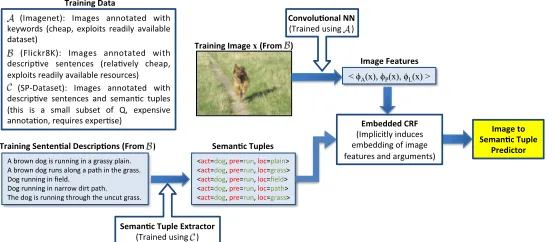
θ : X × P × A × L → IR that scores the compatibility between images and semantic tuples. HereXis the space of images;P,AandLare dis-crete sets of predicate, actor and locative arguments respectively, andhp a liis a specific tuple instance. The overall learning process is illustrated in Fig. 1.
Dataset: For our experiments we used a subset
of the Flickr8k dataset, proposed in Hodosh et al. (2013). This dataset (subset B in Fig. 1) consists of 8,000 images from Flickr of people and animals
Training'Image'x (From!Q)'
Training'Senten2al'Descrip2ons'(From'Q)'
Seman2c'Tuple'Extractor' (Trained)using)L)))
Seman2c'Tuples'
Image'Features'
A)brown)dog)is)running)in)a)grassy)plain.) A)brown)dog)runs)along)a)path)in)the)grass.) Dog)running)in)field.))
Dog)running)in)narrow)dirt)path.) The)dog)is)running)through)the)uncut)grass.)
<act=dog,)pre=run,)loc=plain>) <act=dog,)pre=run,)loc=grass>) <act=dog,)pre=run,)loc=field>) <act=dog,)pre=run,)loc=path>) <act=dog,)pre=run,)loc=grass>))
< ϕA(x), ϕP(x), ϕL(x) >
Convolu2onal'NN' (Trained)using)U)))
Image'to' Seman2c'Tuple'
Predictor' U) (Imagenet):) Images) annotated) with)
keywords) (cheap,) exploits) readily) available) dataset))
Q) (Flickr8K):) Images) annotated) with) descripJve) sentences) (relaJvely) cheap,) exploits)readily)available)resources)) L) (SPMDataset):) Images) annotated) with) descripJve) sentences) and) semanJc) tuples) (this) is) a) small) subset) of) Q,) expensive) annotaJon,)requires)experJse))
Training'Data'
[image:2.612.170.447.64.185.2]Embedded'CRF'' (Implicitly)induces) embedding)of)image) features)and)arguments))
Figure 1: Overview of our approach. First, imagesx∈ Aare represented using image featuresφs(x), and semantic tuples are
obtained applying our semantic tuple extractor (learned from the subsetC) to their corresponding captions. The resulting enlarged training set, is used to train our embedded CRF model that maps images to semantic tuples.
(mostly dogs) performing some action, with five crowd-sourced descriptive captions for each one.
We first manually annotated 1,544 captions, cor-responding to 311 images (approximately one third of the development set (subsetCin Fig. 1), produc-ing more than 2,000 semantic tuples of predicate, ac-tor and locative. For the experiments we partitioned the images and annotations into training, validation and test sets of 150, 50 and 100 images respectively.
Data augmentation: To enlarge the manually
an-notated dataset we trained a model able to predict semantic tuples from captions using standard shal-low and deep linguistic features (e.g., POS tags, de-pendency parsing, semantic role labeling). We ex-tract the predicates by looking at the words tagged as verbs by the POS tagger. Then, the extraction of arguments for each predicate is resolved as a classi-fication problem.
More specifically, for each detected predicate in a sentence we regard each noun as a positive or neg-ative training example of a given relation depend-ing on whether the candidate noun is or is not an argument of the predicate. We use these examples to train a SVM classifier that predicts if a candidate noun is an argument of a given predicate based on several linguistic features computed over the syntac-tic path of the dependency tree that connects them. We run the learned tuple predictor model on all the captions of the Fickr8k dataset to obtain a larger dataset of 8,000 images paired with semantic tuples. 3 Bilinear Models with Output Features In this section we explain how we incorporate out-put feature representations into a factorized linear model. For simplicity, we will consider factorized
sequence models over sequences of fixed length. However, it should not be hard to see that all the ideas presented here can be easily generalized to other structured prediction settings.
Let y = [y1. . .yT] be a set of labels and S =
[S1, . . ., ST] be the set of possible label values,
whereyi∈Si. We are interested in learning a model that computesP(y|x), i.e., the conditional probabil-ity of a sequence y given some input x. We will consider factorized log-linear models that take the form:
P(y|x) = Pexpθ(x,y)
yexpθ(x,y) (1) The scoring functionθ(x, y)is modeled as a sum of unary and binary bilinear potentials and is defined as:
θ(x, y) =XT
t=1
vy>tWtφ(x, t) + T
X
t=1
vy>tZtvyt+1 (2)
wherevyt ∈ IRnt is ant−dimensional feature
rep-resentation of label argumentsyt∈Standφ(x, t) ∈
IRdt is a dt−dimensional feature representation of
thetthinput factor ofx.
The first set of terms in the above equation are usually referred as unary potentials and measure the compatibility between a single state attand the fea-ture representation of input factort. The second set of terms are the binary potentials and measure the compatibility between pairs of states at adjacent fac-tors. The scoringθ(x, y)function is fully parameter-ized by the unary parameter matrices Wt∈IRnt×dt and the binary parameter matricesZt∈IRnt×nt.
multilabel scenario (Weston et al., 2010; Akata et al., 2013), having full feature representations for ar-guments will allow us to share information across different classes and generalize better. With a good output feature representation, our model should be able to make sensible predictions about pairs of ar-guments that it has not observed at training. This is easy to see: consider a case were we have a pair of arguments represented with feature vectors a1 and a2and suppose that we have not observed the factor a1, a2in our training data but we have observed the
factorb1, b2. Then ifa1 is close in the feature space
to argumentb1 anda2 is close tob2 our model will
predict thata1anda2are compatible. That is it will
assign probability to the factor a1, a2 which seems
a natural generalization from the observed training data.
Now we show that the rank ofW andZhave use-ful interpretations. LetW = UΣV be the singular value decomposition ofW. We can then write unary potentials: v>
yW φ(x, t)as:vy>U Σ [V φ(x, t)]Thus
we can regard the bilinear form as a function com-puting a weighted inner product over some real em-beddingv>
yU representing stateyand some real em-bedding[V φ(x, t)]representing input factort. The rank ofW gives us the intrinsic dimensionality of the embedding. Thus if we want to induce shared low-dimensional embeddings across different states it seems reasonable to impose a low rank penalty on
W. Similarly, let Z = UΣV be now the singular value decomposition ofZ. We can write the binary potentialsv>
yZvy0 as: v>yU ΣV vy0 and thus the
bi-nary potentials compute a weighted inner product between a real embedding of statey and a real em-bedding of statey0. As before, the rank ofZgives us
the intrinsic dimensionality of the embedding and, to induce a low dimensional embedding for binary potentials, we will impose a low rank penalty onZ. After having described the type of scoring func-tions we are interested in, we now turn our at-tention to the learning problem. That is, given a training set D = {hx yi} of pairs of in-puts x and output sequences y we need to learn the parameters {W} and {Z}. For this purpose we will do standard max-likelihood estimation and find the parameters that minimize the conditional negative log-likelihood of the data in D. That is, we will find the {W} and {Z} that
mini-mize the following loss functionL(D,{W},{Z}):
−Phx yi∈DlogP(y|x;{W},{Z}) Recall that we are interested in learning low-rank unary and binary potentials. To achieve this we take a common ap-proach which is to use as the nuclear norm|W|∗and
|Z|∗as a convex approximation of the rank function,
the final optimization problem becomes:
min{W}L(D,{W}) +X
t
α|Wt|∗+β|Zt|∗ (3)
where L(D,{W}) = Pd∈Dloss(d,{W}) is the negative log likelihood function and α and β are two constants that control the trade off between minimizing the loss and the implicit dimensionality of the embeddings. We use a simple optimization scheme known as Forward Backward Splitting, or FOBOS (Duchi and Singer, 2009).
For our task we will consider a simple factor-ized scoring function: θ(x,hp a li) that has one factor associated with the locative-predicate pair and one factor associated with the predicate-actor
pair. Since this corresponds to a chain structure,
argmaxt∈Tθ(x;hp a li)can be efficiently computed
using Viterbi decoding in timeO(N2), whereN = max(|P|,|A|,|L|). Similarly, we can also find the topk predictions in O(kN2). Thus for this
appli-cation the scoring function of the bilinear CRF will take the form of:
θ(x,hp a li) = λloc(l)>Wlocφloc(l)
+λpre(p)>Wpreφpre(p)
+λact(a)>Wactφact(a)
+φloc(l)>Wprelocφpre(p)
+φpre(p)>Wactpreφact(a) (4)
The unary potentials measure the compatibility be-tween an image and a semantic argument, the first binary potential measures the compatibility between a locative and a predicate, and the second binary po-tential measures the compatibility between a predi-cate and an actor. The scoring function is fully pa-rameterized by the unary parameter matricesWloc∈
IRdl×nl, Wpre ∈ IRdp×np andWa ∈ IRda×na and
the binary parameter matricesWloc
pre ∈ IRnl×np and
Wactpre ∈ IRnp×na. Where,n
da are the dimensionality of the image tions. Notice that if we let the argument representa-tion φt(r) ∈ IR|St| be an indicator vector for label argumentt, we obtain the usual parametrization of a standard factorized linear model, while having a dense feature representations for arguments instead of indicator vectors will allow us to share informa-tion across different classes.
4 Representing Semantic Arguments We will conduct experiments with two differ-ent feature represdiffer-entations: 1) Fully unsupervised
Skip-Gram based Continuous Word Representations
(SCWR) representation (Mikolov et al., 2013) and 2) A feature representation computed using the
hcaption, semantic-tuplesi pairs, that we call
Se-mantic Equivalence Representation(SER).
We decided to exploit the dataset of captions paired with semantic tuples to induce a useful fea-ture representation for arguments. The idea is quite simple: we wish to leverage the fact that any pair of semantic tuples associated with the same image will be likely describing the same event. Thus, they are in essence different ways of lexicalizing the same underlying concept. Let’s look at a con-crete example. Imagine that we have an image an-notated with the tuples: hplay, dog, wateri and
hplay, dog, riveri. Since both tuples describe the
same image, it is quite likely that both “river” and
“water” refer to the same real world entity, i.e,
“river” and “water” are ’semantically equivalent’
for this image. Using this idea we can build a rep-resentation φloc(i) ∈ IR|L| where the j-th dimen-sion corresponds to the number of times the argu-ment j has been semantically equivalent to argu-menti. More precisely, we compute the probabil-ity that argumentjcan be exchanged with argument
ias: [i,j]sr
P
j[i,j]sr Where[i, j]sr is the number of times
thatiandjhave appeared as annotations of the same image and with the same other arguments. For ex-ample, for the actor arguments[i, j]srrepresents the number of time that actoriand actorjhave appeared with the same locative and predicate as descriptions of the same image.
5 Related Work
In recent years, some works have tackled the prob-lem of generating rich textual descriptions of im-ages. One of the pioneers is (Kulkarni et al., 2011),
where a CRF model combines the output of several vision systems to produce input for a language gen-eration method. In Farhadi et al. (2010), the authors find the similarity between sentences and images in a “meaning” space, represented by semantic tuples which are very similar to our triplets. Other works focus on a simplified problem: ranking of human-generated captions for images. Hodosh et al. (2013) propose to use Kernel Canonical Correlation Anal-ysis to project images and their captions into a joint representation space, in which images and captions can be related and ranked to perform illustration and annotation tasks. Socher et al. (2014) also address the ranking of images given a sentence and vice-versa using a common subspace learned via Recur-sive Neural Networks. Other recent works also ex-ploit deep networks to address the problem (Vinyals et al., 2015; Karpathy and Fei-Fei, 2015). Using la-bel embeddings combined with bilinear forms has been previously proposed in the context of multi-class and multilabel image multi-classification (Weston et al., 2010; Akata et al., 2013).
6 Experiments
For image features we use the 4,096-dimensional second to last layer of BVLC implementation of ‘AlexNet’ ImageNet model, a Convolutional Neu-ral Network (CNN) as described in Jia et al. (2014). To test our method we used the 100 test images that were annotated with ground-truth semantic tuples. To measure performance we first predict the top tu-ple for each image and then measure accuracy for each argument type (i.e. the number of correct pre-dictions among the top 1 triplets). The regularization parameters of each model were set using the valida-tion set. We compare the performance of the fol-lowing models: 1) Baseline Separate Predictors (S-Pred): We consider a baseline made of independent predictors for each argument type.
Anal-<act=dog,pre=run,loc=beach>3 <act=girl,pre=sit,loc=pool>3
<act=dog,pre=run,loc=grass>3
<act=man,pre=stand,loc=street>3
<act=man,3pre=ride,3loc=street>3
<act=boy,pre=play,loc=field>3
<act=people,pre=sit,loc=camera>3
<act=dog,pre=run,loc=water>3 <act=boy,pre=sit,loc=pool>3
<act=dog,3pre=run,3loc=water>3 <act=dog,pre=stand,loc=field>3 <act=dog,pre=perform,loc=air>3 <act=woman,pre=sit,loc=pool>3 <act=player,pre=hold,loc=football>3
Incorrect(loca+ve(&(ac+on( Incorrect(actor( Incorrect(actor( Incorrect(actor(&(ac+on( Incorrect(actor(&(loca+ve( TRAINING(SENTENCES(
A3guy3is3doing3a3skateboard3trick3in3front3of3a3crowd3 A3man3is3skateboarding3in3front3of3a3group3of3people.3 A3skateboarder3performs3a3trick3in3front3of3a3large3crowd3.3333 A3skateboarder3leaping3from3a3pool3in3front3of3a3crowd.333 Skateboarder3does3tricks3in3front3of3crowd3while3photographer33 watches3333
3 3 3 3 3 3 3
<act=people,pre=perform,loc=air>3
<act=people,pre=jump,loc=air>3
<act=people,pre=wear,loc=air>3
<act=people,pre=watch,loc=air>3
<act=people,pre=perform,loc=pool>3 <act=people,pre=sit,loc=air>3
[image:5.612.76.541.63.233.2]<act=people,pre=gather,loc=air>3
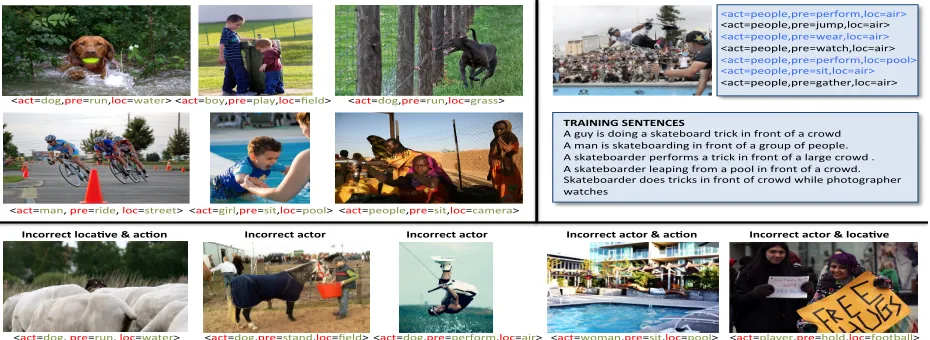
Figure 2: Samples of predicted tuples. Top-left: Examples of visually correct predictions. Bottom: Typical errors on one or
several arguments. Top-right: Sample image and its top predicted tuples. The tuples in blue were not observed neither in the SP-Dataset nor in the automatically enlarged dataset. Note that all of them are descriptive of what is occurring in the scene.
ysis approach of Hodosh et al. (2013). We first note that this approach is able to rank a list of candidate captions but cannot directly generate tuples. To gen-erate tuples for test images, we first find the caption in the training set that has the highest ranking score for that image and then extract the corresponding se-mantic tuples from that caption; 3) Indicator Fea-tures (IND), this is a standard factorized log-linear model that does not use any feature representation for the outputs; 4) A model that uses the skip-gram continuous word representation of outputs (SCWR); 5) A model that uses that semantic equivalence rep-resentation of outputs (SER); 6) A combined model that makes predictions using the best feature repre-sentation for each argument type (COMBO).
S-Pred KCCA IND SCWR SER COMBO
LOC 15 23 32 28 33
PRED 11 20 24 33 25
ACT 30 25 52 51 50
[image:5.612.72.299.518.576.2]MEAN 18.6 22.6 36 37.3 36 39.3
Table 1:Comparison of Output Feature Representation.
Table 1 shows the results. We observe that our proposed method performs significantly better than the baselines. The second observation is that the best performing output feature representation is dif-ferent for difdif-ferent argument types, for the locatives the best representation is SER, for the predicates is the SCWR and for the actors using an output fea-ture representation actually hurts performance. The
biggest improvement we get is on the predicate ar-guments, where we improve almost by 10% in aver-age precision over the baseline using the skip-gram word representation. Overall, the model that uses the best representation performs better than the indi-cator baseline.
Regarding the rank of the parameter matrices, we observed that the learned models can work well even if we drop the rank to 10% of its maximum rank. This shows that the learned models are effi-cient in the sense that they can work well with low-dimensional projections of the features.
7 Conclusion
In this paper we have presented a framework for ex-ploiting input and output embeddings in the context of structured prediction. We have applied this frame-work to the problem of predicting compositional se-mantic descriptions of images. Our results show the advantages of using output embeddings and induc-ing low-dimensional embeddinduc-ings for handlinduc-ing large state spaces in structured prediction problems. The framework we propose is general enough to consider additional sources of information.
8 Acknowledgments
References
[Akata et al.2013] Zeynep Akata, Florent Perronnin, Zaid Harchaoui, and Cordelia Schmid. 2013. Label-embedding for attribute-based classification. InProc. IEEE Conference on Computer Vision and Pattern Recognition (CVPR).
[Duchi and Singer2009] John Duchi and Yoram Singer. 2009. Efficient online and batch learning using for-ward backfor-ward splitting. Journal of Machine Learn-ing Research (JMLR), 10:2899–2934.
[Farhadi et al.2010] Ali Farhadi, Mohsen Hejrati,
MohammadAmin Sadeghi, Peter Young, Cyrus Rashtchian, Julia Hockenmaier, and David Forsyth. 2010. Every picture tells a story: Generating sen-tences from images. In Proc. European Conference on Computer Vision (ECCV).
[Hodosh et al.2013] Micah Hodosh, Peter Young, and Ju-lia Hockenmaier. 2013. Framing image descrip-tion as a ranking task: Data, models and evaluadescrip-tion metrics. Journal of Artificial Intelligence Research (JAIR), 47:853–899.
[Jia et al.2014] Yangqing Jia, Evan Shelhamer, Jeff Don-ahue, Sergey Karayev, Jonathan Long, Ross Girshick, Sergio Guadarrama, and Trevor Darrell. 2014. Caffe: Convolutional architecture for fast feature embedding.
arXiv preprint arXiv:1408.5093.
[Karpathy and Fei2015] Andrej Karpathy and Li Fei-Fei. 2015. Deep visual-semantic alignments for
gen-erating image descriptions. InProc. IEEE Conference on Computer Vision and Pattern Recognition (CVPR). [Kulkarni et al.2011] Girish Kulkarni, Visruth Premraj, Sagnik Dhar, Siming Li, Yejin Choi, Alexander C Berg, and Tamara L Berg. 2011. Baby talk: Un-derstanding and generating image descriptions. In
Proc. IEEE Conference on Computer Vision and Pat-tern Recognition (CVPR).
[Mikolov et al.2013] Tomas Mikolov, Kai Chen, Greg Corrado, and Jeffrey Dean. 2013. Efficient estimation of word representations in vector space. InProc. In-ternational Conference on Learning Representations (ICLR).
[Socher et al.2014] Richard Socher, Andrej Karpathy, Quoc V. Le, Christopher D. Manning, and Andrew Y. Ng. 2014. Grounded compositional semantics for finding and describing images with sentences. Trans-actions of the Association of Computational Linguis-tics (TACL), 2:207–218.
[Vinyals et al.2015] Oriol Vinyals, Alexander Toshev, Samy Bengio, and Dumitru Erhan. 2015. Show and tell: A neural image caption generator. InProc. IEEE Conference on Computer Vision and Pattern Recogni-tion (CVPR).