A Dynamic Programming Algorithm for
Tree Trimming-based Text Summarization
Masaaki Nishino1, Norihito Yasuda2, Tsutomu Hirao1, Shin-ichi Minato2,3, Masaaki Nagata1 1NTT Communication Science Laboratories, NTT Corporation
2ERATO Minato Discrete Structure Manipulation System Project, JST 3Graduate School of Information Science and Technology, Hokkaido University
Abstract
Tree trimming is the problem of extracting an optimal subtree from an input tree, and sentence extraction and sentence compres-sion methods can be formulated and solved as tree trimming problems. Previous ap-proaches require integer linear programming (ILP) solvers to obtain exact solutions. The problem of this approach is that ILP solvers are black-boxes and have no theoretical guar-antee as to their computation complexity. We propose a dynamic programming (DP) algo-rithm for tree trimming problems whose run-ning time is O(NLlogN), where N is the number of tree nodes andLis the length limit. Our algorithm exploits the zero-suppressed bi-nary decision diagram (ZDD), a data struc-ture that represents a family of sets as a di-rected acyclic graph, to represent the set of subtrees in a compact form; the structure of ZDD permits the application of DP to obtain exact solutions, and our algorithm is applica-ble to different tree trimming proapplica-blems. More-over, experiments show that our algorithm is faster than state-of-the-art ILP solvers, and that it scales well to handle large summariza-tion problems.
1 Introduction
Extractive text summarization and sentence com-pression are tasks that basically select a subset of the input set of textual units that is appropriate as a summary or a compressed sentence. Current text summarization and sentence compression methods regard the problem of extracting such a subset as a combinatorial optimization problem (e.g., (Filatova and Hatzivassiloglou, 2004; McDonald, 2007; Lin
and Bilmes, 2010)). Tree trimming, the problem of finding an optimal subtree of an input tree, is one kind of these combinatorial optimization problems, and it is used in three classes of text summarizations: sentence compression (Filippova and Strube, 2008; Filippova and Altun, 2013), single-document sum-marization (Hirao et al., 2013), and the combination of sentence compression and single-document sum-marization (Kikuchi et al., 2014). In these tasks, the set of input textual units is represented as a rooted tree whose nodes correspond to the minimum tex-tual units such as sentences and words. Next, a sub-set is made by forming a subtree by trimming the input tree. Since the optimal trimmed subtree pre-serves the relationships between textual units, it is a concise representation of the original set that pre-serves linguistic quality.
A shortcoming of tree trimming-based methods is that they are formulated as integer linear program-ming (ILP) problems and so an ILP solver is needed to solve them. Although modern ILP solvers can solve many instances of tree trimming problems in a short time, there is no theoretical guarantee that they obtain an optimal solution. Furthermore, even if an optimal solution can be obtained, we cannot es-timate the running time. Estimating the running time is critical for practical applications.
In this paper, we propose a dynamic programming (DP) algorithm for tree trimming problems that fo-cus on text summarization. The algorithm can solve all three different classes of tree trimming problems proposed so far in a unified way, and it can always find an optimal solution inO(NLlogN) time for these problems, whereN is the number of nodes of the input tree andLis the length limit. The running time of our algorithm only depends onN andLand
so is independent of the input trees structure. Find-ing an exact solution is important since we can use it to evaluate the performance of heuristic algorithms. The key idea of our algorithm is to use the zero-suppressed binary decision diagram (ZDD) (Minato, 1993) to represent the set of all subtrees of the input tree. ZDD is a data structure that represents a fam-ily of sets as a directed acyclic graph (DAG). It can represent a family of sets in compressed form. We use ZDD to represent the set of subtrees of the in-put tree, and then run a DP algorithm on the ZDD to obtain the optimal solution that satisfies the length limit. The algorithm runs in time O(|Z|L), where
|Z| is the number of nodes of ZDD, and L is the length limit. Although the number of ZDD nodes depends on the set we want to represent, we can give theoretical upper bounds when we represent the set of all subtrees of an input tree. ZDD uses
O(NlogN) nodes to represent the set of all sub-trees of anN node input tree. Hence the DP algo-rithm runs inO(NLlogN)time. The main virtues of the proposed algorithm are that (1) it can always find an exact solution, (2) its running time is the-oretically guaranteed, and (3) it can solve the three known tree trimming problems. Furthermore, our al-gorithm is fast enough to be practical and scalable. Since text summarization methods are often applied to large scale inputs (e.g., (Christensen et al., 2014; Nakao, 2000)), scalability is important. We compare it to state-of-the-art ILP solvers and confirm that the proposed algorithm can be hundreds of times faster. Since our method assumes known formuations for text summarization, the summary created by our al-gorithm is exactly the same as that obtained by ap-plying previous methods. However, we believe that algorithmic improvements in computational cost is as important as improvements in accuracy in order to make better practical systems.
2 Tree Trimming Problems
We briefly review the three tree trimming formula-tions used in text summarization and sentence com-pression. They all try to find the subtree that maxi-mizes the sum of item weights while satisfying the length limit. LetD={e1, . . . , eN}be the input set of textual units, whereeirepresents thei-th unit. We usewi andli to represent the weight and length of
ei, respectively. Given length limitL, these methods solve the following optimization problem:
Maximize
T⊆D
X
ei∈T
wi
Subject toT ∈ T and X ei∈T
li ≤L ,
(1)
whereT ⊆DandT ⊆ 2D. We useT to represent the set of subtrees that can be feasible solutions if we ignore the length limit. The following problems employ differentT to match each problem setting. If
T = 2D, i.e.,T equals the set of all possible subsets ofD, it is equivalent to the 0-1 knapsack problem, and is solved with the standard DP algorithm.
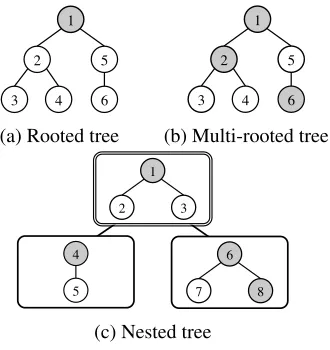
Sentence Extraction Hirao et al. (2013) proposed a single-document summarization algorithm to solve a tree trimming problem. They represent a document as a set of elementary discourse units (EDUs) and then select an optimal subset to make a summary. Each EDU is a minimal unit that composes the dis-course structure of the document; it usually corre-sponds to a clause. Their summarization method first represents a document as a dependency discourse tree (DEP-DT) that represents the dependency struc-ture between EDUs. DEP-DT is a rooted tree in which each node corresponds to an EDU. They then select the rooted subtree that maximizes the sum of weights and satisfies the length limit to make a sum-mary, where we say a subtree is rooted if it contains the root node of the input tree. This problem can be formulated as the combinatorial optimization prob-lem of Eq.(1), whereT is the set of all rooted sub-trees of the input DEP-DT.
(a) Rooted tree (b) Multi-rooted tree
[image:3.612.109.274.58.233.2](c) Nested tree
Figure 1: Example trees.
is the set of all subtrees of the input tree whose root node is contained inR.
Sentence Extraction & Compression Kikuchi et al. (2014) proposed a single-document summariza-tion method that can select compressed sentences. It is an extension of the sentence extraction method proposed in (Hirao et al., 2013). They represent a document as a sentence dependency tree that is ob-tained from DEP-DT, and then represent each sen-tence in the sensen-tence dependency tree as a word de-pendency tree. In the following, inner trees refer to the word dependency trees that correspond to sen-tences, while the outer tree represents the sentence dependency tree that represents a document. Hence a document is represented as a nested tree where each node of the outer tree corresponds to an inner tree. They then make a summary by first selecting a rooted subtree of the outer tree, and then selecting a subtree for each inner tree that corresponds to a node of the selected subtree of the outer tree. Each inner tree has multiple root candidate nodes, and the root node of a subtree of an inner tree is a root candidate node of the tree. The set of feasible solutions, T, corresponds to all possible nested trees constructed in this way1.
Fig. 1 shows example input trees used in the above three tasks: (a) a rooted tree used in sentence extrac-tion, (b) a multi-rooted tree used in sentence
com-1Kikuchi et al. (2014) set further constraints on possible
sub-trees of a syntactical tree. Our method can also cope with these additional constraints (see Sect. 7).
Table 1: Examples of valid and invalid subtrees of the input trees in Fig. 1
Valid Invalid
Rooted tree e1e2e3,e1e2e5 e2e3e4,e6 Multi-rooted tree e1e2e5,e2e3e4 e3,e5e6
Nested tree e1e2e4,e1e4e5e8 e4e5e6,e1e2e7
pression, and (c) a nested tree used in sentence ex-traction & compression. Gray nodes are root candi-date nodes. Each tree yields a different set of valid subtrees. Tab. 1 shows examples of valid and invalid subtrees of each input tree, where we assume that each subtree in T is represented by a set of nodes that is contained in the subtree.
3 Zero-suppressed Binary Decision Diagram (ZDD)
The key idea of the proposed algorithm is to rep-resent the set of candidate subtrees T as a zero-suppressed binary decision diagram (ZDD) (Minato, 1993). ZDD is a variant of binary decision diagram (BDD) (Bryant, 1986; Akers, 1978), and is a data structure that can succinctly represent a family of sets as a DAG. ZDD has two types of nodes, namely branch nodes and terminal nodes. Branch nodes are non-terminal nodes. Each branch node has exactly two out edges, called low-edge and high-edge, and a label that represents the item that the node corre-sponds to. We usehi(i),lo(i), andv(i)to represent the node pointed to by the high-edge, low-edge, and the label of thei-th node of the ZDD, respectively. The branch node that has no parent node is the root node. Terminal nodes have no outgoing edges, and a ZDD has exactly two terminal nodes whose labels are >and ⊥. A path from the root node to termi-nal node>represents a set of items contained in the family of sets represented by the ZDD. We can re-cover the set of items that corresponds to a path by selecting the labels of the branch nodes whose high-edges lie on the path.
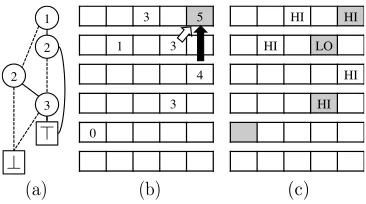
[image:3.612.317.533.97.145.2]Figure 2: An example ZDD and how the dynamic programming algorithm works with the ZDD. (a) An example ZDD that represents the family of sets
{e1e2, e1e3, e2e3}, (b) tableSand (c) tableB after completion of the table filling phase.
in Fig. 2(a) is 1. The ZDD has three different paths that start at the root node and end at>. Each path corresponds to an item contained in the family of sets.
In the following, letz1, . . . , z|Z| be the nodes of
a ZDD. We use Z to represent a ZDD, and|Z|to represent the number of nodes in Z. We assume
i < hi(i),lo(i) for every i = 1, . . . ,|Z| −2. z1 corresponds to the root node, and z|Z|−1, z|Z|
cor-responds to > and⊥ terminal nodes, respectively. We also assume that the ZDD is ordered, i.e., there is a total order on the labels, and the label of a par-ent node comes before that of a child node for every parent-child node pair. The ZDD in Fig. 2(a) is an ordered ZDD whose order ise1, e2, e3.
4 Dynamic Programming Algorithm for Tree Trimming Problems
Our algorithm takes the following three-step proce-dure. First, we represent the set of subtrees T for each tree trimming problem as a ZDD. Then we ap-ply a bottom-up and table-filling style DP algorithm to the ZDD. Finally, we backtrack the filled table to obtain an optimal solution.
Our algorithm is similar to the standard DP al-gorithm for the 0-1 knapsack problem, which solves the problem inO(NL)time withNitems and length limitL. The DP algorithm solves a knapsack prob-lem by filling anN×(L+1)table by recursively ex-ploiting previously computed partial solutions. Our algorithm also fills a table for problem solving, but the table’s size is |Z| ×(L + 1). That is, the size of the table equals the number of nodes of the ZDD
Algorithm 1Dynamic Programming Algorithm
Input: ZDDZthat representT, length limitL, andwi,lifor
1≤i≤N
Output: Optimal subtreer
1: InitializeS[i][j]← −∞for alli, j. 2: S[|Z| −1][0]←0.
3: fori=|Z| −2, . . . ,1do
4: forj= 0, . . . , Ldo
5: ifj≥lv(i)and
S[hi(i)][j−lv(i)] +wv(i)> S[lo(i)][j]then
6: S[i][j]←S[hi(i)][j−lv(i)] +wv(i) 7: B[i][j]←HI
8: else
9: S[i][j]←S[lo(i)][j], B[i][j]←LO
10: k∗←argmax
0≤k≤LS[1][k]
11: i←1, j←k∗, r← ∅
12: while(i, j)6= (|Z| −1,0)do
13: ifB[i][j] =HIthen
14: r←r∪ {v(i)}, i←hi(i), j←j−lv(i) 15: else
16: i←lo(i)
17: returnr
that represents a set of subtreesT. The tables can be seen as the set of|Z|arrays with(L+1)entries, and each array is associated with each ZDD node. We fill these tables by referring to previously computed re-sults by using the ZDD’s structure.
Alg. 1 is the DP algorithm that can solve the prob-lem of Eq.(1), given the ZDD that represents the family of setsT. We first prepare two tables,Sand
B; both have|Z| ×(L+ 1)entries. TableSis used for storing intermediate weights, andB is used for storing information used in recovering the optimal solution. We first fill the elements inSandB while traversing the ZDD in order from the terminal nodes to the root node. We then useB to recover the so-lution that maximizes the weight. In the table filling phase (lines 1 to 9), we updateS[i][j]andB[i][j], recursively. WeightS[i][j]represents the maximum weight of the ZDD path from the i-th node to the
>terminal node, whose total length isj. We com-pareS[hi(i)][j−lv(i)] +wv(i) andS[lo(i)][j], and select the maximum weight to setS[i][j]. The value ofB[i][j]stores which candidate we set toS[i][j]. If we use the former one, we set labelHI toB[i][j], otherwiseLO. After filling the table, we run a back-tracking procedure to obtain an optimal solution. In the backtracking phase (lines 10 to 16), we start from
We give here a proof of the correctness of the al-gorithm. We use the fact that the ZDD is constructed recursively; given thei-th branch nodeziof a ZDD, the subgraph induced by the set of nodes that are de-scendants ofzi is also a ZDD. Let the ZDD whose root node iszi be Zi, and the family of sets repre-sented byZibeTi. Family of setsTi,Tlo(i)andThi(i) satisfy the following relationship.
Ti =Tlo(i)∪ {ev(i)∪T|T ∈ Thi(i)}
Proposition 1. Alg. 1 can find the optimal solution of the problem of Eq.(1), where we assumeT is rep-resented as an ordered ZDD.
Proof. We use induction to give a proof that
S[i][j] = maxTPei∈Twi after running our
algo-rithm, whereT is a set of tree nodes that satisfies
T ∈ Ti and Pei∈T li = j. If i = |Z| − 1, then
Ti = {∅}and S[i][0] = 0and S[i][j] = −∞ for
j 6= 0, which satisfies the condition. Suppose that
S[lo(i)][j]andS[hi(i)][j]both satisfy the condition for j = 0, . . . , L. If the set that maximizes S[i][j]
does not haveev(i), then the set is contained inTlo(i), and its size is j. Therefore, the maximum weight equalsS[lo(i)][j](Alg.1 line 9). Otherwise, the set that maximizesS[i][j]hasev(i), so the item is con-tained in {ev(i)∪T|T ∈ Thi(i)}, and its weight is
S[hi(i)][j−lv(i)]+wv(i)(Alg.1 line 6). SinceZ1 cor-responds to the root node and it represents all possi-ble solutions,maxjS[1][j]is the maximum weight of the subset that satisfies the length limit and is con-tained inT.
Proposition 2. The time and space complexity of Alg. 1 are bothO(|Z|L).
Proof. We have to store tablesS, Band solutionr. The tables have|Z| ×(L+ 1)entries and|Z| ≥ |r|, the space complexity isO(|Z|L). For the time com-plexity, filling entries inSandB requiresO(|Z|L)
time since to fill an entry requires constant time. Backtracking requires at mostN updates, hence the time complexity isO(|Z|L).
We show an example of our algorithm in Fig. 2. Suppose thatD = {e1e2, e1e3, e2e3},(l1, l2, l3) =
(1,1,3)and(w1, w2, w3) = (2,1,3). SetDis rep-resented as the ZDD in Fig. 2(a). LetL= 4and run the DP algorithm yielding tablesS andB shown in
[image:5.612.333.519.63.221.2](a) (b) (c)
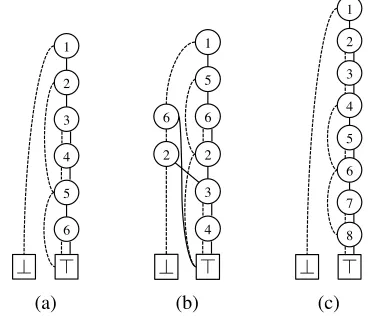
Figure 3: Example ZDDs representing the set of trimmed subtrees of the trees in Fig. 1. (a) Rooted-tree, (b) multi-rooted Rooted-tree, and (c) nested-tree
Fig. 2(b,c). Suppose that we want to fill entryS[1][4]
(the upper right cell). There are two possible paths to reach the entry; the first path takes the high-edge fromS[2][3], and the second path takes the low-edge fromS[3][4]. We use hollow and black arrows to rep-resent these paths in Fig. 2(b). Since the former path results in weight5, which is higher than that of the later path, hence we setS[1][4] = 5andB[1][4] = HI. After filling all the entries in tables, we can see
S[1][4]has the maximum weight, and the backtrack-ing fromB[1][4]→B[2][3] → B[4][3] → B[5][0].
B[5][0]corresponds to the>terminal node, and the backtracking yields the optimal solutione1e3.
5 ZDD Sizes
We give upper bounds on the size of the ZDD rep-resenting the family of setsT of Eq.(1) for the three problems. The number of subtrees contained in T
may grow exponentially with the size of the original tree, however, we can represent them as a ZDD with very few nodes. Since the running time of our algo-rithm isO(|Z|L), these theoretical upper bounds de-termine the running time of the proposed tree trim-ming algorithms.
We first give a proof of the size of the ZDD that represents all rooted subtrees of a given tree.
of ZDD labels.
This result can be derived from the result of (Knuth, 2011), Chap.7.1.4, exercise 266. Fig. 3(a) is a ZDD that represents the set of all rooted subtrees of the tree in Fig. 1(a), where we employ pre-ordering
e1, e2, e3, e4, e5, e6.
We next show the size of the ZDDs that represent the set of all subtrees of a multi-rooted tree.
Proposition 4. Given anN node tree and the set of candidate root nodesR, the set of all possible sub-trees can be represented by a ZDD whose number of nodes isO(Nlog|R|).
Proof. (Sketch) The set of all possible subtrees can be represented as the union of the sets of rooted sub-trees for different rootr ∈R. The set of rooted sub-trees for a root nodercan be represented as a ZDD that hasO(N)nodes, hence the set of ZDDs for dif-ferent root nodes has O(N|R|) nodes in total. We can further reduce this upper bound by employing appropriate depth first pre-ordering so as to share as many ZDD substructures as possible, and this order-ing results in a union ZDD whose number of nodes isO(Nlog|R|).
This proposition is related to a recently proved re-sult that the set of all subtrees of anN-node tree can be represented as a ZDD whose number of nodes isO(NlogN)(Yasuda et al., 2014). This is a spe-cial case of the above theorem thatRequals the set of all nodes of the tree, i.e., |R| = N. The key point is to use theheaviest-last depth first pre-order
as the ZDD label order. In this order, a node with the heaviest weight always comes after other sib-lings, where we define the weight of a node as the size of the maximum rooted subtree T ∈ T that is contained in its descendant tree. Fig. 3(b) is an example of the ZDD that represents the set of all possible rooted subtrees of the multi-rooted tree in Fig. 1(b), where the heaviest-last depth first pre-order ise1, e5, e6, e2, e3, e4.
The upper bound size of a ZDD for nested sub-trees can be estimated by combining the above two theoretical results on rooted subtrees and multi-rooted subtrees.
Proposition 5. For a nested tree whose sum of the number of nodes of inner trees is N, and the sets of candidate root nodes for inner trees are
R1, . . . , RM, whereM is the number of inner trees,
we can represent the set of possible nested subtrees byO(Nlog|R∗|), where|R∗|= maxi|Ri|.
Proof. (Sketch) The ZDD corresponding to the set of nested subtrees can be constructed as follows: first we make ZDDs that represent the set of rooted subtrees of the outer tree and inner trees. The outer tree is represented as a ZDD withO(N)nodes, and the i-th inner tree is represented as a ZDD with
O(Nilog|Ri|) nodes, where Ni is the number of nodes of thei-th inner tree. Then we can construct the ZDD for the nested tree by replacing each ZDD node of the outer-tree ZDD with the inner-tree ZDD corresponding to that node.
Fig. 3(c) is a ZDD that represents the set of nested subtrees of the tree in Fig. 1(c), where we employ the ordere1, e2, e3, e4, e5, e6, e7, e8.
We can directly prove the running time of the DP algorithm by exploiting the above three results to show the DP algorithm for the three problems takes
O(NL),O(NLlog|R|), andO(NLlog|R∗|)time,
respectively. Here we assume that a ZDD that repre-sents the setT is given. We need additional time for constructing a ZDD that representsT i.e. the input tree. However, ZDD construction also can be done inO(|Z|)for the three tree trimming problems. We show details of ZDD construction in the next sec-tion.
6 Efficient ZDD Construction
We introduce here an efficient algorithm for con-structing a ZDD that is used in the tree trimming problems. A ZDD can be constructed by repeatedly applying set operations between intermediate ZDDs, however, this process may be too slow since the run-ning time of the set operations depends on the size of input and output ZDDs.
top-down algorithm can efficiently construct a ZDD that represents the set of all connected components of a graph, and we can use it for constructing the set of all rooted subtrees with small modification. The running time of top-down construction algorithms may not beO(|Z|), but our modified algorithm can obtain the ZDD in O(|Z|) time by exploiting the structure of the input tree to avoid to make unnec-essary ZDD nodes.
We can extend this ZDD construction algorithm to create ZDDs that represent the set of nested subtrees. We first compute the orders of outer tree and each in-ner tree, and then construct ZDDs for them using the top-down construction algorithm. Finally, we obtain the required ZDD by replacing ZDD nodes of the outer tree with the corresponding inner ZDDs. These procedure also can be done in O(|Z|) time, since constructing the ZDDs for each tree takes time pro-portional to its size, and the ZDD substitution phase also takes time proportional to ZDD size.
7 Discussion
When solving a tree trimming problem, we some-times want to add constraints to the problem so as to obtain better results. For example, Kikuchi et al. (2014) use additional constraints to set the mini-mum number of words (sayθwords) extracted from a sentence if the sentence is contained in a sum-mary, and require each selected inner tree to con-tain at least one verb and noun if the inner tree has them. Since our tree trimming approach can work once the ZDD that represents the set of feasible so-lutions is constructed, adding new constraints to the set of solutions can be easily performed by apply-ing ZDD operations. These operations can be per-formed efficiently for many cases and the proposed approach will still work well. Moreover, we can ex-tend the algorithm to construct ZDDs that represent the extended set of feasible solutions. We can also give theoretical upper bounds for the new constraint-added problem. In this nested tree case, we can prove that the number of ZDD nodes isO(Nθlog|R∗|).
8 Experiments
We conduct experiments on the three tree trimming tasks of text summarization, sentence compression, and the combination of summarization and text
com-pression. For the text summarization experiments, we use the test collection for summarization evalua-tion contained in the RST Discourse Treebank (RST-DTB) (Carlson et al., 2001), which is used in the pre-vious work. The test collection consists of 30 docu-ments with the reference summaries whose length is about 10% of the original document. We used the same parameters used in the previous papers. For sentence compression, we use the English compres-sion corpus used in (Filippova and Strube, 2008), which consists of 82 news stories selected from the British National Corpus and American News Text Corpus, and consists of more than 1,300 sentences. We set the sizes of compressed sentences to be 70% of the original length, which is used in the origi-nal paper. We compare the proposed algorithm to Gurobi 5.5.0, a widely used commercial ILP solver2.
It was run in the default settings and we used single-thread mode. We run Gurobi until it finds an optimal solution. Our algorithm was implemented in C++, and all experiments were conducted on a Linux ma-chine with a Xeon E5-2670 2.60 GHz CPU and 192 GB RAM.
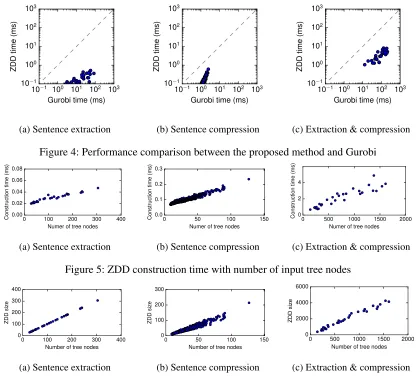
Fig. 4 compares the running time of our algorithm (includes ZDD construction time) and Gurobi. Each plotted marker in the figures represents a test in-stance, and if the position of a marker is below the dashed line, it means that our method is faster than Gurobi. We can see that our method is always faster than Gurobi; it was, at most, 300, 10, and 50 times faster in sentence extraction, sentence compression, and extraction & compression, respectively. Fig. 5,6 shows the relation between the input tree size and the ZDD construction times, and the relation be-tween the input tree size and converted ZDD size respectively. These results show that both ZDD sizes and construction time were linear to the number of input tree nodes. The number of ZDD nodes looks like smaller than theO(NlogN)bounds for multi-rooted trees and nested trees. This result is caused since the set of root candidate nodesRis small com-paring withN for a typical input document.
Next we conduct experiments to assess the scala-bility of the proposed method by solving problems with different input sizes. We choose the nested tree
2We also used CPLEX 12.5.1.0, but Gurobi shows better
10−1 100 101 102 103
Gurobi time (ms) 10−1
100
101
102
103
ZDD
time
(ms)
(a) Sentence extraction
10−1 100 101 102 103
Gurobi time (ms) 10−1
100
101
102
103
ZDD
time
(ms)
(b) Sentence compression
10−1 100 101 102 103
Gurobi time (ms) 10−1
100
101
102
103
ZDD
time
(ms)
[image:8.612.98.514.69.451.2](c) Extraction & compression
Figure 4: Performance comparison between the proposed method and Gurobi
0 100 200 300 400 Numer of tree nodes 0.00
0.02 0.04 0.06 0.08
Constr
uction
time
(ms)
(a) Sentence extraction
0 50 100 150
Numer of tree nodes 0.0
0.1 0.2 0.3
Constr
uction
time
(ms)
(b) Sentence compression
0 500 1000 1500 2000 Numer of tree nodes 0
2 4
Constr
uction
time
(ms)
(c) Extraction & compression
Figure 5: ZDD construction time with number of input tree nodes
0 100 200 300 400 Number of tree nodes 0
100 200 300 400
ZDD
siz
e
(a) Sentence extraction
0 50 100 150
Number of tree nodes 0
100 200 300
ZDD
siz
e
(b) Sentence compression
0 500 1000 1500 2000 Number of tree nodes 0
2000 4000 6000
ZDD
siz
e
(c) Extraction & compression
Figure 6: ZDD sizes with number of input tree nodes
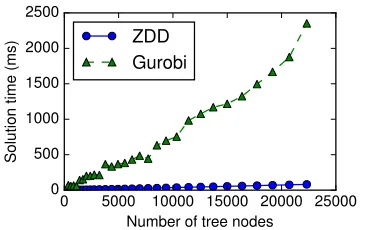
trimming problem since it is the most complex prob-lem. We make a large artificial nested tree by con-catenating outer-trees of the nested trees of 30 RST-DT datasets. The results are shown in Fig. 7, and it shows that out method scales well with large inputs comparing with Gurobi.
9 Related Work
Recently proposed text summarization and sentence compression methods solve a task by formulating it as a combinatorial optimization problem (McDon-ald, 2007; Woodsend and Lapata, 2010; Martins and Smith, 2009; Clarke and Lapata, 2008). These combinatorial optimization-based formulations en-able flexible models that can reflect the properties re-quired. However, their complexity makes it difficult
to solve optimization problems efficiently. These problems can be solved by using ILP solvers, how-ever, they may fail to find optimal solutions and they have no guarantee on the running time. Since the proposed method is a DP algorithm and it has a the-oretical guarantee, it always find an optimal solution in time proportional to the size of the input tree.
0 5000 10000 15000 20000 25000 Number of tree nodes
0 500 1000 1500 2000 2500
Solution
time
(ms)
[image:9.612.95.281.66.181.2]ZDD Gurobi
Figure 7: Solution time of our algorithm and Gurobi with different input tree sizes.
that algorithms that have guarantees on both running time and quality of solutions are highly demanding, and the proposed pseudo-polynomial time exact al-gorithm is valuable.
The Zero-suppressed Binary Decision Diagram (ZDD) (Minato, 1993) is a variant of the Binary De-cision Diagram (BDD) (Akers, 1978; Bryant, 1986). BDD is a data structure that represents a Boolean function as a DAG, and ZDD can represent a fam-ily of sets in a compact form. Recently, ZDD and BDD have been used for solving optimization prob-lems (Bergman et al., 2014a; Bergman et al., 2014b); they find the optimal solution by representing the set of feasible solutions in a BDD or its variants. Com-pared to these optimization methods, the proposed method differs in two main points. First, the pro-posed algorithm extends the ZDD-based optimiza-tion algorithm to solve knapsack problems. Second, it offers proofs of the size of ZDDs representing trimmed subtrees.
The ZDD-based method presented in this paper is related to our previous work of a BDD-constrained search (BCS) method (Nishino et al., 2015). In BCS, a BDD is used to solve constraints-added variants of shortest path problems on a DAG, and a 0-1 knap-sack problem with additional constraints also can be solved by BCS. The main advantage of the DP-algorithm shown in this paper is that it has a theoret-ical guarantee on its running time which depends on only the size of the input tree. This advantage comes from using ZDD instead of BDD, and designing an algorithm specialized for variants of the knapsack problem. Though not obvious, it is possible to ex-tend BCS to use ZDD instead of BDD and employ
the label order used in this paper to give a theoretical bound that only depends on the size of an input tree. Nevertheless, the bound attained with this extension is worse than that shown in this paper.
10 Conclusion
We have proposed a DP algorithm for the tree trim-ming problems that appear in text summarization. Our approach always finds an optimal solution, and it runs inO(NLlogN)time, whereN is the num-ber of tree nodes andLis the length limit. The key to our approach is to represent a set of subtrees of an input tree as a ZDD. By using ZDD, we can give a theoretical guarantee of the running time of the al-gorithm. Experiments show that the proposal allows three different tree trimming problems to be solved in the same way.
References
Sheldon B. Akers. 1978. Binary decision diagrams.
Computers, IEEE Transactions on, C-27(6):509–516. David Bergman, Andre A. Cire, and Willem-Jan van
Ho-eve. 2014a. MDD propagation for sequence con-straints. Journal of Artificial Intelligence Research, 50:697–722.
David Bergman, Andre A Cire, Willem-Jan van Hoeve, and Tallys Yunes. 2014b. BDD-based heuristics for binary optimization. Journal of Heuristics, 20(2):211– 234.
Randal E Bryant. 1986. Graph-based algorithms for boolean function manipulation. Computers, IEEE Transactions on, C-35(8):677–691.
Lynn Carlson, Daniel Marcu, and Mary Ellen Okurowski. 2001. Building a discourse-tagged corpus in the framework of rhetorical structure theory. In Proceed-ings of the Second SIGdial Workshop on Discourse and Dialogue - Volume 16, SIGDIAL’01, pages 1–10. Janara Christensen, Stephen Soderland, Gagan Bansal, and Mausam. 2014. Hierarchical summarization: Scaling up multi-document summarization. In Pro-ceedings of the 52nd Annual Meeting of the Associ-ation for ComputAssoci-ational Linguistics, ACL’14, pages 902–912.
James Clarke and Mirella Lapata. 2008. Global infer-ence for sentinfer-ence compression an integer linear pro-gramming approach. Journal of Artificial Intelligence Research, 31(1):399–429.
summa-rization. In IEEE 12th International Conference on Data Mining Workshops, ICDMW, pages 454–463. Elena Filatova and Vasileios Hatzivassiloglou. 2004.
A formal model for information selection in multi-sentence text extraction. In Proceedings of the 20th International Conference on Computational Linguis-tics, COLING’04.
Katja Filippova and Yasemin Altun. 2013. Overcom-ing the lack of parallel data in sentence compres-sion. In Proceedings of the 2013 Conference on Empirical Methods in Natural Language Processing, EMNLP’13, pages 1481–1491.
Katja Filippova and Michael Strube. 2008. Dependency tree based sentence compression. In Proceedings of the Fifth International Natural Language Generation Conference, INLG’08, pages 25–32.
Tsutomu Hirao, Yasuhisa Yoshida, Masaaki Nishino, Norihito Yasuda, and Masaaki Nagata. 2013. Single-document summarization as a tree knapsack prob-lem. In Proceedings of the 2013 Conference on Empirical Methods in Natural Language Processing, EMNLP’13, pages 1515–1520.
Yuta Kikuchi, Tsutomu Hirao, Hiroya Takamura, Man-abu Okumura, and Masaaki Nagata. 2014. Single document summarization based on nested tree struc-ture. InProceedings of the 52nd Annual Meeting of the Association for Computational Linguistics, ACL’14, pages 315–320.
Donald E Knuth. 2011. The Art of Computer Program-ming, Volume 4A: Combinatorial Algorithms, Part 1. Addison-Wesley.
Hui Lin and Jeff Bilmes. 2010. Multi-document sum-marization via budgeted maximization of submodu-lar functions. InHuman Language Technologies: The 2010 Annual Conference of the North American Chap-ter of the Association for Computational Linguistics, NAACL/HLT’10, pages 912–920.
Hui Lin and Jeff Bilmes. 2011. A class of submodu-lar functions for document summarization. In Pro-ceedings of the 49th Annual Meeting of the Associa-tion for ComputaAssocia-tional Linguistics: Human Language Technologies, ACL/HLT’11, pages 510–520.
Andr´e FT Martins and Noah A Smith. 2009. Summa-rization with a joint model for sentence extraction and compression. InProceedings of the Workshop on In-teger Linear Programming for Natural Langauge Pro-cessing, pages 1–9.
Ryan McDonald. 2007. A study of global inference algo-rithms in multi-document summarization. In Proceed-ings of the 9th European Conference on Information Retrieval, ECIR’07, pages 557–564.
Shin-ichi Minato. 1993. Zero-suppressed BDDs for set manipulation in combinatorial problems. In
De-sign Automation, 1993. 30th Conference on, DAC’93, pages 272–277.
Yoshio Nakao. 2000. An algorithm for one-page sum-marization of a long text based on thematic hierarchy detection. In Proceedings of the 38th Annual Meet-ing of the Association for Computational LMeet-inguistics, ACL’00, pages 302–309.
Masaaki Nishino, Norihito Yasuda, Shin-ichi Minato, and Masaaki Nagata. 2015. BDD-constrained search: A unified approach to constrained shortest path prob-lems. InProceedings of the 29th AAAI Conference on Artificial Intelligence, AAAI’15, pages 1219–1225. Xian Qian and Yang Liu. 2013. Fast joint compression
and summarization via graph cuts. InProceedings of the 2013 Conference on Empirical Methods in Natural Language Processing, EMNLP’13, pages 1492–1502. Kristian Woodsend and Mirella Lapata. 2010. Automatic generation of story highlights. InProceedings of the 48th Annual Meeting of the Association for Computa-tional Linguistics, ACL’10, pages 565–574.