2018 International Conference on Computer Science and Software Engineering (CSSE 2018) ISBN: 978-1-60595-555-1
Based on Particle Swarm Optimization
Algorithm for Finding Ideal and Effective
Solution of Dynamic Batch Reactor
Multi-objective Optimization
Yuanbin Mo and Yanyue Lu
1
ABSTRACT
Chemical production process integration is higher and higher, the operation is more and more complex. Based on the dynamic simulation of the process, analysis automation engineering and obtain decision, is beneficial to improve the production efficiency, also ensure safety. The mathematical model is a multi-objective dynamic optimization problem, and it is difficult to solve the multi-objective and it involves the numerical solution of differential system. The particle swarm algorithm strategy is given in this paper for the problem of a numerical solution. Penalty term was added to the PSO algorithm is put forward, as well as the local extremum and global extremum was used to adjust further, so that PSO algorithm is suitable for finding the ideal efficient solutions for multi-objective optimization problem, at the same time in the process of evolution, embedded Runge-Kutta method, the algorithm could been used for dynamic multi-objective optimization problems.
INTRODUCTION
Chemical industry is the supporting industry of many end product manufacturing industries, which can be seen everywhere in actual production and daily life. In recent years, the energy crisis and environmental pollution have brought about more and more serious challenges to human survival, so and the operation performance and control target of chemical process are getting more and
Yuanbin Mo, Yanyue Lu
more attention. Chemical production process integration is more and more high, the operation is more and more complicated, making the mathematical model for these problems are becoming more and more complex, the optimization strategy based on steady state model is difficult to describe such problems, dynamic simulation is getting more and more attention, and rapid development. However, the difficulty of solving complex dynamic characteristics is increasingly becoming the bottleneck of increasing efficiency, increasing production and reducing energy consumption. Therefore, the dynamic optimization of chemical process becomes a research hotspot in process system engineering.
The actual chemical production process usually needs to optimize multiple targets simultaneously, such as the shortest time, the minimum energy consumption, the highest yield, etc. These goals often interact and even conflict, resulting in complex multi-objective dynamic optimization problems. Therefore, it is not easy to solve this kind of problem, and in engineering practice, a satisfactory and feasible solution is needed. Therefore, it is practical significance to explore this kind solution and given an algorithm to find it quickly.
DYNAMIC MULTI-OBJECTIVE MODEL
The actual chemical production in the process of the transfer as the evolution of time and space, a variety of state variables will change, and that there are always various kinds of interference, volatility, operating conditions will also change, so strictly speaking, all the industrial engineering is the process of dynamic, steady state is only a special case of dynamic. Steady-state model built on all process conditions don't change with time and space, and the dynamic model is simulate each process parameter of the system when its parameter change [1]
General dynamic model described by the algebraic equation, differential equation, or differential equation, the algebraic equation describing the thermodynamic and physical relationship in the model, the differential equation and difference equation expressed in the model such as quality, energy balance, and dynamic characteristics of the process of its mathematical model is:
where, t0is the initial point, tfis the terminal point, it can be given or can be free,
) (t
x is a state variable, u(t)is the control variable, it is composed of m control variables, and each control variable has its upper and lower limits. J is the performance function, and is composed of k target function, through the k mapping function control variables are mapped to the target space, and each objective function usually consists of two parts, Ψ was called the terminal point tf
performance index function of state variables x(t) , Φ was called system performance of the generated in the process of change. Objective function was constrained by the system of algebraic equations, spis the first p a path constraint,
namely the constraints of function in the process of change, gqis the first q a
terminal constraint, the variable in terminal time should satisfy the constraints of the function.
In literature [2, 3], the multi-objective optimization problem is solved by combining the target linear combination into single target optimization problem. Literature [4] used fuzzy optimization to transform multiple targets into single targets. In conclusion, most of the multi-objective optimization problems are solved by converting multiple targets into single targets. The problem of multi-objective optimization is solved by linear combination into single objective optimization problem. Aiming at this problem, this paper puts forward the ideal effective solution of multi-objective problem on the basis of analyzing the multi-objective problem, and gives the ideal and effective solution to the problem of dynamic multi-objective optimization.
In fact, the multi-objective optimization problem is widely existed in various fields, and it is good to solve the above multi-objective programming problems, which can help to improve the income. On the other hand, it helps reduce risk. However, there is no universal effective method for solving multi-objective programming.
Nowadays because of various evolutionary algorithm was proposed, and because of its a kind of computing technology based on group collaboration, multiple solutions of implicit parallel search solution space, and can use the similarity between different solutions to improve the efficiency of the concurrent solution, therefore more suitable for solving multi-objective optimization problem. Evolutionary algorithm is used firstly to study multi-objective optimization problems is Schaffer, he proposed the "vector to assess genetic algorithm" [5], and then there are many evolutionary algorithm used to solve the problem of multi-objective optimization evolutionary algorithms have been proposed, and applied successfully to the [6] in the multi-objective optimization problem.
was applied to multi-objective optimization problem is a very meaningful research direction. Although there have been some using PSO algorithm to solve multi-objective optimization problems, but about using the ideal point method to find the closest distance with the ideal point solution of multi-objective optimization problem (called a ideal efficient solution) to analyze the chemical dynamic multi-objective optimization problems are not covered. Such method was used to study the chemical dynamic multi-objective optimization resource ideal that improve the speed and the quality of the solution, in order to meet the chemical dynamic multi-objective optimization process control and operation of the actual needs.
THE IDEAL EFFECTIVE SOLUTION TO MULTI-OBJECTIVE OPTIMIZATION PROBLEM
Multi-objective optimization problem:
)), ( , ), ( ), ( ( ) (
miny= f x = f1 x f2 x fn x (2)
Where, m
R
∈
x is the decision vector, n
R
∈
y is the target vector, fj(x),j=1,2,n
is the target function. In most cases, there may be conflicts between the target functions, which make multi-objective optimization problems generally do not exist in the global optimal solution that makes all objective functions optimal at the same time. The commonly used solutions to multi-objective optimization problems are effective solutions and weak effective solutions. The ideal point method is a method to solve the effective solution. The specific method is to transform the multi-objective optimization into single-multi-objective optimization and solve the optimal solution of single-objective optimization.
Definition : if *
j
f is the optimal value of the j-th target in (2), then the problem
∑
=
− =
n
j
j
j f
f f
1
* ) ) ( ( ))
( (
minϕ x x (3)
Its optimal solution was called the ideal effective solution of (2), which is the most recent effective solution to the ideal point of the effective solution. The ideal effective solution has a wide range of applications in practice [9], and it is valuable to find the ideal and effective solution.
PARTICLE SWARM OPTIMIZATION ALGORITHM
information sharing mechanism in biological group, it provides an advantage for the evolution of the group, which is formed on the basis of PSO algorithm.
Each particle in the PSO algorithm is a solution in the solution space, which adjusts its flight according to its own flight experience and companion's flight experience. The best place for each particle to experience in flight is the optimal solution found by the particle itself. The best position that the entire group has experienced is the optimal solution that the entire group has now found. The former is called the individual extreme point (pBest), the latter is called the global extreme point (gBest). The "good and bad" degree of the particle is evaluated by the objective function value determined by the optimization problem in practice. Each particle is constantly updated with these two extremes to create a new generation. The group size of the particle is N, and the i-th particle is represented by xi, and its velocity is denoted by vi, and the "best" position it experiences is recorded as pBest[i], and the iterative formula of PSO algorithm is.
) ()(
) ] [ (
() 2
1 i i
i
i v c rand pBesti x c rand gBest x
v =ω× + × × − + × − (4)
i i
i x v
x = + (5)
Where c1,c2 is the control parameter, also known as the learning factor; rand () is a random number and can be considered as an inertial weight.
PARTICLE SWARM OPTIMIZATION ALGORITHM FOR SOLVING MULTI-OBJECTIVE OPTIMIZATION IDEAL EFFECTIVE SOLUTION
Basic Idea of Algorithm
For the problem (2), the PSO algorithm is improved from the following aspects, (1) PSO algorithm was applied to the following problem.
) (
min fj x j=1,2n (6)
2 1
1( ) ( ( ) ( ))
min f f fj m
n
j j
n =∑ −
=
+ x x (7)
where, fj(m) is the optimal value obtained by the calculation of the j-th objective function to the m generation. It's a kind of punishment. On the one hand, it is necessary to optimize, on the other hand, to make the obtained solution move in the direction of the shortest distance from the optimal value of the current target. (2) the local extreme value point pBest of PSO algorithm and global extreme value point gBest process is as follows: because (6) and (7) a total of (n + 1) target, for each objective function to find the corresponding local extremum points particle pBest[i ,j]and global extreme value point gBest [j] (where i=1,2,Nis i-th particles,
) 1 ( , 2 ,
1 +
= n
j is the j-th objective function ); at the same time, in the update each
particle's speed, with the gBest [j] "means" as a global extreme value point gBest, to prevent premature convergence to local optimum, random in various pBest [i, j] with their "average" randomly selected from a local extreme value point as the ith particle pBest [i].
Algorithm Flow
For the problem (2):
Step1: initializes the population: given a population size N, the position xi and velocity vi of each particle are randomly generated; and let
Step2: for j=1 to n. The fj(xi) is calculated for each particle xi ,and the optimal value fj(m) is obtained by comparing .
Step3: Construct the problem (7); for j = 1 to n + 1
for each particle xi , it calculated fj(xi), and the local extreme point pBest[i,j] is obtained by comparison.
Step4: Find the global extreme point gBest[j] of each target function fj(x)
(j=1,2,,(n+1)) ;
Step5: Find out the mean value of the global extreme point gBest[j] of each target function fj(x) (j=1,2,,(n+1)) and call it gBest;
Step6: For each particle xi , find the mean value of the local extreme point pBest[i,j] corresponding to each target function.
∑+ =
+ =
1
1
] , [ 1
1 ] [
n
j
j i n
i pBest
In pBest[i,j] (j=1,2,,(n+1)) and pBest[i] (n+2) values, it randomly selected a local extreme point pBest[i] as xi.
Step7: Used formula (4) and (5) to update the velocity vi and xi of each particle. Step8: check whether the suspension condition has been reached. Otherwise,
)} ( ), ( ), ( ]), [ ( ), ( min{ )
( j j j 1 j 2 j N
j m f m f j f f f
f = pBest x x x (9)
return to step 3. Test for the Algorithm
For the validity of the proposed algorithm, the following problems are used to test it, and most of the multi-objective optimization algorithms are tested by these problems.
test question 1[11]:
] 7 , 5 [ ) 2 ( ) ( min ) ( min 2 2 2 1 − ∈ − = = x x x f x x f (10)
test question 2.
] 10 , 5 [ , ) ) 5 . 0 ( ) 5 . 0 (( ) , ( min ) ( ) , ( min 4 1 2 2 2 8 1 2 2 1 − ∈ − + − = + = y x y x y x f y x y x f (11)
The optimal values of the four objective functions of these two problems are 0; the ideal solution for problem 1 is x =1, and the ideal solution for problem 2 is x = (0.5, 0.5).Because it is a random algorithm, each problem is allowed to run the algorithm 10 times independently, and the parameters setting are
45 . 0 , 35 . 0 , 53 .
0 1= 2 =
= c c
ω . For the problem 1 the population number is 100, and
the number of iterations is 100, and the number of population in question 2 is 100, and the iterations is 200. After running the algorithm 10 times for each problem, the average results obtained are listed in table I.
The results obtained by the two examples are a good example of the effectiveness and practicality of the algorithm.
TABLE I. THE OPTIMIZATION RESULTS.
Problems Ideal Pareto solution Objective 1 Objective 2
1 0.9998 2.2015e-006 2.8989e-004
2 (0.4766,0.5094) 0.1326 0.1771
MULTI-OBJECTIVE OPTIMIZATION OF FED-BATCH BIOCHEMICAL REACTION PROCESS
Kinetic Model of Foreign Protein Fed Batch Production Process
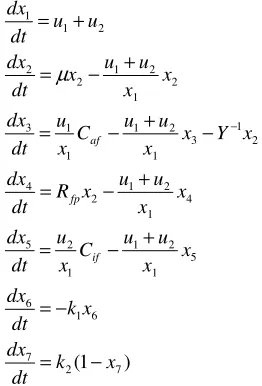
For the dynamic model of fed-batch production process of exogenous protein, the model of the literature [12] describes the process of producing foreign protein using recombinant E. coli D1210 and plasmid pSD8, wherein the nutrient is glucose and the inducer is isopropyl-D thio Galactose (IPTG). The kinetic model of the exogenous protein production process is as follows:
) 1 ( 7 2 7 6 1 6 5 1 2 1 1 2 5 4 1 2 1 2 4 2 1 3 1 2 1 1 1 3 2 1 2 1 2 2 2 1 1 x k dt dx x k dt dx x x u u C x u dt dx x x u u x R dt dx x Y x x u u C x u dt dx x x u u x dt dx u u dt dx if fp af − = − = + − = + − = − + − = + − = + = − µ (12)
In the formula, x1 is the reaction volume (L), x2 is the cell density (g.L-1), x3,x4
and x5 are nutritional supplements exogenous protein and inducer concentrations
(g.L-1), x6 and x7 are the inducer impact coefficients and recovery coefficients of
the specific cell growth rate, respectively. u1 and u2 are the flow rates of glucose and inducers(g.L-1). Y is growth coefficient. Caf and Cif concentrations of the
production rate of foreign protein (h-1), k1 and k2 are impact parameters and recovery parameters, respectively. Each rate expression is:
5 5 2 1 5 5 2 3 3 3 5 7 6 2 3 3 3 034 . 0 09 . 0 ] 22 . 0 0005 . 0 [ 5 . 111 / 35 . 14 233 . 0 )] 22 . 0 22 . 0 ( [ 5 . 111 / 35 . 14 x x k k x x x x x R x x x x x x fp + = = + + + + = + + + + = µ (13)
Several parameters take the following values: Cif =4.0,Caf =100.0,Y =0.51.
The initial state of the model is: x0 =[1,0.1,40,0,0,1].The control variables glucose
flow rate u1 and inducer flow rate u2 have constraints: 0 1,0 1. 2
1≤ ≤ ≤
≤u u
In the production process, the literature [13] aimed at maximizing the production of foreign protein x1(tf)x4(tf) and the minimum consumption of inducer
∫
tfdt t u
0 2( ) , and established a multi-objective optimization problem for this problem. Which is:
∫
= = f t f f dt t u t u t u J t x t x t u t u J 0 2 2 1 2 4 1 2 1 1 ) ( )) ( ), ( ( min ) ( ) ( )) ( ), ( ( max (14)In the formula, tf =10.
Solution Ideas
To solve the dynamic optimization problem, it is required that its accurate solution cannot be achieved in the current situation. For this type of problem, finding the numerical solution is the current research mainstream. Each algorithm has its own advantages and disadvantages in this kind of problem. How to improve the accuracy of the algorithm and reduce the space complexity and time complexity of the algorithm is Meaningful research direction.
The idea of swarm intelligence algorithm to solve this kind of problem is to transform the dynamic optimization problem into a finite-dimensional static optimization, that is, the control quantity is regarded as a ladder-type function, and the time interval is divided into n intervals [t0,t1],[t1,t2],,[tn−1,tn], among them,
f n t
t = .
] , [ , )
(t ui t ti1 ti
u = ∈ − (15)
substituted into the objective function, and the target value J is obtained, thereby completing one iteration. According to the requirement of the algorithm, iteratively iterating until the condition of the end is satisfied, then the optimal value J and the corresponding optimal control variable u(t) can be obtained.
Glucose feed rate u1(L·h-1) Inducer feed rate u2(L·h-1)
Figure 1. Feed profile of glucose and inducer for three Pareto-optimal solutions.
Results
The proposed algorithm is used to solve the calculation of the multi-objective optimization model of this production process system. The parameters are set as follows: ω=0.53,c1 =0.35,c2 =0.45, Initial population 200, running algebra 200. Since the algorithm is a random algorithm, the result is: the value of the target value 1 is 5.7702, and the value of the target 2 is 0.0491; the resulting control curve is shown in Fig 1.
The literature [14, 15] uses the single objective J1 as the optimization goal. The optimal values obtained are 5.57 and 5.5627, respectively, but there is no corresponding target value J2. The algorithm of this paper basically obtains the results of [1, 2] and is the value obtained in the case of multi-objective. The result shows the effectiveness of the algorithm in solving multiple objectives.
Analysis of Results
making it toward (2) the adjustment of the local extremes and the global extremes further moves the particles towards the ideal effective solution direction. The algorithm does not add complexity to the PSO algorithm in terms of computational complexity and is equivalent to the computational cost of the PSO algorithm.
CONCLUSION
The dynamic optimization problem is a common problem in chemical process optimization. However, it is not easy to solve the problem numerically. It includes both the solution of the dynamic system, i.e., the differential equation group, and the integral calculation of the objective function, through the control of u(t). To achieve the goal of optimization, and the relationship between u (t) and the goal cannot be obtained in general, numerical simulation is a way of thinking about this type of problem. This paper presents an alternative and quick method for solving dynamic multi-objective optimization problems, and the test results are good. However, the research on this issue is far from over, but it is constantly exploring.
ACKNOWGEMENT
This work is supported by the Project supported by the National Natural Science Foundation of China (Grant No. 21466008, 21566007).
REFERENCES
1. Long Chen. Research on Dynamic Optimization Method in Industrial Application [D]. Zhejiang University, 2010.
2. Mengyu Chen, Chunming Ye, Jidong Xu. Using Particle Swarm Optimization Algorithm to Solve Portfolio Investment Model with Transaction Cost [J]. Journal of Shanghai University of Science and Technology, 2008, 30(4):379-381.
3. Linyang He, Chunming Ye, Jidong Xu. Portfolio investment model including transaction fee and solution based on adaptive genetic algorithm [J]. Computer Engineering and Applications, 2007, 43(11):235-237.
4. Xia Liu, Hongxia Chu, Kejun Wang. Portfolio Investment Model Based on Particle Swarm Optimization [J]. Commercial Research, 2006, 16:49-50.
5. J D Schaffer. Multiple objective optimization with vector evaluated genetic algorithms. The First Int’l Conf on Genetic Algorithms, Lawrence Erlbaum, 1985.
6. D A V Veldhuizen, G B Lamont. Multi-objective evolutionary algorithm research: A history and analysis. Department of Electrical and computer Engineering, Graduate School of Engineering, Air Force Institute of Technology, Tech Rep: TR-98-03, 1998.
7. R Eberhart, J Kennedy. A new optimizer using particle swarm theory. In: Proc of the 6th Int’l Symposium on Micro Machine and Human Science. Piscataway, NJ:IEEE Service Center, 1995>39-43.
9. Lilei Yu. Bi-Objective Structural Robust Design Using Ideal Point Approach [J]. Journal of Shanghai Jiaotong University, 2003, 37(8):1193-1197.
10. Kennedy J, Eberhart R. Particle swarm optimization//Proc. IEEE Int. Conf.on Neural Networks, Piscataway: IEEE Service Center, 1995:1942-1948.
11. Schaffer J D. Multiple objective optimization with vector evaluated genetic algorithms [A].Proceedings of the First Conference on Genetic Algorithms [C]. Princeton, NJ: Lawrence Erlbaum, 1985: 93-100.
12. Lee J, Ramirez W F. Optimal fed-batch control of induced foreign protein produced by recombinant bacteria. AIChE Journal, 1994, 40:899-907.
13. Sarkar D, Modak J M. Pareto-optimal solutions for multi-objective optimization of fed-batch bioreactors using no dominated sorting genetic algorithm. Chemical Engineering Science, 2005, 60:481-492.
14. Balsa-Canto E, Banga J R, Alonso A A, Vassiliadis V S. Dynamic optimization of chemical and biochemical processes using restricted second-order information. Computers and Chemical Engineering , 2001, 25:539-546.