Unlabeled Data for Morphological Generation With Character-Based
Sequence-to-Sequence Models
Katharina Kann and Hinrich Sch¨utze LMU Munich, Germany
Abstract
We present a semi-supervised way of training a character-based encoder-decoder recurrent neural network for morphological reinflection, the task of generating one inflected word form from another. This is achieved by using unlabeled tokens or random strings as training data for an autoencoding task, adapting a network for morphological reinflection, and performing multi-task training. We thus use limited labeled data more effectively, obtaining up to
9.9% improvement over state-of-the-art
baselines for 8 different languages.
1 Introduction
Morphologically rich languages use inflection— the adaptation of a surface form to its syntactic context—to mark the properties of a word, e.g.,
gender or number of nouns or tense of verbs. This drastically increases the type-token ratio, and thus negatively effects natural language process-ing (NLP), makprocess-ing morphological analysis and generation an important field of research.
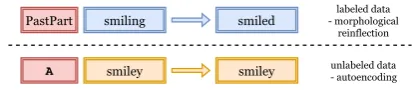
In this work, we focus on morphological rein-flection (MRI), the task of mapping one inflected form of a lemma to another, given the morpholog-ical properties of the target, e.g., (smiling, Past-Part) → smiled. The lemma does not have to be known. Recently, there have been some ad-vances on the topic, motivated by the SIGMOR-PHON 2016 shared task on morphological
rein-flection (Cotterell et al., 2016) and the
[image:1.595.311.518.222.267.2]CoNLL-SIGMORPHON 2017 shared task on universal morphological reinflection (Cotterell et al.,2017). In 2016, neural sequence-to-sequence models, specifically attention-based encoder-decoder mod-els, outperformed all other approaches by a wide
Figure 1: Examples for labeled and unlabeled input. The content of the red boxes (very left in both rows) signalizes if the sample belongs to the MRI task or the autoencoding task.
margin (Faruqui et al., 2016; Kann and Sch¨utze,
2016). However, those models require a lot of
training data, while in contrast many morpholog-ically rich languages are low-resource, and little work has been done so far on neural models for morphology in settings with limited training data. This makes sequence-to-sequence models not ap-plicable to morphological generation in most lan-guages.
An abundance of unlabeled data, in contrast,
can be assumed available for each language in the focus of NLP. Thus, we propose a semi-supervised training method for a state-of-the-art encoder-decoder network for MRI using both la-beled and unlala-beled data, mitigating the need for time-expensive annotations. We achieve this by treating unlabeled words as training examples for an autoencoding (Vincent et al., 2010) task and
multi-task training (cf. Figure 1). We intuit the
following reasons why this should be beneficial: (i) The decoder’s character language model can be trained using unlabeled data. (ii) Training on a second task reduces the problem of overfitting. (iii) By forcing the model to additionally learn au-toencoding, we give it a strong prior to copy the input string. This might be advantageous as often many forms of a paradigm share the same stem,
e.g., smiling and smiled. In order to investigate
the importance of the latter, we further experiment
with autoencoding ofrandom stringsand find that
for our experimental settings and non-templatic languages the performance gain is comparable to using corpus words.
2 Model Description
The log-likelihood for joint training on the tasks of MRI and autoencoding is:
L(θ)= X (fs,ft,t)∈T
logpθ(ft|e(fs, t)) (1)
+ X
w∈W
logpθ(w|e(w)),
T is the MRI training data, with each example
consisting of a source form fs, a target form ft
and a target tagt.W denotes a set of words in the
language of the system. The encoding functione
depends onθ. The parametersθare shared across
the two tasks, resulting in a share of information. We obtain this by giving our model data from both sets at the same time, and marking each example
with a task-specific input symbol, cf. Figure 1.
Following (Kann and Sch¨utze,2016), we employ
a neural encoder-decoder model.
Encoder. For the input of the encoder, we adapt
the format byKann and Sch¨utze(2016), but
mod-ify it to be able to handle unlabeled data: Given the set of morphological subtags M each target tag
is composed of (e.g., the tag1SgPresIndcontains
the subtags1,Sg,PresandInd), and the alphabet
Σof the language of application, our input is of the formB[A/M∗]Σ∗E, i.e., it consists ofeither a
se-quence of subtagsorthe symbol Asignaling that
the input is not annotated and should be autoen-coded, and (in both cases) the character sequence
of the input word. BandEare start and end
sym-bols. Each part of the input is represented by an embedding.
We then encode the inputx = x1, x2, . . . , xTx
using a bidirectional gated recurrent neural
net-work (GRU) (Cho et al., 2014b), i.e., −→hi =
f−→hi−1, xi
and ←−hi = f
←− hi+1, xi
, with f
being the update function of the hidden layer. For-ward and backFor-ward hidden states are concatenated to obtain the inputhifor the decoder.
Decoder. The decoder is an attention-based GRU, defining a probability distribution over strings inΣ∗:
p(y|x) =
Ty
Y
t=1
p(yt|y1, . . . , yt−1, st, ct),
with st being the decoder hidden state for time
t andct being a context vector, calculated using
the encoder hidden states together with attention weights. A detailed description of the model can
be found inBahdanau et al.(2015).
3 Experiments
Dataset. We experiment on the task 3 dataset of the SIGMORPHON 2016 shared task on MRI (Cotterell et al.,2016) and all standard languages provided: Arabic, Finnish, Georgian, German, Navajo, Russian, Spanish and Turkish. German, Spanish and Russian are suffixing and exhibit stem changes. Russian differs from the other two in that those stem changes are consonantal and not vocalic. Finnish and Turkish are agglutinating, almost exclusively suffixing and have vowel har-mony systems. Georgian uses both prefixiation and suffixiation. In contrast, Navajo mainly makes use of prefixes with consonant harmony among its sibilants. Finally, Arabic is a templatic, non-concatenative language.
For each language, we further add randomly sampled words from the respective Wikipedia dumps. We exclude tokens that are not exclu-sively composed from characters of the language’s alphabet, e.g., digits, or do not appear at least 2 times in the corpus. The exact amount of unla-baled data added is treated as a hyperparameter depending on the number of available annotated examples and optimized on the development set,
cf. Section4.1. Evaluation is done on the official
shared task test set.
Training, hyperparameters and evaluation.
We mainly adopt the hyperparameters of (Kann
and Sch¨utze, 2016). Embeddings are 300-dimensional, the size of all hidden layers is 100 and for training we use ADADELTA(Zeiler,2012)
with a batch size of 20. We train all models which
use 1
8 or more of the labeled data for 200 epochs,
and models that see 1
16 and 321 of the original data
for 400 and 800 epochs, respectively. In all cases, we apply the last model for testing.
We evaluate using two metrics: accuracy and edit distance. Accuracy reports the percentage of completely correct solutions, while the edit dis-tance between the system’s guess and the gold so-lution gives credit to systems that produce forms that are close to the right form.
Baselines. We compare our system to three
baselines: The first one isMED1, the winning
ar fi ka de nv ru sp tu
SIG16 SIG17 MED Our SIG16 SIG17 MED Our SIG16 SIG17 MED Our SIG16 SIG17 MED Our SIG16 SIG17 MED Our SIG16 SIG17 MED Our SIG16 SIG17 MED Our SIG16 SIG17 MED Our
1
4 acc .188 .094 .716ED 2.26 3.06 0.940.92.722.293 .325 .8091.90 1.47 0.47.8540.35.814 .831 .9100.42 0.380.28.9120.30 0.47 0.54 0.33.721 .687 .882.8880.312.04 1.95 1.01.317 .403 .7060.97.7110.69 0.65.641 .6380.43 0.43.825.824 .558 .539 .9390.96 0.970.15 0.15.9422.92 3.33 0.27.181 .129 .904.9100.23
1
8 acc .104 .063 .600ED 2.76 3.32 1.37.6401.202.32 1.91 0.85.207 .227 .687.7320.770.47 0.44 0.45.798 .791 .883.8940.42.618 .593 .8510.67 0.73 0.42.8730.35.247 .350 .5162.40 2.23 1.751.40.6190.95 0.92.516 .523 .7660.60 0.60.7721.36 1.35 0.26.441 .409 .8960.22.9163.42 3.80.120 .0800.47.846.8320.54
1
16 acc .052 .043 .470ED 3.36 3.53 1.801.59.533.126 .149 .5432.84 2.34 1.33.6201.16.709 .751 .8600.620.500.58 0.52 0.90 0.94 0.60.875.504 .495 .791.8390.452.71 2.41 2.63.204 .329 .3502.05.4731.23 1.17 0.94.384 .422 .6450.82.6951.80 1.70 0.47.317 .308 .8070.36.8623.81 4.09 0.99.070 .049 .717.7390.94
1
[image:3.595.71.531.61.147.2]32 acc .028 .027 .263ED 3.73 3.73 2.792.22.381.073 .088 .3143.18 2.76 2.48.4022.00.595 .648 .8180.87 0.70 0.76.8520.65.384 .386 .6611.15 1.18 1.01.7220.902.94.174 .303 .1742.653.85 2.73 1.61 1.45 1.71.369.249 .293 .4061.38.5022.22 2.06 0.97.196 .245 .6570.62.7564.19 4.27 1.98.044 .028 .524.5711.80
Table 1: Accuracy (the higher the better) and edit distance (the lower the better) for our system and the three baselines on the official test set of task 3 of the SIGMORPHON 2016 shared task. Only the indicated amount (row labels) of the original training data is used, emulating a low-resource setting. Best results for each language in bold.
tem of the 2016 shared task. The network architec-ture is the same as in our system, but it is trained exclusively on labeled data. Thus, we expect it to suffer stronger from a lack of resources.
The second baseline is the official
SIGMOR-PHON 2016 shared task baseline (SIG16) (
Cot-terell et al.,2016), which is similar in spirit to the
system described by Nicolai et al. (2015). The
system treats the prediction of edit operations to be performed on the input string as a sequential decision-making problem, greedily choosing each edit action given the previously chosen actions. The selection of operations is made by an averaged perceptron, using the binary features described in (Cotterell et al.,2016).2
Third, we compare to the baseline system of the CoNLL-SIGMORPHON 2017 shared task on
uni-versal morphological reinflection (SIG17) (
Cot-terell et al.,2017), which is extremely suitable for low-resource settings. It splits all source and tar-get forms in the training set into prefix, middle part and suffix, and uses those to find prefix or suf-fix substitution rules. Every evaluation example is searched for the longest contained prefix or suffix and the rule belonging to the affix and given target tag is applied to obtain the output.
Results and discussion. As shown in Table 1, additionally training on unlabeled examples im-proves the performance of the encoder-decoder network for nearly all settings and languages, es-pecially for the very low-resource scenarios with
1
16 and 321 of the training data. The biggest
increase in accuracy can be seen for Russian
and Spanish, both in the 1
32 setting, with 0.0963
(0.5023−0.4060) and0.0992(0.7564−0.6572), respectively. For the settings with bigger amounts
2Note that our use of the system differs from the
offi-cial baseline in that we perform a direct form-to-form map-ping. The shared task system predicts first form-to-lemma and then lemma-to-form. However, we assume no lemmata to be given, and thus are unable to train such a system.
of training data available, the unlabeled data does not change performance a lot. This was ex-pected, as the model already gets enough infor-mation from the annotated data. However,
semi-supervised training neverhurtsperformance, and
can thus always be employed. Overall, our semi-supervised training method shows to be a useful extension of the original system.
Furthermore, there are only two cases—
Georgian, 1
16, and Navajo, 321—where any of the
SIGMORPHON baselines outperforms the neural methods. This clearly shows the superiority of neural networks for the task and emphasizes the need to reduce the amount of labeled training data required for their training.
4 Analyses
4.1 Amount of Unlabeled Data
We now consider the amount of unlabeled exam-ples as a function of the number of annotated ex-amples. Data and training regime are the same as
in Section3. This analysis is performed on the
de-velopment set and we report the highest accuracy obtained during training.
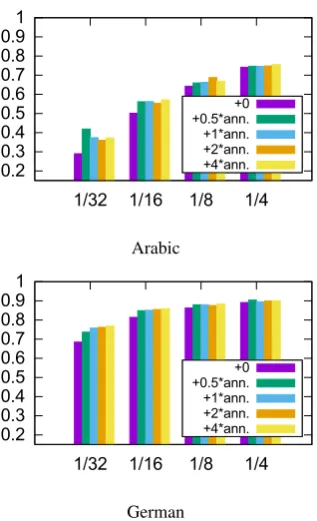
The resulting accuracies for Arabic and
Ger-man can be seen in Figure2. The other languages
behave similarly to German. The loss of perfor-mance for reducing the training data varies a lot between languages, depending on how regular and thus ”easy to learn” those are. Concerning the amount of unlabeled examples, it seems that even though in single cases other ratios are slightly bet-ter, using 4 times more unlabeled examples mostly obtains highest accuracy. Thus, a general rule could be that the more additional examples are used the better. The only exception is Arabic in
the 1
32setting, where using half as many unlabeled
0.2 0.3 0.4 0.5 0.6 0.7 0.8 0.9 1
1/32 1/16 1/8 1/4 +0 +0.5*ann. +1*ann. +2*ann. +4*ann.
Arabic
0.2 0.3 0.4 0.5 0.6 0.7 0.8 0.9 1
1/32 1/16 1/8 1/4 +0 +0.5*ann. +1*ann. +2*ann. +4*ann.
[image:4.595.103.262.64.325.2]German
Figure 2: Comparison of different amounts of unlabeled data, sorted by the amount of labeled training examples in portions of the original data. Evaluated on the development set.
not share a connected stem, we expect that giving the model too much bias to copy might be harm-ing performance in low-resource settharm-ings. How-ever, even for low-resource Arabic, using a ratio of 1:4 of labeled to unlabeled examples still yields a better performance than not using unlabeled ex-amples at all. Thus, we can conclude that if aiming for a language-independent setup, this is a good ratio.
4.2 Autoencoding of Random Strings
We expect the network to benefit from a bias to
copy strings. This suggests thatanyrandom
com-bination of characters from the language’s alpha-bet could be autoencoded in order to improve the performance in low-resource settings. To verify
this, we train models on new datasets with 1
32 of
the labeled examples from task 3 of the SIGMOR-PHON 2016 shared task and the optimal number
of unlabeled examples for each language, cf.§4.1.
However, the unlabeled examples are now random strings of a length between 3 and 20. All mod-els are trained as before. Accuracies on the
offi-cial test sets are shown in Table2, and compared
to (i) training without unlabeled examples and (ii) the data being enhanced by corpus words. Sev-eral aspects of the results are eye-catching. First, for Arabic, the gap to the performance with
cor-ar fi ka de nv ru es tu
MED .2628 .3144 .8184 .6608 .1738 .4060 .6572 .5238 MED+corpus .3811 .4015.8523 .7221 .3688 .5023 .7564 .5713
MED+random .3064 .3793.8531 .7313 .3250 .4958 .7676 .5706
Table 2: Accuracies for MED (Kann and Sch¨utze (2016)), MED+corpusand MED+random. Descriptions in the text.
pus words is the biggest, showing that indeed the tendency of languages to copy the stem when in-flecting is playing an important role. Second, for some languages the performance gains for corpus words and random words are comparable. Third, the performance of random strings is closer to the performance of corpus words the higher the over-all accuracy is. The additional unlabeled examples might be acting as regularizers in this case.
Overall, this experiment shows clearly that giv-ing the model a bias to copy strgiv-ings helps for in-flection in non-templatic languages, and that ran-dom strings can improve a network for MRI.
5 Related Work
For the SIGMORPHON 2016 and the
CoNLL-SIGMORPHON 2017 shared tasks (Cotterell
et al., 2016, 2017), multiple MRI systems were developed, e.g., (Nicolai et al., 2016;Taji et al.,
2016; Kann and Sch¨utze, 2016; Aharoni et al.,
2016; ¨Ostling, 2016; Makarov et al., 2017).
Encoder-decoder neural networks (Cho et al.,
2014a; Sutskever et al., 2014; Bahdanau et al.,
2015) performed best, such that we extend them
in this work. Earlier work on paradigm comple-tion included (Faruqui et al.,2016;Nicolai et al.,
2015;Durrett and DeNero,2013). Work directly
tackling MRI was more rare, e.g., (Dreyer and
Eis-ner, 2009). Our work relates to the line of
re-search on minimally supervised and unsupervised
methods for morphology, e.g., Creutz and Lagus
(2007) and Goldsmith (2001) presenting the
un-supervised morphological segmentation systems
Morfessor and Linguistica, or (Dreyer and
Eis-ner,2011;Poon et al.,2009;Snyder and Barzilay,
2008). However, none of those focused directly on
MRI or on training neural networks for
morphol-ogy. The only case we know of where this was
done was work byKann et al.(2017). They
byHa et al.(2016) for machine translation (MT). Unlabeled corpora were used for semi-supervised
training of models for MT, e.g., by Cheng et al.
(2016);Vincent et al.(2010);Socher et al.(2011);
Ramachandran et al. (2016). Those approaches differ from ours, due to a fundamental difference between the two tasks: For MRI, the source vo-cabulary and the target vovo-cabulary are mostly the same. This makes it intuitive for MRI to train the final model jointly on MRI and autoencoding.
6 Conclusion
We presented a way of semi-supervised training of a state-of-the-art model for low-resource MRI, using words from an unlabeled corpus. We found that the best ratio of labeled to unlabeled data de-pends of the morphological typology of the lan-guage. Finally, we showed that autoencoding ran-dom strings also increases performance, for some languages as much as using corpus words.
Acknowledgments
We would like to thank the anonymous reviewers for their insightful comments. This work was sup-ported by DFG (SCHU2246/10).
References
Roee Aharoni, Yoav Goldberg, and Yonatan Belinkov. 2016. Improving sequence to sequence learning for morphological inflection generation: The BIU-MIT systems for the SIGMORPHON 2016 shared task for morphological reinflection. InSIGMORPHON. Dzmitry Bahdanau, Kyunghyun Cho, and Yoshua
Ben-gio. 2015. Neural machine translation by jointly learning to align and translate. InICLR.
Yong Cheng, Wei Xu, Zhongjun He, Wei He, Hua Wu, Maosong Sun, and Yang Liu. 2016. Semi-supervised learning for neural machine translation. arXiv preprint arXiv:1606.04596.
Kyunghyun Cho, Bart van Merrienboer, Dzmitry Bah-danau, and Yoshua Bengio. 2014a. On the proper-ties of neural machine translation: Encoder–decoder approaches. InSSST.
Kyunghyun Cho, Bart Van Merri¨enboer, C¸alar G¨ulc¸ehre, Dzmitry Bahdanau, Fethi Bougares, Hol-ger Schwenk, and Yoshua Bengio. 2014b. Learning phrase representations using RNN encoder–decoder for statistical machine translation. InEMNLP. Ryan Cotterell, Christo Kirov, John Sylak-Glassman,
G´eraldine Walther, Ekaterina Vylomova, Patrick Xia, Manaal Faruqui, Sandra K¨ubler, David
Yarowsky, Jason Eisner, and Mans Hulden. 2017. The CoNLL-SIGMORPHON 2017 shared task: Universal morphological reinflection in 52 lan-guages. InCoNLL-SIGMORPHON.
Ryan Cotterell, Christo Kirov, John Sylak-Glassman, David Yarowsky, Jason Eisner, and Mans Hulden. 2016. The SIGMORPHON 2016 shared task— morphological reinflection. InSIGMORPHON. Mathias Creutz and Krista Lagus. 2007. Unsupervised
models for morpheme segmentation and morphol-ogy learning. TSLP4(1):3.
Markus Dreyer and Jason Eisner. 2009. Graphical models over multiple strings. InEMNLP.
Markus Dreyer and Jason Eisner. 2011. Discovering morphological paradigms from plain text using a Dirichlet process mixture model. InEMNLP. Greg Durrett and John DeNero. 2013. Supervised
learning of complete morphological paradigms. In NAACL.
Manaal Faruqui, Yulia Tsvetkov, Graham Neubig, and Chris Dyer. 2016. Morphological inflection genera-tion using character sequence to sequence learning. InNAACL.
John Goldsmith. 2001. Unsupervised learning of the morphology of a natural language. Computational linguistics27(2):153–198.
Thanh-Le Ha, Jan Niehues, and Alexander Waibel. 2016. Toward multilingual neural machine trans-lation with universal encoder and decoder. arXiv preprint arXiv:1611.04798.
Katharina Kann, Ryan Cotterell, and Hinrich Sch¨utze. 2017. One-shot neural cross-lingual transfer for paradig completion. InACL.
Katharina Kann and Hinrich Sch¨utze. 2016. MED: The LMU system for the SIGMORPHON 2016 shared task on morphological reinflection. InACL. Peter Makarov, Tatiana Ruzsics, and Simon Clematide.
2017. Align and copy: UZH at SIGMORPHON 2017 shared task for morphological reinflection. In
CoNLL-SIGMORPHON.
Garrett Nicolai, Colin Cherry, and Grzegorz Kondrak. 2015. Inflection generation as discriminative string transduction. InNAACL.
Garrett Nicolai, Bradley Hauer, Adam St Arnaud, and Grzegorz Kondrak. 2016. Morphological reinflec-tion via discriminative string transducreinflec-tion. In
SIG-MORPHON.
Robert ¨Ostling. 2016. Morphological reinflection with convolutional neural networks. InSIGMORPHON. Hoifung Poon, Colin Cherry, and Kristina Toutanova.
Prajit Ramachandran, Peter J Liu, and Quoc V Le. 2016. Unsupervised pretraining for sequence to se-quence learning. arXiv preprint arXiv:1611.02683 .
Benjamin Snyder and Regina Barzilay. 2008. Unsuper-vised multilingual learning for morphological seg-mentation. InACL.
Richard Socher, Jeffrey Pennington, Eric H Huang, Andrew Y Ng, and Christopher D Manning. 2011. Semi-supervised recursive autoencoders for predict-ing sentiment distributions. InEMNLP.
Ilya Sutskever, Oriol Vinyals, and Quoc V Le. 2014. Sequence to sequence learning with neural net-works. InNIPS.
Dima Taji, Ramy Eskander, Nizar Habash, and Owen Rambow. 2016. The Columbia University - New York University Abu Dhabi SIGMORPHON 2016 morphological reinflection shared task submission. InSIGMORPHON.
Pascal Vincent, Hugo Larochelle, Isabelle Lajoie, Yoshua Bengio, and Pierre-Antoine Manzagol. 2010. Stacked denoising autoencoders: Learning useful representations in a deep network with a local denoising criterion. Journal of Machine Learning Research11(Dec):3371–3408.