Synchronous Binarization for Machine Translation
Hao Zhang
Computer Science Department University of Rochester
Rochester, NY 14627
Liang Huang
Dept. of Computer & Information Science University of Pennsylvania
Philadelphia, PA 19104 [email protected]
Daniel Gildea
Computer Science Department University of Rochester
Rochester, NY 14627 [email protected]
Kevin Knight
Information Sciences Institute University of Southern California
Marina del Rey, CA 90292 [email protected]
Abstract
Systems based on synchronous grammars and tree transducers promise to improve the quality of statistical machine transla-tion output, but are often very computa-tionally intensive. The complexity is ex-ponential in the size of individual gram-mar rules due to arbitrary re-orderings be-tween the two languages, and rules ex-tracted from parallel corpora can be quite large. We devise a linear-time algorithm for factoring syntactic re-orderings by bi-narizing synchronous rules when possible and show that the resulting rule set signif-icantly improves the speed and accuracy of a state-of-the-art syntax-based machine translation system.
1 Introduction
Several recent syntax-based models for machine translation (Chiang, 2005; Galley et al., 2004) can be seen as instances of the general framework of synchronous grammars and tree transducers. In this framework, both alignment (synchronous parsing)
and decoding can be thought of as parsing problems, whose complexity is in general exponential in the number of nonterminals on the right hand side of a grammar rule. To alleviate this problem, we investi-gate bilingual binarization to factor the synchronous grammar to a smaller branching factor, although it is not guaranteed to be successful for any synchronous rule with arbitrary permutation. In particular:
• We develop a technique calledsynchronous bi-narizationand devise a fast binarization
algo-rithm such that the resulting rule set allows ef-ficient algorithms for both synchronous parsing and decoding with integratedn-gram language models.
• We examine the effect of this binarization
method on end-to-end machine translation quality, compared to a more typical baseline method.
• We examine cases of non-binarizable rules in a
large, empirically-derived rule set, and we in-vestigate the effect on translation quality when excluding such rules.
Melamed (2003) discusses binarization of multi-text grammars on a theoretical level, showing the importance and difficulty of binarization for efficient synchronous parsing. One way around this diffi-culty is to stipulate that all rules must be binary from the outset, as in inversion-transduction gram-mar (ITG) (Wu, 1997) and the binary synchronous context-free grammar (SCFG) employed by the Hi-ero system (Chiang, 2005) to model the hierarchical phrases. In contrast, the rule extraction method of Galley et al. (2004) aims to incorporate more syn-tactic information by providing parse trees for the target language and extracting tree transducer rules that apply to the parses. This approach results in rules with many nonterminals, making good bina-rization techniques critical.
Suppose we have the following SCFG, where su-perscripts indicate reorderings (formal definitions of
S
NP
Baoweier PP yu Shalong
VP juxing le
huitan
S
NP
Powell VP held a meeting
[image:2.612.68.293.55.121.2]PP with Sharon
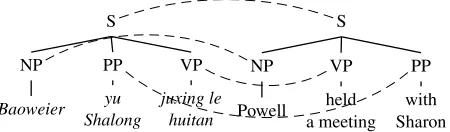
Figure 1: A pair of synchronous parse trees in the SCFG (1). The dashed curves indicate pairs of syn-chronous nonterminals (and sub trees).
SCFGs can be found in Section 2):
(1)
S→ NP(1)VP(2)PP(3), NP(1)PP(3)VP(2)
NP→ Powell,Baoweier
VP→ held a meeting,juxing le huitan
PP→ with Sharon,yu Shalong
Decoding can be cast as a (monolingual) parsing problem since we only need to parse the source-language side of the SCFG, as if we were construct-ing a CFG projected on Chinese out of the SCFG. The only extra work we need to do for decoding is to build corresponding target-language (English) subtrees in parallel. In other words, we build syn-chronous treeswhen parsing the source-language
in-put, as shown in Figure 1.
To efficiently decode with CKY, we need to bi-narize the projected CFG grammar.1 Rules can be binarized in different ways. For example, we could binarize the first rule left to right or right to left:
S→ VNP-PP VP
VNP-PP→ NP PP or
S→ NPVPP-VP
VPP-VP→ PP VP
We call those intermediate symbols (e.g. VPP-VP) vir-tual nonterminals and corresponding rules virtual rules, whose probabilities are all set to1.
These two binarizations are no different in the translation-model-only decoding described above, just as in monolingual parsing. However, in the source-channel approach to machine translation, we need to combine probabilities from the translation model (an SCFG) with the language model (an n-gram), which has been shown to be very impor-tant for translation quality (Chiang, 2005). To do bigram-integrated decoding, we need to augment each chart item (X, i, j) with two target-language
1Other parsing strategies like the Earley algorithm use an
internal binary representation (e.g. dotted-rules) of the original grammar to ensure cubic time complexity.
boundary wordsu andv to produce a bigram-item like u··· v
X
i j
, following the dynamic program-ming algorithm of Wu (1996).
Now the two binarizations have very different ef-fects. In the first case, we first combine NP with PP:
Powell
··· Powell
NP
1 2
:p
with
··· Sharon
PP
2 4
:q
Powell
···Powell ··· with···Sharon
VNP-PP
1 4
:pq
wherepandqare the scores of antecedent items. This situation is unpleasant because in the target-language NP and PP arenotcontiguous so we
can-not apply language model scoring when we build the VNP-PP item. Instead, we have to maintain all four
boundary words (rather than two) and postpone the language model scoring till the next step whereVNP-PP
is combined with held ··· meeting VP
2 4
to form an S item. We call this binarization methodmonolingual bina-rizationsince it works only on the source-language
projection of the rule without respecting the con-straints from the other side.
This scheme generalizes to the case where we havennonterminals in a SCFG rule, and the decoder conservatively assumes nothing can be done on lan-guage model scoring (because target-lanlan-guage spans are non-contiguous in general) until the real nonter-minal has been recognized. In other words, target-language boundary words from each child nonter-minal of the rule will be cached in all virtual non-terminals derived from this rule. In the case of m-gram integrated decoding, we have to maintain 2(m−1)boundary words for each child nontermi-nal, which leads to a prohibitive overall complex-ity ofO(|w|3+2n(m−1)), which is exponential in rule
size (Huang et al., 2005). Aggressive pruning must be used to make it tractable in practice, which in general introduces many search errors and adversely affects translation quality.
In the second case, however:
with
··· Sharon
PP
2 4
:r
held ··· meeting
VP
4 7
:s
held
··· Sharon
VPP-VP
2 7
:rs·Pr(with|meeting)
NP
NP PP
VP VP
PP target (English) source (Chinese)
VPP-VP
NP
PP
VP
Chinese indices
English
boundary
wor
ds
1 2 4 7
Powell
Powellheld
meetingwith
Sharon
[image:3.612.73.274.57.154.2]VPP-VP
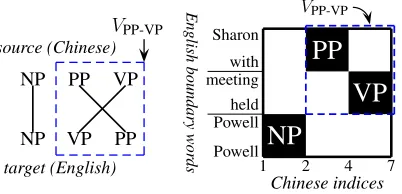
Figure 2: The alignment pattern (left) and alignment matrix (right) of the synchronous production.
language model score by addingPr(with | meeting), and the resulting item again has two boundary words. Later we add Pr(held | Powell) when the resulting item is combined with Powell
··· Powell NP
1 2
to form an S item. As illustrated in Figure 2,VPP-VPhas
contiguous spans on both source and target sides, so that we can generate a binary-branching SCFG:
(2) S→ NP(1)VPP-VP(2), NP(1)VPP-VP(2)
VPP-VP→ VP(1)PP(2), PP(2)VP(1)
In this case m-gram integrated decoding can be done inO(|w|3+4(m−1))time which is much
lower-order polynomial and no longer depends on rule size (Wu, 1996), allowing the search to be much faster and more accurate facing pruning, as is evidenced in the Hiero system of Chiang (2005) where he restricts the hierarchical phrases to be a binary SCFG. The benefit of binary grammars also lies in synchronous parsing (alignment). Wu (1997) shows that parsing a binary SCFG is inO(|w|6)while parsing SCFG is NP-hard in general (Satta and Peserico, 2005).
The same reasoning applies to tree transducer rules. Suppose we have the following tree-to-string rules, following Galley et al. (2004):
(3)
S(x0:NP, VP(x2:VP,x1:PP))→x0x1x2
NP(NNP(Powell))→Baoweier
VP(VBD(held), NP(DT(a) NPS(meeting)))
→juxing le huitan
PP(TO(with), NP(NNP(Sharon)))→yu Shalong
where the reorderings of nonterminals are denoted by variablesxi.
Notice that the first rule has a multi-level left-hand side subtree. This system can model non-isomorphic transformations on English parse trees to “fit” another language, for example, learning that
the(S (V O))structure in English should be trans-formed into a(V S O)structure in Arabic, by look-ing at two-level tree fragments (Knight and Graehl, 2005). From a synchronous rewriting point of view, this is more akin to synchronous tree substitution grammar (STSG) (Eisner, 2003). This larger locality is linguistically motivated and leads to a better pa-rameter estimation. By imagining the left-hand-side trees as special nonterminals, we can virtually cre-ate an SCFG with the same generative capacity. The technical details will be explained in Section 3.2.
In general, if we are given an arbitrary syn-chronous rule with many nonterminals, what are the good decompositions that lead to a binary grammar? Figure 2 suggests that a binarization is good if ev-ery virtual nonterminal has contiguous spans on both sides. We formalize this idea in the next section.
2 Synchronous Binarization
A synchronous CFG (SCFG) is a context-free rewriting system for generating string pairs. Each rule (synchronous production) rewrites a
nontermi-nal in two dimensions subject to the constraint that the sequence of nonterminal children on one side is a permutation of the nonterminal sequence on the other side. Each co-indexed child nonterminal pair will be further rewritten as a unit.2 We define the languageL(G)produced by an SCFGGas the pairs of terminal strings produced by rewriting exhaus-tively from the start symbol.
As shown in Section 3.2, terminals do not play an important role in binarization. So we now write rules in the following notation:
X→X1(1)...Xn(n), X
(π(1))
π(1) ...X (π(n))
π(n)
where eachXi is a variable which ranges over
non-terminals in the grammar andπ is thepermutation of the rule. We also define an SCFG rule asn-ary if its permutation is ofnand call an SCFGn-ary if its longest rule isn-ary. Our goal is to produce an equivalentbinarySCFG for an inputn-ary SCFG.
2In making one nonterminal play dual roles, we follow the
(2,3,5,4) (2,3)
2 3
(5,4)
5 4
(2,3,5,4) 2 (3,5,4)
3 (5,4)
5 4
(a) (b) (c)
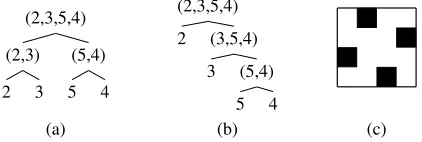
Figure 3: (a) and (b): two binarization patterns for (2,3,5,4). (c): alignment matrix for the non-binarizable permuted sequence(2,4,1,3)
However, not every SCFG can be binarized. In fact, the binarizability of ann-ary rule is determined by the structure of its permutation, which can some-times be resistant to factorization (Aho and Ullman, 1972). So we now start to rigorously define the bi-narizability of permutations.
2.1 Binarizable Permutations
Apermuted sequenceis a permutation of consec-utive integers. For example, (3,5,4)is a permuted sequence while(2,5)is not. As special cases, single numbers are permuted sequences as well.
A sequence a is said to bebinarizable if it is a
permuted sequence and either 1. ais a singleton, i.e.a= (a), or
2. a can be split into two sub sequences, i.e. a= (b;c), wherebandcare both binarizable
permuted sequences. We call such a division (b;c)abinarizable splitofa.
This is a recursive definition. Each binarizable permuted sequence has at least one hierarchical bi-narization pattern. For instance, the permuted se-quence(2,3,5,4)is binarizable (with two possible binarization patterns) while (2,4,1,3) is not (see Figure 3).
2.2 Binarizable SCFG
An SCFG is said to be binarizable if the permu-tation of each synchronous production is binariz-able. We denote the class of binarizable SCFGs as bSCFG. This set represents an important subclass of SCFG that is easy to handle (parsable inO(|w|6)) and covers many interesting longer-than-two rules.3
3Although we factor the SCFG rules individually and
de-fine bSCFG accordingly, there are some grammars (the dashed
SCFG bSCFG SCFG-2
[image:4.612.88.299.68.139.2]O(|w|6)parsable
Figure 4: Subclasses of SCFG. The thick arrow de-notes the direction of synchronous binarization. For clarity reasons, binary SCFG is coded as SCFG-2.
Theorem 1. For each grammarGin bSCFG, there exists a binary SCFGG0, such thatL(G0) =L(G).
Proof. Once we decompose the permutation of n in the original rule into binary permutations, all that remains is to decorate the skeleton binary parse with nonterminal symbols and attach terminals to the skeleton appropriately. We explain the technical details in the next section.
3 Binarization Algorithms
We have reduced the problem of binarizing an SCFG rule into the problem of binarizing its permutation. This problem can be cast as an instance of syn-chronous ITG parsing (Wu, 1997). Here the parallel string pair that we are parsing is the integer sequence (1...n)and its permutation(π(1)...π(n)). The goal of the ITG parsing is to find a synchronous tree that agrees with the alignment indicated by the permu-tation. In fact, as demonstrated previously, some permutations may have more than one binarization patterns among which we only need one. Wu (1997, Sec. 7) introduces a non-ambiguous ITG that prefers left-heavy binary trees so that for each permutation there is a unique synchronous derivation (binariza-tion pattern).
However, this problem has more efficient solu-tions. Shapiro and Stephens (1991, p. 277) infor-mally present an iterative procedure where in each pass it scans the permuted sequence from left to right and combines two adjacent sub sequences whenever possible. This procedure produces a left-heavy bi-narization tree consistent with the unambiguous ITG and runs inO(n2)time since we neednpasses in the worst case. We modify this procedure and improve circle in Figure 4), which can be binarized only by analyzing interactions between rules. Below is a simple example:
iteration stack input action 1 5 3 4 2 1 5 3 4 2 shift 1 1 5 3 4 2 shift 2 1 5 3 4 2 shift 3 1 5 3 4 2 shift
1 5 3-4 2 reduce [3,4]
1 3-5 2 reduce h5,[3,4]i
4 1 3-5 2 shift
1 2-5 reduce h2,h5,[3,4]ii
[image:5.612.83.296.63.187.2]1-5 reduce [1,h2,h5,[3,4]ii]
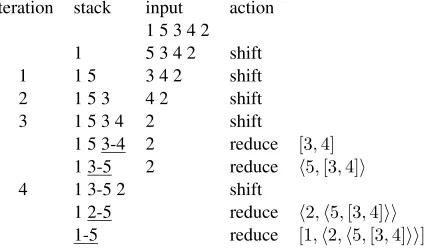
Figure 5: Example of Algorithm 1 on the input (1,5,3,4,2). The rightmost column shows the binarization-trees generated at each reduction step.
it into a linear-time shift-reduce algorithm that only needs one pass through the sequence.
3.1 The linear-time skeleton algorithm
The (unique)binarization treebi(a) for a
binariz-able permuted sequence ais recursively defined as
follows:
• ifa= (a), thenbi(a) =a;
• otherwise let a = (b;c) to be the rightmost
binarizable split ofa. then
bi(a) =
(
[bi(b), bi(c)] b1 < c1
hbi(b), bi(c)i b1 > c1.
For example, the binarization tree for (2,3,5,4) is[[2,3],h5,4i], which corresponds to the binariza-tion pattern in Figure 3(a). We use [] and hi for
straight and inverted combinations respectively, fol-lowing the ITG notation (Wu, 1997). The rightmost split ensures left-heavy binary trees.
The skeleton binarization algorithm is an instance of the widely used left-to-right shift-reduce algo-rithm. It maintains a stack for contiguous subse-quences discovered so far, like 2-5, 1. In each it-eration, it shifts the next number from the input and repeatedly tries to reduce the top two elements on the stack if they are consecutive. See Algorithm 1 for details and Figure 5 for an example.
Theorem 2. Algorithm 1 succeeds if and only if the
input permuted sequence a is binarizable, and in
case of success, the binarization pattern recovered is the binarization tree ofa.
Proof. →: it is obvious that if the algorithm
suc-ceeds then a is binarizable using the binarization
pattern recovered.
←: by a complete induction onn, the length ofa.
Base case:n= 1, trivial. Assume it holds for alln0 < n.
Ifais binarizable, then leta= (b;c)be its
right-most binarizable split. By the induction hypothesis, the algorithm succeeds on the partial inputb,
reduc-ing it to the sreduc-ingle elements[0]on the stack and re-covering its binarization treebi(b).
Let c = (c1;c2). If c1 is binarizable and
trig-gers our binarizer to make a straight combination of(b;c1), based on the property of permutations, it
must be true that(c1;c2)is a valid straight
concate-nation. We claim thatc2must be binarizable in this
situation. So,(b,c1;c2)is a binarizable split to the
right of the rightmost binarizable split(b;c), which
is a contradiction. A similar contradiction will arise ifbandc1can make an inverted concatenation.
Therefore, the algorithm will scan through the whole c as if from the empty stack. By the
in-duction hypothesis again, it will reduce c into s[1]
on the stack and recover its binarization treebi(c).
Since b and c are combinable, the algorithm
re-ducess[0]ands[1]in the last step, forming the bi-narization tree fora, which is either[bi(b), bi(c)]or
hbi(b), bi(c)i.
The running time of Algorithm 1 is linear inn, the length of the input sequence. This is because there are exactlynshifts and at mostn−1reductions, and each shift or reduction takesO(1)time.
3.2 Binarizing tree-to-string transducers Without loss of generality, we have discussed how to binarize synchronous productions involving only nonterminals through binarizing the corresponding skeleton permutations. We still need to tackle a few technical problems in the actual system.
Algorithm 1The Linear-time Binarization Algorithm 1: functionBINARIZABLE(a)
2: top←0 .stack top pointer
3: PUSH(a1, a1) .initial shift
4: fori←2to|a|do .for each remaining element
5: PUSH(ai, ai) .shift
6: whiletop >1andCONSECUTIVE(s[top], s[top−1])do .keep reducing if possible 7: (p, q)←COMBINE(s[top], s[top−1])
8: top←top−2
9: PUSH(p, q)
10: return(top= 1) .if reduced to a single element then the input is binarizable, otherwise not
11: functionCONSECUTIVE((a, b),(c, d))
12: return(b=c−1)or(d=a−1) .either straight or inverted 13: functionCOMBINE((a, b),(c, d))
14: return(min(a, c), max(b, d))
consider the following tree-to-string rule:
ADJP
x0:RB JJ
responsible
PP
IN
for
NP-C
NPB
DT
the
x2:NN
x1:PP
→ x0fuzex1dex2
We create a specific nonterminal, say, T859, which
is a unique identifier for the left-hand side subtree and generate the following two SCFG rules:
ADJP → T859(1), T859(1)
T859 → RB
(1)resp. for the NN(2)PP(3),
RB(1)fuzePP(3)deNN(2)
Second, besides synchronous nonterminals, ter-minals in the two languages can also be present, as in the above example. It turns out we can attach the terminals to the skeleton parse for the synchronous nonterminal strings quite freely as long as we can uniquely reconstruct the original rule from its binary parse tree. In order to do so we need to keep track of sub-alignments including both aligned nonterminals and neighboring terminals.
When binarizing the second rule above, we first run the skeleton algorithm to binarize the under-lying permutation (1,3,2) to its binarization tree [1,h3,2i]. Then we do a post-order traversal to the skeleton tree, combining Chinese terminals (one at
a time) at the leaf nodes and merging English termi-nals greedily at internal nodes:
[1,h3,2i]
1 h3,2i
3 2
⇒
T859 [1,h3,2i]
V[RB,fuze]1
RB fuze
VhV[PP,de], resp. for the NNih3,2i
V[PP,de]3
PP de
NN2
A pre-order traversal of the decorated binarization tree gives us the following binary SCFG rules:
T859 → V1(1)V2(2), V1(1)V2(2)
V1 → RB(1), RB(1)fuze
V2 → resp. for the NN(1)V(2)3 , V (2) 3 NN(1)
V3 → PP(1), PP(1)de
where the virtual nonterminals are: V1: V[RB,fuze]
V2: VhV[PP,de], resp. for the NNi V3: V[PP,de]
Analogous to the “dotted rules” in Earley pars-ing for monolpars-ingual CFGs, the names we create for the virtual nonterminals reflect the underlying sub-alignments, ensuring intermediate states can be shared across different tree-to-string rules without causing ambiguity.
The whole binarization algorithm still runs in time linear in the number of symbols in the rule (includ-ing both terminals and nonterminals).
4 Experiments
0 2e+06 4e+06 6e+06 8e+06 1e+07
0 5 10 15 20 25 30 35 40
0 20 40 60 80 100
# of rules
percentage (%)
[image:7.612.102.512.64.140.2]length
Figure 6: The solid-line curve represents the distribution of all rules against permutation lengths. The dashed-line stairs indicate the percentage of non-binarizable rules in our initial rule set while the dotted-line denotes that percentage among all permutations.
4.1 How many rules are binarizable?
It has been shown by Shapiro and Stephens (1991) and Wu (1997, Sec. 4) that the percentage of binariz-able cases over all permutations of lengthnquickly approaches 0asngrows (see Figure 6). However, for machine translation, it is more meaningful to compute the ratio of binarizable rules extracted from real text. Our rule set is obtained by first doing word alignment using GIZA++ on a Chinese-English par-allel corpus containing 50 million words in English, then parsing the English sentences using a variant of Collins parser, and finally extracting rules using the graph-theoretic algorithm of Galley et al. (2004). We did a “spectrum analysis” on the resulting rule set with 50,879,242 rules. Figure 6 shows how the rules are distributed against their lengths (number of nonterminals). We can see that the percentage of non-binarizable rules in each bucket of the same length does not exceed 25%. Overall, 99.7% of the rules are binarizable. Even for the 0.3% non-binarizable rules, human evaluations show that the majority of them are due to alignment errors. It is also interesting to know that 86.8% of the rules have monotonic permutations, i.e. either taking identical or totally inverted order.
4.2 Does synchronous binarizer help decoding? We did experiments on our CKY-based decoder with two binarization methods. It is the responsibility of the binarizer to instruct the decoder how to compute the language model scores from children nontermi-nals in each rule. The baseline method is mono-lingual left-to-right binarization. As shown in Sec-tion 1, decoding complexity with this method is ex-ponential in the size of the longest rule and since we postpone all the language model scorings, pruning in this case is also biased.
system bleu
monolingual binarization 36.25 synchronous binarization 38.44
alignment-template system 37.00
Table 1: Syntax-based systems vs. ATS
To move on to synchronous binarization, we first did an experiment using the above baseline system without the0.3%non-binarizable rules and did not observe any difference in BLEU scores. So we safely move a step further, focusing on the binariz-able rules only.
The decoder now works on the binary translation rules supplied by an external synchronous binarizer. As shown in Section 1, this results in a simplified de-coder with a polynomial time complexity, allowing less aggressive and more effective pruning based on both translation model and language model scores.
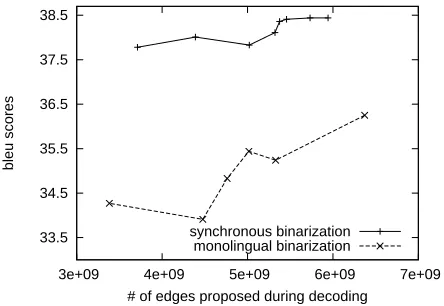
We compare the two binarization schemes in terms of translation quality with various pruning thresholds. The rule set is that of the previous sec-tion. The test set has 116 Chinese sentences of no longer than 15 words. Both systems use trigram as the integrated language model. Figure 7 demon-strates that decoding accuracy is significantly im-proved after synchronous binarization. The number of edges proposed during decoding is used as a mea-sure of the size of search space, or time efficiency. Our system is consistently faster and more accurate than the baseline system.
33.5 34.5 35.5 36.5 37.5 38.5
3e+09 4e+09 5e+09 6e+09 7e+09
bleu scores
# of edges proposed during decoding synchronous binarization
[image:8.612.78.300.67.220.2]monolingual binarization
Figure 7: Comparing the two binarization methods in terms of translation quality against search effort.
system which is trained on a larger data-set but tuned independently.
5 Conclusion
Modeling reorderings between languages has been a major challenge for machine translation. This work shows that the majority of syntactic reorderings, at least between languages like English and Chinese, can be efficiently decomposed into hierarchical bi-nary reorderings. From a modeling perspective, on the other hand, it is beneficial to start with a richer representation that has more transformational power than ITG or binary SCFG. Our work shows how to convert it back to a computationally friendly form without harming much of its expressiveness. As a result, decoding withn-gram models can be fast and accurate, making it possible for our syntax-based system to overtake a comparable phrase-based sys-tem in BLEU score. We believe that extensions of our technique to more powerful models such as syn-chronous tree-adjoining grammar (Shieber and Sch-abes, 1990) is an interesting area for further work.
Acknowledgments Much of this work was done when H. Zhang and L. Huang were visiting USC/ISI. The authors wish to thank Wei Wang, Jonathan Graehl and Steven DeNeefe for help with the experiments. We are also grateful to Daniel Marcu, Giorgio Satta, and Aravind Joshi for discus-sions. This work was partially supported by NSF ITR IIS-09325646 and NSF ITR IIS-0428020.
References
Albert V. Aho and Jeffery D. Ullman. 1972. The The-ory of Parsing, Translation, and Compiling, volume 1. Prentice-Hall, Englewood Cliffs, NJ.
David Chiang. 2005. A hierarchical phrase-based model for statistical machine translation. InProceedings of ACL-05, pages 263–270, Ann Arbor, Michigan.
Jason Eisner. 2003. Learning non-isomorphic tree map-pings for machine translation. InProceedings of ACL-03, companion volume, Sapporo, Japan.
Michel Galley, Mark Hopkins, Kevin Knight, and Daniel Marcu. 2004. What’s in a translation rule? In Pro-ceedings of HLT/NAACL-04.
Liang Huang, Hao Zhang, and Daniel Gildea. 2005. Ma-chine translation as lexicalized parsing with hooks. In Proceedings of IWPT-05, Vancouver, BC.
Kevin Knight and Jonathan Graehl. 2005. An overview of probabilistic tree transducers for natural language processing. InConference on Intelligent Text Process-ing and Computational LProcess-inguistics (CICLProcess-ing). LNCS.
I. Dan Melamed. 2003. Multitext grammars and syn-chronous parsers. InProceedings of NAACL-03, Ed-monton.
Franz Josef Och and Hermann Ney. 2004. The align-ment template approach to statistical machine transla-tion. Computational Linguistics, 30(4).
Giorgio Satta and Enoch Peserico. 2005. Some computa-tional complexity results for synchronous context-free grammars. InProceedings of HLT/EMNLP-05, pages 803–810, Vancouver, Canada, October.
L. Shapiro and A. B. Stephens. 1991. Bootstrap percola-tion, the Schr¨oder numbers, and then-kings problem. SIAM Journal on Discrete Mathematics, 4(2):275– 280.
Stuart Shieber and Yves Schabes. 1990. Synchronous tree-adjoining grammars. InCOLING-90, volume III, pages 253–258.
Dekai Wu. 1996. A polynomial-time algorithm for sta-tistical machine translation. In34th Annual Meeting of the Association for Computational Linguistics.