Review Article
Metformin: moving the cheese for tumor?
Ji Ma
1*, Ji Wang
2*, Qingli Zhao
1, Xiaohui Yu
3, Haiyuan Li
4, Fei Wang
5, Weiqiang Wu
6Departments of 1Breast Surgery, 3Gastroenterology, 6Colorectal Surgery, Lanzhou General Hospital of PLA, Lan-zhou, China; 2Department of General Surgery, The Second People’s Hospital of Gansu Province, Lanzhou, China; 4Department of Oncology Surgery, The Second Hospital of Lanzhou University, Lanzhou, China; 5Department of
Naval Equipment in Chongqing Military Representative Office of Health, Chongqing, China. *Equal contributors. Received December 3, 2016; Accepted August 13, 2017; Epub November 15, 2017; Published November 30, 2017
Abstract: Metformin, an insulin sensitizer, is a biguanide commonly used to treat type 2 diabetes mellitus. An in-creasing number of clinical studies on its anti-tumor effects have suggested that metformin not only reduces the risk of developing cancer but also decreases recurrence and mortality. It is reported that metformin can activate AMPK (AMP-activated protein kinase) and inhibit mTOR (mammalian target of rapamycin) signaling to suppress the growth of tumor cells. Moreover, emerging evidence suggests that metformin also exerts anti-tumor effects by inhib-iting insulin-like growth factor (IGF) or human epidermal growth factor receptor 2 (HER2) signaling, targets cancer stem cells (CSCs), and regulates expression of tumor-related microRNAs. This review critically discusses the role and mechanism of metformin as a potential treatment for cancer.
Keywords: Metformin, anti-tumor effects, clinical trials, signaling pathway
Introduction
Metformin (1,1-dimethylbiguanide
hydrochlo-ride) is a biguanide commonly used to treat
type 2 diabetes mellitus. It is frequently referred
to as an “insulin sensitizer” because it lowers
circulating insulin levels in scenarios of insulin
resistance and hyperinsulinemia [1]. The
pri-mary actions of metformin are inhibition of
hepatic glucose production and reduction of
insulin resistance in peripheral tissue, leading
to enhanced glucose uptake and utilization by
skeletal muscle. The effect is a reduction in
cir-culating glucose levels and in plasma insulin
levels, both of which improve long-term
glyce-mic control and decrease the incidence of
dia-betes-related complications [2, 3]. Use of
met-formin has been found to be generally safe,
with mild gastrointestinal symptoms being the
most common adverse effects [4].
Several retrospective epidemiologic surveys
indicate that metformin not only can reduce the
risk of cancer development but can also
decrease the rates of recurrence and deat
h [5].
Indeed, increasing evidence shows that
metfor-min may be a potential agent for both
prevent-ing and treatprevent-ing neoplastic diseases with some
potential anti-tumor effects. Type 2 diabetes
mellitus, insulin resistance and a high insulin
level might lead to tumorigenesis and
tumor-related mortality, effects that are mainly
asso-ciated with activation of the IGF, HER2, or
estro-gen receptor (ER) pathway. Therefore, it has
been suggested that metformin may decrease
insulin resistance and block the above signal
transduction pathways and even affect the
AMPK/mTOR pathway, inhibit the growth of
tumor cells and reversetumor drug-resistant.In
addition, metformin is associated with
modula-tion of CSCs and microRNAs to ultimately
sup-press tumor growth [5].
This review discusses the current knowledge of
metformin with regard to important anti-tu-
mor clinical trials and the mechanism by which
metformin may inhibit cancer growth and drug
resistance by regulating certain signal path-
ways.
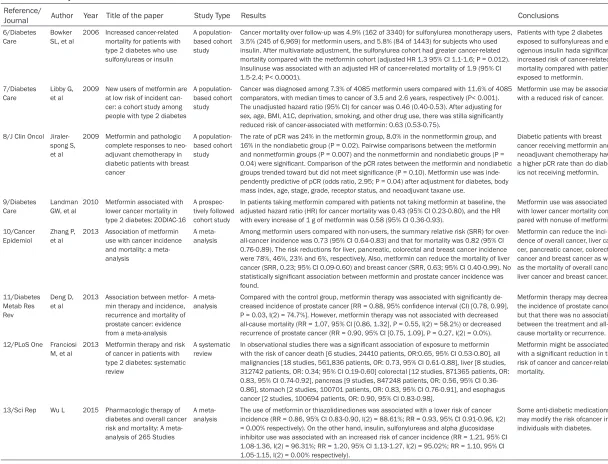
Clinical trials of metformin in cancer
Table 1.
Primary clinical studies of metformin in anti-tumor
Reference/Journal Author Year Title of the paper Study Type Results Conclusions
6/Diabetes
Care Bowker SL, et al 2006 Increased cancer-related mortality for patients with type 2 diabetes who use sulfonylureas or insulin
A population-based cohort study
Cancer mortality over follow-up was 4.9% (162 of 3340) for sulfonylurea monotherapy users, 3.5% (245 of 6,969) for metformin users, and 5.8% (84 of 1443) for subjects who used insulin. After multivariate adjustment, the sulfonylurea cohort had greater cancer-related mortality compared with the metformin cohort (adjusted HR 1.3 95% CI 1.1-1.6; P = 0.012). Insulinuse was associated with an adjusted HR of cancer-related mortality of 1.9 (95% CI 1.5-2.4; P< 0.0001).
Patients with type 2 diabetes exposed to sulfonylureas and
ex-ogenous insulin hada significantly
increased risk of cancer-related mortality compared with patients exposed to metformin. 7/Diabetes
Care Libby G, et al 2009 New users of metformin are at low risk of incident can-cer: a cohort study among people with type 2 diabetes
A population-based cohort study
Cancer was diagnosed among 7.3% of 4085 metformin users compared with 11.6% of 4085 comparators, with median times to cancer of 3.5 and 2.6 years, respectively (P< 0.001). The unadjusted hazard ratio (95% CI) for cancer was 0.46 (0.40-0.53). After adjusting for
sex, age, BMI, A1C, deprivation, smoking, and other drug use, there was stilla significantly
reduced risk of cancer-associated with metformin: 0.63 (0.53-0.75).
Metformin use may be associated with a reduced risk of cancer.
8/J Clin Oncol Jiraler-spong S, et al
2009 Metformin and pathologic complete responses to neo-adjuvant chemotherapy in diabetic patients with breast cancer
A population-based cohort study
The rate of pCR was 24% in the metformin group, 8.0% in the nonmetformin group, and 16% in the nondiabetic group (P = 0.02). Pairwise comparisons between the metformin and nonmetformin groups (P = 0.007) and the nonmetformin and nondiabetic groups (P =
0.04) were significant. Comparison of the pCR rates between the metformin and nondiabetic groups trended toward but did not meet significance (P = 0.10). Metformin use was inde -pendently predictive of pCR (odds ratio, 2.95; P = 0.04) after adjustment for diabetes, body mass index, age, stage, grade, receptor status, and neoadjuvant taxane use.
Diabetic patients with breast cancer receiving metformin and neoadjuvant chemotherapy have a higher pCR rate than do diabet-ics not receiving metformin.
9/Diabetes Care
Landman GW, et al
2010 Metformin associated with lower cancer mortality in type 2 diabetes: ZODIAC-16
A prospec-tively followed cohort study
In patients taking metformin compared with patients not taking metformin at baseline, the adjusted hazard ratio (HR) for cancer mortality was 0.43 (95% CI 0.23-0.80), and the HR with every increase of 1 g of metformin was 0.58 (95% CI 0.36-0.93).
Metformin use was associated with lower cancer mortality com-pared with nonuse of metformin. 10/Cancer
Epidemiol Zhang P, et al 2013 Association of metformin use with cancer incidence and mortality: a meta-analysis
A
meta-analysis Among metformin users compared with non-users, the summary relative risk (SRR) for over-all-cancer incidence was 0.73 (95% CI 0.64-0.83) and that for mortality was 0.82 (95% CI 0.76-0.89). The risk reductions for liver, pancreatic, colorectal and breast cancer incidence were 78%, 46%, 23% and 6%, respectively. Also, metformin can reduce the mortality of liver cancer (SRR, 0.23; 95% CI 0.09-0.60) and breast cancer (SRR, 0.63; 95% CI 0.40-0.99). No
statistically significant association between metformin and prostate cancer incidence was
found.
Metformin can reduce the inci-dence of overall cancer, liver can-cer, pancreatic cancan-cer, colorectal cancer and breast cancer as well as the mortality of overall cancer, liver cancer and breast cancer.
11/Diabetes Metab Res Rev
Deng D,
et al 2013 Association between metfor-min therapy and incidence, recurrence and mortality of prostate cancer: evidence from a meta-analysis
A
meta-analysis Compared with the control group, metformin therapy was associated with significantly decreased incidence of prostate cancer [RR = 0.88, 95% confidence interval (CI) [0.78, 0.99],
-P = 0.03, I(2) = 74.7%]. However, metformin therapy was not associated with decreased all-cause mortality (RR = 1.07, 95% CI [0.86, 1.32], P = 0.55, I(2) = 58.2%) or decreased recurrence of prostate cancer (RR = 0.90, 95% CI [0.75, 1.09], P = 0.27, I(2) = 0.0%).
Metformin therapy may decrease the incidence of prostate cancer but that there was no association between the treatment and all-cause mortality or recurrence. 12/PLoS One Franciosi
M, et al
2013 Metformin therapy and risk of cancer in patients with type 2 diabetes: systematic review
A systematic review
In observational studies there was a significant association of exposure to metformin
with the risk of cancer death [6 studies, 24410 patients, OR:0.65, 95% CI 0.53-0.80], all malignancies [18 studies, 561,836 patients, OR: 0.73, 95% CI 0.61-0.88], liver [8 studies, 312742 patients, OR: 0.34; 95% CI 0.19-0.60] colorectal [12 studies, 871365 patients, OR: 0.83, 95% CI 0.74-0.92], pancreas [9 studies, 847248 patients, OR: 0.56, 95% CI 0.36-0.86], stomach [2 studies, 100701 patients, OR: 0.83, 95% CI 0.76-0.91], and esophagus cancer [2 studies, 100694 patients, OR: 0.90, 95% CI 0.83-0.98].
Metformin might be associated
with a significant reduction in the
risk of cancer and cancer-related mortality.
13/Sci Rep Wu L 2015 Pharmacologic therapy of diabetes and overall cancer risk and mortality: A meta-analysis of 265 Studies
A meta-analysis
The use of metformin or thiazolidinediones was associated with a lower risk of cancer incidence (RR = 0.86, 95% CI 0.83-0.90, I(2) = 88.61%; RR = 0.93, 95% CI 0.91-0.96, I(2) = 0.00% respectively). On the other hand, insulin, sulfonylureas and alpha glucosidase inhibitor use was associated with an increased risk of cancer incidence (RR = 1.21, 95% CI 1.08-1.36, I(2) = 96.31%; RR = 1.20, 95% CI 1.13-1.27, I(2) = 95.02%; RR = 1.10, 95% CI 1.05-1.15, I(2) = 0.00% respectively).
and colleagues compared diabetes patients
treated with metformin alone versus diabetes
patients treated with sulfonylurea or insulin
alone, and the results suggested a lower
tumor-related mortality rate in diabetes patients
under metformin therapy [6]. In 2009, Libby
and colleagues reported a cancer diagnosis of
7.3% among 4,085 metformin users compared
with 11.6% for 4,085 comparators, with
medi-an times to cmedi-ancer of 3.5 medi-and 2.6 years,
respec-tively [7]. In the same year, in an analysis of the
impact of metformin in their series of 2592
patients who received neoadjuvant
chemother-apy for early-stage breast cancer, Jiralerspong
and colleagues found that the rate of
patholog-ic complete response (pCR) was 24% in the
metformin group (including 68 diabetic patients
taking metformin), 8.0% in the non-metformin
group (including 87 diabetic patients not taking
metformin), and 16% in the non-diabetic group
(including 2,374 nondiabetic patients) [8]. For
patients taking metformin compared with pa-
tients not taking metformin at baseline, La-
ndmanand colleagues reported in 2010 that
the adjusted hazard ratio (HR) for cancer
mor-tality was 0.43 (95% CI 0.23-0.80) and that the
HR with every 1 g increase of metformin was
0.58 (95% CI 0.36-0.93) at a median follow-up
time 9.6 years. It was concluded that
metfor-min effectively decreases cancer mortality
rates and that this effect was dose dependent
[9]. In 2013, a meta-analysis analyzing the
overall cancer incidence summary relative risk
of 1,535,636 patients with or without
metfor-min in 37 studies found
that metformin can
reduce the incidence of liver (78%, SRR, 0.22,
95% CI 0.11-0.46), breast (6%, SRR, 0.94; 95%
CI 0.91-0.97), pancreatic (46%, SRR, 0.54; 95%
CI 0.35-0.83) and colorectal (23%, SRR, 0.77;
95% CI 0.64-0.91) but not prostate cancer(RR,
0.93; 95% CI 0.82-1.05) [10]. However, another
meta-analysis reported that patients using
metformin have a reduced incidence of
pros-tate cancer (RR = 0.88, 95% CI 0.78-0.99, P =
0.03) [11]. Moreover, in 2013, a systematic
review of 35 studies reported that patients
using metformin exhibited reduced risk of
developing all cancer (OR = 0.73, 95% CI
0.61-0.88), liver cancer (OR = 0.34, 95% CI
0.19-0.60), colorectal cancer (OR = 0.83, 95% CI
0.74-0.92), pancreatic cancer (OR = 0.56, 95%
CI 0.36-0.86), gastric cancer (OR = 0.83, 95%
CI 0.76-0.91), and esophageal cancer (OR =
0.90, 95% CI 0.83-0.98) [12]. In 2015, a
meta-analysis of approximately 265 studies showed
a lower cancer incidence with metformin or
thi-azolidinediones use by diabetic patients (RR =
0.86, 95% CI 0.83-0.90 and RR = 0.93, 95% CI
0.91-0.96, respectively), whereas increased
cancer incidence was associated with insulin,
sulfonylureas, and alpha glucosidase inhibitor
use (RR = 1.21, 95% CI 1.08-1.36; RR = 1.20,
95% CI 1.13-1.27 and RR = 1.10, 95% CI
1.05-1.15, respectively) [13].
Potential mechanisms of metformin in cancer
Based on preclinical studies, metformin
possi-bly directly or indirectly regulates downstream
targets through many molecular signaling
path-ways to reduce the growth and proliferation of
tumor cells.
AMPK/mTOR signaling pathway
to AMPK-dependent mTOR inhibitionin
pancre-atic cancer cells and in gastric cancer cells [23,
24]. Thus, metformin results in a better
anti-tumor response in cancer cells than rapa-
mycin.
Insulin-like growth factor signaling pathway
IGF, a multifunctional cell proliferation
regula-tion factor, plays key roles in human cell
prolif-eration, differentiation and henogenesis
onto-genesis [25]. Substantial evidence shows that
IGF is involved in regulating pathways of
prolif-eration of both normal and tumor cells [26]. IGF
can bind to and activate insulin-like growth-1
receptor (IGF-1R), which is frequently
overex-pressed in cancer and is a key stimulator of
cancer cell growth [27]. Metformin can reverse
hyperinsulinemia in diabetic or non-diabetic
patients by regulating the balance of glucose
metabolism. Moreover, metformin can interfere
with IGF signaling pathways and reduce the
binding of insulin and IGF to IGF-1R in
endome-trial carcinoma cells [28]. This effect can result
in cancer cell growth inhibition. In addition,
recent studies suggest that AMPK activation
induced by metformin also decreases tyrosine
phosphorylation of insulin receptor substrates
(IRSs) and disrupts crosstalk between the
insu-lin/IGF-1R and G protein-coupled receptor
sig-naling pathwaysin pancreatic cancer cells [29].
In a mouse model of tobacco carcinogen-in-
duced lung cancer, inhibition of IGF-1R/IR by
metformin decreased downstream signaling
through the PI3K/Akt pathway [30].
HER2 signaling pathway
HER2 is a transmembrane receptor with
tyro-sine kinase activity. HER2 belongs to a family of
four receptors (EGFR/HER1, HER2, HER3,
HER4) that are involved in regulating cell gr-
owth, survival and differentiation through
inter-linked signal transduction via activation of the
PI3K/Akt and Ras/Raf/MEK/MAPK pathways
[31, 32]. Amplification of the
HER2
gene and/or
overexpression at the messenger RNA or
pro-tein level occurs in approximately 20% of
patients with early-stage breast cancer [31].
Metformin has been found to decrease HER2
expression in human breast cancer cells by
directly inhibiting p70S6K1, a downstream
effector of mTOR [33]. Interestingly, a low
con-centration of metformin can block activity of
the HER2 protease and reverse drug resistance
induced by HER2-targeted treatment in breast
cancer cells [34]. Importantly, AMPK activation
can protect cardiac cells from injury caused by
HER2 treatment [35]. Thus, metformin may
have a synergistic effect in HER2-targeted
therapy.
Cancer stem cells
The wildly reported CSCs hypothesis of
tumori-genesis was developed based on an
under-standing of the functional heterogeneity ob-
served in human tumor cells [36]. In 2009, the
first study of metformin and CSCs showed that
the drug selectively targets cancer stem cells
and acts together with chemotherapy to block
tumor growth and prolong remission [37]. This
study reported that doxorubicin, a standard
component of breast cancer chemotherapy,
produced a negligible effect on the proportion
of CD44
+/CD24
lowCSCs among the remaining
live cells, whereas metformin alone or in
combi-nation with doxorubicin significantly reduced
the number of surviving CSCs. More important,
doxorubicin plus metformin caused a durable
regression of tumors in nude mice with tumor
xenografts, even after cessation of therapy, si-
milar to the results of rapamycin in a preclinical
model of pancreatic cancer [38]. These results
were subsequently extended to cancer cell
lines including prostate and lung
adenocarci-noma, and metformin similarly inhibits CSCs
[39]. However, the specific mechanisms by
wh-ich metformin inhibit CSCs remain unclear.
Some studies have found that metformin
treat-ment can decrease the mRNA levels of the
transcription factors Nanog, Otc4 and Otc2,
which were originally defined as components of
the self-renewal/maintenance machinery in
embryonic stem cells [40, 41]. Other studies
have suggested that metformin also inhibits
the mRNA expression of Notch1 and enhancer
of zeste homolog 2 (EZH2) in tumor cells. Notch
signaling is key for the regulation of CSCs [42],
and EZH2 is methyltransferase component of
the polycomb repressor complex 2, which
mod-ulates certain genes involved in CSC
differenti-ation [43]. Despite ongoing research, we still
have a very limited understanding of the
molec-ular mechanisms underlying the effects of me-
tformin in tumor suppression and CSC targe-
ting.
MicroRNAs
differ-entiation, apoptosis, stress response and an-
giogenesis, due to their ability to bind to the
3’UTR of multiple target mRNAs [44, 45].
miR-NAs can behave as either oncogenes or tumor
suppressor genes, thereby promoting or
inhibit-ing cancer progression, and growinhibit-ing evidence
shows that metformin can exert anticancer
effects through miRNA modulation. One study
showed that in pancreatic cancer cell lines,
metformin can up-regulate expression of
miR-26a, miR-192 and let-7c to inhibit cancer cell
proliferation, invasion, migration and promote
apoptosis through direct modulation of HM-
GA1 [46]. Interestingly, after metformin
treat-ment, the pancreatic cancer cells re-expressed
many miRNAs that are usually switched off
dur-ing cancer progression, such as the miR-200
family, which plays a major role in the epithelial
to mesenchymal transition and in maintaining
the stem cell state [47]. Furthermore,
metfor-min can inhibit tumor sphere formation by
down-regulating several CSC markers such as
CD44, EpCAM, EZH2, Notch1, Nanog and Oct4,
partially through up-regulation of miRNAs [48,
49]. In human lung cancer cell lines A549 and
NCI-H358, metformin inhibited growth and cell
cycle progression by reducing miR-222 exp-
ression, which directly inhibited p27, p57 and
PTEN [50]. In breast cancer cell lines,
metfor-min decreased c-MYC expression to inhibit
che-moresistance, possibly by up-regulating
miR-33a levels [51].
Conclusion
In summary, there is an increasing amount of
evidence from pre-clinical data and
population-based studies of carcinogenesis that supports
the potential efficacy of metformin as an anti
-cancer agent. Metformin inhibits the growth of
cancer cells by modulating AMPK/mTOR, IGF,
and HER2 signaling pathways, reducing the
number of surviving CSCs, and regulating the
expression of tumor-related miRNAs. However,
studies on the specific molecular mechanism
of metformin are still in early stages. Moreover,
it is very important to improve histology
tech-niques and identify the appropriate tumor
stag-es for utilizing metformin therapy. If the above
limitations are resolved, metformin may prove
to be a non-toxic, inexpensive anticancer drug
in the future.
Acknowledgements
This work was funded by National Natural
Science Foundation of China Grants (No.
81202085), Gansu Province Outstanding Yo-
uth Foundation (No. 1506RJDA296), Lanzhou
Science and Technology Projects (No.
2014-1-39), Army Medical Science and Technology
Projects (No. CLZ13JB03), Natural Science
Foundation of Gansu Province (No. 1308-
RJYA045), and National Medical Special Fund
Project (No. L2014073).
Disclosure of conflict of interest
None.
Address correspondence to: Weiqiang Wu, Depart- ment of Colorectal Surgery, Lanzhou General Hospital of PLA, Lanzhou 730000, China. E-mail: [email protected]
References
[1] Inzucchi SE, Bergenstal RM, Buse JB, Diamant M, Ferrannini E, Nauck M, Peters AL, Tsapas A, Wender R and Matthews DR. Management of hyperglycemia in type 2 diabetes, 2015: a pa-tient-centered approach: update to a position statement of the American Diabetes Associa-tion and the European AssociaAssocia-tion for the Study of Diabetes. Diabetes Care 2015; 38: 140-149.
[2] Grzybowska M, Bober J and Olszewska M. Met-formin-mechanisms of action and use for the treatment of type 2 diabetes mellitus. Postepy Hig Med Dosw (Online) 2011; 65: 277-285. [3] Jalving M, Gietema JA, Lefrandt JD, de Jong S,
Reyners AK, Gans RO and de Vries EG. Metfor-min: taking away the candy for cancer. Eur J Cancer 2010; 46: 2369-2380.
[4] Diabetes Prevention Program Research Group. Long-term safety, tolerability, and weight loss associated with metformin in the diabetes pre-vention program outcomes study. Diabetes Care 2012; 35: 731-737.
[5] Castillo-Quan JI and Blackwell TK. Metformin:
restraining nucleocytoplasmic shuttling to
fi-ght cancer and aging. Cell 2016; 167: 1670-1671.
[6] Bowker SL, Majumdar SR, Veugelers P and Johnson JA. Increased cancer-related mortality for patients with type 2 diabetes who use sulfo-nylureas or insulin. Diabetes Care 2006; 29: 254-258.
[7] Libby G, Donnelly LA, Donnan PT, Alessi DR, Morris AD and Evans JM. New users of metfor-min are at low risk of incident cancer: a cohort study among people with type 2 diabetes. Dia-betes Care 2009; 32: 1620-1625
AM. Metformin and pathologic complete re-sponses to neoadjuvant chemotherapy in dia-betic patients with breast cancer. J Clin Oncol 2009; 27: 3297-3302.
[9] Landman GW, Kleefstra N, van Hateren KJ, Groenier KH, Gans RO and Bilo HJ. Metformin associated with lower cancer mortality in type 2 diabetes: ZODIAC-16. Diabetes Care 2010; 33: 322-326.
[10] Zhang P, Li H, Tan X, Chen L and Wang S. As-sociation of metformin use with cancer inci-dence and mortality: a meta-analysis. Cancer Epidemiol 2013; 37: 207-218.
[11] Deng D, Yang Y, Tang X, Skrip L, Qiu J, Wang Y and Zhang F. Association between metformin therapy and incidence, recurrence and mortal-ity of prostate cancer: evidence from a meta-analysis. Diabetes Metab Res Rev 2015; 31: 595-602.
[12] Franciosi M, Lucisano G, Lapice E, Strippoli GF, Pellegrini F and Nicolucci A. Metformin therapy and risk of cancer in patients with type 2 dia-betes: systematic review. PLoS One 2013; 8: e71583.
[13] Wu L, Zhu J, Prokop LJ and Murad MH. Phar-macologic therapy of diabetes and overall can-cer risk and mortality: a meta-analysis of 265 studies. Sci Rep 2015; 5: 10147.
[14] Tandon M, Chen Z, Othman AH and Pratap J. Role of Runx2 in IGF-1Rbeta/Akt- and AMPK/ Erk-dependent growth, survival and sensitivity towards metformin in breast cancer bone me-tastasis. Oncogene 2016; 35: 4730-4740. [15] Cai H, Zhang Y, Han TK, Everett RS and
Thak-ker DR. Cation-selective transporters are criti-cal to the AMPK-mediated antiproliferative ef-fects of metformin in human breast cancer cells. Int J Cancer 2016; 138: 2281-2292. [16] Vincent EE, Coelho PP, Blagih J, Griss T, Viollet
B and Jones RG. Differential effects of AMPK agonists on cell growth and metabolism. Onco-gene 2015; 34: 3627-3639.
[17] Li Y, Liu Y, Shi F, Cheng L and She J. Knock-down of Rap1b enhances apoptosis and au-tophagy in gastric cancer cells via the PI3K/ Akt/mTOR pathway. Oncol Res 2016; 24: 287-293.
[18] Jin ZZ, Wang W, Fang DL and Jin YJ. mTOR inhi-bition sensitizes ONC201-induced anti-colorectal cancer cell activity. Biochem Bio-phys Res Commun 2016; 478: 1515-1520. [19] Ilagan E and Manning BD. Emerging role of
mTOR in the response to cancer therapeutics. Trends Cancer 2016; 2: 241-251.
[20] de Queiroz EA, Akamine EH, de Carvalho MH, Sampaio SC and Fortes ZB. Metformin reduces the Walker-256 tumor development in obese-MSG rats via AMPK and FOXO3a. Life Sci 2015; 121: 78-87.
[21] Yuan Y, Xue X, Guo RB, Sun XL and Hu G. Res-veratrol enhances the antitumor effects of te-mozolomide in glioblastoma via ROS-depen-dent AMPK-TSC-mTOR signaling pathway. CNS Neurosci Ther 2012; 18: 536-46.
[22] Aksoy S, Sendur MA and Altundag K. Demo-graphic and clinico-pathological characteris-tics in patients with invasive breast cancer re-ceiving metformin. Med Oncol 2013; 30: 590. [23] Cifarelli V, Lashinger LM, Devlin KL, Dunlap
SM, Huang J, Kaaks R, Pollak MN and Hursting SD. Metformin and rapamycin reduce pancre-atic cancer growth in obese prediabetic mice by distinct microRNA-regulated mechanisms. Diabetes 2015; 64: 1632-1642.
[24] Yu G, Fang W, Xia T, Chen Y, Gao Y and Jiao X. Metformin potentiates rapamycin and cisplatin in gastric cancer in mice. Oncotarget 2015; 6: 12748-12762.
[25] Drogan D, Schulze MB, Boeing H and Pischon T. Insulin-like growth factor 1 and insulin-like growth factor-binding protein 3 in relation to the risk of type 2 diabetes mellitus: results from the EPIC-potsdam study. Am J Epidemiol 2016; 183: 553-560.
[26] Youssef A and Han VK. Low oxygen tension modulates the insulin-like growth Factor-1 or -2 signaling via both insulin-like growth Fac-tor-1 receptor and insulin receptor to maintain stem cell identity in placental mesenchymal stem cells. Endocrinology 2016; 157: 1163-1174.
[27] Amin O, Beauchamp MC, Nader PA, Laskov I, Iqbal S, Philip CA, Yasmeen A and Gotlieb WH. Suppression of homologous recombination by insulin-like growth factor-1 inhibition sensitizes cancer cells to PARP inhibitors. BMC Cancer 2015; 15: 817.
[28] Zhang Y, Li M, Wang H, Zeng Z and Li X. Metfor-min down-regulates endometrial carcinoma cell secretion of 1 and expression of IGF-1R. Asian Pac J Cancer Prev 2015; 16: 221-225.
[29] Rozengurt E, Sinnett-Smith J and Kisfalvi K. Crosstalk between insulin/insulin-like growth factor-1 receptors and G protein-coupled re-ceptor signaling systems: a novel target for the antidiabetic drug metformin in pancreatic can-cer. Clin Cancer Res 2010; 16: 2505-2511. [30] Stabile LP, Rothstein ME, Cunningham DE,
Land SR, Dacic S, Keohavong P and Siegfried JM. Prevention of tobacco carcinogen-induced lung cancer in female mice using antiestro-gens. Carcinogenesis 2012; 33: 2181-2189. [31] Arteaga CL, Sliwkowski MX, Osborne CK, Perez
[32] Gallardo A, Lerma E, Escuin D, Tibau A, Muñoz J, Ojeda B, Barnadas A, Adrover E, Sanchez-Tejada L, Giner D, Ortiz-Martinez F and Peiro G. Increased signalling of EGFR and IGF1R, and deregulation of PTEN/PI3K/Akt pathway are related with trastuzumab resistance in HER2 breast carcinomas. Br J Cancer 2012; 106: 1367-1373.
[33] Vazquez-Martin A, Oliveras-Ferraros C and Menendez JA. The antidiabetic drug metformin suppresses HER2 (erbB-2) oncoprotein overex-pression via inhibition of the mTOR effector p70S6K1 in human breast carcinoma cells. Cell Cycle 2009; 8: 88-96.
[34] Vazquez-Martin A, Oliveras-Ferraros C, del BS, Martin-Castillo B and Menendez JA. The anti-diabetic drug metformin: a pharmaceutical AMPK activator to overcome breast cancer re-sistance to HER2 inhibitors while decreasing risk of cardiomyopathy. Ann Oncol 2009; 20: 592-595.
[35] Shell SA, Lyass L, Trusk PB, Pry KJ, Wappel RL and Bacus SS. Activation of AMPK is necessary for killing cancer cells and sparing cardiac cells. Cell Cycle 2008; 7: 1769-1775.
[36] Liu R, Wang JH, Xu C, Sun B and Kang SO. Ac-tivin pathway enhances colorectal cancer stem cell self-renew and tumor progression. Bio-chem Biophys Res Commun 2016; 479: 715-720.
[37] Hirsch HA, Iliopoulos D, Tsichlis PN and Struhl K. Metformin selectively targets cancer stem cells, and acts together with chemotherapy to block tumor growth and prolong remission. Cancer Res 2009; 69: 7507-7511.
[38] Mueller MT, Hermann PC, Witthauer J, Rubio-Viqueira B, Leicht SF, Huber S, Ellwart JW, Mus-tafa M, Bartenstein P, D’Haese JG, Schoenberg MH, Berger F, Jauch KW, Hidalgo M and Heeschen C. Combined targeted treatment to eliminate tumorigenic cancer stem cells in hu-man pancreatic cancer. Gastroenterology 2009; 137: 1102-1113.
[39] Iliopoulos D, Hirsch HA and Struhl K. Metfor-min decreases the dose of chemotherapy for prolonging tumor remission in mouse xeno-grafts involving multiple cancer cell types. Can-cer Res 2011; 71: 3196-3201.
[40] Chambers I, Colby D, Robertson M, Nichols J, Lee S, Tweedie S and Smith A. Functional ex-pression cloning of Nanog, a pluripotency sus-taining factor in embryonic stem cells. Cell 2003; 113: 643-655.
[41] Yang Y, Wang Y, Yin C and Li X. Clinical signifi -cance of the stem cell gene Oct-4 in cervical cancer. Tumour Biol 2014; 35: 5339-5345. [42] Chen M, Zhang J, Liu S and Zhou Z. Effects of
metformin on the polarization and Notch 1 ex-pression of RAW264.7 macrophages. Zhong-hua Yi Xue Za Zhi 2015; 95: 1258-1261. [43] Caretti G, Palacios D, Sartorelli V and Puri PL.
Phosphoryl-EZH-ion. Cell Stem Cell 2011; 8: 262-265.
[44] Iorio MV and Croce CM. MicroRNA dysregula-tion in cancer: diagnostics, monitoring and therapeutics. A comprehensive review. EMBO Mol Med 2012; 4: 143-159.
[45] Pulito C, Donzelli S, Muti P, Puzzo L, Strano S and Blandino G. microRNAs and cancer me-tabolism reprogramming: the paradigm of met-formin. Ann Transl Med 2014; 2: 58.
[46] Li W, Yuan Y, Huang L, Qiao M and Zhang Y.
Metformin alters the expression profiles of mi -croRNAs in human pancreatic cancer cells. Di-abetes Res Clin Pract 2012; 96: 187-195. [47] Bao B, Wang Z, Ali S, Ahmad A, Azmi AS, Sarkar
SH, Banerjee S, Kong D, Li Y, Thakur S and Sarkar FH. Metformin inhibits cell proliferation, migration and invasion by attenuating CSC function mediated by deregulating miRNAs in pancreatic cancer cells. Cancer Prev Res (Phi-la) 2012; 5: 355-364.
[48] Ning X, Shu J, Du Y, Ben Q and Li Z. Therapeu-tic strategies targeting cancer stem cells. Can-cer Biol Ther 2013; 14: 295-303.
[49] Wellner U, Schubert J, Burk UC, Schmalhofer O, Zhu F, Sonntag A, Waldvogel B, Vannier C, Darling D, zur Hausen A, Brunton VG, Morton J, Sansom O, Schuler J, Stemmler MP, Herzberg-er C, Hopt U, Keck T, Brabletz S and Brabletz T. The EMT-activator ZEB1 promotes tumorige-nicity by repressing stemness-inhibiting mi-croRNAs. Nat Cell Biol 2009; 11: 1487-1495. [50] Wang Y, Dai W, Chu X, Yang B, Zhao M and Sun
Y. Metformin inhibits lung cancer cells prolifer-ation through repressing microRNA-222. Bio-technol Lett 2013; 35: 2013-2019.