A Constituent Syntactic Parse Tree Based Discourse Parser
Zhongyi Li1,2, Hai Zhao1,2,∗,Chenxi Pang1,2,Lili Wang1,2,Huan Wang3 1Department of Computer Science and Engineering,
Shanghai Jiao Tong University, Shanghai, 200240, China
2Key Laboratory of Shanghai Education Commission for Intelligent Interaction and Cognitive Engineering, Shanghai Jiao Tong University, Shanghai, 200240, China
3Omron Institute of Sensing & Control Technology(Shanghai)
{rival2710,wang lili}@sjtu.edu.cn,[email protected] [email protected],[email protected]
Abstract
This paper describes our system in the CoNLL-2016 shared task. Our system takes a piece of newswire text as input and returns the discourse relations. In our system we use a pipeline to conduct each subtask. Our system is evaluated on the CoNLL-2016 Shared Task closed track and obtains 0.1515 in F1 measurement, es-pecially the part of detecting connectives, which achieves 0.9838 on blind test set.
1 Introduction
An end-to-end discourse parser is a system using natural language text as input and the discourse re-lation in labeled text as output. It has been widely used in the field of natural language processing, such as text classification, question answering sys-tem. In these discourse relations, two argument spans are marked as targets looked for by dis-course relations, while conjunctions (connective) play an important role to confirm the relationship between the two argument spans. According to whether the conjunctions clearly appear in the text, discourse relations can be divided into two cate-gories: explicit and non-explicit.
Penn Discourse Treebank (PDTB) has become the most important corpus in the field of discourse parsing. Previous work (Lin et al., 2014) inte-grated the entire training process together to form ∗Corresponding author. This paper was partially sup-ported by Cai Yuanpei Program (CSC No. 201304490199 and No. 201304490171), National Natural Science Founda-tion of China (No. 61170114 and No. 61272248), NaFounda-tional Basic Research Program of China (No. 2013CB329401), Major Basic Research Program of Shanghai Science and Technology Committee (No. 15JC1400103), Art and Sci-ence Interdisciplinary Funds of Shanghai Jiao Tong Univer-sity (No. 14JCRZ04), and Key Project of National Society Science Foundation of China (No. 15-ZDA041).
a complete discourse parser. There were five ma-jor components in the system, including Connec-tive classifier, Argument labeler, Explicit classi-fier, Non-Explicit classiclassi-fier, Attribution span la-beler, with a part of PDTB as the training, which has achieved good prediction performance.
2 System Overview
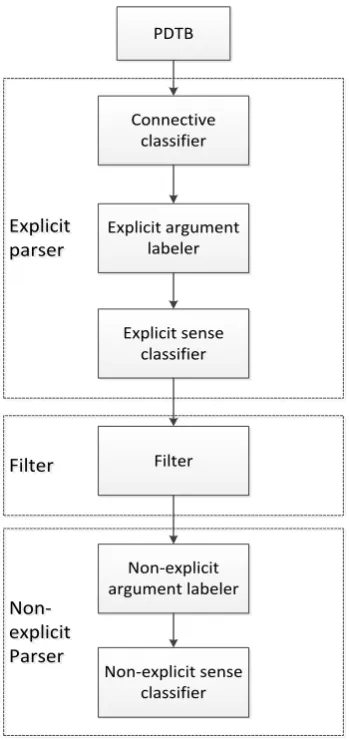
We design our discourse parser as a sequential pipeline, shown in Figure 1. The whole system can be divided into two main parts: explicit and non-explicit.
The Explicit part contains:
(1)Connective ClassifierDetects the discourse connectives. Note that not all commonly used con-junctions have the effect of connective, so we first identify the ones function as discourse connective. (2) Explicit Argument Labeler Locates the relative positions and extracts spans of Arg1 and Arg2. We use an efficient method to extract for integrating Arg1 and Arg2 together.
(3) Explicit Sense Classifier Determines the discourse function of the detected connectives.
For the explicit part and non-explicit part, there is:
(4)FilterGets rid of obviously incorrect parts, such as the ones that have already been marked as explicit relationship, with the remainder as the input part of non-explicit.
The non-explicit part contains:
(5)Non-explicit Argument Labelermarks the location and range of Arg1 and Arg2 in the case that lacks of connective.
(6) Non-explicit Sense Classifier Determines the discourse relations according to the semantic context of Arg1 and Arg2.
3 System Components
Our system consists of six parts, and the general workflow refers to the shallow discourse parser based on the constituent parse tree (Chen et al., 2015). Feature extraction for training follows pre-vious works (Kong et al., 2014; Lin et al., 2014; Pitler et al., 2009; Pitler and Nenkova, 2009).
We deduce each sentence into a constituent parse tree. Relative information is extracted from these constituent parse trees to train models and predict discourse relations.
PDTB
Connective classifier
Explicit argument labeler
Explicit sense classifier Explicit
parser
Explicit parser
Filter
Non-explicit argument labeler
Non-explicit sense classifier Filter
Filter
Non-explicit Parser
[image:2.595.95.270.238.609.2]Non-explicit Parser
Figure 1: System overview
3.1 Explicit parser
3.1.1 Connective Classifier
In PDTB, there are 100 species of discourse con-nective, but not all conjunctions in the form of these 100 kinds of connective in the text are neces-sarily discourse relation. Thus, at first, we find out all connectives appearing in the text by scanning
each constituent parse tree, then use the tive classifier to determine whether each connec-tive functions as discourse connecconnec-tive.
The features in connective classifier are as fol-lows.
(1) ConnPos The category of the tree node which covers the whole connective.
(2) PrevConn The previous word of the con-nective and the concon-nective itself.
(3)PrevPosThe category of the previous word of the connective.
(4)PrevPosConnPosThe category of previous word and category of the connective.
(5) ConnNext The connective itself and the next word of the connective.
(6) NextPosThe category of the next word of the connective.
(7)ConnPosNextPosThe category of the con-nective itself and category of the next word.
After extracting the mentioned feature for each connective, we annotate it as 1 or 0 according to whether this word in PDTB functions as dis-course connective. (Jia et al., 2013; Zhao and Kit, 2008) showed maximum entropy classifier performed well in relative tasks, so we apply it to our classification problem∗. According to offi-cial evaluation, F1 score of this part in our system is 0.9905 on the dev set and 0.9838 on the blind test set, comparing to 0.9514 and 0.9186, the best result of CoNLL-2015. The detailed results are shown in Table 1.
set P R F
dev 0.9971 0.9840 0.9905 test 0.9967 0.9819 0.9892 blind 0.9856 0.9821 0.9838
Table 1: Official scores of connective classifier
From the comparison, we can learn that
(1)From the constituent parse tree we build, we can extract connective features precisely.
(2)We use a straightforward way build our clas-sifier. Comparing to previous works, our features and model are much more intuitively, and finally get even better result.
(3)There are different ways to process text, and our work shows that using constituent parse tree is a proper method in this task or similar ones.
[image:2.595.334.501.494.567.2]3.1.2 Argument labeler
In this part, we use interval mapping based on con-stituent parse tree and the extracting method pro-posed by (Kong et al., 2014). When training, in constituent parse tree, we start with the node of connective, and ended with the root node. Along the path, left and right sibling of each node have become the candidate member of the Argument. Given that some part of the explicit discourse rela-tion used previous sentence (PS) as Arg1, we use the a efficient method (Kong et al., 2014), which is to treat the sentence previous to the one con-tained discourse connective as the candidate of Arg1. Later, we compare these candidates with PDTB, and label them as Arg1 and Arg2 or null, according to their uses in PDTB, of which null means that the candidate doesn’t have the func-tion of Arg1 or Arg2. By this means, we obtain satisfying effect of argument labeling.
The features were as follows:
(1)ConStrPrototype of connective in the text. (2)ConLStrLowercase of connective.
(3)ConCatPart of speech of connective. (4)ConLSibLeft sibling number of connective. (5) ConLSibRight sibling number of connec-tive.
(6)CandiCtxCandidate’s category, category of parent node, category of left sibling, and category of right sibling.
(7)ConCandiPathCategory of each node from the Candi to root node along the tree.
(8)ConCandiPositionThe relative position be-tween Candi and connective (left or right).
(9) ConCandiPathLSib Whether the left sib-ling number of the Candi is bigger than one.
3.1.3 Explicit Sense Classifier
In this part, we combine the feature of Lin’s ex-periment with the feature of Pilter’s, particularly as follows, (1) C prototype (2) C POS (3) prev+C (4) category of parent (5) category of left sibling (6) category of right sibling.
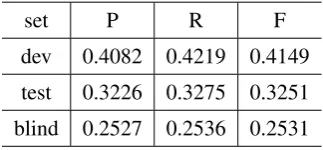
set P R F
dev 0.4082 0.4219 0.4149 test 0.3226 0.3275 0.3251 blind 0.2527 0.2536 0.2531
Table 2: Official scores of explicit sense classifier
The detailed results are shown in Table 2. The results are also better than the best ones of CoNLL-2015, which were 0.3861 on the dev set and 0.2394 on the blind test set.
3.2 Filter
After identifying all explicit discourse relation connectives, and before non-explicit parser, we need to filter the training set. There are two cases for this filtering. (1) If one sentence, is labelled as Arg1 of some explicit discourse in previous step, then the related two sentences will not be con-sidered by the following non-explicit parser. (2) In the original text, if two adjacent sentences are located between the last sentence of the previous paragraph and the first sentence of the next para-graph respectively, then these two sentences will not be considered, either.
3.3 Non-Explicit Parser
After explicit parser and filtering above, we take the rest part as input into non-explicit parser, for finding all the non-explicit discourse relations. In PDTB, there are three kinds of non-explicit dis-course relations, which are Implicit, AltLex and EntRel. We notice that there is only 2.94% of Al-tLex. Besides, according to official evaluation cri-teria, we need to detect only 15 senses of the part of implicit. According to (Chen et al., 2015), we integrate EntRel together with implicit as a special sense for training and predicting.
3.3.1 Non-explicit Argument Labeler
In this part, we simply take the rest adjacent sen-tences which have been filtered as the argument span of non-explicit.
3.3.2 Non-explicit Sense Classifier
We perform sentence classification as mentioned above, practicing EntRel as a special sense of im-plicit, and ignored the senses which have few fre-quency of occurrences in PDTB. According to the previous works, the lost connective plays an im-portant role in senses. Generally, connective ap-pears at the beginning of the second sentence. Ac-cording to this assumption, we use the following features.
[image:3.595.100.262.644.719.2](6)LastSThe last word of Arg1 and Arg2. (7)Arg1First3The first three words of Arg1. (8)Arg1First3The first three words of Arg2. (9)Arg1Last3The last three words of Arg1.
4 Results of Experiments
Our system is trained on the training set and eval-uated on test set provided in the CoNLL-2016 Shared Task. We train our model of detect-ing connectives, extractdetect-ing arguments of explicit part, predicting sense of connectives and predict-ing sense of non-explicit part, respectively.
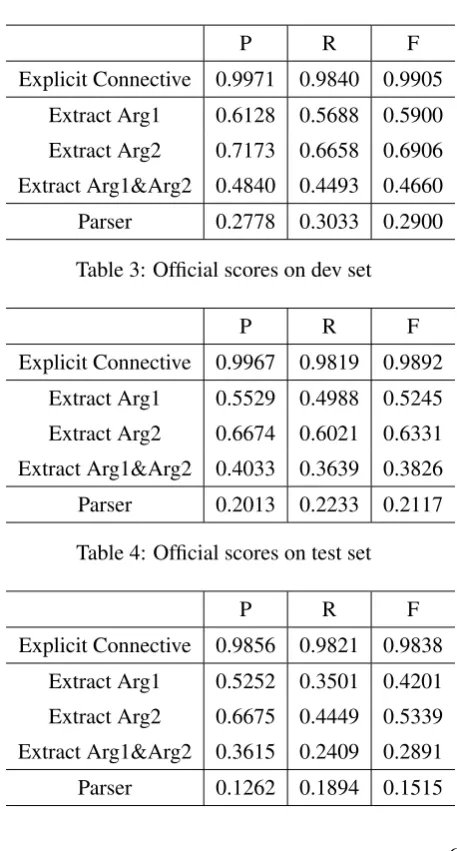
The results of the official evaluation are shown in the Table 3, 4 and 5. From the result, we can learn that
(1) The part of connective detection and classi-fication achieve great performances.
(2) The results of the sampled part are good, while there is still some gap between our system and the best one on the explicit and non-explicit part.
P R F
Explicit Connective 0.9971 0.9840 0.9905 Extract Arg1 0.6128 0.5688 0.5900 Extract Arg2 0.7173 0.6658 0.6906 Extract Arg1&Arg2 0.4840 0.4493 0.4660
Parser 0.2778 0.3033 0.2900
Table 3: Official scores on dev set
P R F
Explicit Connective 0.9967 0.9819 0.9892 Extract Arg1 0.5529 0.4988 0.5245 Extract Arg2 0.6674 0.6021 0.6331 Extract Arg1&Arg2 0.4033 0.3639 0.3826
Parser 0.2013 0.2233 0.2117
Table 4: Official scores on test set
P R F
Explicit Connective 0.9856 0.9821 0.9838 Extract Arg1 0.5252 0.3501 0.4201 Extract Arg2 0.6675 0.4449 0.5339 Extract Arg1&Arg2 0.3615 0.2409 0.2891
Parser 0.1262 0.1894 0.1515
Table 5: Official scores on blind test set
5 Conclusion
In this paper, we present a complete discourse parser. Based on these previous works and through continuous improvement, our system has achieved good results. According to the official evaluation of CoNLL-2016 Shared Task closed track, our sys-tem gets 0.9905 in F1-measure on explicit connec-tive classifier, and finally achieves 0.1515 in F1-measure on the official blind test.
References
Changge Chen, Peilu Wang, and Hai Zhao. 2015. Shallow discourse parsing using constituent pars-ing tree. InProceedings of the Nineteenth Confer-ence on Computational Natural Language Learning - Shared Task, pages 37–41, Beijing, China, July. Association for Computational Linguistics.
Zhongye Jia, Peilu Wang, and Hai Zhao. 2013. Gram-matical error correction as multiclass classification with single model. In Seventeenth Conference on Computational Natural Language Learning: Shared Task, pages 74–81, Sofia, Bulgaria, August.
Fang Kong, Hwee Tou Ng, and Guodong Zhou. 2014. A constituent-based approach to argument labeling with joint inference in discourse parsing. In Pro-ceedings of the 2014 Conference on Empirical Meth-ods in Natural Language rocessing, pages 68–77, Doha, Qatar, October.
Fang Kong, Sheng Li, and Guodong Zhou. 2015. The sonlp-dp system in the conll-2015 shared task. In
Proceedings of the Nineteenth Conference on Com-putational Natural Language Learning - Shared Task, pages 32–36, Beijing, China, July. Association for Computational Linguistics.
Ziheng Lin, Hwee Tou Ng, and Min-Yen Kan. 2014. A pdtb-styled end-to-end discourse parser. Natural Language Engineering, pages 151–184, April.
Emily Pitler and Ani Nenkova. 2009. Using syntax to disambiguate explicit discourse connectives in text.
Proceedings of the Joint Conference of the 47th An-nual Meeting of the ACL and the 4th International Joint Conference on Natural Language Processing of the AFNLP, pages 13–16, August.
[image:4.595.69.298.365.791.2]Rashmi Prasad, Dinesh Nikhil, Alan Lee, Eleni Milt-sakaki, Livio Robaldo, Aravind K Joshi, and Bon-nie L Webber. 2008. The penn discourse treebank 2.0. The International Conference on Language Re-sources and Evaluation, May.
Lianhui Qin, Zhisong Zhang, and Hai Zhao. 2016. Shallow discourse parsing using convolutional neu-ral network. InProceedings of the Twentieth Con-ference on Computational Natural Language Learn-ing - Shared Task, Berlin, Germany, Augest. Associ-ation for ComputAssoci-ational Linguistics.
Jianxiang Wang and Man Lan. 2015. A refined end-to-end discourse parser. InProceedings of the Nine-teenth Conference on Computational Natural Lan-guage Learning - Shared Task, pages 17–24, Bei-jing, China, July. Association for Computational Linguistics.
Rui Wang, Masao Utiyama, Isao Goto, Eiichiro Sumita, Hai Zhao, and Bao-Liang Lu. 2013. Coverting continuous-space language models into n-gram language models for statistical machine trans-lation. InEMNLP, pages 845–850.
Peilu Wang, Zhongye Jia, and Hai Zhao. 2014a. Grammatical error detection and correction using a single maximum entropy model. InProceedings of the Eighteenth Conference on Computational Natu-ral Language Learning: Shared Task, pages 74–82, Baltimore, Maryland, June. Association for Compu-tational Linguistics.
Peilu Wang, Yao Qian, Frank K Soong, Lei He, and Hai Zhao. 2014b. Learning distributed word representa-tions for bidirectional lstm recurrent neural network. InProceedings of NAACL.
Rui Wang, Hai Zhao, Bao-Liang Lu, Masao Utiyama, and Eiichiro Sumita. 2014c. Neural network based bilingual language model growing for statistical ma-chine translation. InEMNLP, pages 189–195. Nianwen Xue, Hwee Tou Ng, Sameer Pradhan,
At-tapol T. Rutherford, Bonnie Webber, Chuan Wang, and Hongmin Wang. 2016. The conll-2016 shared task on multilingual shallow discourse parsing. InIn Proceedings of the Twentieth Conference on Compu-tational Natural Language Learning: Shared Task, Berlin, Germany.
Hai Zhao and Chunyu Kit. 2008. Parsing syntactic and semantic dependencies with two single-stage max-imum entropy models. Proceedings of the Twelfth Conference on Computational Natural Language Learning, pages 203–207, August.
Hai Zhao, Wenliang Chen, and Chunyu Kit. 2009a. Semantic dependency parsing of nombank and prop-bank: An efficient integrated approach via a large-scale feature selection. In Proceedings of the 2009 Conference on Empirical Methods in Natural Lan-guage Processing: Volume 1-Volume 1, pages 30– 39. Association for Computational Linguistics.
Hai Zhao, Wenliang Chen, Chunyu Kit, and Guodong Zhou. 2009b. Multilingual dependency learning: A huge feature engineering method to semantic de-pendency parsing. InProceedings of the Thirteenth Conference on Computational Natural Language Learning: Shared Task, pages 55–60. Association for Computational Linguistics.
Hai Zhao, Yan Song, Chunyu Kit, and Guodong Zhou. 2009c. Cross language dependency parsing using a bilingual lexicon. In Proceedings of the Joint Conference of the 47th Annual Meeting of the ACL and the 4th International Joint Conference on Natu-ral Language Processing of the AFNLP: Volume 1-Volume 1, pages 55–63. Association for Computa-tional Linguistics.
Hai Zhao, Xiaotian Zhang, and Chunyu Kit. 2013. In-tegrative semantic dependency parsing via efficient large-scale feature selection. Journal of Artificial Intelligence Research.