A Shallow Discourse Parsing System Based On Maximum Entropy Model
Jia Sun, Peijia Li, Weiqun Xu, Yonghong Yan
The Key Laboratory of Speech Acoustics and Content Understanding Institute of Acoustics, Chinese Academy of Sciences
No. 21 North 4th Ring West Road, Haidian District, 100190 Beijing, China
{sunjia,lipeijia,xuweiqun,yanyonghong}@hccl.ioa.ac.cn
Abstract
This paper describes our system for Shal-low Discourse Parsing - the CoNLL 2015 Shared Task. We regard this as a classi-fication task and build a cascaded system based on Maximum Entropy to identify the discourse connective, the spans of two arguments and the sense of the discourse connective. We trained the cascaded mod-els with a variety of features such as lexi-cal and syntactic features. We also report the results achieved by our team.
1 Introduction
Discourse parsing is one of the most challenging tasks in natural language processing (NLP) field. It focuses on parsing the structure of a piece of text into a set of discourse relations between in-ter sentences. There is considerable inin-terest in discourse parsing, both as an end in itself and as an intermediate step in a variety of NLP appli-cations like question answering (Verberne et al., 2007), text summarization (Louis et al., 2010), sentiment analysis and opinion mining (Somasun-daran, 2010).
There are many approaches working on identi-fying the discourse relations and data-driven ap-proaches are dominated. A number of pioneers take the discourse relations identification as a clas-sification task (Marcu and Echihabi, 2002; Pitler et al., 2009; Duverle and Prendinger, 2009) by the construction of features like lexical, syntactic and constituent features. Some take the argument seg-mentation task as a semantic role detection task (Wellner and Pustejovsky, 2007) and a sequence labeling task (Ghosh et al., 2011). However, some of the previous research is based on different cor-pus, lacking an common evaluation data set. This has been addressed with the release of Penn Dis-course Treebank (PDTB) 2.0 corpus (Prasad et al.,
2008) which provides detailed annotations about the discourse relations and argument spans ad-dresses this problem. Besides, much research about discourse parsing working on the PDTB ap-pears (Prasad et al., 2010; Lin et al., 2009) and they put more attention on the “harder” part - la-belling the arguments. Lin (Lin et al., 2014) de-signed an end-to-end discourse parser with the PDTB including the explicit, implicit sense and the argument spans identification.
Shallow Discourse Parsing (Xue et al., 2015) is the CoNLL shared task this year1 which takes
a piece of newswire text as input and returns all the discourse relations in the form of a discourse connective (explicit or implicit) taking two argu-ments (which can be clauses, sentences, or multi-sentence segments) in JSON format. A relation will be parsed as correct if the explicit discourse connective (e.g., “because”, “however”) once it has, the spans of text that serve as the two argu-ments for each discourse connective and the sense (e.g., “Comparison”) are all correct. The F1 score of the parser’s performance is the evaluation met-ric.
In this paper, we describe our system details in Section 2, the evaluation result and subsequent ex-periments in Section 3. Finally, we draw some conclusions in Section 4.
2 Our System 2.1 Resources
The resources used in our system are as follows:
Labeled training and development data: The training and development (dev) data is derived from the PDTB 2.0 Section 2-21 and Section 22 in JSON format . There are 32535 relations and 1436 relations annotated in the training data and the dev data respectively. Table 1 shows the dis-tribution of the four types in the data. There are
1http://www.cs.brandeis.edu/ clp/conll15st/
Type Train data Dev data
Explicit 14,727 680 Implicit 13,163 522 EntRel 4,133 215
AltLex 524 19
[image:2.595.304.526.61.320.2]all 32,535 1,436
Table 1: Distribution of the four discourse relation types in the data sets.
Sense level 1 Sense level 2or3 Train Dev
Temporal A.PA.S 1,2771,014 7855 Synchrony 499 100
Contingency Cause.ReasonCause.Result 3,344 1472,137 81 Condition 1,197 52 Comparison ContrastConcession 4,714 2571,293 17
Expansion
Conjunction 7,817 310 Instantiation 1,403 58 Restatement 2,699 110 Alternative 210 6
A.C 241 6
[image:2.595.100.264.62.146.2]Exception 15 0 EntRel 4,133 215 Table 2: Distribution of the 15 senses from the different data sets. A.P, A.S, A.C are the abbre-viations of “Asynchronous.Precedence”, “Asyn-chronous.Succession”, “Alternative.Chosen alter-native” respectively .
15 valid senses including the second-level “types” as well as a selected number of third-level “sub-types”. Table 2 shows the distribution of the 15 senses in the data.
Test data: There are two test data sets. One is the blind set which contains 20,000 to 30,000 words of newswire text annotated following the PDTB annotation guidelines. The other test set is Section 23 of the PDTB which is used for compar-ison with previous work.
The connectives list: A list contains 100 dis-course connectives in the PDTB and three syntac-tic categories form (Knott, 1996).
Opennlp-maxent: We used the open source package Opennlp-maxent2to construct the
classi-fication models.
2http://sourceforge.net/projects/maxent/files/
Figure 1: The structure of the system.
2.2 System overview and Features
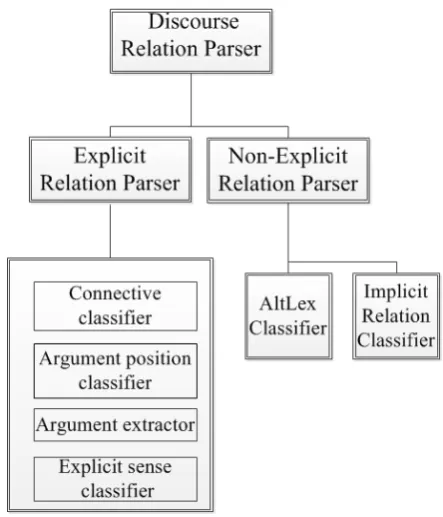
Our system mainly follows the work of (Lin et al., 2014), which consists of two parts: the ex-plicit relation parser and the non-exex-plicit relation parser. The explicit relation parser is composed of the connective classifier, the argument posi-tion classifier, the argument extractor and the ex-plicit sense classifier while the non-Exex-plicit rela-tion parser contains the AltLex classifier and the implicit classifier. The structure of our system is shown in Figure 1.
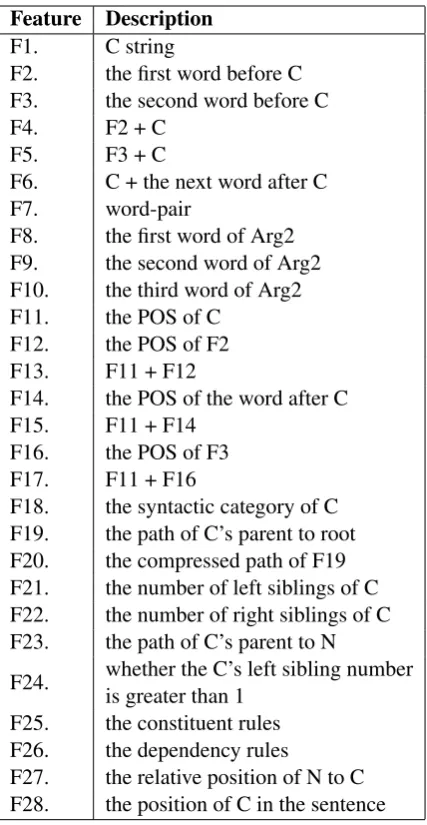
The set of features used in our system are listed in Table 3. All the features fall into four classes: lexical features, part-of-speech (POS) features, syntactic features and positional features.
• Lexical features: The lexical features (F1-F10) contain the connectives C, their contex-tual words and word-pair features (i.e., F7 (wi,wj) where wi is a word from Arg1 and
wj is a word from Arg2) .
• POS features: F11-F17 belong to the POS features .
[image:2.595.72.296.200.422.2]Feature Description
F1. C string
F2. the first word before C F3. the second word before C F4. F2 + C
F5. F3 + C
F6. C + the next word after C F7. word-pair
F8. the first word of Arg2 F9. the second word of Arg2 F10. the third word of Arg2 F11. the POS of C
F12. the POS of F2 F13. F11 + F12
F14. the POS of the word after C F15. F11 + F14
F16. the POS of F3 F17. F11 + F16
F18. the syntactic category of C F19. the path of C’s parent to root F20. the compressed path of F19 F21. the number of left siblings of C F22. the number of right siblings of C F23. the path of C’s parent to N
F24. whether the C’s left sibling numberis greater than 1 F25. the constituent rules
F26. the dependency rules
[image:3.595.73.287.60.473.2] [image:3.595.74.287.67.473.2]F27. the relative position of N to C F28. the position of C in the sentence Table 3: The features used in our system. “C” de-notes the connectives. N means a current node in the constituent tree used in Section 2.3.2.
(F21, F22, F24), constituent rules (F25) and dependency rules (F26).
• Position features: F27 is the relative posi-tion in the syntactic tree structure (left, mid-dle or right), while F28 is the connectives’ positions in the sentence (start, middle or end).
2.3 Training
2.3.1 The Connective Classifier
All the 100 connectives that appeared in one dis-course were extracted whether it functioned as a connective or not. We converted all upper case let-ters in connective to lower case ones.
The connective classifier decides whether a con-nective is functioned as a discourse concon-nective.
The features used were F4, F6, F11-F15, F19-F20 in Table 3.
2.3.2 The Argument Labeller
Once the connective is identified, the argument la-beller identifies the Arg1 and Arg2 spans of this instance. This is accomplished in two steps: (1) Classifying the locations of Arg1 by the Argument Position Classifier. (2) Labelling the spans of Arg1 and Arg2 by the Argument Extrator.
The Argument Position Classifier: Normally Arg2 immediately follows the connective while the position of Arg1 is uncertain. In this model, we classified the Arg1’s locations into two classes: Arg1 was located within the same sentence of the connective (SS) or in the previous sentence of con-nective (PS) (Prasad et al., 2008).
We implemented this as a binary classification task. In this step, features F1-F5, F11, F13, F16-F17, F28 in Table 3 were adopted to train the model. After the position label of Arg1 was de-termined, the result was passed to the argument extractor.
The Argument Extractor:In this module, our classifier labelled the previous sentence as Arg1 immediately for the PS case. The argument spans for the SS case were extracted described as below.
• Classify each internal node N in the con-stituent tree as Arg1-node, Arg2-node, or None with features F1, F18, F21-F24, F27 in Table 3.
• Label a node as node once its Arg1-node predicted probability is greater than 0.1 (which is tuned on the dev data set).
• Select only one Arg1-node and one Arg2-node in one instance with the maximal prob-ability of the respective label.
• Extract the Arg1 and Arg2 spans by tree sub-traction. If the Arg1 node is the ancestor of the Arg2 node, the span of Arg1 should be subtracted from the Arg2 span, and vice versa.
• Remove punctuation tokens and connectives out of the exact argument spans.
2.3.3 The Explicit Sense Classifier
Data Connective Span Sense Parser
[image:4.595.74.297.62.121.2]Dev 0.9152 0.2668 0.1367 0.1814 Test 0.9064 0.2336 0.1191 0.1505 Blind 0.826 0.2195 0.1232 0.1262
Table 4: The results F1 score obtained by our team
sense of the connective. We trained this model us-ing features F1, F4, F11 in Table 3. We picked the output whose maximal sense probability is greater than 0.45 which was experientially determined on dev data set.
2.3.4 The AltLex classifier
We extracted all adjacent sentence pairs within each paragraph and removed the pairs that were identified by the explicit relation parser. Then we trained the AltLex Classifier which decided whether the pairs were AltLex pairs and classified the senses with features F8-F10 in Table 3. The pairs labelled as non-AltLex relations were passed to the next implicit relation classifier.
2.3.5 The Implicit relation classifier
The implicit relation classifier classified the sense of each pair into one of the 15 valid senses or NoRel with F7, F25-F26 in Table 3. After predict-ing, we kept the implicit discourse relations whose maximal sense probability were greater than a threshold (0.25 in our case) which was determined on the dev data set .
3 Experiments and Results
There are two test data sets this year as described in Section 2.1 and the organizers reported the re-sults on the two test data sets and the dev data set. The results of our system obtained are shown in Table 4. We ranked the 10th on every data set.
After the deadline of evaluation, we made some improvements in the module of implicit relation classifier inspired by (Lin et al., 2009). We se-lected the word-pair features (F7) while the ex-periments showed a little degradation in F1 score through selecting the constituent rules and the de-pendency rules (F25, F26) on the dev data set.
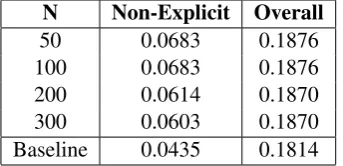
We computed the mutual information between each word-pair feature and the 15 valid senses and then selected the top N as the features. Table 5 shows the improvement of different N.
N Non-Explicit Overall
50 0.0683 0.1876 100 0.0683 0.1876 200 0.0614 0.1870 300 0.0603 0.1870 Baseline 0.0435 0.1814
Table 5: The F1 score in non-explict and overall parser when selecting features F7 using different N on dev data set.
4 Conclusion
We divided the complex task of discourse pars-ing into a set of classification subtasks and glued them together. A variety of features, including lex-ical, part-of-speech, syntactic and positional fea-ture were employed to train the baseline with open Maximum Entropy package, then the system was improved by setting probability-output threshold. We did not utilize any additional resources and only used the annotations the official provided. Our system ranked the 10th among seventeenth teams on the two test data sets.
Acknowledgments
We would like to thank the shared task orga-nizers for their support throughout this work. This work is partially supported by the Na-tional Natural Science Foundation of China (Nos. 11161140319, 91120001, 61271426), the Strategic Priority Research Program of the Chinese Academy of Sciences (Grant Nos. XDA06030100, XDA06030500), the National 863 Program (No. 2012AA012503) and the CAS Priority Deployment Project (No. KGZD-EW-103-2).
References
David A Duverle and Helmut Prendinger. 2009. A novel discourse parser based on support vector
ma-chine classification. In Proceedings of the Joint
Conference of the 47th Annual Meeting of the ACL and the 4th International Joint Conference on Natu-ral Language Processing of the AFNLP: Volume 2-Volume 2, pages 665–673. Association for Compu-tational Linguistics.
[image:4.595.332.504.63.146.2]Alistair Knott. 1996. A data-driven methodology for motivating a set of coherence relations.
Ziheng Lin, Min-Yen Kan, and Hwee Tou Ng. 2009. Recognizing implicit discourse relations in the penn discourse treebank. InProceedings of the 2009 Con-ference on Empirical Methods in Natural Language Processing: Volume 1-Volume 1, pages 343–351. Association for Computational Linguistics.
Ziheng Lin, Hwee Tou Ng, and Min-Yen Kan. 2014.
A pdtb-styled end-to-end discourse parser. Natural
Language Engineering, 20(2):151–184.
Annie Louis, Aravind Joshi, and Ani Nenkova. 2010. Discourse indicators for content selection in summa-rization. InProceedings of the 11th Annual Meeting of the Special Interest Group on Discourse and Di-alogue, pages 147–156. Association for Computa-tional Linguistics.
Daniel Marcu and Abdessamad Echihabi. 2002. An unsupervised approach to recognizing discourse
re-lations. In Proceedings of the 40th Annual
Meet-ing on Association for Computational LMeet-inguistics, pages 368–375. Association for Computational Lin-guistics.
Emily Pitler, Annie Louis, and Ani Nenkova. 2009. Automatic sense prediction for implicit discourse re-lations in text. InProceedings of the Joint Confer-ence of the 47th Annual Meeting of the ACL and the 4th International Joint Conference on Natural Lan-guage Processing of the AFNLP: Volume 2-Volume
2, pages 683–691. Association for Computational
Linguistics.
Rashmi Prasad, Nikhil Dinesh, Alan Lee, Eleni Milt-sakaki, Livio Robaldo, Aravind K. Joshi, and Bon-nie L. Webber. 2008. The penn discourse treebank
2.0. In Proceedings of the International
Confer-ence on Language Resources and Evaluation, LREC 2008, 26 May - 1 June 2008, Marrakech, Morocco. Rashmi Prasad, Aravind K. Joshi, and Bonnie L.
Web-ber. 2010. Exploiting scope for shallow discourse parsing. InProceedings of the International Confer-ence on Language Resources and Evaluation, LREC 2010, 17-23 May 2010, Valletta, Malta.
Swapna Somasundaran. 2010. Discourse-level
rela-tions for Opinion Analysis. Ph.D. thesis, University of Pittsburgh.
Suzan Verberne, Lou Boves, Nelleke Oostdijk, and Peter-Arno Coppen. 2007. Evaluating discourse-based answer extraction for why-question answer-ing. InProceedings of the 30th annual international ACM SIGIR conference on Research and develop-ment in information retrieval, pages 735–736. ACM. Ben Wellner and James Pustejovsky. 2007. Automat-ically identifying the arguments of discourse
con-nectives. In Proceedings of the 2007 Joint
Con-ference on Empirical Methods in Natural Language Processing and Coumptational Natural Language Learning (EMNLP- CoNLL), pages 92–101.
Nianwen Xue, Hwee Tou Ng, Sameer Pradhan, Rashmi Prasad, Christopher Bryant, and Attapol Ruther-ford. 2015. The CoNLL-2015 shared task on
shal-low discourse parsing. InProceedings of the