Penrose Transform on D-Modules, Moduli
Spaces and Field Theory
*
Francisco Bulnes
Department of Research in Mathematics and Engineering, Technological Institute of High Studies of Chalco, Chalco, Mexico
Email: [email protected]
Received August 9, 2012; revised September 15, 2012; accepted September 26,2012
ABSTRACT
We consider a generalization of the Radon-Schmid transform on coherent D-modules of sheaves of holomorphic com- plex bundles inside a moduli space, with the purpose of establishing the equivalences among geometric objects (vector bundles) and algebraic objects as they are the coherent D-modules, these last with the goal of obtaining conformal classes of connections of the holomorphic complex bundles. The class of these equivalences conforms a moduli space on coherent sheaves that define solutions in field theory. Also by this way, and using one generalization of the Penrose transform in the context of coherent D-modules we find conformal classes of the space-time that include the heterotic strings and branes geometry.
Keywords: Penrose Transform; Coherent D-Modules; Derived Sheaf; Moduli Space; Conformal Classes; Heterotic Strings
1. Introduction
It is opportune to consider a generalization of the Radon- Schmid [1], on coherent D-modules [2], of the sheaf of holomorphic bundles into a cohomological context, [3] with the goal of establishing the equivalences between geometrical objects (vector bundles) and algebraic ob- jects as they are the coherent D-modules, these last with the goal of establishing the conformal classes useful to define adequately the differential operators that define the field equations of all the microscopic and macro- scopic phenomena of the space-time through the connec- tions or shape operators [4], of the complex holomorphic bundles in gauge theory. The class of these equivalences is precisely in our moduli space, which has in considera- tion the differential operator that defines the connection of the corresponding vector bundle which establish the relation among dimensions of cohomological conformal classes [5], and the vector bundles corresponding via the differential operators of the equations of shape (connec- tion) of the Riemannian manifold [5].
But studies in algebraic geometry have established that manifolds of Calabi-Yau have the integrals of Penrose type, or at least complex integrals on strings like equiva- lences of geometrical invariants under the philosophy of the mirror symmetry. From a point of view of coherent
D-modules, the conformally comes established in auto- matic form through the use of Penrose transforms on D- modules. Of this manner, we come to D-strings and D- branes corresponding to specific classes of derived she- aves obtained from the appropriate generalized Penrose transform [6].
We define our moduli space as the space of the inva- riant differential operators of the -cohomology modulo that are conformally invariants. We determine a coho-mology between moduli spaces on the space of different- tial operators that accept a scheme of integral operators cohomology of Penrose type in the context of the coher- ent D-modules [7], since the scheme of the ireducible unitary representations to these operators are unitary re- presentations of compact components of the group
4,SL C [5].
2. Conformally Invariant Operators,
Penrose Transform and Derived Sheaves
There exists indictions that the class of differential op- erators that accept an re-interpretation of a integral op- erators cohomology (as the due for the Penrose transform, the Twistor transform, etc.) is accordingly the class of invariant differential operators, of the fact that the Pen- rose transform generates these conformal invariants op- erators [4], and thus we can identify the conformal classes to which they belong [8,9]. Some examples of thesedif-*This work was supported for Postdoctoral fellowship by COMECYT,
ferential operators are the existence of the massless fieldequations (to flat versions and curved of some of their similar ones [10]) and the conformal invariant wave op-erator given by the map [4]:
6 :
R O
□ 1 O 3 .
(1)
or also the Einstein operator [4]:
1A A B B AB A
AB A B
□
: 1
B
□ (2)
or the conformal invariant modification of the square of the wave operator O
1 O
4 , that is to say; thewave operator who involves terms of the Ricci tensor [4],
2 3 ab ,R Rg
2: 2 ab
b b a
□ (3)
Then the integration of the partial differential equa- tions corresponding to these invariant linear differential operators is realized as integrals transform of the Penrose type, because the context of the irreducible unitary rep- resentations for these operators are unitary representa- tions of compact components of the group SL
4,C
2SO n
such as , [7], of the fact that in the flat case the classification of invariant differential operators like those described previously are a problem of representations theory of Lie groups applied to the group ofSL
4,CSL
and its compact subgroups [7]. Then one visualizes these operators through Lie group , as equi-variants operators among homogeneous vector bundles on M con- sidering to
4,C
4,C SL
F
P M
, like homogeneous space [5-11]. The integral operators in this case are realizations of these representations and they are orbital integrals of one integral transform from the resolutions to these differen- tial equations which in this concrete case is the Penrose transform.
The problem is solved using the machinery of repre- sentations theory and is given in [12], and with more generality in [13]. In after studies, the local twistor con-nection [14] is used to investigate the questions as to whether these operators have curved analogues i.e. con-formally invariant operators in the curved case.
For example, some of these operators that are men- tioned in the Equation (2), and the Equation (3) are in- cluded in a conformal class that is obtained by the image of the Penrose transform on the corresponding sheaf whose germs are these differential operators in the holo- morphic vector bundle given. The Penrose transform ge- nerates conformally differential operators.
We consider the Penrose transformation, [15] through the correspondence
(4)
where F F 12 V
, is the manifold of flags of dimension one and two, associated to 4-dimensional complex vector space V. Let P F 1
V , be such that
3
1 V
F P C
4
C M F
V, (complex lines in ), and let 2 , be such that
V G
,F C
4
R
M R C
2 2, 4 (Grassmannian manifold of 2-di-
mensional complex subspaces), with
4
1, , ,2 3 4 , i i i, i, i
z z z z z z z x jy x y
M C R
F
(5) is the 4-dimensional complex compactified Minkowski space[16]. The projections of , are given for:
L L1, 2
,L1 (6) and
1 2
2π L L, ,L
L L V
(7)
where 1 2 , are complex subspaces of dimension
one and two, respectively, defined a element
L L1, 2
,F
of , to know
1 2 1 2 1 2 1
1 2 2
, , , ,
π , ,
L L V V L L V L L L
L L L
F
M
(8)
If , is compactified Minkowski space [16] then
set of equations of massless fields
0, * , 0,
0, 0, , 17
ij ij ij
dF dF j W
R R gR
P
(9)
that is to say, the spectral resolution of complex sheaves is needed [16], of certain class seated in the projective space , to give solution to the field equations modulo a flat conformally connection [16-18]
0 i i1 0,
P P P
O h O h O h
P
,
h
(10)
Let , be the Penrose transform [16] associated to the double fibration (4), used to represent the holomor- phic solutions of the generalized wave equation [16], with parameter of helicity h [17,19]:
(11)
□
UM
on some open subsets , in terms of cohomologi- cal classes of bundles of lines [16], on
U U P
P k
(P, is the super-projective space). It is necessary to mention that these cohomological classes are the conformal classes that we want to solve the phenomenology of the space-time to diverse interac- tions studied in gauge theory [20], and can construct a general solution of the general cohomological problem of the space-time.
With major precision, the tensors of the bundle of lines on , are given Z , by the kth-tensor power
OP k , of the tautological bundle [21], (is the bundle
lines on
P
, the general bundle of lines of M). Let h k
1
2 , k
xP, be and let
1
π ,
x x be. Then a result that establishes the equivalences on the cohomological classes of the bundle of lines on U
M
UM , and the family of solutions of the Equa-tion (9), (equaEqua-tions of the massless fields family on the Minkowski space , with helicity h) is given by the following theorem.
Theorem 3.1. (Classic Penrose transform) Let ,
be a open subset such that U x, is connect and simply
connect x U . Then , the associated mor-
phism to the twistor correspondence (1); which maps a 1-form on
0
k
U , to the integral along the fibers of , of
their inverse image for , induce a isomorphism of co- homological classes:
1 , k
P
H U O k er
U, □h k
,M
2 ,
E
E i
(12)
Proof. [4].
Which are the classes that are extensions of the space of equivalences of the type Equation (12)? Why are these classes necessary to include more phenomena of the space-time? What version of the Penrose transform will be required?
Part of the object of our research is centered in the ex- tension of the space of equivalences of the type (12), under a more general context given through the language of the D-modules, that is to say, we want to extend our classification of differential operators of the field equa- tions to context of the G-invariant holomorphic bundles and obtain a complete classification of all the differential operators on the curved analogous of the Minkowski space of . Thus our moduli space will be one ofthe equivalences of the conformal classes given in the equivalence (12), in the language of thealgebraic objects D-modules with coefficients in a coherent sheaf[13].
A way of answering the first and the second questions is analyzing the origin of the structure of the complexes that define the microscopic physical phenomena. Through this way and in natural form we can establish equiva- lences (isomorphisms), between derivative categories and categories of physical phenomena, considering a complex as the defined in the succession (10), for the micro-local context in which a regularity theorem subja- cent for the Penrose transform on D-Modules is used, that is to say, given a D-Modules complex [13-22]
0 1
E E (13) we can map this complex to the system of branes/anti- branes, in which every i,
This bears to the application of a symplectic context, which also is a consequence of the foliation in Lagran- gian submanifolds of , inside the problem of the uni- queness of the Radon-Penrose transform on the same coherent D-Modules [12].
M
3. Resolution on D-Modules
Considerthe category of D-modules given by the space
L qc
M D , such that the category of quasi-coherent left
D-modules on X, is isomorphic to the category MqcL
Dopp D
, of quasi-coherent right -modules on X. For a cate- gory Mqc
D , of D-modules we denote by Mcoh
Dπ S
, the corresponding subcategory of coherent D-modules.
We consider a correspondence
Y
(14) X
where all the manifolds are analytic and complex, , and , are proper and
S X Y
, induce a closed embed- ment [12]. BedSdimCS, with
, odd defines branes and other sheaves define anti-branes [22]. Such D-branes and anti-D-branes are defined of equal form in the space-time, although dynamically they annihilates for defining a pair of particle and anti-particle [22].
S Y
d dSdY.
We define the transform of a sheaf F, on X, (more generally, of an object of the derived category of sheaves) like
1
π ,
SF R F dS Y
M (15)
and we define the transform of a DX-module , like D
SM M , where
, and
denotes the
direct and inverse images of and respectively, in the sense of the D-modules1 [2], and we consider also
1
!π ,
SG R G dS X
G
(16)
to a sheaf , on Y. Then we have the formula
RHom , RHom , ,
X Y S
S D OX D OY
M M
G
(17)
of which is deduced the formula, to , the sheaf on Y, (coherent sheaf):
1To define the images of direct functors to
D-modules it is have that use derived categories. For it, is simpler defining them for right D-modules. Be b
R
qc
D M D , the derived category bounded for right quasi-co-herent D-modules of the form
R
D Y X
R V R V D
V
,
where , is the characteristic manifold and R, is the right derived functor following:
: R .
qc qc
R M D M D
: , r YX
Also and 1
1
Y X Y X
D D O O D
DYX
1
,
, ,
X X
D Y Y
O d
O d
on (1), in the contex
b R
D M D
:
i YX
i
R X; RHom
R Y; RHom
X
Y
D
S s
M G
M G (18)
This defines a categorical equivalence of the transfor- mati t of the right derived D-modules,
qc , because it is necessary to give an equi- valence with a sub-category of the right D-modules that have support in Y, for this way guarantee the inverse im-age of P, and with it, to obtain an image of closed range of the operator P, conforming their uniqueness on the given context [15-21].
Theorem of Kashiwara 3.2. Let , be the
correspondence (14), a closed immersion. Then the direct image functor , is an equivalence of R i
qc
M D , with
full sub-category of R
qcM D , consisting of modules
with support in Y. Proof: [6].
This equivalence preserves coherency and holonomic- ity [19]. Then preserves conformabilityin M [10-13].
.G C
P
* V T X
M M
E
M M
E Mod
DWe formulate in the language of the D-modules and their sheaves, like the given in a resolution (10), the cor- respondence between the space of coherent D-modules and the space of equations of massless fields. It can be established if we can grant the uniqueness of the Penrose transform. But for it is necessary to include a resultthat it establishes the regularity in the analytical sense of the Riemannian manifold, which shapes the space-time, and that allows the application of the involutive distribution theorem on integral submanifolds as solutions of the cor- responding equations of field without mass on sub-mani- folds isomorphic in the Kaehlerian model inside of the flat model given on 2,4 Of the fact, an analogy in
the obtaining of models of space-time (under the same reasoning) must be realized between specialLagrangian submanifolds and m-folds of Calabi-Yau. But to it, we need define the complex micro-local structure that de-fines all the phenomena of strings and branes in micro-scopic level, which happens in the 6-dimensional com-ponent of the universe (6-dimensional compact Rieman- nian manifold) with ratio of the order 1033 cm (Max
Plank longitude of a string). The Penrose transform is an integral geometric method that interprets elements of va- rious analytic cohomology groups on open subsets of complex projective 3-space as solutions of linear differ- ential equations on the Grassmannian of 2-planes in the 4-space. The motivation for such transform comes from the interpretation of this Grassmannian as the complexi- fication of the conformal compactification of the Min- kowski space and their differential equations being the massless field equations of various helicities.
By the Kashiwara theorem (Theorem 3.2), and some re- sults of Oshima [20-23], on involutive manifolds [24], we can characterize certain spaces to the regularity of the
images of , in D-modules.
4. A Micro-Local Analysis and Version of
the Penrose Transform
Let , be a conic regular involutive submani- fold. We say that a coherent DX-module , has regular singularities on V, if so we has (M is regular if ). We denote by RS V X , the thick subcategory of Mod d
DV b
RS V
D D
bX
D D
goo X , whose objects have
regular singularities on , and by X , the full
triangulated subcategory of good , whose objects
have cohomology groups belong to ModRS V
DX :
good good
Mod Mod b
X RS V X X
b X RS V
D D D D
D D
↖
Associated to the correspondence given in (14), we give the microlocal correspondence:
2 1
* *
a p p
T X T Y
(19)
The manifold , being Lagrangian, is well acquaint-
ance that p2a ,
1 ,
p is smooth if and only if
is an immersion. The consequences of this are:
2 ,
a p
1) is a closed embedment identifying , (deep space) to a closed regular involutive manifold
, (foliation) and
* V T Y
2) p1, is smooth and surjective on T X (ob-
servables of space-time).
*
codim
c V
If V , in , then we have the follow- ing local model of correspondences of (14):
*
T Y
S X Y
Lemma 4.1. Assume that , is a closed
embedment and assumptions given by 1), and 2) above. Then, for every
p q, a
U*
U T Y p U
, there are open subsets X,
X , with X , and Y , a complex manifold Z, of dimension , and a contact transforma-
tion Y X , such that id
q U
V
c
*
:U U T Z
X
U , in-
duces an isomorphism of correspondences:
23
1 2 1
*
*
a a
X Y Z
p
p p p
X Y X X Z
U U T Z
U V U U U T Z
a X X
U U
(20)
:UX UX
, is the graph of a contact trans- where
formation 23a
p
* *
a
X U U T ZU T Z
, and , denotes the pro-
jection X X .
Proof. [16].
associates to every object G, (coherent sheaf on Y) of this category, a Lagrangian cycle Cy
G , into , which is a cone (invariant under recalling of cotangent fibers). If , is the structure sheaf of closed submani- fold like the given by , this cycle is justly the co- normal bundle and this tends to be singular. Then we can enounce the Kashiwara Theorem 3.2, also as:*
T Z
M
G
b
D E M
Mod E
E
*
T X
M
M
M
“The construction of a smoothed characteristic cycle gives origin to an full embedment of derived categories
X
RS V (full subcategory of objects , have co-
homology groups with regular singularities alongV) into
X
RS V (sheaf of micro-differential formal op- erators onX)”.
The X-modules shape a support ring of the DX- modules. A EX-module is a ring of microdifferential operators of finite order on .
It is clear that from the lemma 4.1, we can characterize the cycles propitious to determine an embedment full of derived categories that shapes the structure of our she- aves defined in bounded derived category of the full sub- categoryof sheaves of K-vector spaces comprising com-plexes with constructible cohomology.
Which are the integral transforms that can obtain the quantized contact transformation?
Definition 4.1. 1) Let V, be a closed conic regular in- volutive submanifold of , and let M, be a co- herent DX-module. We say that , is simple along V, if
, can be endowed with a good filtration k , such
that
*
T X
*
T X , is locally isomorphic to , as an *
T X -module. We denote by coh X the full
subcategory of whose objects are sim- ple along V.
GM OV
V O; ,
:
O Mod
X
DX; ,Oco
Mod h
Let f SX , is a morphism, we denote by f!, d an
1
f proper direct image and inverse image for D- modules, and we denote by
the
, th exterior tensor prod- uct. For
e
b X RS V
D
M sing the resolution (13)
we associate their dual
D , and u
X
,X D O
X
RHom ,
X
D X
DM M (21)
X OX X, where X, is the sheaf of holo- morphic forms of maximal degree. We also set
D O
DMDM dX . Thus DM, and DM
b
RS D K D
K
, belong to
V X . Let , be a simple X Y-module along . In particular , is regular holonomic, and hence D
D
RS
M b
X RS V
D D
K , is concentrated in degree zero. For V
XDb D , and N , we set
X Y
1 1
! O qM ,
1
q q1 q2
L 2
q
KM K (22)
where , and q1, is defined X X Y Y . Also
! O N , dXdY , (23)
1 L
1 X Y 2
q D q
KN K
,
j j
H
KM M K (24) , (25)
j j
H KN N K
Theorem 4.1. Assume that q1, q1, are proper on
supp K , and assume 1), and 2) from
a a le
ple DY-mo
(19). Let M, be simple DX-module along T X* , nd t N , be a
sim-dule along V. Then
1) 0K, and 0K, send orphisms omorphism modulo flat connections,
isom (is
M N to isomor- phism (isomorphism modulo flat connections
N M
.2) 0KM, is simple along V, and K0 N , is simple along *
T X . M reover, o 0KM, and KN , are flat
co ctions f
0
nne or j 0.
3) The natural adjunction morphisms M 0K0KM, and
0 0
K KN N , are isomorphisms modulo flat connections. In particular, the functor
0
0
*
coh , coh
F X
G
M T X O M
K
K
, Y ,
V O
are quasi-inverse to each other, and thus esta ish the equivalences of categories. In D-modules theory the
bl
category given by Mcoh
V O, Y
, is of the simple DX-modules to along V. This is due to the support of Radon transform of our R e transform that is re- quired.
The following step is to give a result of equivalences between c
adon-Penros
ategories that suggest the extension to the be- fo
the no
valen
re functors to the category of the vector bundle of lines of where it has the classification of differential operators belong to sheaves defined in the Section 2. Indeed.
Theorem 4.2. [12] With the same hypothesis as given
by the theorem 4.1, assume also d 3. Then with tation of the theorem given by the Section 3, then the following correspondence is an equi ce of categories
00
coh coh
Mod F , ,Y
G
D M V O
K
K L
Precisely these equivalences shape a classification of the homogeneous vector bundles of lines [18,19].
btain th
t
in -ca
As a corollary, using these Penrose transform, which is of Radon type on Lagrangian manifold , we can o
e complex Minkowski space M, simple DM-modules along the characteristic manifold V, of he wave equa- tions that are classified by (half) tegers, so lled helic- ity h k
. The following section establishes these equiva- lences using geometrical additional hypothesis.
coh
Mod DL , is the full subcategory of Modcoh
DX ,whose open sets are of the DL, type to some bu particular, if N , is a simp e along V, there is an unique ( o OX-linear isomorhisms) line bu dle L, on X, such t
ndle of
lines L. In le DY-modul
up t
n hat N 0KDL, in
coh
Mod D OY, Y . In other words, the above theorem says
connections, by
ection , (26) The last theorem concludes,
category of holomorphic vector bundles with flat connections
coh , -modules /Singularities along
of th
Y Y
M V O M D
e involutive manifold V/flat con n
0 N N, (27)
However, it is important in calculating image of a DX-module associated to a line bu w
0 0
D
K L K K
explicitly the ndle, one ay to do it consists in “quantizing” this equivalence. In the following results we will.
Let M, be a simple DX-module along *T X , and let
N , be a simple DY-module along V. Then DM N ,
is a simple
let u, be X Y
D -module along T X V* .
efinition 4.2. 1) Let pT X V* , and a
generator a f
D
t p, o
DM N
, the EX Y -module as- sociated to DM N . Denote by IY say th
, the annihilating ideal of u, in EX at u, is simple if their symbol ideal
We
I, is reduced, and hence coincide with the defining ideal *
T X V
I , of *
T X V .
Continuing ith other incises from the theorem 4.1, we have: for 2) , w
w
Let p e say that a section
HomDXY D ,
M N K , is non degenerate at p, if for a simple generat
p
or u of DM N , at p, s u
, , at p, in the sense of [7, 25]. (Note that locally simpl admit s gen- erators, and one checks immediately that this definition does not depend on the choice of such generators). and for 3) We say that is non-degenerate on , if u is non- degenerate of any p . There is a natural isomor-phism
is a ion of K
e modules imple non degenerat secte
Hom Hom , ,
X Y
D D
M , N M
Y D
N K K
(28) Hence, the sections s, defines a DY-linear morphism
N
M .non de rat
s
K
Theorem 4.3. With the above notations, and with s, is , the
gene e on
s , is an isomorphismm
s the graph of a contact trans-
fo ce , is open in *
T Y) the above re-su
ns a
eristics Cycles and Equivalences
odulo flat connections.Proof. [7-25].
Observe that when , i rmation (and hen V
lts reduce to the so-called “quantized contact transfor- mation”, in psedo-differential equatio nd micro-func- tions [12].
5. Charact
Now in the context of the generalized D-modules to the use of the Schmid-Radon transform, and finally obtain Radon-Penrose Transform, the functor
additional geometrical hypothesis, S
(29)
establishes an equivalence between the category M(DX-
modules/flat connection), and M(DY-modules/Singulari- ties along of the involutive manifold V/flat connection) [12]. Then our moduli space that we construct is the cate- gorization of equivalences:
V , ,
-modul es Singularities along of the
Y
S Y
d M D `
involutive manifold flat connection H U O
(30) considering the moduli space as base [12],
X- modules flat connection
ker U,
h k
,M D
□
`
(31) then the cohomology on moduli spaces is the cohomol- ogy of the space-time with an equivalence like the
S X d
given in the equivalence (12), to a more general cohomological group that the given by H U O1
,
k
P , and whose di-
mension of H
U,O
, can be calculated by the inter-section methods, to a comple [13], which is of the type
x sheaf O
iO (see examples in Section 6).
A version of the theorem 4.1, foreseen in the before section, that es b ishes the regularity through the trans- fo
k
P
ta l
rmations realized by the functor , on the categories of derived D-modules adding the corresponding coho- mological groups of zero dimension is:
Theorem 5.1. Let , smooth and , proper. Let
,π
: ,S X Y be a closed embedding.1) If b
, thengood X
D D
M S
M , orresponds to c
b .
Y RS V
D D
2) If goodb
D M,X
D
M is lo
rang e,
, and cally free and of e on then H0
S
M
, is sim e along of pl V, on*
T
duli that we w
on es the equivalence induced by the trans- fo
Y.
Proof: [25].
Our space mo ant to characterize is the e that establish
rm S, between the category of coherent D-Modules on X, and the category of coherent D-Modules on Y, with regular singularities on V.
We define the category
*
goodModb ;
X
D T X , like the
localization of MDgoodb
D , by the thick sub-cate-gory of holomorphic bundles endowed with theX flat con- nection:
*
good
Mod char ,
X X X
M M D M T X (32)
In particular, the objects of
*
goodModb ;
X
D T X
the same objects of Modgood
DX , and a morw
, are phism
:MM, in Modgood
DX hism in, it turns a isomorp
*
good
Modb ;
X
D T X , if w, an er w, correspond to M. This is equivalent t w :
d cok
X to say tha E EM ME , is an on X . In similar form we define MY,
and db
; *
D T Y , obtained by lo-
isomorphism *
T
calization of
espect to MY. ohomModRS V DY , with r
Considering the c ology groups of zero dimen- sions of the functors S, y S, we
enote by
give functors that we will be able to d 0
S
, and 0, respectively.
S
In other words we obtain the images:
0 , and 0 ,
S H S S H
M M (33)
from which using the theorem 2.1, (usi
0 0
S
ng the local and microlocal analysis of the before sections) the f are established between categories:
unctors
For the doble fibration (14), and the moduli spaces (30) and (31), these equivalences shape the moduli s
0
0
good
Mod S Mod ,
S
X RS V Y
D D
(34)
pace [25]:
good
0
Hom Mod , Mod
, , derived -modules ,
X
D X RS V Y
H D D
H D D M D
M
M
S X Y
`
(35) The additional geometrical hypothesis in the functor (29), comes established by the geometrical duality o Langlands [26], which says that the derived categ co
f ory of herent sheaves on a moduli space Flat , ,
L
G C
` where C, is the complex given by
1 1
2 3
1 1
2
: j j j
j j
d j d j jd
d j+ d
C
E E E
E (36)
is equivalent to the derived category of D-mod moduli space of holomorphic vector G-bundle
,B C [27]. These equivalences permit to map points
G
esults
Theorem 6.1. (F. Bulnes) The moduli space obtained by
Flat L , , where L,
L anifolds ,and defined
ecke). b
ules on the s given by
G
of Flat , ,
L G C
` to eigen-sheaf of Hecke given by
B C [22].
6. R
this way is the is the space of
moduli space ` agrangian subm
G C
with C, a complex of certain special sheaf of holomor- phic G-bundles (eigensheaf of H
Proof. It is necessary to go from the o tained co-cy- cles for the Radon-Penrose transform on Modgood
DX , to the obtained cycles by Penrose on Mod
D , anthe given b Y RS V
d viceversa. The equivalence of both spaces of co- cycles demonstrates that the functors are y
the modu
good
Hom Mod DX , ModRS V DX , o li
space (35). Then these functors are G-invariants and their image under
f
X D H
, is recorded in a moduli space of holomorphic bundles BundG
C [23. The
s must be
], which is an ex- tension of the transformed cycles by the classic Penrose transform [15] equivalence under the G-invariance
of holomorphic bundle demonstrated using a generalized Penrose transform for D-modules that are the composition of an inverse image functor and a direct image functor on the side D-module, which is foreseen by the geometrical duality of Langlands [26,28].
In electromagnetic interactions the functors are the objects that characterize the moduli space
good Flat M DX
, ,
G C
L
` are
•
2 Hom , 2
SU
H X U
, where
X , arehomotopies on the Riem n manifold X [9-20]. In a more general co and using the flag domains that will be necessary to define th ravity
ory (f
annia ntext
e quantum g phe- nomena [28], and equivalences inside of the string the
or example heterotic strings, D-branes and others phe- nomena) to give solution a extensions of the wave equa- tion on observables of curvature, boson and fermion eq- uations, Schmid equation [10], and classify their differ- ential operators on the same base of vector bundles, but now through holomorphic vector bundles that are G-in- variants.
But this only covers some aspects of brane theory as those given outside of the homogeneous space G H,
when H K .
For example, they are acknowledges the cases to het- erotic strings that can develop on D-modules that are
G C T
D -modules when G C T
, is a flag manifold [11].In
tegral o logy on
(10) and generalise this resolution for co
e g tra
o
at will conform a version of Penrose trans- fo
this case the integral operators cohomology given on such complex submanifolds is also equivalent to the in- perators cohomo submanifolds of a com- plex maximum torus. What happen when these flags are complex domains or their equivalents, Lagrangian sub- manifolds in F?
To be able to establish a moduli space that could give a resolution for the equations of the mathematical phys- ics given by the set
herent DF-Modules that are DF-Modules induced by
a bundle of lines F, with complex domains that are in- tegral submanifolds of a Kählerian manifold is necessary to use on eneralized Penrose nsform with the con- formal invariance n the DF-Modules, and that the dif-
ferential operators who are not flat might write each one in accordance with similar operators. This last comes re- flected when a piecewise linear manifold has a differ- ential structure. This piecewise linear manifold, defines a non-symmetrical component curvature, which reflects their difficult expression by conformal operators of supe-rior degree such as the Laplacian, and Dirac differential operators.
It is necessary consider some conjectures on integral geometry, that shows the construction of the geometrical hypothesis th
ogy as the given one by the -cohomology but in a
more generalized context, that it includes the Cĕch-co- homology.
Conjecture 1. A more generali ed Penrose transform is necessary to include differential operators in Hodge rep- resentative c
z
lass to obtain all complete holomorphic co- homological classes.
In other words, there is an isomorphism
w
0,
1 0, 1
holomorpc , 2
,
2
,H D O H D
O
(37)here
0, 1
,
2
solutions
,H D O □F s s
, is the Stein fold and D, is a flag do-
main.
Conjecture 2. The corresponding extended class of tia
ormal operators are those of the Gelfand-Graev- Sh
S
where S mani
differen l operator that can be generated like general- ized conf
apiro type [29].
We want to compute the analytic cohomology
1 ,
H Z O ,of a complex manifold Z.
Since solutions of differential equations on manifolds an
generalize ry of sheaf co-
ho
d cohomological classes are part of the bases of this d Penrose transform, the theo
mology and D-modules was perfectly considered for their modern study. In [5], we used this theory to gener- alize and study the Penrose correspondence given by the double fibration (4). More recently the Equation (17), in [1] has studied the generalized Penrose transform be- tween generalized flag manifolds over a complex alge- braic group G, using M. The Kashiwara’s correspond- dence (see [1-6]) between quasi G equivariant DG H- modules and some kind of representation spaces which are
g, -H
modules (loosely, they are complex vectorspaces endowed together with an action of the Lie - bra g, associated to G, and an action of H, which are com in some way) when H, is a closed algebraic subgroup of G.
Co jecture 3. We have a generalization of Penrose transform on the homogeneous space
alge
patible
n
G H, or a Radon
transform on equivarian odules on generalized flag m
he v
tors with Radon transform will give th
t-D-m anifolds [10-33].
Lemma 7.1. (F. Bulnes) We need t ersion of Ra-
don transform to compute dimensions (transform of di- mensions).Their func
e equivalences on the generalization mentioned in Con- jecture 3.
Proof. See [5,30].
Theorem 7.1. (F. Bulnes)
-equivariant
G G H
` ,C
`G-equivariant
CY C, ˆ
.heorem 3.2, the class given by C
G , is a complex whos lass isProof. By the Kashiwara T
e sub-c C
B , whereB, is a D-brane, that is to say, a D-module
D ,
o C
F
M M B G , since, {Massless fields equations}
ze
a Kählerian moduli sp
D o F
M B , then all G, that is a complex hypersurface in the space
C k, which is complex parameteri d defineace `
C k G, where , is nsion of the brane space. M, is a D-module the dimeP-m
What happens with the orbifolds? It is necessary to con- orbifolds like
o u
which is a odule induced by the bundle of lines ˆP.
sider the D-branes in the D-modules on bundles of lines in P. Of the fact, by the theorem 6.1, we can dem nstrate that `H
G C,
, under certain d -ality [22], is composed for objects of derived category of D-modules on BG
C . This vector bundle of lines underthe same duality [22 is their wide version which is iso- morphic to the moduli sp
G C,
. Using aversion of the Penrose transform predicted by Recillas’s conjecture and etrical duality of Langlands on D-branes, is generated the isomorphism class given by
],
ace `Higgs
geom
Flat G C G C, H , ,k
L
` ` ara theo-
rem between
(using Kashiw
G H
D -modules and some
g, K
-modules)since equivalence exists between D-modules of BG
C ,and some D-branes of `H
G C,
. Then by the propo-Y, is projective [31], that is to say,
sition that says that the scheme
, i anifoles. Th two modu
ry 7.1
y theorem 7.1}.
C B s a complex whose m ds Y (that are orbifolds of CY-manifold), are ˆP-modul e equivalence between the li spaces is completed with inverse Penrose transform.
Corolla . (F. Bulnes). Moduli space = {homo-
logical relations of the black holes with the distinct co- homological dimensions obtained by lemma 5.1 and lemma 7.1} moduli space = {given b
Proof. We use the Radon transform of dimensions [30-32], given by
d d
4 8 4 8
1 1
dimY d x x d x x
1
1
dim d ,
d! j j
j P
n F n x t
A
1 1 d 1
d! i i d! i
i
P P
S
L
L
where xiL
xi , are the Lagrangian operators of in-stantons considered in flat space 4 8
P , of the corre- sponding supertwistor space PT [33]. Then by Theorem 7.1, and using the large resolution
re
coherent D-modules given by the images of Penrose transform in these pro-
Some consequences and components of the space-time
3 1 4d 2 4 d 3 4 d 4 4d 0,
P P P P P
which is a special case of the solution (36), we obtain the equivalence between the moduli spaces.
The long sequence induced by the
re included in the Calabi-Yau manifold, in the hole in the 3-dimensional space.
lated under the isomorphism discussed in the previous theorem are those that establish the equivalences given by the Equation (12), with the microlocal structure of ,
and w
7. Some Applications and New Research
Developments
ith Floer cohomology group deduced from the co-ho
bi mology group sketch by the theorem given in the search of the integral operators cohomology that encloses the Penrose transform class.
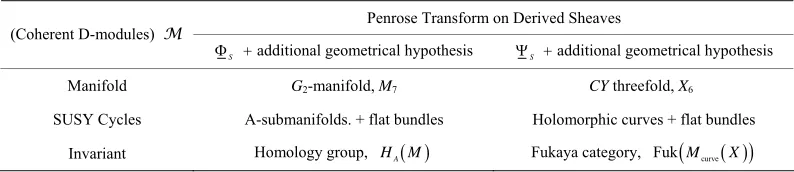
The corresponding category associated to a Cala - Yau threefold X, would be the Fukaya-Floer category of the moduli space of unitary flat bundles over holomor- phic curves in X, denote `curve
X . We summarizethese in the following Table 1.
We base in the scheme on Stein manifolds from Rieman- nian structure of the space-time [34], and using the gen- eralization by Gindikin conjectures formulated in the Section 7, we obtained a result given in [30] to integral operators cohomologies of Radon-Schmid type:
Teorema 8.1. (F. Bulnes) In the integral operator co-
homology H
M, O
, on complex manifolds (Steintype) the following statements are equivalent: Example 1.The image S + additional geometrical
hypothesis, given by the Penrose transform that is a CY-threefold, can be interpreted under the additional geometrical hypothesis, usi ray-Serre spectral sequence for : 1
Y
P , giving th
M, and z
1) The open sets
M
, are G-orbits in X, and their integrals are generalized integrals to .
ng the Le
e exact sequence 2) Exist an integral operator T, such that
g Ho group
1 2 0
Y h OY .
icity h, wh uon with negative helicity cor-re
1 1, 1 , 0 1, 1 ,
Y Y Y
H P O H Y O H P RO
where is the image of right functor on sheaf OY. Then their correspondin dge numbers [33] (corresponding to the cohomology s in mirror symmetry) are
, -equations
T
H MO ker D .
h O
Example 2. Using a similar correspondence to the double fibration (17) in a twistor context, elements of the cohomology group H1
, O
h
PT , correspond
via the Penrose transform to space-time fields of hel ere in particular, a gl
sponds to a twistor wave function of weight 0. PT, is dual orbital corresponding to
PM .
Example 3. Fix an an exact se-
quence
2
1 1 1
0 O k O O k 0,
P P P
Such extensions correspond t airs o integer k 1, and
p
1
P m
o f sections
0 1
, ,
r sH P O k , without com on zeros. If
X X H , is a relative Abelia rface on P1, then
their fibers are supersingular surfaces (D-branes of one 2 1 O n su
dimension
1 1
P P and the inclusion O1( k)
P P ,
comes from the exte
solu-tions are a a
nsion (1). The corresponding ll classes of fields on Calabi-Yau m nifold.
The Fuk
`curve
X
, is the space of branes that are3) M
zM , and
z
z
,
, ,
1
H MO H U O .
Proof: [18-30].
The affirmation 2), and 3), are generalized in the con- text of the moduli space `
LG H C,
Flat . Using some
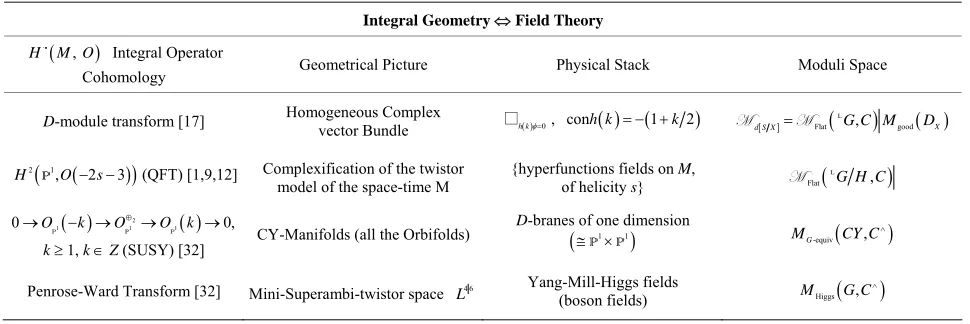
cohomological classes of geometrical integral transforms that give the equivalences T, from the theorem 8.1, with their corresponding identifications in the D-modules context we can give the following Table 2.
Other applications and new results obtained recently [22-27], are the relatives to cohomology group classes whose objects have the same metrics in the Kählerian context:
Proposition [27]. The L2-cohomology groups of `g, de complete Kählerians metrics are all the same coho-mology groups of D’Rham of `g
M
.
A concrete application of this result establishes that the moduli space of the relations between hyperbolic waves (horocycles) [35], and the Haar measure of the group action in SU (2.2), on , is the moduli space of the functors
•
0 2 Hom , 2
, , -modules ,
SU
j
X Y
D k H X U
H D k D D M D
P
F P P
`
,DP k DM
o-cyles of the P ose transform on coherent D-modules. rose Transform on Derived Sheaves
[image:9.595.99.496.650.736.2]The D-module transform of is the -
Table 1. Cycles and c enr
Pen (Coherent D-modules) M
S
+ additional geometrical hypothesis S + additional geometrical hypothesis ifold G2-manifold, M7 CY threefold, X6
Man
Table 2. Some cohomological classes of g nd the ding moduli spaces.
eometrical integral transforms a ir images inside of the correspon
Integral Geometry Field Theory
H·• M O, Integral
Cohomolo Geom Physical Moduli Space Operator
gy etrical Picture Stack
D-module transform [17] Homogeneous Complex vector Bundle □h k 0, conh k 1 k 2 d S X Flat
G C M,
good DXL
` `
2 1, 2
H P O s ] Complexification of the twistor model
3 (QFT) [1,9,12
of the space-timeM
{hyperfunctions fields on M,
of helicity s} Flat
G H C,
L
`
1 0 P k 0,
CY-Manifolds (all the Orbifolds) branes of one dime
1 1 O k
P OP2O
k 1, k Z (SUSY) [32]
D- nsion
1 1
P P MG-equiv
,
CY CPenrose-Ward Transform [32] Mini-Superambi-twistor space Yang-Mill-Higgs fields (boson fields) Higgs
G C,
M
4 6
L
module associated to the wave e
Equa
quation given in the tion (11), where
1 2k
.o braic group G, we enunciate the conjecture based on the result given by Gindikin 10-36] which shows that the D-module inverse image functor
ass ction
8.
he skills used in this work are the developed maps of
eful to realize con f the string theory and brane theory inside SUSY theory, for example that are germs of these sheaves and
h k
Conclusions
Tcoherent sheaves of D-Modules, which establish confor- mal classes that are us texts o
differential operators
their corresponding geometric images in the complex ho- lomorphic bundles, who receive sense in the QFT for the particles fields.
These equivalences gives birth to the moduli spaces on the calculated conformal classes that can be useful in the securing of classes of solutions modulo a geometric characteristic of the different equations of field studied in theoretical physics and that an invariant turns out to be geometric of the application of the Penrose transform on classic elements via their classic version.
In this way, departing from some hypotheses obtained by Gindikin on the geometric invariance of cycles in a Kählerian manifold, we can obtain more general versions of the Radon transform, coming to the point of extrapo- lating these hypotheses to the geometric context of the Penrose transform on the coherent D-Modules in order to use for the generation of the isomorphisms via their dou- ble fibration and with it the moduli spaces securing that establish the equivalences of geometric objects that can be re-interpreted algebraically and vice versa. An exam- ple of it is the theorem 7.1, and their concrete applica- tions in the description of equivalence of objects hap- pened in the Table 1.
Since the generalized Penrose transform for D-mod- ules is the composition of an inverse image functor and a direct image functor on the side D-module, we first de- scribe the algebraic analogs of these functors. More ex- plicitely, if H K, are two closed algebraic subgroups
f a given complex alge
[
ociated to the proje g : G H G K , is equiva-
lent to the forgetful functor from the category of
g, K
-of
,
modules to the category g H -modules. Gindikin also shows that the derived direct image functor Dg, on
the side D-module corresponds (up to a shift) to the al- gebraic Zuckerman functor RKH, which maps
g, H
- modules to
g, K
-modules (more precisely, objects ofthe derived categories). The next step is to obtain an analog of the Bott-Borel-Weil theorem for computing the Zuckerman functor image of “basic objects” of the cate- gory of
g, H
-modules [10,26]. In representation the-ory this is equivalent to computing explicitly the image by the derived Zuckerman functor RKH, of generalized Verma modules MH
[36], associated to weights ,which are integral for g , and dominant for the Lie subalgebra of g , corresponding to H. Those generalized Verma modules are the objects which correspond M, Kashiwara correspondence to the D-modules which gen- erate the Grothendieck group of the category of quasi- G-equivariant
via
G H
D -modules of finite length [23]. In
this way, we can also obtain a classification of the dif- ferential operators considering extensions of the Verma modules considered [18], and showed to invariance of conformal operators by [4].
Nevertheless, from the point of view of the representa- tion theory the demonstration of the theorem 7.1, leaves open questions as soon as to be able to generalize the Radon and Penrose transforms on G H, for not com-
pact case of G, since conditions have not happened to guarantee an operator of this class that is of closed range on these spaces [36,37].
the different Penrose transforms between the dimensions of the singularities, these are seen and shaped by the st
tion
ry.
ring theory, and the projective spaces (in the context of the bundles of lines) [18,22,38] that give birth to the con- formal classes via the derived sheaves and their stacks in physics, given through the applica of the Penrose transform. Likewise, the concrete applications that have been mentioned are studied for the mirror theory in the last advances on field theo
REFERENCES
[1] C. Marastoni and T. Tanisaki. “Radon Transforms for Quasi-Equivariant D-Modules on Generalized Flag Mani- folds,” Differential Geometry and Its Applications, Vol. 18, No. 2, 2003, pp. 147-176.
doi:10.1016/S0926-2245(02)00145-6
[2] A. Borel, et al., “Algebraic D-Modules,” 2nd Edition, Aca- demic Press, Boston, 1987.
[3] S. Gindikin and G. Henkin, “Integral Geometry for - Cohomology in q-Linear Concave Domains in CPn,”
Functional Analysis and Its Applications, Vol. 12, 1978 pp. 247-261.
[4] R. J. Baston a variant Opera
e of Mexico,
Mex-, Vol. 173-174Mex-, No 9
ne-3 July 1992, pp. 1-17.
onformal
Covari-ety, Providenc ,
nd M. G. Eastwood, “In tors,” Twistor in Physics, Cambridge, 1981.
[5] F. Bulnes, “Integral Geometry and Complex Integral Op- erators Cohomology in Field Theory on Space-Time,” Proceedings of 1st International Congress of Applied Ma- thematics-UPVT, Government of Stat
ico City, 2009, pp. 42-51.
[6] M. Kashiwara, “Representation Theory and D-Modules on Flag Varieties,” Astérisque . , 1989, pp. 55-109.
[7] V. Knapp, “Harish-Chandra Modules and Penrose Trans- forms,” American Mathematical Society, Mount Holyoke College, 27 Ju
[8] S. Alexakis, “On Conformally Invariant Differential Op- erators,” In: A. Juhl, Ed., Families of C
ant Differential Operators, Q-Curvature and Holography, Cornell University, Ithaca, 2007, pp. 1-50.
[9] C. R. Graham, “Non Existence of Curved Conformally Invariant Operators,” 1980, in Press.
[10] S. Gindikin, “Penrose Transform at Flag Domains,” The Erwin Schrödinger International Institute for Mathemati- cal Physics, Boltzmanngasse 9, A-1090, Wien, 2011. [11] W. Schmid, “Homogeneous Complex Manifolds and Re-
presentations of Semisimple Lie Groups,” In: Represen-tation Theory and Harmonic Analysis on Semisimple Lie Groups, American Mathematical Soci e, 1989, pp. 223-286.
[12] A. D’Agnolo and P. Schapira, “Radon-Penrose Transform for D-Modules,” Journal of Functional Analysis, Vol. 139, No. 2, 1996, pp. 349-382. doi:10.1006/jfan.1996.0089
ry, and
Representa-e-
[13] M. Kashiwara and W. Schmid, “Quasi-Equivariant D- Modules, Equivariant Derived Catego
tions of Reductive Lie Groups, in Lie Theory and Geo-
metry,” Birkhäuser, Boston, 1994, pp. 457-488. [14] R. Penrose, “Twistor Quantization and Curved Spac
Time,” International Journal of Theoretical Physics, Vol. 1, No. 1, 1968, pp. 61-99. doi:10.1007/BF00668831
[15] R. J. Baston and M. G. Eastwood, “The Penrose Trans- form,” The Clarendon Press Oxford University Press, New York, 1989.
[16] M. G. Eastwood, R. Penrose and R. O. Wells Jr., “Coho- mology and Massless Fields,” Communications in Mathe- matical Physics, Vol. 78, No. 3, 1981, pp. 305-351.
doi:10.1007/BF01942327
[17] R. Penrose, “Solutions of the Zero-Rest-Mass Equations,” Journal of Mathematical Physics, Vol. 10, 1969, pp. 38- 39. doi:10.1063/1.1664756
[18] F. Bulnes, “Cohomology of Moduli Spaces in Differential Operators Classification to the Field Theory (II),” Pro- ceedings of FSDONA-11 (Function Spaces, Differential
G. Eastwood, “Complex Para-Con- Operators and Non-linear Analysis), Tabarz Thur, Vol. 1 No. 12, 2011, pp. 1-22.
[19] T. N. Bailey and M.
formal Manifolds Their Differential Geometry and Twis- tor Theory,”Forum Mathematicum, Vol. 3, 1991, pp. 61- 103. doi:10.1515/form.1991.3.61
[20] M. F. Atiyah, “Magnetic Monopoles in Hyperbolic Space,”
Problems,” VINITI, Moscow, Oxford University Press, Oxford, 1987, pp. 1-34.
[21] S. Gindikin and G. Henkin, “The Penrose Transforms and Complex Integral Geometry
pp. 57-112.
[22] A. Kapustin, M. Kreuser and K. G. Schlesinger, “Homo- logical Mirror Symmetry: New Developments and Per- spectives,” Springer, Berlin, 2009.
[23] M. Kashiwara and T. Oshima, “Systems of Differential Equations with Regular Singularities and Their Boundary Value Problems,” Annals of Mathematics, Vol. 106,1977, pp. 145-200. doi:10.2307/1971163
[24] F. Warner, “Differential Manifolds,” 2nd Edition, Springer- Verlag, Berlin, 1966.
[25] A. Grothendieck, “Techniques de Construction en Géo- métrie Analytique. I. Description Axiomatique de l’Espace de Teichmüller et de Ses Variantes,” Séminaire Henri Cartan, Vol. 13, No. 1, 1960, pp. 1-33.
-168.
[26] D. Miličič, “Algebraic D-Modules and Representation Theory of Semi-Simple Lie Groups,” American Mathe-matical Society, Providence, pp.