A Cellular-Assisted Efficient Handover Algorithm for
Wireless Sensor Networks
Jun Zhu1, Hui Gao1,2, Yuling Ouyang2
1
Key Laboratory of Intelligent Computing & Singnal Processing, Ministry of Education Anhui University, Hefei, China 2
Shanghai Research Center for Wireless Communications, Shanghai, China Email: [email protected], [email protected], [email protected]
Received August 10, 2012; revised September 15, 2012; accepted September 25,2012
ABSTRACT
Heterogeneous network convergence and handover have become very hot in recent years. This paper proposed an effi- cient handover scheme in Multi-PAN Wireless Sensor Networks (WSNs). A number of edge nodes are set at the edge of each Personal Area Networks (PANs). A user equipment (UE), which has WSN and cellular network interface, acts as sensor node or mobile cluster head in WSN area. Thus, edge early warning can be acquired from edge nodes and neighbor channel information can be acquired with BS-assistance. Simulation results show that low transmission inter-rupted delay and low energy consumption can be achieved compared with conventional scheme in WSN.
Keywords: Efficient Handover; Edge Early Warning; Special Beacon; Wireless Sensor Networks
1. Introduction
With the development of WSNs [1-3] and cellular net- works, modern technologies have been prepared for cre- ating the convergent communication infrastructures, through which WSNs and cellular networks convergence have become inevitable. These heterogeneous networks appear in many application areas [4], especially in the health care. In these applications it is usually needed for mobile sensor nodes to frequent handover and to transmit data between Multi-PANs.
If sensor nodes move between Multi-PANs, the nodes are required to scan all channels to find the channel of nearby PAN which sensors move to, and then hand over to the target transmission channel. Because of scanning all channels, it will not only bring energy cost, but also will interrupt the data transmission for a long time and influence the transmission delay and QoS. So how to use the UE or cellular network assisted to realize and opti- mize efficient handover between Multi-PANs in Zig-Bee wireless sensor network is a key problem to be solved. And because sensor nodes have limited energy and are not convenient to replace battery, how to reduce energy consumption is also an important problem for WSN (e.g., SMAC [5], TMAC [6]).
There are some handover protocols in WSN. Standard ZigBee handover is in specification IEEE 802.15.4 [7] and ZigBee specification [8,9]. If an associated node wants to leave the PAN, it shall send a disassociation notification command to its coordinator. Sensor node
scans all channels from lowest channel number to the highest in order with peak energy. For the duration of the scan, the node shall suspend beacon transmission and data transmission. Until selecting a channel of nearby PAN which it wants to move, the mobile sensor sends an association request command to the coordinator of the PAN. Richard et al. in [10] proposed a handover mecha-nism for WSNs. Sensor nodes can hand over in certain areas to achieve connecting from a mobile cluster head to a fixed and main-powered cluster head which connected to a permanent power supply for saving energy. The mo-bile sensor, momo-bile cluster head and fixed cluster head are on the same channel. It however doesn’t consider sensor nodes moving in different PANs and channels scenario.
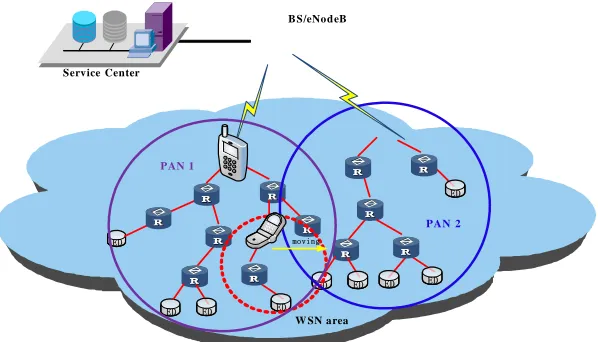
This paper proposed an efficient handover scheme in Multi-PAN WSN. In the scheme, each PAN has one channel for communication in WSN area. UE and mobile nodes form a mobile cluster, they move in one PAN and attach to the fixed node to communicate. The mobile nodes have to transmit data continuously wherever they move. When the mobile nodes move from one PAN to another, they will trigger handover. Through coordina- tion of the BS, edge nodes can be set at the edge of PAN to achieve edge early warning and UE can acquire the neighbor PAN channel information with cellular link to achieve efficient handover and reduce transmission in-terrupted delay.
hand-over scheme we proposed in detail which includes edge node decision algorithm and procedure of the proposed scheme. Section 3 is the results and analysis of the simu-lation. Section 4 concludes this paper.
2. Efficient Handover Algorithm
2.1. System Structure
The efficient handover scheme is based on the scenario which is shown in Figure 1. We consider the convergent scenario for wireless sensor network (WSN) and cellular network. In the cellular system, the user equipments (UEs) are under the control of a cellular base station (BS). In the coverage area of a cellular network, there also ex-ists a group of wireless sensor nodes composing the WSN networks. In the convergent scenario, the cellular UEs are dual-mode and have both WSN and cellular in-terfaces, and they can act as mobile cluster heads for the WSN. The UEs can provide backhaul access for the WSN nodes under the help of 3GPP-LTE BS. The WSN
is based on Multi-PANs topology for beacon-enabled mode. Each PAN has one channel for communication. Some sensor nodes and UEs are moving in the WSN area but connect with the WSN all the time. WSN control unit (e.g., BS) keeps the topology of WSN and knows cover-age area of all PANs and overlapping area of PANs.
2.2. Edge Node Decision Algorithm
Edge node is located at the edge of its PAN or in the overlapping area of two PANs, and it is used to the edge early warning for mobile sensors. The edge node is se- lected by BS after organized the WSN or after topology and usually has strong communication ability.
Edge node sets two beacon formats. If there is no mo-bile node, edge node will send the normal beacon. If there are some mobile nodes, edge node will be triggered and send the special beacon containing edge flag. In bea- con payload, the bit 16 and 17 are reserved. So we add edge flag in beacon payload which occupied 1 bit, which is shown in Table 1 [7] and Table 2.
ED ED
ED
Service Center
BS/eNodeB
ED
W SN area
ED
ED ED
ED
ED PAN 1
[image:2.595.144.443.362.533.2]PAN 2 moving
Figure 1. System application scenario.
Table 1. Beacon frame format of edge node.
MAC Payload
Octets: 2 Variable Variable Variable
MHR
Superframe Specification GTS fields Pending Address fields Beacon Payload
MFR
Table 2. Special beacon payload format of edge node.
Bits: 0 - 7 8 - 11 12 - 15 16 17 18
Protocol ID Stack profile Nwk Protocol version Edge flag Reserved Router capacity
Bits: 19 - 22 23 24 - 87 88 - 111 112 - 119
Device depth End device capacity Nwk extended
PANID
Tx offset
(optional) nwkUpdateID
[image:2.595.58.540.662.735.2]During the network initial phase, each Gateway (GW) obtains approximately location of each sensor node, forms the topology of PAN and reports the information to BS. BS saves the approximately location, range and neighbor PAN information of all PANs and uses the re-lated information of PANs to determine the edge node. The steps are as follows.
BS searches the nodes of neighbor PAN at the double transmission range of node in one PAN (e.g. PAN 1) and saves the nodes of neighbor PAN in edge neighbor node list. Then BS determines node in edge neighbor node list as candidate edge node of PAN 1 and selects the edge node from candidate edge node in PAN 1. If the distance between two candidate edge nodes in the same PAN is below the threshold, BS will select one node as edge node; If BS will select both nodes as edge nodes. After determining all edge nodes in Multi-PAN area, BS will send edge-set signaling to inform them.
2.3. Edge Node Information Table
When all edge nodes are selected, BS saves a PAN chan- nel information table including PAN ID, edge node ID, location, channel and neighbor channel. According to the information in the PAN channel table, BS knows which neighbor channel the edge node has. The edge node in-formation table is shown in Table 3. The detailed pa-rameters in this table include but not limited to below elements:
PAN ID is the 16-bit address of a PAN in WSN net- work.
Edge node ID is the 16-bit network address of a BS- selected edge node in WSN.
Edge node location is the approximate location in-formation of the edge node in a PAN.
Edge node neighbor channel is the neighbor PAN
communication channel of the edge node.
2.4. Procedure of Efficient Handover Algorithm
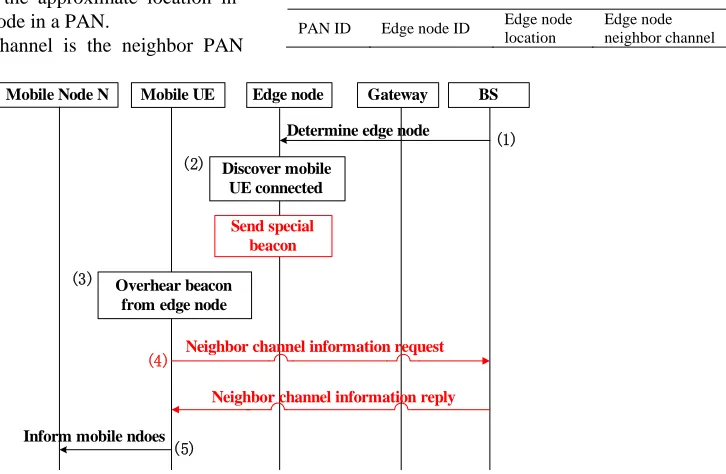
As mentioned above, we used an efficient handover method in Multi-PAN WSN. The complete procedure is as follows:
Step 1: When organizing the WSN, BS determines which sensor to be edge node and informs them with edge-set signaling via WSN links.
Step 2: When UE and its mobile cluster move to the edge of PAN, its topology will be changed and its parent node will change into edge node. At the same time, edge node discovers that there is mobile node connecting to it. So the edge node is triggered and sends the special bea-con periodically.
Step 3: UE receives the special beacon containing edge flag, which is edge early warning for mobile cluster. When the special beacon is received by mobile node of mobile cluster, it will report the information to UE.
Step 4: UE sends request containing PAN ID and edge node ID about channel information of neighbor PAN to BS with cellular interface. BS queries the neighbor chan- nel table and replies neighbor PAN channel information and to UE with cellular interface.
Step 5: UE informs each node of mobile cluster about neighbor PAN neighbor channel information. The mobile cluster scans the obtained neighbor channel and hand- overs.
[image:3.595.166.529.484.721.2]All the procedure of efficient handover scheme is de-scribed in Figure 2.
Table 3. Edge node information table.
PAN ID Edge node ID Edge node location
Edge node neighbor channel
(1)
Mobile Node N Mobile UE Edge node Gateway BS
Send special beacon
Determine edge node
Neighbor channel information request
Neighbor channel information reply Overhear beacon
from edge node
(2)
(5) (4)
Discover mobile UE connected
(3)
Inform mobile ndoes
3. Analysis and Simulation
3.1. Analysis of Efficient Handover Algorithm
WSNs always have the question of energy consumption. Devices will be battery powered, and battery replacement or recharging in relatively short intervals is impractical. Therefore, the power consumption is of significant con-cern. Energy of cellular networks has large advantage comparing with WSN. So it’s a great improvement for WSN to transfer energy consumption from the sensor networks to the cellular networks.
The energy consumption of conventional method in WSN is included in Equation (1):
_
handover wsn request scan
P MP N P MPrequest
_ quest scan
P I P
_
handover wsn request scan request
T M T N T M T
(1)
Prequest means the energy consumption that sensor
node which has disassociation with its coordinator, would send request signaling to its original channel for association again. M is the hop number of request signaling which is sent to original coordinator.
Pscan means the energy consumption that sensor node
which has disassociation with its coordinator, scans each channel from lowest number to highest in order to find a appropriate one to association. The device is expected to scan in 16 channels. N is the number of scanning channels.
Prequest means the energy consumption that sensor
node which has found a appropriate channel, would send a association request to the coordinator. M’ is the hop number of request signaling which is sent to new coordinator.
Thus the energy consumption of proposed method is included in Equation (2):
_ _
handover new edge inform UE re
P P (2)
Pedge_inform means the energy consumption that eNB
sends edge-set signaling to inform the edge node.
PUE_request means the energy consumption that UE
sends neighbor channel request with edge node ID to eNB for itself or mobile cluster.
Pscan means the energy consumption that sensor node
scans the target channel for only one superframe pe-riod. I is the number of mobile nodes in mobile clus-ter.
According to the calculation, N*Pwsn > Pnew (N > 4).
The proposed method is suitable for frequent handover or mobile cluster handover. The proposed method would be used and guarantee the power consuming in the cellular link should be smaller than normal sensor network rou-tine.
When sensor node moving in the WSN area, transmis- sion with less interrupted delay is also very important.
The time spent on handover in conventional method is shown in Equation (3):
(3)
Trequest means the time spent on sending a association
request to the original coordinator. M is the hop num- ber which signaling sent to the original coordinator.
Tscan means the time spent on scanning each channel,
which is [a Base Super frame Duration (2n + 1)] symbols, where the n is the value of the Scan Dura-tion parameter, which at the ranges from 0 to 14. It means scanning each channel will spent 8 ms to 200 ms, which is a long time for transmission interruption. And the number of scanning channel N is random.
Trequest means the time spent on sending a association
request to the new coordinator. M’ is the hop number which signaling sent to the new coordinator.
The time spent on handover in proposed method is shown in Equation (4):
_ _ _
handover new UE request eNB reply scan request
T T T T T (4)
TUE_request means the time UE sends a neighbor
chan-nel request with edge node ID to eNB for itself or mobile cluster.
TeNB_reply means the time eNB sends neighbor channel
response signaling back to UE.
Tscan means the time spent on scanning one channel.
Trequest means the time spent on sending a associa-
tion request to the coordinator.
A signaling interactive time is about 3 ms - 5 ms [11] on the physical layer of air interface in TD-LTE. Ac- cording to the above process, connection time is about 9 ms - 15 ms which calculating the number of signaling interaction. The transmission date time is 4 ms - 6 ms (two child frame length), so the consuming time is 13 ms - 21 ms in cellular, which 18 ms being typical.
According to the calculation, Thandover_wsn > Thandover_new,
the proposed method has reduced a large of interrupted transmission delay. UE would be used and guarantee the time consuming in the cellular link should be smaller than normal sensor network routine.
3.2. Simulation Scenario Description
To evaluate the effectiveness of efficient handover sche- me, we measure the power consumption and average scanning delay when mobile nodes hand over. We com-pare the results of our proposed scheme and traditional scheme. Here we take standard ZigBee handover as tra-ditional scheme. For the convenience of analysis, some assumptions are as follow:
There are 2 numbers of PANs. In each PAN, there are 5 mobile nodes and a UE forming a mobile cluster and N numbers of static sensor nodes.
The number of channel is 16 (ZigBee).
The number of scanning channels in conventional scheme is random.
3.3. Analysis of Simulation Results
We first measure the average scanning delay of our pro-posed scheme and traditional scheme.
The simulation results of latency are shown in Figure 3, where the plus marker represents for latency using tra- ditional scheme, while circle marker represents the la-tency after using efficient handover scheme with BS as-sisted. It can be seen from the simulation results that the proposed scheme improves network performance for each handover.
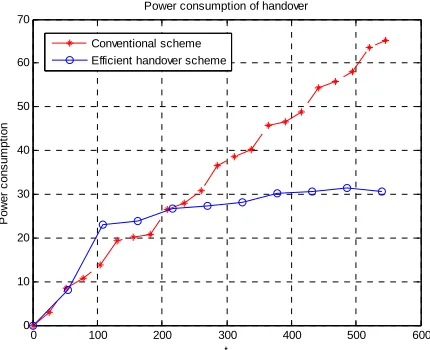
We also measure the power consumption of our pro- posed scheme and traditional scheme.
The simulation results of power consumption are shown in Figure 4, where the plus marker represents for
0 50 100 150 200 250 300 350 400 450 500 0
50 100 150 200 250 300 350 400 450 500
Latency of handover
t
Lat
enc
y
[image:5.595.59.280.308.482.2]Conventional scheme Efficient handover scheme
Figure 3. Performance comparisons with respect to average delay time.
0 100 200 300 400 500 600
0 10 20 30 40 50 60 70
Power consumption of handover
t
P
o
w
e
r c
ons
um
p
ti
o
n
Conventional scheme Efficient handover scheme
Figure 4. Performance comparisons with respect to power consumption.
power consumption using traditional scheme, while cir- cle marker represents power consumption using efficient handover scheme. It can be seen from the simulation results, the circle marker has a slow grow after the in-flection point t = 100, that because mobile nodes in the mobile cluster has received neighbor PAN channel in- formation from UE and need not to scan all the channels for handover. So the addition of handover mechanism with BS assisted can help to reduce the handover power consumption of mobile cluster or frequent handover power consumption of mobile nodes. Because mobile nodes in mobile cluster will obtain the target PAN chan- nel information instead of scanning channels to find an appropriate PAN.
4. Conclusion
In this paper, we propose an efficient handover mecha- nism in Multi-PAN area. We design the edge node used for edge early warning; then we use BS to manage the Multi-PAN channel information and use UE to acquire neighbor PAN channel information to reduce the scan-ning channel time and power consumption. The simula-tion results indicate that the presented scheme can reduce transmission interrupted delay and power consumption when mobile sensor nodes hand over in Multi-PAN un-der the help of cellular network.
5. Acknowledgements
This work was supported by the National Natural Sci-ence Foundation of China (No. 61071168) and the 211 Project of Anhui University, the Anhui Provincial Natu-ral Science Foundation (No. 11040606Q06).
REFERENCES
[1] D. Culler, D. Estrin and M. Srivastava, “Overview of Sensor Networks,” IEEE Computer, Vol. 37, No. 8, 2004, pp. 41-49. doi:10.1109/MC.2004.93
[2] J. Yick, B. Mukherjee and D. Ghosal, “Wireless Sensor Network Survey,” Computer Networks, Vol. 52, No. 12, 2008, pp. 2292-2330. doi:10.1016/j.comnet.2008.04.002 [3] V. Rajaravivarma, Y. Yang and T. Yang, “An Overview
of Wireless Sensor Network and Applications,” Proceed- ings of 35th Southeastern Symposium on System Theory, Morgantown, 22 April 2003, pp. 432-436.
[4] A. Wheeler, “Commercial Applications of Wireless Sen- sor Networks Using Zigbee,” IEEE Communications Ma- gazine, Vol. 45, No. 4, 2007, pp. 70-77.
doi:10.1109/MCOM.2007.343615
[5] W. Ye, J. Heidemann and D. Estrin, “Medium Access Control with Coordinated Adaptive Sleeping for Wireless Sensor Networks,” IEEE/ACM Transactions on Networ- king, Vol. 12, No. 3, 2004, pp. 493-506.
[image:5.595.63.278.528.703.2]Efficient MAC Protocol for Wireless Sensor Networks,” Proceedings of the 1st International Conference on Em- bedded Networked Sensor Systems, 2003, pp. 171-180. doi:10.1145/958491.958512
[7] IEEE-TG15.4, “Part 15.4: Wireless Medium Access Con- trol (MAC) and Physical Layer (PHY) Specifications for Low-Rate Wireless Personal Area Networks (LR-WPANs),” IEEE Standard for Information Technology, New York, 8 September 2006.
[8] ZigBee Alliance, “ZigBee Specification,” 2007 ZigBee
Standards Organization, San Ramon, 2008.
[9] E. Karapistoli, F.-N. Pavlidou, I. Gragopoulos and I. Tsetsinas, “An Overview of the IEEE 802.15.4a Stan- dard,” IEEE Communications Magazine, Vol. 48, No. 1, 2010, pp. 47-53. doi:10.1109/MCOM.2010.5394030 [10] R. M. Miller-Smith, “Handover Mechanism for Sensor
Networks,” US2010/0285807 A1, 2010.