Performance Study of a Distributed Web Server: An
Analytical Approach
*
Sarah Tasneem1, Reda Ammar2
1Math and Computer Science, Eastern Connecticut State University, Willimantic, USA; 2Computer Science and Engineering,
Uni-versity of Connecticut, Storrs, USA. Email: [email protected]
Received July 18th, 2012; revised August 16th, 2012; accepted August 25th, 2012
ABSTRACT
With the rapid expansion of the Internet, Web servers have played a major role in accessing the enormous mass of Web pages to find the information needed by the user. Despite the exponential growth of the WWW, a very negligible amount of research has been conducted in web server performance analysis with a view to improve the time a Web server takes to connect, receive, and analyze a request sent by the client and then sending the answer back to client. In this paper, we propose a multi-layer analytical approach to study the web server performance. A simple client-server model is used to represent the WWW server in order to demonstrate how to apply the proposed approach. We deve- loped a systematic, analytical methodology to quantify the communication delay and queuing overhead in a distributed web server system. The approach uses the Computation Structure Model to derive server processing time required to process a request sent from a client and queueing model to analyze the communication between the clients and the server.
Keywords: Web Server; CSM; Performance Modeling; Performance Analysis; Distributed Systems; Queueing Model
1. Introduction
With the rapid expansion of the “World Wide Web” and our increasing reliance on the information and services provided by it, indicates that the services must be offered with superior performance to retain the current users and attract new ones. For example online banking, stock ex-change, remote surgery, bill payment must be secure, efficient and fast enough to be widely accepted. An es-sential component of WWW is the Web server which is a large computer and a program responsible to serve the HTTP requests from the clients. The most common form of client is a Web browser. The server responds to the multiple clients by sending Web pages such as HTML documents and linked objects (images, videos, etc.). One of the vital aspects of the Internet business is the per-formance issue of the Web server.
However, for such a system to function efficiently and cost-effectively requires that the system development be based upon careful performance analysis, because slow-ness can have far reaching consequences and implica-tions in the Internet-computing. The millions of users surfing the Internet, are unwilling to spend more than few seconds waiting for a Web page to be displayed. The number of requests met per second by a Web server is
one of the major metrics to be considered to a high per- formance Web server system. Because the content of the Web is fluid and sites change frequently, keeping up to date information is challenging [1-3]. In the design of a high performance Web server system the challenge is to keep response-time to a minimum and the generated data as up to date as possible by providing more frequent up-dates. Response time is calculated from the moment the server receives the request until the client starts receiving the answer back from the server. The shorter the re-sponse-time is the better the performance. Despite the popularity of the Web servers, a very negligible number of performance analysis has been done. In this paper, we have reported a partial result of a continuing research which addresses the challenging issue of quantifying the response-time and finally identifying the bottlenecks due to communication and queuing overhead in a distributed Web server system. To keep the response time to a mi- nimum, first, we need to identify the major components of it which is accomplished by applying a systematic, analytical methodology called, Computation System Mo- del (CSM).
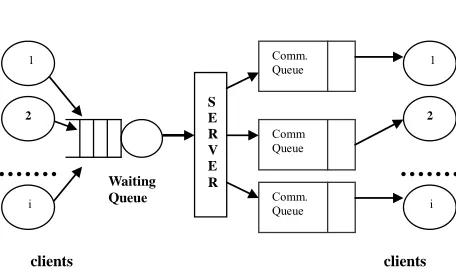
Comm. Queue Comm Queue Comm. Queue
S E R V E R 1
i
2
clients clients
Waiting Queue
1
i
[image:2.595.58.286.67.201.2]2
Figure 1. A single server and multiple clients model.
model for the WWW server. Our goal is to show apply- ing our proposed analysis methodology to predict quan-titative metrics describing the server performance. Study- ing a full WWW server is beyond the scope of this paper. The proposed performance analysis is divided into two parts: we used: 1) CSM (Computational Structure Model) to calculate the processing time cost of server processes; and 2) queueing model to study the network architecture, which includes the server’s request handling model. We will analyze the request handling within the server, as well as the communication between the server and the client, etc. At the system level we are interested in de-termining the time it takes for the server to connect, re-ceive, and analyze a request sent by the client and then sending the answer back to it.
The present paper developed a systematic, analytical methodology to quantify the communication delay and queuing overhead in a distributed web server system.
The CSM derived equations will be used to determine the performance bottleneck which lies in the system ar-chitecture.
The paper is organized as follows: In Chapter 2, we discuss the related research. In Chapter 3, we describe the main components of the system architecture. In Cha- pter 4, we derive the equations to compute the processing time cost (without the communication time) of a request, only, using CSM analysis. In Chapter 5, we derive the response-time equations which include both the process- ing time as well as the time for communication between the server and the clients. In Chapter 6, we conclude.
2. Related Research
CSM: There are three principal methods for computer
performance evaluation and analysis: direct measurement, simulation and analytic modeling. Direct measurement is the most accurate of the methods, but requires the system to be implemented first in order to collect specific formance information. Besides, the motivation of per-formance engineering is to find the perper-formance bottle-neck at the design phrase, so one can avoid an efficient design at the earliest time. Simulations are prototypes of the real system that provide a fairly accurate performance
measurement, but are often time consuming and difficult to construct. Analytic modeling which exercises tech-niques such as queueing networks [1,4], Markov models [4], Perti-nets, state charts and CSM [5-9], is the least expensive because hardware and software do not need to be implemented. It also provides insight into the variable dependencies and interactions that are difficult to deter-mine using other methods. In the present paper we have used the CSM analysis in which during the design phase, one builds a mathematical model to describe the system behavior. Then the performance model equations are derived as a function of different design parameters. The advantage of this model not only lies on the fact that it gives an insight of the software system but also it pro-vides plenty of details. However, the mathematics in-volved may be complex. Ammar et al. [10] makes use of
user model to derive the software optimization. In sepa-rate papers Ammar et al. [5] and Qin et al. [11] present
techniques for deriving the time cost of parallel computa-tions.
Webserver: With the increased popularity of Web
servers, recently Web server performance modeling and analysis has become an active area of research. To the best of our knowledge there is little to no published work that presents a comprehensive analysis of performance for Web server systems. Below we briefly review the previous work on the performance analysis of Web server.
Heidemann et al. [12] present analytical performance
models to characterize the interaction of HTTP with seve- ral transport protocol layers. Slothouber [13] and Vander Mei et al. [14] both uses queueing model for Web server
performance. The later presents an end-to-end queueing model for the performance to study the impact of client workload characteristics, as well as communication tocols and interconnect topologies. Menasce [15] pro-vides a classification of Web server software architec-tures and studies the pool size behavior using queuing networks approach. Kamra et al. [16] present a
theoreti-cal approach to control overload of a 3-tiered Web sites. Liu et al. [17] use a multi-station queuing center to
model each of the 3-tiered Web services architecture including the Web, application and database servers. Kant et al. [18] describe a queuing network model based
on detailed measurements of a multiprocessor system with static Web workload. Interested readers may refer to Trivedi [19] and Lipsky [4] for further detail about queueing model and its application. Lipsky expresses a systematic approach using queueing models which in-volves advance mathematics. Wells et al. [20], Gaeta et al. [21], Gvozdanovic et al. [22], Scarpa et al. [23] uses
Petri net models for the performance analysis of various features of Web servers. Gokhale et al. [24] propose an
Net (SRN) modeling paradigm to quantify the perfor- mance and the reliability tradeoffs in the process-based and the thread-based Web server software architectures. Kohavi and Parekh [25] offer several useful practical recommendations to improve e-commerce Web sites. Kaaniche et al. [26] illustrates a hierarchical modeling
framework to evaluate the availability as well as de- pendability of an Internet based travel agency. There are also some efforts which consider availability/depend- ability analysis of a Web server. Merzbacher et al. [27]
first present experimentally measured availability results for selected Web sites and services, then propose a new metric for availability.
Hu et al. [28] measure and analyze the behavior of the
popular Apache Web [3] server on both a uniprocessor system and a 4-CPU SMP Symmetric Multi-Processor system running the IBM AIX operating system. Their discovery shows that on an average, Apache spends about 20% - 25%, 35% - 50%, and 25% - 40% of the total CPU time, on user code, kernel system calls and interrupt handl- ing, respectively. For systems with small RAM size, the Web server performance is limited to the disk bandwidth. For systems with reasonably large RAM size, the TCP/IP stack and the network interrupt handler are the major performance bottlenecks. They also suggest new per-formance improvement metric of the Apache Web server. First generation Web crawlers of Google (developed at Stanford), the most popular search engine were imple-mented in python and distributed in a LAN or WAN re-porting to a centralized analysis server that performed all the indexing functionality on the data collected. The hardware given at the time, three Google crawlers were able to collect an average of about 48.5 pages per second while the Indexer was just fast enough to finish analyzing the data before new crawler results arrived [2]. With the development of modern high speed hardware the per-formance bottleneck of Web crawler system has shifted from hardware processing power to communication net-work latency and speeds. Crawlers of Mercator [2], an-other popular search engine, are similar to Google’s, ex-cept that they are implemented in Java, instead of Python. In principle, first they fetch a URL from a shared server called the “frontier”, which is then fetched and processed. By distributing the work in hundreds of worker threads in each of the five or more machines, Mercator achieved an impressive crawler page rate of 112 pages per second. By using two processors per machine running at 533 MHz and 2 GB RAM, the bottleneck shifted from processing power to network speed and latency, which in this small setup already averaged at 1682 KB/s. Also, at this point, the DNS lookups became more and more frequent, so local DNS caches were implemented.
UbiCrawler is another Web crawler that incorporates meaningful performance improvements [1] over the past
two cases described where the spiders were always con-trolled by a central instance that coordinated the crawling process. In UbiCrawler’s case, the network line speed was the limit later on. There are several limiting factors such as, communication network delay, to the perfor- mance and scalability of complex systems like Ubi- Crawler yet to be addressed.
A limited amount of research has been done in per-formance analysis of Web server, and to the best of our knowledge this is the first approach in applying hierar-chical CSM modeling technique.
[image:3.595.314.528.486.717.2]3. System Description
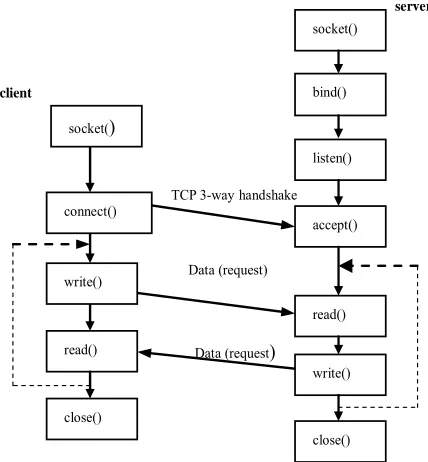
Figure 2 depicts the main functions of the server and the
client which are the two major components of the system architecture.
3.1. Server Architecture
A prototype of the server application, which respond to the different requests sent by the client is developed us-ing C language. If the client sends a regular GET mes-sage, then the response will be based upon whether the requested file is found in the current directory or not. If yes, the response message contains the status line “HTTP/1.1 200 OK” and the requested file will be in-cluded in the message body. If the requested file is not found, then a response message contains the status line “HTTP/1.1 404 Not Found” and an empty body will be sent. If the client sends a conditional GET message, then the response will be based on whether the requested file has been modified since the specified date or not. If
TCP 3-wayhandshake
Data (request)
Data (request) read()
close()
client
server
bind() socket()
close() write() read() accept() listen()
connect() socket()
write()
modified then the message contains the status line “HTTP/1.1 OK” and the requested file is included in the message body. Otherwise, a response message contains the status line “HTTP/1.1 304 Not Modified” and an empty body will be sent. If the client sends a HEAD message, then the response will be based upon whether the requested file is found in the current directory or not. If yes, the response message contains the status line “HTTP/1.1 200 OK” and an empty body will be sent. If the requested file is not found, then a response message contains the status line “HTTP/1.1 404 Not Found” and an empty body will be sent.
The main functions of the server as shown in Figure 2
are illustrated below:
1) socket(): The function socket described as int socket(int domain, int type, int protocol), acts as the
in-terface between the application and the transport layer. The domain should be set to PF_INET. The type argu-ment tells the kernel what kind of socket is this: SOCK_STREAM or SOCK_DGRAM, and set protocol to ’0’ to have socket() choose the correct protocol based on the type.
2) bind(): This function comes after creating the socket to associate this socket with a port number on the local machine. The port number is used by the kernel to match an incoming packet to a certain process’s socket descrip-tor.int bind (int sockfd, struct sockaddr *myaddr, int addrlen); sockfd is the socket file descriptor returned by
socket(). myaddr is a pointer to a struct sockaddr which contains information about the address, namely, port and IP address. addrlen can be set to sizeof *myaddr or sizeof(struct sockaddr).
3) listen(): The process is done in two steps: first lis-ten(), then accept().int listen(int sockfd, int backlog);
sockfd is the usual socket file descriptor from the socket() system call. backlog is the number of connections al-lowed on the incoming queue. Incoming connections are going to wait in this queue until accept() and this is the limit on how many can queue up. The limit is about 20 for most systems. Usually, listen() returns −1 and sets errno on error. Well, bind() needs to be called before listen() or the kernel will have one listen on a random port.
4) accept(): The accept() call will try to connect() to the machine on a port that one is listen()ing on. Their connection will be queued up waiting to be accept()ed. One calls accept() and tell it to get the pending connec-tion. It will return a brand new socket file descriptor to use for this single connection. Suddenly there will be two socket file descriptors, the original one is still listening on the port and the newly created one is finally ready to send() and recv().int accept(int sockfd, struct sockaddr *addr, socklen t *addrlen); sockfd is the listen()ing
socket descriptor. addr will usually be a pointer to a local
struct sockaddr_in. This is where the information about the incoming connection will go and then one can deter-mine which host is calling from which port. addrlen is a local integer variable that should be set to sizeof *addr or sizeof(struct sockaddr in) before its address is passed to accept(). accept() will not put more than that many bytes into addr. If it puts fewer in, it will change the value of addrlen to reflect that.
5) recv() and send(): These functions are used to re-ceive requests from the client and send a response back according to the specified request. The send() call:int send(int sockfd, const void *msg, int len, int flags);
sockfd is the socket descriptor one intends to send data to (it’s the one returned by socket()) , msg is a pointer to the data to be sent, and len is the length of that data in bytes. Just set flags to 0. The recv() call is similar to send() in many respects: int recv(int sockfd, void *buf, int len, un-signed int flags); sockfd is the socket descriptor to read
from, buf is the buffer to read the information into, len is the maximum length of the buffer, and flags can again be set to 0. recv() returns the number of bytes actually read into the buffer, or −1 on error (with errno set, accord-ingly).
6) close(): This function will be used to close the socket connection just simply by writing close(sockfd).
3.2. Client Architecture
A persistent TCP connection will be used to connect a client process to the server. The client application will request a Web page from a Web server by using a com-mand line including an URL with either of the two dif-ferent options: “-h” and “-d”. The “-h” option will re-quest a Web page from the Web server using the HEAD command, which sends only the header lines without the object, whereas the “-d” option will request a Web page from the Web server using the GET command, which sends only the object file if it has been modified accord-ing to a given date. If no option is included, the server will send the requested object. Then the program will be able to write the response into an output text file. The functions of the client are omitted here, as the present paper is dealing with the server performance.
4. The CSM of the System
computation. The focus of the paper is on the execution time behavior, so we will not consider the DFG any fur-ther.
The CFG is a directed graph that can be used to model any computation (task). The CFG shows the way in which different subtasks fit together in a task. It is a common tool for modeling the control flow of a tation, and is used to organize the calculation of compu-tation execution time (the time a program will take to complete). The CFG consists of nodes (elements) that represent action in the computation that consume time, and edges that depict how the thread of execution reaches these nodes. Each node is given a time cost (a single value or a distribution) and each edge a control flow count.
The control flow through an element is defined as the number of times that the element is activated, on the ave- rage, for each execution of the computation represented by the CFG.
Time equivalent CFG transformation steps: A me-
thod is described in [11] that provides a set of transfor-mation steps which can be used to transform a given CFG, composed of elements and control flows, into a simpler, time equivalent CFG. The transformations steps are termed as time equivalent transformation steps, be-cause, two CFG segments representing the “before” and “after” of a proposed transformation step have equivalent execution time distribution. Rules are defined to make sure that the execution time probability distribution of the two CFGs will be identical.
Probability distribution of execution time: Applying
these ideas in an orderly algorithmic manner, one can obtain the overall distribution of execution time of a computation with the following form:
1 2 3
1 2 3
, , , ,
, , , ,
N N T t t t t
P p p p p
A task will take any one of time with associated probability to execute. i
t
i
Next, we describe the Computation Structural Model of the present system. The CSM uses Control Flow Graphs (CFG), and Spanning Trees to model the flow of a system mathematically [5,11], which is then used to derive the cost expression of the system.
p
4.1. Server Control Flow Graph
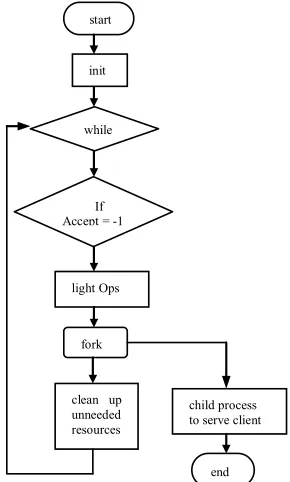
The software (counts over 500 lines of C/C++ code) de-veloped to represent the server is simplified into the CFG as shown in Figure 3. The CFG shows only the groups
of continuous lines of code in a single node, as long as there is no probabilistic factor, meaning a loop or an if-else conditional statement within the groups. After performing the initialization part which is depicted as init,
the program proceeds to an infinite loop, where it keeps
fork start
end init
while
If Accept = -1
light Ops
clean up unneeded resources
[image:5.595.350.495.85.326.2]child process to serve client
Figure 3. Main server control flow graph.
listening to any new incoming connections. Once a new connection is established, the main process first performs a few light weight operations, for example logging the time of the incoming connection etc. A child process is then created to serve the request. While the child process is serving the request, the main process continues in par-allel to clean up the unneeded resources, for example open ports, go back to listen to new connections, etc. Each child process start with a few initialization opera-tions, then proceed to analyze the server request, clean up and terminate.
4.2. Spanning Tree and Mathematical Model
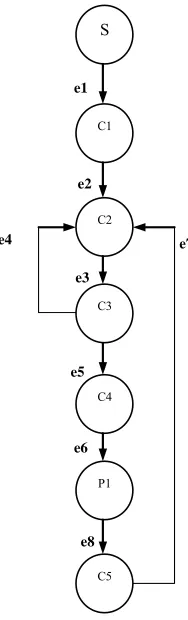
In order to derive a mathematical model for the system, we first need to derive a spanning tree from the CFG and then use it to derive the cost expression. Figure 4 shows
e2 e1
e4 e7
e3
e5
e8 e6
S
P1 C4 C2 C1
[image:6.595.124.218.83.393.2]C5 C3
Figure 4. Main server spanning tree CFG.
0 1
2 0 1
3 4
5 3 4
6 5 8 7
1 1 1
1 1
e e
e e e
e e
e e e
e e e e
Using the above flow, the cost expression can be writ-ten as:
1 1 2 4 2 3 3 5 4 6 1 8 5
1 2 3 4 5 1 4 2 3
s
s
t e c e e c e c e c e p e c
t c c c c c p e c c
(1)
Note ts, is the processing time of a request sent by a client to the server as mentioned in Section 5.
where e4
0.1 and 1 is the cost of fork.Using this approach, we have derived the equations for the complete system.
p
4.3. Client Process
The client part has six CFGs: five child functions, namely:
request, parse, command, address and message, in total
and one main function. We have calculated the execution time contributions from each of the functions separately in detail (which is omitted due to space limitation), using CSM technique, as shown in Section 4 for the main server function.
5. Client-Server Communication
First, we illustrate the sequence of communication be-tween the server and the client. The client initiates the communication with the server by requesting a resource (Web pages). All communication goes through the server main process which listens to incoming requests con-tinuously. Once a request is received, the main process creates a child process to serve the request and the com-munication channel is therefore passed to the child proc-ess. The parent process has nothing to do with this par-ticular client anymore. With this approach, each client will be served by a dedicated child process which termi-nates after serving its client. No child process will serve more than one client at a time.
This is a model with multiple sources and multiple communication channels. Where N is the maximum
number of child processes that are allowed to run simul-taneously at a given time. Therefore the system to ana-lyze is an M/M/N/N, assuming that the arrival and
depar-ture rates follow Poisson process. Clients make connec-tion to the server through a communicaconnec-tion port (chan-nel). All communication goes through the Network In-terface Card (NIC) of the machine running the Web server application. Although the NIC might buffer (queue) data received from clients before feeding it to the server application, but for the purpose of this analysis and the sake of simplicity, we will not consider this queue.
The average response time of a request , expressed
as r
T
r c
T T Ts (2)
where, c is the communication time between the server and the clients, and
T
s
T is the time to process the
request.
Here we drive equations to compute Ts and Tc, re-spectively. First, we derive Ts, the processing time of a request from any arbitrary client j. We assume a single
processor server model. Requests from all of the j clients
form a single processing queue, our objective is to evaluate
s
T as a function of different parameters.
Let s be the utilization factor for the processing queue. We assume that the utilization factor for both the processing and communication queues add up to 1.
Therefore,
1 s j cj
(3)From Little’s law, we have
s
LT (4)
where, L is the average length of the processing queue.
s s
T t w (5)
where, ts is the mean processing time (Equation (1)) and w is the average waiting time in the queue.
Note, ts can be derived using CSM technique as mentioned in Section 4.2 (Equation (1)).
Let j be the average request arrival rate from client
j into the server, then
1
j j
(6)For an M/M/1 queue L can be expressed as
1
s s
L
and sts
We have,
1
s s
s
T
Therefore,
1
1 1
s s s
s s
t t
T
(7)
Once the request has been processed the answer is re-turned back from the server to the client. Here we assume one Comm. Queue for each of the j clients.
Now, we calculate communication time between the server and each of the clients (as modeled in Figure 4 by
Comm. Queue) first. Let tcj tcj, and cj be the ave- rage service time, average arrival rate, and average utili-zation factor for channel of the Comm. Queue (Figure 4), respectively.
th
j
1 1 1 2 2 2
cj pj p j pnj n n
(8)
1 1 1
1 n n n
cj c j cnj cj cj
p p
t t
t (9)
where, i i is the rate from client i and pij is the
fraction going into channel . j tcij m R
. m and R are
the average message size and the average communication channel capacity, respectively. By definition cj cj cjt . The total communication time, Tc can be written as:
1 1
1 1
c c cn c c c
c c c
T t t t
cn (10)
The average service time is calculated by taking in consideration the flow rate of each class of users (clients)
1
1 n
s s
s s
t t
tsm (11)
The average total execution time is:
1
s s
s
t T
(12)
6. Utilizing the Analytical Model during
Web Server Design Phase
The derived equations above describe the performance (the average response time) of the web server as a func-tion of the used architecture (the Cs values in Equafunc-tion (1) and the link capacity R for each class of users), the
statis-tical properties of each class of users (the flow rate, the message size m, etc.) and the algorithm of handling
dif-ferent users’ requests (flow rate in Equation (1)). The designer can utilize the analytical equations in two dif-ferent ways:
1) Compare different architectures for the same design and a given set of clients’ classes.
a) Each architecture is represented by a set of opera-tions’ execution time Cs and links’ capacities.
b) For each architecture, evaluate the average response time for the given design and the properties of clients’ classes.
c) It is also possible to evaluate the average response time as a function of the system workload (the total input flow) and repeat it for each architecture.
2) Compare different designs for the same architecture and a given set of clients’ classes.
a) Each design is represented by the flows in equation #1. The given architecture provides the Cs values and the Rs values.
b) Evaluate the average response time for each design given the statistical properties of clients’ classes (input flows, message sizes).
c) Repeat the process for each design alternative and study the system behavior with different workloads.
It is also possible to make the study for different de-sign alternatives using a given set of architectures.
The goal is to find the best design-architecture combi-nation that minimizes the average response time. Fur-thermore, the design can write the equations in a spread-sheet. This gives him a tool to study the effect of differ-ent design parameters to the objective function (the av-erage response time in this case).
7. Conclusion
com-plexity analysis expression could provide. For instance, the expression from complexity analysis would reveal the polynomial running time of the system as a whole in terms of big O notations which can give a high level idea
of the system timing in general. However, by applying CSM, we developed a detailed mathematical cost expres-sion for the request processing time from which one can identify the bottleneck in the system and suggests further improvements. The analytical model can also be utilized to select the best design-architecture combination for the web server that minimizes the average response time.
REFERENCES
[1] P. Boldi, B. Codenotti, M. Santini and S. Vigna, “Ubi- crawler: A Scalable Fully Distributed Web Crawler,”
Software-Practice & Experience, Vol. 34, No. 8, 2004, pp.
711-726. doi:10.1002/spe.587
[2] M. Najork and A. Heydon, “High-Performance Web Crawling,” In: J. M. Abello, P. M. Pardalos and M. G. C. Resende, Eds., Handbook of Massive Data Sets, Kluwer
Academic Press, Dordrecht/Boston/London, 2002. [3] Apache Software Foundation, “Apache HTTP Server
Project.” http://httpd.apache.org/
[4] L. Lipsky, “Queueing Theory: A Linear Algebraic Ap- proach (LAQT),” Macmillan Publishing Company, New York, 1992.
[5] R. A. Ammar and B. Qin, “An Approach to Derive Time Costs of Sequential Computations,” Journal of Systems and Software, Vol. 11, No. 3, 1990, pp. 173-180.
[6] T. L. Booth, “Performance Optimization of Software Systems Processing Information Sequences Modeled by Probabilistic Languages,” IEEE Transactions on Software Engineering, Vol. 5, No. 1, 1979, pp. 31-44.
doi:10.1109/TSE.1979.226496
[7] B. M. MacKay and H. A. Sholl, “Communication Alter-natives for a Distributed Real-Time System,” Proceed-ings of the ISCA Computer Applications in Industry and Engineering Conference, Honolulu, November 1995.
[8] H. A. Sholl and T. L. Booth, “Software Performance Modeling Using Computation Structures,” IEEE Transac- tions on Software Engineering, Vol. 1, No. 4, 1975, pp.
414-420. doi:10.1109/TSE.1975.6312874
[9] R. Ammar, “Hierarchical Performance Modeling and Analysis of Distributed Software,” In: S. Rajasekaran and J. H. Reif, Eds., Handbook of Parallel Computing: Mod-els, Algorithms, and Applications, Chapman & Hall/CRC
Press, London.
[10] R. A. Ammar and T. L. Booth, “Software Optimization Using User Models,” IEEE Transactions on Systems, Man, Cybernetics, Vol. 18, No. 4, 1988, pp. 552-560.
doi:10.1109/21.17373
[11] B. Qin, H. A. Sholl and R. A. Ammar, “Micro Time Cost Analysis of Parallel Computations,” IEEE Transactions on Computers, Vol. 40, No. 5, 1991, pp. 613-628.
doi:10.1109/12.88485
[12] J. Heidemann, K. Obraczka and J. Touch, “Modeling the
Performance of HTTP over Several Transport Protocols,”
IEEE/ACM Transactions on Networking, Vol. 5, No. 5,
1997, pp. 616-630. doi:10.1109/90.649564
[13] L. Slothouber, “A Model of Web Server Performance,”
Proceedings of the 5th International World Wide Web Conference, 1996.
[14] R. D. Van der Mei, R. Hariharan and P. Reeser,” Web Server Performance Modeling, “Telecommunication Sys-tems, Vol. 16, No. 3-4, 2001, pp. 361-378.
doi:10.1023/A:1016667027983
[15] D. Menasce, “Web Server Software Architecture,” IEEE Internet Computing, Vol. 7, No. 6, 2003, pp. 78-81.
doi:10.1109/MIC.2003.1250588
[16] A. Kamra, V. Misra and E. Nahum, “Controlling the Per-formance of 3-Tiered Web Sites: Modeling, Design and Implementation,” Proceedings of the Joint International Con-ference on Measurement and Modeling of Computer Systems,
June 2004, pp. 414-415.
[17] X. Liu, J. Heo and L. Sha, “Modeling 3-Tiered Web Ap-plications,” 13th IEEE International Symposiumon Mod-eling, Analysis and Simulation of Computer Telecommu-nications Systems (MASCOTS’05), 2005, pp. 307-310.
[18] K. Kant and C. R. M. Sundaram, “ A Server Performance Model for Static Web Workloads,” IEEE International Symposium on Performance Analysis of Systems and Software (ISPASS’00), 2000, pp. 201-206.
[19] K. S. Trivedi, “Probability and Statistics with Reliability,
Queuing, and Computer Science Applications,” John Wi- ley and Sons, Chichester, 2001.
[20] L. Wells, S. Christensen, L. M. Kristensen and K. H. Mortensen, “Simulation Based Performance Analysis of Web Servers,” Proceedings of 9th International Work-shop on Petri Nets and Performance Models, 2001, pp.
59-68. doi:10.1109/PNPM.2001.953356
[21] R. Gaeta, M. Gribaudo, D. Manini and M. Sereno, “A GSPN Model for the Analysis of DNS-Based Redirection in Distributed Web Systems,” Proceedings of 12th An-nual International Symposium on Modeling, Analysis, and Simulation of Computer and Telecommunications Systems (MASCOTS’04), 2004, pp. 39-48.
[22] D. Gvozdanovic, D. Simic, U. Vizek, M. Matijasevic, K. P. Valavanis and D. Huljenic, “Petri Net Based Modeling of Application Layer Traffic Characteristics,” EURO-CON’01, 2001, pp. 424-427.
[23] M. Scarpa, A. Puliafito, M. Villari and A. Zaia., “A Model- ing Technique for the Performance Analysis of Web Searching Applications,” IEEE Transactions on Knowl- edge and Data Engineering, Vol. 16, No. 11, 2004, pp.
1339-1356. doi:10.1109/TKDE.2004.65
[24] S. S. Gokhale, P. J. Vandal and J. Lu, “Performance and Availability Analysis of Web Server Software Architec- ture,” Proceedings of 12th IEEE International Symposium on Pacific Rim DependableComputing (PRDC’06), 2006, pp. 351-358. doi:10.1109/PRDC.2006.50
[25] R. Kohavi and R. Parekh, “Ten Supplementary Analyses to Improve E-Commerce Web Sites,” Proceedings ofthe
5th WEBKDD Workshop (WEBKDD’03), 2003, pp. 29- 36.
Perceived Availability Evaluation of a Web Based Travel Agency,” Proceedings of the 2003 International Confer- ence on Dependable Systems and Networks (DSN’03),
22-25 June 2003, pp. 709-718. doi:10.1109/DSN.2003.1209986
[27] M. Merzbacher and D. Patterson, “Measuring End User Availability on the Web: Practical Experience,” Proceed- ings of the 2002 International Conference on Dependable
Systems and Networks (DSN’02), 2002, pp. 473-477.
[28] Y. Hu, A. Nanda and Q. Yang, “Measurement, Analysis and Performance Improvement of the Apache Web Server,” IEEE International Performance, Computing and Communications Conference (IPCCC’99), 1999, pp.