Bachelor thesis:
Hedonic Quality: The Inference and perspective processing approach.
Quincy Boom
s1099477
June 2013
University of Twente
Faculty Behavioral sciences
Psychology
First supervisor: Dr. Martin Schmettow
Index
Abstract Page 1
Introduction Page 1
Theoretical Background Page 5
First impressions Page 5
Information-processing stage model of aesthetic processing Page 6
Visual complexity Page 7
Prototypicality Page 8
The influence of visual complexity and prototypicality in beauty Page 8
Hedonic Quality Page 9
Research Question Page 10
Method Page 11
Design Page 11
Participants Page 11
Materials Page 11
Stimuli selection Page 11
Rating Page 12
Procedure Page 12
Data analyses Page 12
Results Page 13
Differences between HQI and HQS scales Page 13
Influences of VS, PT and RefJ in different time-conditions Page 14
Discussion Page 17
Information-processing stage model of aesthetic processing Page 17
HQI and HQS scales Page 18
Perceptive processing compared to inference perspective Page 19
Acknowledgments Page 20
References Page 21
ABSTRATCT
Dit artikel is gebaseerd op een onderzoek door Tuch et al. (2012). In dit artikel wordt de rol van visuele complexiteit (VC) en prototypicaliteit (PT) op de van websites op de hedonic qua-lity (HQ) oordeel van gebruikers. Gedurende dit onderzoek worden 76 websites gepresenteerd die variëren in VC en PT. Deze 76 websites moesten in totaal vier keer beoordeeld worden op HQ, gedurende verschillende presentatie-tijden (17 ms, 33 ms, 500 ms en zonder limiet). De resultaten van het experiment toonden aan dat VC en PT HQ oordelen van gebruikers beïn-vloedden zelfs in de 17 ms conditie. Naarmate de presentatie-tijden toenamen, nam het effect van VC op HQ oordelen geleidelijk af. Deze resultaten ondersteunen de informatieverwerking stadium model van esthetische verwerking (Leder et al., 2004), door te laten zien dat informa-tie in verschillende stadia word beoordeeld. Wanneer presentainforma-tie-tijden toenemen blijft het effect van PT op HQ oordelen echter gelijk, dit in tegenspraak met het model van Leder et al. (2004). Websites met een lage VC en hoge PT beloond met hogere HQ scores, in het bijzon-der wanneer presentatie-tijden toenamen. Over het algemeen lijkt het alsof HQ oordelen op een iets andere manier gevormd worden dan esthetische oordelen. Dit is in tegenspraak met het inferentie perspectief voorgesteld door Hassenzahl & Monk (2010).
This paper replicates a study made by Tuch et al. (2012), investigating the role of visual com-plexity (VC) and prototypicality (PT) as website design factors, on shaping users’ hedonic quality (HQ) judgments. During this study 76 website varying in VC and PT were randomly presented and rated on perceived HQ. These 76 websites were rated four times for varying presentation-times, 17, 33, 500 and without limit. Results showed that VC and PT affected HQ judgments, even when websites were presented for 17 ms. As presentation-times increase, the effect of VC declines steadily, supporting the reasoning of the information-processing stage model of aesthetic processing (Leder et al., 2004) that information is processed in dif-ferent stages. As presentation-times increase the effect of PT remains stable, contradicting the stage model by Leder et al. (2004). Websites with low VC and high PT received high HQ ratings, especially when presentation-times were higher. Overall, it seems that HQ judgment is formed in a somewhat different fashion than beauty judgment, contradicting the occurrence of an inference effect as supposed by Hassenzahl & Monk (2010).
Computers are vastly complex systems, which are used for many purposes. Be it for relaxa-tion, education or work, users interact with computers to fulfill these personal needs. Within the field of Human Computer Interaction (HCI) focus lies on interaction between users and computers, making it a very important mean to assess the quality of different interactive sys-tems. A research held within HCI is UX, the purpose of which is to assess the quality of pro-grams by measuring User Experience (UX). User Experience consists of different dimensions, namely Generic UX, Affect, Enjoyment, Aesthetics, Hedonic quality, Engagement, Motiva-tion, Enchantment and Frustration (Bargas-avila & Hornbaek, 2011). Apart from UX, usabil-ity is the most important criterion within HCI. By measuring usabilusabil-ity, more insight can be gained on how experience users certain computer programs and what this user experience is caused by.
[image:4.595.88.444.617.694.2]Despite usability scales being vastly used, it is not exactly clear how users generate ratings on these scales. Different studies have shown that usability correlates with beauty to a remarkably high degree (Tractinsky, Katz, & Ikar, 2000; Tracktinsky, Cokhavi, Kirschen-baum, & Sharfi, 2006). Hassenzahl & Monk (2010) explain the high correlation between beauty and usability using an inference perspective. The inference perspective supposes that when judging a product, inexperienced users may use all currently available information to infer the unavailable information. Because beauty relies heavily on sensory information, it is thought by Hassenzahl & Monk (2010) to be the starting-point for many inference processes. Hassenzahl & Monk (2010) thought this high correlation between beauty and usability is mainly caused by a mediating variable, namely ‘Goodness’. Hassenzahl & Monk (2010) indi-cated that when forming a usability score, beforehand a beauty score is generated. Beauty scores are then used to infer a general value, named a goodness score. Finally, the unavailable usability score is inferred from goodness. Hassenzahl & Monk (2010) found that unlike other usability aspects, Hedonic Quality was directly inferred from Beauty (Figure 1).
Tuch, Presslaber, Stöcklin, Opwis, & Bargas-Avila (2012) dispute this hypothesis by discussing the influence of visual complexity (VC) and prototypicality (PT) regarding first impressions of websites. The research of Tuch et al. (2012) extensively used a model por-trayed by Leder et al. (2004). This model shows that the analysis of visual information occurs in different processing stages (Figure 2). Tuch et al. (2012) focused primarily on the first two stadia of the model, showing that VC and PT had a large effect on website beauty scores when websites were presented very shortly. Because VC and PT seem to influence beauty scores, it is highly likely that processing of other UX scales is similar to beauty processing.
In this current article the research of Tuch et al. (2012) was replicated. Users were shown the same websites as in Tuch et al. (2012), however in this study users rated the web-site according to a different UX dimension, namely Hedonic Quality. If Hedonic Quality judgment is indeed dependent of VC and PT, the role of VC and PT in UX scales would be extended.
Theoretical background
First impressions
Forming first impressions is found to be very important with regard to website perceptions of usability. The first instant an impression is formed people tend to stick by them by only seek-ing information that supports their initial hypothesis, while ignorseek-ing other information. This effect is called the ‘confirmation bias’ (Mynatt, Doherty, & Tweney, 1977). While the im-portance of first impressions is widely accepted, there is still a lot about first impressions that remains unknown. Lindgaard, Fernandes, Dudek, & Brown (2006) grant some clarity by con-ducting three studies to assess how fast people form an opinion about the visual appeal of webpages. Notable is that in Lindgaard et al. (2006) no masking was used. The first study was conducted to determine the reliability of visual appeal ratings and select website homepages to use during the second study. Study 1 showed that there was a high consistency between the visual appeal ratings collected during phase 1 and phase 2. All correlations were highly signif-icant (p < .001), thus all participants’ ratings were reliable.
charac-teristics, it seemed that 5 out of 7 design characteristics correlated highly with visual appeal. The five visual characteristics that correlated highly with visual appeal also correlated highly with each other. Since 500 ms is a fairly long time to form a first impression, a third study was conducted. During Study 3 the same stimuli as in Study 2 were used, with the difference that in this study participants were randomly assigned to a 50 or 500 ms condition. Results showed significant results even in the 50ms condition. It thus seems that design characteristics influence visual appeal within 50ms when viewing websites.
In conclusion Lindgaard et al. (2006) has shown that visual appeal is influenced by the same design variables in all time-conditions. Since visual appeal in the 50ms condition is de-pendent of the same design variables as in the 500 ms or timeless condition, it seems that in-ference has not occurred despite information being less readily available. Since judgments were stable in all time-conditions, the likelihood of an inference effect occurring is very small. The absence of an inference effect in the study of Lindgaard et al. (2006) weakens as-sumptions made by Hassenzahl & Monk (2010). What still remained unclear however was how the relationship between design characteristics and visual appeal changed for different presentation-times, since only a 50ms and 500 ms presentation-time was used.
Information-processing stage model of aesthetic processing
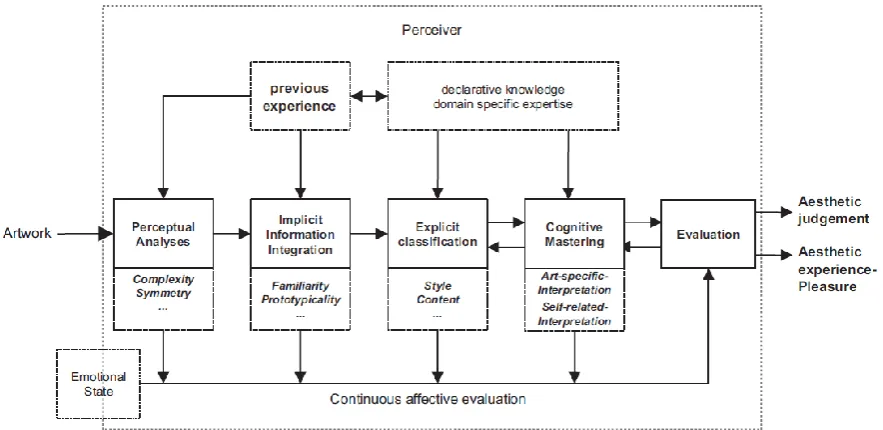
[image:6.595.78.520.506.721.2]The information-processing stage model of aesthetic processing proposes that there are five different processing stages when it comes to aesthetic evaluations, as shown in Figure 2.
Information processed in the perceptual analyses (1) and implicit information integration (2) stages are formed swiftly and do not have to become conscious thoughts in order to influence aesthetic processing. Explicit classification (3) and cognitive mastering (4) are more con-science processes which are affected by expertise and knowledge possessed by perceivers. Since expertise and knowledge play a smaller role in website perception than in art percep-tion, explicit classification (3) and cognitive mastering (4) are considered irrelevant for the study conducted by Tuch et al. (2012). At stage five ‘evaluation (5)’ the processed infor-mation is evaluated leading to two different outputs of evaluation, namely aesthetic appraisal and aesthetic judgment. Aesthetic appraisal refers to how an object positively influences par-ticipants emotionally and aesthetic judgment refers to the artistic value perceivers believe the object has. Despite the model of Leder et al. (2004) originally being intended for art percep-tion it is still useful for website perceppercep-tion, since variables such as complexity and prototypi-cality also appear in websites (Tuch et al., 2009; Tuch et al., 2012; Harper, Michailidou, & Stevens, 2009).
In Leder, Carbon, & Ripsas (2006) the information-processing stage model proposed in Leder et al. (2004) is used to assess the influence of title information on the understanding and appreciation of paintings. Leder et al. (2006) found that in titles did not affect apprecia-tion when paintings were presented for 1s, 10s or 90s when paintings were presented for 1s descriptive titles increased understanding. In the 10s and 90s condition elaborative titles in-creased understanding of the paintings. These findings support the model by Leder et al. (2004), as it shows that information is processed in stages as presentation-times increase.
The information-processing stage model by Leder et al. (2004) opposes the inference perspective purposed by Hassenzahl & Monk (2010). The inference perspective by Hassen-zahl & Monk (2010) shows that users process information using an inference process when information is not readily available. The information-processing stage model by Leder et al. (2004) shows that information is not inferred, information is just processed in stages. When not all information can be processed due to lack of time information is not inferred, infor-mation is just processed in lower stages than it would otherwise.
Visual complexity
timeframe. Processing within the perceptual analysis stage (1) is mostly dedicated by the vis-ual complexity of the stimulus. Visvis-ual Complexity (VC) is a way to assess the degree of com-plexity within a design. A lot of research is committed into finding effects VC has on users (Reber, Schwarz, & Winkielman, 2004; Tuch et al., 2009; Tuch et al., 2012). According to Berlyne (1974) the relationship between viewer pleasure and arousal can be represented by an inverted U-curve, with medium levels of arousal being viewed as most pleasurable. Later studies try to verify these findings try to verify these results, but fail to offer any direct sup-port (Tuch et al., 2009; Pandir & Knight, 2006). Many other effects of visual complexity have been researched. Tuch et al. (2009) indicates that VC is an important factor in web design as VC influences perceived pleasure and arousal, physiological response and recognition per-formance of the viewers.
Prototypicality
At the implicit information integration stage (2) aesthetic perception is mostly affected by stimulus characteristics involving the user’s previous experiences, making perceived proto-typicality important within this stage. Protoproto-typicality refers to extent an objects represents a class of objects. Prototypicality thus represents mental models, which are based on experi-ence. Many different domains show that people prefer prototypical objects, for instance in colors or paintings. Prototypical preference is even present in human relationships. It is found that when supervisors are more group prototypical, employees trust their coworkers more than wen supervisors are less group prototypical (Seppälä & Lipponen, 2012).
The influence of visual complexity and prototypicality in beauty
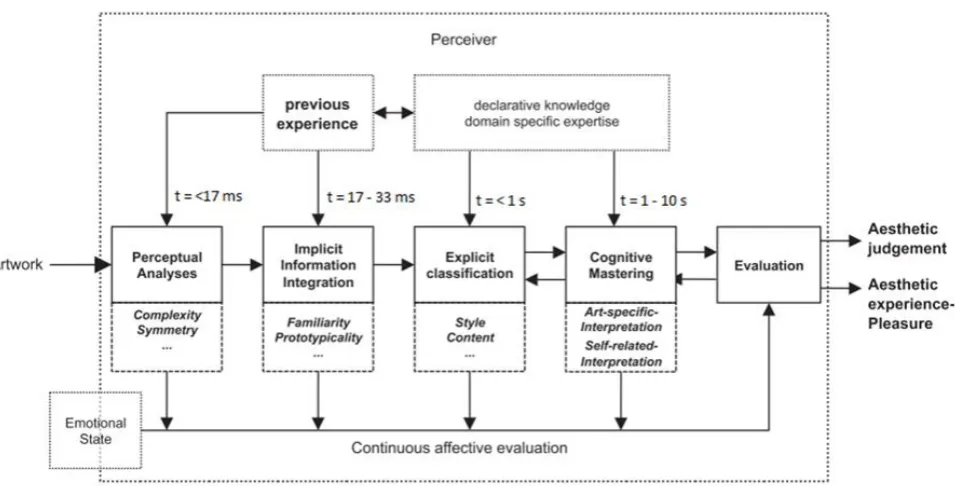
fact to long, a second experiment with even shorter presentation-times was conducted. In the second part of the study, the experiment was repeated with shorter presentation times (17 ms vs. 33 ms vs. 50ms). The results confirmed the effect of VC and PT on per-ceived beauty in all conditions, again indicating that low VC and high PT are found most beautiful. The effects of VC and PT at the 33 ms and 50ms condition almost the same, where-as at the 17 ms condition the effect of VC on beauty wwhere-as higher than the effect of PT. This supports the model of Leder et al. (2004) that VC is processed earlier than PT. It also opposes the model of Hassenzahl & Monk (2010), as perceived beauty is influenced highly by VC and PT in short presentation times opposing the existence of an inference effect. Variance within perceived beauty scores during short presentation times is explained, even though information is not easily available to the participants. When combining research conducted by Tuch et al. (2012) and Leder et al. (2006) with the model of Leder et al. (2004) it is possible to indicate approximately when each stage starts (Figure 3).
Fig. 3; Information-processing stage model of Leder et al. (2004) combined with results made by Tuch et al. (2012) and Leder et al. (2006).
Hedonic Quality
had intended it. Thus Hedonic Quality clarifies the correspondence of intended and perceived product quality (Hassenzahl 2001).
Bernardo, Marimon, & Alonso-Almeida (2012) demonstrate the role of Hedonic Qual-ity of e-commerce by examining the impact of Hedonic QualQual-ity of traveling websites on per-ceived value. Bernardo et al. (2012) stated that dimensions suggested by the E-S-QUAL in-strument to influence e-service quality (efficiency, system availability, fulfillment and priva-cy) all focus on Functional Quality rather than Hedonic Quality. In order to assess the influ-ence of Hedonic Quality in e-service quality, a structured questionnaire was administered by phone amongst 1201 consumers of online travel agencies in Spain. The questionnaire consist-ed of 30 items which were arrangconsist-ed in four constructs, namely E-service Quality, Hconsist-edonic Quality, Perceived Value and Loyalty. All items were presented as statements respondents could either agree or disagree with on a five-point Likert scale (1 = strongly disagree to 5 = strongly agree). Results of this study show that although Functional Quality and Hedonic Quality both positively influence perceived value, Functional Quality has a higher influence than Hedonic Quality. Despite perceived value being primarily influenced by Functional Quality, Hedonic Quality contributes to perceived value as well, making it an important factor to focus on within e-commerce (Bernando et al., 2012; Lee & Kozar, 2009).
Hedonic Quality (HQ) can be divided into Hedonic Quality Stimulation (HQS) and Hedonic Quality Identification (HQI) (Hassenzahl, 2004). In this current study HQS refers to how creative or innovating the website designs are perceived. HQI relates to the nature of people to express themselves through objects. In this study it would refer to what people be-lieve the website would express about them as a person. What the website says about how stylish or professional the person is.
Research Question
This study will identify to what extent VC and PT direct Hedonic Quality judgments. Since Tuch et al. (2012) found that VC and PT influence beauty judgments and numeral stud-ies have found beauty and hedonic quality to be related to high extents (Hassenzahl & Monk, 2007; Schaik et al., 2012; Cogan, Parker & Zellner, 2013), we expect that VC and PT also influence Hedonic Quality judgments. This present study primarily focusses the extent to which Hedonic Quality is influenced by early information-processing stages. This study also identifies if HQI and HQS are processed in different fashions.
judg-ments are dependent of VC and PT in exactly the same fashion as beauty, it would support the inference perspective by Hassenzahl & Monk (2010). It would show that beauty relates to Hedonic Quality to such a high extent that inference is likely. If Hedonic Quality judgments are dependent of VC and PT in a somewhat different fashion than beauty, the information-processing stage model by Leder et al. (2004) would gain support. As it would show that even though Hedonic Quality perception occurs in the same stages as beauty perception, Hedonic Quality judgment occurs in a different fashion. This would make beauty inference within He-donic Quality judgments more unlikely.
Methods
Design
This experiment closely resembles research made by Tuch et al. (2012), yet the procedure within this study is somewhat different as this study consists solely of within-subject inde-pendent variables (i.e. repeated measures design). Indeinde-pendent variables included visual com-plexity (low or high), prototypicality (low or high), condition (17 ms, 33 ms, 500 ms or with-out limit) and scale (HQI or HQS).Judgment ratings were used as the dependent variable. This experiment was shared with a researcher examining the role of VC and PT on credibility ratings, therefore the experiment consisted of both a hedonic quality and credibility scale.
Participants
A total of n = 25 participants (11 female and 14 male) participated in the experiment. 21 par-ticipants were students on the University of Twente. 3 parpar-ticipants were attending an HBO study and 1 participant quit its study after high school. The average age of the participants was 21.9 years old (SD = 3.3) and age varied between 17 and 31 years. Participants whom studied behavioral sciences could receive 1 credit for participating in our research.
Materials
Stimuli selection
This experiment used a subset of the stimuli used by Tuch et al. (2012). Only screenshots of company websites were used, as Roth, Schmutz, Pauwels, Bargas-Avila, & Opwis (2010) has shown that people have consistent mental models of such websites. In Tuch et al. (2012) a final pool of 120 websites was used. These websites differed visual complexity (low vs. me-dium vs. high) and prototypicality (low vs. high). The present study however, does not use stimuli with a medium level of VC. Since Tuch et al. (2012) indicated that VC had a linear effect on aesthetics it was very likely that VC also had a linear effect on HQ judgment, mak-ing it unnecessary to also include medium levels of VC. Eventually, 76 websites were used in this study differing in VC (low and high) and PT (low and high).
Rating
To assess participants’ hedonic quality judgments a visual analogue scale was developed with different anchors for HQI and HQS. For HQI the following anchors were used: Isolating – integrating, amateurish – professional, gaudy – classy, cheap – valuable, noninclusive – inclu-sive, takes me distant from people – brings me closer to people, unpresentable – presentable. For HQS the anchors used were: Typical – original, standard – creative, cautious – coura-geous, conservative – innovative, lame – exciting, easy – challenging, commonplace - new. The Dutch translations of these anchors were taken from Hassenzahl (2004).
Procedure
The experiment was conducted on one computer in a small separate room at the University of Twente using the same computer. Participants were seated in front of a computer one at a time and were asked for their gender, age and education. Instructions about the experiment were given on screen during the experiment. Participants started the experiment with a brief ‘prac-tice phase’, in which several images were shown. After each image, participants had to make a judgment ranging from negative to positive on a visual analogue scale. This judgment was made using the computer mouse. After finishing the ‘practice phase’, the actual experimental started.
ranging from negative to positive. After all websites were rated, the experiment was conduct-ed with the same 76 websites in another random order. Websites were now shown for a longer presentation times, namely 33 ms, 500 ms and without limit in a second, third and fourth block respectively.
Data analyses
To test if website complexity and prototypicality had any effect on subject’s Hedonic Quality judgments a regression analysis was conducted. A 2 x 3 regression analysis was performed, where judgment was entered as a dependent variable. Independent variables within this analy-sis were Scale (HQI or HQS), and Condition (17 ms, 33 ms and 500 ms). Scores of the limit-less condition was used as a Reference Judgment (RefJ). Since participants in the limitlimit-less condition had the most time to assess a judgment, this score would be closest to their ‘true judgment’. Since Visual Complexity (VC) is known to negatively affect judgment scores, the item was reversed and renamed it Visual Simplicity (VS). VS, PT and RefJ were character-ized as covariates, in order to clarify to what extent VS, PT and RefJ influence HQ judgments. The assumptions for regression analysis were met, as items and independent variables were previously validated in the research by Tuch et al. (2012).
To assess if there was any association between RefJ and HQ judgment within the dif-ferent conditions, a reliability analysis was conducted. In the reliability analysis RefJ was thus used as a reference for HQ judgment.
Results
Differences between HQI and HQS scales
Although small, another difference between both scales appeared in the effect of PT on judgment. It seemed that the effect of PT on judgment seems slightly stronger in the HQI than in the HQS scale during all time-conditions (Figure 4). This scale difference in the Con-dition x PT relationship however is too small to be considered significant (χ² = 2.419, df = 3, p = .490).
Fig. 4; Colom containing averaged judgment beta values per component, per conditie, per schaal.
Influences of VS, PT and RefJ in different time-conditions
Since results on the HQI scale and the HQS scale showed no significant differences, it was decided to combine both scales into one (Figure 5). When evaluating the effect of VS on HQ judgment a Condition x VS interaction effect appeared (χ² = 55.730, df = 2, p < .001).
Table 1; Beta values of VS per condition.
Beta Lower bound Upper bound Chi-square Sig.
17 ms 0.050 0.038 .063 60.846 .000
33 ms 0.025 0.013 .037 16.816 .000
500 ms 0.004 -0.008 .016 .487 .485
It is apparent that the influence of VS on the HQ judgments declines as presentation-times increase. VS directs judgment to the highest degree in the 17 ms condition (χ² = 60.846, df = 1, p < .001). In the 33 ms condition VS directs judgment to a lesser degree (χ² = 16,816, df = 1, p = .000). In the 500 ms condition the effect of VS on HQ judgment is no longer significant (χ² = .485, df = 1, p = .485). These results are summarized in Table 1.
0 0,1 0,2 0,3 0,4 0,5 0,6
17 ms 33 ms 500 ms 17 ms 33 ms 500 ms
HQI HQS
Fig. 5; Colom displaying averaged judgment beta values per component, per condition.
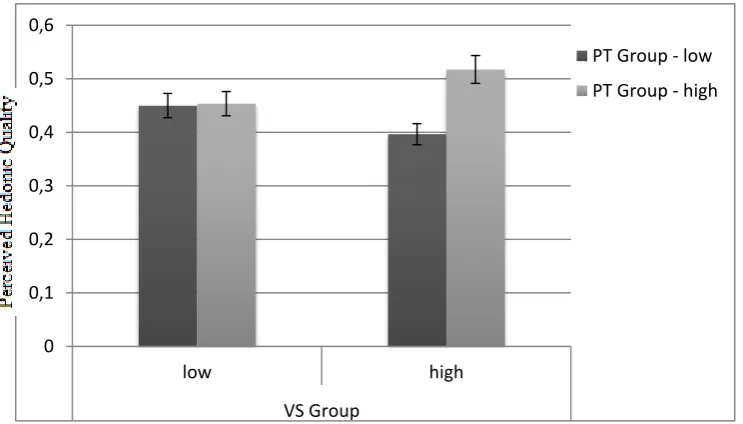
When examining PT in the different time-conditions, some surprising results arise. Firstly, a PT main effect was found, indicating that PT had a significant effect on HQ judg-ments (χ² = 182.390, df = 1, p < .001). However, there was no Condition x PT interaction found (χ² = 3.174, df = 2, p < .205). The effect of PT was the same in all the conditions, meaning that PT played an equally important part in the 17 ms, 33 ms and 500 ms conditions within our experiment. A VS x PT interaction-effect occurred within the data (χ² = 10,210, df = 1, p = .001).When further examining these results it seemed that PT had a higher effect on HQ judgments when VS was high. The effect of PT on HQ judgments was lower when VS was low. To display these results, VS and PT were grouped in VS group and PT group and depicted in Figure 6.
Fig. 6; Colom with averaged HQ judgments for high and low website VS and PT. 0
0,1 0,2 0,3 0,4 0,5 0,6
17 ms 33 ms 500 ms
Condition
VS PT RefJ
0 0,1 0,2 0,3 0,4 0,5 0,6
low high
VS Group
[image:15.595.63.435.533.745.2]Although weaker, there was also a Condition x VS x PT interaction-effect (χ² = 9.440, df = 2, p = .009), meaning that the interaction between VS and PT varied slightly in the dif-ferent time-conditions. When accessing this variation it seems that in the 17 ms condition the combined effect of VS and PT is fairly weak. PT seems to influence HQ judgment both when VS is low and high. In the 33 ms condition the VS x PT interaction effect is very apparent, showing that PT has far less influence on HQ judgment when VS is high. In the 500 ms con-dition it seems that the overall effect of PT increases, making the effect of PT on judgment a bit more pronounced both when VS is low and when VS is high (Figure 7).
[image:16.595.62.421.277.474.2]
Fig. 7; Colom with average HQ judgments per condition for high and low website VS and PT.
[image:16.595.66.493.594.703.2]When analyzing the association between of RefJ and judgment, a Condition x RefJ interaction was detected (χ² = 400.979, df = 3, p < .001).
Table 2: Reliability of RefJ and HQ judgment per condition.
Cronbach’s Alpha Cronbach’s Alpha based on
standardized items
Number of Items
17 ms .246 .246 2
33 ms .460 .462 2
500 ms .703 .703 2
RefJ associated more with judgment increased as presentation-times got higher (Table 2). In the 17 ms condition the influence of RefJ on HQ judgment was at its lowest (α = .246). In the
0 0,1 0,2 0,3 0,4 0,5 0,6
low high low high low high
VS Group VS Group VS Group
17 ms 33 ms 500 ms
33 ms condition the influence of RefJ on HQ judgment grew (α = .460) reaching its peak at 500 ms (α = .703). Since RefJ scores were closest to ‘true judgment scores’ it appeared that judgments got closer to their ‘true judgments’ as presentation-times increased.
Discussion
Results of this study clearly point out that visual complexity (VC) and prototypicality (PT) are important factors in the Hedonic Quality (HQ) perception of websites. When forming a first impression, websites with lower visual complexity are judged more favorably than websites with high visual complexity. The effect of visual complexity diminishes if participants are confronted with the websites for longer periods of time. In general, prototypical websites are judged more positively than less prototypical websites. However a VC x PT interaction is also present within the data. When VC is high the effect of PT is more pronounced than when VC is low. Thus it seems that the combination of high PT and low VC amounts to the highest HQ judgments. These results are the same results reached by Tuch et al. (2012).
Information-processing stage model of aesthetic processing
This study offers some support for the model by Leder et al (2004), primarily due to findings concerning website VC and RefJ. This study showed that the effect of VC on judgment was highest when presentation time was lower. According to Leder et al. (2004) judgment is made in progressively higher stages as presentation-times increase. In higher stages judgment is directed by other factors, diminishing the effects present in lower stages. When viewing the Leder et al. (2004) model, it would be explain why the effect of VC on judgment to decrease as presentation-times increase. RefJ also offers support for the model of Leder et al. (2004). In this study it seemed that, as presentation-times increase the influence of RefJ on HQ judgment seems to also increase. HQ judgments made in higher presentation-times thus seem to get closer to the HQ reference judgment made at 5000ms. Since scores gradually seem to get closer to the RefJ it appears that as perception moves to higher stages, HQ judgments are gradually being influenced by the similar factors as the RefJ. Supporting the model by Leder et al. (2004), stating that judgment is influenced by different variables as presentation-times increase.
accurate predictor for HQ judgment within all time-conditions. The early occurrence of the PT effect could have been caused by the TFT-screens the experiments were conducted on. Since the 17 ms condition is very short for frames to be presented on the screen, it is possible that websites in this condition were actually presented longer than 17 ms. Still the influence of using TFT-screens in the conduction of this experiment might not be high, as Tuch et al. (2012) also conducted their experiment using TFT-screens and found no PT influence on judgment in the 17 ms condition. Either way, it is impossible for this study to distinguish whether the VC effect occurred before the PT effect as both effects were apparent in the shortest time-condition. For following research it would thus be necessary to use CRT screens and also use a time-condition shorter than 17 ms, possible clarifying when VC and/or PT starts to influence HQ judgments.
With regards to the relationship between VC and PT this study also found some inter-esting results. It seemed that the VC x PT interaction changed in the different time-conditions. In the 17 ms condition the influence of PT on HQ judgment hardly differed when VC was high or low. However in the 33 ms condition a clear distinction arose, indication that PT in-fluenced judgments only when VC was high. In the 500 ms condition PT affected HQ judg-ments more in both the low and high VC condition (Figure 7).
It seems as if the VC x PT interaction gains strength as the influence of VC on HQ judgment decreases. It would thus seem as if the effect of VC does not decline as presentation times, it is just combined into a broader VC x PT interaction. This VC x PT interaction is weaker in the 17 ms condition probably because participants were not able to combine VC and PT in-formation this fast. In the 33 ms and 500 ms condition the participants have adequate time to view VC and PT as a whole, creating a clear VC x PT interaction.
(uitleggen hoe dat mogelijk is)
HQI and HQS scales
This can possibly be caused by the fact that the HQS consists has a wider notion of the defini-tion of creativity and innovadefini-tion than PT does.
The effect of RefJ on HQI scores and HQS scores differed somewhat in the different conditions. In the 17 ms condition the effect of RefJ on HQI scores was lower than on HQS scores. Since personally identifying oneself with a website is a bit more demanding task than viewing website innovation. It is thus very likely that participants in the 17 ms condition were only able to rate items on the HQI scale using more superficial means. Since it was a bit easier to rate items on the HQS scale, there was more room for other variables to take over judg-ment. In the 33 ms and 500 ms conditions the influence of RefJ on HQI scores was higher than on HQS scores. It thus seems that when given the time, HQI scores gets closer to ‘true judgment’ faster than HQS scores. Since website HQI scores are processed faster, it would thus seem that users slightly prioritize personal identification with a website over how stimu-lation the website is found. This shows that in website perception the need to personal identi-fication exceeds the need for stimulation.
Perceptive processing compared to inference perspective
A fair amount of the results in this study are comparable to findings made by Tuch et al. (2012), showing that visual complexity and prototypicality also play an important role in the process of hedonic quality judgments. This study showed that websites with low visual complexity and high prototypicality were more preferred by users. Prototypicality seems to influence website judgment more when visual complexity within the website is low. Both visual complexity and prototypicality seem to influence hedonic quality judgment even when websites are only presented for 17 ms. This research also offered some support to the infor-mation integration stage model developed by Leder et al. (2004), showing that hedonic quality judgment is indeed processed in stages.
pro-totypicality. If inference would have in fact taken place, the prototypicality effect in the 17 ms condition should be non-existent in hedonic quality judgment just as in beauty judgment. The discrepancy between hedonic quality judgment and beauty judgment shows that it is unlikely a beauty inference has taken place in this instance.
In sum, this study shows both visual complexity and prototypicality are important web design characteristics. Complex designs or designs not typically expected of a websites could make bad first impressions, causing decreased user expectations. Research has shown that negative expectations can lead to lower satisfaction (Raita & Oulasvirta, 2011). Considering visual complexity and prototypicality when designing a website could thus prevent user dis-satisfaction.
Future research
There is still a lot about Hedonic Quality perception which remains unclear, leaving room for further research. Since not all stages of the model by Leder et al. (2004) were used, further research is necessary in the other stages to explore other factors affecting hedonic quality judgment. If for example timelines depicted in Figure 3, are all implemented in a research it is possible to see how hedonic quality judgment changes over these stages.
A combined research for beauty processing and hedonic quality processing should be conducted. This research should research the similarities between beauty and hedonic quality processing and the speed at which beauty judgment and hedonic quality judgment get closer to their true judgment. If beauty and hedonic quality processing differ in many respects the possibility of an inference effect becomes even more unlikely.
Other UX scales need to be measured using the model by Leder et al. (2004). The model by Leder et al. (2004) would be strengthened if stages also appear in other UX scales. If processing occurs in a different fashion within UX scales, the existence of an inference ef-fect would become even more unlikely.
Acknowledgements
I would like to thank Alexandre N. Tuch for allowing the use of stimuli previously used in his own research.
References
Bernardo, M., Marimon, F., & Alonso-Almeida, M.D.M. (2012). Functional quality and he-donic quality: A study of the dimensions of e-service quality in online travel agencies.
Information & Management, 49(7-8), 342–347. doi:10.1016/j.im.2012.06.005.
Cogan, E., Parker, S., & Zellner, D.A. (2013). Beauty beyond compare: effects of context extremity and categorization on hedonic contrast. Journal of experimental psychology. Human perception and performance, 39(1), 16–22. doi:10.1037/a0031020.
Goldstein, E.B. (2009). Sensation and Perception. Arizona: Wadsworth, ISBN-10: 0495601497, ISBN-13: 9780495601494.
Harper, S., Michailidou, E., & Stevens, R. (2009). Toward a definition of visual complexity as an implicit measure of cognitive load. ACM Transactions on Applied Perception, 6(2), 1–18. doi:10.1145/1498700.1498704.
Hassenzahl, M. (2004). The Interplay of Beauty, Goodness, and Usability in Interactive Prod-ucts. Human-Computer Interaction, 19(4), 319–349.
doi:10.1207/s15327051hci1904_2.
Hassenzahl, M. (2001). The Effect of Perceived Hedonic Quality on Product Appealingness.
International Journal of Human-Computer Interaction, 13(4), 481–499. doi:10.1207/S15327590IJHC1304_07.
Hassenzahl, M., & Monk, A. (2010). Human – Computer Interaction The Inference of Per-ceived Usability From Beauty The Inference of PerPer-ceived Usability From Beauty, (March 2013), 37–41. doi:10.1080/073700242010500139.
Leder, H., Belke, B., Oeberst, A., & Augustin, D. (2004). A model of aesthetic appreciation and aesthetic judgments. British journal of psychology (London, England : 1953),
Leder, H., Carbon, C.C., & Ripsas, A.L. (2006). Entitling art: Influence of title information on understanding and appreciation of paintings. Acta psychologica, 121(2), 176–98. doi:10.1016/j.actpsy.2005.08.005
Lindgaard, G., Fernandes, G., Dudek, C., & Brown, J. (2006). Attention web designers: You have 50 milliseconds to make a good first impression! Behaviour & Information Tech-nology, 25(2), 115–126. doi:10.1080/01449290500330448.
Mynatt, C.R., Doherty, M.E., Tweney, R.D., Mynatt, C.R., Doherty, M.E., & Ryan, D. (1977). Quarterly Journal of Experimental Confirmation bias in a simulated research environment : An experimental study of scientific inference. Quarterly Journal of Ex-perimental Psychology 29, 85-95.
Nose, T., Ikeda, N., & Kanoh, H. (1999). LCD Legibility as a Function of Resolution, IEICE translations E82-C (10), 1792–1797.
Raita, E. & Oulasvirta, A. (2011). Too good to be bad: Favorable product expectations boost subjective usability ratings. Interacting with Computers, 23(4), 363–371.
doi:10.1016/j.intcom.2011.04.002.
Reber, R., Schwarz, N., & Winkielman, P. (2004). Processing fluency and aesthetic pleasure: is beauty in the perceiver’s processing experience? Personality and social psychology review : an official journal of the Society for Personality and Social Psychology, Inc, 8(4), 364–82. doi:10.1207/s15327957pspr0804_3.
Roth, S. P., Schmutz, P., Pauwels, S. L., Bargas-Avila, J.A., & Opwis, K. (2010). Mental models for web objects: Where do users expect to find the most frequent objects in online shops, news portals, and company web pages? Interacting with Computers,
22(2), 140–152. doi:10.1016/j.intcom.2009.10.004.
van Schaik, P., Hassenzahl, M., & Ling, J. (2012). User-Experience from an Inference Per-spective. ACM Transactions on Computer-Human Interaction, 19(2), 1–25.
Shieh, K.K., & Lin, C.C. (2000). Effects of screen type, ambient illumination, and color combination on VDT visual performance and subjective preference. International Journal of Industrial Ergonomics, 26(5), 527–536.
doi:10.1016/S0169-8141(00)00025-1.
Seppälä, T., Lipponen, J., & Pirttilä-Backman, A.M. (2012). Leader fairness and employees’ trust in coworkers: The moderating role of leader group prototypicality. Group Dy-namics: Theory, Research, and Practice, 16(1), 35–49. doi:10.1037/a0026970.
Tractinsky, N., Katz, A.., & Ikar, D. (2000). What is beautiful is usable. Interacting with Computers, 13(2), 127–145. doi:10.1016/S0953-5438(00)00031-X.
Tractinsky, N., Cokhavi, A., Kirschenbaum, M., & Sharfi, T. (2006). Evaluating the con-sistency of immediate aesthetic perceptions of web pages. International Journal of Human-Computer Studies, 64(11), 1071–1083. doi:10.1016/j.ijhcs.2006.06.009.
Tuch, A.N., Bargas-Avila, J.A., Opwis, K., & Wilhelm, F.H. (2009). Visual complexity of websites: Effects on users’ experience, physiology, performance, and memory. Inter-national Journal of Human-Computer Studies, 67(9), 703–715.
doi:10.1016/j.ijhcs.2009.04.002.
Appendix
Output of the Regression analysis:
Model Information
Dependent Variable Judgement
Probability Distribution Normal
Link Function Identity
Subject Effect
1 Subj
2 trial
3 AnchorLow
Working Correlation Matrix Structure Exchangeable
Case Processing Summary
N Percent
Included 4200 100,0%
Excluded 0 0,0%
Total 4200 100,0%
Correlated Data Summary
Number of Levels Subject Effect
Subj 25
trial 168
AnchorLow 14
Number of Subjects 4200
Number of Measurements per
Subject
Minimum 1
Maximum 1
Correlation Matrix Dimension 1
Categorical Variable Information
N Percent
Factor
Scale
HQI 2100 50,0%
HQS 2100 50,0%
Total 4200 100,0%
Condition
0.017s 1400 33,3%
0.033s 1400 33,3%
Total 4200 100,0%
Continuous Variable Information
N Minimum Maximum Mean Std. Deviation
Dependent Variable Judgement 4200 ,00 1,00 ,4720 ,26983
Covariate
VS 4200 2,32 5,88 4,1230 ,88723
PT 4200 2,29 5,55 4,3855 ,74546
referenceJudgement 4200 ,00 1,00 ,4691 ,28500
Goodness of Fita
Value
Quasi Likelihood under
Inde-pendence Model Criterion
(QIC)b
304,878
Corrected Quasi Likelihood
under Independence Model
Criterion (QICC)b
298,717
Dependent Variable: Judgement
Model: Scale * Condition * VS, Scale *
Condition * PT, Scale * Condition *
refer-enceJudgement, Condition * VS, Condition
* PT, Condition * referenceJudgement,
Condition * VS * PT, VS * PT, VS, PT,
referenceJudgement
a. Information criteria are in small-is-better
form.
b. Computed using the full log
quasi-likelihood function.
Tests of Model Effects
Source Type III
Wald
Chi-Square
df Sig.
Scale * Condition * VS ,652 3 ,885
Scale * Condition * PT 2,419 3 ,490
Scale * Condition *
referen-ceJudgement
Condition * VS 32,848 2 ,000
Condition * PT 3,174 2 ,205
Condition *
referenceJudge-ment
93,521 2 ,000
Condition * VS * PT 9,440 2 ,009
VS * PT 10,210 1 ,001
VS 55,730 1 ,000
PT 182,390 1 ,000
referenceJudgement 273,095 1 ,000
Dependent Variable: Judgement
Model: Scale * Condition * VS, Scale * Condition * PT, Scale * Condition *
referenceJudgement, Condition * VS, Condition * PT, Condition *
refer-enceJudgement, Condition * VS * PT, VS * PT, VS, PT,
referenceJudge-ment
Parameter Estimates
Parameter B Std. Error 95% Wald Confidence Interval Hypothesis Test
Lower Upper Wald Chi-Square df Sig.
[Scale=2] * [Condition=1] *
VS
,077 ,0110 ,055 ,099 48,877 1 ,000
[Scale=2] * [Condition=2] *
VS
,035 ,0110 ,014 ,057 10,455 1 ,001
[Scale=2] * [Condition=3] *
VS
-,001 ,0110 -,023 ,020 ,010 1 ,922
[Scale=3] * [Condition=1] *
VS
,079 ,0124 ,054 ,103 40,436 1 ,000
[Scale=3] * [Condition=2] *
VS
,042 ,0108 ,021 ,063 14,884 1 ,000
[Scale=3] * [Condition=3] *
VS
,006 ,0106 -,014 ,027 ,359 1 ,549
[Scale=2] * [Condition=1] *
PT
,070 ,0100 ,050 ,090 48,654 1 ,000
[Scale=2] * [Condition=2] *
PT
,068 ,0097 ,049 ,087 48,596 1 ,000
[Scale=2] * [Condition=3] *
PT
,055 ,0100 ,035 ,075 29,997 1 ,000
[Scale=3] * [Condition=1] *
PT
,061 ,0104 ,040 ,081 34,101 1 ,000
[Scale=3] * [Condition=2] *
PT
[Scale=3] * [Condition=3] *
PT
,041 ,0094 ,023 ,059 19,142 1 ,000
[Scale=2] * [Condition=1] *
referenceJudgement
,088 ,0441 ,002 ,175 4,003 1 ,045
[Scale=2] * [Condition=2] *
referenceJudgement
,261 ,0424 ,178 ,344 38,069 1 ,000
[Scale=2] * [Condition=3] *
referenceJudgement
,520 ,0410 ,440 ,600 161,176 1 ,000
[Scale=3] * [Condition=1] *
referenceJudgement
,135 ,0445 ,048 ,222 9,184 1 ,002
[Scale=3] * [Condition=2] *
referenceJudgement
,214 ,0422 ,132 ,297 25,844 1 ,000
[Scale=3] * [Condition=3] *
referenceJudgement
,495 ,0393 ,418 ,572 158,213 1 ,000
[Condition=1] * VS 0a . . . .
[Condition=2] * VS 0a . . . .
[Condition=3] * VS 0a . . . .
[Condition=1] * PT 0a . . . .
[Condition=2] * PT 0a . . . .
[Condition=3] * PT 0a . . . .
[Condition=1] *
referenceJud-gement
0a . . . .
[Condition=2] *
referenceJud-gement
0a . . . .
[Condition=3] *
referenceJud-gement
0a . . . .
[Condition=1] * VS * PT -,010 ,0027 -,015 -,005 14,060 1 ,000
[Condition=2] * VS * PT -,005 ,0025 -,010 ,000 3,687 1 ,055
[Condition=3] * VS * PT ,001 ,0024 -,004 ,006 ,143 1 ,706
VS * PT 0a . . . .
VS 0a . . . .
PT 0a . . . .
referenceJudgement 0a . . . .
(Scale) ,061
Dependent Variable: Judgement
Model: Scale * Condition * VS, Scale * Condition * PT, Scale * Condition * referenceJudgement, Condition * VS, Condition * PT, Condition *
referenceJudgement, Condition * VS * PT, VS * PT, VS, PT, referenceJudgement
Output of the Reliability Analysis on RefJ and judgment:
Condition = 0.017s
Case Processing Summarya
N %
Cases
Valid 1400 100,0
Excludedb 0 ,0
Total 1400 100,0
a. Condition = 0.017s
b. Listwise deletion based on all variables in the
procedure.
Reliability Statisticsa
Cronbach's
Alp-ha
Cronbach's
Al-pha Based on
Standardized
Items
N of Items
,246 ,246 2
a. Condition = 0.017s
Inter-Item Correlation Matrixa
Judgement
referenceJud-gement
Judgement 1,000 ,140
referenceJudgement ,140 1,000
a. Condition = 0.017s
Inter-Item Covariance Matrixa
Judgement
referenceJud-gement
Judgement ,069 ,011
referenceJudgement ,011 ,081
Summary Item
Statisticsa
a. Condition =
0.017s
Condition = 0.033s
Case Processing Summarya
N %
Cases
Valid 1400 100,0
Excludedb 0 ,0
Total 1400 100,0
a. Condition = 0.033s
b. Listwise deletion based on all variables in the
procedure.
Reliability Statisticsa
Cronbach's
Alp-ha
Cronbach's
Al-pha Based on
Standardized
Items
N of Items
,460 ,462 2
a. Condition = 0.033s
Inter-Item Correlation Matrixa
Judgement
referenceJud-gement
Judgement 1,000 ,300
referenceJudgement ,300 1,000
a. Condition = 0.033s
Judgement
referenceJud-gement
Judgement ,067 ,022
referenceJudgement ,022 ,081
a. Condition = 0.033s
Summary Item
Statisticsa
a. Condition =
0.033s
Condition = 0.5s
Case Processing Summarya
N %
Cases
Valid 1400 100,0
Excludedb 0 ,0
Total 1400 100,0
a. Condition = 0.5s
b. Listwise deletion based on all variables in the
procedure.
Reliability Statisticsa
Cronbach's
Alp-ha
Cronbach's
Al-pha Based on
Standardized
Items
N of Items
,703 ,703 2
a. Condition = 0.5s
Inter-Item Correlation Matrixa
Judgement
Judgement 1,000 ,542
referenceJudgement ,542 1,000
a. Condition = 0.5s
Inter-Item Covariance Matrixa
Judgement
referenceJud-gement
Judgement ,082 ,044
referenceJudgement ,044 ,081
a. Condition = 0.5s
Summary Item
Statisticsa
a. Condition =