ISSN: 2333-5742(Print), 2333-5734 (Online) Copyright © The Author(s). 2014. All Rights Reserved. Published by American Research Institute for Policy Development DOI: 10.15640/rjmc.v2n2a3 URL: http://dx.doi.org/10.15640/rjmc.v2n2a3
Reporting Recession in Online News Worldwide: Spain as a Test-case
Maria-Angeles Cabrera1, Elad Segev2 & Menahem Blondheim3
Abstract
This study measures the presence of Spain in online news worldwide as an example of the significance of economic news in a globalizing, interdependent environment. Employing the ´Global Salience Meter` based on a multilingual news-mining technique, Spain´s relative prominence was traced over 43 months in 35 leading news sites in 10 languages. Our findings reveal a growing online attention given to Spain, especially in the business section of European digital news outlets. Network analysis of country co-mentions finds that together with European countries, Spain is frequently mentioned together with the US and international organizations. This reflects the underlying regional and global economic structures and ties related to the European economic recession. More generally it points to the increasing connectedness of the world´s economies and the world´s online news reporting.
Keywords: International news; news mining; online media; globalization; economic crisis
I.Introduction
Economic news, like all other brands of news, is a chronicle of change. Changes in the local economy can be expected to be covered routinely by national media. But how national media respond to economic change abroad is anything but routine: What changes are selected for coverage and where, represent fluid and transient decisions. News rooms around the world make their selections from among changes that occur the world over separately, and on the fly.
1 University of Malaga
2 Tel Aviv University
This study seeks patterns in the confluence of decisions reached by news outlets, as to the economic news from abroad that they see fit to report.
It does so by focusing on the international coverage of the news concerning a single country experiencing dramatic change in its economic conditions. We will observe the case of the international coverage of Spain and its unique economic plight in the recent global economic crisis.
I.1. The Economic Crisis in Spain
Spain has changed politically, economically and socially during the last thirty years. Until the economic crisis of 2008 it experienced a period of intense and sustained economical growth (Alonso & Furio, 2010). According to CountryRep´s ranking (2009), Spain was 10th among the world´s leading countries in terms of economic growth rate, even ahead of the US, notwithstanding its being regarded as a model welfare state. Since the 1980s the Spanish economy has experienced constant growth compared to other EU countries, and particularly its main members (Germany, France, UK and Italy). From 1985 to 2005 the per capita income gap has been reduced by 12 points. This process has been further intensified since 1999, as reflected in the growth of its GDP per capita.
The structure of the Spanish economy had changed due to internal and external factors such as the increasing population, employment and construction on the one hand, and the introduction of new global economic structures on the other.
Today Spain faces the challenge of resolving this crisis by changing its production model and reducing its dependency on real estate-driven development, and reforming its financial sector (Alonso & Furio, 2010, IMF, 2013).
These challenges are being faced within the broader context of a world reeling from its worst economic recession in nearly a century, a recession whose global reach was unprecedented (Gore, 2010; Reid et al., 2013).
I. 2. News about Spain
Major political and economic changes have always been reflected in the news. The growing scale of online information provides researchers with new possibilities for multi- and inter-disciplinary research of national and international conditions and their reflection in the media. This is demonstrated by previous studies based on the quantitative, even automated, analysis of a massive body of digital news, such as those by [Authors] on America´s changing place in world news and on the level of significance of the Israeli-Palestinian conflict in the news of the world (2010, 2013b). Such studies and their results are of interest to fields as diverse as policy, economy, culture, communication media and society.
While most previous studies examined the salience of countries in the news of traditional media, the present study will follow Wu’s example in examining online news worldwide. News websites have recently become a common way of acquiring news. A report by the Pew Research Center for People and Press revealed that 40% of Americans get their national and international news from the Internet (2008), and that share has steadily increased thereafter (Williams & Delli Carpini, 2011).
Similarly, Wurff and Lauf (2005) and Schifferes, Lusoli, and Ward (2009) showed a continuous growth in online news readership in Europe.
The increasing use of online news raises questions about their geopolitical perspective, which could affect the picture they depict, and consequently, at least to some extent, the public perceptions of the world we live in. While national and regional web-based news sites can be expected to be self-centered and highlight local and national issues, they also make choices that both reflect and effect geopolitical biases in their coverage of the rest of the world.
By mining digital materials it is possible to examine a dramatically longer period of time than in traditional studies of news content mentioned above, let alone surveying a much larger field of countries (Authors). Software tools developed by these authors allow a large-scale real time frequency analysis of countries selected in different topical categories of news sites, in a variety of languages, from around the world.
Our current analysis focuses on Spain´s prominence in the news reported from around the world. We chose looking at a critical period of almost four years between 2009 and 2012, reflecting the major economic changes in Europe (Authors, 2014).
The questions addressed in this paper are:
RQ1. Has Spain become more prominent in world news during the crisis period? RQ2. What were the changes in Spain´s international environment during that period?
II. Methods
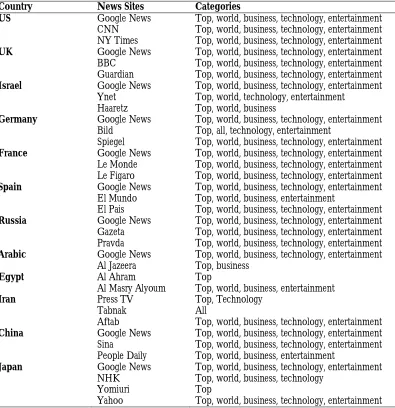
This study employed quantitative techniques in order to measure the level of Spain´s salience in world news. The data analyzed were collected from a variety of news sites in 12 different countries. These countries were selected on the basis of several considerations.
First, we chose besides Spain, other countries with a large number of online users, since they play a central role in the dissemination of news to smaller countries in their region (Tunstall, 2008). Applied to the Internet, this factor would reflect the popularity of the language used in the country. We ended up with the most popular online languages, including English, Chinese, Spanish, Japanese, French, German, and Arabic (Danet & Herring, 2007).
Second, we chose economically leading countries with high GDPs such as Japan, China, Germany, The UK, USA, and France. Since the Middle East is historically, politically and economically linked to Europe (Authors), we included news from key Middle Eastern countries: Egypt, Israel and Iran. Finally, when addressing the role of Spain, it is important to study countries to which Spain has varying degrees of relevance, spanning, for instance, France and Iran.
Table 1. Countries, News Sites and Categories Studied
Country News Sites Categories
US Google News Top, world, business, technology, entertainment
CNN Top, world, business, technology, entertainment
NY Times Top, world, business, technology, entertainment
UK Google News Top, world, business, technology, entertainment
BBC Top, world, business, technology, entertainment
Guardian Top, world, business, technology, entertainment
Israel Google News Top, world, business, technology, entertainment
Ynet Top, world, technology, entertainment
Haaretz Top, world, business
Germany Google News Top, world, business, technology, entertainment
Bild Top, all, technology, entertainment
Spiegel Top, world, business, technology, entertainment
France Google News Top, world, business, technology, entertainment
Le Monde Top, world, business, technology, entertainment
Le Figaro Top, world, business, technology, entertainment
Spain Google News Top, world, business, technology, entertainment
El Mundo Top, world, business, entertainment
El Pais Top, world, business, technology, entertainment
Russia Google News Top, world, business, technology, entertainment
Gazeta Top, world, business, technology, entertainment
Pravda Top, world, business, technology, entertainment
Arabic Google News Top, world, business, technology, entertainment
Al Jazeera Top, business
Egypt Al Ahram Top
Al Masry Alyoum Top, world, business, entertainment
Iran Press TV Top, Technology
Tabnak All
Aftab Top, world, business, technology, entertainment
China Google News Top, world, business, technology, entertainment
Sina Top, world, business, technology, entertainment
People Daily Top, world, business, entertainment
Japan Google News Top, world, business, technology, entertainment
NHK Top, world, business, technology
Yomiuri Top
Yahoo Top, world, business, technology, entertainment
The software identified the date of each news item, its title and content, the category of the article, the countries mentioned in it, and its source. We used the title of each news item and its content to extract the countries mentioned in it.
For each country name, we asked the research assistants to provide all common names and alternatives names (e.g. “Unites States”, “USA”, and so on). They were then asked to omit all alternative country names that might be ambiguous and therefore yield irrelevant search results.
II.1. Country Salience Index
We used the proprietary software to automatically measure the number of news items mentioning each country in news sites of other countries. We could also focus on specific countries or categories. For example, we could obtain the number of news items in American news sites mentioning Madagascar, or the number of news items from the “Business” category in British news sites mentioning Congo. We designed a Salience Index (SI) to find how prominent a country is in the news sites of other countries. The SI of a country is defined as the percentage of news that mentioned it (not including items from its own news sites) out of all items that mentioned any country names (e.g., the percentage of news items mentioning the US in non-American news sites). The SI ranges from 0 to 100, 0 indicating that the country was not mentioned at all by news items of other countries, and 100 meaning that all news items of other countries mentioned the country. Definition 1 provides a simple formula for calculating the SI of a country:
Definition 1. Salience Index
SI of i* = (Number of news items that mentioned a certain country) / (Number of all news items that mentioned any country) x 100
*i is country indicator. The SI of a country reflects Only news items from other countries and not news items from its own news sites.
Ii.2. Country Network Analysis
A cumulative International network emerges when countries are considered as nodes, and news items about them provide a descriptive map of the links between them (hereafter “news-links”; see also Authors). Constructing the cumulative relations between nodes as an International network may demonstrate the extent to which countries are mutually engaged and the overall structure of the International network. In addition, network analysis can serve to identify countries that are central, dominant hubs in the network vis-à-vis countries that are less connected and play a more marginal role. It should be noted that the analysis that follows is the representation of the International network as reflected by popular news sources rather than the actual economic relations between countries.
While the SI shows the relative frequency of the appearance of countries in the news, the network analysis focuses on the links between countries in news items. It charts the intensity of the bilateral relations between countries and the overall structure of the International network. It can indicate not only which countries appear more frequently in mainstream news, but also with which other countries they are frequently engaged, and what their position in relation to other countries is. It is quite possible that countries that were mentioned often (i.e., those with high SI scores) will also be located at the center of the news-link network. However, it may also be that some countries tend to be mentioned independently (i.e., not linked to other countries), and therefore they will be less central in the network analysis. In contrast, countries and entities that are not prominent as independent actors, and tend to appear in the news in the context of their relations to other countries, will become more central in the network analysis (extreme examples would be the UN or the EU). Thus, the network analysis provides a focus on International political, economic and cultural relations, and the links of a country with other countries as an aspect of its presence in news reporting worldwide.
Many of these studies point to the centrality of North America and Western Europe in the production and dissemination of information and particularly of International news.
Unlike previous network studies surveying the diffusion of International news, in the present study network analysis emerges not from the flow but from the actual content of news (see also Authors). Similar to the SI, in order to limit biases of self-reporting, we counted in our analysis only news-links that did not mention the country in which the news was posted. For example, we did not count news-links between the US and Iran from the New York Times, but we did count news-link between the US and Iran from the BBC. We used the standard software for network analysis, UCINET 6 (Borgatti, Everett, & Freeman, 2002), to produce visual representations of Networks of news-links between countries and to demonstrate the relative centrality of nodes in the network. In this way, the network analysis not only yields the centrality of certain countries, it also provides an overview of the standing of each country in relation to other countries, together underscoring the contours of the world that emerges from international news. Our focus is on the place of Spain therein.
III. Results
III.1. Salience Index
Figure 1 shows the general SI of Spain and its SI in the business section of news sites from around the world between February 2009 and September 2012. It shows that in general the news attention to Spain is low, its SI ranging from as high as 2.6% in France to 0.8% in Japan. Naturally, European countries that are geographically closer to Spain and share more political and economic ties with it are also those that display relatively higher news attention.
They mention Spain in a constantly low level, and do not display a heightened interest in its economy.
Figure 1. The Salience Index of Spain and the Spanish Economy in News Sites from Around the World
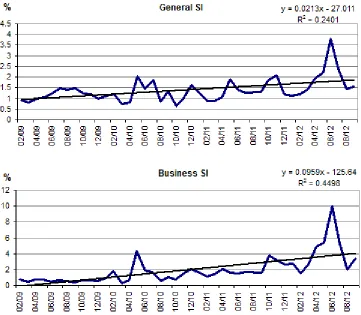
Figure 2 displays the monthly trends in the SI of Spain in general and in the business section in particular. In both, there is a constant trend of increase in the news attention over the last three and a half years. This increase is much more significant in the business section (R2=.45, a rise of about 0.1% each month) than in
all news sections in general (R2=.24, a rise of about 0.02% each month), suggesting that the higher attention given to Spain in the news is mostly in the economic context. News about Spain in the entertainments and technology sections did not show any significant trends over that period.
Figure 2. Trends in the Salience Index of Spain
Several relevant events occurred in Spain on these dates. In May 2010 international news mentioned two main stories: First about the critical economic situation of Spain, which was compared with that of Greece, and second about the presidency of Spain in the EU. Yet, the latter was not mentioned in the Business category as much as the former. In June 2012 online news reported extensively on the necessity of a European bank bailout for Spain.
III.2. Network Analysis
Figure 3 shows the results of the network analysis based on the business section of the news sites of all the countries we studied. We construct two networks—one for the first half of 2009 and another for the first half of 2012—in order to delineate the changes that occurred in the reported business ties of Spain.
Figure 3. Networks of News-Links with Spain in the Business Section
Note: The size of a node indicates its “degree of centrality,” namely, the number of countries with which it has news links. The width of links is an indication of their strength as measured by the number of news items that mention the two countries together. We show here countries that were co-mentioned at least in two news items or more.
Thus our RQ2 seems to be answered conclusively: the international environment to which Spain is relevant increased dramatically in parallel to the unfolding of its economic crisis, as unmistakably demonstrated graphically in figure 3.
IV. Discussion
It got much more attention from European countries in which it was mentioned in the economic section at twice the relative frequency as in other sections. Business news also displayed the most significant increase during that period.
In response to our second question, a news-link analysis provided the international context in which Spain was mentioned in the business section. As noted, many more countries and international organizations were mentioned together with Spain in 2012 compared to 2009. This network reflects the major players involved in the European economic crisis, namely the EU, Greece, Italy, France, Germany and the US, and the second circle that includes more distant countries and entities.
Built on the news flow literature surveyed above, our findings clearly demonstrate the attention given in world news to a country as a consequence of a major economic event or process. In line with previous observations and theoretical expectations, news about economic crisis, significantly increased the news prominence of Spain. It is important to note, however, that not all events around the world of similar magnitude, will get the same news attention. As previous observations show (Chang et al., 1987, 1992, 2000; Authors), some countries can be said to be ´more equal’ than others.
News of the economic crisis in Spain can serve as an excellent example. Our network analysis clearly reveals the international relevance of the Spanish crisis to the US and other powerful core states in Europe. It is also well established in international news research, that negative events bring much national and international news attention than good news (Galtung &Ruge 1965; Lynch, 2005; Maoz et al., 2007; Shinar, 2003; Wolfsfeld, 1997, 2004). On the one hand, the heightened news attention given to Spain in the context of the crisis might scare off potential investors and further harm its relative economic standing. On the other hand, it is also known that world attention, whether it is good or bad, provides leverage in itself, a possible window for a change. In other words, when foreign media mention a country it excites world interest and opportunity for that country to enhance its eminence, emphasize positive actions and recruit others to help overcome its crisis.
But this preliminary investigation calls for further qualitative content analyses to reveal the different frames of Spain in the news of different countries and the changing image of Spain over time. This is mainly since as Noya (2002) puts it, a country’s image is a key asset to defend its international economic and political interests, which are characterized by greater competition and interdependence. Our findings may provide empirical evidence for the imperative that Spain to act now, when ´the whole world is [still] watching`.
V. References
Alonso Pérez, M. & Furio Blasco, E. (2010) “La economía española. Del crecimiento a la crisis pasando por la burbuja inmobiliaria”, in Cahiers de civilisation espagnole contemporaine. De 1808 au temps présent. URL: http://ccec.revues.org/3212#ftn6 Argandoña, A. (2012) “Tres dimensiones éticas de la crisis financiera” , Documento de
Investigación. DI-944. Cátedra “La Caixa” de Responsabilidad Social de la Empresa y Gobierno Corporativo. IESE Business School - Universidad de Navarra, enero 2012. Barnett, G.A. (2001). A longitudinal analysis of the International telecommunications
network: 1978-1996. American Behavioral Scientist, 44, 1638-1655.
Barnett, G.A., Jacobson, T.L., Choi, Y., & Sun-Miller, S.L. (1996). An examination of the international telecommunication network. Journal of International Communication, 3, 19-43.
Barnett, G.A, & Lee, M. (2002). Issues in intercultural communication. In W.B. Gudykunst & B. Mody (Eds.), Handbook of international and intercultural communication (pp. 275-290). Thousand Oaks, CA: Sage.
Barnett, G.A. & Sung, E. (2005). Culture and th estructure of the International hyperlink network. Journal of Computer - Mediated Communication, 11 (1). Retrieved from http://jcmc.indiana.edu/vol11/issue1/barnett.html
Bennett, W.L. (1990). Toward a theory of press-state relations in the United States. Journal of Communication, 40, 103-125.
Benton, M.,& Frazier, P. (1976). The agenda setting function of the mass media at three levels of “information holding”. Communication Research, 3, 261-274.
Borgatti, S. Everett, M. & Freeman, L. (2002). UCINET 6 for Windows. Harvard, MA: Analytic Technologies.
Castells, M. (2000). The global economy. In D. Held & A. McGrew (eds.), The global transformation reader (pp.259-273). Cambridge: Polity Press and Blackwell Publishers.
Chang, T.K., Himelboim, I.,& Dong, D. (2009). Open global Networks, closed International flows: World system and political economy of hyperlinks in cyberspace. International Communication Gazette, 71, 137-160.
Chang, T.K., Lau T.Y., & Hao, X. (2000). From the United States with news and more: International flow, television coverage and the World system. Gazette, 62, 505-522. Chang, T. & Lee, J. (1992). Factors affecting gatekeepers´ selection of foreign news: A
Chang, T.K. Shoemaker, P., & Brendlinger, N. (1987). Determinants of International news coverage in the US media. Communication Research, 14, 396-414.
Chase-Dunn, C. & Grimes, p. (1995). World system analysis. Annual Review of Sociology, 21, 387-417.
CIP- Ecosocial (2011). “Impactos y consecuencias de la crisis”, in Revista Papeles, nº 113. URL: www.revistapapeles.fuhem.es
CountryRep™, “What are the reputations of countries? What drives country reputation? Which countries would you invest in and visit?” 2009. in URL:
www.reputationinstitute.com
“2012 Country RepTrak”, by Reputation Institute. URL: http://reputationinstitute.com Danet, B., & Herring, S.C. (2007). The multilingual Internet: Language, culture, and
Communications online. Oxford: Oxford University Press.
Dearing, J.W. & Rogers E.M. (1996). Communication concepts: Agenda setting London-Sage. Domingo, D.; Larrañaga, J.; Meso, K.; Cabrera. M.A.; Masip, P.; López, X. y Pereira, X. (2008). “Research methodology and techniques for professional studies in cyber-journalism”. En Díaz Noci, J. y Palacios, M. Online Journalism: Research methodology in comparative perspective. Servicio de Publicaciones de la Universidad de País Vasco. Bilbao.
“España, cuarto mayor deficit de la Unión Europea”, in ABC, URL.
http://www.abc.es/20100422/economia-economia/deficit-201004221126.html “Eurostat. News release Euro indicators, 22 of October 2012. URL:
http://epp.eurostat.ec.europa.eu/cache/ITY_PUBLIC/2-22102012-AP/EN/2-22102012-AP-EN.PDF
Eurostat. News release Euro indicators, 22 of April 2010. URL:
http://epp.eurostat.ec.europa.eu/cache/ITY_PUBLIC/2-22042010-BP/EN/2-22042010-BP-EN.PDF
“Fechas decisivas en la crisis económica española”. In El Mundo, URL:
http://www.elmundo.es/elmundo/2012/06/09/economia/1339243054.html Friedman, T.L. (1999). The Lexus and the olive tree: Understanding globalization. New York,
NY: Anchor Books.
Friedman, T.L. (2007). The World is flat: a brief history of the 20th Century. New York, NY: Farrar, Straus & Giroux.
Galtung, J. & Ruge, M. Holmboe (1965). The Structure of Foreign News, Journal of Peace Research, 2, 64-91
Golan, G. (2008). Television Networks where in the World is Africa?: Predicting coverage of Africa by US. International Communication Gazette, 70, 41.
Golan, G. & Wanta, W. (2001). Second-level agenda setting in the New Hampshire primary: a Comparison of coverage in three newspaper and public perceptions of candidates. Journalism and Mass Communication Quarterly, 78, 247-259.
Gore, C. (2010). The global recesion of 2009 in a long-term Development perspective. Journal of International Development, 22: 714-738.
[IMF] International Monetary Foundation (2013). Spain: Continue Reforms to Strengthen Recovery, Create Jobs.
https://www.imf.org/external/pubs/ft/survey/so/2013/car080213a.htm
Kariel, H.G., & Rosenvall, L.A. (1984). Factors influencing International news flow. Journalism Quarterly, 60, 434-436.
Katz, E. (2009). Media-government-publics: Coalitions and oppositions. The Communication Review, 13, 199-204.
Kim. K. & Barnett, G.A. (1996). The determinants of International news flow: A network analysis. Communication Research, 23, 323-352.
Kiousis, S. (2004). Explicating media salience: a factor analysis of New York Times issue coverage Turing the 2000 US presidential election. Journal of Communication, 54, 71-87.
Lee, S., Monge, P., Bar, F., & Matei, S. (2007). The emergence of clusters in the global telecommunications network. Journal of Communication, 57, 415-434.
Lynch, J. and McGoldrick, A. (2005). Peace Journalism. Gloucestershire, U.K.: Hawthron Press.
Maoz, Z. (2010). Networks of nations: The evolution, structure, and impact of international networks, 1816-2001. New York, NY: Cambridge University Press.
Maoz, Z., Terris, L.G., Kuperman, R.D., & Talmud, I. (2007). Network centrality and International conflict: Does it pay to be important? in T. N. Friemel (Ed.), Applications of Social Networks Analysis (pp. 121-151). Konstanz: Universitat Verlag Konstanz.
Merle, Patrick and Craig, Clay. “Experiment shows higher information recall for soft rather than hard Business news”. In Newspaper Research Journal, vol. 33. Number 3. Summer 2012. pp. 101-110.
Monge, P. R., & Contractor, N. (2003). Theories of Communications Networks. New York, NY: Oxford University Press.
Noya, Javier (2002). La imagen de España en el Exterior. Estado de la Cuestión. Real Instituto Elcano de Estudios Estratégicos e institucionales. Octubre 2002. URL: http://www.realinstitutoelcano.org/wps/wcm/connect/1c9cbb004f0195cd88d6ec31 70baead1/Noya_Imagen_Espana_Exterior.pdf?MOD=AJPERES
Nemeth, R. J., & Smith, D.A. (1985). International trade and World-system structure: A multiple network analysis. Review, 8, 517-560.
Park, H.W., Barnett, G.A. & Chung, C.J. (2011). Structural Changes in the Global Hyperlink Network 2003-2009, Global Networks, 11(4), 522-544.
Pew Research Center for People and the Press. (2008). Internet overtakes newspaper as news outlet. Retrieved from http://people-press.org/report/479
Pritchard, D. (1986). Homicide and bargained justice: The agenda-setting effect of crime news on prosecutors. Public Opinion Quarterly, 5, 143-159.
Reid, N., Carroll, C., & ye, X. (2013). The Great Recession of 2007-2009. Economic Development Quarterly, 27 (2): 87-89.
Rubin, A.J. (2009, January 31). Pointing to a new era, US pulls back as Iraqis vote. New York Times. Retrieved from
Schifferes, S., Lusoli, W., & Ward, S. (2009). What´s the story…? Online news consumption in the 2005 UK election. Northern Lights, 51-71.
Shinar, D. (2003). Peace process in cultural conflict: The role of the media. Conflict & Communication, 2, 1.
Smith, L.R. (1999), Intercultural network theory: A cross-paradigmatic Approach to acculturation. International Journal of Intercultural Relations, 23, 629-658.
Snyder, D., & Kick, E. (1979) Structural position in the World system and economic growth. 1955-70: A multiple network analysis of transnational interactions. American Journal of Society, 84, 1096-1126.
Tunstall, J. (2008). The media were American: US mass media in decline. Oxford: Oxford University Press.
Williams, B. A., & Delli Carpini, M. X. (2011). After Broadcast News: Media
Regimes, Democracy, and the New Information Environment. Cambridge: Harvard University Press.
Wolfsfeld, G. (1997). Media and political conflict: News from the Middle East. Cambridge: Cambridge University Press.
Wolfsfeld, G. (2004). Media and the path to peace. Cambridge: Cambridge University Press. World Bank (2010). World Development Report, Eurostat News Release, Euroindicaotrs
55/2010.
Wu, D.H. (2007). A brave new World for International news? Exploring the determinants of the coverage of foreign news on US websites. International Communication Gazette, 69, 539.
Wurff, R. & Lauf, E., (eds.). (2005). Print and online newspaper in Europe: A comparative analysis in 16 countries. Amsterdam: Het Spinhuis.
Yum, J. O. (1984). Network analysis. In W. B. Gudykunst & Y. Y. Kim (Eds.), Methods for intercultural communications research (pp. 95-116). Beverly Hills, CA: Sage.