University of Warwick institutional repository:
http://go.warwick.ac.uk/wrap
A Thesis Submitted for the Degree of PhD at the University of Warwick
http://go.warwick.ac.uk/wrap/71413
This thesis is made available online and is protected by original copyright.
Please scroll down to view the document itself.
) /
ANISOTROPIC SUHFf\CI~ \vAVES AND IN3TA"SILITIES
UNDER A VERTICAL ZLECTROHAGN:8TIC FORCE
by
I.S. Robinson,
M.A.
. .
BEST COpy
.
AVAILABLE
Poor text in the original
. thesis.
.
Some text bound close to
. the spine.
ABSTRACT
This, thesis describes
theoretical
and experimental
research into
the anisotropic
waves and instabilities
which can be produced
at the surface
of a conducting
fluid, or at the interface between a conducting
and
non-conducting
fluid, when the conductor is subject to a vertical
electromagnetic
force due to the imposition
of a horizontal
magnetic
field and an electric
current.
The basic theory of M.H.D.anisotropic
surface waves is expanded to
include
the effect of surface tension, viscosity,
and a two-fluid interface.
Polar plots of phase and group velocity
and lines of constant phase are
presented
for sets of experimentally
feasible parameters.
The nature of
the anisotropy
is discussed.'
The problems of reflection
and refraction,
the initial impulse
problem and the 'ship-wave' and 'fish-line' problems,
as applied to
.
anisotropic
surface waves, are solved using methods of'wave-crest
kinematics.
The requirements
of a rig to demonstrate
the anisotropic
waves in
the laboratory
are discussed. Two different rigs are described. One using
mercury
produces inconclusive
results. The other using electrolyte
covered
by organic solvents clearly demonstrates
the existence of anisotropic
waves,
giving qualitative
agreement with the theoretical
predictions.
As background
to the theoretical
study of the H.H.D.Rayleigh-Tayl,or
instability,
the influence of
jx ~ forces on free surface shapes is examined.
Vari~ts
of the instability
itself are analysed, and it appears that some
interesting
instability
motions may exist. 'The variation of orientation
of
the ~stability
with the electromaenetic
parameters is determined.
Experiments
and experimental
techniques
to demonstrate
some of the
predicted
instabilities
are described. A novel, large amplitude
'bridge'
instability
is recorded,
and excellent agreement with theory is obtained
LIST OF FIGURES NOHENCLATURE
ACKNO~'/LEDGEMENTS
1. INTRODUCTION
CONTENTS
1.1. The Nature and Scope of the Research 1.2. The Evolution of the Research
1.3. Layout of Thesis
2. ANISOTROPIC SURFACE ~IAVES UNDER A VBRTICAL j X B FORCE ' 2.1 Introduction to the Problem
2.1.1. 2.1.2. 2.2
Outline of chapter contents
Basic assumptions and approximations made '
Previous Work
.
'2.2.1. 2.2.2. 2.2.3.
General literature
The basic dispersion relation (Shercliff,
~969)
Predicted results2.3 Adaptation of Theory for Practical Situation
2.3.2.
Waves at a two-fluid interface The effect of surface tension The effect of viscosity
2.4 Theoretical Predictions
Note about phase and group velocity and lines of const1ll1tphase
Computational methods
2.5
Further Basic Considerations of Anisotropic Surface Waves Discussion on the nature of the anisotropy The orientation of the anisotropy,;'
3·
THE
ANISOTROPIC DISPERSION OF SURFACE WAVES APPLIED TO VARIOUS ,WAVE PIIJ!NOHENA 3.1 - Basis of the Chapter
3.1.1 •
Introduction to chapter3.1.2 Assumptions
Brief review of methods of dealing with wave systems
3.2
Reflection of Anisotropic Surface Waves3.2.1.
3.2.2.
The problem stated Graphical method Analytical method
3.3
The Initial Value Problem klalytical.solution3.3.2.
Computational results3.4
The Refraction of Anisotropic Surface Waves3.4.1.
The problem stated3.4.2.
The analytical solution3.4.3.
The numerical solution3.5
The Kelvin Ship-Wave Problem3.5.1.
T4e problem stated3.5.2
3.5.3·
3·5.4·
3·5.5.
Kelvin's method Ursell's method·Theoretical
M.H.D.
ship wave patterns\vith surface tension included - the 'fish-lina'problem·
4.
EXPERI~~NTAL PRODUCTION OF ANISOTROPIC SURFACE WAVES
4.1
The Basic Problem4.1.1.
4.1.2.
'j .,'"
The nature and scope of the problem The basic alternative systems
4.2
Preliminary Experiments using 1-1ercury4.2.1.
4.2.2.
4.2.3·
Introduction
The experimental equipment Observations and conclusions
.>(
4.3
Experimental Hig for use with Electrolytes4.3.1.
The fluids usedThe scale of the experiments
4-.3.4.
4-.3·5·
4-.3.6.
4-.3.7.
(iii)
The electric current supply The wave tanks
Wave generation equipment Wave observation
4-.4
Point Source Experiments4.5
Line Source Experiments4.6
Experiments to show up other Anisotropic Surface Wave Phenomena4-.6.1.
4.6.2.
4-.6.3.
Introduction Refraction experiments Reflection experiments5.
VARIATIONS OF THE H.H.D. RAYLEIGH-'rAYLOR INSTABILI'rY5.1
Basis of Chapter5.1.1.
5.1.2.
Introduction
Other work on the H.H.D. Rayleigh-Taylor instability The irrotationality condition
5.2.1.
5.2
The j x B Force and the Shape of a Fluid Surface The need to consider the problemThe eifect of conservative j x ~ force upon surface shape
The effect of rotational lx B forces The effect of a disturbed surface on the ~ x
a
configurationThe effect of surface tension in the presence of j x
:s
forces5.3
Variations of the 11.H.D. Rayleigh-Taylor Instability5.3.1.
5.3.2.
5.3.3.
5.3.4.
5.3·5.
Solving the basic configuration
Variation of current density in the current direction Variation of current density in the vertical direction Variation of magnetic field in the vertical direction Variations of electric field with time
(iv)
6.
EXPEHIMENTAL ~'JORK REI.A'rING '1'0 TRZ H.R.D. RAYLEIGH-TAYLOR INSTABILITY6.1 Introduction
6.2
General Experimental Considerations6.2.1.
Choice of workf.ng fluid6.2.2.
Magnetic fieldContaining vessels and scale of experiments Current supply
6.2.5.
Depth probes6.3
The Effect of Teepol on the Surface Tension6.4
Experiments to investigate the Rayleigh~aylor Instability~i
when
~~:;t:.
0
6.4.1.
Small amplitudeLarge amplitude motion
6.5
The effect of B Varying with Height6.6
The dependence of Instability mode Orientation with the' Relative Orientation of rlagnetic Field and Current Density7.
CONCLUSIONS AND SUGGESTIONS FOR FURTHER \oJORK. 8.
REFERENCESAPPENDIX
2.1 2.2
2.8
2.9
2.10 2.11 2.12 2.13
(v)
LIST OF FIGURES
Notation of wave analysis Shercliff's dispersion plots
Construction for constant phase lines Dispersion plots (l1ercury)
Dispersion plots (two-fluid interface with Teepol) Dispersion plots (two-fluid interface without Teepol) Long wave dispersion plots
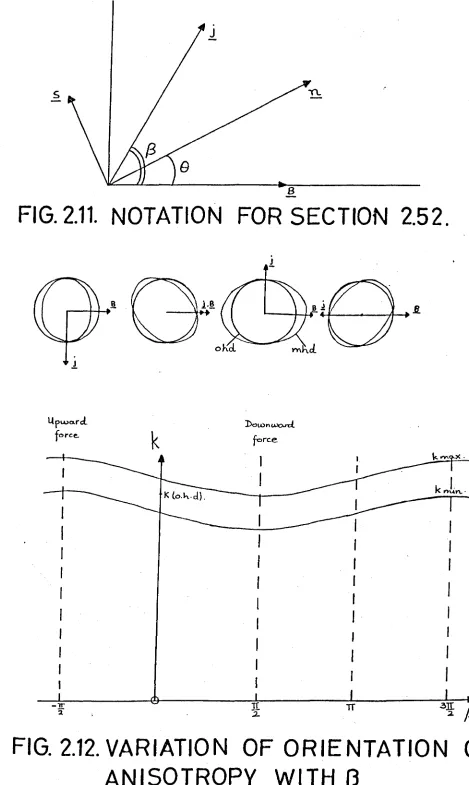
Wavenumber, frequency relationships Anisotropy ratio-frequency dependence Phase-velocity, wavenumber relationship Notation for Section 2.5.2.
Variation of orientation of anisotropy with~
To illustrate the resolving effect of,the wave on j and B
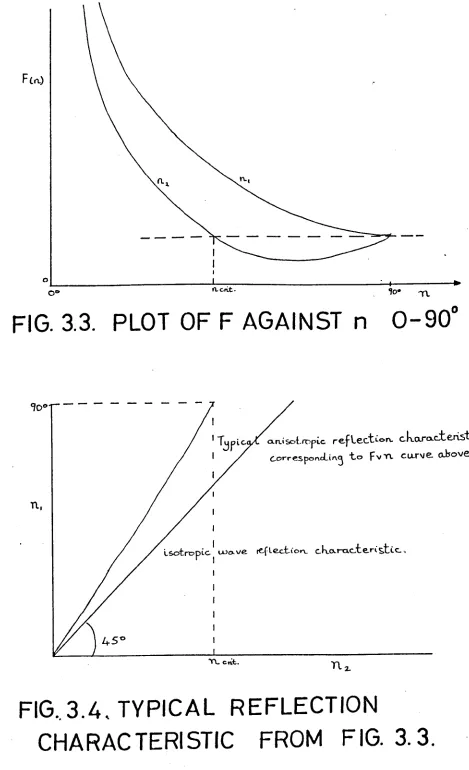
Reflection construction - anisotropic waves Reflection construction - isotropic waves Reflection function F v n, 0 - 90°
I
.
:3.4
Typical reflection characteristic, from fig.3.3.
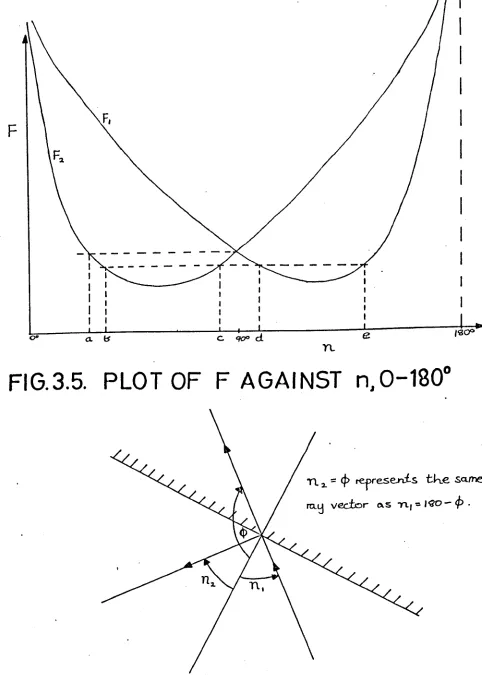
3.5
Fv n,
0 - 180°3.6
To illustrate the meaning of n>
90°
3.7
Notation for analytical solution of reflection problem3.8
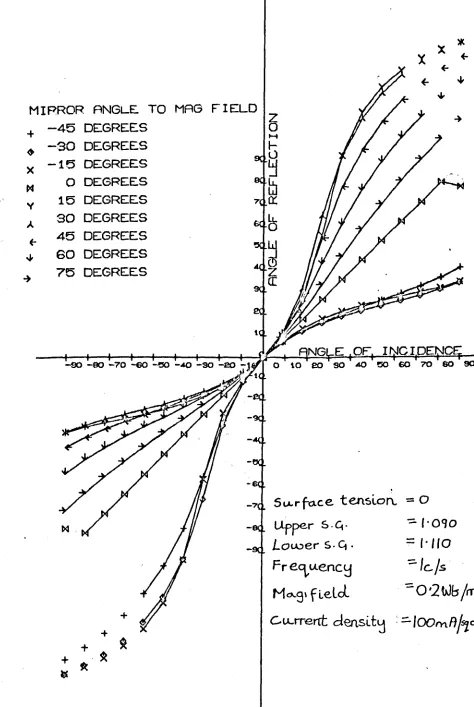
Computed reflection characteristics3.9
Wave reflection pattern when r>
90°3.10 Wave pattern after initial disturbance - ignoring surface tension 3.11 Computed constant phase lines after initial disturbance - mercury
3.12
Detail of fig.3.11
(c)(vi)
3.14
Notation for refradtion problem3.15
3.16
3.17
3.18
3.19
'.3.
20
3.21
3.22
4.5
4.6
4.7
4.8
4.9
4.10
4.11
4.12
Notation of numerical solution, line source
Computed plots of group rays, line source, linear variation of ~
Computed plots of group rays, line source, quadratic v~iation of
'If .
Computed plots of group rays, point sourceLamb's typical ship wave pattern Notation for Lamb's method
Notation for Ursell's method
To illustrate method of plotting lines of constant pbase
.
°
Typical H.H.D. anisotropic ship ...rave patterns,o<.= 0, 900' 0
Typical. M.R.D. anisotropic ship wave patternst~=
.-15
,
.+
15
'1
30°, 45°, 60°, 75°,
Total anisotropic ship-wave pattern to be expected. Computed wave crest patterns for the fish-line problem
Photograph - Tank for mercury experiments
Photograph - General view of equipment for mercury experiments Optical path for wave observation in mercury experiments
Photograph - Typical wave pattern observed in mercury experiments Photograph - General view of ancillary equipment
Photograph - Vie\V"of Relmhol tz Coil magnet Magnet conductor section
Photograph - Flow monitor
Magnet protection electrical circuits Magnet calibration curve
Axial field plot Transverse field plot
4.15
4.16
4.17
4.18
4.19
4.24-4.25
4.26
4.27
4.28
5.5
5.6
5.7
5.8
5.9
5.10
6.1
6.2
(vii)
Sketch of details of large tank Photograph - Large tank in position Photograph - Smaller tank
Photograph - Overall view of equipment Photograph - Plungers used to produce waves Expected flow produced by disturbed surface
Photographs - Anisotropic waves from a point source Photographs - Waves from a line source
Anisotropy ratio plotted against the parameterA~
ufg
Photographs - Waves from a line source, different ~rientations Wavelength ratio plotted against orientation
Sketch of false floor for wave refraction experiment Photographs - v/ave refraction
Photograph -'attempted wave reflection
General notation for m.h.d. Rayleigh Taylor problem
The effect of inclined ~ upon surface inclination, notation Variation of surface inclination with magnetic field inclination Plane of instability when heavier fluid is lifted above lighter fluid by j x ~ force
Comparison of menisci for different j
x ~
forces Comparison of menisci for different liquids'2)'
Typical tank configuration for
~~;6
0~'
Predicted surface profile for ~~
=F
0Mathieu function stability diagram
jB to produce instability for a given ~
min
r
(viii)
6.3
Photograph - depth probes 6.4 Circuit for resistance probes6.5
Typical calibration curve for resistance probe6.6
Circuit for T-probe6.7
Photographs - Effect of Teepol on meniscus6.8
Surface profiles plotted using resistance probe6.9
Photograph -i~
=/:::. 0 instability in large tank6.10 Photographs - Sequence to show 'bridge' instability
6.11 Photographs - Interfacial instability when
~=F-o
6.12 Photographs - Effect of magnetic field alone on .fluids of different
J1
6.13
Photographs - Typical photographs from orientation experiment 6.14 Plotted results of orientation experiment.TABLES
(ix)
NOMENCLATURE
Other symbols used occas\,ionally will be defined as used •.
-li
I1agnetic field strengthc Phase velocity of waves
C
Group velocity of waves g acceleration due to gravityh depth of fluid
i unit vector in the vertically upwards direction points
Variables definingl in the Electric current density
numerical solutions of
"
k,!f_ vlavenumber,wavenumber vec tor
)11-)1,
--_;;..__- a type of dynamical viscosity term
f-a.-f1
Instability time constant or frequency (chapter
5)
Mn
n Co-ordinate "axis normal to a given surface
p Pressure in fluid
p
p
Point in a numerical solution Stress (normal and shear)
s Co-ordinate axis lying along a given surface
t
Timeu,U Speed of travelling disturbance Fluid velocity
x
Dummy variable in computations for shallow fluidsx,y
Horizontal co-ordin~te axesz Vertical co-ordinate axis
Surface tension
Angle between 'mirror' and ~ direction in
§
3.2Angle
between 'ship' direction and&
inj
3.5
(x)
j5
Angle between j and ~ if not assumed as 90°j)
Angle used in ship wave solution, for§
3.5.2 see fig(3.20),for
§
3.5.3 and 3.5.5. see fig(3.21)E
The difference in the value of a parameter across an interface. Dirac's delta function
A small quantity
Surface or interface level Angle between
k
and ~e
Angle ~ makes with horizontal inS
5.2.2A
Wavelength 1Viscosity
Hagnetic Permeability in
S
5.3.4
-,
Kinematic viscosity
jA1
+jJ..t
-- - a type of kinematic viscosity term
p,
+f1
-Density of fluid
i:
Summation symbola
FrequencyCJ Fluid conductivity in
S
5.2.4Velocity potential in the wave solution Phase function (chapter 3)
Surface angle to the
-1 Ca
tan -- in
Ck
horizontal in
"
Part of velocity 'potential' term in viscous waves solution Vorticity
(xi)
Subscripts
:-i,j denote co-ordinate directions in vector differential expressions k denotes wavenumber direction
n denotes normal to wave crest (ch 2) n denotes normal to surface (ch
5)
p,q denote directions parallel and normal to the 'mirror' respectively in
S
3.2
s denotes along wave crest (ch 2) s denotes in plane of surface (ch
5)
0( denotes all relevant co-ordinate directions in 'summation
terms
e
o
1
2
1
2
normal to wavenumber direction "
indicates value of parameter at surface or interface denotes j direction in
§
3.4
denotes B direction in
S
3.4
(xii)
ACKNOIVLEDGEHENTS
I wish to express my thanks to all those who have contributed to the development of the work described here, and towards the production of the thesis itself.
In particular I must thank P~ofessor J.A. Shercliff, my supervisor, who first suggested the subject of H.H.D. anisotropic surface waves as a topic for research, and who has guided and encouraged me throughout. Thanks are also due to Dr. C.J. Alty for help with practical arrangements in the
laboratory.-J-;r.P. Worsnop of U .K.A.E.A., Culham, supervised the -, design and construction of the Helmholtz Coils described in
Chapter
4.
Various members of the workshop staff in the Warwick
until success was achieved. The cheerful assistance of Mr. Colin Major University engineering department helped to build the equipment
described in the thesis. HO\...ever, in this respect I pwe the biggest debt of gratitude to Hr. Alf. Webb who not only helped to make the equipment work smoothly through his skill and effort but also encouraged me to persevere with the experimental work _
in developing the equipment, and of Nr. Alec Ross must also be acknowledged.
I thank Hr. Colin Lovatt for help in processing the photographic records of wave patterns. Tharu{s must also go to Miss E. Peatman who willingly ruld patiently typed this thesis.
The work was carried out whilst I \...as on a research studentship from the Science Research Council, whom I thank for
i'
,
financial support.
Finally, I want to thank my wife, who helped in drawing diagrams and other editorial work on the thesis, for her patient encouragement and support throughout all this work.
1. INTRODUCTION
1.1.!he
Neture and Scope of the Research
Problems in magnetohydrodynamics
(M.ll.D.)
can be loosely
ditided into three types;
those of kinematic H.ll.D. where the'
motion of a conducting fluid which influences the electromagnetic
~ameters
is giTen ab initio,and
essentially the solution is
merely an exercise in electromagnetic
field theory;
those where
the problem is basically one of fluid mechanics, with the Lorentz'
(j
x ~ )
force, imposed and invariant from the start, acting as
one more (albeit possibly rotational) force acting on the fluid
along with pressure gradients, gravity etc.;
and those w~ch
exhibit a true 11.H.D. coupling where the fluid mechanical and
electromagnetic
equations are interrelated and cannot be solTed
independently.
The research presented
inthis thesis is
basically to do with problems of the second type, although in
fact the phenomena described could not occur were it not for
a particular mechanism whereby the fluid mechanical parameters
feed back to influence the electromagnetic
ones.
The subject is the study of the waves, instability,
and the stationary profile of the surface, or interface with
.an insulating liquid, of a conducting fluid which is subject
to an imposed magnetic field and carries an imposed electric
current, such that the resultant
jx ~ force is irrotational.
To the extent that current and field are both imposed, the
•.'
problem is of the second category, but the particular coupling
effect 'referred to above is that the current always tends to
"fill" the conducting fluid, and so at the surface of the
fluid-it is always to be found parallel to the surface.
" "
2
-In this way the fluid motion, or more strictly the motion of the liquid surface, is able to influence the electromagnetic
forces, and the result is strong anisotropy in the wave dispersion and instabilities.
The basic phenomenon of anisotropy 1n the above circumstances has already been reported by Shercliff
(1969)
in the case of waves, and in instabilities by Lemaire
(1963)
and others. The original theoretical work in this thesis has been to examine some of the implications which this anisotropy has beyond the simplest cases already solved •.
"
Thus a number of classical surface wave phenomena have been
applied to the case of anisotropic surface waves, with interesting results. In the stability problem an attempt hqs been made to study the effect of small variations in the configuration of electromagnetic parameters upon the instability motions, with the result that novel instability modes have been discovered.
The experimental work has been to demonstrate the
anisotropy, which has not been done before, to show its' influence on other wave phenomena, and to discover what effect it has on various configurations of instability.
'.2.
The Evolution of the ResearchThe whole of the work reported here grew out of an initial attempt to demonstrate experimentally the existence of anisotropic surface waves. It soon became apparent that further theoretical work needed to be done to predict accurately the practical
3
-Most of the work has as its goal the academic aim to
inquire, learn and verify;
it is not related very closely to
current technological needs, but since M.H.D. is a relative-ly.
new, and still largely uncharted subject, it was thought well
worthwhile to explore this corner of it relating to free surfaces
and interfaces under imposed
jx B
forces.
As far as is known,
the phenomena under investigation do not occur naturally in the
universe.
In
the instability work
inparticular, although the
results are presented in a lo~ical sequence, it would be f~se
to pretend that the particular problems dealt with \"ere
inpractice posed, solved, and experimentally verified, in that
order.
Rather, only when the instability mechanisms were
better understood through a combination of theoretical study
and experimental work, 'and the answers effectively obtained,
could the questions be posed
inthe '"ay set out
inchapter
5.
Thus the overall philosophy with which the research was approached
was one of going step by ste~, asking questions and finding
answers as the understanding grew, rather than starting with
the research mapped out from the beginning.
The interplay
between experimental and theoretical work has fostered this
approach, which is somewhat unusual in
t-l.H.D.,a subject
inwhich
it is not often easy to match experimental and theoretical progress
and let each influence the other.
One practical aim which does lie behind the wave experiments,
"although not developed as yet, is that of using the anisotropic
4
-for the general study of anisotropic waves
inphysics.
It was
this Rim which prompted the theoretical study of the application
of the anisotropic
dispersion relation to classical surface wave
problems, since these could be the very things used to visually
.demonstrate
the sometimes unexpected
properties of anisotropic
waves.
Finally, it is worth recording
that a ten month delay
inthe delivery of the central piece of equipment, the large Helmholtz
coil magnet system, has seriously limited the progress
inexperimentally
demonstrating
all the wave phenomena it was hoped to show.
Layout of Thesis
"The thesis is in two broad sections, chapters 2, ,and
4
on
anisotropic
surface waves, and chapters
5
and
6
on the M.H.D.
Rayleigh-Taylor
inl3t~hility and related
pr-obl.ema,Ch"lpter 2 is
':ldeb-dlc,.lstudy
('Ifthe basd,c anisotropic
wave problem,
RSa preliminary to the experiments,
and so contains
Borne of the work alre,9.dydone
byShercliff,
as a basis, but the
rest is original, computing and plotting theoretical dispersions
involving surface tension, the solution involving viscosity, and
discussion on the nature of the anisotropy.
Chapter , moves on to deal in more general terms with the
application
of the anisotropic dispersion to classical wave problems,
and is more
enexercise in kinematic wave theory than M.H.D.
There is a review of methods of wave kinematics
developed by others,
and then these methods are applied successively
to
(a) the reflection
of anisotropic
surface waves,
5
-i.e. the pattern of waves to be f01md a given time after an instantaneous point impulse or point surface displacement, (c) the refraction of waves due to j varying in a plane normal to
,!!,
and(d) the problem of finding the pattern of waves when a disturbance moves steadily across the surface - the "ship wave" problem, or when account is taken of surface tension, the "fish line" problem.'
Chapter
4
describes the experimental work to demonstrate the existence of anisotropic surface WllVes, and to show soma of the phenomena of chapter3.
This covers 'the consideration of possible experimental approaches and choice of suitable parameters, the design and operation of equipment, and the results obtained.Chapter
5
covers the theoretical aspects of the work on th~ Rayleigh-Taylor instability, with a section on the effect ofj x,!!
forces on the shape of stable liquid surfaces, a brief resum& of the simple H.ll.D. instability case already solved, and then investigation into the effect on the instability of varying
j and ~ whilst still maintaining irrotationality.
In chapter
6,
the experimental work on instabilities is detailed, including a description of the equipment, the development of surface-height sensing probes, and a novel large-amplitudeinstability which was discovered, as well as attempting to verify the phenomena predicted in chapter
5.
Finally, brief conclusions are drawn in chapter
7,
along with suggestions for further work.Where possible figures are bound next to the relevant pages of script. Some information, not considered relevant to the main text, is relegated to the appendices, notably specification of '.
6
-which are simply copied out.
Since the programmes were
merely used as tools to solve lengthy equations, both directly
and numerically,
and to plot out results, no attempt has ~een made
to describe their operation except the numerical plotting of
group rays in chapter
3,
since computing at this level cannot be
considered an end
initself, but merely a means of solving
problems it would be otherwise time consuming to solve by hand.
",
-w"
7
-2.
ANISOTROPIC SURFACE WAVES UNDER A VERTICAL
jx
B FORCE
2.1.
Introduction to the Problem
2.1.1.
Outline of chapter contents
In this chapter, the basic theory of anisotropic surface
waves
ina conducting liquid is examined.
When a horizontal
.
magnetic field and horizontal electric current are imposed on an
electrically conducting liquid, producing a vertical electromagnetic
force, waves on the surface of the fluid, which must be excited by
external means, propagate at different speeds in different directions.
The foundation of this theory is the work of Shercliff
(1969),
the
salient features of which are outlined for completeness
in'2.2~ .•..
".
since they form the basis of the rest of the original work relating
to the anisotropic surface waves'.
In 2.3 the analysis has been extended to cope more
realistically with experimental conditions.
Theoretical predictions,
.
are obtained from a dispersion relation for waves at the interface
between two liquids, with surface tension taken fully into account
and an attempt has been made to analyse the effect of.viscosity
inboth liquids.
In 2.4 the computational solution is described and polar
plots of phase and group velocity and lines of constant phase ~e
presented, along with a discussion of their implications.
In 2.5 the fundamental nature of the anisotropic effect 1s
discussed, in an attempt to isolate the true M.H.D. aspect of the
phenomenon.
Finally, the effect is considered of varying the angle
between the imposed magnetic field and electric current directions, .
for the practically possible case involving surface tension.
,cThe aim of the work
inthis Chapter has been to take
the-theoretical base of Shercliff, and modify and present it
ina form
· 8
-2.1.2. B~sic assumptions and approximations made
These are the same as those made in Shereliff
(1969).
Small amplitude waves are considered in every cl'l.seso that only the linear terms of the hydrodynamic perturbation equations are necessary.
,
The magnetic field is imposed horizontally and is supposed I steady and uniform throughout and the electric current due to an applied D.C. electric field is assumed to be horizontal and of uniform density throughout the conducting fluid in the undisturbed ..state. Thus the liquid surface is normally at rest horizontally
under gravity and vertical irrotational j x D forces.
The magnetic induction due to the imposed curr~nts is assumed negligible compared with the applied field, and induced currents due to wave motion in the presence of the magnetic field are also neglected. These assumptions will be justified later in
chapter
4.
In general when the surface is disturbed vertically the distortion of the current density field will give rise to rotational
j x
.!!
forces but we shall assume the waves to be of small enough amplitude for this to be ignored.2.2. Previous lvork
2.2.1.
General LiteratureHelcher (1963) gives a fairly comprehensive description of field coupled H.H.D. surf~ce waves \'Ihichin some cases are anisotropic but those are a different phenomenon from the one under consideration here, being. for cases where the electric and magnetic fields are not effectively independent, and are an integral part of the wave
propagating mechanism.
9
-2.2.2.
The basic dispersion relation
(Shercliff.
1969)
Using the notation of Fig. 2.1. we consider a plane wave
train of frequency rowith normal
inthe n direction, trougns and
crests in the s direction.
js' the component of imposed current in the
s direction will not be perturbed by the waves whereas
jis perturbed
n
in the z,n ~lane,. and
infact in this plane, the current at the surface
follows the surface profile.
Thus it follows that curl
(1
x ~),
( =
(~.grad)
1
since div
1
=
0 and ~ is uniform) has zero
8component.
Now the linearized perturbation equation of motion
is:-()" J .
B
.
f
d~
+ ~
f
=
j_x_ -r'3 ~
• ••• 2.1 .neglecting viscosity, with all variables harmonic functions, of timd
h
is a unit vector in the
+
z direction.
Taking the curl of (2.1) gives
which has no s component, and so
=
0 which requires w
=
0 if
1,\is a harmonic function of time.
-s ='s
Therefore it is possible to define a velocity potential
~ (z,n,t) for the irrotational flow in the z,n plane.
Now
lx
B in (2.1) may be expressed as
-jB
i+ j'x
B
+j'
x
B
s n- - -8 - -n
where.it is the current vector in the z,n plane.
jt x B
acting
n
J:iorizontallympy be neglected as small in this small amplitude
approximation,
whilst it should be noted that
j'x B
will be
irithe
- -s
z,n plane, and at the surface will always be normal to the surface.
Thus (2.1) may be expressed as
:-()9>
g_rad
(P
~t
+
P
+
(f~
+JsBn)2)=
l'
x
Bs
••••2.2
If this is integrated along the surface z
=
z ,
j'x B
o - -B
contributes nothing, and if the ambient pressure above the surface
j
I e.j ~
+jn.
1-
-
-'Z
" JT\.
1
L(U"Lt ve.c.tor)
-
10-with
. I
and hence all the variables
are harmonic functions of n.
":I.
~ Za
k1.
For surface tension
c:J... ,at the surface, p
=
-ex. ~
7\.\, = ol.Zoto a first approximatiOn.
Hence, at z
=
0(applying the classic linearization
process such;
that all variables are the same at z
=
0as at z
=
z
)
o
'.
••••2.3
(2.3)
is effectively the boundary condition on pressure
at
the
surface.
.
The motion of the fluid as a whole is defined also by the
two-dimensional
Laplacian
\7
'1.¢
=
0 ,
•••• 2~4.since we assume incompressibility,
andby the boundary
conditions:-_ ~ _ ~"ZoV.,_ -
~z. -
~
~
"dz.
at
z=
0' •••• 2~.5
and
= 0at z
= -h
•••• 2.6.
in a bounded fluid of depth h.
(2.4), (2.5)
and
(2.6)
require a
form:-cf
=
C
r
9
e,,(Cot -
kfl)
f
sink
k
2.HOt.)..
kit
"",.,I..
b] ...
;2.1
'For
(2.3)
also to be satisfied, a constraint relating ~ and k
is required, and this is the dispersion relation.
Substituting
(2.7) in (2.3) gives
:-1
(k~o(.""
f~
+js
B,,)
•••
2.8
N.B. A somewhat different approach to solVing for the dispersion
relation may be found in chapter
5
where the stability equation is
effectively the same as the dispersion relation.
Thus it can be clearly seen that of the field and current
components, only js and Bn affect the dispersion relation.
This'"11
-produces anisotropy of wave propagation, since the magnitude of
"
j B
varies with the orientation of the wave number direction
Ie ,s
n
relative to the imposed
jand B fields, and given that oo-is fixed
there is directional variation of
I~I
2.2.
3.;
Predicted results
Shercliff went on to eValuate the sort of results to be
expected from the dispersion relation
(2.8)
in both the case of
"surface" waves on a deep fluid, where the wavelength is short
compared with the depth;
and "long" waves in shallow fluid,where
the depth is small compared with the wavelength, and vertical
accelerations
can be ignored; i.e. tanh kh
=
1, and tanh kh
=
k h
'.
respectively.
oB
Taking
i
=Las
adimensionless parameter indicating the
f3
relative strengths of J_x
Band gravity forces, and,ignoring
surface tension to simplify the calculations;
and considering
the case where
jand B are imposed mutually at right angles, to
-
-
,produce
1-
x.!!.
upwards, equ.
(2.8)
reduces
to:-=gk
(I -)'
Cc":)'1.e )
for surface waves and
••• 2.9a
2
00
for long waves,
•••
2.91>
where
e
is the angle between the
k.
and ~ directions.
This configuration of imposed fields produces the greatest
degree of anisotropy, although there is
astability limit of
)5<
1
if the net force on the fluid is not to be upwards, causing the
,
Rayleigh-Taylor
instability to occur.
Shercliff presented the anisotropy visually
inpolar plots
of phase and group velocity,
(see
2.4.1.
and
3.1.3.)
and these are
shown
infig.
(2.2),
adjusted to suit the particular case of the
1
1. d.i.rec.ti.,."
(i)
Pha.se Ve.lo~i.t~
r
a)surface waves
a
I
i
ti)
Ph.a.se.
V L
.
t
-
j tlirf".ctio",-...
e
OCL ~. 1"1
V L
.
t
J cl~,.!:C-t';ot\,OJ)
G
rou~e
OCL. ~. ..b)long waves
.FIG.2.2.
SHERCLIFF'S'
DISPERSION PLOTS
12
-is drawn, and the complete picture -is obtained by reflection in
both axes.
The salient features to note as characteristic of the
dispersion are that waves propagating in the
jdirection are
unaffected
by the
jx ~ force, whilst those in the
B
direction are
most affected, to the degree that when
~= +1the waves will not
" ,
propagate at all.
For wave~ in ;-ther directions ,-the eff;ct is
somewhere between the two extremes, and of great interest is the
fact that the phase and group velocity are not in the same direction.
Lines of constant phase due to a continuously oscillating
point source, i.e. the trough and crest pattern which would be
observed in an experimental situation, are identical in shape to
the polar plot of group velocity for the dispersion relati~n6
specified by eq. (2.9).
~
"
"
2.3
AdaptAtion of Theory for Practical Situation
2.3.1.
Waves at a two fluid interface
Now the first'aim of this project was to demonstrate
experimentally
that the anisotropy of B.Il.D. surface waves exists
.,
at all, and to do this I had to determine how to show up the.
anisotropy
to best advantage.
From some of the practical
considerations
to be found
inchapter
4,
it became clear that
"
probably the best way to obtain suitablp. waves was at the interface
between two liquids of very simil~r densi.ties, one electrically
. conducting,
the other not.
Usin::;tl:ese, t~1.e
gravity force
influencing the waves could be reduced by an order of magnitude,
making it practically !,>ossiblefor the
jx ~ force to "compete"
with the gravity force.
In this case, the dispersion relation is obtained assuming
the anisotropic effect of
jx B as discussed above, simply adding
-
-2
the
jB cos
e
term where appropriate to Lamb's analysis
(Lamb 1932 Art. 2.31 ) and it is supposed therefore that iand
B
·fN·f).Tht, ,..~
~~
,-L:,~~ ~ ~,9.
i..?'~l
~
~
~
U1.. ~~
~
w-k ~~
t.~ ~~e'Otk ~
~
..a ~~
13
-are applied mutually at right angles and that j x B acts upwards,
-
-
.
and
e
is then the angle between the wave direction and the magnetic field.If subscript (1) denotes the upper non conducting fluid, and (2) denotes the lower conducting fluid, the analysis is as '
follows.-In the upper fluid,
V\1>,
=
0 In the lower fluid, \7~<P~=0)
)
)
the wave number vector ••• 2.10 In a vertical plano containingt
being a two dimensional velocity potential, as we saw in Shercliff's analysis.The equation of motion
is:-grad
(f1~+:P'
+ f'1~Z_)
=
0grad
(P:z.~+l''I.+[F2.~-~BOo'lSJ2..)
= /
x ~sAt the interface,
1.
x ~ is always normal, 60 integrat?-ng~ ~, •••: 2.11a
•••
2.11b .(2.11b) along the interface z
=
p,..<
;P
t"")z.Zo
.
+.plo
+(P2
gand (2.11a) gwes
fl( ~~\"ZO
z
gives:-o
2
- jB cos
e)
z=
0o
+:p,
+p,
g z0 = 0•••
2.12•••
2.13 Now the interfacial condition on pressure at z=
0is:-b~Zo
r
2.=
PI -
0<. ~ 'l'\.z. • •••2.14.-••• from (2.12), (2.13) and (2.14)
Jt
••• 2.16But
Now if the interface
•••
2.17(2.10) can be solved using (2.16)
~
boundary conditions ~z
=
0 at z = + hl and~d (2.17), with the
"?J¢,_
-= 0 at z
=
-h
d2. _2
14
-LW£.
t(wt-kon)f
k
k
]
Thus ~,
=
k.e.
- -
s~
2. - coth.h,
co,!;h.
b~ol
rl, \.w
£.
i(w
t: - k0t\)f
Ik
]
'"1''1.
=
T ~
--
[SiTU\. "2.+c.oth
khl..
C6Sh.boa.
r0 •• 2.18
For (2.18) to be compatible with the boundary condition on pressure, (2.15), the constraint necessary is the dispersion relation ro
=
f(k)
obtained by substituting (2.18) in (2.15) and(
~)
assuming that
"dt 2.a-z.o
Hence:-••• 2.19
From this it can be seen that the two fluid case is essentially the same as that of the surface waves on a single fluid in contact with vacuum or gas, since had we introduced,
j x B acting downwards in the upper field, l-l1ththe lower fluid
-
-non-conducting, the dispersion relation would have been identical (showing that the anisotropy term j B cos2
e
is independent of the actual fluid parameters used).The final choice of experimental parameters is discussed in chapter
4,
but it is worth noting here that the degree of anisotropy obtainable will depend upon the right hand side of (2.19),in°
». particular the ratio
t-Oompardng rthd.ewith the single fluid case it can be seen that if
(f'l..-f1)
is made very small, j B can compete with it all the more easily, though of course j B must not exceed(f'l. -
f1
)g or else the Rayleigh-Taylor instability occurs. Whereas in the single fl~id case negative j B (i.e. downward acting j x B )15
-upward force, here, if
(P1-
f1)g
is an order of magnitude less thanj Bt as is possible by almost equalising the two densities, then a large degree of anisotropy is obtainable with a downward j x B too,
-
-with no problem of inst"1.bility. Cert~inly the possibility of varying the ffi3.C;nitude of the term
(f'2.. - (',)
offers more scope for obt<:>inin:!suitqble ex:,erimcntal parnmet ez-s,2.3.2. The effect of surface tension
Shercliff, to show up the b".sic phenomenon to best advantage, and for ease of manipulation chose to ignore surface tension effects in plottin5 the sort of shapes of wave pattern to be expected
(fig. 2.2). Whilst this is justified for that reason, ;t is misleading when approaching the problem of actually generating such shapes in practice. One might initially assume that given a large enough space. dimension, waves of sufficiently long wave-lengths could be produced for surface tension effects to be of no practical significance. However in the extreme cases of anisotropy the theory predicts zero or nearly zero wavelength in the directions where the j x B force has most effect. So that however long the usual wavelength of the system is, there would always be present some wavelength short enough to be affected by surface tension. However- small surface tension is, the more severe anisotropv could not be achieved in practice for this reason.
2
Looking at eq. (2.19), it is the size of the dlk term
2
compared with (
('2.. -
f1
)g - jB cosa
which determines the extent to which surface tension is important, but of course k itself ie the dependent variable in this equation for most situations16
-possible
to determine the overall effect which surface tension
does have on the pattern by simply introducing
some sort of
correctine
factor.
In fact it is true to say that here-is
a fluid mechnnics problem where the exclusion of surface tension from
the analysis has a qualitative as well as quantitative effect.
Thus
eq.
(2~19)
must be solved as it stands, and this is done
in2~4.
2.3.3.
The effect of Viscosity
Since
inthe search for suitable experimental liquids
a number of otherwise possibly useful ones had a viscosity an
order of magnitude higher than water, which is usually ~on61dered
inviscid
for surface wave propagation problems, it was thought
necessary
to determine by analysis what effect, if any, viscosity
has on the anisotropy.
Moreover,
in the two-fluid case, the
wavelength
for a given frequency is less than for the free-surface'
case, and it is not immediately
obvious whether this would result
inmore or less damping of energy by viscosity, whilst there is also the
effect of shear stresses at the interface to be taken into account.
As far as coUld be determined,
the problem of solving the
'
";
wave equation, with viscous effects, for the interface between two
liquids, has not been tackled
inthe literature and so it is set'out
below, using Lamb's analysis for the free surface case as a guide'
(Lamb
1932 ~ 349).
The axis notation is es shown in fig. 2.1, subscript 1 for
upper parameters
and variables, 2 for lower.
The equations of motion
inthe z, n plane
are:-•••
2.2Oa17
-and diVe !!1
=
dive !!2
=
0
••• 2.21
where the vectors are two dimensional with
z,
n components.
(2.20) and (2.21) are satisfied by
d
q,o(
'd
Yo(.
a
<Po*. ~YoI,
r.
Uo(.'l1.
= -~
-
~£.. 'U",2.
=: - ~'Z.+
d1"\.
Lex.=
1, 2J
•••
2.22.
with
V\p
=
0,t~
~
\J"2twhere
Vl.
is a two dimensional Laplacian operator,
•••
2.23
with
'P1
=..:..:a. -
del>
gzP1
dt
1>'1 ~~2.
(g
+jB
cos2
e)z
-=
--f'-
~t
f2.•••
and
•••
ikon.
+crt
On assuming the variables to vary as
.e..
the solutions of (2.23) are
:-CA
-b,,"
B
1<:20)
1
e
+ 1 ~~=
ik'l'\. +
crt
.e:
ok
t}
Z>O
l n
+0-e.
cf>'l.
=
(A ~
'f,_ -
(C,-••• 2.25
where
'2.I'l.
0-ltJ1o( -
<
+-Voc.
•••
2.26
It
the fluids hsve infinite height And depth (for simplicit
y)
+
then one boundary condition is for zero motion at z
= -~
Hence B1
=
B2
=
0, and providedtn~has
its real part positive,
18
-Substituting
(2.25) in (2.22) gives
( \ R
-kz.C
-~I-z..)
t:b".u ....
t:)
U.
?It-
- l< 1e.- m,
1e,e.
)
+
(kA
1e--
k-z.I
-",,4)
u«
nof- tr i:
)
LlZ.1 of-
i
<.e,
-e, e,)
)
( kz.
M"2.)
ik'J'\.-ttt-l)
•••
2.27"
Uh1
-
lk
R
'J. -e, t-m:z.
(2-e ~e
)
~
(I
k2'kC
m~"2.)
i.k-~.,.o-t:UZ1
-
<..
A'J..e.
-
L 1.e.
.e:
)
)
If
z ='l.
denote the inter'fa.ce,with ~
= 0the undisturbed level,
~
then
~t
=
u
z1=
u
z2at the interface, is ~other
boundary condition,
and the small amplitude a~proximation is made that
d!l -
(l! "\
-
(u )
)t - 21 )2.::(!) - Z2.. 2=0
"
k .
)
'I
t:k
)
lk'Y\+o··t- (R
..
C
L {')I.·flr - -_(R
-lC
..e
Hence
1.,::::-
er
f t L t-e.
-
er
"l.:z. •••2.28
The other boundary conditions are those due to norma.l and shear
stresses,
viz : -P'l..2.'1.
-
P1Zl.. = 0<..;'l~
and
,
where
0<.is surface tension
•••
,
2.29
But
•••
Substituting
for
pvC.from
(2.24)
at z
=1t,
with
fat
z
=0
(
)
d
Ut\~ ~ U·UI. ~u2.OCfrom
2.25,
and substituting
for
d"Z..
,~'
~
from
(2.27)
gives
R2:Z. /
Pt
=
f_-o-+-~
-2.
v,
kl.] At
+ [~ ~ -
2.
111
km,,]
L
(1
I;1tjp&
=[-o--(~+lB~l.e)~
-2v~k
J
A~+[(3+SB~:Le)~t2~k~1] ~
c,
ft1\.'Z.
==)L,
[2
i
k't
A1 -
(k'4t'W\11.)
e,
J
.
D ••.•
2.31
rl.'M.
==
)1'l.[-1Lk1A:),-(k2t1n1~)C2]
(2.31) in .(2.29) gives, with
j
B
Co?z
8
=
r ,
A1
=-li";l
,C,=
C2.
t~om
(2.28)
[ (f'-
+(>1)
0-+ [ (
f:t -
Pi) ~
+
r] ~
+
(y,_
+!-1)
2 k~
+ ~"
3]
A
1.19
-••• 2.'3
Combining
(2.3~)
amd
(2.33)
to eliminate A1 and C1 we have
(f'.
+
(1)O-(f'.-J')2
k'
+
0'':_J',~4-
k~
-+-
(r:-(',')",' .,_
(re
('.)\k
~(f.-
('0
rk
+~> -f,)(?'
+f,)2
k
'a-
+ '"
k'(P'-('1)
=
4-
k?
(fl."'"
+jL.
'lny{P.j!~
and
frequency without viscosity
for the given wave number k)
•••
2.34
This is the dispersion relation.
The simplest case is.when
jA,
cr- ,
Then
cl
+
w2+
)J1'1:.1
k
'l ~=
0
• •• C1
= -
k'l)}11±
J
k~
V,.,,'). -
(.U l.M=O
•••
This case gives at least an approximate guide·to·the
Bort of beh~viour to be expected
inthe more general case.
For the present, what matters is the extent to which the viscosity
alters the wavelength for a given frequency, as this would alter
the anisotropy, and also the magnitude of the wave damping.
·Both
k~\
Ieffects depend upon the size of the term
vMThe former effect·is negligible for
w2»
k
4
)JMl.Whence
a c -k2){,
+LCV , since the
termiw,
which contains the
anisotropy, dominates the magnitude of
C1.The effect of having two fluids is to increase k for
20
-the viscous term, which effectively sets a limit on the closeness to which the liquid densities may usefully be matched. Similarly,
in the case of an upward force
(r
-ve), the usefulness of increasing the magnitude ofr
is limited, si.ncek is thereby increased in one direction, increasing the influence of viscosity in that direction. However, with a downward force, if the frequency is unaffectedby
viscosity in the o.h.d. case it will be unaffected in theM.H.D.
case. For
en
upward force, it is worth noting that the viscous term will increase as the square of the anisotropy ratio betweenk~
l.smallest and largest wave numbers encountered, so that
)}M
could possibly increase by two orders of magnitude. This' suggests that viscosity may not be negligible even ,...ith the use of fluids such as water normally considered inviscid for wave propagation purposes, and certainly discourages the use of more viscous liquids. The limiting effects of viscosity on the size of frequency and wave· length to be used in practical cases will be considered in chapter
4.
I" The general interpretation and solution of eq. (2.34) is more complex, since after substitution for m, a polynomial
ot
order 8 in
a
is encountered. It is interesting to note that the consideration of two fluids has the effect, via the right hand sideof
(2.34)
of doubling the order of the equation. In practice,some of the terms may well be negligible compared with others, and in chapter
4.
the equatirm will be examined with pertinent v'llues inserted.Thus although (2 •.311-)does not re~dily give a cle'l.ridea of what happens when viscosity dominates, (i,.e. when the problem is no longer a true wave motion. problem, n!J.vingodd order terms in (J comparable in m~gnitude to even order terms), it does enable
ih~
21
-results of an inviscid solution to be tested as to the validity of the inviscid assumption.
2.4
Theoretical Predictions2.4.1.
Note about phase and grou!' velocity and lines of constant phaseSince we are dealing with anisotropic waves, dispersive with respect to direction as well as frequency, distinction must be made between polar plots of phase and group velocity and lines of constant phase (at unit time after that phase has left a point source),
whereas in an isotropic system all would give polar plots that were circles, although possibly of different size. The dispersion relation so far has been expressed in the polar
k
plane, ~.e.ro
=
f(k,a) where k is the wave number of wave crests lying normal to thee
direction. In this situation the phase velocity c=
.ttjk, '
, .
The group velocity, the speed of wave cr-eabs , is in the
e
direction.which may be thought of as the speed and direction of a packet· of waves with a given k and ro or equivalently as the speed of propagation of energy contained in a given ro,
k
mode, has componentsIt.both ptlI'alleland perpendicular to
e.
1
(~UJ.'\
and
Co
=
k
'deA,
c and C(
=JC:+C:)
are conveniently displayed in polar plots • These are C . cle
for a given
~w
(~)e
:- Shercliff
(1970).
22
-relation includincr surface tension, k~ F(e)
G(w)
so that, referring to Shercliff(1970),
the lines of constant phase are not the S3me shape as the polar plot of group velocity. This is because the vector representing the constant phase curve bears a ratio to the group velocity vector which varies with the wave number dire~tion. The line of constant phase may be plottedgraphically by constructine the envelope of normals to the .' extremity of th~ wave number vector ~, but to be able to draw
the lines by computer, the further fact is needed that such normals touch the lines of constant phase at a point whose direotion from the origin is that of the group velocity corresponding to
ok.
;
2.4.2.
Computational methodsTo explore the experimental possibilities, it was decided to solve eq.
(2.19)
to determine what degree of anisotropy would be available from different experimental parameters.a)
Waves in a deep fluidgreater than half a wavelength;
kh
>
TT..1
-<
c.oth.k~
1·1
l
and we may take
w
2=[(P2."f1)~
-lBcosle+oc.kJ·](f~"f&)
"/henh is
h
>
r '
For
w
fixed, this turns out to be a cubic ink ,
or afterrearrangement, in c, i.e.
c.
3 -(ea.-P,)tj
c1.lBeos·e -~
=
0
(p, .. (' ..
)w
('tf-fa1T
The computer was used to solve this for the range of
0 -<
e
<.l:
for varying values of w, j B, f1 ,
fa.
and 0<:tand this range gives all the results by reflection in the
e
=
01T
and
Taxes.
Details of the programme are given in the appendix.The group velocity was then calculated directly from
and
ce
~P1-
1",)'3 -
j.5c.o,'1e
2w
(f,
+fa)
iB
shl'1e
23
-,'11 The group velocity, then, is in a direction
e
+ ~
to therh -1 (
Ce)
B direction, where 't'
=
tan Ck'The lines
ot
constant phase were then obtained as follows.If their locus be (x3,
Y3 ),
at such a time and distance scale that(x
3'Y3 )
is the locus of the perpendiculars from the position, vectors £ (i.e. unit time after the phase in question left the 'origin), and if the locus of ,£ be
(xi'
y
1)'
then x3 = x1 -
ctan ~
sine
and Y3=
Y1 + c tan~ cose.
See fig. (2.3).b) Lon~ waves in shallow fluid
\-Ihenh is small cif ).. , i.e..
kh« 1
then tanh kh ~ kh
for hi and h2 both small,
••• (2.19)
reduces to ())2=[
( fa.-p,
)g -
j
B cos2
e
+
oc.k2]
p,
k"tha.J..,
Ita..
f ..
h,
- a quadratic in
k
2, but again the which is more easily. solublecomputer was used to obtain 8 series of theoretical predictions.
See appendix
•
c) One fluid shallow, the other deep
a qUClrtic. in
k.
but it may reasonably be approximated to
(l
= [_(
Plo -
f1)';} -
iBcosle ....
o«.l/J
k
~h2,WhiCh is now again a quadratic2 ('2.
in
k
•
b) and c) can then be combined
X
h,ka,using a variable
== fl
h .. • fah,into one computation
h~
h,
or
-'fa. p,
solution
FIG.2.3. CONSTRUCTION
FOR CONSTANT
-24-Hence e" -
c1.
[(f~-f'1)<J
-
j1:>
(A.)~eJX -
0(. w1.X
=
0
c
=Jf
i
[(f2. -f,)9 -
jB
~s1eJX +fj[Cp1-f')Cj
-jBCOS1erX\~O«Oxil
C
k
=
[(f~-f1)~ -
}B~s~
e
+
4-o{k'] ~:
kX
o.."J..
C,
=
!
1)
si.n2..9
2
coThe lines of constant phase are plotted as for a).
The resulting ~lots are shown in figs. 2.4 - 2.7 for the ease of mercury with a free surface, and that of a conducting liquid of S.G. 1.100 covered by ~ non-conducting liquid of S.G. 1.080. The surface tension for mercury wns t~ken as 0.5 N/m and for the
other case 0.04 N/m and O.O~~
N/m
were chosen to represe~t a pos~ible range of practically realisable values, the latter case being where a detergent, Teepol, has been added to the c~nducting liquid.The magnetic. field was set at
0.2Wb/m2,
and' the current5'
2oB
density, for the mercury at
5
x 10Aim
(giving ~ ~ 0.82 °1)
and for the other case at 1000
Aim
giving (l ~1.02 which,r-:
f')~though nominally unstable, is in fact stabilized by the surface tension for the frequencies used.
It can be seen that the phase velocity results are of the sarne sort of shape as for the ideal case, but the degree of
anisotropy is markedly reduced, and the group velocity curve, where 6 +
1
>90
0, is of a different shape, whereas the constant phase lines for this case still show the sarne cusped shape.-Cl
•
--..t
•N
(!)
-LL
.~
I-o
Co
o
---~~
o
.
.,.
.Q...4.
...-..._ ..._._
"l.-'". wO'~':)".J'l'
8---~~~---L---~--O~----~--~-:---r71Q
;.,
•
-
.
~.. '
•
..
,
.'
'\ \
/ ".
..
'.
,
.!?
11
....
..
"l\
.
..., .t I
,:'
---'
:;)__ __..,j
:1
_£.::..,....,;:::::.::::;;..----t~
~0"
T
o
a
,.1-.
...
4. __-w
u
Lt
Cl::
W
J-
.
z:J
-0
Qc...
-w
:JW
_JJ-u,
,
OJ:
~t:
!:;~
(/)
i-o
_J
a.
z
o
-(/)
0:
W
0-tf)
-o
LCi
•N
(!)
-u,
~ 09
-£
,..
0£
~ lI)-....
-...
j, G:"3
E
N 0.
.Q0
"
"
"
"
~-
2..:t
8
o
I'
to
.~
-r»
dl~
~ ~
~
\I)
o
....
o< ,.."l.o
J
----~.
_.
.."
-·6
~• ..J 0"
U
~ ~
~
0
~0"
._j
-d
b~
()
-_._-.~
p
Vl
~
..
• ..;J P
-J
<lJ
I/.)
~ ~
d
.s:
Q_
~ ~
d
~ (
0
U
.-\.:;
I.t)
r<
u,
9'
9
FIG.2.6. DISPERSION
PLOTS
(TWO FLUIDS
WITHOUT TEEPOL).
pa.ra.
meters
as
for-
1:,5
ex..cept
su.rfo.ce
tertsiort-O·OL.
tvlm:
__[j)
Ph
a.se
Ve
loe..
i.
t
lj~
'03
j
d
irecti.on
.0( •02.