The Patients' Voice 1
The Patients' Voice:
Analysis of acceptance and general applicability of AAT - programs
as take home version.
Maik Kuhlmann s0159239
University of Twente, Enschede Faculty of behavioral sciences Psychology
First supervisor: Dr.Marcel Pieterse
Abstract EN
The purpose of this study is to find out more about the possible success and necessary design steps concerning an online version of an already existing Approach-Avoidance Task (AAT). The focus of this current paper is hence on examining users´ attitude towards the existing AAT and their motivation to continue training with this program at home. It is also placed emphasis on discovering details about an adequate and popular design of a feedback system that heightens compliance, gives the possibility to stay in touch with the patients and monitor the after-care process.
NL
The Patients' Voice 3
The patients voice:
Analysis of acceptance and general applicability of AAT - programs
as take home version.
how people actually behave (For more details on this matter see Elliot, 1999). Finally the development of dual process theories and a deeper understanding of the goal pursuit concept (P.M. Gollwitzer, 2004) threw a new light into the infamous black-box of the human mind by dividing cognitive processes into reflective (conscious) and impulsive (non-conscious) processes (Reber, 1993, p.219; Hofmann et al., 2007, p. 55). Various research is done that describes the impact of implicit cognition on health behavior explicitly on drinking habits and their genesis (e.g.: Houben et al. 2010; Wiers et al. 2011, p. 490).
Though knowing that a particular behavior is potentially harmful to ones health it is often
nevertheless executed. The reason for such self destructive actions is partly explained by the fact
that health related behaviors are partially guided by automatic and implicit processes which are
not always under conscious control. When this phenomenon is causing harmful addictive
behavior an imbalance occurred between relatively strong automatic and relatively weak
controlled processes. The strong automatic processes or habits then cause a hyperesthesia for
addiction related cues leading to action tendencies which result in addictive behavior. Wiers et
al. (2011) designated three major cognitive biases related to alcohol-addiction: (1) An attentional
The Patients' Voice 5
helps the patients to recover. According to this concept a computer-based AAT program was
introduced in the therapy schedule of the Salus Clinic Lindow, Germany. In the NKT
(Neuropsychologisches Kontrolltraining) version of the AAT program the patients were
instructed to push away alcohol related pictures, thereby generating an avoidance tendency and
to pull neutral stimuli like soft drink pictures to generate an approach tendency. This procedure is
known as an CBM (cognitive-bias modification). The tendencies are caused by the “zooming
effect”. This effect contains that the pictures that are pushed away and pulled respectively shrink
and grow, thereby causing a body reference interpretation (Rink & Becker, 2006). This means
that if the pictures are pushed they seem to quickly disappear in the distance and therefore are
The Patients' Voice 7
monitor the success of the after-treatment. Because of this close contact the clinic knows about the patients´ condition and it is possible to promptly deal with relapses in the everyday life. Additionally it is possible to get an insight into information processing of the patients just after a recurrence by comparing reaction times before and after the event. This helps developing new intervention programs like a counseling interview in case of relapse and gives interesting data that can be used to also design interventions for patients with other afflictions e.g. nicotine addiction and depression.
The present study analyzes three major topics. The attitude that patients have pertaining to the NKT – AAT training at the clinic and the associated interest in a take home version of the program (1). Information about mobile popularity, email popularity and favored amount of feedback are collected to help establishing an adequate reminder-system (2). It is also investigated if patients with other trainings that are also based on an AAT show interest in an internet based after-care program (3). These information help to adjust the take home version of the AAT to the needs of the patients and thereby enhance the probability of training compliance. Additionally the willingness of other patients with other trainings (Obesity - AAT and Positivity – AAT) is recorded to give an evaluation of the feasibility for additional online training platforms in the future that also offer the same ecological and communicative possibilities that the online NKT – AAT version provides.
Method
Participants
The Patients' Voice 9
Procedure
Due to insufficient equipment and no internet access in the clinic the data for this study was collected from pen and paper surveys whose content later was digitized for calculation purposes. After the construction of a concept version it was necessary to adapt it to the clinic´s agenda concerning polls. This was done by two therapists and the director of the clinic. In this process several items of the early version of the survey were deleted to make it shorter and less stressful for the patients. After the approval of the survey it was printed and handed out to the patients during a therapeutic meeting. The completion of the survey took only 10 – 15 minutes to heighten the number of participants. About four patients filled in their survey at a time accompanied by one therapist to heighten the return of the filled in papers. Data was transcribed into an excel format and then copied and transposed to Spss to meet the programs requirements. The data of two surveys was later disregarded in data analysis because several questions were not properly answered.
Apparatus
program. At the end of the survey several questions concerning the access to telephone, internet, email and PC were asked. This makes it possible to estimate the benefit of each possible way to deliver feedback what finally heightens potential participation rate and reachability of the users for feedback and support issues.
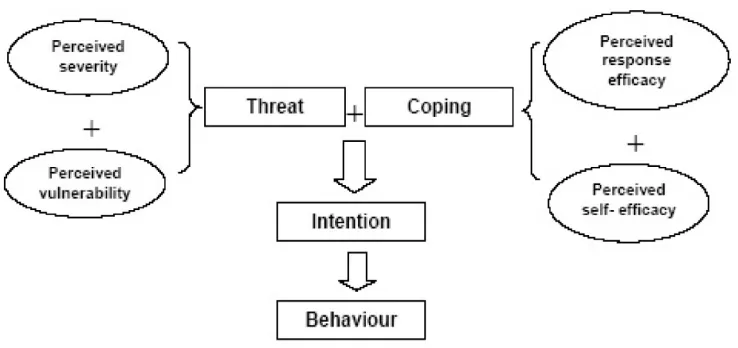
Protection Motivation Theory
The Protection Motivation Theory was originally thought of as a way to explain the genesis of anxiety states (Rogers, 1975). Later versions expanded the theory to other health related areas and mainly focused on the cognitive background processes which mediate behavioral changes. According to these reworked versions of the theory threatening health related events trigger possible coping reactions that reduce or abort the risks (Boer & Seydel, 1996). In this study PMT is used to determine the likelihood of accepting follow up care. This involves measurement of the perceived severity of a threatened event, which in this study is operationalized as relapse (a). The perceived probability of the occurrence, or vulnerability which in this context depicts the chance of a relapse (b). The perceived efficacy of the recommended preventive behavior in form of the respective AAT program the patient has experience with(c). And the perceived self-efficacy i.e. the level of confidence in one’s ability to undertake and continue the recommended preventive behavior in form of an approach avoidance training (d).
The Patients' Voice 11
patients can me motivated to engage in an online follow-up care program. A helpful addition to analyze the perceived efficacy of the device are the questions concerning equipment status and experience at the end of the list which help finding the right medium to deliver support and monitoring features of training progress.
Figure 1. (Lee et al. 2007)
Technology Acceptance Model II
[image:11.612.121.490.313.487.2]Design
The Patients' Voice 15
Results
Constructs
active internet connection. 70.4 % possessed a telephone connection and an overwhelming majority of 92.6 % own a mobile phone.
General outcomes
Perceived Self Efficacy had a very low mean value (xZ¯= 1.7, s= .6465) which implies that
these patients in general feel confident to continue after care programs. Attitude towards the AAT was restrained when averaged over all cases (xZ¯ = 2.576, s= .7). The user experience concerning their computer skill were average (xZ¯ = 2.4383, s= 1.0). The usefulness of the AAT program was considered as quite low considering that a likert scale format from 1 (best) to 5 (worst) was used (xZ¯ = 3.33, s= .796). Frequency of feedback (xZ¯ = 2.9086, s= 1.195) was not wished as much overall as a higher amount of feedback (xZ¯= 2.676 s= 1.242). Mobiles (xZ¯=2.78, s= .92) are more popular than emails (xZ¯= 3.25, s= 1.21).
Table8: Means and std. Deviations of the main Variables
Variable
Mean
Std. Deviation
Self Efficacy towards follow up
1,7202
0,64648
Attitude AAT
2,5765
0,69969
PC skill
2,4383
1,0012
Usefulness AAT
3,3292
0,79625
Frequency Feedback
2,9086
1,19501
Amount Feedback
2,6759
1,24213
Popularity Mobile
2,7802
0,92065
The Patients' Voice 17
Age
Mean age was 47.69 years, s= 8,585. A correlation using Spearmans rho (ρ) was executed. PC skill (r =,255 ; p < .022) and the popularity of mobiles (r = .372; p < .001) differed significantly when tested in correlation with age (alpha <0.05). A Kolmogorov-Smirnov test indicated that the data was not normally distributed (df= 10, p= .006) with a kurtosis of ,222 of and a skewness of -,651 concerning age differences. Therefore a nonparametric Kruskall – Wallis test was conducted relating the patients age to the data. Differences were found for PC skill (χ² = 11.496, df= 2, p= .003), perceived usefulness (χ² = 6,599, df= 2, p=.037) and the popularity of mobiles (χ² = 14,632, df= 2, p=.001). A pairwise comparison using a Mann-Whitney test was conducted to examine the direction of distribution. All comparisons showed that younger patients had better PC skills (Z= -2,927, p= .003), perceived the AAT as more useful (Z= -2,387, p= .016), and mobiles were more popular in this group (Z= -3,448, p= .0001).
Level of education
(Z= -2,374, p= .018). The popularity of mobiles was normally distributed and therefore tested with a t-test after adding up the two lower education levels that had no significance to each other in a prior tested anova. This test showed (t= -2,059, df= 79, p= .0427) that more educated patients significantly dislike mobiles more than lower educated patients.
Total time addicted
A correlation using Spearmans rho (ρ) was executed. PC skill (r =,255 ; p < .028) and the popularity of mobiles (r = ,360; p < .0001) differed significantly when tested in correlation with the total time addicted (alpha <0.05). PC skill was not normally distributed (df= 36, p= .006) and there were no significant differences (χ² = 5,662, df= 2, p= .059). The popularity of mobile showed to be normal distributed (df= 36, p= ,200). Because in an anova calculation with bonfferoni distances the two highest categories were not significant to each other they were added up and tested against the lowest category with a t-test. It was statistically significant (t= -2,80 p= .006) that patients who were addicted for less than ten years liked and used the mobile more than patients that were addicted for a longer time.
Number of support groups
The Patients' Voice 19
significant. It was then tested for significant differences in the group by testing no prior therapy vs. at least one prior therapy with a t – test. There was significant statistical evidence that people who at least visited one support group prior to the AAT training liked more than the others to be informed via mobile ( t= 2,10 p= .0011) and and via email (t= 2,50, p= .009).
Prognosis
Prognosis showed not to cause any viable significant differences behalf a borderline significant result concerning mobile popularity (χ² = 3,854, p= .049).
Dehabituation
Sex
62 % of the patients were men. The data of the sex variable were not normally distributed. A Mann-Whitney test was used to find significant differences. Only significant result was that women have a lower attitude towards the AAT (t= -2,599, p= 0,009)
Training
The data of the training variable were not normally distributed. Using a Mann-Whitney test the desired amount of feedback (Z= -2.30, p= .021) and the popularity of emails (Z= -2,144, p= .032) became significant, indicating that the patients that have experience with the NKT version of the test want to get more feedback via mail.
Discussion
The Patients' Voice 21
Findings and results
mobile and email support. Patients that already did have experience with withdrawal showed to have a higher attitude towards the program, perceived it as more useful than the others and were more likely to accept feedback. Data suggested that females very much disliked the AAT when related to the male patients. People that did the NKT program designed for alcohol-addicted patients generally wanted more feedback in comparison with patients in the other training conditions.
Interpretation
The Patients' Voice 23
advantages concerning offering and monitoring of the aftercare. AAT programs showed to be effective in the treatment of alcohol addiction. Not much is known yet about the practical benefit of take home versions of the AAT considering that there are no published studies in this field of research. But as illustrated in this paper a modified more popular version of the AAT might be worth a try. It is not advised to generalize the findings of this study to other areas of AAT usage because only alcohol-addicted patients that followed a clinical therapy program participated in the study. Therefore it is expected that people who encounter the AAT program in other settings and in other health conditions will have deviant attitudes towards a take home version and different usage habits concerning mobile, PC and Email communication.
Implications and shortcomings
Due to the reason that a very short questionnaire was expected to not overly stress the patients some constructs show a lack of internal validity. That´s the reason why some constructs originally involved in the survey were not taken into data evaluation and thus discarded. It would be interesting to ask the patients about the perceived severity of a relapse and the perceived probability of such a incident. This would deliver additional data to consolidate the calculated probability of compliance with the online AAT program. Also the low number of respondents who have passed through the other trainings is far from representative. Therefore it just gives a limited insight into the acceptance of a potentially great tool for after-care in these areas.
The Patients' Voice 25
References
Aarts, H. (2007). Health and goal-directed behavior: The nonconscious regulation and motivation of goals and their pursuit. Health Psychology Review. 53- 82
Adams, D. A; Nelson, R. R.; Todd, P. A. (1992), Perceived usefulness, ease of use, and usage of information technology: A replication, MIS Quarterly 16: 227–247
Ajzen, I. & Fishbein, M. (1980). Understanding attitudes and predicting social behavior. Englewood Cliffs, NJ: Prentice-Hall.
Ajzen, I. & Madden, T. J. (1986). Prediction of goal directed behaviour: attitude, intentions and perceived behavioural control. Journal of Experimental Social Psychology, 22, 453-474.
Bagozzi, R.P. (2007), "The legacy of the technology acceptance model and a proposal for a paradigm shift.", Journal of the Association for Information Systems 8, p. 244–254. Boer, H., & Seydel, E.R. (1996). Protection motivation theory. In M. Connor and P. Norman
(Eds.) Predicting Health Behavior. Buckingham: Open University Press.
Bentham, J. (1779/1879). Introductions to the principles of morals and legislation. Oxford,
England: Clarendon.
The Patients' Voice 27
Eberl, C., Lindenmeyer J , Becker, E., & Rinck, M. (2010). Je mehr, desto besser? – Die Vorhersage des Therapieerfolgs durch implizite Messverfahren bei Alkoholpatienten.
Poster auf dem 3. Deutschen Suchtkongress, Tübingen, 22.-25. 09. 2010.
Elliot, A. J. (1999). Approach and avoidance Motivation and Achievement Goals. Educational Psychologist 34(3), 169-189
Fishbein, M. & Ajzen, I. (1975). Belief, Attitude, Intention and Behavior. An Introduction to Theory and Research.Massachuttes: Addison Wesley
Gollwitzer M. G., Fujita K., Oettingen G. (2004). Planning and the implementation of goals.
Handbook of self-regulation: Research, theory, and applications., New York, NY, US:
Guilford Press. (pp. 211-228)
Houben, K. (2010). Learning to dislike alcohol: conditioning negative implicit attitudes toward alcohol and its effect on drinking behavior. Psychopharmacology 79–86
McLellan, A.T., McKay, J.R., Forman, R., Cacciola, J., & Kemp, J. (2005). Reconsidering the
evaluation of addiction treatment: From retrospective follow-up to concurrent recovery monitoring. Addiction, 100, 447-458.
Moore, C. G. & Benabast, I. (1991). Development of an instrument to measure
the perceptions of adopting an information technology innovation. Information Systems Research, 2, 192-222.
Reber, A. S. (1993). Implicit learning and tacit knowledge: An essay on the cognitive unconscious. New York, NY: Oxford University Press.
Rinck, M. & Becker, E. S. (2007). Approach and avoidance in fear of spiders. Journal of Behavior Therapy and Experimental Psychiatry, 38, 105-120.
Robins, L.N., Wing, J., Wittchen, H.U., Helzer, J.E., Babor, T.F., Burke, J., et al. (1988). The Composite International Diagnostic Interview: An epidemiologic instrument suitable for use in conjunction with different diagnostic systems and in different cultures. Archives of General Psychiatry, 45, 1069–1077.
Rogers, R. W. (1975). A protection motivation theory of fear appeals and attitude change. Journal of Psychology, 91, 93-114.
Rogers, R.W. (1983). Cognitive and physiological processes in fear appeals and attitude change: A revised theory of protection motivation. In J. Cacioppo & R. Petty (Eds.), Social Psychophysiology. New York: Guilford Press.
Stanford Encyclopedia of Philosophy (2004). Retrieved from the Web 7/01/12. http://plato.stanford.edu/entries/hedonism/#2
Strack, F., & Deutsch, R. (2004). Reflective and impulsive determinantsof social behavior. Personality and Social Psychology Review, 8, 220–247.
Szajna, B. (1994), "Software evaluation and choice: predictive evaluation of the Technology Acceptance Instrument", MIS Quarterly 18, p. 319–324
The Patients' Voice 29
Wiers R. W., Eberl C., Rinck M.,Becker E. S., Lindenmeyer J. (in press). Retraining
Automatic Action Tendencies Changes Alcoholic Patients’ Approach Bias for Alcohol and Improves Treatment Outcome. Psychological Science.
Figure Captions
Figure 1. Flow chart of Protection Motivation Theory. Lee et al. BMC Cancer 2007
Figure 2. Venkatesh, V., Davis, F.D. A. Theoretical Extension of the Technology
– Das ausfüllen des Fragebogens dauert nur wenige Minuten.
– Bitte versuchen Sie so genau wie möglich ihre Meinung wiederzugeben.
– Pro Frage bitte nur eine Auswahl treffen und Korrekturen bitte deutlich auf dem Fragebogen angeben.
Vielen Dank für ihre Teilnahme.
Frage Ihre Antwort
01.) Ich könnte mir vorstellen nach dem Klinikaufenthalt eine Selbsthilfegruppe aufzusuchen.
02.) Ich glaube, dass Psychotherapie der richtige Ansatz ist und zur Verbesserung entschieden beiträgt.
03.) Der Gedanke an die Zeit nach dem Klinikaufenthalt erfüllt mich mit Sorge.
04.) Ich habe Erfahrung im Umgang mit Computern.
05.) Ich nutze den PC regelmäßig für private Zwecke.
06.) Das Joysticktraining ist übersichtlich aufgebaut.
07.) Es fiel mir leicht mit dem Joysticktraining zu arbeiten.
08.) Ich glaube, dass das
09.) Ich habe eine positive
Einstellung zu dem Joysticktraining.
10.) An meinen Reaktionszeiten konnte ich sehen, dass ich Fortschritte gemacht habe.
11.) Das Joysticktraining hilft mir einen Rückfall zu vermeiden.
12.) Ich merke, dass das Joysticktraining Auswirkungen auf meinen Umgang mit alltäglichen Situationen hat.
13.) Es fällt mir leichter mit dem Joysticktraining zu arbeiten als mit anderen Therapieangeboten.
14.) Ich finde, dass das Joysticktraining ein guter Ersatz für aufwendigere
Therapiemaßnahmen ist.
15.) Das Joysticktraining ist eine gute Möglichkeit , um “spielend” meine Ziele zu erreichen.
16.) Haben Sie zu Hause Zugang zu einem eigenen funktionierenden PC?
17.) Verfügen Sie zu Hause über einen Internetanschluss?
18.) Haben Sie eine eigene E- Mail-Adresse?
*Stellen Sie sich vor, Sie würden eine Version des Joysticktrainings mit nach Hause nehmen. Welche Unterstützung durch die Klinik würden Sie sich bei der Anwendung zu Hause wünschen?
21.) Ich würde gerne regelmäßig an die Anwendung des Joysticktrainings erinnert werden.
22.) Ich möchte gerne vor jeder
Trainingseinheit eine Erinnerungs- E-Mail oder SMS erhalten.
23.) Häufige Erinnerungen an das Training würden mir dabei helfen das Joysticktraining beizubehalten.
24.) Ich glaube, dass es mir leicht fiele, mich an die entsprechenden Termine zu erinnern.
25.) Ich möchte gerne häufig über meine Fortschritte (veränderte Reaktionszeiten) informiert werden.
26.) Ich möchte gerne ausführliche Informationen über meine Fortschritte (veränderte Reaktionszeiten) erhalten.
27.) Ich würde mir wünschen, durch das Training engen Kontakt zur Klinik halten zu können.
28.) Ich würde es begrüßen, mich mit einem Therapeuten über meinen
29.) Ich würde mich freuen, mich
telefonisch mit einem Klinikmitarbeiter über mein Training austauschen zu können.
Für die Entwicklung künftiger Therapieangebote haben wir
abschließend noch folgende Fragen:
30.) Ich benutze mein Mobiltelefon täglich mehrere Male.
31.) SMS senden und empfangen gehört bei mir zum Alltag.
32 Im Allgemeinen bin ich über mein Mobiltelefon gut zu erreichen.
33.) Ich benutze mein Mobiltelefon gerne als Terminplaner.
34.) Informationen erhalte ich lieber über SMS als über E-Mail.
35.) Ich überprüfe regelmäßig mein E-Mail Postfach.
36.) E-Mail senden und empfangen ist für mich eine alltägliche Angelegenheit.