The Development of Guidelines to
Design Collaborative Serious Games
for a New Educational Game Platform.
Aniek Poort
(S1478745)MSc. Thesis
Psychology, Learning Sciences
December 2017
Graduation Committee
First supervisor Dr. Henny Leemkuil
Second supervisor Dr. Hans van der Meij
External supervisor Rogier Kauw-A-Tjoe, MSc. MA.
Abstract
Games can be played for fun, but there are also games that aim to teach players new skills or
knowledge. These serious games can be used in education, but learning does not naturally
occur form games. Research identified several factors that support learning in games, one of
these factors is collaboration. A new educational gaming platform that uses collaboration as a
key element, is Luqo. However, the company does not have sufficient knowledge about how
to create a serious collaborative game. Besides, literature does not provide a clear overview of
which elements should be incorporated in serious collaborative games. For this reason, a set
of guidelines will be designed for Luqo, to guide the design of serious collaborative games.
The design process was guided by the generic design model from Mckenney and Reeves
(2012). After analyzing the context, a theoretical framework was established to define
relevant elements in the fields of serious games, learning support and collaboration. This has
led to a first set of guidelines. After that, five evaluations were used to test and improve the
guidelines. These evaluations consisted of assessing existing programming and collaborative
games, discussions, interviews and a case study. After each evaluation, changes were made to
the guidelines and a new version was established before starting the next evaluation.
The step-by-step process that was used to design and evaluate the guidelines provides a
clear overview over the whole process. Each evaluation had some strong and weak points, but
each helped to identify new points for improvement. However, the guidelines could still
benefit from further research. For example, it was not tested if novice designers are able to
design a game based on the guidelines. Also, it showed that the guidelines can elicit
discussions about how certain elements can be applied. However, even though the guidelines
seemed usable as a design tool, it was not tested if using the guidelines leads to games from
Contents
1 Introduction ... 4
2 Design process ... 5
3 Analysis ... 6
3.1 Luqo ... 7
3.2 Guidelines based on requirements from the Luqo platform ... 8
4 Theoretical background... 9
4.1 Game design ... 10
4.1.1 Game design guidelines ... 10
4.2 Learning support ... 13
4.2.1 Guidelines learning support ... 14
4.3 Collaboration ... 15
4.3.1 Collaboration guidelines ... 15
5 Guidelines ... 18
6 Evaluations ... 19
6.1 First evaluation ... 20
6.1.1 Changes in the content ... 21
6.1.2 Changes of the Structure ... 22
6.2 Second evaluation ... 23
6.2.1 Analysis of collaborative games... 23
6.3 Third evaluation ... 24
6.3.1 Changes after the third evaluation ... 25
6.4 Fourth evaluation ... 27
6.4.1 Changes after the fourth evaluation ... 28
7 Case study ... 30
7.1 21st century skills ... 30
7.2 21st century skills guidelines ... 31
7.3 Fifth Evaluation ... 32
7.3.1 Game concept ... 32
7.3.2 Practical application of the guidelines... 33
7.3.3 Changes of the fifth evaluation ... 34
3
References ... 39
Appendices Appendix A: Final version of the guidelines ... 44
Appendix B: Basis for the guidelines from the theoretical framework. ... 79
Appendix C: First version of the guidelines ... 81
Appendix D: game design frameworks ... 84
Appendix E: Programming games ... 89
Appendix F: Collaborative games ... 96
Appendix G: Fourth version of the guideline ... 99
4
1
Introduction
Many games are already available on the market for children. These are not only games that
can be played just for fun, but also games from which children are supposed to learn new
skills or knowledge. These so-called serious games can be used in education for a variety of
subjects in different grades. It seems intuitive that children born in a digital world with a large
role for computers, enjoy working with computers, are used to playing computer games, and
are therefore receptive to learning with computer-based materials (Girard, Ecalle, & Magnan,
2013). This was supported by the finding that playing games is more motivating for students
than traditional teaching methods (Papastergiou, 2009). However, existing research shows
that students can learn from serious games, but learning does not occur naturally by playing a
game (Wouters & van Oostendorp, 2013).
Several studies have researched relevant factors for learning in the context of serious
games. According to Wouters, van Nimwegen, van Oostendorp and van der Spek (2013),
games can affect learning by influencing motivation and by altering cognitive processes.
Also, active cognitive processing of learning material is required for learning to be effective
and maintained. It helps to construct or automate cognitive schemas (Wouters, Paas, & Van
Merriënboer, 2008). This fits computer games, since activity is one of their key characteristics
(Wouters et al., 2013). Besides that, if a game task overlaps with cognitive and psychomotor
processes in real world situations, performance in the real world can increase as a result of
playing the game (Tobias, Fletcher, Dai, & Wind, 2011).
Other factors that could improve learning from games were studied by of Wouters and
van Oostendorp (2013). This study showed that learning from games can be improved when
certain types of support are embedded. Ten types of support were identified, of which six
positively affected learning, these are reflection, modeling, collaboration, modality, feedback
and personalization (Wouters & van Oostendorp, 2013). One of these factors, namely
collaboration, will highlighted because it has become one of the dominant instructional
methods in schools and it can be used for different subjects and in different grades (Johnson
& Johnson, 2009). Collaboration is sometimes also referred to as cooperation, both terms
have a slightly different meaning based on the amount of task division in the group
(Dillenbourg, 1999). However, since both terms are used interchangeably, it remains unclear
when each term should be used and what is the exact distinction between them. In this study,
the term collaboration will be used to refer to groups of students working together on a task,
to avoid confusion between the two terms. Collaboration plays a key role in a new gaming
5 developed an interactive gaming platform on a new type of gaming device for which serious
games can be designed.
Even though it seems to be an effective type of learning support that can be used in
serious games, there is no clear overview of which factors should be present in a collaborative
serious game. On the one hand, several game design frameworks are available that could be
used to develop serious game, but collaboration is not part of these frameworks. (Annetta,
2010; Marsh, 2011; Mitgutsch & Alvarado, 2012). On the other hand, important factors to
facilitate collaboration were identified by Johnson and Johnson (2009), but these were not
directly linked to serious games. It is important to have such a framework for collaborative
serious games, since collaboration requires more than just putting students together in a group
to achieve effective learning (Johnson & Johnson, 2009). Consequently, there is a need to
design a new framework that combines elements of collaboration and game design to develop
collaborative serious games that can effectively support learning. A question that arises from
this is: how do game developers think these guidelines can help the design process of
collaborative serious games? Thus, the goal of this study is to establish a set of guidelines that
will help to design collaborative serious games. This will be done in the context of the new
gaming platform, Luqo.
2
Design process
The design process will be guided by a generic model for conducting design research in
education. This model, presented in figure 1, was proposed by Mckenney and Reeves (2012)
and consists of three topics. First, analysis and exploration, design and construction, and
evaluation and reflection are the core phases that are applied in a flexible and iterative
structure. The analysis and exploration phase consists of identifying the problem and a
diagnosis within the relevant context, which in this case is Luqo. Theoretical inputs will help
to fully understand the current situation. In the following design and construction phase,
possible solutions are developed, based on theory and/or practice. After that, the evaluation
and reflection phase results in ideas to refine the design. Second, there is a focus on both
theory and practice in the model, which means that the result of the design process will
contribute to both. The third topic, implementation and spread of the design, means that there
is a constant interaction between practice and the design that grows in strength over time
6 Figure 1 The generic design model (Mckenney & Reeves, 2012), which is used to structure the design process of the guidelines.
The design process will lead to a final version of the guidelines that is presented in
Appendix A. All decisions that will be made in the design process will lead to that version. In
order to get to this final version of the guidelines, several steps will be taken based on the
design model. First, existing literature will be used to find out which elements are important
for learning in games. Three topics are distinguished, namely game design, learning support,
and collaborative learning. For every topic, some guidelines will be derived as a first design
phase. This will contribute to the current theoretical understanding about serious collaborative
games. A full overview of this first basis of the guidelines can be found in Appendix B. This
basis has led to the first version of the guidelines, which can be found in Appendix C. Second,
the guidelines will go through several rounds of evaluations to enhance their quality as much
as possible. The biggest changes after each evaluation will be explained to show the
development of the guidelines. The iterative structure of the model allows these iterations
between different phases of the design process. This way, the guidelines can become more
suitable to use in practice.
3
Analysis
The analysis will provide a description of Luqo and the current situation related to the design
of Luqo games, in order to clarify the context of the study. After that, some findings from
literature will be connected to the Luqo platform, from which the first guidelines will be
derived. The numbers between brackets in section 3.1 correspond to the numbers in the lists
of guidelines at the end of that section and Appendix B. Together with the guidelines from the
theoretical framework in section 4, these guidelines form the basis for the first version of the
7
3.1 Luqo
A new educational gaming platform, called Luqo, will serve as the context for the design of
guidelines for collaborative serious games. Key elements of Luqo are, collaboration and
playing independently, which means that students work together in the game instead of
playing against each other as individuals. Besides that, games can be played without the
presence of a teacher. This way, students can learn new skills, while the teacher can focus on
teaching other subjects in classroom. In the future, the Luqo platform should be able to track
and save the actions and performances of each student, so every student can receive learning
challenges that are adapted to his own level. However, adaptivity is not yet incorporated in the
Luqo platform and is therefore excluded from this study.
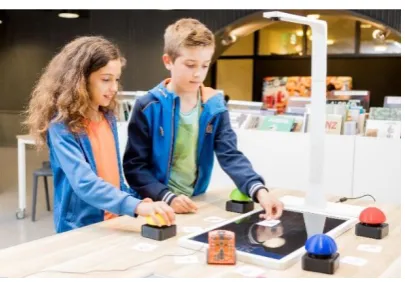
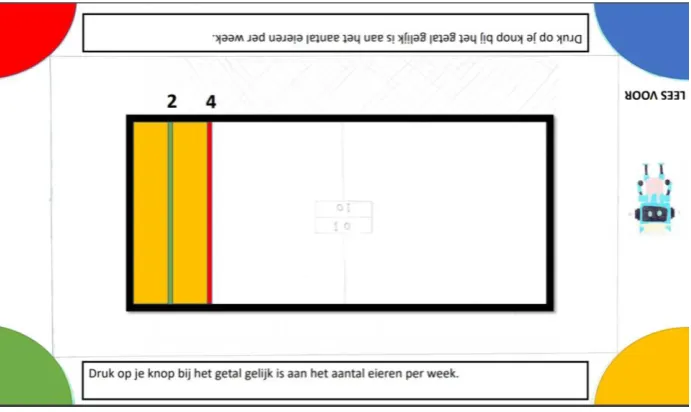
Luqo games are presented on a large digital game board that shows the same content
to all students who stand around the board while playing the game, as can be seen in figure 2.
This makes it easy for all students to refer to the same visual elements and to explain these to
each other. Interaction between students can occur naturally, since everyone is directly facing
each other, and players are not constrained by a screen standing between them. This way,
players can simultaneously interact with each other and with the digital environment. Also,
each student can physically manipulate game elements and be part of playing by using the
[image:8.595.215.418.439.580.2]personal button that they can use to execute actions in the game.
Figure 2 Students playing with Luqo
Currently, games are designed by the Luqo company in cooperation with schools and
other third parties. However, in the future the company will not design the games, but the
games will be developed by other parties from outside of the company, who may also not be
familiar with designing games, educational material or both. These people should be able to
design their own games for the Luqo platform, based on the needs of their target group. For
example, teachers could design games that fit the needs of their students. An existing issue at
the Luqo company is that there is insufficient didactical knowledge to design collaborative
8 how to facilitate collaboration and learning in serious games. However, there is no tool yet
that can be used during the design process that informs these new designers what elements
should be part of a good educational collaborative game. For this reason, the Luqo company
wants to have a set of guidelines that will provide designers of Luqo games with support that
clearly shows which elements should be incorporated.
3.2 Guidelines based on requirements from the Luqo platform
Serious games can be presented on a computer screen, tablet, or a larger display. The Luqo
platform uses a large screen that lies on a table, which makes it easy for students to stand
around and to refer simultaneously to the same game elements, because of this all group
members can easily contribute to the task (1) (Rogers & Lindley, 2004). A disadvantage of
tablets and computer screens for playing games is that they may not be promotive for group
interaction, especially if there is only one screen available for the whole group. These screens
are relatively small, which makes it difficult for multiple students to sit properly in front of
the screen and see it well at the same time (2). The chance that students will discuss the
problem at hand decreases and opportunities for “thinking out loud” will become limited. This
is unfavorable to create greater understanding, which is required for problem solving (Polya,
as cited in Scarlatos, 2002). Also, it is difficult to work well with others, because only one
person at a time can use the mouse or the touchscreen to have physical control over the game.
Using a large tabletop display is not a guarantee for successful learning on itself. It is
also necessary for students to keep interested in working on the task, otherwise an opportunity
to learn will be lost. Students will lose their interest, if they do not feel able to make progress
and help is not directly available (Scarlatos, 2002). The game should be able to provide the
support that students need, since Luqo games should not require presence of a teacher (3).
This way, the game screen applies modeling as a type of learning support, by presenting hints
or feedback on how to complete the task (Wouters & van Oostendorp, 2013). Other types of
learning support, that can used as well in collaborative serious games will be discussed in
section 4.2.
The absence of a teacher while playing Luqo games does not only have implications
for the way support is provided to players, but also for monitoring performance. Players are
supposed to learn something from the game, therefore it seems reasonable to check how much
they have learned. Learning could be measured with a test, which is not part of the game, or it
could be measured directly in the game. Linehan, Kirkman, Lawson and Chan (2011) argued
9 test separate from the game. Besides that, a separate test would not fit Luqo, because these
games focus on learning by playing and do not aim to be a method for testing skills or
knowledge.
Actions of students in the game should show whether learning goals are achieved.
Thus, data can be used to analyze the gap between the current and desired performance of a
student (4). Computer recordings can present data in a way that is easy to understand for
teachers, for example in a line graph (5) (Linehan et al., 2011). This way, accuracy of the
performance is measured, however this should not be the only source of information. Time
related aspects should also be taken into account, since these indicate how fluent someone can
work with the material (6) (Linehan et al., 2011). Besides that, data can be tracked over a
longer period of time, which provides the opportunity to find a trend in a student’s
performance (Annetta, 2010).
The following guidelines were derived from the analysis and will be used as input for
the first evaluation:
1. All students have the opportunity to manipulate game elements.
2. The display shows the same information to all students.
3. Help can be provided on-screen.
4. The game records data on players’ actions.
5. Recorded data is available for teachers or students.
6. The game records how long players are working on a task.
4
Theoretical background
The analysis showed that Luqo needs a clear framework that can be used to design games for
the platform. Next, an overview of the literature will be provided to identify the important
elements that should be considered in collaborative serious games. This will be the design
phase from the Mckenney and Reeves (2012) model, presented in figure 1. In this first design
phase, a first draft for the guidelines will be made based on existing literature about games,
learning support, and collaboration. Four frameworks related to game design will be used for
this purpose. These are not specifically about serious games, but indicate what games in
general should contain. The following frameworks are used: intrinsic motivation (Malone,
1981), applied behavior analysis, or in short ABA (Linehan et al., 2011), the six I’ design
framework (Annetta, 2010), and the assessment framework (Mitgutsch & Alvarado, 2012). A
full description of each framework can be found in Appendix D. These frameworks share
10 useful in creating collaborative games for the Luqo platform, by directly connecting game
design elements to collaboration and learning support. This will lead to an overview of the
key characteristics that should be included in a collaborative serious game, according to
existing literature and a basis for the first set of guidelines. The numbers between brackets in
the text correspond to the numbers in the lists of guidelines at the end of sections 4.1, 4.2, 4.3,
and Appendix B.
4.1 Game design
Before identifying relevant factors for learning and collaboration in serious games, it should
be clear what serious games are and what makes them useful. A clear definition of serious
games will provide a starting point from where important elements can be determined.
Serious games are computer games that are used for the purpose of learning and instruction.
This type of learning can also be referred to as game-based learning (Wouters et al., 2013).
The following section will provide information about the most important characteristics of
game design and how these can be related to serious games.
4.1.1 Game design guidelines
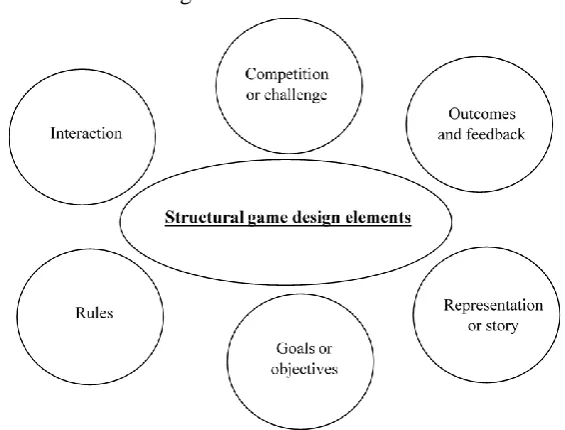
According to Prensky (2001) games in general contain six essential structural game elements,
namely rules, goals or objectives, outcomes and feedback, competition or challenge,
interaction, and representation or story. An overview of these elements can be found in figure
3. Guidelines were derived from all six elements. All elements can be applied to serious
games with the addition of a purpose, which refers to what players are supposed to learn from
the game (Marsh, 2011). This means that serious games are not meant to be played for fun
[image:11.595.155.438.537.752.2]only, but there has to be some other goal as well.
11 The first structural element that is described by Prensky (2001) is rules, which
distinguishes games from free play by organizing it and determining the paths players can
follow while playing (7). Rules determine what is fair in the game, impose limits, and force
all players to take specific paths towards the goal. Usually, rules of non-digital games are
written down, while computer game rules are built into the game. (Prensky, 2001). Another
function of rules is that they enable increasing complexity within a level or between different
levels. This helps to create an environment that matches the developing complexity level of
players’ knowledge and skills (8) (Annetta, 2010). As a result, curiosity, which is a crucial
factor for eliciting intrinsic motivation, can be aroused (Malone, 1981).
Second, goals or objectives distinguish games from other sorts of play and
non-goal-oriented games. These types of plays are referred to as toys. Achievement of goals is an
important factor that motivates players, since people are naturally goal-oriented (9) (Prensky,
2001). It is important to note that players can only be oriented towards goals, if they are fully
made aware of the goals (10). The implementation of goals is also incorporated in the
assessment framework, which differentiates between in-game goals and learning goals. In
other words, a difference can exist between what is to be accomplished in the game, and what
the player is supposed to learn and remember from playing, (Mitgutsch & Alvarado, 2012).
This distinction makes sense, since an important characteristic of serious games is that they
are not just played for fun. Thus, the learning goal represents what the game aims to teach
players (11).
Third, the outcomes and feedback component is about comparing a player’s progress
to the goals (12). Feedback can immediately inform players about the quality of their actions
by making changes in the game. By directly responding to actions of players, the game
becomes interactive. It helps players to learn how the game works and what leads to success
or failure. This way, learning can take place from feedback (13) (Prensky, 2001). Besides just
telling players whether an action was right or wrong, computer games can directly explain
why an action is either correct or incorrect. These explanations enable players to improve
themselves and lead to better performances than just informing players about the correctness
of their actions (Moreno & Mayer, 2005). However, not giving enough feedback or giving too
much feedback can easily frustrate players (Prensky, 2001).
Fourth, competition or challenge refers to the problems that need to be solved in the
game. Problems or challenges can be presented that need to be solved against an opponent, or
12 most games, some kind of challenge is present which can be solved individually or
collaboratively. This elicits excitement about playing and most people enjoy challenge,
especially if the challenge is in balance with their ability (Prensky, 2001). A challenge can
only be intrinsically motivating if players do not have the guarantee that they will either fail
or succeed (14) (Malone, 1981). Annetta (2010) supported this idea by stating that students
thrive when they are challenged to the range of their abilities. A challenge that is too difficult
causes frustration, while on the other hand, boredom arises when the challenge is too easy.
Thus, the right level of challenge can motivate players (15).
Fifth, interaction consists of two aspects. First of all, there is interaction between the
player and the computer, which corresponds to the game providing feedback, as mentioned
before in this section. Secondly, there is interaction between players (16). This social element
of games makes that they are more fun to play than individual games (Prensky, 2001). Also,
social interaction or communication is one of the requirements for effective collaboration, as
will be discussed further in section 4.3.2 about collaboration (Johnson & Johnson, 2009).
Last, representation or story clarifies in an abstract or concrete way what the game is
about, it includes the narrative and story elements in the game (17) (Prensky, 2001). It was
also categorized by Wouters and van Oostendorp (2013) as a type of effective learning
support. Fantasy is another way to create representation in a game-based learning
environment, in which real-world elements can be included. Malone (1981) argued that
fantasy refers to mental images of physical objects or social situations in the student’s
environment. Fantasy can help players to connect new knowledge to their prior knowledge, if
skills and fantasy are integrated in the game. This means that the actions of the player can
influence the represented fantasy in the game (18) (Malone, 1981). Another way to apply
representation is to focus on providing a context for all the information that is embedded in
the game. This serves as a context for actions that can be performed in the game, within the
boundaries of the rules (Mitgutsch & Alvarado, 2012) (19). However, even though fantasy is
included in different studies, research was not supportive of its learning value. This can be
explained by the distraction hypothesis, which states that a strong narrative will have a
negative effect on learning, since players need to direct too much of their cognitive capacity
towards the story instead of the learning content (Adams, Mayer, Macnamara, Koenig, &
Wainess, 2012). This implies that the context needs to be considered carefully to avoid asking
too much cognitive capacity from players to process the story at the expense of capacity for
13 The following guidelines were derived from game design theory:
7. The game has rules that places limits on the actions the player is allowed to execute.
8. The game becomes more complex while playing.
9. The game has one or more goals.
10.The player is made aware of the goals by the game.
11.The game serves to achieve a learning goal.
12.The game measures the progress towards the goal of the player.
13.Players receive immediate feedback on their actions.
14. It is not guaranteed beforehand that the goal will be accomplished.
15.The game presents challenges to the player that need to be solved.
16.The game promotes interaction between players.
17.The game contains story elements.
18.The actions of the player influence the game environment.
19. The game provides a context in which actions can be performed.
4.2 Learning support
Before designing the guidelines, it is important to know if and how serious games can lead to
successful learning outcomes. However, not all studies are supportive of the effectiveness of
serious games. In their meta-analysis Girard et al. (2013) found that only two out of six
serious games in their review had a positive effect on learning when compared with different
or no training. A review that was published some years earlier also found that games were not
beneficial in comparison to traditional teaching methods, when learning was measured on an
immediate posttest (Randel, Morris, Wetzel, & Whitehill, 1992). In other studies, positive
effects were found on a delayed post-test for groups that played the games compared to the
control group (Randel et al., 1992).
The fact that not all research results show beneficial learning results of serious games
does not mean that they cannot be useful in education, since these games are more motivating
for students than traditional teaching methods (Papastergiou, 2009). Besides that, according to
Wouters and van Oostendorp (2013) learning from games can be supported by adding several
types of support. In their meta-analysis, they aimed to investigate the role of learning support
in game-based learning. Ten types of learning support were identified, of which six showed to
improve learning. First, reflection encourages players to think about and explain their answers
14 discussions. Third, personalization presents ideas, characters and messages in a way that is
interesting for players. Reflection, collaboration, and personalization can be combined with
collaboration theories, guidelines will be derived from this in section 4.3.1. Since
collaboration is a key element of Luqo games, and therefore a focus point of the guidelines, it
is presented as a separate topic, even though it is also a type of learning support.
The fourth type of support is modeling, which indicates to players how a problem can
be solved. This was already translated in the analysis to guideline 3; “help can be provided
on-screen”. Fifth, feedback refers to the information players receive about the quality of their
answers or actions. The role of feedback in game design was already discussed in section 4.1.
However, the role of feedback in relation to providing learning support has not yet become
clear, this will be addressed in the next section. The sixth type of support, modality, will not
be further discussed in this study. Modality means that textual explanations should preferably
be presented in an auditory way (Wouters & van Oostendorp, 2013). However, games of the
Luqo platform are fully visual and therefore modality is not applicable in this context.
4.2.1 Guidelines learning support
Feedback as a type of learning support was found to significantly enhance learning and can
regularly be found in serious games. Research showed that support to select relevant
information is more effective for learning than stimulating, modeling and integrating new
information (Wouters & van Oostendorp, 2013). According to Malone (1981), feedback
should address the gap between the current performance of players and the goal performance,
to inform them whether they are achieving the goal. Also, students’ curiosity can be supported
by providing informative feedback that responds to performed actions and is given in a way
that explains how they can make changes instead of just telling them their performance is
inadequate (Malone, 1981). Prensky (2001) also mentioned it as a structural game element
that informs players about the quality of their actions in the game (20). Feedback can be given
to individual players or to the whole group. However, it does not seem intuitive to abandon
group feedback in collaborative groups. Since students are working together to accomplish a
shared goal, it makes sense to give feedback that informs them about how close they are to
their goal (21).
The following guidelines were derived from learning support theory:
20. Students receive individual feedback.
15
4.3 Collaboration
Collaboration has become one of the dominant instructional methods in schools and can be
used for different subject areas and in different grades (Johnson & Johnson, 2009). When it is
compared with competition or individual work, collaboration results in greater long-term
retention, higher intrinsic motivation, higher expectations for success, more creative thinking,
greater transfer of learning, and more positive attitudes towards the task (Johnson & Johnson,
2009). Also, it is an effective types of learning support (Wouters & van Oostendorp, 2013).
In traditional classrooms, students mostly work on individual tasks and do not need
their peers to complete their learning tasks. This way, every student is responsible for his own
learning and there is room for competition between students, which does not necessarily
enhance learning. Competition can be a poor motivator, especially for low-performing
students (Slavin, 1995). Even if these students manage to improve themselves, they are still
behind on their higher performing peers. This can be avoided by letting students work
together effectively. If students want their team to be successful, they will help their team
members in learning, encourage them, and boost their performance. This way, students can
help each other to be successful (Slavin, 1995).
Another reason that supports collaboration is that communication with peers can help
students to learn. If new information has to be stored in memory, it should be related to
information that is already stored. This can be done by elaborating or structuring the material.
Explaining things to others is one of the most effective ways to accomplish this (Slavin,
1995). Also, interaction on learning tasks between peers is effective in itself, because students
can learn from cognitive conflicts that arise during discussions and expose their reasoning
(Slavin, 1995). Despite the advantages of learning together, there are a few risks that should
be considered. In some groups, a few students do all the work, while others profit from the
work of their group members, this is called the free rider effect. Another problem that can
arise is diffusion of responsibility, this means that not every group member feels equally
responsible for the product the group has to deliver (Slavin, 1995).
4.3.1 Collaboration guidelines
A first guideline for collaboration was derived from the definition that was mentioned in the
introduction. Collaboration refers to groups of students working together on a task to avoid
confusion between the two terms (22). However, just putting students together in a group does
not automatically foster effective learning. Johnson and Johnson (2009) mentioned five
16 individual accountability, promotive interaction, appropriate use of social skills, and group
processing. Positive interdependence means that students need each other in order to
successfully complete their task (23) (Sharan, 2015). Giving rewards or setting goals are ways
to create interdependence (24) (Johnson & Johnson, 2009). More specifically, verbal rewards
positively affect intrinsic motivation, while tangible rewards seem to have a negative effect on
intrinsic motivation (25) (Deci, Koestner, & Ryan, 1999). Another possibility is to give
individual instead of group feedback, this can increase achievement, positive relationships
among members, self-esteem, and positive attitudes towards the subject (26) (Archer-Kath,
Johnson, & Johnson, 1994). This element implies that communication is required if students
need to work together and reach their goal, (27).
Second, when there is individual accountability, it shows how much every member
contributes to the group. Every individual in the group is responsible and is assessed on his
personal performance instead of only getting assessed by the performance of the whole group.
(28, 29). In general, individual accountability is higher in smaller groups, where members
believe their input is more necessary than in larger groups (Johnson & Johnson, 2009). Third,
with promotive interaction, students encourage and facilitate each other’s effort to reach their
goal. Thus, interaction should be present in a way that students encourage and help each other
to satisfy the promotive interaction element (30 and 31). Fourth, students must possess
appropriate interpersonal and small-group skills if they want to work together effectively.
Examples of these skills are being able to communicate accurately and unambiguously, and to
resolve conflicts constructively. In order to achieve this, group members need to get familiar
with each other and trust, support, and accept each other (32) (Johnson & Johnson, 2009).
Last of all, group processing means that individuals in the group reflect on the actions
of group members and make decisions about which actions to take next. Reflection is also
about stimulating learners to think about and explain their answers (33) (Wouters & van
Oostendorp, 2013). Group processing can also be considered related to goals. If it is possible
to accomplish a goal it in different ways, it will create the opportunity for group members to
discuss past and future actions to find the best way to finish the task successfully. In case
there is only one way to finish the task, there is only one path to follow and a discussion about
what to do seems redundant (34).
Thus, positive interdependence, promotive interaction, appropriate use of social skills
and group processing all require some form of communication. In a collaborative game,
17 chat. Players interact through a personal identity with the game and other players,
experiencing this identity is also necessary to become fully immersed in the game. (35)
(Annetta, 2010). Also, personalization is an effective type of learning support, it refers to
adapting the context of the game and to presenting characters in an interesting way for players
(Wouters & van Oostendorp, 2013). This means that the character through which players
interact and receive messages from, should be meaningful for each player.
Another element that is important regarding communication, is the way group
members communicate with each other, since this influences how much they will learn.
Mercer, Wegerif and Dawes (1999) compared the communication and performance of groups
who received instruction about ground rules for exploratory talk to a group of students who
did not receive this instruction. Exploratory talk can be defined as communication in which all
members of the group are critical and work constructively with ideas of others. Knowledge is
explicitly shared among group members, statements are challenged and reasoning has an
essential role (Mercer et al., 1999). The study showed that students who had received the
instruction, worked more effectively together on problem-solving tasks, used more
exploratory talk, and showed larger individual gains on a problem-solving posttest compared
to the pre-test than students who did not receive the instruction. A later study also showed that
games can support students to engage in exploratory talk and communication is not
automatically effective (36) (Rojas-Drummond & Mercer, 2003).
Communication is needed, but also takes up a certain amount of time (37, 38). If there
is no time limit to complete a task, players have the full opportunity to do this. However,
Karau and Kelly (1992) found that groups that have an abundance of time to solve a task are
less focused and engaged in less task activity than groups who received the optimal amount of
time. In contrast, limited time can lead to a higher performance rate, but with a decrease in
quality (Karau & Kelly, 1992). If time is scarce, students’ attention is more focused on the
most important task characteristics. This means that time scarcity can decrease performance,
because students are not able to attend to all relevant information in the available time.
Therefore, a balance should be found between the available and needed time for a task.
The following guidelines were based on literature about collaboration:
22.At least two students can work simultaneously on the task.
23.At least two students are required to solve the task.
24.The game provides clear goals to the player.
18 26.Players need to communicate with each other to reach the goal.
27.Players receive individual feedback based on their actions in the game.
28.Students receive a group score.
29.Students receive an individual score.
30.Interaction between students is needed to solve the task.
31.Input from every student is required to solve the task.
32.At the beginning the game provides an opportunity for players to get to know each
other.
33.Students receive prompts to reflect on their actions.
34.There is more than one way to accomplish the goal.
35.Each player has his or her own character in the game.
36.The game supports players to communicate on a high level.
37.Time is available in the game to discuss next steps.
38.Time is available in the game to reflect on past steps.
5
Guidelines
Literature research identified many elements were found that should be part of a serious
collaborative game. 38 guidelines were found to be related to learning support, collaboration
and game design theory. Since literature from different research areas was used, it was
possible that some overlap would occur. Guidelines that overlapped were deleted or
combined, after which 31 guidelines remained that formed the first complete set of guidelines.
An overview of which guidelines were combined, the result of those combinations can be
seen in Appendix B. Also, six categories based on the literature were added to make the list of
guidelines more structured and give the user a better overview of its components. These
categories are feedback, multiplayer, goals, data, screen, and other.
The first complete set of guidelines can be found in Appendix C, these will be used for
the first evaluation. An example that shows the structure of the first version of the guidelines
is shown in figure 4. Most guidelines will be usable for games in multiple topics, but there are
also a few guidelines that apply specifically to a new Luqo game. This game will serve as a
case study in a later stage of the design process. The rationale behind these guidelines will be
discussed later in section 7, because these are not generally applicable for all games.
However, since they will go through the same evaluations as the other guidelines, they are
19
Theory Category Guideline Present Clarification
Collaborative learning
[image:20.595.64.532.98.155.2]Feedback Players receive individual feedback based on their actions in the game
Figure 4 Example of the first version of the guidelines
6
Evaluations
The set of guidelines in Appendix C was a first version, but it was unsure whether they were
useful and complete. Practical experience with the guidelines was necessary to establish this,
and to determine possible changes or additions to improve the quality of the design. For this
purpose, there will be five rounds of evaluations and improvements of the guidelines. The
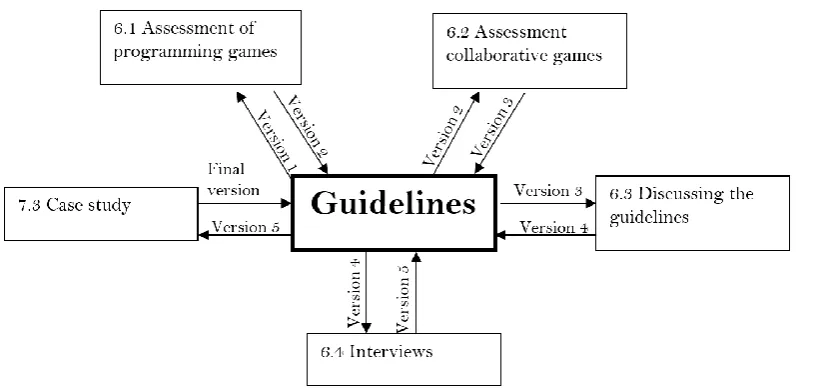
methods and results of each evaluation will be described, including the most important
changes that were made as a consequence of each evaluation. Figure 5 presents an overview
of where descriptions of each evaluation can be found, and which version of the guidelines
was used for each evaluation.
Figure 5 Overview of which evaluation can be found in which section of the reports and which versions of the guidelines were used for each evaluation.
In the first evaluation, the guidelines will be used to assess existing programming
games. This will show how clear and complete the guidelines are and it will identify where
changes need to be made. The second evaluation will be similar to the first round, since it is
also an assessment of existing games. However, in this case the focus will be on collaborative
[image:20.595.97.504.394.588.2]20 evaluations is not only find flaws in the guidelines, but also to see if and how they are already
applied in existing games. Both evaluations will be executed by the designer of the guidelines.
The third and fourth evaluation are more focused on how the guidelines are interpreted
by other people than the designer, to gain new perspectives. Also, the guidelines will now be
treated as a design tool, which is their main function, instead of using it as an assessment tool.
During the third evaluation, the guidelines will be the subject of a discussion at Luqo. The
goal is to analyze the formulation of every guideline and to check interpretation and
applicability in a design process. The fourth evaluation will consist of two parts to see if
people who are unfamiliar with designing educational games and the Luqo platform can
understand the guidelines. This is important, because the guidelines can only be used properly
if people understand their meaning and perceive them as sufficiently clear to design a game.
First, people will be asked to assess the guidelines on paper. Then, based on these
assessments, personal interviews will be conducted by the designer. For the last evaluation, a
concept version of a new game, specifically a programming game, will be used as a case
study to find out if and how the guidelines for collaborative serious games can be applied in a
real design process at Luqo.
6.1 First evaluation
The first evaluation was aimed at finding out whether the guidelines were usable for
assessment of existing serious games. In order to do this, nine programming games were
selected by the designer to test the guidelines, this way flaws could be determined and
adapted. Descriptions of all the games can be found in Appendix E. A ‘yes’ or ‘no’ was noted
by the designer for each guideline to indicate if it was present in a game or not. This provided
two sources of information. First, it became clear which guidelines are currently applied and
missing in existing games. This served to establish differences between and similarities of the
games. Second, by using programming games for this evaluation, the characteristics of
existing programming games became clear. This way, it can be avoided that the new
programming game, that is currently being developed at Luqo, becomes a copy of an existing
game. The new game will be discussed later in section 5 about the case study.
The analysis showed that many elements from theory are not always applied in
practice. Only seven of the guidelines seem to be naturally incorporated in programming
games, since these were present in all games. This contrasts to six other characteristics that
were missing in all games. However, it must be noted that the missing guidelines were mostly
21 a game is not automatically suitable for collaboration, but attention is needed to include these
characteristics. Special attention is also needed for the 18 guidelines that were only applied in
some of the games. This finding indicates that a large group of the guidelines is not
automatically applied, therefore attention to these guidelines is desired in a design process.
The first use of the guidelines showed that not all formulations were clear or complete.
Consequently, changes had to be made to the content of the guidelines. Also, the table
structure of presenting guidelines was adapted. A short explanation of the most important
changes in the guidelines will be provided next two sections.
6.1.1 Changes in the content
Some of the guidelines were revised because of the way they were formulated. The original
guidelines were in some cases vaguely formulated, therefore it was ambiguous what was
meant exactly. For example, the guidelines about feedback were quite general, and it was not
specified when feedback was given. In a game with a level structure, it is possible that
feedback is given after finishing a level, during a level or both, but this was not specified in
the guidelines. A distinction in the feedback guidelines was made about the moment the
feedback is given. This way, the guideline became more specific. Guidelines can be used
better when they are more specific, because then there is little space for different
interpretations and confusion. It is important that the guidelines are clear and specific, because
unexperienced designers of serious games should be able to work with them.
The evaluation did not only show overlap or vague formulations of the guidelines, but
it also indicated that some theoretical aspects did not work out in a practical use. For example,
one of the guidelines stated that the game should support students to find the most efficient
solution. During the assessment of the programming games, it showed that most games
contain the opportunity to repeat a level, but there is no explicit encouragement. Therefore, a
distinction had to be made between providing the opportunity to find the most efficient
solution and encouraging players to do this. Another guideline was also changed because of
practical issues, it stated that every action of a player should be recorded and saved. This was
too strict, since most games do save some data but not everything, which would cause a
negative assessment of the guideline. This way, it does not become clear what type of
information the game does save. Also, the question is which information is necessary to get an
overview of how students are performing and if some information may be redundant. This
22 be recorded. Finally, one guideline was added from a practical point of view. Students should
be able to play Luqo games outside of the classroom without needing their teacher. Thus, it
would not make sense if a teacher was needed to set up the game. This means that it should be
easy for players to start the game.
6.1.2 Changes of the Structure
The original format was changed after the first evaluation, in the first version of the guidelines
there were no different levels. During the assessment of the guidelines it showed that some
guidelines are part of a broader guideline or can only be present if another guideline is present
as well. For example, a game can only present goals to players if there are goals in the first
place. For this reason, the guidelines were divided in main guidelines and sub-guidelines after
the first evaluation. If a main guideline is not present in a game, the sub-guidelines that
belong to it, are automatically absent as well. Thus, sub-guidelines only need to be checked if
their main guideline is present. Adding these levels makes it more efficient to fill in the
guidelines. A consequence is that one main category can contain guidelines that originate
from different theories. In order to avoid confusion, the theories column was deleted from the
guidelines. An example of the new format is presented in figure 6.
It is still possible to give an explanation about why a guideline was scored with yes or
no, however in some cases a few additional questions were added that need to be answered in
case the guideline is present. Answering these questions results in a more detailed analysis
that provides information about characteristics of a game, so changes can me made
accordingly. The questions were not included in the guidelines themselves, but in a separate
column, since giving an answer requires an explanation. The answers to the additional
questions and optional explanations can be put in the box for explanations that was already
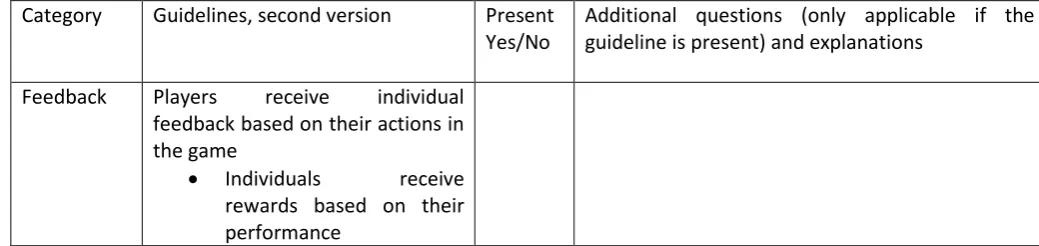
present in the first version of the guidelines.
Category Guidelines, second version Present Yes/No
Additional questions (only applicable if the guideline is present) and explanations
Feedback Players receive individual feedback based on their actions in the game
[image:23.595.60.580.606.729.2]• Individuals receive rewards based on their performance
23
6.2 Second evaluation
6.2.1 Analysis of collaborative games
The analysis of programming games showed which elements from the guidelines were
missing in existing games. However, these games were mostly aimed at individuals playing a
game and were not specifically designed for collaboration. Therefore, the guidelines about
collaboration could not be tested properly. Since collaboration is a key aspect for Luqo
games, more information was needed to find out how the guidelines regarding this topic are
currently applied in collaborative games. In order to do this, one computer game and four
non-computer games were assessed by the designer, based on the second version of the
guidelines. Again, the presence of each guideline was assessed for all games. Some of the
guidelines were not assessed, because they were not applicable to non-computer games, these
were for example about the screen that is used in digital games. Besides that, the second
evaluation helped to identify some more flaws in the guidelines that were missed during the
first evaluation. The most important changes based on this evaluation will be explained in the
next section.
Analysis of the guidelines about collaboration showed positive results, a full overview
of the games can be found in Appendix F. The analysis showed that even though some
guidelines about collaboration are generally applied, other important aspects are not always
present in collaborative games. This indicates that designers need to be informed and
reminded of important elements regarding collaboration. In all games, at least two players
could work on the task at the same time, could manipulate game elements, and players had to
communicate to solve the task. Even though all games required communication, only one
game supported communication on a high level. Besides that, only one game supported
players to get to know each other before playing.
6.2.2 Changes of the second evaluation
Based on the evaluation of collaborative games, some changes were made to the content of
the guidelines, the structure remained the same. Two guidelines were changed because they
automatically assumed the presence of certain elements in games. For example, the guideline
‘scores are based on actions from individuals and from the group’ assumed that scores are
always given. It does not provide the option to say that scores are not given in the game.
Therefore, this guideline was changed to ‘scores are given in the game’. The other guideline
that was changed for the same reason, ‘the game provides the opportunity to repeat a level’,
24 that can be repeated. These things need to be adapted, since the assessed programming and
collaborative games have shown that not all guidelines are always present in games. It is
important that missing elements can be easily reported, so designers can clearly see what is
missing to improve their games.
A new guideline was added to the feedback category in addition the guideline ‘help
can be provided to students if they keep making mistakes’. This guideline aims at help or
feedback provided by the game. However, the collaborative games showed that help can also
be provided by group members, but this was not yet included in the guidelines. Next to adding
a new guideline, the formulation of the original guideline was changed as well, so there is a
clear distinction between feedback from the game and feedback from peers. This makes the
guideline more complete and it shows the different options of how a guideline can be used.
Users can consider these options and make a well-informed decision about which one to use.
A remarkable change was the removal of a guideline that caused confusion during the
evaluation. The terms goals and challenges are two different words that refer to the same
concept in the guidelines. Both indicate what players need to accomplish. Therefore, two
guidelines are basically the same. The guideline ’the game presents challenges to the player that need to be solved’ is kept. This one is more clear and specific than ‘the game makes
players aware of the goals’, which is now deleted from the guidelines. Confusion about the
meaning of terms should be avoided, since wrong assessments can be made if terms are not
understood properly. This is important, because adequate assessments are required to properly
improve a game.
6.3 Third evaluation
The first two evaluations confirmed that the guidelines are usable for the assessment of
games, but nothing could be said yet about their usability as a design tool. The third
evaluation consists of two separate discussions at the Luqo company. The first one is focused
on the general structure of the guidelines, while the second discussion is about the specific
formulation of each guideline. After the first discussion, initial changes will be made to avoid
double work in the second discussion. The goal of these discussions is to find out if changes
need to be made, so it is clear how each guideline should be used.
Before, the guidelines were formulated in a way that made them usable for assessment
purposes. However, since the guidelines should mainly have a design function, they should
25 person. Therefore, it was unknown how they would be interpreted by other people.
Interpretation of the guidelines and the guidelines as a design tool will be the focus points of
this evaluation. The designer and founder of Luqo took part in both discussions, two other
people working at Luqo only participated in the first discussion. The designer mostly had an
observatory role during this discussion to allow the other participants to freely discuss their
interpretation, but they could ask questions to the designer. In the second discussion, the
designer did actively participate.
6.3.1 Changes after the third evaluation
During the first discussion, not all guidelines were discussed in detail. After looking at several
guidelines, some general points for improvement were clearly identified already. The most
important finding was that the guidelines needed some clarifications. First, it became apparent
that some of the terms lacked clarity. These terms stem from educational research and the
people participating in the discussion, besides the designer, were no experts in this field.
Therefore, it is not surprising that some terms required an extra explanation. For this reason, a
list of definitions was added for all the terms that could be unclear or interpreted in different
ways. This is important, since the guidelines are designed for people who may not be familiar
with these terms and educational research. Second, most guidelines now have a context
description that is based on literature to provide them with a strong theoretical basis and to
explain their importance. Third, some examples are now provided for each guideline to show
users some possibilities of how guidelines could be applied.
Another point that came up during the discussion was when, and on what level each
guideline could be applied. This led to the insight that a single guideline can often be used at
different moments in the game, and can be applied on the individual or the group level. It
would make the guidelines too complicated to add these moments and levels to each separate
guideline. Therefore, a scheme is added that represents the different levels and moments in
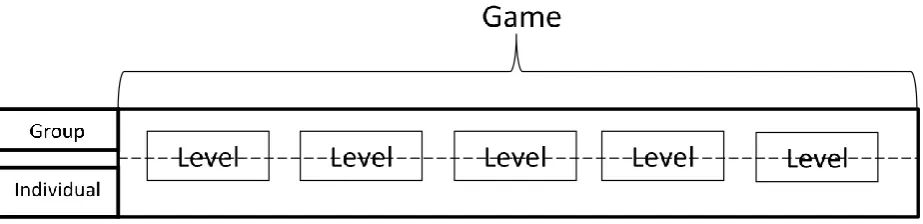
which the guidelines can be applied, these levels are called dimensions. This means, a
guideline can be applied to a group or an individual, as is indicated by the dotted line in figure
7. Furthermore, the figure shows that a game can consist of multiple levels, guidelines can be
26 Figure 7 Guideline dimensions as presented in version 4 of the guidelines
Before starting the second discussion, some steps were taken to make the guidelines
suitable for a design process. Originally, the guidelines were presented as statements that
could be either present or absent, which made them usable as an assessment tool. The
guidelines were changed into a more active mode by starting each sentence with a verb, which
indicates that something still needs to be done, opposed to something that should already be
there. This fits the main purpose of the guidelines as a design tool.
The guidelines that Nielsen (1995) used for his ten usability heuristics for interface
design, served as a template for the new formulation of the guidelines. This means that first a
situation is mentioned in which the guideline can be relevant, then the guideline tells users
what to do, and finally an example clarifies how the guideline can be applied. This new
formulation of the guidelines was subject of the second discussion at Luqo. The goal was to
determine if the text conveyed the intended content. As a result, some changes were made
again. This did not have a large impact on the content, but it was mainly a clarification of
what was already present in the previous version by using a different way of formulating.
When discussing the new formulation, it also became clear that some of the guidelines were
put in a category where they did not belong, these were moved to another category in which
they fit better. Most of these guidelines were first placed in the “other” category, because
initially they did not seem to fit well within one of the regular categories. However, during the
discussion it became clear that they matched with categories like ‘multiplayer’ or ‘goals’.
Two changes were made regarding the structure of the guidelines to make them more
attractive for users. First, the situation, guideline and example were separated instead of
presented as one piece of text to give users a better oversight over the three different parts and
to create a clear distinction between the three elements. Second, the guidelines were made
more attractive by presenting them in a visual format. On top of the page, the full guideline,
including situation and example, is stated. This is followed by a picture that to visualize and
clarify the guideline. On each page, a context and relevant definitions were added for each
27 background information or definitions, an example of the new format is present in figure 8. A
last thing that was added, is a short introduction and instruction to the guidelines. This will
inform users about what the guidelines are, and how they should be used. The new guidelines
[image:28.595.164.470.159.476.2]in the visual format, including the instruction can be found in Appendix G.
Figure 8 Example of the fourth version of the guidelines
6.4 Fourth evaluation
So far, the evaluations have shown that the guidelines can be used to assess games, but
changes in the formulations were needed to make them suitable as a design tool. However, it
was not tested yet if the new formulations would be helpful in a design process. The
guidelines should be able to help novice designers of collaborative serious games, for this
reason it is important that everyone can interpret and understand them. Therefore, some
people who were not familiar with the guidelines or serious game design were asked to assess
the guidelines in the fourth evaluation. This was done with the plus-minus methods, followed
by an interview. This method is a simple way to find problems in a text and it offers concrete
indications for improvements (Vroom, 1994). In total, eight persons with different
backgrounds participated. All participants were students or were recently graduated. Two of
28 participants were psychology students, but only one of them was specialized in learning. None
of the participants was an expert in game design.
First, participants received the visual format of the guidelines via e-mail and they were
asked by the designer to add a plus-sign for each positive or clear element and to put a
minus-sign for everything they disliked or did not understand. Plusses and minuses could be added to
small or large pieces of text and to the pictures. Participants were free to decide the size of
elements to comment on. After this, a one-on-one interview was held by the designer with
each participant to find out the reasons behind the comments. These steps are in accordance
with the plus-minus method from Vroom (1994). Besides discussing their comments,
participants were asked about their general impression of the guidelines, their impression of
the structure of document, and if they thought they would be able to design a game
themselves with the guidelines.
6.4.1 Changes after the fourth evaluation
The interviews made it clear some changes were necessary. These were related to formulation
and content related issues, but the overall structure seemed to be clear and did not have to be
changed. Even though all participants mentioned different points, some guidelines received
similar comments from several participants. The most important changes will be described in
this section.
The biggest overall change refers to the pictures. In the fourth version, the pictures did
not support the text by representing their meaning. For this reason, all pictures were changed,
even though some elements could be used to create a better picture. In the new version of the
guidelines, every picture consists of two parts. One part represents the guidelines, by showing
what should be applied in the game, while the other part emphasizes what should be avoided.
This way, the picture tells a story of how to interpret each guideline.
During the interviews, it became apparent that a few things were not easy to
understand. First, it was not clear what of positive interdependence and cognitive conflict
meant, therefore they were added to the list of definitions. These terms may be clear for
people with knowledge of psychology or collaboration, but it showed that the terms can be
unfamiliar to others. Another element that was unclear, was the dimensions picture, as
presented figure 7. Participants did not know how to interpret this picture, but when it was
explained to them with an example, they were able to understand it. For this reason, an