Design
with
Intent
101 patterns for influencing
behaviour through design
1.0
Dan Lockton
withDesign with Intent:
101 patterns for influencing behaviour through design Dan Lockton with David Harrison & Neville A. Stanton
ISBN 978-0-9565421-0-6 (printed cards) ISBN 978-0-9565421-1-3 (ebook) April 2010
Published by Windsor, Berkshire, UK
This is Tiresias Infofont, made available under the GNU General Public Licence by the RNIB, and available from http://www.tiresias.org
Produced on Ubuntu (and Windows XP via Sun VirtualBox) Your feedback is very welcome: [email protected]
designwithintent.co.uk
With the exception of certain images, the proprietors and nature of which are identified on the introduction card for each lens, this work is licensed by Dan Lockton under the Creative Commons Attribution-Non- commercial- Share Alike 3.0 licence, available at: http://creativecommons.org/licenses/by-nc-sa/3.0 or by writing to: Creative Commons, 171 2nd Street, Suite 300, San Francisco, California, 94105, USA Cleaner Electronics Research GroupBrunel Design, Brunel University
The Architectural Lens draws on techniques used to influence user behaviour in architecture, urban planning and related disciplines such as traffic management and crime prevention through environmental design (see also the Security Lens).
While most of the techniques have been developed in the built environment, many of the ideas can also be applied in interaction and product design, even in software or services; they are effectively about using the '''structure of systems''' to influence behaviour. Some of the patterns, such as Simplicity,Feature deletion and Hiding things are really fundamental to all kinds of design.
Architectural Lens
Image for Pave the Cowpaths is a screenshot of an annotated Google Map on Kittelson & Associates' website (http://prj.kittelson.com/tigardtrails) All other photos by Dan Lockton
Design
with
Intent
Can you slant or
angle things so
some actions
are easier than
others?
Angles
Some cigarette bins are sold to authorities using the sloping top as a feature, discouraging people leaving litter on top
A
3.ly/ArchCan you channel
people so they
come together
(or split up)?
Converging & diverging
Gates (and gatehouses) channel visitors through a narrow opening, allowing a toll to be levied, or to help control potential threats
Ar
A
3.ly/Arch
Design
with
Can you bring a
feature to the
users, or move
the users to
where you want
them to be?
Conveyor belts
Moving walkways in airports help travellers move more quickly, but also prevent people blocking corridors, especially in groups
Ar
A
3.ly/ArchWhat would
happen if you
simply took away
features you don’t
want people to use?
Feature deletion
Various politicians have proposed simply removing standby buttons from consumer electronic
products, to reduce energy use
Ar
A
3.ly/ArchCan you hide
functions or
elements you’d
prefer people
didn’t use?
Hiding things
These church hall heating controls have been hidden (leaving only the timer accessible) to reduce errors by users unfamiliar with them
Ar
A
3.ly/ArchCan you use the
properties of
different materials
to make some
actions more
comfortable than
others?
Material properties
Rough-textured paving can act as a subtle barrier between cycle and pedestrian tracks: stray over the line on a bike and you’ll feel it
Ar
A
3.ly/ArchCan get people to
follow the path you
want them to, on
the way to reaching
something
they
want?
Mazes
Some store layouts route or channel shoppers past ‘impulse purchase’ items—often snacks—on their way to the checkouts
Ar
A
3.ly/ArchCan you recognise
the 'desire paths'
of some of your
users, and then
codify them into
your system, so
others follow too?
Pave the cowpaths
In Tigard, OR, residents marked informal ‘neighbourhood trails’ they used on a map, so the city could prioritise ones to ‘formalise’
Ar
A
3.ly/ArchCan you rearrange
things so people
interact with
them in the
locations you
want them to?
Positioning
Positioning pedestrian crossing push-button units on the right-hand side (UK) makes it more likely that users turn to notice oncoming traffic
Ar
A
3.ly/ArchCan you put
things in users’
way, so they take
an alternative
route, or adjust
their speed?
Roadblock
‘Chicanes’ can slow down drivers, pedestrians and cyclists; the crossing chicane prevents running or cycling straight across the road
Ar
A
3.ly/ArchCan you divide
your system up
into parts, so
people only use
one bit at a time?
Segmentation & spacing
These individual seats replace a bench on the Paris Métro – spaced so that someone cannot lie down or occupy more than one
Ar
A
3.ly/ArchHow simply can
you structure
things, to make
it easier for users
to do what you’d
like them to do?
Simplicity
EcoButton allows a user to put a computer into a low-power state with just one press, making it much easier for users to save energy.
Ar
A
3.ly/Arch
The Errorproofing Lens represents a worldview treating deviations from the target behaviour as ‘errors’ which design can help avoid, either by making it easier for users to work without making errors, or by making errors impossible in the first place. It’s often found in ergonomics, health & safety-related design, medical device design and manufacturing engineering (as poka-yoke): where, as far as possible, one really doesn’t want errors to occur at all.
A key difference between errorproofing and some other views of influencing user behaviour which imply attitude change leading to the target behaviour, is that errorproofing doesn’t care whether or not the user’s attitude changes, as long as the target
behaviour is met. Attitude change might be an effect of the errorproofing, but it doesn’t have to be.
Errorproofing Lens
Images for Defaults, Did you mean? and
Opt-outs are screenshots of CIB PDF Brewer software, a Google search for ‘recursion’ and Yorkshire Building Society website respectively.
All other photos by Dan Lockton
Design with Intent 3.ly/Erro
Can you design
an extra
‘confirmation’
step before an
action can be
performed?
Some British Rail train doors require passengers to lower the window to get access to the handle, mounted on the outside
Are you sure?
3.ly/Erro
Design with Intent
Can you edit the
choices presented
to users so only
the ones you want
them to have are
available?
Choice editing can be driven by legislation, e.g. leaded 4-star petrol being phased out in the EU by 2000 (when this photo was taken)
Ep
Choice editing
3.ly/Erro
Design with Intent
Can you give
users warnings
based on
detecting the
error they’ve
made, or might be
about to make?
The parking brake warning light on a car’s dashboard is a warning to the driver: don’t drive off without releasing the brake!
Ep
Conditional warnings
3.ly/Erro
Design
with
Can you make
the default
setting the
behaviour you’d
prefer users to
perform?
In this software ‘nag’ screen, the default button (pressed if the user just hits ‘enter’) is information on licensing rather than ‘I agree’
Ep
Defaults
3.ly/Erro
Design
with
Can you detect
and suggest a
better option to
users when it
looks like they’re
making an error?
Google’s suggestion algorithm is continually evolving to take account of search trends; it also includes this nice ‘easter egg’!
Ep
Did you mean?
3.ly/Erro
Design with Intent
Can you set
things up so one
action can’t be
performed until
another is
completed?
Most modern cash machines don’t dispense cash until you remove your card, making it less likely you’ll leave it behind
Ep
Interlock
3.ly/Erro
Design with Intent
Can you make
parts fit only
when the right
way round, or
only with the
products they
should do?
Ep
Matched affordances
3.ly/Erro
Design
with
Intent
E
What happens if
you make an
option something
people opt out
of, rather than
opt in to?
This building society asks new savers if they want to opt out of donating part of their interest to charity – by default it is donated
Ep
Opt-outs
3.ly/Erro
Design with Intent
Can you change
the size of the
portions or the
units of ‘stuff’
you give users?
‘Portion packs’ for snacks give customers the ‘right’ amount of food to eat in one go (sometimes a particular amount of calories)
Ep
Portions
3.ly/Erro
Design with Intent
Can you keep a
task going that
needs to be, or
prevent one
being started
inadvertently?
To prevent accidentally engaging reverse gear, most gearboxes include a ‘gate’ over/under which the stick must be lifted or pressed
Ep
Task lock-in/out
3.ly/Erro
Design with Intent
All the patterns are really about interaction design in one form or another, but the Interaction Lens brings together some of the most common design elements of interfaces where users' interactions with the system affect how their behaviour is influenced. So there are some core Human-Computer Interaction patterns here, such as kinds of feedback,progress bars, and previews, and some currently less-used such as feedforward.
This lens also includes some patterns from the growing field of Persuasive Technology, where computers, mobile phones and other systems with interfaces are used to persuade users: changing attitudes and so changing behaviour through
contextual information, advice and guidance. Among these are kairos, tailoring and tunnelling, identified in BJ Fogg's seminal book Persuasive Technology: Using Computers to Change What We Think and Do.
Interaction Lens
Images for Feedback through form, Summary feedback and Tailoring are taken from promotional videos/demos by Royal VKB, GreenPrint and Pam, available at http://shop.royalvkb.com/shopexd.asp? id=423&menu=2, http://www.printgreener.com and http://www.pam.com/indexc.php?demo=1 &f=1&ClientTZ=-60 respectively. Images for Partial completion, Peer feedback, Progress bar, Simulation & feedforward andTunnelling & wizards are screenshots of Amazon, Slashdot, Digg, LinkedIn, Wikipedia, Yahoo! savings calculator and Foxit PDF reader. Other photos by Dan Lockton
Can you use the
form of your
object itself as a
kind of interface,
giving feedback
or suggestive
cues?
Royal VKB’s 100g/250g Balancing Bowls are weighted so they tilt noticeably and audibly when the ‘portion size’ is reached when filling
In
Feedback through form
3.ly/Inte
Design with Intent
Can you give
users a
suggestion at
exactly the right
moment for
them to change
their behaviour?
Automatic warning signs can alert drivers to upcoming dangers at the right point for them to respond and slow down accordingly
In
Kairos
3.ly/Inte
Design with Intent
Can you show that
the first stage of
a process has
been completed
already, to give
users confidence
to do the next?
Pre-filled details such as delivery addresses can be an effective way of speeding up an order process and red-ucing ‘shopping cart abandonment’
In
Partial completion
In
3.ly/Inte
Design with Intent
Can you give
users feedback on
their behaviour
from other users
of the system,
equal in status to
themselves?
Peer feedback on comments and stories is central to sites such as Slashdot (‘karma’ scores) and Digg (’digging’ and ‘burying’)
In
Peer feedback
In
3.ly/Inte
Design with Intent
Can you let users
know their
progress towards
achieving a goal?
As demonstrated by examples from LinkedIn and Wikipedia, progress bars showing ‘nearly complete’ can make a goal seem more achievable
In
Progress bar
In
3.ly/Inte
Design with Intent
Can you let users
know how what
they’re doing is
affecting the
system?
Energy meters can allow house- holders to see which appliances use the most electricity, and how much this is costing
Real-time feedback
3.ly/Inte
Design with Intent
Can you give
users a preview
or simulation of
the results of
different actions
or choices?
Interactive savings / loan simulat-ors such as this from Yahoo! are increasingly common, and can influence customer decisions
In
Simulation & feedforward
3.ly/Inte
Design with Intent
Can you give
users a report on
what they’ve
been doing, or
its effects?
GreenPrint, software that reduces wasted prints through better usability, provides users (and their bosses!) with a summary of resources saved
In
In
In
3.ly/Inte
Design with Intent
I
Could your
system adapt
what it offers to
match individual
users’ needs and
abilities?
The Pam personal activity monitor suggests exercise regimes tailored to the user—something approaching the role of a ‘personal trainer’
In
Tailoring
In
In
3.ly/Inte
Design with Intent
Can you offer
users a wizard to
‘tunnel’ them
through a decision
process in the way
you’d like?
This installation wizard tries to get users to ‘choose’ to install additional (and irrelevant) software by presenting them as default parts of the process
In
Tunnelling & wizards
In
In
3.ly/InteDesign
with
Intent
Games are great at engaging people for long
periods of time, getting them involved, and, if
we put it bluntly, influencing people’s behaviour
through their very design. Yet this potential has
(so far) been underexplored in application to
other kinds of situations outside ‘recreation’.
The Ludic Lens includes a number of techniques
for influencing user behaviour that can be
derived from games and other ‘playful’
interactions, ranging from basic social
psychology mechanisms such as goal-setting via
challenges & targets
, to operant conditioning via
unpredictable reinforcement
and
rewards
, to
common game elements such as
scores
,
levels
and
collections
.Ludic Lens
Images for Collections are screenshots of the University of Washington's UbiFit software, developed in collaboration with Intel Labs Seattle, available at
http://dub.washington.edu/projects/ubifit
Images for Levels and Rewards are screenshots of Facebook/FarmVille and KPT5 software.
Images for Playfulnessand Role-playing
are promotional photos kindly supplied by Steve Divnick
(http://www.spiralwishingwells.com) and Tim Holley (http://timholley.de)
Image for Make it a meme is a screenshot of Regretsy’s story on Gooseontheloose's chicken ponchos (http://www.regretsy.com/2009/10/20/ke ntucky-frilled-chicken)
Other photos/images by Dan Lockton
What happens if
you set people a
challenge, or
give them a
target to reach
through what
they’re doing?
Whoever laid out this coffee tub as a target for throwing coins knew a lot about influencing people to donate generously and enjoy it
Challenges & targets
3.ly/Ludi
Design
with
What happens if
you encourage
users to collect a
set of things
(friends, activities,
places, objects,
etc) through using
your system?
UbiFit Garden encourages users to maintain a regular variety of exercise activities, in order to ‘collect’ different types of flower
Lu
Collections
Lu
3.ly/Ludi
Design with Intent
Can you leave
deliberate gaps (in
a design, message,
etc) which users
will want to fill,
becoming engaged
in the process?
Deliberate use of red links on Wikipedia, signifying articles which should be written, “encourage[s] new contributors in useful directions”
Lu
Leave gaps to fill
Lu
3.ly/Ludi
Design
with
Intent
Can you split
your system up
into achievable
levels which help
users feel like
they’re making
progress?
Easy-to-reach levels lower the barriers to participation and encourage continued engagement for games such as FarmVille
Lu
Levels
Lu
3.ly/Ludi
Design with Intent
What happens if
you plan your
design to be
something people
want to spread,
and make it easy
for them to do so?
ShareThis and similar quick-access social sharing services can mean rapid ‘viral’ or ‘meme’ status for interesting or amusing stories
Lu
Make it a meme
Lu
3.ly/Ludi
Design with Intent
Can you design
something which
‘plays’ with its
users, provoking
curiosity or making
interactions into
a game?
Spiral wishing wells turn giving money to charity into something actively fun for donors, and provoke curiosity of passers-by
Lu
Playfulness
Lu
3.ly/Ludi
Design
with
Can you encourage
users to take up or
continue a
behaviour by
rewarding it,
through the design
of the system?
Kai’s Power Tools (pioneering visual effects software) revealed ‘bonus functions’ to reward users who developed their skill level
Lu
Rewards
Lu
3.ly/Ludi
Design with Intent
What happens if
your system gives
users particular
roles to play, or
makes them feel
like they’re playing
a role?
Tim Holley’s Tio encourages children to become ‘energy champions’ for their household, influencing parental behaviour
Lu
Role-playing
Lu
3.ly/Ludi
Design with Intent
Can you give
users feedback
on their actions
as a score or
rating allowing
comparison to a
reference point ?
The ‘Brain Age’ score given by Dr Kawashima’s games for Nintendo gives users a clear incentive to keep using the software
Lu
Scores
Lu
3.ly/Ludi
Design with Intent
Can you tell a
story via your
design, which
interests users
and keeps them
engaged?
Dyson uses narrative booklets drawing customers (and potential customers) into the story behind the company and its technology
Lu
Storytelling
Lu
3.ly/Ludi
Design with Intent
What happens if
you give rewards
or feedback on an
unpredictable
schedule, so users
keep playing or
interacting?
Arcade games such as this coin pusher usually employ a strong element of unpredictable reinforce-ment, to keep users playing/paying
Lu
Unpredictable reinforcement
3.ly/Ludi
Design with Intent
The Perceptual Lens combines ideas from
product semantics, semiotics, ecological
psychology and Gestalt psychology about how
users perceive patterns and meanings as they
interact with the systems around them, and puts
them into forms which invite the designer to
think about how they might influence people's
behaviour. Most are predominantly visual, but
they need not be: sounds, smells, textures and
so on can all be used, individually or in
combination.
These techniques are often applied by
interaction designers in the course of doing a job
without necessarily considering how they can
influence user behaviour.
Perceptual Lens
Images for Implied sequences and
Nakedness are from Sludgegulper's and ITDP-Europe's Flickr streams, CC-BY-SA and CC-BY licensed respectively (http://www.flickr.com/photos/sludgeulp er/4188746062 and
http://www.flickr.com/photos/38607288 @N03/3836906872)
Images for Metaphors, Mimicry & mirroring andSimilarity are screenshots of Tipjar.com from the Wayback Machine, Eliza chatbot from http://nlp-addiction.com and a Microsoft Bing search
Other photos by Dan Lockton
Can you use
symmetry to make
elements look
related, or
asymmetry to show
difference and
focus attention?
The symmetrical holes on this lifebuoy, even without the text, suggest that it should be gripped with both hands simultaneously
Pe
(A)symmetry
3.ly/Perc
Design with Intent
Can you use
colour to suggest
associations
between particular
behaviours and
outcomes?
This racecourse bookmaker’s key-board has a detailed language of colour-coded groups of functions, to aid rapid action-taking
Pe
Colour associations
3.ly/Perc
Design with Intent
Can you create an
obvious contrast
between parts of
your design or the
context in which
it's used?
In 2004, Britain’s Royal Mail switched to using red rubber bands for bundling post, to make them easier to spot if dropped accidentally
Contrast
3.ly/Perc
Design with Intent
Is there anything
to be gained from
making something
look like it works
one way, while
actually doing
something else
(or nothing at all)?
Many elevator/lift ‘door close’ buttons are reputedly ‘placebo buttons’, giving an illusion of control but not speeding up the process
Pe
Fake affordances
3.ly/Perc
Design with Intent
Can you make it
look like there’s
a sequence for
users to follow,
through the
layout of
elements?
This East German rail ticket machine makes very clear the order in which the interface should be used, with a sequential layout
Pe
Implied sequences
3.ly/Perc
Design with Intent
Can you employ a
metaphor / analogy
of something
familiar, so people
understand or use
your system the
same way?
Tipjar.com, launched in the late 1990s, was one of the first simple micropayment systems, using the familiar metaphor of a tip jar
Pe
Metaphors
3.ly/Perc
Design with Intent
Can your system
mirror or mimic a
user’s behaviour
or mood in some
way, to increase
the engagement a
user feels?
Chatbots have evolved beyond the classic ELIZA, and are being used in social engineering attacks to extract information and deliver malware
Pe
Mimicry & mirroring
3.ly/Perc
Design
with
Intent
Can you use colour,
images or other
sensory stimuli to
set a particular
mood for a user’s
interaction with
your system?
Changes in hue, saturation and brightness can set moods: which room would you choose to stay in? (assuming the bed was made!)
Pe
Mood
3.ly/Perc
Design with Intent
Can you remove
cues that people
take for granted, to
get them to think
more about what
they’re doing?
‘Naked roads’ with signage and markings removed can encourage pedestrians, cyclists and drivers to be more aware of each other’s presence
Pe
Nakedness
3.ly/Perc
Design with Intent
Can you design
the form of your
system to suggest
particular actions
(or constraints on
action) to users?
Reshaping the holes on bins to match the ‘form’ of different types of waste has been shown to increase recycling levels significantly
Pe
Perceived affordances
3.ly/Perc
Design
with
Can you give
people a ‘map’ of
the routes or
choices they can
use to achieve
different goals?
Presenting a simplified set of poss-ibilities, transport maps can influence users’ perceptions of geography, and promote certain routes over others
Pe
Possibility trees
3.ly/Perc
Design with Intent
Can you direct your
users’ attention to
what you want, by
making it more
prominent, obvious
or exaggerated?
The ‘big red button’ is a common way of making a control prominent. Here on London’s DLR, it is recessed to help avoid accidental presses
Pe
Prominence
3.ly/Perc
Design
with
Can you group
elements so that
users perceive
they have similar
functions or should
be used together?
This power supply has controls often used in pairs (coarse & fine voltage adjustment, and output terminals) explicitly grouped
Pe
Proximity & grouping
3.ly/Perc
Design with Intent
Can you use
ambient sensory
effects (sound,
light, smell, etc) to
encourage users to
interact or behave
in the way you’d like?
The distinctive ‘Subway smell’ may only be a by-product of baking, but intentional ‘scent branding’ is incr-easingly common in retail design
Pe
Seductive atmospherics
3.ly/Perc
Design with Intent
Can you make
elements look
similar so users
perceive them to
share characteristics,
or that they should
be used together?
Paid-for links on Microsoft’s Bing look very similar to the real search results, to increase the chance of users clicking them
Pe
Similarity
3.ly/Perc
Design with Intent
Can you (perhaps
selectively) reveal
what’s going on
under the surface,
to influence users’
perceptions and
behaviour?
Dyson’s transparent dust container both demonstrates the vacuum cleaner’s effectiveness, and makes it likely to be emptied more often
Pe
Transparency
3.ly/Perc
Design with Intent
Can you make a
user feel like he
or she (or
someone else)
‘owns’ or has
responsibility for
something?
One UK shopkeeper writes custom-ers’ names on the packaging of snacks they buy, discouraging litter-ing through ‘taklitter-ing ownership’
Pe
Watermarking
3.ly/Perc
Design with Intent
The Cognitive Lens draws on research in
behavioural economics and cognitive psychology
looking at how people make decisions, and how
this is affected by ‘heuristics’ and ‘biases’. If
designers understand how users make
interaction decisions, that knowledge can be
used to influence interaction behaviour. Equally,
where users often make poor decisions, design
can help counter this, although this may lead to
a ‘we know what’s best for you’ attitude.
Dozens of cognitive biases and heuristics have
been identified which could potentially be
applied to design. The patterns detailed below
are some of the most commonly used; this
selection draws heavily on the work of Robert
Cialdini, Richard Thaler and Cass Sunstein.
Cognitive Lens
Images for Desire for Order and Personality are promotional photos from the Interactive Institute’s AWARE project (http://www.tii.se/aware/designConcept.h tml) and Philips robotics
(http://www.research.philips.com/technol ogies/projects/robotics.html)
Images for Decoys, Do as you’re told, Provoke empathy, Rephrasing & renaming andSocial proof are screenshots of Magazines.com, the US DHS ESTA website, Twitterfall.com, Twitter.com and Amazon.co.uk respectively.
Other photos by Dan Lockton
Can you influence
users by helping
them reduce
feelings of guilt
about their
behaviour?
This message both implies that one should feel bad about the ethics of coffee production, and offers an easy way to take away the guilt
Assuaging guilt
3.ly/Cogn
Design with Intent
Can you get users
to commit to an
idea or goal, so
they feel they
should behave
consistently with
this commitment?
In a 1976 study, householders sent a ‘We are saving oil’ sticker subsequently used 10% less heating oil than groups not sent the sticker
Cg
Commitment & consistency
3.ly/Cogn
Design with Intent
Can you add
‘decoy’ choices,
making the
others (which you
want people to
pick) look better in
comparison?
Would you choose the $79.88 option here, when the other two offer you a free gift AND save you slightly more money?
Cg
Decoys
3.ly/Cogn
Design with Intent
Can you use
people’s desire
for tidiness to
influence them to
rearrange elements
or take actions
you want them to?
The AWARE Puzzle Switch, a light switch design by Loove Broms and Karin Ehrnberger, is visibly ‘disordered’ when in the ‘on’ position
Cg
Desire for order
Cg
3.ly/Cogn
Design
with
Can you use an
authority figure
or authoritative
instruction to
tell users what
they should (or
should not) do?
Impenetrable ‘agreements’ such as this often make heavy use of authority (and threats) to reinforce their message: do as you’re told
Cg
Do as you’re told
Cg
3.ly/Cogn
Design with Intent
Can you design
your system to
engage people’s
emotions, or make
them emotionally
connected to their
behaviour?
The open beak of these ‘baby bird’ litter bins at a city farm (visited by lots of children) suggests that they are hungry and would like to be fed
Cg
Emotional engagement
Cg
3.ly/Cogn
Design
with
Is it possible to
show users the
choices that an
expert or authority
figure would make
when in the same
situation they’re in?
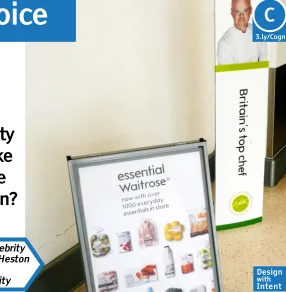
Endorsements where the celebrity is an ‘expert’ (such as chef Heston Blumenthal in this Waitrose campaign) can lend credibility
Cg
Expert choice
Cg
3.ly/Cogn
Design with Intent
Can you selectively
present choices
in a way which
frames the range
available in a more
positive light?
Starbucks’ drink sizes start with ‘tall’, framing the range further up the scale and avoiding any mediocre implications of ‘small’ or ‘medium’
Cg
Framing
Cg
3.ly/Cogn
Design with Intent
Can you make it
easy for a new
behaviour to
become habitual,
by building it into
an existing routine?
Simply choosing to take the stairs rather than the lift / elevator can quickly become part of a daily routine at home or work
Cg
Habits
Cg
3.ly/Cogn
Design
with
Can you give your
system a
personality or
character that
engages users,
becoming a
‘social actor’?
Dutch researchers have used Philips’ iCat robot to influence users’ decision-making with washing machines, advising and expressing opinions
Cg
Personality
Cg
3.ly/Cogn
Design with Intent
Can you help users
see other people’s
perspectives and
thought processes,
by revealing them
through the design
of your system?
Twitter, Facebook et al allow us to see at any moment the problems and concerns of millions of others just like us (or not) all over the world
Cg
Provoke empathy
Cg
3.ly/Cogn
Design with Intent
Can you make users
feel they’ve been
done a favour (by
the system, or by
other users) and
want to return it?
This busker’s postcards may be ‘free’, but the social norms of reciprocation mean most people will give him some tip in return
Cg
Reciprocation
Cg
3.ly/Cogn
Design with Intent
Can you rephrase
or rename what
you’d like users to
do, so it aligns
better with what
they already want
to do?
Twitter changed the name of the ‘Devices’ tab to the more easily understandable ‘Mobile’ to encourage more users to set up their phones
Cg
Rephrasing & renaming
Cg
3.ly/Cogn
Design with Intent
Can you emphasise
that a resource is
valuable, limited in
quantity, or
running out (or
actually limit it
artificially)?
We’re used to retailers emphasising that ‘everything must go’ and then not actually closing; in this case, however, the shop did close down
Cg
Scarcity
Cg
3.ly/Cogn
Design with Intent
Can you show
people what other
users like them are
doing in this
situation, and
which choices are
most popular?
Amazon’s recommendations can be helpful to buyers by expanding the scope of their knowledge, while increasing sales for Amazon
Cg
Social proof
Cg
3.ly/Cogn
Design with Intent
The Machiavellian Lens comprises design
patterns which, while diverse, all embody an ‘end justifies the means’ approach of the kind
associated with Niccolò Machiavelli. These will often be considered unethical, but nevertheless are commonly used to control and influence consumers through pricing structures, planned obsolescence, lock-ins and so on, and are central to work by authors such as Vance Packard and Douglas Rushkoff, revealing the ‘hidden’
structures which shape our everyday behaviour. In technology contexts, Benjamin Mako Hill and Chris Nodder have both done great work
exploring this area.
Elements of game theory are present in some of the patterns, and this is worth further investigation.
Machiavellian Lens
Image for Antifeatures & crippleware is from Orin Zebest's Flickr stream, CC-BY-SA licensed
(http://www.flickr.com/photos/orinrobertj ohn/68106611)
Images for First one free, Forced dichotomyandSlow/no response are screenshots of Bill Moggridge’s ‘Designing Interactions’ website (http://www.designinginteractions.com/b ook), an example survey built using surveymonkey.com, and a registration form on the Univadis website
(http://www.univadis.co.uk/medical_and_ more/Registration?locale=en_GB) respectively.
Other photos by Dan Lockton
Can you affect
users’ expectations
or assumptions
by controlling the
reference points
they have?
Restaurant menus may use
‘anchor’ items: prominently placed, higher-priced dishes, raising what customers expect to be paying
Mv
Anchoring
3.ly/Mach
Design
with
Intent
Can you deliberately
disable some
functions even
though they’re still
present, to drive
users to upgrade,
or to allow price
discrimination?
Sony’s cheaper 60-minute MiniDiscs were identical to the 74-minute ones except for a pre-written portion of code preventing full use of the space
Mv
Antifeatures & crippleware
3.ly/Mach
Design with Intent
Can you include
something you
want users to do,
along with
something they
want to do, so both
get done?
Crushing up pills or tablets in a spoonful of peanut butter can be a good way to get dogs to take medi-cines they would otherwise refuse
Mv
Bundling
3.ly/Mach
Design
with
Intent
Can you degrade
the performance
of a product or
system until users
comply with some
behaviour change
you want?
Some Nokia phones allegedly sense when a 3rd-party battery is used and switch into a high-power mode so it runs out more quickly
Mv
Degrading performance
3.ly/Mach
Design
with
Intent
Can you give
something away
which gets people
interested or
addicted, so they
come back and
pay for more?
Offering one chapter (often the introduction) free has become increasingly common as a way of promoting new books more widely
Mv
First one free
3.ly/Mach
Design with Intent
Can you configure
a system so there
is no ‘middle
ground’ possible,
and users must
make a choice one
way or the other?
An even-numbered (e.g. four- point) rating scale does not allow a ‘middle’ value: it forces respondents into making a ‘good or bad?’ choice
Mv
Forced dichotomy
3.ly/Mach
Design with Intent
Can you design
your system so
users become
committed to a
particular format
or way of doing
things?
Panasonic cameras include a ‘battery authentication’ system, which prevents using cheaper non-Panasonic replacements
Format lock-in/out
3.ly/Mach
Design with Intent
Can you design
things to become
technologically
superseded (or
even wear out)
quickly, so people
replace them?
While new models do bring real technological advances, Apple has managed to create an ‘upgrade treadmill’ for iPhone buyers
Mv
Functional obsolescence
3.ly/Mach
Design
with
Can you structure
a system so that
no one user can
get an advantage
over others
simply by being
first to act?
If person 1 cuts a cake into halves, and person 2 chooses the half he or she wants, there is no advantage in person 1 cutting the cake unfairly
Mv
I cut, you choose
3.ly/Mach
Design
with
Intent
Can you arrange
things so that an
otherwise attractive
option has an
unpleasant,
self-defeating deterrent
side-effect?
Security ink tags release indelible ink if removed incorrectly, in an attempt to make it simply not worth stealing the clothes
Mv
Poison pill
3.ly/Mach
Design with Intent
Can you direct
users to use a
product or system
in a particular way
through examples
or demonstrations?
Alka-Seltzer reputedly introduced the ‘two tablets per dose’ direction to users as part of a 1960s TV ad; before that, only one was taken
Mv
Serving suggestion
3.ly/Mach
Design with Intent
Can you get users
to try different
actions or repeat a
behaviour by
making the system
respond or give
feedback slowly?
Duplicate orders can be a problem where web forms are slow to submit and users click multiple times: this kind of instruction is common
Mv
Slow / no response
3.ly/Mach
Design with Intent
Can you design
things to become
unfashionable or
undesirable quickly,
to spur the desire
for replacement or
upgrades?
Fashions and trends are obvious in high-street retailing, but are also prevalent (and can be deliberately created) in other fields
Mv
Style obsolescence
3.ly/Mach
Design with Intent
Can you help
users overcome
worry about their
behaviour (perhaps
after having
suggested it in
the first place)?
The term ‘halitosis’ was allegedly introduced in a 1921 Listerine ad, part of a series making people worried about bad breath, then offering a solution
Mv
Worry resolution
3.ly/Mach
Design with Intent
The Security Lens represents a ‘security’
worldview, i.e. that undesired user behaviour is
something to deter and/or prevent though
‘countermeasures’ designed into products,
systems and environments, both physically and
online, with examples such as digital rights
management.
From a designer’s point of view, this can often
be an ‘unfriendly’ – and in some circumstances
unethical – view to take, effectively treating
users as ‘guilty until proven innocent’. However,
thinking further about the patterns, it’s possible
to think of ways that they could be applied to
help users control their own habits or behaviour
for their own benefit – encouraging exercise,
reducing energy use, and so on.
Security Lens
Image for Sousveillance is a screenshot of TheyWorkForYou
Can you use
ambient sensory
effects (sound,
light, smell, etc) to
make it harder for
users to behave in
certain ways?
Blue lighting is used in some pub- lic toilets (e.g. here, in Edinburgh) to discourage drug injection by making veins difficult to see
Se
Coercive atmospherics
3.ly/Secu
Design
with
Intent
What happens if
users know (or
believe) that what
they’re doing is
visible to their
peers also using
the system?
Neighbourhood Watch schemes are signed so that they provide a deterrent effect—”people here are vigilant about what’s going on”
Peerveillance
3.ly/Secu
Design with Intent
Can you give people
‘lower down’ a
hierarchy the
ability to observe
and monitor the
behaviour of
people above them?
TheyWorkForYou allows the public to monitor politicians’ activities easily: transparency leading to better accountability
Se
Sousveillance
3.ly/Secu
Design with Intent
What happens if
users know (or
believe) their
behaviour is visible
to or monitored by
people in positions
of power / authority?
CCTV is often presented as a crime deterrent, influencing public behaviour, whether or not it is switched on or actually monitored
Se
Surveillance
3.ly/Secu
Design with Intent
What happens if
your design
threatens to (or
actually does)
harm users who
behave in the
‘wrong’ way?
Spikes on walls—such as these stick-on plastic ones—can act as a deterrent to climbing or sitting, with varying effectiveness
Se
Threat of injury
3.ly/Secu
Design with Intent
What happens if
your design
threatens to
damage users’
property if they
use it the
‘wrong’ way?
‘Traffic control spikes’ are an attempt to enforce one-way traffic at entrances to car parks (etc): the threat is made very clear
Se
Threat to property
3.ly/Secu
Design with Intent
Can you give
users different
choices or access
to functions
depending on the
capabilities they
can demonstrate?
Child-proof lids are often used on containers for dangerous
substances, such as medicines and garden and cleaning products
Se
What you can do
3.ly/Secu
Design with Intent
Can you give users
options or access
to different functions
depending on their
possession of a
special tool, key,
device or token?
Access cards allow the issuer to restrict entrance to certain
buildings or areas to whoever has a card with the right permissions
Se
What you have
3.ly/Secu
Design with Intent
Can you test what
users know
(information,
passwords, etc) to
give them access
to different
functions?
Remembering usernames, pass-words and answers to security ques-tions is increasingly part of our everyday lives, on- and offline
Se
What you know
3.ly/Secu
Design with Intent
Can you change
the options
available to
users based on
their current or
previous
behaviour?
‘Teaching machine’ textbooks allow students to progress in different orders depending on which concepts need more explanation
Se
What you’ve done
3.ly/Secu
Design with Intent
Can you make
different choices
available to
users depending
on their location?
Some supermarket trolleys have devices fitted to lock the wheels when taken outside a defined area, usually an adjacent car park
Se
Where you are
3.ly/Secu
Design with Intent
Can you use criteria
innate to particular
individuals, groups
or objects to block
or make different
options available?
Artificial height restrictors
attempt to allow only certain types of vehicles into a car park, by discriminating on vehicle height
Se
Who or what you are
3.ly/Secu
Design
with
Intent