University of Warwick institutional repository: http://go.warwick.ac.uk/wrap
This paper is made available online in accordance with publisher policies. Please scroll down to view the document itself. Please refer to the repository record for this item and our policy information available from the repository home page for further information.
To see the final version of this paper please visit the publisher’s website. Access to the published version may require a subscription.
Author(s): Leslie J. Francis; Yashoda Romil Santosh; Mandy Robbins and Savita Vij
Article Title: Internal consistency reliability and construct validity of the Attitude toward Muslim Proximity Index (AMPI): a measure of social distance
Year of publication: 2009 Link to published version:
http://dx.doi.org/ 10.1080/01416200903112417
Publisher statement: ‘This is an electronic version of an article published in Francis, L. et al. (2009). Internal consistency reliability and construct validity of the Attitude toward Muslim Proximity Index (AMPI): a measure of social distance. British Journal of Religious Education, Vol. 31, pp. 241-249. British Journal of Religious Education is available online at:
C:\Users\Leslie\Desktop\SusanThomas\Articles\Village_A\Attitude toward Muslim Proximity Index.doc RESEARCH ARTICLE
Internal consistency reliability and construct validity of the Attitude toward Muslim Proximity Index (AMPI): A measure of social distance
Adrian Brockett1
Andrew Village
York St John University, York, UK
Leslie J. Francis
Warwick Religions and Education Research Unit, University of Warwick, UK.
1
Internal consistency reliability and construct validity of the Attitude toward Muslim Proximity Index (AMPI): A measure of social distance
Abstract
The Attitude toward Muslim Proximity Index (AMPI) is a 6-item scale that uses
tolerance to different degrees of social distance to assess prejudice towards Muslims.
It was tested on 1777 teenage school children from Northern England who indicated
their religion as either ‘Christian’ or ‘no religion’, and demonstrated good internal
reliability (Cronbach’s alpha = .81). The index was higher among pupils who
supported the views of the British National Party and among those who believed that
British Muslims should adopt Western culture; but lower among those who knew
Muslims or had Muslim friends. The AMPI is a useful measure of Islamophobic
attitudes that does not rely on responses to specific events or on detailed knowledge of
the Muslim religion.
Introduction
There has been a widespread and long-term interest among sociologists regarding the
relationships between groups of different ethnic or religious backgrounds that co-exist
in the same societies. In Western societies this interest includes studies of attitudes of
the majority toward minorities, such as whites toward African-Americans in the USA
(Bogardus 1928; Hughes and Tuch 2003; Johnson and Marini 1998; Westie 1953),
indigenous European populations towards immigrants (McLaren 2003; Pettigrew et al.
1997; Pettigrew and Meertens 1995; Stephan, Ybarra, and Bachman 1999) and those
from a predominantly Christian background toward Jews or Muslims (Duriez and
Hutsebaut 2000; Eisinga, Billiet, and Felling 1999; Jacobson 1998). Such studies
generally rely on measures that attempt to operationalize an underlying attitude of
prejudice, fear or loathing linked to concepts such as racism and Islamophobia.
A recognized way of operationalizing such constructs involves identifying
items that typify stereotypes found among the majority population being investigated.
In a study of religion and racism among undergraduates in Belgium, for example,
Duriez and Hutsebaut (2000) used a range of items considered to be related to specific
fears about immigrants in that country, such as: ‘Guest workers come here to exploit
our social security’, ‘Guest workers endanger the employment of Belgians’ and ‘In
some neighborhoods, government is doing more for immigrants than for the Belgians
who live there’. An advantage of such measures is that they are relevant to the
attitudes of the majority group under study, and may therefore be said to have high
face validity. In addition, they enable assessment of the relative importance of
different personal and contextual factors that might contribute to the overall attitude
There are, however, some disadvantages in using such scales. First, they may
be overly specific to particular groups and their interactions. This means that scales
may not be generalizable across different populations, or even within the same
population over time. A measure designed to assess attitudes of whites toward
Afro-Caribbeans in Britain, for example, may not be easily compared with a measure
constructed to assess attitudes of whites toward Muslims in Britain; measures used in
Britain may not work if applied elsewhere in Europe; and measures developed in
response to a particular context, event or crisis might be incomprehensible to later
generations. Field (2007) found that British opinion polls between 1988 and 2006
concerned with negative attitudes toward Muslims (‘Islamophobia’) drew on
stereotypes and were often conducted in response to particular events or crises.
Although Field was able to identify some trends, comparison was hindered by the way
that items in surveys tended to reflect particular preoccupations at the time when the
questionnaires were constructed.
A second problem with attitude scales developed in relation to specific
interactions is that they sometimes require a fairly sophisticated and detailed
knowledge of the outgroup. An example of this sort of instrument is provided by a
measure of attitude toward Islam developed for use among school children by Smith
and Kay (2000). This instrument was designed for use among children who were
expected to have been taught about Islam, and consequently many items drew on
particular Islamic beliefs or practices. Typical items included: ‘I respect Moslems
who try to follow the Five Pillars of Islam’, ‘I like the Moslem idea of only eating
halal meat’ and ‘I admire the moral beliefs of Islam’. Children who had not been
taught about these aspects of Islam, or who had been exposed to such teaching but
this case, neutral answers (such as a ‘not certain’ response) may betoken lack of
understanding, rather than a particular attitudinal stance.
A third problem with using items relating to specific aspects of an inter-group
relationship is that they may measure matters of fact or legitimate belief, rather than
indicators of underlying prejudice. A respondent who agrees that immigrants should
learn the language of their adopted country, for example, might be drawing on a
genuine concern that incomers might find integration more difficult if they do not
make the effort to learn the local language, rather than a cultural arrogance demanding
that outsiders conform to the majority convention.
Social psychologists have sometimes drawn on the widely used concept of
‘social distance’ to measure discrimination or prejudice (Bogardus 1928, 1959;
Ethington 2007).This concept is conceived of as a mixture of physical and spatial
proximity and more metaphorical understandings of distance relating to differences in
social class or social location. The underlying theory assumes that prejudice is related
to how comfortable people feel at different levels of proximity to members of an
outgroup. Researchers measure levels of prejudice by creating items that specify
different levels of spatial (e.g. living in the same area, eating in the same restaurant,
encountering headscarves, etc.) or social (e.g. attending the same school, being related
by marriage, etc.) proximity. Summated scales are then created on the assumption that
low tolerance of proximity equates with underlying discrimination, prejudice or fear
of the outgroup in question. Social distance has been used in this way to assess
prejudice associated with race (Bogardus 1928; Westie 1953), mental illness
(Angermeyer and Matschinger 1997; Brockman and D'Arcy 1978; Corrigan et al.
2001) and religion (Brinkerhoff and Jacob 1994). Although the concept of ‘distance’
reasons for including an element of spatial proximity in such scales (Ethington 2007).
Spatial distance may be a direct way of examining the extent of irrational fear or
prejudice towards a racial or religious outgroup.
This study reports on the development of a social distance scale to measure
attitude toward Muslims that should be generalizable across different populations.
Likert-type items (Likert 1932) were used to create a summated rating scale that was
tested for internal consistency reliability and construct validity among predominantly
white teenage pupils in two areas of Britain specifically selected because of their
different proportions of Muslims in the local population.
Method
Sample
Questionnaires were administered by class teachers during normal school activities to
pupils between the ages of 14 and 18 years in 2003 and 2004 within three areas of
northern England (Blackburn, Kirklees and York) as part of a wider study into attitude
toward Muslims and Islam (Brockett et al. 2007). All pupils were assured of
anonymity and confidentiality, and given the opportunity to opt out of the survey.
Response rates were high, and nearly all pupils agreed to complete the questionnaire.
Data for Blackburn and Kirklees were combined due to small sample sizes and the
similarity of these areas. The catchment area of the Blackburn and Kirklees schools
included a higher proportion of Muslims than that of the York schools. In 2001, the
proportion of Muslims in the populations of Blackburn, Kirklees and York was 19%,
10% and <1% respectively (Office for National Statistics 2003, Table KS07). This
trend was reflected in the samples in this study, which included 23% Muslims in
categories (Buddhist, Hindu, Jewish, Other Religion) made up less than 4% of the
total sample and were excluded from the final sample. Analyses reported in the
present paper were confined to respondents who classed their religion as ‘Christian’
or ‘no religion’ (490 in Blackburn and Kirklees and 1287 in York).
Measures
A number of items were included in the questionnaire to assess attitude toward having
Muslims in some sort of proximity to the respondent (Table 1). Items were introduced
with the words ‘How would you feel about…’ and responses were scored from 1 (=
very pleased) to 5 (= very unhappy). Of these items, four referred to spatial proximity
(having Muslims living next door, in the same street, in the next street, or elsewhere
in the town), one to social proximity (having a Muslim marry into the family) and
one to proximity to those who are noticeably different (pupils wearing of headscarves
in school).
Other items included in the questionnaire were designed to assess correlates
(and hence construct validity) of the proximity items: ‘I agree with the views of the
British National Party (BNP)’ (1 = strongly disagree to 5 = strongly agree); ‘Muslims
should adopt Western culture when living in the UK’ (1 = strongly disagree to 5 =
strongly agree); ‘Do you have any Muslim friends?’ (0 = no, 1 = yes); ‘Do you know
any Muslims?’ (0 = no, 1 = yes).
Data analysis and scale properties
The six items were initially subject to exploratory factor analysis using principal
components extraction, which identified a single factor accounting for 58% of the
Item – rest-of-test correlations (ranging from .48 to .72, Table 1) and the Cronbach’s
alpha coefficient ( = .81) indicated that the six items formed a scale with good
internal reliability, so item scores were summed to create the Attitude toward Muslim
Proximity Index (AMPI).
[Table 1 about here]
Results
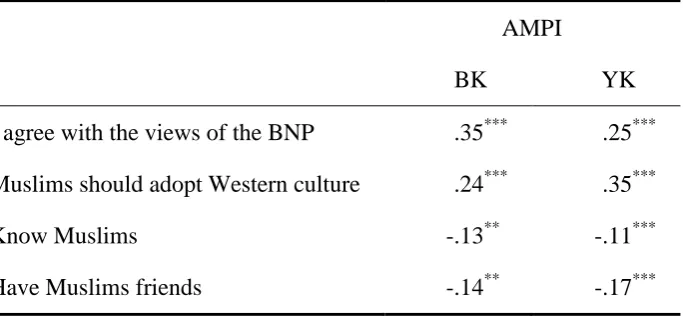
Construct validity of the AMPI was investigated by comparing the correlation
coefficients between the total scale score and the four items presented in Table 2. In
view of the different proportions of Muslims living in the different communities, the
correlations were calculated separately for pupils in Blackburn and Kirklees and those
in York.
[Table 2 about here]
Higher scale scores were associated with agreement with the views of the BNP and
with agreement that Muslims in the UK should adopt Western culture; and lower scale
scores were associated with knowing Muslims and with having Muslim friends. These
correlations support the view that the scale is a measure of prejudice against Muslims.
AMPI scores were significantly higher in Blackburn and Kirklees (mean (± SE)
= 18.4 ± 0.2. n = 490) than in York (16.2 ± 0.1, n = 1287; t = 159.5, p < 0.001), and
this was reflected in the endorsement of individual items in the scale (Table 3). For
each of the six items, the proportion of pupils who chose the ‘very unhappy’ or
[Table 3 about here]
Pupils in Blackburn or Kirklees were also more likely than those in York to agree
with the views of the BNP and to agree that Muslims should adopt Western culture
when living in the UK. At the same time, pupils in Blackburn and Kirklees were twice
as likely to know Muslims or to have Muslim friends compared to pupils in York
(Table 3), clearly reflecting the considerably higher proportion of Muslims among the
Blackburn and Kirklees communities compared with the community in York. The
greater contact with Muslims in Blackburn and Kirklees was not, however, reflected
in more tolerant overall attitudes toward Muslims among non-Muslims within those
communities. Although knowing Muslims or having Muslim friends reduced
prejudice within these areas, the absolute measures of prejudice were higher in
Blackburn and Kirklees than in York (Table 4).
[Table 4 about here]
Discussion
Reliability and validity of the AMPI scale
The main purpose of this paper has been to establish the possibility of using a social
distance scale to measure Islamophobia among young people in Britain. The six
items in the AMPI formed an internally reliable scale with an acceptably high
Cronbach’s alpha of .81. This implies that a given individual is likely to respond in
the same direction to each item. The underlying construct linking the six items seems
to be fear of interacting with Muslims, and a general aversion to them. The item
related to the wearing of the hijab was the least well correlated with the overall scale,
representing as it does a slightly different way of measuring fear of proximity.
the construct into different modes of proximity. In the case of the hijab, aversions may
also be linked to a desire to remove markers of cultural or religious difference.
The other items generally showed an expected pattern of increasing
unhappiness with increasing proximity of contact. An exception was attitude toward
Muslims living in the same city, where responses were slightly more negative than
expected from the items that referred to Muslims living in specific spatial proximity
(in the same street or next door) to the respondent. It may be that this reflects the
nature of immigrant settlement in Britain, which has been much higher in some areas
than in others, resulting in the sort of uneven distribution of religious groups
displayed in the communities in this study. Rejection of Muslims living ‘in your city’
may reflect unease with the possibility of the community having a large proportion of
poorly-integrated religious or ethnic groups. For the other items there was an
incremental increase in scores from the item referring to Muslims living in the next
street through to Muslims marrying into the family, which was the most negatively
rated item.
These scores suggest that a mixture of daily social contact, spatial proximity
and social proximity may be useful items in a social distance scale of this sort. We
concur with Ethington (2007) who argues that social distance scales should retain
elements of both geometric and metaphorical distance. The items included in this
scale were the only ones available on the questionnaire, but future studies could
investigate a wider range of items referring to different sorts of distance.
The positive correlation of AMPI scores with attitude toward the views of the
BNP is in line with the argument that the scale measures prejudice towards, and
irrational fear of, Muslims. Whatever the policies of the BNP, the party is widely
those who hold prejudiced or phobic attitudes toward Muslims. The positive
correlation with the belief that Muslims should adopt Western culture when living in
the UK probably also indicates fear of outgroup difference, though this belief might
not necessarily be driven by religious prejudice.
The levels of knowing Muslims and having Muslims friends in the two main
study areas reflect the very different opportunities of meeting Muslims in the different
communities. Nonetheless, in both areas, those who knew or had befriended Muslims
were likely to have lower scores on the AMPI. This agrees with many studies that
have shown that prejudice is lower among those who have close contact with the
outgroup (Alexander and Link 2003; Corrigan et al. 2001; Pettigrew 1998; Pettigrew
and Tropp 2006), and again confirms the validity of the AMPI as a measure of social
distance related to religious prejudice.
Results from other parts of the questionnaire suggest that knowledge of
Muslim practices among the white populations was generally low (Brockett et al.
2007), so a scale of prejudice based on aspects of Islam or Muslim culture might have
confounded racism with ignorance of the outgroup. Where religion and race are
closely associated it is not easy to separate out which is the cause of the prejudice and
more detailed research is required to test if religious prejudice is distinct from racial
prejudice in the case of Islam. However, we believe the current measure indicates a
way of measuring a general attitude toward a minority group that taps into irrational
fear or prejudice and that is not dependent on detailed knowledge of the religious
beliefs or practices of Muslims. As such it may be a useful measure of attitude toward
Muslims, or ‘Islamophobia’, that could be employed across different communities and
over time. It should also be possible to convert it fairly easily into a scale related to
Application of the scale
An interesting finding that requires further investigation is that although contact with
Muslims reduced prejudice within communities, this was not so between communities.
Pupils in Blackburn and Kirklees were more likely to contact with Muslims than were
those in York, but average AMPI scores were still significantly higher, implying
greater levels of prejudice. The notion that frequent contact reduces prejudice is based
on the assumption that prejudice is largely driven by fear of the unknown. Bringing
different religious groups into contact should increase familiarity, reduce fear and
therefore reduce prejudice. This seemed to happen within each of the communities,
where knowing Muslims (even without having Muslim friends) significantly reduced
AMPI scores. However, this ‘familiarity effect’ was small compared with differences
between communities, which worked in the opposite direction. Here, the communities
with highest likelihood of encounter with Muslims (Blackburn and Kirklees) had the
highest level of prejudice. As a result, AMPI scores were higher among respondents
in Blackburn and Kirklees who knew Muslims than among those in York who did not.
Perhaps it is easier to be open to the idea of increased proximity with a minority when
the possibility of this happening is small. This study sampled only two communities
with very different proportions of Muslims: future work could apply the AMPI scale
to more communities with varying proportions of Muslims in the population in order
Table 1. Scale properties of the Attitude toward Muslim Proximity Index (AMPI)
Mean SD IRC
How you feel about Muslims living in your city? 2.68 1.20 .64
How you feel about Muslims living in the next street? 3.10 0.45 .62
How you feel about Muslims living in your street? 3.14 0.51 .71
How you feel about Muslims living next door? 3.23 0.63 .72
How would you feel about a close relative marrying a
Muslim person? 3.27 0.92 .56
Would you mind if girls in your school/college wore a
headscarf? (scale 1-3) 1.42 0.81 .48
Table 2. Construct validity of the Attitude toward Muslim Proximity Index (AMPI)
AMPI
BK YK
I agree with the views of the BNP .35*** .25***
Muslims should adopt Western culture .24*** .35***
Know Muslims -.13** -.11***
Have Muslims friends -.14** -.17***
Note. Table reports bivariate Pearson correlation coefficients. BK= Blackburn and
Table 3. Percentage of item endorsement in the AMPI and its correlates
BK YK
N = 490 1287
% % χ2
How do you feel about: 1
Muslims living in your city? 36 14 118.7***
Muslims living in the next street? 20 6 81.7***
Muslims living in your street? 26 9 86.0***
Muslims living next door? 38 16 96.2***
A close relative marrying a Muslim person? 43 24 58.2*** Girls in your school wearing a headscarf? 33 15 70.1***
I agree with the views of the British National Party (BNP)2 13 5 31.0*** Muslims should adopt Western culture when living in the UK2 41 26 40.5***
Do you know any Muslims?3 79 41 207.5***
Do you have any Muslim friends?3 64 28 197.7***
Note: BK= Blackburn and Kirklees; YK = York; ***p < 0.001.
1 Items in the AMPI; endorsement reported on sum of ‘very unhappy’ or ‘unhappy’
2
Correlates with AMPI; item endorsement reported on sum of ‘agree strongly’ or
‘agree’.
Table 4. Mean (SD) AMPI scores in relation to knowing or not knowing Muslims or having Muslim friends
Note: BK= Blackburn and Kirklees; YK = York
BK n YK n
Do you know any Muslims? No 19.5 (4.6) 101 16.5 (2.9) 757 Yes 18.1 (3.8) 389 15.9 (2.9) 530
References
Alexander, L., and B. Link. 2003. The impact of contact on stigmatizing attitudes toward people with mental illness. Journal of Mental Health 12, no. 3: 271-289.
Angermeyer, M.C., and H. Matschinger. 1997. Social distance towards the mentally ill: Results of representative surveys in the Federal Republic of Germany.
Psychological Medicine 27, no. 1: 131-141.
Bogardus, E.S. 1928. Immigration and race attitudes. Lexington, MA: Heath. ———. 1959. Social distance. Yellow Springs, OH: Antioch Press.
Brinkerhoff, M.B., and J.C. Jacob. 1994. Racial, ethnic and religious social distance in Surinam: An exploration of the 'Strategic Alliance Hypothesis' in a Caribbean community Ethnic and Racial Studies 17, no. 4: 636-661.
Brockett, A.A., N. Noret, S. Harenwall, P.D. Baird, and I. Rivers. 2007. Adolescent attitudes in York toward Muslims and Islam. In Community identity:
Dynamics of religion in context, edited by S. C. H. Kim and P. Kollontai. London: T & T Clark.
Brockman, J., and C. D'Arcy. 1978. Correlates of attitudinal social distance toward the mentally ill: A review and re-survey Journal Social Psychiatry and Psychiatric Epidemiology 13, no. 2: 69-77.
Corrigan, P.W., A.B. Edwards, A. Green, S.L. Thwart, and D.L. Perm. 2001. Prejudice, social distance, and familiarity with mental illness. Schizophrenia Bulletin 27, no. 2: 219-225.
Cronbach, L.J. 1951. Coefficient alpha and the internal structure of tests.
Psychometrika 16: 297-334.
Duriez, B., and D. Hutsebaut. 2000. The relation between religion and racism: The role of post-critical beliefs. Mental Health, Religion and Culture 3, no. 1: 85-102.
Eisinga, R., J. Billiet, and A. Felling. 1999. Christian religion and ethnic prejudice in cross-national perspective: A comparative analysis of the Netherlands and Flanders (Belgium) International Journal of Comparative Sociology 40, no. 3: 375-393.
Field, C.D. 2007. Islamophobia in contemporary Britain: The evidence of the opinion polls, 1988-2006. Islam and Christian-Muslim Relations 18, no. 4: 447-477. Hughes, M., and S.A. Tuch. 2003. Gender differences in whites' racial attitudes: Are
women's attitudes really more favorable? . Social Psychology Quarterly 66, no. 4: 384-401.
Jacobson, C.K. 1998. Religiosity and prejudice: An update and denominational analysis. Review of Religious Research 39, no. 3: 264-272.
Johnson, M.K., and M.M. Marini. 1998. Bridging the racial divide in the United States: The effect of gender. Social Psychology Quarterly 61: 247-58. Likert, R. 1932. A technique for the measurement of attitudes. New York: Columbia
University Press.
McLaren, L.M. 2003. Anti-immigrant prejudice in Europe: Contact, threat perception, and preferences for the exclusion of migrants. Social Forces 81, no. 3: 909-936.
Office for National Statistics. 2003. Key statistics for England and Wales. London: HMSO.
Pettigrew, T.F. 1998. Intergroup contact theory. Annual Review of Psychology 49, no. 1: 65-85.
Pettigrew, T.F., J.S. Jackson, J.B. Brika, G. Lemaine, R.W. Meertens, U. Wagner, and A. Zick. 1997. Outgroup prejudice in Western Europe. European Review of Social Psychology 8, no. 1: 241-273.
Pettigrew, T.F., and R.W. Meertens. 1995. Subtle and blatant prejudice in Western Europe. European Journal of Social Psychology 25, no. 1: 57-75.
Pettigrew, T.F., and L.R. Tropp. 2006. A meta-analytic test of intergroup contact theory. Journal of Personality and Social Psychology 90, no. 5: 751-83.
Smith, D.L., and W.K. Kay. 2000. Religious terms and attitudes in the classroom (part 2). British Journal of Religious Education 22, no. 3: 181-191.
Stephan, W.G., O. Ybarra, and G. Bachman. 1999. Prejudice toward immigrants.
Journal of Applied Social Psychology 29, no. 11: 2221-2237.