University of Twente
Master Thesis
Extract Offender Information from Text
Author:
Supervisors:
Eduard Rens
Dr. ir. M. van Keulen
Prof Dr. M. Junger
Dr. M. Theune
External Supervisor:
Elmer Lastdrager
Abstract
This study is an attempt to investigate the feasibility and reliability of extracting a specific target information automatically out of Unlabeled Dutch Text. The Text sources consists out of stored email exchanges between the dutch help organization Fraudehelpdesk and the victims/informants that report fraud-incidents. The target information to extract is about the offenders that attempted a fraud. The research describes all the necessary processes that are needed to detect offender information and to extract the detected offender information. It starts with assigning Part of Speech (POS) tagging and Named Entity Recognition (NER) on each word by comparing the performance of external dutch data sources for POS & NER tagging and shows a reliable way to attain a good performance on predicting POS & NER tags on unlabeled Data.
Keywords
Acknowledgements
I would like to express my deepest appreciation to all the involved people that guided me through the whole project and the University of Twente which gave me the opportunity to study the Master program Human Media Interaction. I give especially my gratitude to Dr. ir. Maurice van Keulen who helped me to coordinate to write this report and contributed with suggestions, advices that guided and encouragement me through the whole project.
Furthermore I would like to give my thanks to Prof Dr. Marianne Junger for the feedbacks and ideas on the report from the view of person from a different field.
Another thanks goes to Dr. Mena Habib from the Maastricht university for the guidance to learn and ask question on the missing knowledge for Natural Language Processing at the begin of the project starting from the Research topic.
A give thanks to Jan Flokstra and the EDV team for providing access to a room and equipment. A SPECIAL thanks to Elmer Lastdrager who provided access to the FHD data and as a contact person who answered my questions about FHD, access problems and the usage of the FHD data.
Contents
List of Tables 4
List of Figures 6
1 Introduction 8
1.1 Motivation . . . 8
1.2 Problem statement . . . 9
1.3 Objective . . . 10
1.4 Aims of the offender extraction application . . . 10
1.5 Research Question . . . 11
1.6 Available Data,Tools and Restrictions . . . 13
1.6.1 Data collection . . . 13
1.6.2 Confidential data and its limitation. . . 14
1.7 Methodological approach . . . 15
1.7.1 The global solution direction . . . 15
1.8 Research steps . . . 16
2 State of the art / Literature review 18 2.1 literature studies . . . 18
2.2 Natural Language Processing (NLP) . . . 20
2.2.1 NER(Named entity Recognition) . . . 21
2.2.2 Bootstrapping and other methods . . . 23
2.2.3 Relation Extraction . . . 24
3 Research Setup/ Architecture 27 4 Bootstrapping Unlabeled Data 29 4.1 Dataset . . . 29
4.1.1 CONLL . . . 29
4.1.2 SONAR . . . 30
4.2 NER & POS method . . . 31
4.2.1 Chosen NER Method . . . 31
4.2.2 Conditional Random Fields(CRF) . . . 31
4.2.3 CRF Toolkit . . . 32
4.2.4 CRF Feature extraction . . . 33
4.3 Experimental Results . . . 35
4.3.1 CONLL2002 NER Results . . . 36
4.3.2 CONLL02 POS Results . . . 39
4.3.4 SONAR1 NER Results . . . 40
4.3.5 SONAR1 POS Results . . . 41
4.4 SONAR1 vs CONLL02 comparison . . . 42
4.4.1 NER comparison . . . 42
4.4.2 Conclusion . . . 43
4.4.3 POS comparison . . . 43
4.5 Bootstrapping . . . 45
4.5.1 Results of annotated FHD Data . . . 45
4.5.2 Experimental Result . . . 47
4.5.3 Conclusion . . . 49
4.6 Language Detection . . . 51
4.6.1 Language detection methods . . . 51
4.6.2 English Tagger Result . . . 52
4.6.3 Conclusion . . . 54
4.7 Base module . . . 55
5 Forming Clauses/ Relation extraction 56 5.1 Open Information Extraction . . . 56
5.2 Rules of the Clause-object builder to define Clause Objects . . . 58
5.3 Clause-builder Rules to combine Clause Objects into Clause . . . 60
5.4 Experimental Results . . . 62
5.5 Conclusion . . . 63
5.6 Clause-builder module . . . 64
6 classifications 65 6.1 Text Classification on numerous (large amount of) fraud-type classes 65 6.1.1 Metrics in fraud-type text classification . . . 66
6.1.2 Information about the FHD data . . . 67
6.1.3 Feature Extraction . . . 67
6.1.4 Prediction of a fraud-type . . . 68
6.1.5 Experimental Results . . . 69
6.1.6 Interpretation/Discussion . . . 70
6.1.7 Explanation of the Results . . . 70
6.1.8 Conclusion of the Fraud-type classification . . . 73
6.2 Sender Classifier. . . 74
6.2.1 Sender annotation . . . 74
6.2.2 Experimental Results . . . 74
6.2.3 Conclusion . . . 76
6.3 Clause Builder classifier . . . 77
6.3.1 Experimental Result . . . 77
6.3.2 Conclusion . . . 79
6.4 Offender information classifier . . . 80
6.4.1 Experimental Results . . . 81
6.4.2 Conclusion . . . 84
7 Rule based offender information Extraction 86
7.1 Rule based Information Extraction . . . 86
7.1.1 Characteristics of Fraud-incident texts . . . 87
7.1.2 Characteristic based on sender . . . 87
7.1.3 Changing the predicted sender . . . 88
7.2 Rules to extract offender information . . . 88
7.3 Personal identifiable information (PII) Class . . . 89
7.4 Experimental Results . . . 89
7.4.1 Conclusion . . . 91
8 Comparison & Measurement of acquired offender information 93 8.1 Measurement of offender information . . . 93
8.2 Quality Measurement . . . 96
8.3 Conclusion . . . 100
9 Conclusion 101 9.1 Main research findings . . . 101
9.2 Reflection/Discussion . . . 103
9.3 Recommendations . . . 105
Bibliography 107
List of Tables
4.1 List of CONLL POS Tags . . . 35
4.2 List of CONLL NER Tags . . . 36
4.3 CONLL02 Challenge Results . . . 38
4.4 State of the art methods on SONAR1 . . . 41
4.5 List of additional NER Tags . . . 46
4.6 List of CONLL POS Tags . . . 46
4.7 List of CONLL NER Tags . . . 47
4.8 CONLL03 Challenge Results . . . 54
6.1 Confusion-Matrix . . . 66
6.2 Results of all different methods of the Fraud-type classifier . . . 70
6.3 amount of training data for the Sender classifier . . . 75
6.4 Logistic Regression Result of the Sender Classifier . . . 75
6.5 Confusion matrix of the LogReg Sender Classifier . . . 75
6.6 Naive Bayes Result of the Sender Classifier . . . 76
6.7 Confusion matrix of the Naive Bayes Sender Classifier . . . 76
6.8 Logistic Regression Result of the Clause Builder Classifier . . . 78
6.9 Confusion matrix of the LogReg Clause Builder Classifier Result . . . 78
6.10 Naive Bayes Result of the Clause Builder Classifier . . . 78
6.11 Confusion matrix of the NB Clause Builder Classifier Result . . . 79
6.12 CRF Result of the Clause Builder Classifier . . . 79
6.13 Confusion matrix of the CRF Clause Builder Classifier Result . . . . 79
6.14 Logistic Regression and NB Result of the Offender info Classifier . . . 81
6.15 Confusion matrix of the LogReg and NB Offender info Classifier Result 81 6.16 CRF Result of the Offender info Classifier . . . 82
6.17 Confusion matrix of the CRF Offender info Classifier Result . . . 82
6.18 logreg of the latest Offender info Classifier . . . 82
6.19 single CRF Result of the latest Offender info Classifier . . . 83
6.20 latest CV CRF Result of the Offender info Classifier . . . 83
6.21 Confusion matrix of the CRF Offender info Classifier Result . . . 84
7.1 table columns . . . 89
7.2 Confusion matrix of extracted offender info . . . 90
7.3 Result of the Offender info extraction . . . 90
7.4 Confusion matrix of extracted offender info allO . . . 91
7.5 Result of the Offender info extraction allO . . . 91
7.6 Confusion matrix of latest extracted offender info . . . 91
8.1 Comparison of offender Names . . . 98
8.2 Comparison of offender Organization . . . 99
1 Groupvorm of Fraud-types I . . . 125
List of Figures
4.1 POS and NE structure of the Sonar1Dataset . . . 30
4.2 graphical models and their joint probability counterparts. . . 31
4.3 Linear chain crf with factor dependencies on current observations. . 32
4.4 Features of the CRF Model . . . 33
4.5 options of Feature Word Shape . . . 34
4.6 Result of NER detection on CONLL02 validation sets . . . 36
4.7 Result of NER detection on CONLL02 Test set A . . . 37
4.8 Result of NER detection on CONLL02 Test set B . . . 38
4.9 Result of NER detection on SONAR1 testset with SONAR1 trained model . . . 40
4.10 Result of NER detection on SONAR1 testset with conll2002 notation 41 4.11 Result of POS detection on SONAR1 testset with conll2002 notation 42 4.12 Result of NER detection on SONAR1 with trained conll model . . . . 43
4.13 Result of NER detection on FHD Data with CONLL trained model . 48 4.14 Result of NER detection on FHD Data with SONAR1 trained model 48 4.15 Result of NER detection on FHD Data with annotated FHD-data trained model in conll notation . . . 49
4.16 Result of NER detection on FHD Data with annotated FHD-data trained model . . . 49
4.17 Result of NER detection on the whole FHD Data with CONLL trained model . . . 50
4.18 Result of NER detection on the whole FHD Data with SONAR1 trained model . . . 50
4.19 Result of NER detection on FHD Data with a SONAR1 trained model combined with the FHD trained model . . . 50
4.20 Result of NER detection on pseudo FHD Data testset with a SONAR1 FHD trained model combined with pseudo labeled FHD data . . . 51
4.21 NER Results of the CONLL03 testset A . . . 52
4.22 NER Results of the CONLL03 testset B . . . 53
4.23 POS Results of the CONLL03 testset . . . 53
4.24 Architecture of the Base Module . . . 55
5.1 Sample of clausetype extraction of([Corro and Gemulla, 2013]) . . . 58
5.2 a Graphical view to Form a Clause . . . 61
5.3 Architecture of the Clause Builder Module . . . 64
6.1 Architecture of the Classifier Module . . . 65
6.2 promising fraudtypes >60% . . . 71
6.4 Architecture of the Classifier Module . . . 84
7.1 Architecture of the Information Extraction Module . . . 86
8.1 Architecture of the Analyses Module . . . 93
8.2 Amount of manual and extracted data . . . 96
8.3 Performance result Family Names . . . 97
8.4 Performance result Organization . . . 99
1 Result of POS detection on SONAR1 testset with SONAR1 trained model . . . 113
2 Result of POS detection on SONAR1 with trained conll model . . . . 113
3 Result of NER detection on CONLL testsets with CONLL2002 trained model . . . 114
4 Result of NER detection on CONLL testsets with Sonar1 trained model115 5 Result of POS detection on CONLL testsets with CONLL2002 trained model . . . 116
6 Result of POS detection on CONLL testsets with Sonar1 trained model117 7 precision of Naive Bayes on Fraud . . . 118
8 precision of Log-regression on Fraud . . . 119
9 precision of Naive Bayes on Fraudgroup . . . 120
10 precision of Log regression on Fraud . . . 121
11 probability position of correct fraud type . . . 122
12 confusionmatrix . . . 123
Chapter 1
Introduction
[Kount, 2017] explains that Opportunism is the act to take advantage of an event to benefit and to thrive for oneself. Such opportunistic behavior can be observed in each living being with its will to survive. One negative aspect of opportunism is by creating an opportunistic event self to benefit oneself and harming others of its own kind, such an act becomes fraud at some point in case when deceit and trickery is involved to achieve its goal. During the history of mankind from bartering till commerce the trickery of fraud evolved rapidly with the development of mankind’s technology. According to [Beattie, 2017] the earliest record that mentioned a fraud scheme was at 300 B.C.. There are also stories of fraud mentioned in Greek mytholo-gies and in the bible. Even in today’s time offenders are thinking of new ways of attempting fraud. To prevent victims of fraud the Netherlands have established a national anti fraud hot-line called Fraudehelpdesk (FHD) to deal with questions and reports about fraud that were committed. Furthermore FHD warns companies and the Dutch citizens about the reported fraud schemes and informs and forwards them further to the corresponding institutions that can help the victims of fraud.
1.1
Motivation
Fraudehelpdesk (FHD) is a help center organization in the Netherlands for fraud incidents and helps the victims of fraud for private and business cases. FHD collects a lot of information on fraud incidents that victims and informants are providing. Some of the provided information is information about offenders. The FHD wants to use the gathered data about the offenders to detect possible fraud cases and prevent future fraud attempts by exposing the patterns and aliases that the offenders are using.
FHD is a part of Stichting Aanpak Financieel-Economische Criminaliteit in Ned-erland (SafeCin) and they have gathered data of fraud incidents since their estab-lishment in 2003. With the overwhelming data that they have gathered in all those years, SafeCin wants to use and extract the information about the fraud offend-ers from the gathered data to improve the detection of fraud and to prevent more incidents.
with the help of a literature study and experimental results.
1.2
Problem statement
Definition of Fraud
According to [Farlex, 2008], the legal definition of fraud is a criminal act on a false representation of facts, such as false and misleading allegations by words or conduct. For example pretending to be a person or representing an organization to deceive its victim of money or other value of objects or by concealing facts that should have been disclosed to get a financial advantage against others. There are a lot of different types of fraud against a private person or an organization.
The Problem of Fraud
The problem of fraud is that it is difficult to recognize new evolving patterns of fraud attempts. Furthermore it is also difficult to apprehend a fraud-offender, be-cause most of the time they can only be apprehended during a fraud attempt. The characteristics of fraud is that the information that was given to the victim is false, because the offender often uses a false identity to deceive the victim. It is difficult to detect an organization or a single offender, based on the false information that the offenders are revealing to swindle the victims. Furthermore with the low apprehen-sion rate in fraud, fraud-offenders are able develop new fraud methods to deceive their victims or focusing their attempts on other countries that haven’t heard of the fraud method yet.
In most cases the financial damage that fraud causes cannot be recovered and the only prevention that can be offered is to warn people about the fraud methods that the offenders are using. The only method to detect and apprehend an offender is to gather more information about the fraud that the offender is executing and to catch the offender during the act of fraud. The rise and advancement of technology that the Internet provides to connect people around the world is also one of the reasons that the criminal rate in fraud increases. According to [Martinez et al., 2017] and [West and Bhattacharya, 2016] offenders are able to use the Internet as a tool to stay anonymous and to target and contact people all over the world. If the location of the offenders is in a foreign country the laws of the foreign countries might hinder or delay the police to arrest an offender.
Concentration of fraud
In the FHD’s report in 2016, there were 621,000 registered cases for fraud in which around 596,000 (95.7%) cases are declared to be non-fraud such as false emails, phishing, malware, spam and others. Only around 27,200 (4.3%) were cases of actual fraud that would be declared as fraud, while in 2015 there were around 28,600 registered cases of actual fraud. The financial damage of the total registered cases amounts to 9,918,000AC of which around 7,300,000AC was caused by actual fraud
in 2016. In 2015 the total damage of registered cases was 18,370,000AC of which
12,200,000AC was caused by actual fraud. the high damage of actual fraud consists
of the stolen money, goods and follow up damage in companies that the fraud caused. The financial damage in non-fraud cases is caused because of Malware, criminal acts and non-criminal acts that can’t be declared as fraud but caused financial damage on a private person or on an organization.
and they gathered reports from 30 different studies and the data of their crime statis-tics showed that the worst 5% criminals were behind 40% of all registered crimes, while 10% of all criminals amount to 63% of all crimes and 20% of all criminals amount to 80% of crimes. The results were similar in different countries and states in the USA. Except for females the distribution of crime concentration was similar in the 30 different crime statistics. Assuming that the same crime concentration of the study in [Martinez et al., 2017] applies to fraud and that only 4% of all the reg-istered incidents in 2016 were actual fraud and caused already 7,300,000AC financial
damage, the apprehension of fraud offender or a fraud organization could decrease the number of fraud incidents significantly.
1.3
Objective
Until now FHD finds information about offenders by selecting the fraud incidents to analyze, based on the damage and number of fraud incidents that have happened. The FHD employees are analyzing fraud cases manually, by searching the database for fraud incidents in which the offenders were using the same pattern for the fraud or in which they use similar names, websites and other things with the same name. To research offender information manually the employee needs to analyze several fraud cases and read the cases which are similar in detail, to get information about the offenders, which is a very time consuming task. An automated process that could extract the information and associate patterns and other information about the fraud offender would help to reduce the time to gather that information about the offenders significantly. Therefore the request of the FHD is to find a solution to gather offender information automatically. The proposed solution is the application: offender information extractor that is able to detect offender information from the registered fraud-incidents in the FHD’s database and to store it in another database about offenders.
summarize the results and the method that was used
1.4
Aims of the offender extraction application
extracted data and the employees can focus more on researching the data that the offender extractor gathered than to manually gathering information on offender by reading each fraud-incident. The statistic on the offender extractor will give an in-dication if new data was gathered for a new entry of a fraud pattern, or if new data was gathered on already extracted information, which the offender extractor will be ordering to the corresponding entry.
After implementing the offender information extractor the FHD gets the follow-ing thfollow-ings:
1. An application to extract offender informations from their database.
2. A step by step instruction on how to operate the offender extraction applica-tion.
3. A statistic to measure how much information was gained in comparison to manually gathering the same data and a statistic to measure the correctness of the gathered data by comparing how correct it gathered existing offender informations.
1.5
Research Question
This section will answer how the research question was formed. Furthermore this section describes the intended plan to solve each of the research question.
How to extract offender information on each fraud-type?
Beginning with the main research question: How to extract offender information from the FHD database? The main research question was separated in four sub-questions that are shown below below
• How to detect offenders?
– How to Bootstrap NER&POS data on a new unlabeled dataset
– How are extraction features in Clause Information extraction (Clause IE) formed?
– To what degree are extracted and self annotated information classifiable?
• How to detect aliases/organization from the gathered offender information?
• To what degree does the offender extractor find correct and new information compared to manual research?
• How to optimize the offender extractor to get better results? Explaining How to detect offenders?
detector and an offender information detector which uses a similar method as in the paper [Zaeem et al., 2017]. The lead solution for the fraud classifier will be explained in section 6. The intended solution for the NER will be implemented by by training on an already existing corpus of labeled entities from the Dutch SONAR project. The SONAR project contains millions of words in Dutch which are already labeled in Named entities and POS (Part of speech) tags that labels the structure of each sentences in (Nouns, verbs, prepositions, etc.). Furthermore if a part of the fraud-incident text is labeled manually some additional NE information could be added as well as a verification method to measure the performance of the POS and NER detector.
The application is able to form associations and facts With the help of the POS and NER detector, which will be needed for the offender information detector.
The associations and facts that contain Named Entities (NE) have a high pos-sibility to be offender information. Some specified rules will assign and extract the Named Entities to its corresponding group to be information about victims, offenders or third parties. Those rules needs to be defined like in the method of [Zaeem et al., 2017] with their PII (Personal Identifiable Information) attributes.
Following afterwards are the sub research question that were formed from the literature study in Chapter2
How to detect different aliases of fraud offenders?
The second sub research question is: "how to relate information on offenders from different fraud incidents through aliases or relate members of an offender organiza-tion?". This sub-question was formed through the question: "what kind of informa-tion can be gathered after the offender is detected and the offender informainforma-tion is extracted?" The information on linking aliases or members of an offender organiza-tion together is very crucial to prevent future fraud incidents. The intended soluorganiza-tion is by using the methods from [Hassani et al., 2016] by using either the method Social Analysis Network, Cluster Analysis, Association Rule or by imitating the research-method that is used by the FHD employees to gather such information automatically.
To what degree does the offender extractor find correct and new infor-mation compared to manual researches?
After distinguishing all offender information in each fraud-incident. the extracted offender information will be stored in a database that shows the amount of offender data that the extractor was able to extract such as how many names, addresses, phone number etc. were extracted. In addition the extracted data will be com-pared to existing data about offenders that were manually extracted from specific researches of a specific fraud-case. The end-result will be a statistic which shows the amount of new, missing and same information that was found through the com-parison to existing offender data.
How to optimize the offender information extractor?
and which is also correct.
Each of the research questions is depending on the other so first the focus is on the question: "How to detect information about offenders for the offender extractor?". Afterwards the research will focus on how to analyze the gathered information and to relate the information to form conclusions: Like which names are probably aliases or are belonging to the same organization? What fraud pattern did they use? etc. After that a statistical analysis will be done to measure how much new information was gathered in comparison to previous data of manual researches. At the end the offender extractor will be improved with various optimization methods that were thought of during the implementation.
1.6
Available Data,Tools and Restrictions
This section will describe how Fraudehelpdesk (FHD) is gathering their data on fraud, as well as which tools FHD is using and is able to provide and what kind of restrictions needs to be followed.
1.6.1
Data collection
FHD provides three different options for a first contact to inform them about a fraud incident and to get data from the fraud victims/informants. They are able to inform FHD via telephone, email or via a predefined form on the FHD website that differs depending on the fraud-type that the victim/informant can choose from. Based on the provided data of the fraud incident, the incident is assigned to one of the cor-responding fraud categories which is then forwarded further into an administrative database system.
Phone
The first contact that most victims/informants choose to report their fraud incident is by phone. The advantage is that they have direct contact with a FHD employee who can ask specific questions about the fraud incident to judge what kind of fraud type this incident belongs to, and to fill in and get the information that is needed for the specific fraud incident. Another advantage is that the employees can uncover information during the fraud-story that might be useful which wouldn’t be told via email exchanges which answer static questions. Furthermore the victims/informants get to hear what options they have to proceed further.
Form fields
The last option are predefined forms on the FHD website to get the information that is needed for the specific fraud incident, but in most cases several of the fields will stay empty, because the information is either not known to the victims/informants or the name of the field is confusing and they don’t know what kind of information is needed in the field. Therefore most of the time the free text-field will be used to write what happened on the fraud incident. Another disadvantage is that the victim/informants might choose the wrong fraud type and they get wrong form fields. This might lead to a wrong fraud type categorization and the only useful information that can be retrieved is from the free text field.
Further contact
Further contact is mostly done via email or via the combination of phone and email which depends on the information the victims/informants are providing and depends on the fraud type that occurred in the incident.
Each time that a fraud-incident is forwarded to the administrative database, most of the time only the current time-stamp, the chosen fraud-type, the meta data of the email sender and the email context is filled into the database. In case of a phone call a fraud-incident will be created/updated and only the phone number, the provided email-address and the summarized text of the phone call is filled in the database. Further information like information about offender would only be filled in case that an employee is researching a specific fraud-case with a lot of incidents manually, otherwise all information will be contained in the Text column in which the emails and other text is registered. Furthermore FHD can only get information that was provided by the informants.
While most columns about offender information are empty on fraud-incidents, some columns in the database could be used for machine learning purposes such as :
• The manually filled offender information that is only found in a small portion of all fraud incidents.
• The classified Fraud-type that was chosen for each created fraud-incident
• the text column that contains the whole email exchanges and other text of the fraud-incident
1.6.2
Confidential data and its limitation
computer is established. The RDP controlled FHD computer is able to work with the FHD data to develop the offender information extraction tool.
Confidentiality and its limitation
Since there is an agreement that all FHD data of the database stays on the FHD computer, to fulfill such a clause, there are a number of limitations of using Ma-chine Learning techniques. One of those limitations is that it is not allowed to use pre-build Machine learning techniques that are connecting to their own server. Therefore all trained machine learning models must be self trained from external datasets. Pre-build taggers that connect to their own server are prohibited to be used. Furthermore outside the system it is only allowed to work with made up pseudo data that has nothing to do with the actual data, and all trained models with actual FHD data are only be able to be used and stored on the FHD’s own computer systems. Furthermore Open extraction systems like Ollie, Textrunner, and ReVerb can only be used by self reproducing the trained data with its given Dataset to train itself. After considering these limitations the ethical consent is fulfilled to work with the FHD data.
The documentation of the Master thesis fulfills the requirement as well since only the planning, construction of the application to extract offender information is explained as well as the results of the amount of the extracted offender informa-tion, without mentioning any information about the actual content of the offender information from the FHD data.
1.7
Methodological approach
1.7.1
The global solution direction
To achieve an automated system that can extract the offender information out of email-text from the database, there are three main steps that are need to be carried out. These three steps are: the Text Classification, the Named Entity Recognition and the Identification of offender information.
• The Fraud-type Text Classification
In this process the system learns to differentiate the different fraud-types through the text on a fraud incident from the administrative database sys-tem. This is done by giving the system a lot of text of fraud incidents which are known to be of a certain kind of a fraud-type. So the system has a lot of ex-amples of fraud incidents for each fraud-type. This is done so that the system is able to associate a new text automatically to the corresponding fraud-type by calculating which text has the most similarities of words and patterns that were given to the system from the many examples for each fraud-type.
• The Named Entity Recognition
• The Identification of Offender Information
The previous two steps are only able to give a probability of their performance to recognize a specific text classification or a specific named entity, therefore there is the probability that a named entity or text classification is wrongly classified. In case that both steps are recognizing the named entity and text classification correctly from a given text, we will need another step that uses the information of both steps to detect offender information. The combination of both steps is necessary because each text classification needs a different pattern to identify information about the fraud offenders. Afterwards the relation between the detected named entities is needed to understand which named entity is the victim and the offender based on the words and verbs that are used in a sentence to extract the correct information automatically about the offenders .
1.8
Research steps
To construct an offender extractor a number of steps are needed to be answered consecutively.
1. The first step is to do a literature review on previous work that is similar to the task of an offender extractor. Based on this a method will be decided on that is suitable to implement the offender information extractor .
2. The second step is to understand the data through text classification, because the application depends on the data on which it is feeding. So it is best to work with the data to find out which information can be used from the data, what the data lacks and what difficulties might be occurring and to measure how reliable a text classification is on the actual data.
3. The third step is to build a Part of Speech (POS) tagger and a named entity recognizer(NER) model. The POS tagger is able to recognize the structure of the sentences while the named entity recognizer gives the application the ability to understand which word is a name, organization, street-name, website and other things. The application is only able to recognize the words of a text if it has a trained model in which tons of examples were given to the system to understand a pattern to recognize a word as a name or as a different named entity. The same applies to the POS tagger to understand the structure of sentences instead of the names in a text.
4. the fourth step is to structure the data by forming clauses of each sentence by grouping words together on specific grammar rules to identify triplets such as subject, verb and objects and other types of associations, facts or clauses of a sentence
Chapter 2
State of the art / Literature review
2.1
literature studies
This section describes the related work about about fraud in general as well as specific methods such as related work about Named Entity Recognition (NER), Bootstrapping and Relation Extraction.
Fraud research
relations in the text to analyze the trends and losses of each PII attribute over time. The result was: that individuals and organizations were the main victims and the most impact/risk that causes identity theft was obtained via the PII attribute So-cial Security Number, then by credit cards, bank accounts, afterwards passwords, phone numbers, account numbers and emails. Most of the data (37%) was obtained from individuals by questioning them, (30%) from federal government, (23%) from banks and (3%) from consumer services. The author concludes that by preventing the four groups (government, banks, individuals and consumer service) to expose information, identity theft could be prevented. Such a prevention could be done by reducing the information that individuals are revealing in social networks or by paying attention to whom information about oneself or others is revealed. Govern-ment, banks and consumer services could prevent identity theft by using a higher security level at confirming an identity before giving information out to people who are trying to get information on a specific person. Through the statistical time-line that the authors provide can be seen that identity theft is increasing over the years by obtaining either the social security number, bank account number or phone number. The study of [Zaeem et al., 2017] is very similar to the task of extracting offender informations from the FHD database, so the method that they used might be a solution to implement the goal of an automatic offender information extractor. The paper [West and Bhattacharya, 2016] has reviewed several intelligent fraud systems and their performance against other algorithms to detect fraud. Most intel-ligent fraud detection systems are about financial fraud and credit card fraud which are looking at certain attributes of requested incomes for a company or statistical tables of a bank. These fraud detection systems detect fraud more easily than fraud detection systems that need to use text mining to detect fraud. Therefore the fi-nancial fraud types are getting high detection performances of 95% accuracy. The disadvantage is that only a specific fraud type can be detected while text mining systems are able to detect a lot more fraud types. The best performing algorithm are Neural Network, Logistic Regression and Self Organizing Maps for the numer-ical order and income entries for financial fraud type detections. In case that the preprocessing of a text mining system is able to extract the most important infor-mation as features, then one of these three algorithms might be able to increase the performance.
Another useful paper is [Hassani et al., 2016]. They researched the different data mining applications and their purpose which are used to gather data of crime activities. There are five main applications in data-mining that are used:
• Entity Extraction: to extract valuable information like personal informa-tion, street-name, organization etc.
• Classification Techniques: to categorize the data in types or for a binary decision of yes or no.
• Cluster analysis: to group different type of categorize which are similar together or to detect the highest concentration of crime in an area or in a group.
entities that are in relation with each other. It is also used to link crime incidents that might be related with each other together.
• Social Network Analysis Links person, organization and events in a tree node together, to form relations like two person have participated in a certain event. It is also used to identify key members and interaction pattern between groups.
2.2
Natural Language Processing (NLP)
The paper [Agnihotri et al., 2014] describes the steps that most NLP text mining are using. The first step is to gather the text. Most text is unstructured text from books, news and articles which needs to be preprocessed. The preprocessing step filters the stopwords, whitespace, HTML code and white-spaces from the text to ac-quire plain text. So words like "to", "the" and punctuations are filtered out. There is also a stemming filter that decodes words like "using" and filter it to its stem word "use". Afterwards each word is tokenized and put in a dictionary or a bag of words to determine the frequency of each word in a text or document. The next step is either term weighting, clustering documents or word association. The term weighting algorithm is used to apply a weight on each word to identify good and bad features in which a high occurrence of a word in a single text is weighted positively while words that occur often in a lot of different texts will be weighted negatively. Tf-idf is a term weighting algorithm in which words that appear often in all text and documents are weighted negatively. The Clustering document step forms clusters out of the text and words in documents. Then similarities/distances are computed for a similarity/distance matrix against each cluster. The most similar/distant clus-ters are merged together and are forming a top down tree in a hierarchical structure together. This process is repeated until all clusters are merged together to form a dendogram. Otherwise the Word Association algorithm can be used to compute the association frequency of two words with each other to determine the most used word association. Each of these text mining approaches have their own usages to extract features and there is always one of the three approaches such as term weighting, clustering or word association used in a text mining approach.
their text mining methods. The usage of Naive Bayes in text mining is widespread and is able to perform well in various variations that Naive Bayes is applied on.
The paper [Levatić et al., 2015] shows the performance of hierarchical classes against normal classes. The hierarchical classes are classes in which similar groups are grouped together. They have for each level in the hierarchy another trained classifier which is able to predict a text from the classes in its level. For example the fraudgroup "voorschotfraude" has several different "voorschotfraude" fraud types. like "datingfraude", "erfenis voorschotfraude" and others, while another fraud group like "cybercrime" has the fraud types "Phishing", "Malware", etc. The whole fraud-group list and corresponding fraud-types are shown in Table 1 and Table2. So the fraud incident can first be classified as a certain group and afterwards classified to one of the specific classes with a classifier for this certain group. A hierarchical group class might also have several levels of hierarchy groups which makes it possible to classify multiple labels. [Levatić et al., 2015] main focus was on the hierarchical multi-labels. The problem with multi-label classification is that some labels have a certain constraint and cannot be labeled together with another label. So this mul-tilevel hierarchical class is able to assign such multi labels with constraints in which multiple labels can only be assigned based on its hierarchical level. a label from a higher hierarchical level of a different class cannot be predicted on the same feature . With the multilevel hierarchical classes, the similarity of labels on higher levels are more important than similarity of labels on lower levels in the hierarchy. The performance on hierarchical single and multi-label classification is better than its normal classifier counterparts. Sometimes the performance increases by 10% while other hierarchical datasets are only increasing slightly by 0.5%. The groups in the hierarchical classes are formed through a predictive cluster tree in which a top down Decision Tree is used to form groups for each level of similar groups that are known to be in the same hierarchical group. Each level has either a flat classifier that classifies everything or a local classifier that assigns labels per level or per parent node or per child node.
2.2.1
NER(Named entity Recognition)
class weighted voting. The selection of possible classifier combinations is done via a genetic algorithm for an optimized solution. The evaluation was performed on a Dutch dataset called SONAR1. The overall score shows that the CRF classifier had the highest performance on predicting the NER labels correctly with a performance of a F1 score of 84%. Based on [Agerri, 2017] [Wu et al., 2015] and [Peirsman, 2017] the CRF has the disadvantage that it’s not able to form semantic similarities be-tween words except if multiple dictionaries called gazetteers are used which are only limited to specific context such as cities, countries, etc. The semantic similarities on other unknown words will go unnoticed. The solution of understanding seman-tic similarities are called word embeddings which are a form of clustering features. The paper [Wu et al., 2015] compared different word embedding methods with the CRF algorithm by calculating the highest Point Mutual Information (PMI) score of each algorithm. The word embedding algorithms outperformed the CRF algorithm by 2.5%. The paper [Agerri, 2017] in contrast is combining all word-embeddings , gazetteers and local information of each word together and shows the performance on 5 different language datasets such as Basque, Dutch, English, German and Span-ish of the CONLL competition as well as the performance on another Dutch dataset the SONAR1 dataset. The approach of [Agerri, 2017] outperforms the winner of each CONLL language with less than 1% difference on its test datasets. while on the development dataset the CONLL winner in the languages English and German had a slightly higher performance. The paper [Peirsman, 2017] are also using word-embeddings and outperforms the CRF model by explaining the process to attain one of the highest F1 score performance by combining word embeddings with a bidirectional deep neural network LSTM algorithm that is combined with the CRF model together. This algorithm is able to get a performance of 91.7% in a F1 score. The only disadvantage is the high complexity to combine all those algorithms to-gether. The CRF model alone on the CONLL 2003 English dataset was able to get a performance of a F1 score of 81% while a complex BI-LSTM algorithm with self trained word-embeddings is only able to get 76% while a higher pre-trained word embedding called Glove is able to outperform the standalone CRF model. The paper [Peirsman, 2017] describes a method with one of the highest NER classifi-cation performance using a combination of a deep neural network method called bidirectional Long-short-term memory (Bi-LSTM)unit of a recurrent neural net-work(RNN) in combination with word embeddings and Conditional random fields. Bidirectional states are able to get information of past and future states by using two LSTM layers on which reads a sentence from left to right and the other that gets the sentence in a reverse order. Further more the algorithm combines it with word embeddings which are able to understand semantic similarities of words in which even unknown words are able to be recognized. Such a combination of a Bi-LSTM and word-embeddings have a high computing cost and the feature processing and implementation of combining several algorithm cost a lot of time and are increasing the classification performance by only 5-8 %.
2.2.2
Bootstrapping and other methods
In [Zhu, 2005] is an overview and explanation of most semi-supervised classification algorithms. According to [Zhu, 2005] semi supervised learning combines a large amount (bulk) of unlabeled data to predicts its class and combines the predicted data into the already trained model for the purpose of improving the trained model with new data that is assumed correctly to achieve a better performance. One of those methods is the generative model based on the Bayes theorem :
p(x, y) = p(y)p(x|y)
where p(x|y) is an identifiable mixture distribution like Gaussian mixture model (GMM). Preferably there should be at least one correct label for each class to be able to separate them to form clusters. Another method is the graph based model in which a graph is defined for the labeled and unlabeled data and each edge in the graph is weighted. Some graph models are using the algorithm of a Boltzmann machine or Gaussian Random Fields. The disadvantage is that this semi-supervised classifier is only as good as its defined graph and its weights. The third method is self-training (bootstrapping) in which the most confidently predicted data of a trained classifier model is used to retrain its model so that it is able to train itself with new unlabeled data. The fourth method is co-training in which each class has its own classifier and all class classifiers are teaching the other classifiers their prediction. The fifth method is called transductive support vector machine (TSVM) in which the SVM is also predicting the unlabeled data as unlabeled class 0 or unlabeled class 1. The sixth method explains the corresponding model for structured output spaces of sequential data. So the generative model there would be the Hidden Markov model while the graph based Kernel model would be the Conditional Random Field (CRF) or the Maximum Margin Markov model(MMM) in which the observation looks at past and future elements. The last method is to use unsupervised learning methods to cluster and label unlabeled data.
The blog article [Jain, 2017] explains the advantage of the pseudo labeling (self training) technique in semi supervised learning. First of all it is difficult and expen-sive to get labeled data while unlabeled data is abundant and cheap to get. The other advantage is that retraining a model on unlabeled data improves the robust-ness of the trained model by forming a more precise decision boundary between different classes. While the supervised model will just form a line between different classes for its decision boundary the pseudo-labeling would form a donut as a de-cision boundary to differentiate between classes, because the newly trained data’s decision boundary would transform from a simple one dimensional line that splits the different classes in two separate areas, to a two dimensional circle which provides more information about the decision boundary.
[Longhua Qian and Zhu, 2009] shows that a semi supervised training model de-pends on the sampling method of the self-bootstrapping which could increase the performance of a random sampling model by 2%. Furthermore it shows the charac-teristic that the precision rate increases more while the recall rate slightly decreases. This phenomenon occurs because the self-bootstrapping augments the data that is most similar to initial instance.
there are from the MNISt10, Cifar10, or conll2003 dataset. They are able to contend with fully supervised approaches that are only slightly better in their performance.
2.2.3
Relation Extraction
Relation extraction is one of the most important technique in extracting informa-tion out of unstructured text. Several different techniques were proposed in the past decades to extract relations from text. [Vo and Bagheri, 2018] and [Meiji et al., 2017] listed 7 different kind of relation extraction methods such as: rule based approaches, supervised learning, semi-supervised learning, unsupervised learning, distant super-vision, deep learning and open information extractions.
Rule based approaches
[Meiji et al., 2017] describes that previous work on rule based relation extraction ap-proaches were done by pre-defining rules that describes the entities that are wanted to be extracted. rule based approaches requires a deep understanding of the back-ground and characteristics of the data and the field in which information is extracted. The disadvantage was in a poor portability to other information extractions. Supervised learning
The supervised learning approach is one of the most commonly used approach in ex-tracting relations, because of its high performance. According to [Vo and Bagheri, 2018] and [Meiji et al., 2017] the supervised learning relies strongly on an extensive amount of annotated data and the data needs to be preprocessed in a specific structure oth-erwise prone to produce errors. The supervised learning uses either feature based or kernel based methods. The feature based method such as [Kambhatla, 2004] needs to select feature about parse trees, Named Entities, POS tags or other feature are that are suited to the information to that needs to be extracted. While the ker-nel based approaches that calculates similarity between objects through d words sequences, parse trees and POS tags such as [Choi and Kim, 2013]. Another kernel based approaches is by using the shortest path algorithm between two words in a sentences such as in [Bunescu and Mooney, 2005] Which uses the SVM for classifica-tions as its kernel based method. This approach is used often to detect pair entities based on pre-defined relations. The disadvantage is that they doesn’t have rules to define which relations
Unsupervised learning
The unsupervised learning approach are able to handle unstructured data, by by clustering words of strings based on their similarities or distances and simplifies the string of words into relation pairs. Unsupervised learning can handle large amount of data and can extract a lot of relation, but produces also a lot of wrong rela-tion pairs, because it relies on co-occurrences of words or phrases. Furthermore different kind of phrases that are correlated but semantically different are confus-ing the unsupervised learnconfus-ing approaches. Such unsupervised approaches are used in[Vlachidis and Tudhope, 2015] and [Yan et al., 2009].
Semi-supervised learning
pat-tern which is not applicable on other text. [Brin, 1999], [?] are such semi-supervised approaches. One other disadvantage is that such a method produces a poor per-formance on precision except if the method is combined with rules and the labeled instances are limited such as in [Agichtein and Gravano, 2000].
Distant supervision
Distant supervision generates training data automatically by learning a classifier based on a weakly labeled dataset and annotates training data automatically. Af-terwards rules from a knowledge based database is used such as Freebase that is applied on the unstructured text. [Mintz et al., 2009] used a distant supervision approach with the assumption that two entities that were in a relation, any other sentence that contain those two entities will also be in a relation. This assumptions is not always correct and was improved in [Surdeanu et al., 2012] by expecting that two entities needs to occur at least once before in a sentence that mentions both entities. As well as by using a multi-label approach for several entities that occur in the text. Another disadvantage is that there are a lot of noisy labels that are caused by the heuristic annotation of training data.
Deep Learning
The deep learning approach is the only approach that doesn’t rely on strong fea-tures for its performance. errors based on feature are caused by the processing of features. Deep Learning approaches are generating features automatically and learns continuous features from the input text data and its POS tags, chunking and named entities as well through external features such as word embedding like word2vec or others. Relation extraction with deep learning is done either via Recursive Neural Network(RNN) and Convolutional Neural network(CNN). [Socher et al., 2012] and [Zheng et al., 2017] use RNN approaches which are able to extract entity pairs from arbitrary length of phrases and sentences. They use the help of syntactic paths to get information about the structure of the sentence. CNN algorithms are able to weight invalid instances but has the problem that it can’t handle temporal features such as sequences so [Zheng et al., 2017] used the RNN algorithm LSTM in com-bination with CNN to cover temporal features as well as weight invalid instances Furthermore the use of shortest path is able to solve the problem with sub-phrases so that sentence with arbitrarily long phrases and sentences can be handled.
Open Information Extraction (OIE)
According to [Vo and Bagheri, 2018] and [Meiji et al., 2017] Open Information Ex-traction(OIE) are pre-build systems that are able to generate verb phrased triplets from the sentences of unstructured text such as[Banko et al., 2007] with its TEX-TRUNNER framework. The main difference on OIE and other approaches is that other approaches are targeting certain entities suhc as Co-Founder(Bill Gates, Mi-crosoft), while OIE is able to extract all or most facts without the need to target a certain aspect and OIE can handle arbitrary sentences. There are several OIE
sys-tems called TEXTRUNNER, ReVerb and OLLIE. According to [Bast and Haussmann, 2013] ReVerb can be seen as an extension of TEXTRUNNER and is able to handle
incoher-ent and uninformative relations in its relations of verb phrased triplets. Furthermore the OIE OLLIE has an improved function over ReVerb, because OLLIE is able to to form also facts that are not mediated by verbs and additional information through indirect speech in facts are added such as(He said that ..) . Furthermore OLLIE is able to extract all relations mediated by verbs, nouns, adjectives and others.
because ClauseIE exploits linguistic knowledge about the English grammar. First it identifies clauses in an input sentence followed by identifying each clause-types based on grammatical functions. Clause IE uses a dependency parser to understand the structure of a sentence before it identifies its clause-type. In various papers are OIE compared to each other and all those paper show that ClauseIE is able to extract the most facts and relations and has the highest performance compared to other OIE methods such as TEXTRUNNER, ReVERB and OLLIE. Those papers are
Chapter 3
Research Setup/ Architecture
This chapter describes the function that the offender information extractor needs in form of an architecture. For a better understanding the function are grouped into five different modules and the interaction between the modules and function are showing the architecture of the offender information extractor.
Figure 13 in the Appendix shows the architecture of the offender extractor in a visual form. The visual figure of the architecture shows not only the planned structure of the offender extractor, it also shows which steps and milestones are needed for its implementation. The architecture has also the function to be used as a visual timetable to show its current progress so each following chapter will show the image of its corresponding module and explains the functions in the module. Figure13 in the Appendix uses four different kind of items:
1. The transparent rectangular item which is a module which is formed by all the items that are contained in the module.
2. A rectangular color shaped item which represents the processing application which will generate or form the output data.
3. An ellipse color shaped item which shows the resulting in- and output data.
4. An arrow that connects two items with together shows the interaction between the function and its output, it shows also what kind of data a function is producing, sending and receiving.
There are five modules shown in figure 13 in the Appendix: The base(Tagger) module, the clause generator, the classifier module, the information extractor mod-ule and the analysis/statistic modmod-ule. Each modmod-ule has its own purpose and depends on the previous modules.
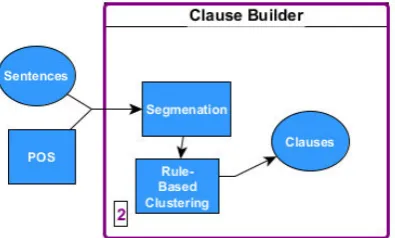
2. The clause builder module is a dependency parser and uses the sentences and their POS tags from the sentence dumps for the purpose of grouping words in a sentence into specific segments, which are called clause-objects such as subjects, objects or verbs. These clause-objects are grouped or combined with other clause-objects to form and generate clauses, based on specific rules so that a sub-clause or several objects can be combined into one object to form into several simple clause forms which differ on each sentence.
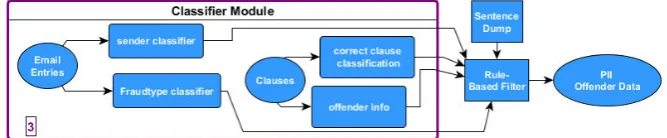
3. The classifier module consist of four classifiers in which the fraud-type and sender classifier are using the whole fraud-incident text to classify the text to its corresponding fraud-type and to detect by whom the text was sent. The correct clause build classifier is using the formed clauses from the clause-builder and detects if a clause is correctly build or not, correctly build clauses can be interpreted as actual text content in an email, while wrongly build clauses can be interpreted as meta data in an email or as information after the closing words. The offender information detector classifier is also using the the output of the clause-builder module to predicts if the clause contains information about offenders or not.
4. The information extractor module uses the output of the three classifier: the correct clause-builder, sender classifier and the offender info detector and ap-plies specific rules that are defined in the information extractor module to extract and assign information from clauses to one of three PII (Personal Identity Information) collectors. There are three different PII collectors one that stores information about offenders, one about victims and one about third parties. Based on some specific rules and the results of the three classifiers the information extractor module will extract information out of the clauses to form PII entries which will be stored into the assigned PII collector. The fraud-type classifier will be used to structure the data to its corresponding fraud-type in each PII collector. Afterwards some specific rules can be applied based on the fraud-type.
5. The Measurement module will send the PII data for each unique fraud-incident into a database and analyzes and compares the extracted data with the existing older data about offenders to measure the quantity and quality of the extracted data in comparison with the old manually extracted data.
Chapter 4
Bootstrapping Unlabeled Data
Chapter 4 describes all functions that are contained in the base module that was shown in Figure 13 from the Appendix. That includes the Named Entity Recog-nition (NER) Part of Speech (POS) tagger and a language detector. Furthermore the data that the functions are using will be explained as well as the performance of each functions and their algorithm will be shown and analyzed. The result of the chapter will be able to answer the research question:
How to Bootstrap NER & POS data on a new unlabeled Dataset?
4.1
Dataset
FHD has no labeled data for Part of Speech (POS) and Named entities (NE) data available and most of the data is only available in the dutch language. Without any labeled text to train and without any means to acquire structured text it is not possible to extract information out of unstructured data. One method to structure the data is through Part of Speech (POS) tags. POS tags are able to identify the purpose of each word to form a sentence and without training a model to identify POS tags the program will not be able to understand anything about a text or sentence. The same goes for the Method of Named Entity Recognition (NER) in which the program is able to learn if the word is a specific name or not. In case a name is detected the program will be able to differ between several different Named Entities, like a name of a person or organization or the name of a location and many others. Therefore external datasets in the Dutch language are required. Furthermore most of the data are emails from Dutch citizens that were collected from the year 2003 till now, which means the external dataset should have text from the year 2000 and onwards. Email text is more informal than a letter and the text differs from each other in each decade and century.
There are two Dutch dataset available with labeled POS & NER tags called CONLL2002 and SONAR1.
4.1.1
CONLL
4 newspaper from the year 2000. There were four different Named entities to identify: names of a Person (PER), Location (LOC), Organization (ORG) and Miscellaneous Names (MISC). This dataset is widely known and one of the most used Dutch datasets on for Natural Language Processing (NLP) in Dutch. The POS tags in the CONLL02 Dataset consist of 10 different POS tags: Adj, Adv, N, Prep, Pron, Verb, Num, Misc and Punc, which are shown in Table4.6
4.1.2
SONAR
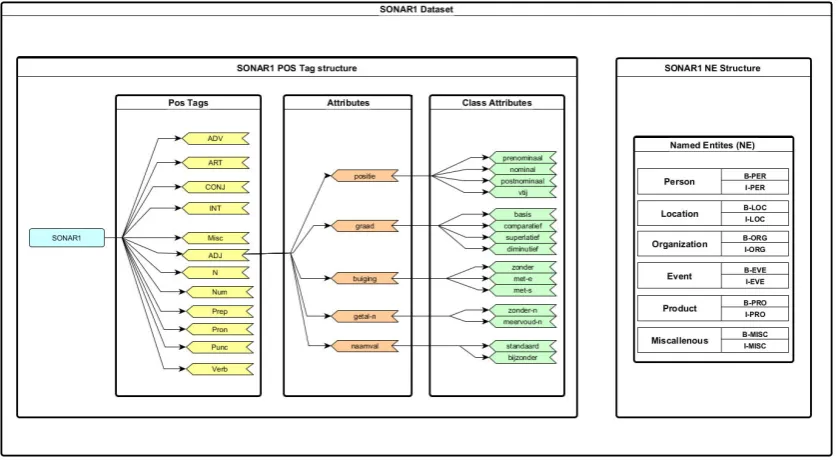
[image:35.595.89.509.374.604.2]The SONAR Corpus consist of the SONAR1 and SONAR500 dataset. The SONAR1 has 1 million manually annotated and controlled words, while the SONAR500 dataset has 500 million words which were only annotated with a semi supervised method without a manual examination of correctness. The SONAR corpus was built-on previous projects that were called Dutch Corpus Language Initiative (D-COI) and Dutch Parallel Corpus (DPC), in addition some Dutch Wikipedia articles were used as well. The SONAR corpus consist of text entries from the year 1954-2011 in the Dutch language. The texts are selected out of newspapers, reports, blogs, chats, SMS, forum messages and emails. The final version of SONAR was released in 2013 and was only available for a period of 5 years.
Figure 4.1: POS and NE structure of the Sonar1Dataset
4.1. With so much information for each different POS tag the SONAR1 data has an overwhelming amount of in-depth knowledge for each word.
4.2
NER & POS method
4.2.1
Chosen NER Method
Section2.2.1 described several methods to acquire tag classifiers such as NER and POS tag for sequential data. For the offender extractor application the CRF(Conditional Random Fields) method was chosen, because the CRF method is able to achieve a high performance with a simple algorithm with a fast computing time in comparison to the Deep Neural network methods that combine several algorithms together that were described in the paper [Peirsman, 2017] and [Agerri, 2017]. Furthermore most deep neural network methods are using word-embedding which have the disadvan-tage that it needs a lot of training data. A self trained word-embedding from the CONLL02 and SONAR1 dataset is not enough to get reliable word-embeddings and might get a lower score than CRF even with the combination with Bi-LSTM. There-fore a pre-trained word embedding model will be needed. This puts confidentiality at risk, because pre-trained data might use server communications or might have mal-ware in it which should be avoided in this application.
4.2.2
Conditional Random Fields(CRF)
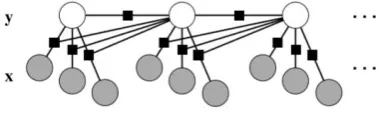
The Conditional Random Field (CRF) is a variation of a graphical model. As in [Sutton and McCallum, 2011] described a graphical model uses a graph to simplify the complexity of probability distributions over many variables. A joint probability of many variables will costO(2n)of storing variables in contrast to graphical models which are able to summarize the probability distribution in a graph, which depends on a much smaller subset of variables by the product of its local functions. The subset of local functions are called factorizations and have the properties of con-ditional independent relations among the variables. Each graph and factorization is able to consider incoming and outgoing paths to form conditional relations in a graph which decreases the amount of functions to calculate its dependency. Figure 4.2shows several graphical models and their factorization function which are shown as Rectangular points that are connected to a graph circle.
Most existing CRF algorithms are using the linear-chain CRF as their graph model, because of its simple design and its fast computation time which is also able to observe current and future observations. Figure 4.3 shows a linear chain model with a factor dependency of its current observation. Such a model is able to extend
Figure 4.3: Linear chain crf with factor dependencies on current observations.
to further observations and variables. The formula that is needed to use extended features on observation is cited in [Sutton and McCallum, 2011]:
p(y|x) = 1
Z(x)
T Y
t=1
ψt(yt, yt−1, xt)
where Z(x) is an independent normalization function:
Z(x) = X
y T Y
t=1
ψt(yt, yt−1, xt)
and where each local functionψt has the log-linear form of:
Ψt(yt, yt−1, xt) = exp K X
k=1
δkfk(yt, yt−1, xt)
4.2.3
CRF Toolkit
There are two well known CRF toolkits CRF++ and PyCRFSuite.
• CRF++is a customizable toolkit written in C++ for segmenting and labeling sequential data. CR++ is able to generate a generic amount of features of either segmentation label like chunking and a POS tag or Named entity.This means that each word needs to have the same amount of attributes and it is only able to generate a model which needs to be generated every-time for each change in its features.
• PyCRFSuite instead has a python wrapper function and is able to use an arbitrary amount of features, so each word can have different amount of at-tributes and it is more customizable than crf++.
4.2.4
CRF Feature extraction
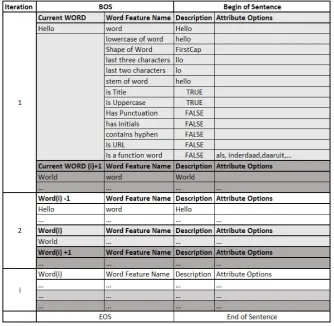
[image:38.595.131.466.295.621.2]Since a POS tagger and NER classifier are using the same CRF algorithm the features that are used are also the same with the exception that the NER classifier includes the POS tag itself as its feature for each word. Each feature word is either a one-gram, bi-gram or a trigram depending on the words in the sentence that was provided as an input. Furthermore the SONAR1 dataset provided a CRF++ model and its source code for the feature extraction that was created by Bart Desmet. Some of the extracted features that the CRF++ used were applied to the application such as the feature wordshape, ishyphen, function word, and isURL. The idea of using the extracted features of previous and following words of a sentence came from the articles [bogdani, 2016b],[bogdani, 2016a] and [Peirsman, 2017] and were applied as well. The features for each extracted word are shown in Figure4.4that can be seen below:
Figure 4.4: Features of the CRF Model
feature list. The bi-gram consists of the current word and the following word. Then a new iteration round is created to form another item with trigram features in the feature list until the end of a sentence is reached and the EOS feature is appended at the end.
There is one specific feature called word shape which has several options to choose from that are shown in Figure4.5.
Figure 4.5: options of Feature Word Shape
4.3
Experimental Results
Since there are two promising datasets for the Dutch language, both of them were used to figure out which dataset has the better performance for Named Entity Recog-nition. The POS tag classifier is also necessary, but is less important than NER, because the POS tag is only used as another feature for the CRF algorithm. Another use for the POS tags is to build clause segments. Both tags are important for classi-fication. The NER classifier has the purpose to detect the Named entities. Only the Named Entities are able to contain offender information. The POS tag instead is used to form clauses to build structure data to extract and distinguish information about offenders. The SONAR1 and CONLL02 dataset are using different notation labels in their dataset.
Table 4.1: List of CONLL POS Tags
POS Tag Description Examples Adj Adjectives goed, groot, lang Adv Adverb nog, alweer, trouwens Art Articles het de
Conj Conjunction dat, om, en, dan Int International Ja, Welkom, Jazeker Misc Miscellaneous Child, power, generation
N Noun Ouders, stem,
Num Numerical twee, dree, 6356 Prep Preposition in,op, onder Pron Pronoun we, welke, onze Punc Punctuation .,@:’"
V Verb lopen, eten, spreken
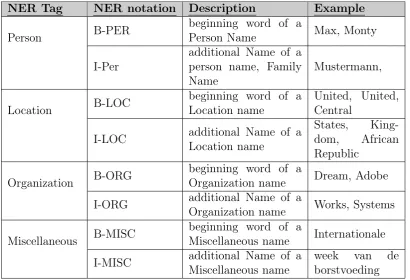
Therefore it is necessary to transform both to the least common denominator. So each label is transformed to the corresponding label in the CONLL02 notation for the NER as well as for the POS tag notation shown in Table 4.6and Table4.2.
Table 4.2: List of CONLL NER Tags
NER Tag NER notation Description Example
Person B-PER
beginning word of a
Person Name Max, Monty
I-Per
additional Name of a person name, Family Name
Mustermann,
Location B-LOC
beginning word of a Location name
United, United, Central
I-LOC additional Name of a Location name
States, King-dom, African Republic
Organization B-ORG
beginning word of a
Organization name Dream, Adobe
I-ORG additional Name of a
Organization name Works, Systems
Miscellaneous B-MISC
beginning word of a
Miscellaneous name Internationale
I-MISC additional Name of a Miscellaneous name
week van de borstvoeding
4.3.1
CONLL2002 NER Results
Since both labels for POS tagging and NER are annotated on the same dataset two CONLL02 CRF models were trained one for the Named Entity Recognition (NER) and another for the Part of Speech (POS) tagging.
Figure 3 in the Appendix shows the results of the NER in the CONLL02 dataset. CONLL02 was a challenge task in which CONLL provided a training set and a development set called Testset A. Each participant used the same training data to train their algorithm and they used the Test set A to confirm the performance of the algorithm and to optimize it. Test set B was used to declare the winner of its participants. The figure below shows the results of the validation set which is a part of the training data. The support column describes the occurrence of each label in the test-set.
Figure 4.6: Result of NER detection on CONLL02 validation sets
[image:41.595.94.505.108.388.2]