A Thesis Submitted for the Degree of PhD at the University of Warwick
http://go.warwick.ac.uk/wrap/1204
This thesis is made available online and is protected by original copyright. Please scroll down to view the document itself.
Commitment Amongst South African Knowledge Workers
by
Jeffrey J. Bagraim
A thesis submitted in fulfilment of the requirements for
the degree of Doctor of Philosophy
University of Warwick, Warwick Business School
TABLE OF CONTENTS
TABLE OF CONTENTS
ILIST OF TABLES
XLIST OF FIGURES
XIACKNOWLEDGEMENTS
XIIDECLARATION
XIVABSTRACT
XVABBREVIATIONS
XVICHAPTER 1: INTRODUCTION
1Why study organizational commitment? 3
Why study the organizational commitments of knowledge workers? 6
Why study the organizational commitments of knowledge workers in South Africa?
8
Definition of core terms 10
Organizational commitment 11
Knowledge workers 13
How is the dissertation structured? 15
First endings 16
CHAPTER 2: LITERATURE REVIEW
18Organizational commitment as an independent construct 20
The nature of commitment , 23
The nature of organization 24
Approaches to organizational commitnzent 29
The behavioural perspective 29
Salancik (1977) 30
Becker (1960) 31
Ritzer and Tric e (1969) 32
Hrebiniak and Alutto (1972) 33
The attitudinal approa ch 35
Mowday, Stee rs and Porter (1979) 36
Angle and Perry (1981) 41
Buchanan (1974) 42
O'Reilly and Chatman (1986) 43
Akhtar and Tan (1994) 46
De Cotiis and Summers (1987) 47
Kanter (1968) 48
Vardi, Wiener and Popper (1989) 50
Jaros, Jermier, Koehler, and Sincich (1993) 51
Meyer and Allen (1990, 1993, 1997) 51
Integrating the two perspectives 60
Integrated definitions of commitment 61
Linking behaviours and attitudes 62
Alternative approaches 65
Organizational commitment as a rational-choice 69 Alienation: the opposite of organizational commitment? 72
Assumptions in commitment research 74
Conceptualizing commitment 79
Final notes 82
CHAPTER 3: EXPLANATORY MODEL
84Developing the commitment in 85
Antecedents of affective commitment 88
Challenge 90
Fairness 92
Distributive justice 93
Procedural justice 93
Esteem 96
Organization based self-esteem (OBSE) 96
Organizational prestige 97
Job characteristics 98
Leadership 101
Security 104
Met expectations 104
Job security 105
Support 107
Perceived Organizational Support 107
Social support 108
Variables excluded from the ACORG model 111
PromotionalOpportunity ... .112
Assignment to important clients 114
Antecedents of continuance commitment 115
Self-investment 117
Skill transferability 118
Job alternatives 120
Kinship responsibility 121
Antecedents of normative commitment 121
Met expectations 123
Correlates of organizational commitment 124
Work motivation —job involvement 125
Job satisfaction 126
Occupational commitment 127
Consequences of commitment -128
Turnover intentions 129
Next step 130
Organizational citizenship behaviour 130
Wellness 136
Job performance 137
Interaction effects between commitment components 138
Control variables 144
Affectivity 145
Demographic variables 147
Organizational commitment in the public sector and private sector 148
Final notes 155
CHAPTER 4: RESEARCH DESIGN, METHODS AND
PROCEDURES
156Research design 156
Research participants 158
Sample scope 158
Description of participants 160
Research methods -164
Focus groups 164
Focus group design issues 166
Interviews 170
Secondary sources 171
Survey 172
Survey fieldwork strategy 173
Questionnaire 174
Measures 177
Survey design issues: threats to internal validity 180
Survey design issues: threats to generalizability 184
Data analysis -188
Analysis of interview and focus group data 188
Analysis of survey questionnaire data 189
Testing of assumptions 189
Testing reliability: Cronbach's alpha 190
Testing validity 191
Testing the model 193
Ethical threats and human subject concerns 205
Final notes 206
CHAPTER 5: RESULTS
207Data screening and initial analyses 207
Descriptive statistics 208
Dimensionality of commitment 214
Dimensionality of organizational commitment 215
Confirmatory factor analysis 215
Exploratory Factor analysis 218
Higher-order factor analysis 221
Correlation analysis of factors and scales 223
Levels of organizational commitment 226
Foci of commitment 227
Multiple foci of affective commitment 234
Commitment model 235
Commitment model: Control variables 237
Initial analysis 240
Hierarchical regression analysis 245
Commitment model: antecedents of continuance commitment (CCORG). 247
Initial analysis 248
Hierarchical regression analysis 250
Commitment model: antecedents of normative commitment (NCORG).... 252
Initial analysis 253
Hierarchical regression analysis 254
Note on regression diagnostics 255
Outcomes of organizational commitment 256
Initial analysis 257
Regression analysis 261
Next Step 267
Foci of commitment 268
Comparison of public sector and private sector knowledge workers 275
Final notes 278
CHAPTER 6: DISCUSSION
279Self-reflection 280
Personal factors 280
From pragmatism to critical realism 281
Critical realism and statistics 283
The persistence of commitment 284
The nature of commitment 286
Defining commitment 289
Multiple foci of commitment 290
Dynamics of commitment 292
Context and commitment 292
The importance of commitment 295
Turnover Intention 295
Next step 297
Many to one model of organizational commitment 297
Performance 299
Citizenship behaviours 299
Helping .300
Boosting behaviour .301
Wellbeing 301
Interaction effects 302
Proximity thesis 302
The drivers of organizational commitment 306
Control variables 306
Antecedents of affective commitment 308
Antecedents of continuance commitment 310
Antecedents of normative commitment 311
Propositions 313
CHAPTER 7: CONCLUSIONS
317
Contribution to knowledge
317
Theory
317
Application
318
Method
319
Issues not reflected in this study
320
Issues that require further investigation
326
Final notes
330
APPENDIX A: DEFINITIONS
331
APPENDIX B: SURVEY MATERIALS
332
APPENDIX C: STATISTICAL TABLES
344
APPENDIX D: STATISTICS BY SECTOR
355
LIST OF TABLES
Table Description Page
3.1 Summary of Propositions 152
4.1 Summary of Data Sources 158
4.2: Sector Breakdown of Survey Participants 164
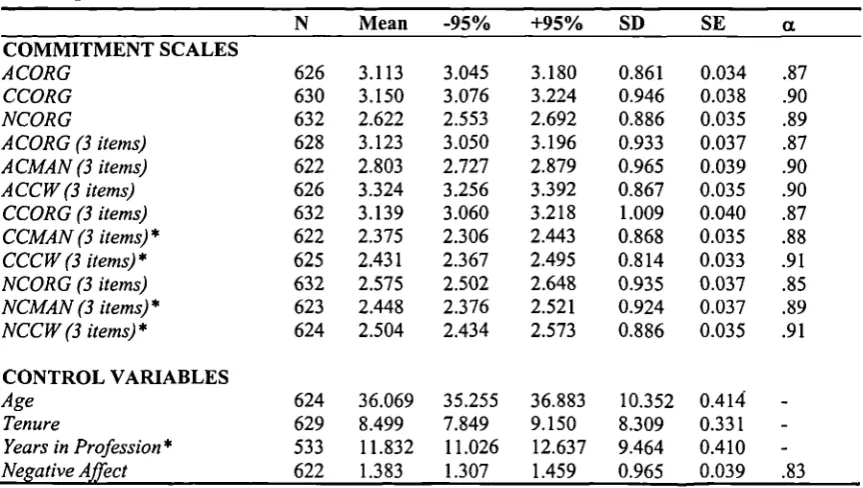
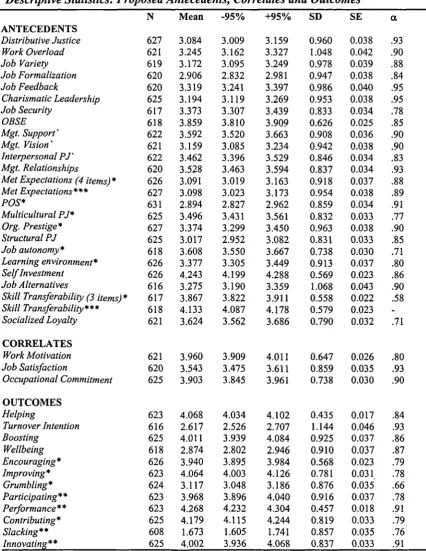
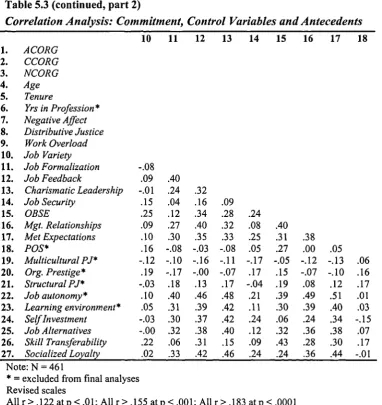
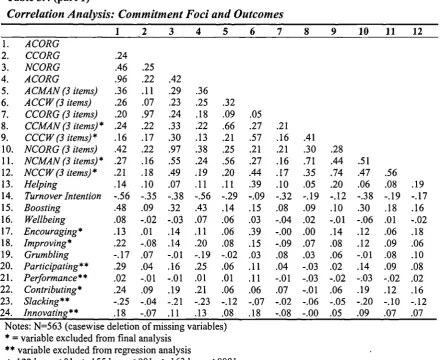
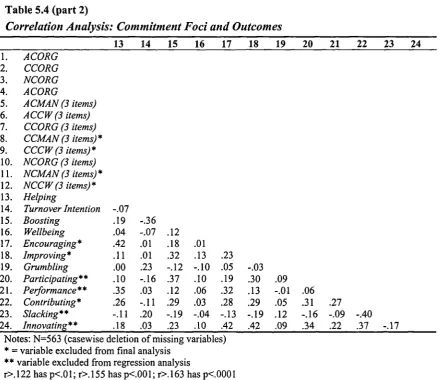
4.3: Mean Demographic Details Per Sector and Occupation 164 5.1 Descriptive Statistics of Commitment Scales and Interval Control Variables 209 5.2 Descriptive Statistics of Proposed Antecedents with Outcomes 210 5.3: Correlation Analysis: Commitment, Control Variables and Antecedents 211 5.4: Correlation Analysis: Commitment Foci and Outcomes 213 5.5: Fit Indices: Three Component Model of Organizational Commitment 217 5.6: Noncentrality Fit Indices: Three-Component Oblique Model (M9) 218
5.7: Factor Analysis: Commitment Components 219
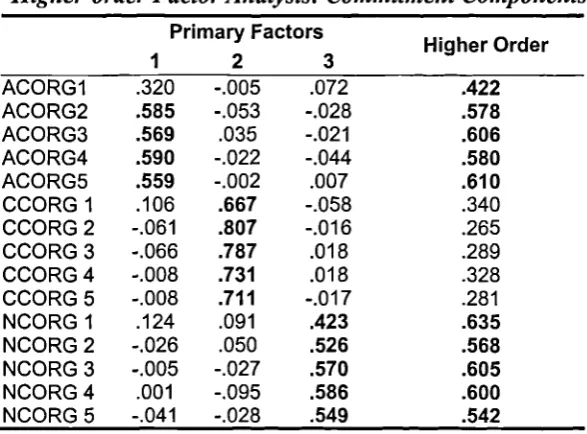
5.8: Higher-Order Factor Analysis: Commitment Components 222
5.9: Correlations: Commitment Components 224
5.10: Non-parametric Tests: Differences Between Commitment Components 226
5.11: Summary: Levels of Commitment 227
5.12: Fit Indices: Commitment Components Per Focus 228 5.13: Fit Indices: Three Commitment Components Across Foci 230 5.14: Fit Indices: Nine Factor Commitment Model 231 5.15: Correlation Analysis: Nine Commitment Foci (revised scales) 232 5.16: Fit Indices: Three-component Commitment Measurement Models 233 5.17: Correlation Analysis: Affective Foci with Support Variables 235 5.18: Correlations: Commitment Components with Proposed Antecedents 236
5.19: Correlation Analysis: Control Variables 237
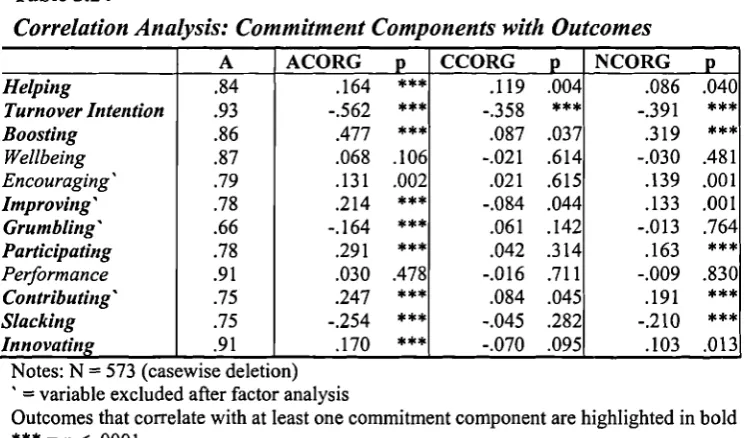
Table Description Page 5.24 Correlations: Commitment Components with Outcomes 260
5.25 Regression Analysis: DV = Turnover Intentions 261
5.26 Regression Analysis: DV = Boosting 262
5.27 Regression Analysis: DV = Helping 262
5.28 Hierarchical Regression Analysis (Interactions): DV = Turnover Intention 264
5.29 Hierarchical Regression Analysis (Correlates): DV = Turnover Intention 265
5.30 Hierarchical Regression Analysis (Interactions): DV = Boosting 266
5.31 Summary: Next Step Responses 268
5.32 Correlations: Affective Commitment Foci with Outcomes 269
5.33 Hierarchical Regression Analysis (Affective Foci): DV = Boosting: 269
5.34 Hierarchical Regression Analysis (Affective Foci): DV = Turnover Intention 270
5.35 Hierarchical Regression Analysis (Affective Foci): DV = Helping 270
5.36 Fit Indices: "One of Many" and "Key-Mediating Construct" Models 274
6.1: Summary Assessment: Propositions, Operationalizations, and Results 314
LIST OF FIGURES
Fig. Description Page
ACKNOWLEDGEMENTS
Writing this dissertation was like running a marathon. Marathons are
great testaments to the human spirit; they are gruelling, physically draining,
and emotionally exhausting. They require countless hours of preparation, all
of which may be thwarted by the common cold on race day. The final hours
of a marathon extract the most and successful completion is a bittersweet
combination of relief and satisfaction. In short, marathons are best watched
on television.
The marathon metaphor is an especially apt metaphor in the South
African context, where the Comrades Marathon is a long-standing national
institution. Its legacy of comradeship between participants and unstinting
support from bystanders along the road are legendary. Similarly, while this
was a solitary race whose end performance remains my responsibility, I had
many helpers who made this submission possible. To each of them I am
grateful.
I would like to thank my supervisor, Professor Jean Hartley for her
critical insight, general support, and ability to provide supervision and make
me feel like a colleague rather than "just another student". My, thanks to all
those at the LGC (especially Rachel) and WBS PhD Office who always made
interviewed managers, and the professors who answered my frantic
questions.
To my colleagues who supported my decision to study in England,
impoverish my family, and take inevitably longer to submit. To Microsoft who
taught me patience and the fallibility of technology. To all the forces that
helped develop my character by conspiring so that I experienced two total
hard drive crashes, three "thermal events", the loss of a computer to theft,
two serious computer viruses, multiple software crashes, damaged discs,
and the conflagration of one computer monitor.
My special thanks to Zac, my two year old son and most beloved
distraction, who has taught me more about life and love than any degree
could ever do. And to Paula for her support and encouragement and for
putting up with my late night work and stolen hours to read "just one more
paper".
Thanks would not suffice for the support provided by my parents. This
dissertation is dedicated to them. My late father was not spared to join me
during this marathon but he is always with me. My mom has never ceased to
DECLARATION
I confirm that my thesis has been prepared in accordance with the
University's guidelines on the presentation of a research thesis
The work presented in this thesis is entirely original and my own,
unless otherwise indicated. This thesis has not been submitted for a degree
ABSTRACT
Knowledge workers, who typically enjoy global labour mobility, are considered critical to economic growth in developing countries. The purpose of this dissertation was to examine the organizational commitment of South African knowledge workers, a commitment widely considered both
improbable and unobtainable. In this study, a critical review of the organizational commitment literature, to ascertain its psychometric applicability to knowledge workers in South Africa, uncovered an
unsystematic and fragmented body of research that has been imperfectly integrated in previous research models. A new definition of organizational commitment is therefore developed to account for current contextual
complexities and theoretical advances in commitment research (e.g. multiple foci, variable duration, and changing intensities).
A mixed-method research design was used in all stages of the investigation. To establish the construct validity and practical validity of the organizational commitment construct, a multidisciplinary explanatory model was developed based on the extant literature and focus group discussions with knowledge workers. To test the proposed model, a self-administered survey questionnaire was developed. A total of 637 usable questionnaires from knowledge workers employed in the accounting and information
technology occupations in both the public and private sector were analysed using a variety of statistical techniques, primarily hierarchical regression analysis and structural equation modelling. Particular care was taken that appropriate and strict statistical criteria guided the analyses. The survey results were then presented to focus groups for discussion.
The results clearly evidence the widely accepted three-component structure of organizational commitment but provide new insight into the
nature of the relationship between the commitment components. The veracity of a multiple foci approach is demonstrated and interaction effects between commitment bases and commitment foci are examined. The results are mixed concerning the proposed model, which required revision after the psychometric analyses. Overall, however, the results are both surprising and encouraging. Surprising given the evidence of high levels of organizational commitment amongst knowledge workers, and encouraging given the amount of variance explained in salient organizational outcomes such as turnover intentions (37%) and boosting behaviour (24%).
Analysis per employment sector showed no overall effect of sector in the regression models but further analyses showed different patterns of significant antecedents amongst knowledge workers employed in the public and private sectors.
ABBREVIATIONS
ACCW Affective Commitment to Co-Workers
ACMAN Affective Commitment to the Immediate Manager
ACORG Affective Commitment to the Organization
AGFI JOreskog Adjusted Goodness of Fit Index
AIC Akaike Information Criterion
CCCW Continuance Commitment to Co-Workers
CCMAN Continuance Commitment to the Immediate Manager
CCORG Continuance Commitment to the Organization
CFI Comparative Fit Index
DF Degrees of Freedom
ECVI Browne-Cudeck Expected Cross Validation Index
GFI JOreskog Goodness of Fit Index
NCCW Normative Commitment to Co-Workers
NCMAN Normative Commitment to the Immediate Manager
NCORG Normative Commitment to the Organization
NFI Bentler-Bonnet Normative Fit Index
NNFI Bentler-Bonnett Non-Normed Fit Index
OBSE Organization Based Self-Esteem
PFI James-Muliak-Brett Parsimonious Fit Index
CHAPTER 1: INTRODUCTION
And I, who had my head with horror bound, Said: Master what s this which now I hear?
What folk is this, which seems by pain so vanquished?
And he said to me: This miserable mode Maintain the melancholy souls of those Who lived withou ten infamy or praise.
I.---1
And I: 0 Master, what so grievous is To these, that maketh them lament so sore? He answered: I will tell thee very briefly.
These have no longer any hope of death; And this blind life of theirs is so debased,
They envious are of every other fate.
No fame of them the world permits to be;
Misery and Justice both disdain them. Let us not speak of them, but look, and pass.
- The Divine Comedy of Dante Alighieri: Canto 3
The current confluence of economic turbulence, corporate scandals,
and global uncertainty represent an exciting context in which to investigate
employee commitment. The above lines from Dante's Divine Comedy refer to
the uncommitted, destined to join a despicable collection of souls that will
suffer in a vestibule beyond the gates of Hell because "both saints and
sinners" hold them in contempt. Of course, Dante is writing about those who
lacking commitment to entities to which their commitment is expected
persists even in this more secular age. For example, commitment to one's
family or to a just cause is almost universally seen as virtuous. Media images
of New York fire-fighters entering the collapsing Twin Towers, the doctors of
Doctors without Borders tending to those with unidentified infectious
diseases, and the tireless unnamed researchers seeking a vaccine for the HI
virus are a profound, public, and contemporary testament to the power of
commitment.
Turning now to consider commitment in the workplace, the expectation
that an employment relationship will last from the cradle to the grave may no
longer be reasonable but even social analysts admit that organizational
commitment "has not disappeared entirely" (Reich, 2000, p.87). Within
organizations, the frequently witnessed commitment demonstrated by
employees to their employing organizations during a crisis and their
determination to "go the extra mile" for their organization regardless of
possible reward bear testimony to the abiding power of commitment. For the
organizational researcher this is an auspicious time to examine
organizational commitment and assess the appropriateness of the construct
amongst those most affected by contemporary changes to the nature of work
and the nature of the employment relationship.
This dissertation examines the nature, antecedents, and outcomes of
organizational commitment amongst South African knowledge workers. The
decision to focus sustained research energy on this topic begs three
organizational commitment of knowledge workers? (c) Why study the
organizational commitment of knowledge workers in South Africa? Each of
these questions will be considered in turn.
Why study organizational commitment?
Baruch's (1998) argument that commitment to organizations is no
longer prevalent, is no longer expected, and may not even be desirable
implies that studying organizational commitment and investigating its
antecedents and outcomes is not a valuable research activity. In fact,
dramatic shifts in economic and social realities make organizational
commitment seem like a naïve sentiment (Baruch, 1998). Increasing
cynicism about organizations in the wake of corporate scandals (e.g. Enron,
WorldCom, and Arthur Anderson), restructuring efforts that betray employee
trust by downsizing during times of record profits, and management rhetoric
about the "post-commitment era" are grist for the mill of those who question
the continued relevance of the organizational commitment construct. But
there are important countervailing voices that are supported by recent
empirical investigations.
Rousseau (1998) argued that employees derive "psychological
benefits from their actions by identifying" (p.222) with their employing
organization and acting for its benefit. She supports her argument by
highlighting the steady stream of empirical research evidencing a strong
reciprocal relationship between perceived organizational support and
Recent empirical research shows that organizational commitment is
stable across and between generations. Valenti (2001) found that the
affective and normative commitment of "Generation X" (i.e. individuals born
between 1965 and 1978) in the United States increased as a function of
career stage development and that those in later stages of their careers
reported higher levels of affective and normative commitment than those in
the early stages of their careers. These career stage effects are consistent
with those found by Meyer, Bobocel, and Allen (1991) and the mean
commitment scores they calculated were consistent with scores reported in
earlier research (Meyer & Allen, 1997). These results challenge assumptions
that "Generation X" employees are less committed to organizations than
previous generations. Reflecting on the enduring nature of employee
identification with their employing organization, Rousseau (1998) noted that
identification with an organization remains an important aspect of
socialization, especially in high-involvement workplaces and particularly for
permanent, full-time employees.
If organizational commitment displays sufficient stability, as evidenced
above, then three further arguments can be made for continued
organizational commitment research. First, organizations remain the primary
domain of work activity. Permanent employees form a core group in most
organizations, even in flexible, knowledge-based organizations that
outsource many job functions (Handy, 1994).
Second, organizational commitment has consistently been shown to
effectiveness indicators such as long-term employee retention may no longer
be important to some organizations (Brown, 1996) but other indicators of
effectiveness have emerged (e.g. role innovation and service), which require
commitment energy during the employee's period of employment. Highly
responsive customer service that requires self-initiative, creativity and
discretion while ensuring that service is consistent with organizational goals
has created what Lincoln and Kallenberg (1990) labelled the "imperative of
maximising workforce commitment" (p.1).
Third, commitment relationships are important for human wellbeing.
Most people have a need to establish commitment relationships (even
hermits claim to "commune" in "spiritual" relationships). Failure to satisfy this
need may result in personal feelings of alienation that are stressful and
ultimately unhealthy (Kobasa, Maddi, & Kahn, 1982). In a world in which
many people no longer subscribe to traditional sources of commitment (e.g.
nation, marriage, religion), organizations that fail to facilitate organizational
commitment may further foment feelings of personal alienation and
encourage employees to find objects of commitment outside the
organization. This represents a loss of commitment energy to the
organization and the achievement of its objectives (Meyer & Allen, 1997).
Similarly, overcommitment may also have deleterious effects on employee
wellbeing and organizational outcomes. Randall (1987) argued that very high
levels of commitment could be unhealthy, stunt individual growth, and limit
opportunities for mobility and career success. Pfeffer (1997) documented the
sometimes characterise the highly committed employee. The above suggests
that commitment be understood and managed to develop optimal levels of
commitment and avoid both alienation and overcommitment.
In sum, there is sound theoretical argument and consistent empirical
research evidence to argue that organizational commitment remains an
important, organizationally salient construct that deserves sustained research
attention.
Why study the organizational commitments of knowledge
workers?
Knowledge workers, highly qualified and mobile individuals that
exercise expertise in organizations (Despres & Hiltrop, 1995), are particularly
important in organizational research given the knowledge intensification of
work and the emergence of important new sectors of knowledge production
within the global economy (See Scarbrough, 1999). Munk (1998) even
referred to knowledge workers as "gold-collar workers" (p.64), an elitist term
that has not gained much currency but still emphasises the distinct position
that these workers occupy.
Organizations with Fordist production methods and high levels of
employee surveillance (e.g. McDonalds) may not need high commitment
from employees but organizations where employees need to apply their
discretion, exercise autonomy, demonstrate citizenship behaviour, and apply
their mind to client problems will not be able to rely on surveillance or simple
Research concerning the organizational commitment of knowledge
workers is of particular interest because of the level of ambiguity in
knowledge work. The ambiguity inherent in knowledge work often means that
management cannot rely on direct means of evaluation and control
(Alvesson, 2000, Sveiby, 1997). There are typically few criteria on how to
evaluate work results, which are often not amenable to observation (e.g.
problem solving expertise). Client evaluation may not be useful as clients
may have little insight into the quality of the work undertaken (Alvesson,
2000). Expert panels (a rare form of evaluation) often fail to reach consensus
or differ from client's evaluations (Alvesson, 2000). Organizations can
therefore no longer rely on traditional control mechanisms that require
minimal levels of co-operation and commitment from employees.
Organizations can also not rely on the findings in much of the extant
literature. Most empirical research on organizational commitment has been
conducted with participants in service-oriented employment, with hospital
nurses and non-academic employees at universities the most frequently
surveyed (Meyer & Allen, 1997). The typical structural characteristics of the
work conducted by service-oriented employees (fragmentation, routinization.
lack of autonomy, lack of participation in decision-making) are widely
believed to contribute to alienation (Gouldner, 1954; Braverman, 1974). For
many service-oriented workers, the job is often "just a job". This is in sharp
contrast to the work experiences of knowledge workers who typically
structural aspects of work also depend on the nature of the employing
organization).
The reason why knowledge workers remain committed (or not) to their
organizations remains unclear and under-examined. Given the importance of
knowledge workers as levers of competitive advantage it can be concluded
that insufficient attention has been given to empirical investigations of this
question.
Why study the organizational commitments of knowledge
workers in South Africa?
South Africa is no longer isolated from changes in the wealth creation
processes of contemporary capitalism. In the last ten years it has become an
open economy that must compete, in certain economic sectors, with
post-industrial, post-Fordist economies in which knowledge workers are a critical
resource for gaining competitive advantage. Progress in information
technologies may have been the catalyst for a fundamental transformation in
human life, relationships, and work (Cascio, 1995; Hirsch, 1987; Reichheld,
1996) but the effective use of human knowledge has become the central
challenge for organizations. Knowledge and the ability to apply it
(competence) have emerged as an important competitive resource, as
important as capital or property. South African organizations face the urgent
challenge of attaining competitive advantage through the effective utilization
and retention of "skilled employees who contribute the basis of their success"
In South Africa, the emigration of knowledge workers has been "a long
drawn out process of skills exfoliation" (Balogun & Muthaba, 1990, p. 65).
This has created an employment crisis rendered even more complex by
recent affirmative action legislation and new market opportunities. In some
cases, entire groups of knowledge workers have left large, established
organizations to start their own companies, stripping their former employers
of their most important personnel and most important clients. The emigration
of knowledge workers is underreported and the estimation of its extent is
complicated by the absence of valid data because the South African
authorities only records those who "officially emigrate", not the vast majority
that simply leave the country without formally emigrating (Terreblanche,
2004). Emigration is particularly high in the Accounting and Information
Technology sectors and there are too few students in these areas to address
the skills shortage in the medium term (Terreblanche). There is some debate
regarding the extent of emigration from South Africa and the extent to which
it is offset by increasing levels of immigration into South Africa (Terreblance).
Though many immigrants into South Africa are unskilled illegal immigrants
from other parts of Africa, a significant number of skilled immigrants from
Africa and elsewhere choose to work and live in South Africa (Terreblanche).
A major motivation for this study derives from the urgent challenge of
attaining competitive advantage through the effective utilization and retention
of skilled knowledge workers in South Africa. This is of particular concern for
those wishing to ensure the success of a developing South Africa emerging
Africa rejoins the global economy, it faces the dual challenges of global
competitiveness and social reconstruction; to develop a market economy
flexible enough to remain competitive amidst the vicissitudes of the global
economy and to provide basic services and greater economic equality
amongst all its citizens. The commitment energy of knowledge workers also
lies at the centre of South Africa's struggle to foment an African Renaissance
and actualise the initiative known as the New Deal for African Development
(NEPAD). South Africa is, arguably, the leading economy in Africa and its
president, Thabo Mbeki, has assumed a leadership responsibility for effecting
the transformation of the African continent.
The importance of research concerning the organizational
commitment of knowledge workers has also been widely acknowledged by
decision-makers in South Africa's leading corporations (Bennett, 1999).
Despite this, only two empirical research studies on the drivers of
organizational commitment amongst South African knowledge workers have
been published (Bagraim, 2002; Kinnear & Sutherland, 2000), the most
recent of which was the pilot study for this dissertation.
Definition of core terms
Before proceeding with an investigation concerning the organizational
commitment of knowledge workers (in any context), it is necessary to define
the two core terms that frame the investigation: "organizational commitment"
and "knowledge workers". Both terms have been subject to a multiplicity of
disagreement concerning their meaning. Each term is therefore discussed in
turn.
Organizational commitment
Organizational commitment, the complex psychological bond between
an employee and the organization in which they work (Meyer & Allen, 1997),
defies simple explication. Attempts to understand this psychological bond by
adopting a single, clear conceptual framework is not a simple matter because
over three decades of sustained research has spawned a multiplicity of
competing conceptual models (Mathieu & Zajac, 1990; Meyer, Stanley,
Herscovitch, & Topolnytsky, 2001), resulting in a confounding lack of
consistency in the literature regarding the meaning and measurement of
commitment (Morrow & McElroy, 1993). Chapter 2 critically discusses the
most important conceptual models of organizational commitment and the
various scholarly attempts to integrate the multiple themes in the commitment
literature (Angle & Perry, 1981; Mayer & Schoorman, 1992; O'Reilly &
Chatman, 1986; Penley & Gould, 1988). Of these the three-component
model proposed by Allen and Meyer (1990) has become the most widely
accepted.
Meyer and Allen (1991) suggested that commitment to the
organization is a psychological state characterised by three distinct
components (affective, continuance, and normative commitment), each
reflecting one of the three basic themes in the literature. Affective
commitment refers to the employee's emotional connection (attachment,
commitment is the tendency to remain a member of the organization because
of the costs associated with leaving or the lack of alternatives. Normative
commitment is a sense of loyalty based on a sense of reciprocity or an
internalised sense of obligation to maintain membership of the organization
(Meyer & Allen, 1991, 1997). Chapter 2 discusses issues related to the
dimensionality of these components and evidence regarding the
psychometric properties of specific measurement scales.
Recent commitment researchers have started to integrate the
three-component model with earlier research examining multiple foci of
commitment (e.g. Stinglhamber, Bentein, & Vandenberghe, 2002). This
stream of research recognises that organizations are not monolithic entities
and that employee commitment may be directed to multiple foci, both within
(manager, co-workers) and outside (clients, profession) the organization.
Employees may also experience conflicts between commitments (Reichers,
1985) or strong interdependencies may exist between commitments to
different entities (Wallace, 1995a). For example, an employee with a strong
commitment to their manager may feel constrained to stay with the
organization to maintain this relationship (Lawler, 1992), their primary focus
of commitment being nested within the organization and thereby affecting
their overall level of commitment to the organization. This study continues
and develops this new area of commitment research by incorporating a
Knowledge workers
Definitional complexities regarding the term "knowledge workers"
complicates any investigation regarding the organizational commitment of
knowledge workers (May, Korczynski, & Frenkel, 2002). Use of the term
"knowledge workers" has been severely criticised for its lack of theoretical
and methodological rigour (Scarbrough, 1999). For most scholars the
development and use of the term reflects the consequence of a broader shift
from an industrial to post-industrial society (Badaracco, 1991; Drucker, 1988;
Drucker, 1992; Handy, 1994; Prahalad & Hamel, 1990; Reich, 1991; Webber,
1991), which has been noted for some time (Galbraith, 1967, Bell, 1973).
Others are sceptical and remain sensitive to possible ideological
ramifications of the term (Blackler 1995; Knights, Murray, & Willmott, 1993;
Lebedoff, 1978; Scarbrough, 1999; Wuthnow & Shrum, 1983). They contend
that reference to the term "knowledge workers" serves to legitimise the social
division of labour and gloss over their common position as wage labour within
an exploitative capitalist mode of production (Knights, Murray, & Willmott,
1993). Others, such as Alvesson (1993, 1999), have noted that the use of the
term might be part of a broader system of persuasion. That is, specialists are
not only attracted by the mystique of being called knowledge workers but this
rhetoric allows them to protect their positions, earn prestige, and claim
specific authority. The self-management enjoyed by knowledge workers
increases the image intensity of knowledge work (impression management)
which in turn increases its rhetoric intensity so that knowledge workers
their relationships (Alvesson, 1994). This code, aimed at securing social
recognition, is important to knowledge workers because their "standing" is a
socially constructed phenomenon (Alvesson, 2000).
Blackler (1995) warned that much of the literature regards knowledge
as a cognitive phenomenon, residing in the heads of knowledge workers or
codified in the systems that they use. Such an approach disregards
approaches in which knowledge is an active process of knowing and
sensemaking that is mediated, situated, provisional, pragmatic, and
contested. It also reflects functionalist concerns with integrating knowledge
workers into the organization and promotes the position that knowledge
workers are amenable to management control and evaluation. Some have
focussed on whether knowledge workers represent a new class (Lebedoff,
1978; Wuthnow & Shrum, 1983). Overall, concerns with categorising
knowledge workers as a distinct constituency are most concisely expressed
by Collins (1997) who, applying the argument that theorising is both a
cognitive and social activity, cautioned that the concept of knowledge
workers serves as "a brake on academic analysis" (p.48) and is a limiting
term with limited academic value.
It is my contention that the ambiguity and lack of occupational
identity associated with the term "knowledge worker" is not a limitation of the
term but one of its greatest strengths. Without the demarcations and controls
of statutory professional groups, knowledge workers are defined by the work
they do — knowledge work — which is relatively unstructured and
dynamics within organizations rather than occupationally defined norms and
practices. It is an inclusive term that, while conflating occupational groups
such as technical workers and professionals, still distinguishes knowledge
workers from other broad groupings such as service workers (See Drucker,
1988). The use of a single term such as "knowledge workers" permits
researchers to categorise an important constituency of employees (though
not all knowledge workers are employed in organizational structures) as
distinct from other groups of employees within the organization. There is no
widely accepted taxonomy to distinguish between different types of
knowledge worker but typical occupational groups include accountants,
Information technology specialists, consultants, lawyers, researchers,
analysts, medical doctors, psychologists, and engineers.
How is the dissertation structured?
In the pages ahead, I examine the organizational commitment
of South African knowledge workers by critically reviewing and refining
existing understandings of the construct as the precursor to developing a
new explanatory framework and conducting an extensive mixed-method
empirical investigation. The content, process, results, and critical reflections
concerning this empirical examination of the commitments of South African
knowledge workers has been written up in seven chapters. Chapter 2
systematically reviews and critiques different approaches to understanding
organization commitment and presents a new framework that is adopted and
operationalized in this dissertation, with the suggestion of future refinements
commitment. Chapter 3 draws on the literature, the contributions of
participants in a series of focus group, and interviews with executive
managers to develop an explanatory model of organizational commitment
appropriate for knowledge workers in South Africa. The research design,
methods, sample, research strategies and data analysis choices are
discussed in Chapter 4 and the results of the statistical analysis of the survey
data are presented in Chapter 5. Chapter 6 contains my personal reflections
concerning the research process and the evolution of my epistemological
stance. It proceeds to discuss the key findings of the study with reference to
the literature, and the way that follow-up focus group participants made
sense of the results. Throughout the chapter, the key theoretical, practical
and methodological contribution of the research is highlighted. The seventh
and final chapter reflects on issues that require further research attention;
those beyond the scope of this dissertation and those suggested by the
results of this dissertation.
First endings...
This chapter sets the stage for the dissertation by affirming the
importance of the topic, unpacking each aspect of the investigation,
discussing the meaning of key terms, and providing a broad overview of the
forthcoming chapters, which will systematically examine the organizational
commitments of knowledge workers in South Africa. This systematic
examination is necessary and important for at least three reasons: (a) to
extend commitment theory to account for contemporary organizational
commitment appropriate for knowledge workers in an emerging economy,
and (c) to apply recent methodological advances to the examination of this
topic. The proposed outcome of this dissertation is therefore to both advance
theory and offer practical suggestions to those concerned with formulating
CHAPTER 2: LITERATURE REVIEW
Organizational commitment has been the focus of sustained research
attention for over three decades and an enormous literature has developed.
Unfortunately, the literature is characterised by fragmentation and an
emphasis on empirical studies rather than theoretical development. It is
therefore necessary to review the extant literature and synthesise its key
insights and findings to develop a framework for the examination of the
organizational commitment construct in this dissertation. The focus of this
review is therefore on commitment within work organizations.
The literature review presented in this chapter has been divided into
six sections. The first section considers the nature of "organizational
commitment" by examining the term and its independence from other
organizational behaviour constructs. The second section presents the most
important approaches to conceptualising organizational commitment,
discusses related approaches to its operationalization, examines the
possibility of integrating these divergent approaches, and considers three,
little known alternative approaches to its conceptualization. The fourth
section examines recent research concerning the multiple foci of
organizational commitment. The fifth section examines the assumptions
underlying organizational commitment research. The sixth section presents
synthesis of existing research, which is adopted as the conceptual point of
reference for understanding organizational commitment in this dissertation.
The seventh and final section presents some final notes on the content of the
chapter and its importance within the dissertation.
The literature review process extended over five years and relied on a
variety of approaches. Subsequent to consulting available books, increasing
use was made of electronic databases (primary database sources were:
Psycinfo, Sciencedirect, Emerald, Ebsco, Wilson full-text, Eric, Philosophers
Index, ACM, Masterfile, and the Index of South African Periodicals, ISAP).
The database search was repeated at least every three months and was
supplemented by broad Internet searches (using Google.com and
Altavista.com ) every four months. These electronic searches were further
supplemented by a request to five internationally established researchers for
access to unpublished papers of interest, manual searches within journals,
the scanning of conference websites for lists of presentation titles, and by
checking the reference lists in prominent articles.
Nature of organizational commitment
Managerial and scholarly interest in employee commitment began with
the genesis of concern for the "human" element in organizations (e.g. Mayo,
1933), a concern that inspired the Western Electric studies (Roethlisberger &
Dickson, 1939) and the Human Relations Movement borne of those studies.
A leading proponent of this approach to understanding behaviour in
organizations, Chester Barnard (1938), argued for the importance of
their efforts could be directed towards the achievement of organizational
objectives. The argument proved persuasive and commitment soon became
recognised as central to the human capacity to influence others in a group
context (Salancik, 1978). The emergence of the industrial state in the 1950s
and the concomitant need to energise the work efforts of skilled technology
workers (Galbraith, 1971) sparked further attention to organizational
commitment and marked the beginning of a flurry of research (Morrow,
1983).
Unfortunately the increased attention to organizational commitment
resulted in a proliferation of definitions and a wide variety of measurement
scales. Morrow (1983) considered the different definitions and measurements
of commitment related constructs proposed since 1956 and noted over 25
commitment related constructs. She noted that the multiple meanings
associated with the term "commitment" and its association with a multiplicity
of different constructs within the organizational behaviour literature would
confound any research concerning organizational commitment because the
same term would be used for very different concepts. Therefore, prior to any
organizational commitment research it is important to differentiate between
these constructs and meanings and determine whether organizational
commitment is an independent construct.
Organizational commitment as an independent construct
Morrow and Goetz (1988) were justifiably surprised that few studies
had proceeded to empirically examine the independence between
commitment construct (and its measures) is necessary to justify its position
as the object of research in an already densely populated nomological net
(Schwab, 1980). Organizational commitment loses its analytic utility if it is
defined in manner that does not differentiate it from related constructs. For
example, if commitment is synonymous with the motivation to engage in a
particular line of activity then it lacks distinctive value as an explanatory
concept because it contributes nothing more than existing theories of
motivation (Meyer & Herscovitch, 2001). Unlike existing theories of
motivation, however, organizational commitment helps explain consistent
lines of behaviour even when equity and expectancy (lowered expectancy
through changes in subjective probabilities or reward valences) conditions do
not exist and this is sufficient reason to differentiate it from motivation theory
(Scholl, 1981). Unfortunately, Scholl did not extend his analysis to consider
different commitment constructs.
Morrow (1983) used facet analysis as a taxonomic device "to clarify
understanding of the overarching commitment construct" (p.486). She
suggested that the 25 work commitment construct she considered had five
clear forms or foci, with a number of constructs representative of each: value
focus (including the Protestant Work Ethic and other work ethic
endorsements), job focus (including Job involvement and Central Life
Interest), career focus (including Career Salience and Professionalism),
union focus (Union Commitment), and an organizational focus
Morrow and McElroy (1986) noted that organizational commitment
(based on an attitude of attachment to an organizational entity), should
overlap the least with other forms of commitment because these other forms
of commitment are concerned with work attitudes, not organizations, and
therefore relate to one another more than they do to organizational
commitment. Subsequent empirical studies have confirmed the
independence of the organizational commitment construct from other forms
of commitment (Morrow & Goetz, 1988; Morrow, Eastman, & McElroy, 1991;
Morrow & Wirth, 1989; Brooke, Russell, & Price, 1988).
Nevertheless, the evidence concerning the independence of the
organizational commitment construct is not equivocal (Blau, 1985; Mowday,
Porter, & Steers, 1982). For example, Mathieu and Farr (1991) replicated the
Brooke et al (1988) study with data drawn from two different employee
populations "to broaden the scope of the collective findings" (p.127). Their
findings were consistent with those obtained by Brooke et al (1988) although
they sampled different employee populations and investigated different sets
of correlates. They did note the high correlations between the latent variables
but this could be an artefact of mono-method variance (but c.f. Randall &
Cote, 1991). Mathieu and Zajac's (1990) meta-analysis showed a correlation
of .44 between organizational commitment and job satisfaction over twenty
studies and an average corrected correlation of .53 between organizational
commitment and overall job satisfaction across 43 studies. These
correlations are high, although only correlations of .6 and higher pose
(Nunnally, 1978). Lower corrected correlations were found between
organizational commitment and specific aspects of job satisfaction (e.g., pay,
supervisors, etc.), suggesting that future organizational commitment research
measure specific aspects of job satisfaction (not global job satisfaction) to
reduce multicollinearity problems (Mathieu & Farr, 1991). Recent studies
have focussed on the relationship between occupational commitment
(synonymous with career commitment and professional commitment) and
organizational commitment. Despite some contrarian studies (e.g. Boshoff &
Mels, 2000), the prevailing consensus is that organizational commitment and
occupational commitment are distinct constructs (Meyer & Allen, 1997;
Wallace, 1993; Wallace, 1995a; Wallace, 1995b).
Despite some concerns delineated above, organizational commitment
has consistently been shown to be the most independent of the commitment
constructs (Morrow & McElroy, 1986; Morrow & McElroy, 1993). Morrow and
McElroy (1993) even acknowledged that her earlier suggestions of extensive
concept redundancy were somewhat exaggerated.
The nature of commitment
There is no uniformity on the literature concerning the definition of
commitment and it has been defined in different ways, creating a great deal
of confusion (Morrow & McElroy, 1993). Meyer and Herscovitch (2001)
argued that there must be some "core essence that characterizes the
construct and distinguishes it from other constructs" (p.300). To establish this
core essence requires a careful examination of current conceptualizations. A
variety of extant definitions and the distinct perspectives of different
researchers within this research domain. Reflecting on the disparate
definitions in Appendix A uncovers one underlying commonality: the implicit
agreement that commitment is an obliging force or energy that directs
behaviour to a specific target or focus of that commitment energy. Given this
commonality, the different conceptualizations differ only in the emphasis they
give to different aspects of the commitment process, its dimensionality, its
origins, and its consequences. The major deficiency across all but the most
recent definitions is that while they provide insight concerning "organizational
commitment", they seem fixated on the notion of "commitment", ignoring the
notion of "organization", an important component of any understanding of
"organizational commitment" (Coopey & Hartley, 1991). It is therefore
necessary to preface any examination of extant theory with an examination of
the "organizational" component of "organizational commitment".
The nature of organization
The referent of organizational commitment is the organization but the
meaning of organization is controversial. For example, the organizational
commitment literature remains predicated on the meaning of organization as
an entity, which places it in outside general research trends in organizational
behaviour, where researchers have increasingly tended to adopt process
approaches to defining organizations (i.e. activities such as communication,
decision-making, and sense-making) and therefore focus on team-level
phenomena such as social networks, managerial cognition,
Similarly, interest in the social construction of organizations,
particularly in Europe, represents a shift in epistemological assumptions that
has had little impact on current organizational commitment research. This
has been to the detriment of commitment research because one of the
precipitating reasons for this epistemological shift may have been
contemporary disruptions in the traditional patterns of roles, careers, and
structures in a context of turbulence sustained by institutional forces
(hyper-competition, inter-organizational cooperation, communication technologies,
and differentiated employment relationships). These disruptions are relevant
in understanding changing patterns of organizational commitment.
Nevertheless, it is not a new approach; Drucker (1950) noted that
considering the organization as an entity was concurrent with the emergence
of the industrial state (whose modes of production focus on goods
manufactured using machine technology) and that process definitions of
organization long predates it.
Another concern, particularly with the early literature, was the
tendency to consider organizations as unproblematic and unitarist (consisting
of members with shared interests). This no longer represents a plausible
metaphor for organizational reality (Coopey & Hartley, 1991) and does not
align with contemporary organizational theory (Reichers, 1985) in which
organizations are presented as coalitional entities with multiple, competing
constituencies competing for employees' commitment energy because the
goals and values of a particular constituency may be in conflict with the goals
If the organization is not a "monolithic, undifferentiated entity"
(Reichers, 1985, p.465) and the identification of a target (organization) for
commitment need not depend on its isolation from social alternatives (Lawler,
1992) then different groupings within an organization such as co-workers and
managers may each contribute differentially to an employee's sense of
organizational reality. Accordingly, co-workers and managers will elicit a
sense of commitment from the employee that remains independent of their
commitment to the abstract entity that is the "organization". That is, each
employee holds multiple workplace commitments, which may help explain
variance in key outcome variables.
Lawler (1992) in "one of the few discussions that grapple explicitly with
the development of multiple commitments" (Meyer & Allen, 1997, p.97)
suggested that organizations, as social structures, place employees "in
multiple, nested collectivities in which they are simultaneously members of at
least two groups, one encompassed within the other" (p.327). The nested
nature of these collectives' means that belonging to one implies belonging to
another. For example, membership of a particular work team may require
membership of a specific work unit, division and organization - employees
can develop strong commitments to one or more of these (Meyer & Allen,
1997). This suggests that it is important to consider an employees
commitment profile (Becker, 1992; Becker & Billings, 1993). Recent multiple
commitment research has concentrated on determining how a multiple foci
approach helps predict organizationally salient outcomes (Becker, 1992;
Becker, Billings, Eveleth, & Gilbert, 1996; Bentein, Stinglhamber &
Vandenberghe, 2002; Boshof & MeIs, 2000; Boyle, 1997; Siders, George, &
Dharwadkar, 2001; Stinglhamber, Bentein & Vandenberg he, 2002;
Vandenberghe, Stinglhamber & Bentein, 2001) and if different foci have
different antecedents (Clugston, Howell, and Dorfman, 2000).
The augmentation of the organizational commitment construct to
incorporate multiple commitment foci has three advantages:
1. Focusing on organizations as political, constituent entities not only
represents a more plausible metaphor of organizational reality (Coopey &
Hartley, 1991) but also fills a gap in the commitment literature, permitting
the integration of the organizational commitment research with
contemporary organizational theory.
2. The relative complexity of a multiple commitment approach, compared to
global conceptualizations of commitment, focuses attention on the nature
of employee-organization attachments as employees actually experience
them. The individual employee's experience of being committed is absent
from most definitions of organizational commitment (Reichers, 1986).
3. Focusing on multiple commitment foci raises new questions concerning
the potential for conflict among commitment foci and its possible (perhaps
even paradoxical) effects (Reichers, 1986). For example, too many
intense, competing commitments within the organization may foment
employee stress, which they may choose to reduce by withdrawing from
Any augmentation of the organizational commitment construct to
incorporate multiple commitments requires a clear specification of terms,
which is lacking in the literature. Blau and Scott (1962) used the term
'publics' to describe various groups that benefit from organizational
functioning, thus failing to distinguish between internal and external groups.
Similarly, Gouldner's (1957) distinction between 'cosmopolitans' and 'locals'
limits the possibility of a multiple, competing commitments. Even Reichers
(1985) failed to distinguish between external and internal commitment foci
when referring to customers, top management, supervisors, co-workers,
workgroups, and other groups as (undifferentiated) foci of commitment.
Meyer and Allen (1997) distinguished between internal and external
foci of commitment. Internal foci or 'constituencies' refer to units within a
larger organization such as top management, the work group, co-workers
and supervisors. External foci or 'domains' refer to those larger bodies such
as the organization, union and the occupation or profession. This study
focuses on commitment to the employing organization as an entity and
internal foci of commitment salient to knowledge workers (within their
employing organization) because commitment to multiple, sometimes
idiosyncratic, domains of commitment do not impact on the strength of
commitment to the organization (Wallace, 1993), commitments within the
employing organization, or organizationally salient outcomes of commitment.
Any broader consideration of employee commitments (i.e. to domains outside
the employing organization) would therefore extend beyond the theoretical
Approaches to organizational commitment
Much of the conceptual confusion regarding organizational
commitment stems from the use of a single term ("organizational
commitment") to describe two very different phenomena: attitudes and
behaviours (Mowday, Steers, & Porter, 1979; Mowday, Porter, & Steers,
1982; Salancik, 1977). The distinction between attitudinal and behavioural
perspectives is a useful, though somewhat crude, rubric under which to
organise any consideration of the multiplicity of extant approaches to
understanding organizational commitment (Mowday et al., 1979). Not all
definition fit neatly within one perspective, nor are the perspectives unrelated
but the distinction remains useful and is widely used in reviews of the
commitment literature.
The behavioural perspective
The behavioural perspective (sometimes termed the irrational or social
psychological school) focuses on the process through which employees
become "locked into a certain organization and how they deal with this
problem" (Mowday et al., 1982, p.26). This process is best articulated in the
oft-quoted phrase: "To act is to commit oneself' (Salancik, 1977, p.4). Scholl
(1981) added that the behavioural perspective explains organizational
membership with reference to personal investments made by individual
employees and thereby implicitly defines commitment as "a type of force
directing individual behaviour" (p.590). Nevertheless, the focus is on "overt
manifestations of commitment" (Mowday et al., 1979, p.255) that exceed
Summers, 1987, p.446) and empirical research within this perspective tends
to focus on the process by which individuals become bound to an
organization so that this will translated into committed behaviours such as
high levels of performance (Mowday et al., 1982). Of course, a major
limitation of this perspective is that it is difficult to disentangle the
antecedents of "committed behaviour" (e.g. high levels of performance may
also be the outcome of an effective reward system or performance
management programme). Six researchers within this perspective
developed the work of others and made an important contribution to the
commitment literature: Salancik, Becker, and the two research partnerships
that furthered Becker's work (Ritzer & Trice and Hrebiniak & Alutto).
Salancik (1977)
Based on Kiesler (1971) and Kiesler and Sakumura (1966), Salancik
defined organizational commitment as "a state of being in which an individual
becomes bound to his actions and through these actions to beliefs that
sustain the activities and his own involvement" (1977, p.62). He identified
four characteristics of behavioural acts that bind an employee to their acts (in
general) and applied them to organizational commitment. According to
Salancik, employees will become behaviourally committed when binding
behaviours are (a) explicit and unambiguous (i.e. can be said to have taken
place), (b) difficult to revoke (i.e. not easy to reverse), (c) public (i.e. subject
to publicity about the action and its protagonists), and (d) volitional (i.e.
perceived to have taken place without external constraint or compulsion).
employees to justify their behaviour, setting up a self-reinforcing cycle of
commitment behaviours and attitudes as employees seek consistency
between them.
Becker (1960)
Becker's (1960) side-bet theory of organizational commitment is no
longer considered to be a stand—alone theory but it has been incorporated
into widely accepted theoretical models and therefore deserves further
examination (Powell & Meyer, 2003). Becker (1960) conceptualized
organizational commitment as the result of an exchange between two parties:
"commitments come into being when a person, by making side-bets, links
extraneous interests with a consistent line of activity.. .the more favourable
the exchange from the participants point of view, the greater the commitment
to the system" (Becker, 1960, p.32). Becker (1960) suggested that the more
of a stake an employee has accrued in an organization and hence the more
they could lose by leaving the organization , the greater the personal
commitment of that employee to the organization because they are "deterred
(from leaving the organization) by a complex of side-bets" (Becker, 1960,
p.38). Accordingly, commitment is a structural phenomenon which occurs as
a results of an employee becoming committed to an organization because of
transactions and alterations in "side-bets" (i.e. valued benefits such as
accrued vacation time, reputation, non-transferable pension fund
investments, tenure, firm-specific skills, seniority, connections, locked-in
share options, familiarity with firm-specific work) that are contingent on the
these accrued investments and a perceived lack of alternatives to replace the
loss binds the employee to maintain membership of the organization
(commitment behaviour). This represents a refinement to the simple
exchange paradigm (Barnard, 1938; Gouldner, 1960; Homans, 1958) by
introducing the element of time (with the time lag between current
contributions and future inducements) and the idea that the investment
quality of organizational participation (side bets) remain even when the
employee is dissatisfied with their exchange relationship with their
organization (e.g. the employee may feel that they are "paying dues").
Becker's (1960) side-bet theory initially received mixed empirical
support but many of these studies were beset with methodological problems
(Cohen & Lowenberg, 1990; Meyer & Allen, 1984; Shore, Tetrick, Shore, &
Barksdale, 2000). More recent research has proved encouraging (Powell &
Meyer, 2003). Two early studies on Becker's theory stand out for the strength
of their theoretical contributions. Both are frequently cited and both deserve
further examination: Ritzer and Trice (1969) and Hrebiniak and Alutto (1972).
Ritzer and Trice (1969)
Ritzer and Trice (1969) examined the relationship between a set of
side-bets and behavioural commitment. They asked respondents to indicate
whether they would be likely to leave the organization if offered no, slight or
large increases in pay, freedom, status, responsibility, and promotional
opportunity. They found no relationship between side-bet indices (such as
tenure, age, and marital status) and behavioural commitment, leading them