An Automatic Number Plate Recognition System using
OpenCV and Tesseract OCR Engine
Andrew S. Agbemenu
Dept. of Computer Eng.KNUST Kumasi, Ghana
Jepthah Yankey
Dept. of Computer Eng.KNUST Kumasi, Ghana
Ernest O. Addo
Dept. of Computer Eng.KNUST Kumasi, Ghana
ABSTRACT
Automatic Number Plate Recognition (ANPR) is a fairly well ex-plored problem with many successful solutions. However, these so-lutions are typically tuned towards a particular environment due to the variations in the features of number plates across the world. Algorithms written for number plate recognition are based on these features and so a universal solution would be difficult to realize as the image analysis techniques that are used to build these algorithms cannot themselves boast hundred percent accu-racy. The focus of this paper is a proposed algorithm that is op-timized to work with Ghanaian vehicle number plates. The algo-rithm, written in C++ with the OpenCV library, uses edge detec-tion and Feature Detecdetec-tion techniques combined with mathemat-ical morphology for locating the plate. The Tesseract OCR en-gine was then used to identify the detected characters on the plate.
General Terms
Number Plate Recognition, Character Localization, Character Extraction and Segmentation, Image Processing
Keywords
OpenCV, edge detection, template matching, morphology, Tesser-act OCR engine
1. INTRODUCTION
Intelligent Transportation Systems (ITSs) have become common-place in an attempt to improve the safety, security and mobility on our roads[4, 3]. Automatic Number Plate Recognition (ANPR) is one of the technologies employed in ITSs to identify vehicles by capturing and extracting vehicle registration from their number plates using image processing techniques. ANPR was invented in 1976 by the UK police[6].
The ANPR process typically involves three stages:
—plate detection —plate segmentation —character recognition
The plate detection stage is the most important as a failure at this stage immediately means complete failure of the algorithm. This stage largely depends on certain features that the number
plate should have. These features include shape, colour, height and width; symmetry and spatial frequency. The ability of the algorithm to detect the plate also depends on the conditions (lighting, vis-ibility, image skew and camera quality) in which the image was captured, and the nature of image itself. Most ANPR algorithms add a preprocessing stage that involves grayscaling, thresholding and noise removal techniques to prepare the image. The most com-mon method of grayscaling is simple averaging of RGB values in a colour pixel[2].
In most published ANPR systems like [7, 1, 5] , proprietary tools like MATLAB are used. These tools are usually not affordable for use in developing countries.
Ghanaian vehicular number plates are standardised into two main classes:
—’Long’ plates which measure approximately 52cm by 13cm —’Square’ plates which are 34cm by 17cm in dimension
[image:1.595.340.530.484.526.2]Characters on the standard number plates typically begin with a two-letter regional or special code followed by a registration num-ber between 1 and 9999 inclusive, and single letter or a two digit number suffix as shown in Figure 1.
Fig. 1. A standard Ghanaian number plate.
2. PROPOSED SYSTEM MODEL
The proposed ANPR system is made up of four block as shown in Figure 2. Our system is capable of using either Edge-detection or Template matching combined to mathematical morphology to ex-tract the number plate from the input image. Character recognition is done by the open source Tesseract OCR engine.
2.1 Image Preprocessing
Image Preprocessing
Plate Localization
and Extraction
Character Segmentation
[image:2.595.66.283.66.135.2]Character Recognition
Fig. 2. Architecture of proposed ANPR model.
grayscaled using the Luma method employed by OpenCV. Equa-tion 1 relates each resultant gray image pixel value,Pgray to its
corresponding colour image RGB values:Pred,Pgreen, andPblue.
Pgray= 0299(Pred) + 0.587(Pgreen) + 0.114(Pblue) (1)
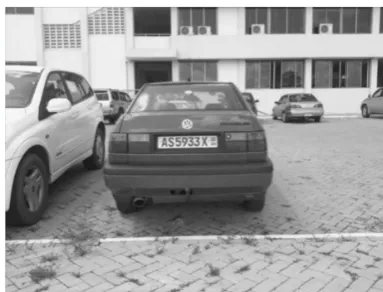
[image:2.595.322.550.71.148.2]A test image and its grayscaled version are shown in Figures 3 and 4. The gray image was then blurred to remove noise to improve plate localization and detection accuracy.
[image:2.595.82.267.280.428.2]Fig. 3. Original sample test image used to test the proposed system.
Fig. 4. Grayscaled image of the original test image.
Candidate Detection
Candidate Analysis
Plate Detected?
Fuzzy Plates?
Success
Fail Fuzzy
Analysis Yes
No
Yes No
Fig. 5. Process flow for the plate detection and localization block.
2.2 Plate Localization and Extraction
After the captured image was preconditioned, the second block of our model was applied to identify the number plate and extract it for further processing. The flow chart in Figure 5 summarises the processes involved in finding and extracting the plate from the grayscaled image.
[image:2.595.338.530.372.518.2]2.2.1 Candidate Detection. In localizing the plate, all areas in the image that may contain the number plate were identified and marked as candidates. Our proposed system offers two candidate detection algorithms: edge detection and template matching. The three-stage edge detection algorithm used focusses on enhanc-ing the image and identifyenhanc-ing the number plate edges in the image. In this algorithm, the grayscaled image is first convolved with a Gaussian kernel to reduce detail and remove noise as illustrated in Figure 6. Typically, number plates have strongly defined edges thus the Gaussian blur have no effect on them thereby reducing possible areas that the algorithm must consider.
Fig. 6. Grayscaled image smoothened using Gaussian image smoothen-ing.
Vertical and horizontal Sobel-Feldman convolution kernels are ap-plied separately to the blurred image, producing vertical and hor-izontal edge images shown in Figures 7 and 8 respectively. These filters locate areas of high spatial frequency or large pixel value differences and mark them as edges. After both convolutions, the two edge images are combined into a full edge image and bina-rized using Otsu’s simple but effective global thresholding method [8]. Figure 9 is the result of the edge image unification and bina-rization.
[image:2.595.78.266.498.646.2]Fig. 7. Horizontal Sobel-Feldman convolution applied to image to deter-mine horizontal edges of the plate.
Fig. 8. Vertical Sobel-Feldman convolution applied to image to determine vertical edges of the plate.
Fig. 9. Binarized image of combined horizontal and vertical edges.
plates.An aspect ratio filter to select rectangles whose width-height ratios correspond to specified plates aspect ratios. Objects that pass both filters are tagged as plate candidates A number plate typically appear as a rectangular area with a white border after edge detec-tion and binarizadetec-tion as shown in Figure 11.
[image:3.595.339.531.238.386.2]Template matching, on the other hand, involves the use of trained classifiers to detect features of number plates learned. In training
[image:3.595.76.269.253.400.2]Fig. 10. Image showing all detected edge components.
Fig. 11. Selected plate candidates from edge detection.
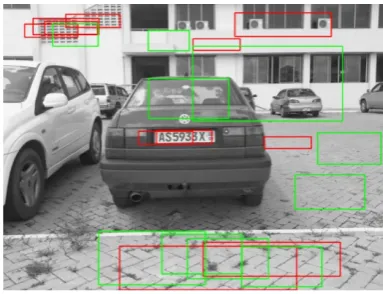
these classifiers, two types of images were obtained and used in the process: positive images and negative images. Positive images are those that contained number plates whiles negative images did not contain any plate at all. A library of 303 rectangular plate and 359 square plate images was compiled and used in training 10 rectan-gular and square plate classifiers each. The trained classifiers were then applied to the grayscaled image for candidate plate identifi-cation. Figure 12 illustrates the detection of plate candidates using classifiers.
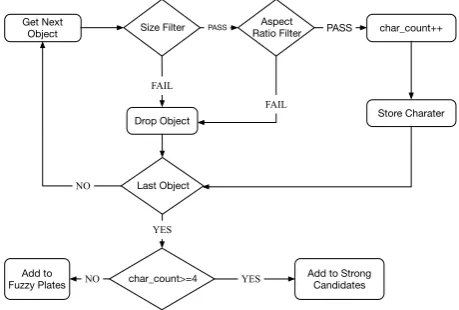
[image:3.595.76.269.445.591.2] [image:3.595.339.531.514.661.2]2.2.2 Candidate Analysis. After detection, the coordinates of candidate areas were used to examine corresponding areas on the binarized form of the original image. Connected component anal-yses, summarised in Figure 13, were performed on corresponding candidate areas to locate the objects on the number plate. The size and aspect ratio of each object is then tested. A character count is maintained for each object that passed both filters. Each success-ful object was also stored. Ghanaian number plates have at least four characters thus any candidate with a character count of four or higher is marked as a strong candidate. Any candidate with a com-ponent count of two or three is tagged as a fuzzy plate. Figures 14 and 15 illustrate component and character detection on a candidate plate.
Get Next Object
Aspect
Ratio Filter char_count++
Drop Object Store Charater
PASS
Last Object Size Filter
char_count>=4 Add to Strong Candidates Add to
Fuzzy Plates
PASS
FAIL FAIL
YES NO
NO
[image:4.595.58.288.226.381.2]YES
Fig. 13. Process flowchart for candidate analysis.
The set of strong candidates were re-evaluated to get the best candi-date after initial candicandi-date analysis. The candicandi-date with the highest character count in the set is selected. If multiple candidates have that maximum value, the candidate with the best bump score is se-lected. If the set of strong candidates is empty, the set of fuzzy plates is evaluated. This secondary assessment is done using both the character counts and their bump scores of the fuzzy candidates. The selected plate is then cut out of the original image and bina-rized for further processing.
2.3 Character Segmentation
Our system implements character segmentation before character recognition to forestall effects of noise, character arrangement and skew especially with square plates. Each character was first cut out of the plate image and de-noised. A new image was created and the de-noised characters were placed on a single line in the new image as in Figure 16.
Fig. 14. Object detection on successful plate candidate.
Fig. 15. Character detection on successful plate number object candidates.
Fig. 16. Image with segmented characters.
2.4 Character Recognition
This extremely crucial process forms the final stage in the ANPR process. Here, the Tesseract OCR engine is applied to the detected plate to recognize the alphanumeric characters on it. The Tesser-act engine used was trained in order to increase the accuracy of the recognition process. The training involved creating images of the characters to be recognized, using the expected fonts, and com-piling a dictionary of possible character combinations to be found on a number plate, that is: regional codes, suffixes and registration numbers.
The output of this stage is the text representing the vehicle number.
3. TESTING, RESULTS AND DISCUSSION
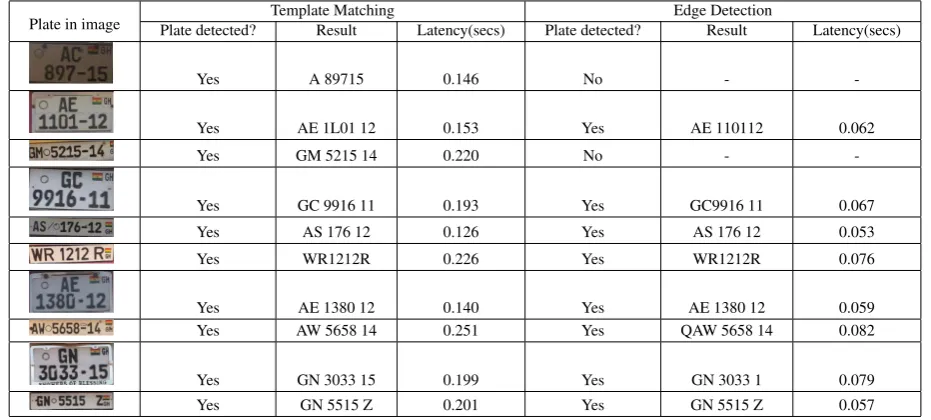
500 number plates were processed with the proposed ANPR system to test its performance in terms accuracy and speed. of 10 results The edge detection algorithm detected 397 plates (79.4%), with an average speed of 0.037s. Feature detection was much slower, but had higher accuracy, detecting 454 plates (90.8%) with an average speed of 0.185s. The optical character recognition added an av-erage of 0.031s to the process, and successfully recognised about 60% of detected plates. Faded characters and certain plate decora-tions, along with noise on the plates due to dirt, greatly hampered the plate segmentation process, which in turn affected character recognition. Both plate detection algorithms proved reasonably ac-curate up to a distance of 5 metres. Feature Detection exhibited ran-dom successes with variations in view angle, while Edge Detection stayed accurate for a range of up to 30 degrees.
4. CONCLUSION
The proposed ANPR detected most of the Ghanaian number plates tested with a successful recognition rate of 60% with an average processing time of about 0.2s to complete the entire image captur-ing to character recognition stage. This system will produce more accurate results upon further training.
5. ACKNOWLEDGEMENT
Table 1. Sampled results detected and non-detected plates using and proposed ANPR system
Plate in image Plate detected? Template MatchingResult Latency(secs) Plate detected? Edge DetectionResult Latency(secs)
Yes A 89715 0.146 No -
-Yes AE 1L01 12 0.153 Yes AE 110112 0.062
Yes GM 5215 14 0.220 No -
-Yes GC 9916 11 0.193 Yes GC9916 11 0.067
Yes AS 176 12 0.126 Yes AS 176 12 0.053
Yes WR1212R 0.226 Yes WR1212R 0.076
Yes AE 1380 12 0.140 Yes AE 1380 12 0.059
Yes AW 5658 14 0.251 Yes QAW 5658 14 0.082
Yes GN 3033 15 0.199 Yes GN 3033 1 0.079
Yes GN 5515 Z 0.201 Yes GN 5515 Z 0.057
6. REFERENCES
[1] K. M. Babu and M. V. Raghunadh. Vehicle number plate de-tection and recognition using bounding box method. In2016 International Conference on Advanced Communication Con-trol and Computing Technologies (ICACCCT), pages 106–110, May 2016.
[2] J. Canny. A computational approach to edge detection.IEEE Transactions on Pattern Analysis and Machine Intelligence, PAMI-8, 1986.
[3] W. L. Hao and H. T. Yong. Detection of license plates in natu-ral scenes with mser and sift unigram classifiers.IEEE Confer-ence on Sustainable Utilization and Development in Engineer-ing and Technology, pages 95–98, 2010.
[4] T. B. Joewono and H. Kubota. Safety and security improve-ment in public transportation based on public perception in de-veloping countries.IATSS Research, 30(1):86 – 100, 2006.
[5] J. A. Mayan, K. A. Deep, M. Kumar, L. Alvin, and S. P. Reddy. Number plate recognition using template comparison for vari-ous fonts in matlab. In2016 IEEE International Conference on Computational Intelligence and Computing Research (ICCIC), pages 1–6, Dec 2016.
[6] M. T. Qadri and M. Asif. Automatic number plate recognition system for vehicle identification using optical character recog-nition. In2009 International Conference on Education Tech-nology and Computer, pages 335–338, April 2009.
[7] S. Singh and B. Kaur. Number plate recognition through im-age using morphological algorithm. In2016 3rd International Conference on Computing for Sustainable Global Develop-ment (INDIACom), pages 3157–3160, March 2016.