Creatinium perchlorate
Amel Messai,aAmani Direm,aNourredine Benali-Cherif,a* Dominique Luneauband Erwann Jeanneaub
aLaboratoire des Structures, Proprie´te´s et Interactions Interatomiques, Centre
Universitaire de Khenchela, 40000 Khenchela, Algeria, andbLaboratoire des
Multimate´riaux et Interfaces, UMR 5615, Universite´ Claude Bernard Lyon1, 69622 Villeurbanne Cedex, France
Correspondence e-mail: [email protected]
Received 5 January 2009; accepted 26 January 2009
Key indicators: single-crystal X-ray study;T= 293 K; mean(C–C) = 0.006 A˚; Rfactor = 0.075;wRfactor = 0.230; data-to-parameter ratio = 13.3.
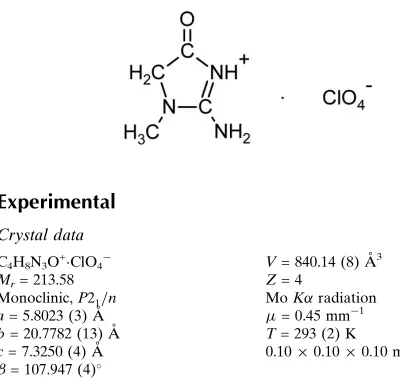
The title compound, C4H8N3O +
ClO4
, is built up from creatininium cations and perchlorate anions. Crystal cohesion and perchlorate stability are ensured by N—H O hydrogen bonds that together with weak C—H O interactions build up a three-dimensional network.
Related literature
For background on organic–inorganic hybrid materials, see: Benali-Cherifet al.(2004); Hill (1998); Kaganet al.(1999). For a related structure, see: Cherouanaet al.(2003); Berrahet al. (2005). For interpretation of the solution acidity effect on NMR chemical shifts, see: Kotsyubynskyyet al.(2004).
Experimental
Crystal data
C4H8N3O+ClO4
Mr= 213.58 Monoclinic,P21=n a= 5.8023 (3) A˚
b= 20.7782 (13) A˚
c= 7.3250 (4) A˚
= 107.947 (4)
V= 840.14 (8) A˚3
Z= 4
MoKradiation
= 0.45 mm1 T= 293 (2) K 0.100.100.10 mm
Data collection
Nonius KappaCCD diffractometer Absorption correction: none 4080 measured reflections
1587 independent reflections 1209 reflections withI> 2(I)
Rint= 0.126
Refinement
R[F2> 2(F2)] = 0.075 wR(F2) = 0.230
S= 1.05 1587 reflections
119 parameters
H-atom parameters constrained max= 0.39 e A˚
3
[image:1.610.47.247.498.687.2]min=0.42 e A˚ 3
Table 1
Hydrogen-bond geometry (A˚ ,).
D—H A D—H H A D A D—H A
N1—H1 O4 0.86 2.18 2.905 (5) 142 N2—H2B O4 0.86 2.33 3.044 (6) 141 N2—H2A O2i
0.86 2.31 3.077 (6) 148 N2—H2A O2ii
0.86 2.52 3.186 (5) 136 N2—H2B O3iii
0.86 2.39 2.947 (5) 123 C3—H3A O2ii
0.96 2.51 3.455 (5) 168 C4—H4A O1iv
0.97 2.43 3.284 (5) 147
Symmetry codes: (i) x;y;zþ1; (ii) xþ1;yþ1;zþ1; (iii)
xþ2;yþ1;zþ1; (iv)x1 2;yþ
3 2;zþ
1 2.
Data collection: COLLECT (Nonius, 1998); cell refinement:
SCALEPACK (Otwinowski & Minor, 1997); data reduction:
SCALEPACK and DENZO (Otwinowski & Minor, 1997);
program(s) used to solve structure:SIR92 (Altomare et al., 1993); program(s) used to refine structure:SHELXL97(Sheldrick, 2008); molecular graphics: ORTEP-3 for Windows (Farrugia, 1997) and
PLATON (Spek, 2003); software used to prepare material for publication:WinGX(Farrugia, 1999).
We wish to thank the Centre Universitaire de Khenchela for financial support.
Supplementary data and figures for this paper are available from the IUCr electronic archives (Reference: DN2425).
References
Altomare, A., Cascarano, G., Giacovazzo, C. & Guagliardi, A. (1993).J. Appl. Cryst.26, 343–350.
Benali-Cherif, N., Bendheif, L., Bouchouit, K. & Cherouana, A. (2004).Ann. Chim. Sci. Mater.29, 11–24.
Berrah, F., Lamraoui, H. & Benali-Cherif, N. (2005).Acta Cryst.E61, o210– o212.
Cherouana, A., Bendjeddou, L. & Benali-Cherif, N. (2003).Acta Cryst.E59, o1790–o1792.
Farrugia, L. J. (1997).J. Appl. Cryst.30, 565. Farrugia, L. J. (1999).J. Appl. Cryst.32, 837–838. Hill, C. L. (1998).Chem. Rev.98, 1–2.
Kagan, C. R., Mitzi, D. B. & Dimitrakopoulos, C. D. (1999).Science,286, 945– 947.
Kotsyubynskyy, D., Molchanov, S. & Gryff-Keller, A. (2004).Pol. J. Chem.78, 239–248.
Nonius (1998).COLLECT. Nonius BV, Delft, The Netherlands.
Otwinowski, Z. & Minor, W. (1997). Methods in Enzymology, Vol. 276,
Macromolecular Crystallography, Part A, edited by C. W. Carter Jr & R. M. Sweet, pp. 307–326. New York: Academic Press.
Sheldrick, G. M. (2008).Acta Cryst.A64, 112–122. Spek, A. L. (2003).J. Appl. Cryst.36, 7–13. Acta Crystallographica Section E
Structure Reports
Online
supporting information
Acta Cryst. (2009). E65, o460 [doi:10.1107/S1600536809003171]
Creatinium perchlorate
Amel Messai, Amani Direm, Nourredine Benali-Cherif, Dominique Luneau and Erwann
Jeanneau
S1. Comment
Studies of organic-inorganic hybrid materials, including amino acids and various inorganic acids (Benali-Cherif et al.,
2004), have received a great deal of attention in recent years, because of their electrical, magnetic and optical properties
(Kagan et al., 1999; Hill, 1998).
Creatinine is formed by the metabolism of phosphocreatine, a high-energy molecule which provides a rapid supply of
ATP to muscles. Phosphocreatine is converted spontaneously to creatinine on a regular basis. Consequently, creatinine is
released into the blood and excreted by the kidneys as a metabolic waste product.
The present structure analysis of creatininium perchlorate, (I), was undertaken as part of a more general investigation
into the nature of hydrogen bonding between organic bases or amino acids and inorganic acids in their crystalline forms
(Cherouana et al., 2003).
In the present study, only the imino group of the imidazolyl moiety (atom N1) in creatinine is protonated, which
confirms the possibility of the existence of creatininium cations in various tautomeric forms in aqueous solution. This is
discussed and quantified in the light of the interpretation of the solution acidity effect on 1H, 13 C and 14 N NMR
chemical shifts (Kotsyubynskyy et al., 2004).
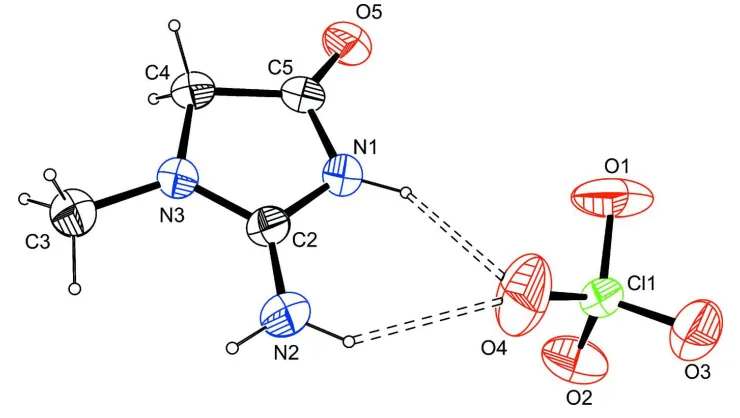
The asymmetric unit of (I) contains a monoprotonated creatininium cation and two perchlorate anions (Fig.1).
The bond distances in the imidazolyl ring of (I) are, in general, not significantly different from those found in similar
hybrid compounds containing protonated imidazolyl moieties like creatininium nitrate (Berrah et al., 2005). The
creatininium ring is planar, as expected, with a mean deviation from planarity of 0.0017 Å.
The average Cl—O bond distances and O—Cl—O bond angles are 1.40625 (4) Å and 109.50 (3)°, respectively,
confirming a tetrahedral configuration, similar to other perchlorates studied at low temperature. Perchlorate anions
(ClO4-), surrounded by two creatininium residues via hydrogen bonds play an important role in stabilizing the crystal
structure.
The cation-anion N—H—O interactions form sheet parallel to the (0 1 0) plane (Table 1, Fig.2). Weak C-H···O
interactions further link the sheets to form a three dimensionnal network (Table 1).
S2. Experimental
The title compound (I) was cristallized by slow evaporation at room temperature of an aqueous solution of creatinine and
perchloric acid in a 1:1 stochiometric ratio.
S3. Refinement
The title compound crystallizes in the centrosymmetric space group P21/n. All non-H atoms were refined with anisotropic
refined as riding model with C—H and N—H bond lengths constrained to 0.96–0.97 Å and 0.834 Å, respectively.
Figure 1
Asymmetric unit and atom-numbering scheme of creatininium perchlorate. Displacement ellipsoids are drawn at the 30%
probability level. H atoms are represented as small sphere of arbitrary radii. H bonds are shown as dashed lines.
Figure 2
Partial packing view showing the hydrogen bond pattern between cation and anion. H atoms not involved in hydrogen
[image:3.610.127.482.354.657.2]creatininium perchlorate
Crystal data
C4H8N3O+·ClO4− Mr = 213.58
Monoclinic, P21/n Hall symbol: -P 2yn a = 5.8023 (3) Å b = 20.7782 (13) Å c = 7.3250 (4) Å β = 107.947 (4)° V = 840.14 (8) Å3 Z = 4
F(000) = 440 Dx = 1.689 Mg m−3
Mo Kα radiation, λ = 0.71073 Å Cell parameters from 4863 reflections θ = 2.0–26.0°
µ = 0.45 mm−1 T = 293 K Prism, colourless 0.10 × 0.10 × 0.10 mm
Data collection
Nonius KappaCCD diffractometer
Radiation source: fine-focus sealed tube Graphite monochromator
ω–θ scans
4080 measured reflections 1587 independent reflections
1209 reflections with I > 2σ(I) Rint = 0.126
θmax = 26.0°, θmin = 2.0° h = −7→6
k = −23→25 l = −9→9
Refinement
Refinement on F2 Least-squares matrix: full R[F2 > 2σ(F2)] = 0.075 wR(F2) = 0.230 S = 1.05 1586 reflections 119 parameters 0 restraints
Primary atom site location: structure-invariant direct methods
Secondary atom site location: difference Fourier map
Hydrogen site location: inferred from neighbouring sites
H-atom parameters constrained w = 1/[σ2(F
o2) + (0.139P)2 + 0.288P] where P = (Fo2 + 2Fc2)/3
(Δ/σ)max = 0.003 Δρmax = 0.39 e Å−3 Δρmin = −0.42 e Å−3
Special details
Geometry. All e.s.d.'s (except the e.s.d. in the dihedral angle between two l.s. planes) are estimated using the full covariance matrix. The cell e.s.d.'s are taken into account individually in the estimation of e.s.d.'s in distances, angles and torsion angles; correlations between e.s.d.'s in cell parameters are only used when they are defined by crystal symmetry. An approximate (isotropic) treatment of cell e.s.d.'s is used for estimating e.s.d.'s involving l.s. planes.
Refinement. Refinement of F2 against ALL reflections. The weighted R-factor wR and goodness of fit S are based on F2, conventional R-factors R are based on F, with F set to zero for negative F2. The threshold expression of F2 > σ(F2) is used only for calculating R-factors(gt) etc. and is not relevant to the choice of reflections for refinement. R-factors based on F2 are statistically about twice as large as those based on F, and R- factors based on ALL data will be even larger.
Fractional atomic coordinates and isotropic or equivalent isotropic displacement parameters (Å2)
x y z Uiso*/Ueq
O5 0.3264 (6) 0.74385 (13) 0.3068 (5) 0.0803 (9)
N1 0.4969 (5) 0.65462 (13) 0.4848 (5) 0.0623 (8)
H1 0.5899 0.6421 0.4202 0.075*
N2 0.5866 (6) 0.57013 (14) 0.7078 (6) 0.0723 (10)
H2B 0.6800 0.5526 0.6508 0.087*
N3 0.3285 (5) 0.65583 (13) 0.7149 (4) 0.0577 (8)
C2 0.4753 (6) 0.62392 (16) 0.6428 (5) 0.0555 (8)
C3 0.2475 (8) 0.6361 (2) 0.8757 (6) 0.0729 (11)
H3A 0.2690 0.5905 0.8942 0.109*
H3B 0.0793 0.6466 0.8491 0.109*
H3C 0.3409 0.6581 0.9897 0.109*
C4 0.2340 (7) 0.71236 (15) 0.5973 (6) 0.0622 (10)
H4A 0.2797 0.7516 0.6713 0.075*
H4B 0.0588 0.7106 0.5451 0.075*
C5 0.3498 (7) 0.70880 (15) 0.4411 (6) 0.0628 (10)
Cl1 0.89960 (16) 0.57125 (4) 0.24596 (14) 0.0599 (5)
O1 0.8635 (8) 0.63394 (16) 0.1663 (8) 0.1392 (18)
O2 0.7200 (7) 0.52990 (16) 0.1320 (6) 0.1017 (12)
O3 1.1298 (6) 0.5496 (2) 0.2543 (6) 0.1112 (13)
O4 0.8863 (10) 0.5762 (3) 0.4326 (7) 0.1394 (19)
Atomic displacement parameters (Å2)
U11 U22 U33 U12 U13 U23
O5 0.105 (2) 0.0604 (16) 0.085 (2) −0.0036 (14) 0.0420 (17) 0.0152 (14) N1 0.0699 (17) 0.0527 (16) 0.075 (2) −0.0020 (13) 0.0384 (16) −0.0039 (14) N2 0.082 (2) 0.0549 (19) 0.088 (2) 0.0147 (14) 0.0381 (19) 0.0059 (15) N3 0.0663 (16) 0.0474 (15) 0.0692 (19) 0.0027 (13) 0.0353 (14) 0.0031 (13) C2 0.0587 (18) 0.0449 (16) 0.066 (2) −0.0009 (14) 0.0244 (16) −0.0049 (15)
C3 0.087 (3) 0.064 (2) 0.079 (3) 0.008 (2) 0.042 (2) 0.0080 (19)
C4 0.074 (2) 0.0415 (17) 0.081 (3) 0.0048 (15) 0.0369 (19) 0.0024 (15) C5 0.072 (2) 0.0421 (17) 0.081 (3) −0.0083 (15) 0.0334 (19) −0.0017 (16) Cl1 0.0651 (7) 0.0471 (6) 0.0728 (7) 0.0028 (3) 0.0289 (5) −0.0067 (3)
O1 0.144 (3) 0.0463 (18) 0.198 (5) 0.0036 (19) 0.010 (3) 0.017 (2)
O2 0.110 (2) 0.074 (2) 0.108 (3) −0.0300 (17) 0.014 (2) 0.0009 (17)
O3 0.088 (2) 0.104 (3) 0.155 (4) 0.015 (2) 0.058 (2) −0.016 (3)
O4 0.164 (4) 0.187 (5) 0.091 (3) 0.029 (3) 0.074 (3) −0.019 (3)
Geometric parameters (Å, º)
O5—C5 1.197 (5) C3—H3A 0.9600
N1—C2 1.361 (4) C3—H3B 0.9600
N1—C5 1.389 (5) C3—H3C 0.9600
N1—H1 0.8600 C4—C5 1.497 (6)
N2—C2 1.305 (4) C4—H4A 0.9700
N2—H2A 0.8600 C4—H4B 0.9700
N2—H2B 0.8600 Cl1—O3 1.393 (3)
N3—C2 1.312 (4) Cl1—O4 1.396 (4)
N3—C3 1.455 (5) Cl1—O2 1.409 (3)
N3—C4 1.460 (4) Cl1—O1 1.416 (4)
C2—N1—H1 124.3 N3—C4—C5 103.6 (3)
C5—N1—H1 124.3 N3—C4—H4A 111.0
C2—N2—H2A 120.0 C5—C4—H4A 111.0
C2—N2—H2B 120.0 N3—C4—H4B 111.0
H2A—N2—H2B 120.0 C5—C4—H4B 111.0
C2—N3—C3 126.5 (3) H4A—C4—H4B 109.0
C2—N3—C4 110.0 (3) O5—C5—N1 126.0 (4)
C3—N3—C4 123.3 (3) O5—C5—C4 129.3 (3)
N2—C2—N3 126.6 (4) N1—C5—C4 104.6 (3)
N2—C2—N1 123.1 (3) O3—Cl1—O4 108.8 (3)
N3—C2—N1 110.3 (3) O3—Cl1—O2 110.7 (3)
N3—C3—H3A 109.5 O4—Cl1—O2 111.8 (3)
N3—C3—H3B 109.5 O3—Cl1—O1 109.5 (3)
H3A—C3—H3B 109.5 O4—Cl1—O1 106.8 (3)
N3—C3—H3C 109.5 O2—Cl1—O1 109.2 (2)
H3A—C3—H3C 109.5
Hydrogen-bond geometry (Å, º)
D—H···A D—H H···A D···A D—H···A
N1—H1···O4 0.86 2.18 2.905 (5) 142
N2—H2B···O4 0.86 2.33 3.044 (6) 141
N2—H2A···O2i 0.86 2.31 3.077 (6) 148
N2—H2A···O2ii 0.86 2.52 3.186 (5) 136
N2—H2B···O3iii 0.86 2.39 2.947 (5) 123
C3—H3A···O2ii 0.96 2.51 3.455 (5) 168
C4—H4A···O1iv 0.97 2.43 3.284 (5) 147