
Farida Himeur Aidoudi
A Thesis Submitted for the Degree of PhD at the
University of St Andrews
2012
Full metadata for this item is available in Research@StAndrews:FullText
at:
http://research-repository.st-andrews.ac.uk/
Please use this identifier to cite or link to this item: http://hdl.handle.net/10023/2592
This item is protected by original copyright
Synthesis
A thesis submitted in application for the title of
Doctor of Philosophy
In the Faculty of Science of the University of
St. Andrews by
Farida Himeur Aidoudi
University of St Andrews
I, Farida Himeur Aidoudi, hereby certify that this thesis, which is approximately 42000 words in length, has been written by me, that it is the record of work carried out by me and that it has not been submitted in any previous application for a higher degree.
Date Signature of candidate
I was admitted as a research student in January 2008 and as a candidate for the degree of PhD in January 2009; the higher study for which this is a record was carried out in the University of St Andrews between 2008 and 2011.
Date Signature of candidate
I hereby certify that the candidate has fulfilled the conditions of the Resolution and Regulations appropriate for the degree of Ph.D. in the University of St Andrews and that the candidate is qualified to submit this thesis in application for that degree.
permission for it to be made available for use in accordance with the regulations of the University Library for the time being in force, subject to any copyright vested in the work not being affected thereby. I also understand that the title and the abstract will be published, and that a copy of the work may be made and supplied to any bona fide library or research worker, that my thesis will be electronically accessible for personal or research use unless exempt by award of an embargo as requested below, and that the library has the right to migrate my thesis into new electronic forms as required to ensure continued access to the thesis. I have obtained any third party copyright permissions that may be required in order to allow such access and migration, or have requested the appropriate embargo below.
The following is an agreed request by candidate and supervisor regarding the electronic publication of this thesis:
Embargo on both printed copy and electronic copy for the same fixed period of 1 year on the following ground: publication would preclude future publication.
Date Signature of candidate
An ionothermally-prepared S = ½ vanadium oxyfluoride kagome lattice
Farida H. Aidoudi, David W. Aldous, Richard J. Goff, Alexandra M. Z. Slawin, J. Paul Attfield, Russell E. Morris and Philip Lightfoot, Nature Chemistry, (2011),
http://dx.doi.org/10.1038/NCHEM.1129.
Ionic liquids and deep eutectic solvents as new solvents for the synthesis of vanadium
fluorides and oxyfluorides.
Farida H. Aidoudi, Peter J. Byrne, Phoebe K. Allan, Simon J. Teat, Philip Lightfoot and Russell E. Morris,Dalton Trans., (2011), 40, 4324-4331
Increasing the dimensionality of hybrid vanadium oxyfluorides using ionothermal
synthesis
Farida Himeur, Phoebe K. Allan, Simon J. Teat, Richard J. Goff, Russell E. Morris and Philip Lightfoot,Dalton Trans.,(2010), 39, 6018-6020
The ionothermal synthesis of metal organic frameworks, Ln(C9O6H3)((CH3NH)2CO)2
using deep eutectic solvents
First of all I would like to thank Professor Russell Morris for giving me the opportunity to work in his group, and for his guidance and supervision throughout this Ph.D. I really appreciate his support and patience, without him it would have been very difficult for me to accomplish this work. I also would like to thank Professor Philip Lightfoot for his invaluable advice and help based on his expertise in crystallography and metal fluorides.
I am grateful to many other people who have contributed in some way towards this thesis. I would especially like to thank Professor Alex Slawin for the collection of most of the single crystal data. Professor Paul Attfield and Dr Richard Goff are thanked for their assistance in some of the magnetic data analysis. Thanks also go to Dr Sharon Ashbrook and Mr Daniel Dawson for solid state NMR work (experimental and simulation). Ms Phoebe Allan is also thanked for the collection of some of the single crystal data at the ALS and also for the diffraction pattern figures she provided me with. I am also grateful to all the technical staff at the University of St Andrews. The assistance and discussion offered by my colleagues in the Morris group have been very helpful; a big thank you to all the past and present REM members. Special thanks to Dr Zhouija Lin (Candy) it was a great pleasure to meet her especially in my early days at the University of St Andrews. Thanks must also be given to Dr David Aldous for reading through most chapters of this thesis. Dr Paul Wheatley, Dr Morven Duncan and Ms Phoebe Allan are also thanked for proof reading the remaining parts.
I thank EPSRC for funding this project.
An exploration of some organic-inorganic hybrid metal fluorides and lanthanide
containing metal organic frameworks (Ln-MOFs) has been carried out under
ionothermal conditions. In this synthesis technique an ionic liquid (IL) or deep eutectic
mixture (DES) is used as the solvent and in many cases as the provider of the organic
structure directing agent.
A wide range of ILs and DESs have been investigated as the reaction solvent for the
synthesis of organically templated vanadium fluorides and oxyfluorides (VOFs), and
initially this has proved to be successful with the isolation of 13 phases, including eight
new materials. In the VOFs synthesis the IL acts as a solvent, however the DES acts as
a solvent and also as a template delivery agent, where the expected template is provided
by the partial breakdown of the urea derivative component. Interestingly, it has been
shown that the same structure can be accessiblevia two different ways; either by using
IL with an added templating source, or simply through the use of a DES without any
other additive; since the template is provided by thein situ breakdown of the DES.
The synthesis of VOFs with extended structures was achieved by the use of the
hydrophobic IL 1-ethyl-3-methylimidazolium bis(trifluoromethylsulfonyl)imide
(EMIM Tf2N) as the solvent. [HNC5H5][V2O2F5] represents the first VOF with a 2D
network that contains exclusively V4+. This material may be considered as arising via condensation of the previously known ladder-like chains. Furthermore, using imidazole
as an added template has produced another layer material that has significant
displaying the known ladder-type building units. Further investigations in the
ionothermal synthesis of VOF using EMIM Tf2N resulted in a successful synthesis of
[NH4]2[HNC7H13][V7O6F18], a novel material displaying a unique double layered
topology featuring a S = ½ kagome type lattice of V4+ ions (d1). Two of the V4+based kagome sheets are pillared by V3+ions to form a double layered structure templated by both ammonium and quinuclidinium cations. This compound exhibits a high degree of
magnetic frustration, with significant antiferromagnetic interactions but no long range
ordering was observed above 2 K. This material presents an interesting comparison to
the famous Herbertsmithite, ZnCu3(OH)6Cl2, and may provide an excellent candidate
for realising a quantum spin liquid (QSL) ground state. Interestingly, in this system the
use of EMIM Tf2N as a solvent produces mainly V4+-containing materials, despite the high reaction temperature (170 C). This characteristic is unprecedented in VOFs
synthesis, as rising the reaction temperature above 150 C in other techniques (i.e. hydrothermal synthesis) would often result in further reduction of V4+to V3+.
Using the ionothermal technique in the synthesis of hybrid iron fluorides resulted in the
isolation of three chain-type materials. Again, the IL acts as the solvent and the DES
acts as the solvent and also as the template provider where the expected template is
released by the partial breakdown of the urea derivative component of the DES.
The synthesis of Ln-MOF using a choline chloride/ 1,3-dimethylurea deep eutectic
mixture has produced three novel isostructural materials. Usually, in ionothermally
prepared materials (i.e. zeolites) the urea portion of the DES is unstable and breaks
final structure. Using a choline chloride/ethylene glycol deep eutectic solvent led to the
isolation of a Ln-MOF with interesting structural properties, however none of the DES
components appeared in the final structure.
These results demonstrate once more the usefulness and applicability of the ionothermal
synthesis method and emphasise how this synthesis technique can be further extended
and applied in the preparation of important structures with unique properties and
1. Introduction 1
1-1. Overview 1
1-2. Ionic Liquids and Deep Eutectic Mixtures 3
1-2-1. Background 3
1-2-2. Conventional preparation of ionic liquids 5
1-2-3. What makes ILs attractive solvents? 8
1-2-4. Eutectic mixtures 9
1-3. Ionothermal Synthesis 11
1-3-1. Background 11
1-3-2. Recent development in ionothermal synthesis 13
1-4. Metal Fluorides 14
1-4-1. Introduction 14
1-4-2. Concepts of building units and out of centre distortion 15
1-4-3. Structural features and diversity 19
1-4-3-1. Zero-dimensional structures 19
1-4-3-2. One-dimensional structures 25
1-4-3-3. Two-dimensional structures 28
1-4-3-4. Three-dimensional structures 30
1-4-4. Synthesis aspects: synthesis methods, solvent, template 33
1-4-4-1. Solvent 33
1-4-4-2. Template 34
1-5-1. Background 38
1-5-2. Synthesis of Ln-MOFs 41
1-6. References 42
2. Aims and Objectives 49
2-1. Synthesis of Transition Metal Fluorides and Lanthanide
MOFs using ILs and DESs 49
2-2. Characterisation 51
2-3. References 52
3. Experimental techniques 54
3-1. Introduction 54
3-2. Ionothermal Synthesis 54
3-3. Single Crystal and Powder X-Ray Diffraction 55
3-3-1. Background 55
3-3-1-1. Introduction 55
3-3-1-2. Generation of X-rays 56
3-3-1-3. Crystals and crystal chemistry 59
3-3-1-4. Diffraction of X-rays by crystals and Bragg’s law 62
3-3-1-5. Powder X-ray diffraction 68
3-3-2. Experimental 71
3-4. Bond Valence Sum Calculation 72
3-5. Magnetic Properties 73
3-5-1. Background 73
3-5-2. Experimental 78
3-6. Elemental Analysis (CHN Analysis) 78
3-7. Nuclear Magnetic Resonance Spectroscopy (NMR) 79
4. Ils and DESs as novel solvents 84
for the synthesis of VOfs
4-1. Introduction 84
4-2. Synthesis of the ILs 86
4-2-1. Synthesis of EMIM Br 86
4-2-2. Synthesis of BMIM Br 87
4-2-3. Synthesis of EMIM Tf2N 87
4-2-4. Synthesis of HBet Tf2N 88
4-2-5. Synthesis of BPB 88
4-2-6. Synthesis of BMIM Asp 89
4-2-7. Synthesis of the eutectic mixtures 90
4-3. ILs as Solvents in the Synthesis of VOFs 91
4-3-1. The system V2O5/NH4F in ILs 91
4-3-2. The system V2O5/HF in ILs 93
4-3-3. Adding organic amine to the system V2O5/HF 100
4-4. VOFs Synthesis using DESs as Solvents and Template 106
Delivery Agents
4-5. Synthesis of NH4VF4(VF-13) using chiral IL 126
4-6. Concluding Remarks 133
4-7. References 139
5. VOFs synthesis using EMIM Tf2N 141
5-1. Introduction 141
5-2. Synthesis of the IL 145
5-3. Increasing the Dimensionality of VOFs using EMIM Tf2N 145
5-4. Imidazole as an Added Template 155
5-7. References 194
6. Synthesis of Iron fluorides 197
using Ils and DESs
6-1. Introduction 197
6-2. Synthesis of ILs and DESs 199
6-3. BMIM Br as a Solvent in the Synthesis of Iron Fluorides 199
6-3-1. Synthesis of FeF3(H2O)·H2O 199
6-3-2. Synthesis of [H2NH2(CH2)2NH2][FeF5] 203
6-4. Iron Fluoride Synthesis using DESs as 208
Solvents and Template Delivery Agents
6-4-1. Chains[H2NH2(CH2)2NH2][FeF5] 208
6-4-2. Chains (NH4)2FeF5 210
6-5. Concluding Remarks 214
6-6. References 216
7. Ionothermal synthesis of 217
Ln-trimesate
7-1. Introduction 217
7-2. Synthesis of the DESs 219
7-3. Synthesis of Ln(C6O9H3)3(CO(NH)2(CH3)2)2 219
7-4. La(C6O9H3) (LnMOF-4) 231
7-5. Concluding Remarks 238
7-6. References 241
8. Summary, conclusions and
further work 244
8-3. References 252
Chemical shift
Magnetic susceptibility
adap N-(3-aminopropyl)-1,3-diaminopropane)
BMIM Br 1-butyl-3-methylimidazolium bromide
BPB N-butylpyridinium bromide
BMIM Asp 1-butyl-3-methyimidazolium aspartate
CTA 1,3,5-cyclohexanetricarboxylate
DES Deep eutectic mixture
dpe Trans-1,2-bis(4-pyridyl)-ethylene
dap 1,3-diamino propane
DMU 1,3-dimethyurea
DMF Dimethylformamide
EMIM Br 1-ethyl-3-methylimidazolium bromide
EMIM Tf2N 1-ethyl-3-methylimidazolium bis(trifluoromethylsulfonyl)imide
EMIM BF4 1-ethyl-3-methylimidazolium tetrafluoroborate
EMIM PF6 1-ethyl-3-methylimidazolium hexafluorophosphate
en Ethylenediamine
FCC Face centred cubic
H3TMA Trimesic acid (benzene-1,3,5-tricarboxylic acid)
H21,3-bdc Isophtalic acid
HBet Tf2N Betainium bis(trifluoromethylsulfonyl)imide
IL Ionic liquid
MOF Metal organic framework
NCS Non-centrosymmetric
NMR Nuclear magnetic resonance
pipz Piperazine
PBU Primary building unit
PMIM PF6 1-methyl-3-propylimidazolium hexafluorophosphate
PXRD Powder X-ray diffraction
RTIL Room- temperature ionic liquid
SDA Structure directing agent
SHG Second harmonic generation
SIZ St Andrews ionic liquid zeotype
SQUID Superconducting quantum interference device
tca Propane-1,2,3-tricarboxylic acid
THF Tetrahydrofuran
TSIL Task specific ionic liquid
tren Tris(2-aminoethyl)amine
trien Triethylenetetramine
VOF Vanadium fluoride and oxyfluoride
Introduction
1-1. Overview
The work described in this thesis concerns the use of ionic liquids (ILs) and deep
eutectic mixtures (DESs) as the reaction media for the synthesis of two types of
organic-inorganic hybrid materials; organically-templated transition metal fluorides and
lanthanide containing metal organic frameworks. In this chapter a brief summary of ILs
and DESs will be given. The presentation of the properties of these solvents will make
it easier to understand why they have received and still receive much interest and rank
as a major research topic in fields as diverse as organic synthesis, electrochemistry, and
nanotechnology. These are only a few of applications where ILs have been used and
widely studied, and it is quite fair to imagine that there are many other potential
applications in various domains where ILs can be explored.
Materials scientists also have benefited greatly from the exceptional features of ILs
where ILs and DESs have been used as solvents for the synthesis of crystalline
materials “ionothermal synthesis”.1The second section will be devoted to highlight the
advantages of ionothermal synthesis compared to the hydrothermal synthesis and
outline some recent development in ionothermal synthesis.
The two remaining sections will be reserved to the two types of organic-inorganic
the third section will deal with organically-templated metal fluorides and oxyfluorides
by briefly presenting their main structural characteristics and how they have been
synthesised, along with describing some properties of fluorides. In the fourth section
1-2. Ionic liquids and deep eutectic solvents
1-2-1. Background
Ionic liquids (ILs) are molten salts consisting of ionic species having a melting point
lower than 100 °C.2,3 ILs that are liquid at or around room temperature are often called
“room-temperature ionic liquids” (RTILs). Such a liquid is obtained when combining a
bulky asymmetric organic cation and a small anion, which results in a poorly
coordinated network.
While the discovery of ILs dates back to more than 100 years ago, it is only since the
late 1990’s that these solvents have received a lot of attention. The interest in ILs is
reflected by the increase of the number of publications related to this topic; 2500 papers
were published in 2008, compared with just 37 papers in 1999. A nice and complete
history of ILs with the most memorable key dates was reported by Freemantle in his
recent book.4 Broadly speaking, historically, ILs can be classified into three
generations. The first generation consists of the haloaluminate, the first pyridinium
based ILs with chloroaluminate ions were developed in 1948. One of the first
1,3-dialkylimidazolium RTILs, 1-ethyl-3-methylimidazolium tetrachloroaluminate, which
was obtained through the mixing of 1-ethyl-3-methylimidazolium chloride with
aluminium trichloride, was reported in 1982. However, these haloaluminate ILs were
found to be moisture sensitive and reactive towards various orga
nic compounds, consequently limiting their range of application. A few years later this
[CF3CO2–], were discovered by Wilkes and Zaworotko,5 this was followed by the
synthesis of completely hydrophobic ILs with [(CF3SO2)2N−] anion by Bonhote.6Since
then, a considerable amount of research has been carried out and a wide selection of
different ILs have been synthesised. These ILs are the second generation of ILs. The
third generation emerged in the early 2000s and comprises task-specific ILs and chiral
ILs. Task-specific ILs have been introduced by incorporating additional functional
groups into the cations7 and/or anions.8 Numerous ILs with either chiral cations9 or
chiral anions10have been also synthesised.
An ionic liquid is formed from an organic cation and an inorganic or organic anion.
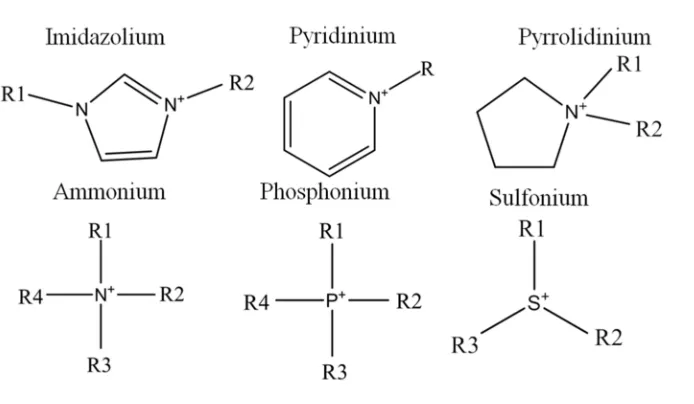
Commonly used cations are large and asymmetric, e.g. derivatives of imidazolium,
pyridinium, pyrrolidinium, ammonium, phosphonium and sulfonium (Figure 1-1).
Typical anions commonly used include: halides (Cl–, Br–, I–), tetrachloroaluminate
(AlCl4–), hexafluorophosphate (PF6–), tetrafluoborate (BF4–),
[image:20.595.137.484.489.691.2]bis(trifluoromethylsulfonyl)imide (CF3SO2)2N–.
The chemical and physical properties of ionic liquids including solubility, miscibility,
solvating ability, viscosity, catalytic activity and melting point can be tuned or tailored
by varying the anion and/or the cation.11,12 In theory ILs can be designed to deliver
almost any set of physical and chemical properties for almost any application in the
chemical sciences. Hence the term “designer solvent” is often used when describing
ILs. However in practice ILs have been actually selected rather than designed for
specific applications and this selection has often been based on trial and error. The
tailoring or designing of ILs requires a full knowledge of patterns and trends in the
characteristics of ILs, which are limited in most types of ILs.4
1-2-2. Conventional preparation of ionic liquids
As the number of ILs increases, different methods have been suggested for their
synthesis. We will focus in this section on the common methods for preparing ILs of
interest in this project, which are mainly imidazolium or pyridinium based ILs.
The general synthetic pathways for preparing ILs from an amine are illustrated in
Figure 1-2.2 The first step is usually a quaternisation reaction, where an amine is
alkylated with an appropriate alkylation agent (RX) such as alkyl halide, resulting in the
corresponding IL. Since alkyl halides are cheap and easily available they are widely
used as alkylation agent in a quaternisation reaction in which the amine and the desired
alkyl halide are mixed and the reaction mixture is heated. The reaction temperature and
the reaction time depend on the reactivity of the alkyl halide. The reactivity decreases
the reactivity of the alkyl halide. Iodine is the most reactive, followed by bromine and
chlorine.
Many ILs with a desired anion such as (BF4–) and (CF3SO2)2N–cannot be formed via
this reaction; in these cases an anion exchange reaction is needed. A previously formed
IL is used as a precursor, and the anion is changed by a metathesis reaction or with a
Lewis acid (MXy). The metathesis reaction can be performed by using a metal salt
(MA), a Bronsted acid (HA) or an ion exchange resin.
Figure 1-2. Synthetic pathways for preparing ILs from an amine.2
As an example, Figure 1-3 presents the widely used synthetic path for preparing the IL
EMIM Tf2N. The preparation requires two steps, the first step is the preparation of
EMIM Br through alkylation ofN-methylimidazole this step usually is carried out under
inert atmosphere with reaction temperature around 30 °C for 3 hrs, after that the product
is crystallised with ethyl acetate. The next step is the anion exchange with LiTf2N salt
Figure 1-3.Alkylation and anion metathesis reactions used for the synthesis of EMIM Tf2N.
While the process mentioned above is efficient for the synthesis of many high purity
ILs, however for some it is difficult to prevent halide contamination, especially when
the resulting IL is miscible with water as it is the case with EMIM BF4. This could
interfere with some applications; for example when the IL is used as a solvent for
deactivation. For this reason many groups were involved in extensive research for the
development of halide-free synthesis methods of ILs. As an example the synthesis of
dialkylimidazolium alkyl sulphate ILs was achieved by the direct alkylation of
alkylimidazole with either dimethyl sulphate or diethyl sulphate.13
While the synthesis of the above mentioned ILs is often straight forward, the synthesis
of ILs belonging to the third generation is relatively more complicated and tedious, and
it seems that even the simplest procedure requires a sequence of steps to obtain the
desired IL. As it is the case in the preparation of ILs with chiral anions, and according
to Ohno10 who prepared a series of ILs with chiral anions derived from amino acids,
these ILs can be synthesised in three steps; alkylation of the amine followed by anion
exchange using an ion exchange resin and the last step is the neutralisation using the
corresponding amino acid.
1-2-3. What makes ILs attractive solvents?
There is no doubt that ILs have opened up a new area of chemistry and they have
contributed to the development of many areas of chemical science. This is due to their
unique properties and impressive features. ILs consist exclusively of cations and anions
and therefore the obvious and natural characteristic of ILs is ionic, this will alter the
chemistry by providing a unique environment compared to the molecular solvents.
Another important feature of ILs that has attracted academic interest is their physical
and chemical properties can be dramatically altered by simply varying the anion and
cation, by introducing specific functionalities into the cation and/or anion or just mixing
Many but not all ILs tend to have good thermal stability and can be liquid
over a range of 300 °C. This wide liquid range is a distinct advantage over
traditional solvent systems that have a much narrower liquid range.
Low vapour pressure resulting from the strong ionic interaction; although
certain ILs can be distilled at high temperature and low pressure.14
ILs have wide range of solubilities and miscibilities with water and other
solvents, for example some ILs are hydrophilic while others are
hydrophobic.
ILs are non-flammable, and recyclable.
1-2-4. Eutectic mixtures
By definition, a deep eutectic solvent (DES) is a type of ionic solvent with special
properties composed of a mixture, which forms a eutectic with a melting point much
lower than either of the individual components.15,16 The first generation of eutectic
solvents were based on mixtures of quaternary ammonium salts with hydrogen bonds
donors such as amides and carboxylic acids. The deep eutectic phenomenon for a 2 to 1
molar ratio of choline chloride (2-hydroxyethyl-trimethylammonium chloride) and urea
was first described by Abbotet al.16 Choline chloride has a melting point of 302 °C and
that of urea is 133 °C. The eutectic mixture, however, has a melting point of 12 °C.
The decrease in the melting point arises from the hydrogen bonding interaction between
the urea molecules and the chloride ions. The physical and chemical properties of DESs
are dependent on the properties and functionality of its components, and also on the
ratio of the mixture. Compared to molecular solvents, eutectic solvents have a very low
liquids but are a mixture of an ionic compound with a molecular compound. In addition
they exhibit some more significant advantages such as relatively high polarity so they
can dissolve many metal salts and metal oxides, their trivial preparation from easily
available components and their relative unreactivity towards atmospheric moisture.
Also they can be regarded as eco-friendly as they do not need any further purification
which is an important step in the preparation of most other types of ionic liquids. This
step generally requires a large amount of organic solvents; posing the question of how
1-3. Ionothermal synthesis
1-3-1. Background
The ionothermal method1 is the use of an ionic liquid or eutectic mixture as the reaction
solvent and, in many cases, also as structure directing agent in the preparation of
crystalline solids.
The research published by Morris et al.1 in 2004 can be considered as the pioneering
work in this domain. The term of “ionothermal synthesis”1 was introduced to
distinguish it from the hydrothermal or solvothermal synthesis.
ILs and DESs were first used as solvents for the synthesis of zeotype materials.17-21
Since then much effort has been initially directed towards the use of this technique in
the preparation of other porous solids such as metal coordination polymers,22-25 after
which many other solids have been investigated under ionothermal conditions.26
Research in this field is dramatically growing and the number of publications has
exponentially increased in recent years. There are also at least four reviews devoted to
“ionothermal synthesis”.27-30
The most popular ILs and DESs used to date in the ionothermal synthesis of different
type of materials are imidazolium based i.e.EMIM Br, BMIM Br, EMIM Tf2N, EMIM
PF6 and BMIM Asp. These ILs have shown great success for the preparation of
zeotypes and MOFs. Perhaps the most interesting property of ILs is their relatively low
vapour pressure,2 as they are composed entirely of ions. Ionothermal synthesis takes
safety concerns associated with high hydrothermal pressures. Many reactions can take
place using simple containers such as round bottomed flasks or glass vials,29 which
makes using a microwave a safe heating method; as in a system containing a pure stable
IL as a solvent no autogenous pressure will develop during the heating even at high
temperature. However, it has been shown that even the addition of a very small amount
of water to the system can generate significant pressures.31
In addition to the advantages of ionothermal sythesis mentioned above, it has been
shown that the structural characteristics of the materials prepared by this route can be
traced back to the solvent chemistry used and many materials have been synthesised
with unusual bonds that are difficult to stabilise under conventional hydrothermal
conditions. This can be well illustrated in the unusual cobalt aluminophosphate material
(SIZ-13),32this compound features Co-Cl bonds that are hydrolytically unstable.
In the ionothermal synthesis of materials, the IL or the DES, in addition to its principal
role as a solvent, can play multiple roles. In most syntheses they can template the
structure and balance the ionic framework through the organic cation,24 or through the
anion.33 They also can provide the template to the reaction by thein situbreakdown of
one part of the DES.34 One report has shown that the chiral IL BMIM Asp can induce
chirality in MOFs23 even though the chiral anion is not occluded into the structure. In
other cases the IL acts only as a solvent; it is actually the case where a hydrophobic
IL,20 or a choline chloride/carboxylic acid deep eutectic solvent35 is involved in the
1-3-2. Recent development in ionothermal synthesis.
The early work on ionothermal synthesis showed that ILs are excellent solvents in the
synthesis of porous materials, notably zeotypes where the ILs play two-fold role;
solvent and template. Many spectacular structures have been synthesised and a lot of
work was devoted to delineate the relationship between the IL used and the structural
features of the materials obtained. The influence of other parameters i.e. presence of
water or HF in the reaction has been moderately studied.31,36 The association of
ionothermal synthesis and microwave heating has proved to be very efficient and often
resulted in a purer phase and higher crystallinity.24
In very recent years, research in ionothermal synthesis has moved another step forward,
as much effort now is directed towards creating materials with different functionalities
and properties. In this context, Lin and co-workers introduced an organic amine
(1,6-hexanediamine) to act as a co-SDA, resulting in a unique material with extra large pores
and high stability. This material may have potential applications in separation, catalysis
and gas storage.37 It has also been shown that ILs can be used in the synthesis of
functional materials that are difficult to achieve under other synthetic routes. One
example is the ionothermal synthesis of Li-based fluorophophates electrodes, LiFePO4F
and LiTiPO4F38 at 260 °C, while temperatures of 600 - 700 °C are needed to produce
the same materialsviasolid state route. The synthesis of magnetic open frameworks has
also proved to be successful in ILs, where a nickel phosphate
5H3O·[Ni8(HPO3)9Cl3]·1.5H2O39 was synthesised using PMIM PF6. This material has
1-4. Metal Fluorides
1-4-1. Introduction
Although purely inorganic metal fluorides have been known for a long time,40 the
chemistry of organically-templated metal fluorides and oxyfluorides has flourished only
recently. This started with the introduction of fluoride as mineraliser in many
microporous materials from zeolites to metal organic frameworks. The F–ion was first
introduced as a new route for the synthesis of zeolites.41After that the fluoride route has
been extended to the synthesis of other types of organic-inorganic hybrid materials such
as: aluminium phosphates and metal organic frameworks where F–ions can play several
roles; framework charge balancing and catalysing the formation of some bonds like
Al-O-P in zeotypes. In these systems, F– can be incorporated into the framework or
occluded within small cages.
Later several groups have carried out an intensive investigation into various systems,
leading to the synthesis of several organically-templated metal fluoro-phosphates42 or
fluoro-sulphates.43 This was followed by an exploration of different systems that allow
F– to be the only or predominant ligand, and as a consequence the chemistry of
The spectacular development in fluoride containing compounds led to numerous
applications from their incorporation in polymers (Teflon) to their use as catalysts in
organic reactions. Many properties of metal (oxy)fluorides have been documented; the
optical properties represent one class of the physical properties which takes advantage
of the higher ionicity of the M-F bond.50 Metal fluorides, and in particular
lanthanide-based systems, are thus often excellent materials for applications requiring luminescent
behaviour.51,52
Interest in hybrid metal fluorides is drawn by the wide range of materials that are
accessible and the astonishingly diverse structure architectures, in addition to their
potential optical and magnetic properties. Moreover, the difference in the bonding
nature between M-O and M-F bonds in metal oxyfluorides can have a great impact on
their physical properties, and it would be expected that the physical properties of these
materials can be tuned according to their structure.40 This new interest in metal
(oxy)fluorides therefore justifies acquiring better knowledge and increasing the
availability of appropriate synthetic techniques and the development of new synthetic
routes.
1-4-2. Concepts of building units and out of centre distortion
Metal (oxy)fluorides are built up from MXn(M is an appropriate metal and X could be
O or F) polyhedra, with n is the coordination number and can vary from 4 to 9, the
most common being the six coordinated octahedron. These simple primary building
units (PBUs) can be assembled by their corners, edges or faces to form more complex
different shapes (e.g. Y shape, bow-tie); this will be illustrated in more details in the
following sub-section. MX6polyhedra are frequently observed in transition metal (oxy)
fluorides, in particular octahedra having the formula [MOxF6-x] (x = 1, M = V, Nb, Ta;
and x = 2, M = Mo, W) are of great interest as they exhibit the characteristic of
out-of-centre distortion. An asymmetric environment around the metal out-of-centre will be created as
a consequence of this distortion. For example Figure 1-4 illustrates a typical distorted
octahedron found in a variety of vanadium based oxyfluorides, which can be as an
isolated monomer or can be connected with others to form more extended structures.
Figure 1- 4.Typical distortion found in VOF5octahedron (left) and VOF4(H2O)
octahedron (right).
In the VOF5 octahedron (Figure 1-4 (left)) the distortion occurs towards the oxide
ligand, this results in one short metal-oxide bond (~ 1.6 Å), one long metal-fluoride
bond in trans position (~ 2.2 Å) and the remaining four bonds are within the normal
range (~ 1.9 Å). In many cases a water molecule can take the place of the trans F–
Octahedra displaying out of centre distortion provide some possibility to disfavour
centrosymmetric packing and therefore these types of polyhedra are key constituents of
non-centrosymmetric (NCS) materials that exhibit important structure-dependent
properties. However, in practice the rational design of NCS materials remains a great
challenge for synthetic chemists. To impart a NCS sense in a material, one important
factor is to prevent oxide/fluoride ligand disorder around the transition metal. The
second is to ensure the individual NCS units combine to form a NCS structure, in order
to achieve this, the relationship between the anionic group and the surrounding bond
network must be well understood.
Despite several approaches having been followed for designing such materials and
some success has been achieved, in particular by Poeppelmeier and co-workers,44 this
field is still far away from being well understood and it appears that different
parameters influence the way a structure crystallises. In this context the two compounds
KNaNbOF5 and CsNaNbOF545 can be compared as both of them contain the acentric
(NbOF5)2–anion. KNaNbOF5crystallises in the polar orthorhombic space groupPna21,
in contrast to CsNaNbOF5that crystallises in the centrosymmetric space groupPbcn. In
this study it was revealed that the small potassium cations play an essential role in the
acentric packing of the (NbOF5)2–anions.
Another interesting example can be found in two vanadium based oxyfluoride
compounds, [H2en][VOF4(H2O)]46 and [H2pipz][VOF4(H2O)]47 both based on the
acentric [VOF4(H2O)]2– octahedron, and both of which display isolated monomeric
further connected through the protonated organic amines. However,
[H2en][VOF4(H2O)] crystallises in the polar space group P21 and [H2pipz[VOF4(H2O)]
crystallises in a centrosymmetric space groupPī. In this case it was suggested that the
polar ordering in [H2en][VOF4(H2O)] is mediated by hydrogen bonding. (This will be
discussed further in sub-section 1-4-3).
Materials including metal (oxy)fluorides that crystallise in a non centrosymmetric space
groups are predisposed to exhibit useful bulk physical properties such as: optical
activity, pyroelectricity, piezoelectricity, ferroelectricity and second-harmonic
generation. The relationship between the crystal structures and properties is illustrated
in Figure 1-5.48From the 21 acentric crystal classes, only compounds found in the class
432 do not posses SHG. It is interesting to note that some properties are inter-related
[image:34.595.161.457.449.650.2]For example, all pyroelectric materials have SHG behaviour but the opposite is not true.
1-4-3. Structural features and diversity
Since organically-templated metal (oxy)fluorides have emerged as a new class of
organic-inorganic hybrid materials, various structural types of fluorides have been
brought forward. It is not intended here to list all the existing structures, but I shall
attempt to discuss the main structural features of various crystal structure types that
have been reported, giving examples of some interesting structures related to transition
metals. Structures based on other metals (e.g. main group metals and lanthanides) will
be considered where relevant. Structures will be discussed according to their
dimensionality, from 0D to 3D. There are now many books40,49,50 and reviews51,52 that
cover most existing purely inorganic and organic-inorganic hybrid metal (oxy)fluorides.
A comprehensive review by Lightfoot et al.,53 was recently devoted exclusively to
organically-templated metal fluorides.
1-4-3-1. Zero-dimensional structures
Where the metal-fluoride anions have limited dimensions in all directions and are
quasi-isolated from each other, they can be quasi-isolated monomers, dimers, trimers, tetramers or
polyanions, usually they can be hydrogen bonded to form a continuous network.
Isolated polyhedra:
Several structures have been reported displaying different type of monomers. As an
example, the structure of [H2en][VOF4(H2O)]46 was synthesised by a solvothermal
technique using a mixture of water and ethylene glycol. It crystallises in the polar space
all possible H-bond donors in both the water ligand and the ethylenediammonium
cation. This material exhibits a significant SHG response which is a property of
non-centrosymmetric crystals. It is suggested the polar ordering of this material is traced
back to the H-bonding requirements of both the water molecules and the template. It is
interesting to note that a similar material [H2pipz][VOF4(H2O)]47has also been reported
displaying the same highly distorted VOF4(H2O) and the same hydrogen bonded
dimeric chains, however due to different templates used in the synthesis
ethylenediamine and piperazine, this has dictated different H-bonding schemes in the
two materials as it is illustrated in Figure 1-6. The latter crystallises in a
[image:36.595.155.477.366.573.2]centrosymmetric space groupPī, so it is not SHG active.
Figure 1-6.The centrosymmetric [H2pipz][VOF4(H2O)]47(left) and the polar
Joined polyhedra (oligomers):
Several structures have been described that exhibit dimeric, trimeric, tetrameric and
even larger polyanionic units.
Dimers in metal (oxy)fluorides can be corner-, edge- or face-shared as illustrated in
Figure 1-7.
Figure 1-7.Examples of corner-, edge- and face-shared dimers types found in metal (oxy)fluorides.
One example of corner-shared dimers can be found in Cs[C4H12N][V2O2F8(H2O)],54
edge-shared dimers can be found in [H4trien][V2O2F8]55 and face-shared dimers can be
found in [(NMe4)3][V2O4F5].56 There are several other examples of fully fluorinated
dimers, such as those in [NH3OH]6[Zr2F14].57
Trimeric units are also known in metal (oxy)fluorides, as an example the compound
K[C4H12N][V3O3F12].54The trimeric unit of this compound is shown in Figure 1-8 and
it is built of three corner shared octahedra in a triangular symmetry. The trimeric units
are joined together through ionic bonds to the K+ions to form chains, which are further
Figure 1-8. Trimeric unit found in K[C4H12N][V3O3F12].54
Tetrameric units are very common in metal (oxy)fluorides, they can be formed by
octahedra sharing a corner or edge or simultaneously corner and edge. They can be
arranged in different modes (e.g.square, linear or Y shape).
Square tetramer units (Figure 1-9) can be found in [H3tren]2[V4O4F14]·3H2O.55 The
structure is composed of octahedra sharing an edge to form an edge sharing dimer, as
described earlier, these dimers are further connected by sharing a corner to form the
tetramer.
[image:38.595.248.379.505.676.2]Figure 1-10 illustrates two other different tetramer types, the tetramer in Figure 1-10(a)
is found in [H2pipz]4[V4O3F17]·4H2O,47 and is composed of corner- and edge- sharing
octahedra containing V4+and V3+ions, these octahedra are arranged in a Y shape, by
two octahedra sharing an edge and only the octahedron composed of a V3+ ion will
further corner-share two other fluorine atoms with two separated octahedra.
The tetramer in Figure 1-10(b) is found in [H3adap]2[V4O4F14]·2H2O55 and can be
described as an edge sharing dimer, with each octahedron of this dimer sharing a further
two fluorine atoms with two other different octahedraviatheir corners, in a way that the
octahedra forming the central dimer have only one terminal F atom, however the two
other surrounding octahedra have three terminal fluorine atoms.
Figure 1-10. (a) Tetramer found in [H2pipz]4[V4O3F17]·4H2O,47(b) tetramer found
in [H3adap]2[V4O4F14]·2H2O.55
Pairs of polyhedra greater than four are quite rare in transition metal (oxy)fluorides,
but frequently observed in main group metal fluorides,e.g. the heptameric unit seen
in (H3O)·[H3tren]2[Al7F30]58 and the octameric units in
[(H3tren)4][(Al8F35)·(OH)·H2O].58 The latter is shown in Figure 1-11 and can be
[image:40.595.251.394.539.667.2]considered as the largest known fluorinated polyanion.
Figure 1-11.Octameric units found in [(H3tren)4][(Al8F35)·(OH)·H2O].58
There is also a heptameric unit found in a V/Cu mixed system,59Figure 1-12 shows
the V heptameric unit only. All fluorines in the central octahedron are bridging, so
the central octhedron shared a corner with six neighboring octahedra. It is
interesting to note that all the six surrounding octahedra are not connected to each
other, they are connected to the central octahedron only.
1-4-3-2. One-dimensional structures
When the metal fluoride anions extend infinitely in one dimension and form chains, the
individual polyhedra are joined together into a single chain by either sharing corners,
edges, faces or simultaneously corners and edges. There are many reports of vanadium
or other metal based (oxy)fluorides with chain like structures. These chains range from
the simplest corner sharing (cisortrans) to very complicated arrangements. Mostly the
polyhedra are connected through bridging F atoms, however in some cases the bridging
atom is oxygen rather than fluorine as it is the case in [H2en][TiOF4].60
Other chains exhibit more complex and fascinating connectivities, one example being
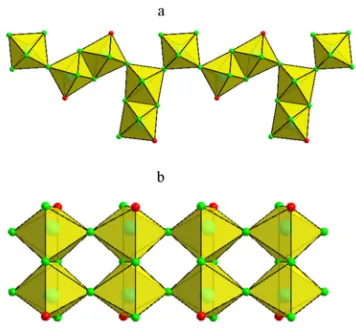
the alternating edge and corner shared octahedra found in [H2pipz][V3O3F20]·2H2O47
(Figure 1-13(a)) and in [H2dpe][V2O2F6]61 (Figure 1-13(b)) displaying a ladder-like
type structure, where two octahedra share an edge to form the rung of the ladder, and
[image:41.595.222.400.499.663.2]are further connectedviathe corners to form therailof the ladder.
A beautiful structure in vanadium based systems displaying an unusual chain type was
reported for [H2pipz][V7F27].62 The structure can be regarded as a construction of
heptameric pyrochlore-like units that are further linked through bridging F atoms into
an infinite chain along thec-axis as illustrated in Figure 1-14.
Figure 1-14.Chain type found in [H2pipz][V7F27]62displaying pyrochlore-like
heptameric unit.
The inorganic chains are separated by piperazinium moieties as shown in Figure 1-15.
This structure is based on a triangular motif, and potentially can present interesting
magnetic properties (e.g. magnetic frustration) and can be compared with KCrF4.63
Although [H2pipz][V7F27] and KCrF4 are both based on triangular motifs, they present
different connection modes, as illustrated in Figure 1-16. In [H2pipz][V7F27] two
triangular motifs are connected to other two through a monomeric unit to form an
alternating trimeric and monomeric chain in a 3-3-1 configuration (Figure 1-16(a)).
However the chain KCrF4can be considered as a trimeric chain formed by repeating the
[image:43.595.106.531.300.573.2]triangular motif in 3-3-3 configuration (Figure 1-16(b)).
Figure 1-16.(a) The 3-3-1 configuration found in [H2pipz][V7F27] (top left) and a
projection down thecaxis (top right), (b) The 3-3-3 configuration found in KCrF4
KCrF4 is known to display magnetic frustration, however in [H2pipz][V7F27], and as
stated by the authors, the magnetic data were inconclusive. Although the material did
not show any magnetic transition down to the lowest measured temperature, there was
no clear evidence to prove if the material is a frustrated magnet.
1-4-3-3. Two-dimensional frameworks
Although some structures displaying two-dimensionality were reported for transition
metal fluorides, it was noted that layer structures are more frequently observed in main
group metals (Al), lanthanides and actinides.53
The 2D arrangement can be made by the polyhedra sharing a corner, edge or
simultaneously a corner and an edge. Several existing examples can be described as the
association of units displaying definite known shapes. For example, the layer in
[H2en][Sc2F8]64 is formed from the connection of “bow-tie” shaped units as shown in
Figure 1-17. Very recently a Ti based system featuring the same structural motif was
reported.65
The structure of [H2pipz][Mn4F16]66 shown in Figure 1-18 contains layers separated by
piperazinium cations. This structure can be described as the association of edge shared
dimeric units to form continuous layers. The layer is shown in Figure1-19.
Figure 1-18.Layers found in [H2pipz][Mn4F16]66separated by piperazium moieties
viewed down thebaxis.
Very recently an interesting vanadium (oxy)fluoride material was reported,
[H2pipz]3[V4F17O]·1.5H2O,67 displaying a 2D structure that can be regarded as the
association of “Y shaped” units (see Figure 1-20 ). The most interesting point about this
material is it shows direct relation to the tetrameric Y shaped structure
[H2pipz]4[V4O3F17]·4H2O47 and the chain structure based on Y shaped tetramers
[H2pipz][V3O3F20]·2H2O.
Figure 1-20. Layers found in [H2pipz]3[V4F17O]·1.5H2O67, the red circle shows how
the Y shaped unit is connected to its three neighbouring.
1-4-3-4. Three-dimensional frameworks
Organically-templated metal fluorides with extended 3D connectivities are fairly rare.
Many examples have been reported, all of them concerned metals with high
As an example, the U based framework [H2pipz][U2O4F6],68 is shown in Figure 1-21.
The 3D structure is constructed from corner- and edge-sharing anionic uranium
pentagonal bipyramids [UO2F5]–, and charge balance is maintained by piperazinium
cations. This structure contains three intersecting channels consisting of 10-, 8- and
6-membered rings, as respectively shown in Figure 1-21 and Figure 1-22.
[image:47.595.148.479.214.432.2]Figure 1-21.A view of [H2pipz][U2O4F6],68showing the 10-membered ring.
Figure 1-22.A view of [H2pipz][U2O4F6],68showing the 8-membered ring (left) and the
Another example is [H2dap]0.5[Y3F10]69 displaying a 3D connected framework. The
structure of [H2dap]0.5[Y3F10] is presented in Figure 1-23 and may be described as a
‘Super-Diamond’ network arising from the cubic arrangement of Y6F32SBUs, shown in
[image:48.595.242.396.466.622.2]Figure 1-24.
Figure 1.23.Polyhedra representation of the [Y3F10] framework in [H2dap]0.5[Y3F10].69
1-4-4. Synthesis aspects: synthesis methods, solvent, template
The most commonly used route to the synthesis of organically-templated metal
(oxy)fluorides is hydrothermal synthesis.70 This involves mixing the reagents in water
in the presence of an organic template then heating the resulting solution at the required
temperature (< 300 °C) in an autoclave at autogenous pressure (> 1 bar). Other
synthetic procedures,i.e., crystallisation from solution has been used for the preparation
of organically-templated metal fluorides. Most of the materials synthesised this way
consist of isolated [MF6] octahedra units, with very few extended-connectivity
lattices.51Solid state reactions and gas-solid reactions have been also widely used in the
synthesis of purely inorganic fluorides such : Li3AlF6, Li4ZrF8.40
1-4-4-1. Solvent
Water remains the prefered solvent used in the preparation of organically-templated
metal (oxy)fluorides, hence the term “hydrothermal synthesis”, where in many cases
it not only acts as a solvent, but it is actually a reactant and can appear in the final
structure as a coordinating ligand55 or as space filling71 where it plays a role in
stabilising the whole structure by providing H-bonding to the inorganic framework.
In many cases a mixture of water and other organic co-solvents such as ethanol,
ethylene glycol, pyridine, etc. has also been used (solvothermal synthesis). To date,
the role that the co-solvent plays in the reaction has not been assessed, and it is not
clear if it acts only as a diluent and heat transfer medium or if it can play other
positive roles even though in the synthesis of organically-templated vanadium
reduction of vanadium.55 It is worth noting that some ILs have been used as a
solvent and/or as a fluoride source for the synthesis of some known metal fluorides
but never organically-templated metal (oxy)fluorides.20,72-75 One example is the
synthesis of YF3 with different phases and morphologies depending on the ratio
IL/metal, using 1-butyl-3-methylimidazolium tetrafluoroborate, BMIM BF4, in
H2O.75 Another example is the synthesis of β–NH4AlF420 using
1-ethyl-3-methylimidazolium hexafluorophosphate, EMIM PF6.
1-4-4-2. Template
Templating can be broadly defined as the use of small organic molecules (or hydrated
metal ions) to provide a support about which an inorganic host may crystallise. In
general, template molecules may serve several different functions, including framework
support and/or charge balance to their hosts. To date, quaternary ammonium cations
and a wide range of organic amines have been used as a template for the synthesis of
metal (oxy)fluorides. In addition to taking the role of charge balancing to the inorganic
frameworks, these play a significant role in structure crystallisation, as a wide range of
anionic frameworks with different topologies and dimensionalities have been
synthesised within the same system simply by changing the organic amine. One
example of this can be found in the thorium based systems76 where two
organically-templated thorium compounds were synthesised under exactly the same conditions
(temperature, time, reactant stoichiometry and solvent) just varying the organic
template; the use of piperazine afforded a 2D material [C4N2H12]0.5[ThF5], while the use
of 2-methylpiperazine resulted in a 1D face shared chain [C5N2H14][ThF6]·0.5H2O. The
Figure 1-25.(a) Layers found in [C4N2H12]0.5[ThF5], (b) Chains found in
[C5N2H14][ThF6]·0.5H2O.
1-4-4-3. Reactions variables and mechanism
As mentioned earlier, in relatively recent years, hydrothermal synthesis has been
shown to be a powerful technique for the synthesis of organically-templated metal
(oxy)fluorides. Several groups now are carring out extensive research in this domain
and exploring different systems: Albrecht-Schmitt, O’Hare, Weller, Maisonneuve
and Lightfoot have developed the corresponding zirconium,77 uranium,78
beryllium,79 aluminium,80,81 rare earth,64,69 early transition metal62,82 and indium83
explored organically-templated metal fluorides as part of their research work.67 This
has resulted in different compounds displaying an astonishingly diverse range of
structural topologies and novel polyhedral connectivities. It was observed in
general, that the synthesis is very sensitive to various reaction conditions, including
reagents, pH, water content, organic template, solvent, time, temperature, and even
the fill of the autoclave. The chemistry that occurs in such systems is very
complicated, making any clear understanding of how these materials form difficult,
and it is almost impossible to design or engineer a new material with particular
structural features for specific properties. Although it was suggested that it is
through the condensation of the PBUs (MXn), assumed to pre-exist in solution, that
the extended solid will form, the crystallisation mechanism is not well understood,
and the vast majority of products are unpredictable,.
There have been several attempts to try to identify the mechanism governing the
synthesis of metal (oxy)fluorides. One approach is to identify key reaction variables
and systematically explore their influence. In this context, composition space
diagrams have been developed by varying the reactants composition, while other
variables such as temperature, time and solvent are held constant.71,81,84-86 One
example is found in the Al(OH)3/tren/HFeq/ethanol system58 where different phases
are accessible, ranging from monomers to 1D structures. Another excellent example
that shows the evolution from molecules to frameworks is found in the
UO2(CH3COO)2·2H2O/HFaq/pipzsystem, where three different materials spaning the
range of dimensionalities from 0D through 3D framework have been synthesised by
An alternative approach is to keep all composition variables fixed and vary only an
external parameter. A recent example of this second approach is the focussed study
of the system V2O5/HF/H2O/ethylene glycol/pipz,47 where it has been observed that
there is a clear progression in dimensionality from 0D to 1D structures through a
common type-motif (Y shape tetramer) upon increasing the reaction temperature
(isolated tetramer has been obtained at 100 °C and 1D chain at 160 °C). In the same
system a very recent study shows that a 2D structure displaying the same type-motif
can be isolated under different conditions where the molar ratio HF/pipzand time of
the reaction have been introduced as other variables. This structure can be added to
the previous 0D and 1D structures based on Y shaped units to show the progression
[image:53.595.146.488.378.669.2]from 0D to 2D from the same system with variation of the reaction conditions.
Figure 1-26. Products of the system V2O5/HF/pipz/H2O/ethylene glycol under different
1-5. Lanthanide organic frameworks
1-5-1. Background
Metal-organic frameworks (MOFs), consisting of metal ions coordinated to organic
molecules, are one class of organic-inorganic hybrid materials that have attracted much
attention in recent years due to their potential applications in a wide variety of domains,
most famously in gas adsorption and storage applications.87 Recently, the potential
biological and medical applications of MOFs have also been studied.88 Among these
compounds lanthanide-containing MOFs (Ln-MOF) are of special interest owing to
their unique topological structures and fascinating chemical/physical properties.89
Ln-MOFs have been applied in fields such as gas adsorption, luminescence, magnetism and
catalytic activity. Therefore, many spectacular Ln-MOFs have been well documented
recently.90-93
The higher coordination number of lanthanide ions and the more variable nature of their
coordination sphere can induce a versatile structural topology. In particular the
structural chemistry of metal carboxylates is quite fascinating, due to the flexibility of
the carboxylate groups to adopt different coordination modes. Compared with N-donor
ligands, which are intrinsically mono-dentate, carboxylic groups are more complex and
less predictable for the framework formation. They have flexible binding behaviour
from monodentate and chelating to multi-bridging.
eight-coordinate. One example can be found in the system
europium/propane-1,2,3-tricarboxylic acid, Eu(tca)(H2O)3·nH2O,94 (Figure 1-27) the Eu ion is nine-coordinated
by six oxygens from carboxylic acid and three oxygens from the coordinated water
molecules. Each carboxylate group in the tca ligand is chelating (bidentate) as shown in
Figure 1-27.
Figure 1-27.Structure of Eu(tca)(H2O)3·nH2O94(left), coordination environment of the
Eu ion and coordination behaviour of the tca (right).
However a low coordination number (six-coordinate) was reported for: (Ln(C6H9O6):
Ln = Er3+, Tb3+).95The structure of Er(C6H9O6), as shown in Figure 1-28, consists of a
single Er3+ metal centre in an octahedral geometry, connected through
1,3,5-cyclohexanetricarboxylate, CTA, ligand into a 3D framework. In this material each
carboxylate group of the 1,3,5-CTA exhibits a bridging bidentate connectivity. It was
Figure 1-28.Structure of Er(C6O9H9) (left), the coordination environment of the metal
centre and connectivity behaviour of 1,3,5-CTA (right).
Lanthanide ions have a strong tendency to form extended inorganic skeletons in the
presence of suitable organic linkers, this may generate robust frameworks incorporating
a 1D or a 2D inorganic network. MIL-6396 and MIL-7897 are good examples. MIL-63,
(Eu3(H2O)(OH)6[C6H3(CO2)3)]·3H2O, is a 3D porous material obtained using trimesic
acid as a ligand, the framework is built up from nine-coordinated Eu3+ and trimesate
ions. This structure is made from a two-dimensional europium inorganic network
connectedvia the carboxylates into a 3D framework. MIL-78 (M(C6H3(CO2)3), M = Y,
Ln) exhibits a 3D framework constructed from eight-coordinated lanthanide ions and
trimesate ions. Unlike MIL-63, this material possesses a one-dimensional inorganic
chains connectedviathe carboxylates ions creating a 3D open framework. The structure
of MIL-78 along with the inorganic chains found in the structure and the coordination
Figure 1-29.The inorganic framework found in MIL-78 (top), a view of MIL-78 along theaaxis (below left) and the coordination behaviour for trimesic acid (below right).
1-5-2. Synthesis of Ln-MOFs
Ln-MOFs are synthesised in a similar way as any other MOF, typically via
hydrothermal synthesis in which all chemicals (metal source and an organic linker) are
placed into a Teflon-lined autoclave using water as a solvent, and heated statically
under autogenous pressure. Alternatively other solvents may be used: ethanol, THF,
DMF, hexane, pyridine, or a mix (or mixed with water), more appropriately called
“solvothermal synthesis”.
The use of an additional organic template or SDA in MOFs is not very popular as it is in
the case of the synthesis of zeolites and zeotypes. However SDAs may be used in
1-6. References
(1) Cooper, E. R.; Andrews, C. D.; Wheatley, P. S.; Webb, P. B.; Wormald,
P.; Morris, R. E.Nature2004,430, 1012.
(2) Wasserscheid, P.; Welton, T. Ionic liquids in synthesis; Wiley-VCH:
Weinbeim, 2003.
(3) Wilkes, J. S.Green Chem.2002,4, 73.
(4) Freemantle, M. An Introduction to Ionic Liquids; RSC Publishing:
Cambridge, 2010.
(5) Wilkes, J. S.; Zaworotko, M. J. J. Chem. Soc., Chem. Commun. 1992,
965.
(6) Bonhote, P.; Dias, A.P.; Papageorgiou, N.; Kalyanasundaram, K.;
Gratzel, M.Inorg. Chem.1996,35, 1168.
(7) Visser, A. E.; Swatloski, R. P.; Reichert, W. M.; Mayton, R.; Sheff, S.;
Wierzbicki, A.; Davis, J. J. H.; Rogers, R. D. Chem. Commun. 2001,
135.
(8) Himmler, S.; Hormann, S.; van Hal, R.; Schulz, P. S.; Wasserscheid, P.
Green Chem.2006,8, 887.
(9) Clavier, H.; Boulanger, L.; Audic, N.; Toupet, L.; Mauduit, M.;
Guillemin, J.-C.Chem. Commun.2004, 1224.
(10) Fukumoto, K.; Yoshizawa, M.; Ohno, H. J. Am. Chem. Soc. 2005,127,
2398.
(11) Tokuda, H.; Hayamizu, K.; Ishii, K.; Susan, M. A. B. H.; Watanabe, M.
J. Phy. Chem. B2004,108, 16593.
Watanabe, M.J. Phy. Chem. B2006,110, 2833.
(13) Holbrey, J. D.; Reichert, W. M.; Swatloski, R. P.; Broker, G. A.; Pitner,
W. R.; Seddon, K. R.; Rogers, R. D.Green Chem.2002,4, 407.
(14) Earle, M. J.; Esperanca, J. M. S. S.; Gilea, M. A.; Canongia Lopes, J. N.;
Rebelo, L. P. N.; Magee, J. W.; Seddon, K. R.; Widegren, J. A. Nature
2006,439, 831.
(15) Abbott, A. P.; Boothby, D.; Capper, G.; Davies, D. L.; Rasheed, R. K. J.
Am. Chem. Soc.2004,126, 9142.
(16) Abbott, A. P.; Capper, G.; Davies, D. L.; Rasheed, R. K.; Tambyrajah, V.
Chem. Commun.2003, 70.
(17) Parnham, E. R.; Morris, R. E.J. Mater. Chem.2006,16, 3682.
(18) Parnham, E. R.; Morris, R. E.Chem. Mater.2006,18, 4882.
(19) Parnham, E. R.; Morris, R. E.J. Am. Chem. Soc.2006,128, 2204.
(20) Parnham, E. R.; Slawin, A. M. Z.; Morris, R. E. J. Solid State Chem.
2007,180, 49.
(21) Parnham, E. R.; Wheatley, P. S.; Morris, R. E. Chem. Commun. 2006,
380.
(22) Liao, J.-H.; Wu, P.-C.; Bai, Y.-H.Inorg. Chem. Commun.2005,8, 390.
(23) Lin, Z.; Slawin, A. M. Z.; Morris, R. E. J. Am. Chem. Soc. 2007, 129,
4880.
(24) Lin, Z.; Wragg, D. S.; Morris, R. E.Chem. Commun.2006, 2021.
(25) Lin, Z.; Wragg, D. S.; Warren, J. E.; Morris, R. E. J. Am. Chem. Soc.
2007,129, 10334.
(26) Xie, Z.-L.; White, R. J.; Weber, J.; Taubert, A.; Titirici, M. M.J. Mater.
(27) Morris, R. E.Chem. Commun.2009, 2990.
(28) Parnham, E. R.; Morris, R. E.Acc. Chem. Res.2007,40, 1005.
(29) Morris, R. E.Angew. Chem. Int. Ed.2008,47, 442.
(30) Taubert, A.; Li, Z.Dalton Trans.2007, 723.
(31) Wragg, D. S.; Slawin, A. M. Z.; Morris, R. E. Solid State Sci.2009, 11,
411.
(32) Drylie, E. A.; Wragg, D. S.; Parnham, E. R.; Wheatley, P. S.; Slawin, A.
M. Z.; Warren, J. E.; Morris, R. E. Angew. Chem. Int. Ed. 2007, 119,
7985.
(33) Jin, K.; Huang, X.; Pang, L.; Li, J.; Appel, A.; Wherland, S. Chem.
Commun.2002, 2872.
(34) Parnham, E. R.; Drylie, E. A.; Wheatley, P. S.; Slawin, A. M. Z.; Morris,
R. E. Angew. Chem. Int. Ed.2006,45, 4962.
(35) Sheu, C.-Y.; Lee, S.-F.; Lii, K.-H.Inorg. Chem.2006,45, 1891.
(36) Wragg, D. S.; Fullerton, G. M.; Byrne, P. J.; Slawin, A. M. Z.; Warren, J.
E.; Teat, S. J.; Morris, R. E.Dalton Trans. 2011,40, 4926.
(37) Wei, Y.; Tian, Z.; Gies, H.; Xu, R.; Ma, H.; Pei, R.; Zhang, W.; Xu, Y.;
Wang, L.; Li, K.; Wang, B.; Wen, G.; Lin, L. Angew. Chem. Int. Ed.
2010,49, 5367.
(38) Recham, N.; Chotard, J. N.; Jumas, J. C.; Laffont, L.; Armand, M.;
Tarascon, J. M.Chem. Mater.2009,22, 1142.
(39) Xing, H.; Yang, W.; Su, T.; Li, Y.; Xu, J.; Nakano, T.; Yu, J.; Xu, R.
Angew. Chem. Int. Ed.2010,49, 2328.
(40) Hagenmuller, P. Inorganic solid fluorides; Academic Press: London,
(41) Flaningen, E. M.; Patton, R. L. U. S. Patent 4073864, 1978.
(42) Ouellette, W.; Yu, M. H.; O'Connor, C. J.; Zubieta, J.Inorg. Chem.2006,
45, 7628.
(43) Rao, C. N. R.; Behera, J. N.; Dan, M.Chem. Soc. Rev.2006,35, 375.
(44) Maggard, P. A.; Kopf, A. L.; Stern, C. L.; Poeppelmeier, K. R.; Ok, K.
M.; Halasyamani, P. S.Inorg. Chem.2002,41, 4852.
(45) Marvel, M. R.; Lesage, J.; Baek, J.; Halasyamani, P. S.; Stern, C. L.;
Poeppelmeier, K. R.J. Am. Chem. Soc.2007,129, 13963.
(46) Stephens, N. F.; Buck, M.; Lightfoot, P.J. Mater. Chem.2005,15, 4298.
(47) Aldous, D. W.; Stephens, N. F.; Lightfoot, P.Dalton Trans.2007, 4207.
(48) Halasyamani, P. S.; Poeppelmeier, K. R.Chem. Mater.1998,10, 2753.
(49) Nakajima,T.; Žemva, B.; Tressaud, A. Advanced Inorganic Fluorides,
Synthesis, Characterisation and Applications;Elsevier: Lausanne, 2000.
(50) Tressaud, A. Functionalized Inorganic Fluorides: Synthesis,
Characterization and Properties of Nanostructured Solids; Wiley: New
York, 2010.
(51) Bentrup, U.; Feist, M.; Kemnitz, E. Prog. Solid State Chem. 1999, 27,
75.
(52) Massa, W.; Babel, D.Chem. Rev.1988,88, 275.
(53) Adil, K.; Leblanc, M.; Maisonneuve, V.; Lightfoot, P. Dalton. Trans.
2010,39, 5983.
(54) Hilbers, M.; Leimkuhler, M.; Mattes, R. Z. Naturforschung. B - Chem.
Sci1989,44, 383.
(55) Aldous, D. W.; Stephens, N. F.; Lightfoot, P.Dalton Trans.2007, 2271.

![Figure 1-6.246 The centrosymmetric [Hpipz][VOF4(H2O)]47(left) and the polar](https://thumb-us.123doks.com/thumbv2/123dok_us/8708816.382698/36.595.155.477.366.573/figure-centrosymmetric-hpipz-vof-h-o-left-polar.webp)
![Figure 1-9. Square tetramer found in [H3tren]2[V4O4F14]·3H2O.55](https://thumb-us.123doks.com/thumbv2/123dok_us/8708816.382698/38.595.232.393.71.220/figure-square-tetramer-found-in-h-tren-v.webp)
![Figure 1-10. (a) Tetramer found in [H 2pipz]4[V4O3F17]·4H2O,47(b) tetramer found55](https://thumb-us.123doks.com/thumbv2/123dok_us/8708816.382698/39.595.108.460.379.592/figure-tetramer-found-pipz-v-o-tetramer-found.webp)
![Figure 1-11. Octameric units found in [(H3tren)4][(Al8F35)·(OH)·H2O].58](https://thumb-us.123doks.com/thumbv2/123dok_us/8708816.382698/40.595.251.394.539.667/figure-octameric-units-found-in-tren-al-oh.webp)
![Figure 1-16. (a) The 3-3-1 configuration found in [Hprojection down the2pipz][V7F27] (top left) and a c axis (top right), (b) The 3-3-3 configuration found in KCrF4(bottom left) and a projection down the c axis (bottom right).](https://thumb-us.123doks.com/thumbv2/123dok_us/8708816.382698/43.595.106.531.300.573/figure-configuration-hprojection-right-configuration-kcrf-projection-right.webp)
![Figure 1-22. A view of [H 2pipz][U2O4F6],68showing the 8-membered ring (left) and the6-membered ring (right).](https://thumb-us.123doks.com/thumbv2/123dok_us/8708816.382698/47.595.148.479.214.432/figure-view-pipz-showing-membered-ring-membered-right.webp)
![Figure 1.23. Polyhedra representation of the [Y3F10] framework in [H2dap]0.5[Y3F10].69](https://thumb-us.123doks.com/thumbv2/123dok_us/8708816.382698/48.595.242.396.466.622/figure-polyhedra-representation-of-the-y-framework-dap.webp)
