A Study of Compensation Problem for Uncertainty
of Quality in Supply Chain
Yasuhiko Takemoto, Ikuo Arizono
Abstract—The uncertainty of demand occurs at a down-stream side and spreads over an updown-stream side in a supply chain. To the contrary, the uncertainty of supply occurs at an upstream side and spreads over an downstream side in a supply chain. The quality of items is particularly important as a factor in the uncertainty. Imperfect quality items included in the procurement from a supplier brings the uncertainty of supply, that is, whether imperfect quality items are included or not, or how many imperfect quality items are included. An intangible loss due to the uncertainty of imperfect quality items is unavoidable even if the downstream side (taht is, a manufacrurer or retailer) prevented all imperfect quality items from being distributed to customers and society by perfect inspection. Therefore, in this paper, we consider the impact of the uncertainty of imperfect quality items in the situation that the imperfect quality items included in the procurement from the supplier are perfectly retrieved in the downstream side. In particular, the impact of the uncertainty of imperfect quality items is evaluated as an object of a monetary compensation. Hence, we propose a condition of the monetary compensation to maintain supply chain partnarship. Through some numerical examples, the condition of the monetary compensation for the uncertanty of imperfect quality items is illustrated.
Index Terms—compensation, coordination, incentive compat-ible condition, newsvendor model,
I. INTRODUCTION
I
N common production and inventory systems, the uncer-tainty about demand of customers exists. In particular, the spread of the uncertainty about the demand in a supply chain is well known as the bullwhip effect [1]. The uncertainty of demand occurs at a downstream side in a supply chain. Then, the uncertainty of demand spreads over an upstream side in a supply chain. To the contrary, the uncertainty of supply occurs at an upstream side and spreads over a down-stream side. The quality of items is particularly important as a factor in the uncertainty. In many researches regarding production and inventory systems, it has been assumed that the quality of items received from a supplier are perfect. However, imperfect quality items are sometimes included in the procurement to a manufacturer or retailer as some results of imperfect production and inspection by a supplier and damage in transport.The impact of imperfect quality items on customers and society is by no means trivial. It is also known that quality has a great impact on a reputation and customer confidence.
Manuscript received Nov 28, 2017; revised Jan 12, 2018. This work was supported by Japan Society for the Promotion of Science (JSPS) KAKENHI Grant Number 26350433: “The rationalization and optimization of distribu-tion systems based on mechanism design in supply chain environments” and Grant Number 17K01266: “The investigation of data visualization and its application to production and operation management”.
Y. Takemoto is with the Fucalty of Science and Engineering, Kindai University, 577-8502 Osaka, JAPAN (e-mail:[email protected]). I. Arizono is with the Graduate School of Natural Science and Technology, Okayama University, 700-8530 Okayama, JAPAN (e-mail:[email protected]).
Theerefore, the compensation for imperfect quality items to customers and society has to be made. Then, the cost allocation problems regarding the compensation between supply chain members have been considered until now, such as Gao et al.[2]. On one hand, imperfect quality items included in the procurement brings the uncertainty of supply. That is, it is unknown whether imperfect quality items are included or not, or how many imperfect quality items are included. As mentioned above, the uncertainty of supply occuring at an upstream side spreads over a downstream side. That is, a manufacturer or retailer suffers intangible loss due to the uncertainty of containing imperfect quality items in the procurement from a supplier in addition to physical and mental losses due to imperfect quality items themselves. Note that the mental loss due to imperfect quality items in this paper means damage due to a reputation and customer confidence. Even if the manufacturer or retailer prevented all imperfect quality items from being distributed to customers and society by perfect inspection, the intangible loss due to the uncertainty of imperfect quality items is unavoidable.
In this paper, we consider the impact of the uncertainty of containing imperfect quality items in the procurement from a supplier in a supply chain composed of a supplier and a retailer. In particular, we investigate the case where the imperfect quality items included in the procurement from the supplier are perfectly retrieved in the retailer. In this case, we evaluate exactly the impact of the uncertainty of imperfect quality items as a monetary loss. Then, a monetary compensation is calculated in the viewpoint of the uncertanty of imperfect quality items. Further, we propose a condition of the monetary compensation to maintain supply chain partnarship. Through some numerical examples, the condition of the monetary compensation for the uncertanty of imperfect quality items is illustrated.
II. LITERATURE REVIEW
[8], Eloglu and Ozdemir [9], Khan et al. [10], and Hsu and Hsu [11], [12].
Since the 21th century, supply chain models have been frequently considered in the production and inventory man-agement. The objective of the studies based on a supply chain model is to actualize the cooperation between a supplier and a retailer or manufacturer. Some methods for the joint determination of a supplier and a manufacturer or retailer have been proposed. For example, Huang [13], [14] has extended the model in Salameh and Jaber [7] to present an integrated inventory policy for supply chain members where the supplier incurs a warranty cost for the imperfect quality items. In his models, the quantity of procurement to minimize the total annual cost consisting of respective cost functions in the supply chain members has been found. Khan and Jaber [15] have proposed a three level supply chain model by extending the model in Salameh and Jaber [7] where a penalty cost arises in the case that the fraction of imperfect quality items goes beyond a prescribed value.
Also, Chao et al. [16] first have introduced a partial allocation contract between a supplier and a manufacturer for allocating the penalty against selling imperfect quality items to the customers. Gao et al. [2] have shown that the partial cost allocation contract coordinates the quality improvement efforts of a supplier and a manufacturer. Also, Lee et al. [17] have proposed the quality compensation contract in which a supplier compensates a manufacturer for imperfect quality items inadvertently sold to customers. Their study have offered for the first time as an incentive scheme in a supply chain the quality compensation contract that has been long employed for quality control in numerous industries [17]. This study considers the impact of the uncertainty of containing imperfect quality items on the downstream side. And then, a monetary compensation is discussed in the viewpoint of the uncertanty of imperfect quality items for the first time as long as we have investigated.
III. MODEL FORMULATION
In this section, we formulate a model with imperfect quality items on a supply chain consisting of a supplier and a retailer. The notations in this paper are as follows:
r : retail price at retailer. w : wholesale price at supplier. c : original cost at supplier.
s : salvage value for unsold items at retailer. q : order quantity of retailer.
d : demand to retailer.
p : probability of being imperfect quality items. n : number of imperfect quality items included in
procurement.
Then following assumptions are considered:
− The demand dis an integer number and a discrete ran-dom variable. In association with it, the order quantityq is also an integer number and then a decision variable.
− The number of imperfect quality items n follows a binomial distibution withq andp.
− The salvage value for unsold items at the retailer s is less than the wholesale price at the supplierw.
− All imperfect quality items included in the procurement are discovered and removed at the retailer’s side.
− In section III, all imperfect quality items discovered by the retailer are returned to the supplier while the wholesale price w is refunded to the retailer for every imperfect quality item, namely, full price refund policy. At first, the supply chain model consisting of a supplier and a retailer is formulated in the situation that imperfect quality items are not included at all in the procurement, that is, p = 0. The expected profit function of the retailer is defined as the following equation:
ΠR0(q) = q ∑
d=0
{rd−wq+s(q−d)}Pr{D=d}
+
∞
∑
d=q+1
(r−w)qPr{D=d}
= (r−w)q−(r−s)E[(q−d)+], (1) where z+ = max{0, z} and E[x] means the expectation
of random variable x. Also, D means random variables expressing demand. Then, the expected profit function of the supplier in the situation that imperfect quality items are not included at all in the procurement is given as follows:
ΠS0(q) = (w−c)q. (2)
Next, the supply chain model consisting of a supplier and a retailer is formulated in the situation that some imper-fect quality items are included in the procurement. In this situation, we assume that all discovered imperfect quality items are returned to the supplier while the wholesale price w per imperfect quality item is refunded to the retailer. The expected profit function of the retailer is defined as the following equation:
ΠRp (q) = q ∑
n=0 q∑−n d=0
{rd−w(q−n) +s(q−n−d)}
×Pr{D=d}Pr{N =n}
+ q ∑
n=0
∞
∑
d=q−n+1
(r−w)(q−n) Pr{D=d}
×Pr{N =n}
= (r−w)(1−p)q−(r−s)E[(q−n−d)+],(3) whereN means random variable expressing the number of imperfect quality items in the order quantity q. Then, the expected profit function of the supplier in the situation that it is possible that some imperfect quality items are included in the procurement is given as follows:
ΠSp(q) = w(1−p)q−cq. (4)
Note that eqs.(3) and (4) are respectively reduced to eqs.(1) and (2) whenp= 0.
From eq.(3), the following proposition is obtained:
Proposition 1:
The expected profit function of the retailerΠR p (q)
is concave in q for any p. Therefore, an order quantity as maximizesΠR
p (q)is existent uniquely.
Such an order quantity as maximizes ΠRp (q) is
is obtained for any p, where q0∗ means the order quantity maximizingΠR
p (q)underp= 0.
The proof of proposition 1 is shown in appendix A. When the existence of imperfect quality items in the procurement is anticipated, the optimal order quantity becomes larger than that of the situation where imperfect quality items is not included at all in the procurement. This feature is corresponding to an intuitive standpoint.
Further, we have the following proposition.
Proposition 2:
The relationship of ΠR0(q0∗)≥ΠRp(q∗p) ≥ΠRp(q∗0)
is satisfied for any p.
The proof of proposition 2 is shown in appendix B. All imperfect quality items discovered by the retailer are returned to the supplier according to the full price refund policy. Hence, the retailer is compensated for the direct damage from imperfect quality items themselves with the full price refunds. However, the relationship of ΠR
0 (q0∗) ≥ ΠRp (
q∗p) has been derived as shown in proposition 2. It can be understood that this reduction (ΠR
0 (q0∗)−ΠRp (
qp∗)) of the expected profit in the retailer is caused by the uncertainty about the existence of imperfect quality items. From this fact, we find that although the retailer should chooseq∗p(≥q0∗)as the order quantity from the reason that it is possible that some imperfect quality items are included in the procurement, the retailer would have some extra stocks if imperfect quality items were less included or not at all. That is, it means that the retailer has to bear the cost for holding some extra stocks. Also, the retailer would miss sale opportunity if imperfect quality items were included more than expected. The uncertainty about the existence of imperfect quality items brings some losses not compensated by the full price refund policy to the retailer. The responsibility for the quality of items must be usually taken by the supplier. Also, the optimal policy of the retailer cannot recover those losses completely. Therefore, the wholesale price refunded to the retailer by the supplier is not full compensation for imperfect quality items. In this paper, we consider a compensation for a monetary loss due to the uncertainty of imperfect quality items.
IV. COMPENSATION FOR UNCERTAINTY OF IMPERFECT QUALITY ITEMS
In proposition 1, the impact of the uncertainty of contain-ing imperfect quality items in the procurement on the order quantity has been shown, that is, the optimal order quantity of the situation that the existence of imperfect quality items in the procurement is anticipated becomes larger than that of the situation that imperfect quality items is not included at all in the procurement. Then, the impact of the uncertainty of containing imperfect quality items in the procurement on the expected profit of the retailer has been shown in proposition 2, that is, the reduction of the expected profit in the retailer is caused by the uncertainty about the existence of imperfect quality items.
In the previous setion, it has been assumed that imperfect quality items are returned to the supplier while the wholesale price w is refunded to the retailer, that is, full price refund policy. However, it has been shown that the full price refund policy does not recover the loss in the retailer due to the
impact of the uncertainty of imperfect quality items. On evaluating the impact of the uncertainty of imperfect quality items as a monetary loss, we introduce the compensation fee uper imperfect quality item paid to the retailer, whereuis more than the wholesale pricew.
We assume that all discovered imperfect quality items are returned to the supplier while the compensation feeu(> w)
per imperfect quality item is refunded to the retailer. In this case, the expected profit function of the retailer is defined as the following equation:
ΠRp(q, u) = q ∑
n=0 q∑−n d=0
{rd−wq+s(q−n−d) +un}
×Pr{D=d}Pr{N =n}
+ q ∑
n=0
∞
∑
d=q−n+1
{r(q−n)−wq+un}
×Pr{D=d}Pr{N =n}
= (r−w)(1−p)q−(r−s)E[(q−n−d)+]
+(u−w)pq. (5)
Then, the expected profit function of the supplier is given as follows:
ΠSp(q, u) = w(1−p)q−cq−(u−w)pq. (6)
Note that eqs.(5) and (6) are respectively reduced to eqs.(3) and (4) whenu=w.
From eq.(5), the following proposition is obtained:
Proposition 3
The expected profit function of the retailer
ΠR
p (q, u) is concave inq for any p. Therefor, an
order quantity as maximises ΠR
p (q, u) is existent
uniquely. Such an order quantity as maximizes
ΠR
p (q, u) is defined as qp†. In this case, the
rela-tionship ofqp∗≤qp† is given, whereqp∗is the order
quantity maximizingΠR
p (q)in eq.(3).
The proof of proposition 3 is omitted because the proof is similar to that of proposition 1. From proposition 3, it is found that the risk avoidance by the compensation fee to the retailer makes the order quantity larger. In addition, we see that the fair compensation for imperfect quality items by the supplier can be an incentive to the order of the retailer.
Then, we consider the assessment of the compensation fee for the monetary loss due to the impact of the uncertainty of imperfect quality items. At first, the compensation fee u has to secure the profit of the retailer at least. As mentioned above, the compensation fee can be an incentive to the order of the retailer. Then, the following relationship is considered as the assessmeent of the compensation fee:
ΠRp(q, u)−Π0R(q∗0) ≥ 0. (7) The compensation feeu is decided so as to guarantee that the profit of the retailer,ΠR
p(q, u), is equal to or greater than
the profit of the retailer, ΠR
0(q0∗), in the case that there is
no imperfect quality item. Using eqs.(3) and (5), eq.(7) is transformed into
u ≥ w+Π R
0(q0∗)−Π R p(q)
Eq.(8) indicates the condition of the compensation fee u such that the expected profit of the retailer becomes equal to or greater than that of the retailer in the case that there is no imperfect quality item for a given q. That is, the lower bound of the compensation fee for the monetary loss of the uncetainty of imperfect quality items has been shown.
One the other hand, the monetary compensation for the impact of the uncetainty of imperfect quality items is con-sidered from the viewpoint of the supplier. The profit of the supplier is decreased by the payment of the conpensation fee. On one hand, it is expected that the compensation increases the profit of the supplier because the compensation fee can be an incentive to the order of the retailer. Hence, it is desirable to satisfy the following relationship on the assessmeent of the compensation fee :
ΠSp(q, u)−Π0S(q0∗) ≥ 0. (9) The compensation fee can be decided so as to maintain that the profit of supplier ΠS
p(q, u) is equal to or greater
than the profit of supplier, ΠS0(q0∗), in the case that there is
no imperfect quality item. Using eqs.(2) and (6), eq.(9) is transformed into
u ≤ w−c p
(
1−q
∗
0
q
)
. (10)
Eq.(10) indicates the condition of the compensation fee u such that the expected profit of the supplier becomes equal to or greater than that of the supplier in the case that there is no imperfect quality item for a givenq. That is, the upper bound of the compensation fee desirable to the supplier can be considered.
As the results, we have obtained the following relationship about the compensation fee:
w+Π R
0(q0∗)−ΠRp(q)
pq ≤u≤ w−c
p
(
1−q
∗
0
q
)
. (11)
This condition is called the incentive compatible condition for compensation in this paper.
Then, some numerical examples about eqs.(7)-(11) are illustrated. The parameters about revenue and expense are given as follows:
r= 200.0, w= 125.0, c= 75.0, s= 25.0. Then, the demand distribution is assumed to be a discrete symmetrical triangle distribution with the range (400,600), where the mean and standard deviation are respectively given as 500.0 and 40.8. In this case, the optimal order quantity and respective expected profits of the supplier and retailer in the situation that there is no imperfect quality item in the procurement are obtained as follows:
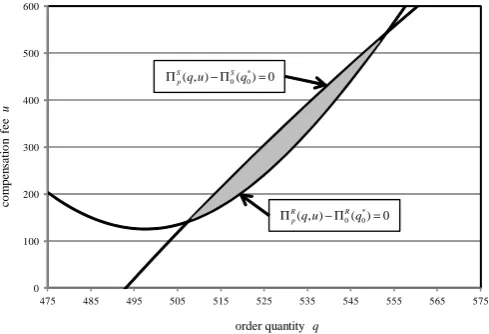
q0∗= 493, ΠR0(q∗0) = 34629.2, ΠS0(q0∗) = 24650.0. Figs.1 and 2 show the result of eqs.(8) and (10) when p = 0.010 and p = 0.025, respectively. In Fig.1, the conpensation feeuis assessed higher as the order quantity of the retailer is larger. When the order quantity of the retailer is larger, it is expected that the impact of the uncetainty of imperfect quality items is significant. On one hand, the profit of the supplier increases when the order quantity of the retailer is large. Hence, the expensive compensation fee can be offered by the supplier. The gray area indicates the
0 100 200 300 400 500 600
475 485 495 505 515 525 535 545 555 565 575
co
m
p
en
sa
ti
o
n
fe
e
u
order quantity q *
0 0
( , ) ( ) 0
S S
pq u q
Π − Π =
* 0 0
( , ) ( ) 0
R R
pq u q
[image:4.595.304.549.55.222.2]Π − Π =
Fig. 1. the relationship of eqs.(8) and (10) whenp= 0.010
0 100 200 300 400 500 600
475 485 495 505 515 525 535 545 555 565 575
co
m
p
en
sa
ti
o
n
f
ee
u
order quantity q * 0 0
( , ) ( ) 0
R R
pq u q
Π − Π =
* 0 0
( , ) ( ) 0
S S
pq u q
[image:4.595.306.548.275.442.2]Π − Π =
Fig. 2. the relationship of eqs.(8) and (10) whenp= 0.025
incentive compatible condition for compensation satisfying eq.(11). In this case, the suppiler can secures the profit himself in addition to compensating the retailer for the mon-etary loss due to the impact of the uncertainty of imperfect quality items. On the other hand, there is no area satisfying eq.(11) in Fig.2. Whenp= 0.025, there are many imperfect quality items in the procurement. The supplier has a large payment due to the compensation for imperfect quality items. Then, the suppiler cannot secures the profit himself when compensating the retailer for the monetary loss due to the impact of the uncertainty of imperfect quality items. From the viewpoint of the uncertainty of imperfect quality items, the importance of quality can be reconfirmed.
Further, supply chain coordination in this model is con-sidered. The coordination approach is well known as one of solutions in supply chain contract problems [18], [19]. At first, we apply the coordination approach to the model with the compensation for imperfect quality items in this paper. On applying the coordination approach, we define the total expected profit of the supplier and retailer as follows:
ΠRp+S(q, u) = ΠpR(q, u) + ΠSp(q, u)
000000000000000000000000000000000000000000000000000000000000000000000000000000000000000000000000000000000000000000000000000000000000000000000000000000000000000000000000000000000 000000000000000000000000000000000000000000000000000000000000000000000000000000000000000000000000000000000000000000000000000000000000000000000000000000000000000000000000000000000 000000000000000000000000000000000000000000000000000000000000000000000000000000000000000000000000000000000000000000000000000000000000000000000000000000000000000000000000000000000 000000000000000000000000000000000000000000000000000000000000000000000000000000000000000000000000000000000000000000000000000000000000000000000000000000000000000000000000000000000 000000000000000000000000000000000000000000000000000000000000000000000000000000000000000000000000000000000000000000000000000000000000000000000000000000000000000000000000000000000 000000000000000000000000000000000000000000000000000000000000000000000000000000000000000000000000000000000000000000000000000000000000000000000000000000000000000000000000000000000 000000000000000000000000000000000000000000000000000000000000000000000000000000000000000000000000000000000000000000000000000000000000000000000000000000000000000000000000000000000 000000000000000000000000000000000000000000000000000000000000000000000000000000000000000000000000000000000000000000000000000000000000000000000000000000000000000000000000000000000 000000000000000000000000000000000000000000000000000000000000000000000000000000000000000000000000000000000000000000000000000000000000000000000000000000000000000000000000000000000 000000000000000000000000000000000000000000000000000000000000000000000000000000000000000000000000000000000000000000000000000000000000000000000000000000000000000000000000000000000 000000000000000000000000000000000000000000000000000000000000000000000000000000000000000000000000000000000000000000000000000000000000000000000000000000000000000000000000000000000 000000000000000000000000000000000000000000000000000000000000000000000000000000000000000000000000000000000000000000000000000000000000000000000000000000000000000000000000000000000 000000000000000000000000000000000000000000000000000000000000000000000000000000000000000000000000000000000000000000000000000000000000000000000000000000000000000000000000000000000 000000000000000000000000000000000000000000000000000000000000000000000000000000000000000000000000000000000000000000000000000000000000000000000000000000000000000000000000000000000 000000000000000000000000000000000000000000000000000000000000000000000000000000000000000000000000000000000000000000000000000000000000000000000000000000000000000000000000000000000 000000000000000000000000000000000000000000000000000000000000000000000000000000000000000000000000000000000000000000000000000000000000000000000000000000000000000000000000000000000 000000000000000000000000000000000000000000000000000000000000000000000000000000000000000000000000000000000000000000000000000000000000000000000000000000000000000000000000000000000 000000000000000000000000000000000000000000000000000000000000000000000000000000000000000000000000000000000000000000000000000000000000000000000000000000000000000000000000000000000 000000000000000000000000000000000000000000000000000000000000000000000000000000000000000000000000000000000000000000000000000000000000000000000000000000000000000000000000000000000 000000000000000000000000000000000000000000000000000000000000000000000000000000000000000000000000000000000000000000000000000000000000000000000000000000000000000000000000000000000 000000000000000000000000000000000000000000000000000000000000000000000000000000000000000000000000000000000000000000000000000000000000000000000000000000000000000000000000000000000 000000000000000000000000000000000000000000000000000000000000000000000000000000000000000000000000000000000000000000000000000000000000000000000000000000000000000000000000000000000 000000000000000000000000000000000000000000000000000000000000000000000000000000000000000000000000000000000000000000000000000000000000000000000000000000000000000000000000000000000 000000000000000000000000000000000000000000000000000000000000000000000000000000000000000000000000000000000000000000000000000000000000000000000000000000000000000000000000000000000 000000000000000000000000000000000000000000000000000000000000000000000000000000000000000000000000000000000000000000000000000000000000000000000000000000000000000000000000000000000 000000000000000000000000000000000000000000000000000000000000000000000000000000000000000000000000000000000000000000000000000000000000000000000000000000000000000000000000000000000 000000000000000000000000000000000000000000000000000000000000000000000000000000000000000000000000000000000000000000000000000000000000000000000000000000000000000000000000000000000 000000000000000000000000000000000000000000000000000000000000000000000000000000000000000000000000000000000000000000000000000000000000000000000000000000000000000000000000000000000 000000000000000000000000000000000000000000000000000000000000000000000000000000000000000000000000000000000000000000000000000000000000000000000000000000000000000000000000000000000 000000000000000000000000000000000000000000000000000000000000000000000000000000000000000000000000000000000000000000000000000000000000000000000000000000000000000000000000000000000 000000000000000000000000000000000000000000000000000000000000000000000000000000000000000000000000000000000000000000000000000000000000000000000000000000000000000000000000000000000 000000000000000000000000000000000000000000000000000000000000000000000000000000000000000000000000000000000000000000000000000000000000000000000000000000000000000000000000000000000 000000000000000000000000000000000000000000000000000000000000000000000000000000000000000000000000000000000000000000000000000000000000000000000000000000000000000000000000000000000 000000000000000000000000000000000000000000000000000000000000000000000000000000000000000000000000000000000000000000000000000000000000000000000000000000000000000000000000000000000 000000000000000000000000000000000000000000000000000000000000000000000000000000000000000000000000000000000000000000000000000000000000000000000000000000000000000000000000000000000 000000000000000000000000000000000000000000000000000000000000000000000000000000000000000000000000000000000000000000000000000000000000000000000000000000000000000000000000000000000 000000000000000000000000000000000000000000000000000000000000000000000000000000000000000000000000000000000000000000000000000000000000000000000000000000000000000000000000000000000 000000000000000000000000000000000000000000000000000000000000000000000000000000000000000000000000000000000000000000000000000000000000000000000000000000000000000000000000000000000 000000000000000000000000000000000000000000000000000000000000000000000000000000000000000000000000000000000000000000000000000000000000000000000000000000000000000000000000000000000 000000000000000000000000000000000000000000000000000000000000000000000000000000000000000000000000000000000000000000000000000000000000000000000000000000000000000000000000000000000 000000000000000000000000000000000000000000000000000000000000000000000000000000000000000000000000000000000000000000000000000000000000000000000000000000000000000000000000000000000 000000000000000000000000000000000000000000000000000000000000000000000000000000000000000000000000000000000000000000000000000000000000000000000000000000000000000000000000000000000 000000000000000000000000000000000000000000000000000000000000000000000000000000000000000000000000000000000000000000000000000000000000000000000000000000000000000000000000000000000 000000000000000000000000000000000000000000000000000000000000000000000000000000000000000000000000000000000000000000000000000000000000000000000000000000000000000000000000000000000 000000000000000000000000000000000000000000000000000000000000000000000000000000000000000000000000000000000000000000000000000000000000000000000000000000000000000000000000000000000 000000000000000000000000000000000000000000000000000000000000000000000000000000000000000000000000000000000000000000000000000000000000000000000000000000000000000000000000000000000 000000000000000000000000000000000000000000000000000000000000000000000000000000000000000000000000000000000000000000000000000000000000000000000000000000000000000000000000000000000 000000000000000000000000000000000000000000000000000000000000000000000000000000000000000000000000000000000000000000000000000000000000000000000000000000000000000000000000000000000 000000000000000000000000000000000000000000000000000000000000000000000000000000000000000000000000000000000000000000000000000000000000000000000000000000000000000000000000000000000 000000000000000000000000000000000000000000000000000000000000000000000000000000000000000000000000000000000000000000000000000000000000000000000000000000000000000000000000000000000 000000000000000000000000000000000000000000000000000000000000000000000000000000000000000000000000000000000000000000000000000000000000000000000000000000000000000000000000000000000 000000000000000000000000000000000000000000000000000000000000000000000000000000000000000000000000000000000000000000000000000000000000000000000000000000000000000000000000000000000 000000000000000000000000000000000000000000000000000000000000000000000000000000000000000000000000000000000000000000000000000000000000000000000000000000000000000000000000000000000 000000000000000000000000000000000000000000000000000000000000000000000000000000000000000000000000000000000000000000000000000000000000000000000000000000000000000000000000000000000 000000000000000000000000000000000000000000000000000000000000000000000000000000000000000000000000000000000000000000000000000000000000000000000000000000000000000000000000000000000 000000000000000000000000000000000000000000000000000000000000000000000000000000000000000000000000000000000000000000000000000000000000000000000000000000000000000000000000000000000 000000000000000000000000000000000000000000000000000000000000000000000000000000000000000000000000000000000000000000000000000000000000000000000000000000000000000000000000000000000 000000000000000000000000000000000000000000000000000000000000000000000000000000000000000000000000000000000000000000000000000000000000000000000000000000000000000000000000000000000 0000000000000000000000000000000000000000000000000000000000000000000000000000000000000000000000000000000000000000000000000000000000000000000 0000000000000000000000000000000000000000000000000000000000000000000000000000000000000000000000000000000000000000000000000000000000000000000 0000000000000000000000000000000000000000000000000000000000000000000000000000000000000000000000000000000000000000000000000000000000000000000 0000000000000000000000000000000000000000000000000000000000000000000000000000000000000000000000000000000000000000000000000000000000000000000 0000000000000000000000000000000000000000000000000000000000000000000000000000000000000000000000000000000000000000000000000000000000000000000 0000000000000000000000000000000000000000000000000000000000000000000000000000000000000000000000000000000000000000000000000000000000000000000 0000000000000000000000000000000000000000000000000000000000000000000000000000000000000000000000000000000000000000000000000000000000000000000 0000000000000000000000000000000000000000000000000000000000000000000000000000000000000000000000000000000000000000000000000000000000000000000 0000000000000000000000000000000000000000000000000000000000000000000000000000000000000000000000000000000000000000000000000000000000000000000 0000000000000000000000000000000000000000000000000000000000000000000000000000000000000000000000000000000000000000000000000000000000000000000 0000000000000000000000000000000000000000000000000000000000000000000000000000000000000000000000000000000000000000000000000000000000000000000 0000000000000000000000000000000000000000000000000000000000000000000000000000000000000000000000000000000000000000000000000000000000000000000 0000000000000000000000000000000000000000000000000000000000000000000000000000000000000000000000000000000000000000000000000000000000000000000 0000000000000000000000000000000000000000000000000000000000000000000000000000000000000000000000000000000000000000000000000000000000000000000 0000000000000000000000000000000000000000000000000000000000000000000000000000000000000000000000000000000000000000000000000000000000000000000 0000000000000000000000000000000000000000000000000000000000000000000000000000000000000000000000000000000000000000000000000000000000000000000 0000000000000000000000000000000000000000000000000000000000000000000000000000000000000000000000000000000000000000000000000000000000000000000 0000000000000000000000000000000000000000000000000000000000000000000000000000000000000000000000000000000000000000000000000000000000000000000 0000000000000000000000000000000000000000000000000000000000000000000000000000000000000000000000000000000000000000000000000000000000000000000 0000000000000000000000000000000000000000000000000000000000000000000000000000000000000000000000000000000000000000000000000000000000000000000 0000000000000000000000000000000000000000000000000000000000000000000000000000000000000000000000000000000000000000000000000000000000000000000 0000000000000000000000000000000000000000000000000000000000000000000000000000000000000000000000000000000000000000000000000000000000000000000 0000000000000000000000000000000000000000000000000000000000000000000000000000000000000000000000000000000000000000000000000000000000000000000 0000000000000000000000000000000000000000000000000000000000000000000000000000000000000000000000000000000000000000000000000000000000000000000 0000000000000000000000000000000000000000000000000000000000000000000000000000000000000000000000000000000000000000000000000000000000000000000 0000000000000000000000000000000000000000000000000000000000000000000000000000000000000000000000000000000000000000000000000000000000000000000 0000000000000000000000000000000000000000000000000000000000000000000000000000000000000000000000000000000000000000000000000000000000000000000 0000000000000000000000000000000000000000000000000000000000000000000000000000000000000000000000000000000000000000000000000000000000000000000 0000000000000000000000000000000000000000000000000000000000000000000000000000000000000000000000000000000000000000000000000000000000000000000 0000000000000000000000000000000000000000000000000000000000000000000000000000000000000000000000000000000000000000000000000000000000000000000 0000000000000000000000000000000000000000000000000000000000000000000000000000000000000000000000000000000000000000000000000000000000000000000 0000000000000000000000000000000000000000000000000000000000000000000000000000000000000000000000000000000000000000000000000000000000000000000 0000000000000000000000000000000000000000000000000000000000000000000000000000000000000000000000000000000000000000000000000000000000000000000 0000000000000000000000000000000000000000000000000000000000000000000000000000000000000000000000000000000000000000000000000000000000000000000 0000000000000000000000000000000000000000000000000000000000000000000000000000000000000000000000000000000000000000000000000000000000000000000 0000000000000000000000000000000000000000000000000000000000000000000000000000000000000000000000000000000000000000000000000000000000000000000 0000000000000000000000000000000000000000000000000000000000000000000000000000000000000000000000000000000000000000000000000000000000000000000 0000000000000000000000000000000000000000000000000000000000000000000000000000000000000000000000000000000000000000000000000000000000000000000 0000000000000000000000000000000000000000000000000000000000000000000000000000000000000000000000000000000000000000000000000000000000000000000 0000000000000000000000000000000000000000000000000000000000000000000000000000000000000000000000000000000000000000000000000000000000000000000 0000000000000000000000000000000000000000000000000000000000000000000000000000000000000000000000000000000000000000000000000000000000000000000 0000000000000000000000000000000000000000000000000000000000000000000000000000000000000000000000000000000000000000000000000000000000000000000 0000000000000000000000000000000000000000000000000000000000000000000000000000000000000000000000000000000000000000000000000000000000000000000 0000000000000000000000000000000000000000000000000000000000000000000000000000000000000000000000000000000000000000000000000000000000000000000 0000000000000000000000000000000000000000000000000000000000000000000000000000000000000000000000000000000000000000000000000000000000000000000 0000000000000000000000000000000000000000000000000000000000000000000000000000000000000000000000000000000000000000000000000000000000000000000 0000000000000000000000000000000000000000000000000000000000000000000000000000000000000000000000000000000000000000000000000000000000000000000 0000000000000000000000000000000000000000000000000000000000000000000000000000000000000000000000000000000000000000000000000000000000000000000 0000000000000000000000000000000000000000000000000000000000000000000000000000000000000000000000000000000000000000000000000000000000000000000 0000000000000000000000000000000000000000000000000000000000000000000000000000000000000000000000000000000000000000000000000000000000000000000 0000000000000000000000000000000000000000000000000000000000000000000000000000000000000000000000000000000000000000000000000000000000000000000 0000000000000000000000000000000000000000000000000000000000000000000000000000000000000000000000000000000000000000000000000000000000000000000 0000000000000000000000000000000000000000000000000000000000000000000000000000000000000000000000000000000000000000000000000000000000000000000 0000000000000000000000000000000000000000000000000000000000000000000000000000000000000000000000000000000000000000000000000000000000000000000 0000000000000000000000000000000000000000000000000000000000000000000000000000000000000000000000000000000000000000000000000000000000000000000 0000000000000000000000000000000000000000000000000000000000000000000000000000000000000000000000000000000000000000000000000000000000000000000 0000000000000000000000000000000000000000000000000000000000000000000000000000000000000000000000000000000000000000000000000000000000000000000 0000000000000000000000000000000000000000000000000000000000000000000000000000000000000000000000000000000000000000000000000000000000000000000 24400 24500 24600 24700 24800 24900 25000 25100 25200 25300 25400 34200 34400 34600 34800 35000 35200 35400
200 220 240 260 280 300 320 340 360 380 400
Compensation fee u
E x p ec te d p ro fit o f s u p p lie r Eq.(13) E x p ec te d p ro fi t o f re ta il er * 0(0)
R
q Π
( , )
S C
pq up
Π
* 0(0)
S
q Π
( , )
R C
pq up
[image:5.595.47.290.52.210.2]Π
Fig. 3. expected profits and conpensation fee whenqC
p = 529
= ΠRp(q) + ΠSp(q) (12)
Note that the terms for the compensation feeuare canceled in the total expected profit because the compensation is a simple transfer between the supplier and retailer.
The coordination approach aims at maximizing the total expected profit ΠRp+S(q, u). It is obvious that ΠRp+S(q, u)
is concave in q. Therefore, we obtain an order quantity as maximizes the total expected profit ΠRp+S(q, u). Such
an order quantity is noted by qC
p, where qCp is unique.
Further, usingqC
p, Eq.(11) is transformed into the following
relationship:
w+Π R
0(q∗0)−ΠRp(qCp)
pqC p
≤u≤ w−c p
(
1− q
∗ 0 qC p ) . (13)
Hence, the setting of the compensation fee in eq.(13) sat-isfies the incentive compatible condition for compensation proposed in this paper. The setting of the compensation fee satisfying eq.(13) is appropriate on acheiving supply chain coordination. Althogh the profit allocation is practiced by setteing of the compensation fee, other theory and techniques will be needed in order to realize a fair profit allocation. Note that the compensation fee satisfying eq.(13) is not existent when there is no incentive compatibel condition for compensation.
Then, a numerical example about eq.(13) is illustrated. The parameter settings is same as Fig.1. In this case, qC
p = 529
is obtained. Hence, the compensation fee u,276≤u≤340
is possible to achieve the supply chain coordination.
V. CONCLUSION
In this paper, we have considered the impact of the uncertainty of containing imperfect quality items in the procurement from a supplier in a supply chain. In particular, we have investigated the case where the imperfect quality items included in the procurement from the supplier are perfectly retrieved in the retailer’s side. This is the reason why the impact of the uncertainty of imperfect quality items is unavoidable in spite of whether imperfect quality items is distributed to customers or not. Then, the monetary compensation for the uncertanty of imperfect quality items has been evaluated. Through some numerical examples, the impact of the uncertainty of imperfect quality items has been illustrated. However, the combination of the compensation
fee and order qunatity has not been detemined uniquely yet in this study. This will be an urgent challenge.
As other researchers [2], [16], [17] have considered, im-perferct quality items is sometimes delivered to customers. In this case, the compensation for imperfect quality items themselves has to be considered in addtion to the compensa-tion for the uncertainty of imperfect quality items. When a supply chain composed of a supplier and a retailer is considered, the supplier has to offer the compensation for the imperfect quality item to the retailer and customers. When a supply chain composed of a supplier and a manufacturer (especially, assembler) is considered, the compensation cost allocation betweeen the supplier and manufacturer depending on the root of failure should be disucussed like the previous researches [2], [16], [17]. In any cases, the compensation for imperfect quality items can be considered from the viewpoint of securing the profits of the supplier and retailer or manufacturer in the situation that there is no imperfect quality item. This will be our next research theme.
APPENDIXA PROOF OF PROPOSITION1
Assume thatfi(x), i=,0,1,2,· · ·, is a concave function
inxand the top offi(x)is given at xi∗, where x∗i ≤x∗i+1.
The functionF(x)defined asF(x) =∑ikifi(x)is concave
andx∗ giving the top ofF(x)has the relation ofx∗0≤x∗, whereki>0 for anyi.
From eq.(3), we get
ΠRp(q) = (r−w)(1−p)q−(r−s)E[(q−n−d)+]
= q ∑
n=0
{(r−w)(q−n)−(r−s)}
×E[(q−n−d)+|N =n] Pr{N =n}
≡ q ∑
n=0
gn(q) Pr{N =n}.
Note thatΠR
0(q) =g0(q). Therefore, we have the relation of
q0∗≤qp∗.
APPENDIXB PROOF OF PROPOSITION2
From eq.(1), we get
ΠR(q∗0) = (r−w)q0∗−(r−s)E[(q∗0−d)+]
= ∑
n {
(r−w)q0∗−(r−s)E[(q0∗−d)+]} ×Pr{N =n}
≥ ∑
n
{(r−w)(qp∗−n)−(r−s)
×E[(qp∗−n−d)+|N =n]}Pr{N =n}
= ΠRp(qp∗).
Further, it is obvious that ΠRp(q∗p) ≥ ΠRp(q∗0). Hence, we
REFERENCES
[1] H. L. Lee, P. Padmanabhan, and S. Whang, “Information Distortion in a Supply Chain: The Bullwhip Effect,”Management Science, vol.43, no.4, pp.546-558, Apr. 1997.
[2] C. Gao, T. C. E. Cheng, H. Shen, and L. Xu, “Incentives for quality improvement effort coordination in supply chain with partial cost allocation contract,” International Journal of Production Research, vol.54, no.20, pp.6216-6231, 2016.
[3] E. L. Porteus, “Optimal Lot Sizing, Process Quality Improvement and Setup Cost Reduction”,Operations Research, vol.34, no.1, pp.137-144, 1986.
[4] M. J. Rosenblatt and H. L. Lee, “Economic Production Cycles with Imperfect Production Process”,IIE Transactions, vol.18, no.1, pp.48-55, 1986.
[5] K. Moinzadeh and H. L. Lee, “Continuous Inventory Model wirh Con-stant Resupply Time and Defective Items”,Naval Research Logistics, vol.34, no.4, pp.457-467, 1987.
[6] M. K. Paknejad, F. Nasri, and J. F. Affisco, “Defective Units in a Continuous Rivew(s, Q)System”,International Journal of Production Research, vol.33, no.10, pp.2767-2777, 1995.
[7] M. K. Salameh and M. Y. Jaber, “Economic Production Quantity Model for Items with Imperfect Quality”,International Journal of Production Economics, vol.64, no.1, pp.59-64, 2000.
[8] K. S. Wu and L. Y. Ouyang, “(Q, r, L)Inventory Model with Defective Items”,Computer & Industrial Engineering, vol.39, no.1-2, pp.173-185, 2001.
[9] G. Eroglu and G. Ozdemir, “An Economic Order Quantity Model with Defective Items and Shortage”, International Journal of Production Economics, vol.103, no.2, pp.546-549, 2007.
[10] M. Khan, M. Y. Jaber, A. L. Guiffrida, and S. Zolfaghari, “A Review of the Extensions of a Modified EOQ model for Imperfect Quality Items”,
International Journal of Production Economics, vol.132, no.1, pp.1-12, 2011.
[11] J. T. Hsu and L. F. Hsu, “An EOQ Model with Imperfect Quality Items, Inspection Errors, Shortage Backordering, and Sales Return”,
International Journal of Production Economics, vol.143, no.1, pp.162-170, 2013.
[12] J. T. Hsu and L. F. Hsu, “A Supplement to an EOQ Model with Imperfect Quality Items, Inspection Errors, Shortage Backordering, and Sales Return”, International Journal of Industrial Engineering Computations, vol.5, no.2, pp.199-210, 2014.
[13] C. K. Huang, “An Integrated Vendor-Buyer Cooperative Inventory Model for Items with Imperfect Quality”, Production Planning & Control, vol.13, no.4, pp.355-361, 2002.
[14] C. K. Huang, “An Optimal Policy for a Single-Vendor Single-Buyer Integrated Production-Inventory Problem with Process Unreliability Consideration”,International Journal of Production Economics, vol.91, no.1, pp.91-98, 2004.
[15] M. Khan and M. Y. Jaber, “A Simple Three Level Supply Chain with Defective Items”, Proceedings of International Conference on Industrial Engineering and Systems Management(IESM’09), May 13-15, Montreal, Canada, 2009.
[16] G. H. Chao, S. M. R. Iravani, and R. C. Savaskan “Quality Improve-ment Incentive and Product Recall Cost Sharing Contracts,” Manage-ment Science, vol.55, no.7, pp.1122-1138, 2009.
[17] C. H. Lee, B. D. Rhee, and T. C. E. Cheng, “Quality Uncertainty and Quality-Compensation Contract for Supply Chain Coordination,”
European Journal of Operational Research, vol.228. no.xx, pp.582-591, 2013.