Abstract— The future of developing countries is determined by the creation of sustainable urban infrastructure created, and the extent to which economic growth in the urban areas are managed. The central governments of developing countries need to perfect infrastructure planning and financing. This research is delimited to stakeholders and sources of financing public urban infrastructure, with the objective of addressing the importance of and to identify the extent of the involvement of stakeholders in the financing of urban infrastructure. More so, the research determined the strength of the current sources of financing public urban infrastructure. The research was conducted based on existing literature, published and unpublished journal papers, government papers, institutional and project reports. The theoretical review contributed understanding for key stakeholders of public urban infrastructure and their level of involvement. The reviewed literature emphasized the importance of municipal involvement (more) for infrastructure development, since it is the sphere where the actual refurbishment, operation and maintenance of infrastructure facilities are executed. The ultimate goal for private involvement is to accelerate service delivery, so as to promote economic development for different communities. The research contributes to the knowledge on stakeholders’ involvement in the financing of urban infrastructure.
Index Terms— Stakeholders, infrastructure investment,
national government, foreign direct investment
I. INTRODUCTION
elm [1] elucidates that the central government plays a crucial role for financing public urban infrastructure projects. The study further shows that the government is responsible for planning, licensing and financing of urban projects. Moreover, government is compelled with the responsibility to boost investor confidence, so as to maximise capital expenditure for the refurbishment, maintenance and operations of public urban infrastructure,
Khotso Dithebe is a Postgraduate Students with the Sustainable Human Settlement and Construction Research Centre, Faculty of Engineering and the Built Environment of the University of Johannesburg, Johannesburg, South Africa (e-mail: [email protected]).
Clinton Aigbavboa is the Vice Dean: Postgraduate Studies, Resaerch and Innovation and the Head: Sustainable Human Settlement and Construction Research Centre, Faculty of Engineering and the Built Environment of the University of Johannesburg, Johannesburg, South Africa (corresponding author to provide phone: +27 78 795 8231; fax: +27 11 559 6630; e-mail: [email protected]).
with an ultimate goal to accelerate service delivery and promote economic development [2].
Zhao and Cao [3] deliberately confirms that the need for public urban infrastructure cannot be over emphasised in developing countries, while the Federation of Indian Chamber of Commerce and Industry (FICCI) [4] clearly appreciates that the current public urban infrastructure in India is insufficient to meet the forecasted population demand. India will need EUR 300 billion in the next 5 years, while Sub Saharan Africa’s public urban infrastructure need stands at $17 to $22 billion [4]. Moreover, India will experience a population growth of about 1.7 billion by the year 2050, thus adding almost 900 million people to Indian towns [4]. Hartig [5] asserts that in the next 20 years, Asia will need to supply an additional 2 billion people with adequate water and power to ensure economic development as well as urban growth.
In addition, 4.4 million people living in Johannesburg account for about 36% of Gauteng’s population and 8% of the national population and require new and improved urban facilities [6]. This is a massive increase compared to other years. The critical contributor is that Johannesburg remains the most developed city in Africa in that it attracts people from other province, and internationally who are looking for better economic opportunities and quality of life [6]. While Lesotho experienced a 1.7% population growth overall from 1966 to 2006, a higher rate of urbanisation occurred in districts with better infrastructure and service delivery [7].
Petru [8] recalls that with ever-increasing populace there is a great need for new and improved public urban infrastructure that can withstand ever-changing conditions and support a greater number of people, and for the expansion of financial support from the central government and other spheres. Bazaz [9] distinguishes that a significant issue is how cities are going to finance their urban infrastructure needs for the coming years. This research is delimited to stakeholders and sources of financing public urban infrastructure, with an ultimate objective of addressing the importance of the two components alluded to, as well as identify the extent of involvement of the recognised stakeholders. More so, the research determined the endurance of the current sources of financing public urban infrastructure.
A Theoretical Review on the Importance of
Stakeholders and Sources of Financing Public
Urban Infrastructure
Khotso Dithebe and Clinton Aigbavboa
II. STAKEHOLDERS’INVOLVEMENTFORPUBLIC URBANINFRASTRUCTUREFINANCING The Cities Development Initiative for Asia [10] and the Asian Development Bank (ADB) [11] emphasise the need for reliable and systematic government frameworks within the public sector for funding public urban infrastructure projects. Various levels of government need to participate in executing urban projects. Financing of public urban infrastructure projects starts with the national government, moves to provincial/state government, and then down to regional agencies and local/city governments. Avis [12] maintains that private developers, government, communities and financial institutions should all be part of public urban infrastructure development, especially during the procurement phase and project execution.
Z/Yen Group Limited and WWF [13] further observes that Cities Development Initiative (CDI), developed in Asia, is also part of the stakeholders responsible for the financing and executing the actual construction projects. In addition, cities development initiatives, especially MDBs, Global Fund for Cities Development (FMDV, ICLEI, World Bank), are also considered in funding, planning and supporting local governments in undertaking urban projects [14].
A. National Government
The national government is entirely responsible for drafting policies and establishing financing frameworks for public urban infrastructure financing and developing strategies which involve the inclusion of the private sector, especially public-private partnerships agreements [2]. Furthermore, central governments ensure the creation of public-private partnership cells, which form part of the agreement. Funds are allocated each financial year to different state governments by the national government to construct, maintain and renew public urban infrastructure facilities [15].
B. Provincial Government
The Indian government has developed para-statal agencies to run and manage water and sanitation programmes to ensure that different communities receive adequate and healthy drinking water and operating sewage systems [16], the para-statals are provincially orientated. However, the number of these agencies has grown over the years, which leaves the government with less power as the main regulator. Thus, sector reforms by state have been considered to downsize the number of agencies available. The downsize occurs in order to retain power within the state to regulate and manage all Water and Sanitation programmes developed according to WaterAid India [17].
The provincial or state government receive funds from the central government to pass to regional agencies for public urban infrastructure projects. Funds are distributed to different regions within the province according to their urban needs [18]. To ensure that funds are used according to what has been planned for them, the state government is required to monitor and control the use of the funds by the regional agencies and to commission and permit urban projects [19].
Of all the functions and responsibilities of regional agencies, urban planning is the priority (regional planning). When the funds from the state government have made their way to the regional level, plans should already be in place as to how the funds are going to be allocated [20; 7]. Moreover, regional and local government infrastructure development is significant in carrying out urban planning solutions to struggling areas to improve the areas’ urban development.
C. Municipal Government
The constitution of South Africa, among other nations such as China and India requires municipalities to deliver basic facilities and services to societies across the country to enhance economic and social wellbeing of communities [21]. Makana Municipality [22] elucidates functions of local governments as promoting social and economic development, as well as promoting a safe and healthy environment for all. The extent of accountability shown by local governments in different states includes providing urban facilities and services such as power and water infrastructure, sewer systems, garbage collection and disposal, parks and recreational areas, as well as public [23]. Local governments have the responsibility to collect taxes within their own municipalities for the maintenance and renovation of public urban infrastructure facilities and services. The transferred funds that come in the form of inter-governmental transfers are meant to assist municipalities when they experience deficits [24]. In addition, municipalities are responsible for local area planning, this means they have to know the exact number of communities that receive inadequate or no water or power supplies and other urban facilities and services [25]. Local governments initiate funds for public urban infrastructure development and maintenance and other social sector activities.
E. Private Sector and Foreign Direct Investment
Government plays a significant role in urban development; however, this should begin with adequate infrastructure investment. Adequate infrastructure investment ensures economic prosperity of communities and the country at large [7]. Sufficient investment in infrastructure development requires the participation of the private sector and foreign direct investments. The public sector is solely responsible for enabling private participation. The private sector, together with foreign direct investment is a recipe for fast tracked infrastructure development. These two infrastructure participants create bankable projects. The public sector (national government) is responsible for policy formulation, and regulating and providing clear legislation for private and foreign participation [26]. Private inclusion is needed for designing, funding, constructing, operating, maintaining and restoring urban infrastructure facilities.
payment during projects and guaranteeing expected returns [27]. According to Helm [1], the private sector has had little to do with financing and planning for public urban infrastructure projects; their involvement occurs as contractors rather than as investors
F. International and Domestic Financial Institutions
Financial institutions give financial advice, about access to low-cost funds, the development of urban projects in various areas, introduction to various financial markets and they offer clarity about risks that may hinder the success of a project. Further, they offer advice on the financial costs and viability of projects [28]. Moreover, financial institutions offer better and improved ways of channelling funds into public urban infrastructure projects to ensure urban development, simultaneously reducing the cost of financing by offering loan interest rates that equal the long-term nature of these urban projects.
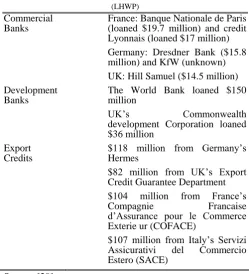
[image:3.595.43.293.506.781.2]The Lesotho Highlands Water Project (LHWP), which was executed to divert the flow of water to the Eastern Cape, South Africa, 570 km from Gauteng, had multiple participants. The project, which included participation from various stakeholders was a success. The first phase of the project was made possible by the World Bank, which approved a $110 million loan for the project [29]. In addition, other financial contributors (donors) that came forward were the African Development Bank (AFDB), the Development Bank of Southern Africa, the European Investment Bank and the UN Development Programme. Kreditanstalt fur Wiederaufbau (KfW) Bankengruppe, Hill Samuel, Credit Lyonnais, Dresdner Bank and Banque Nationale de Paris were all private financiers of the Lesotho Highlands Water Project (LHWP), while the consortium that was developed included firms from France, Italy, United Kingdom, South Africa and Germany [30].
TABLE 1
FINANCERS OF THE LESOTHO HIGHLANDS WATER PROJECT (LHWP)
Commercial Banks
France: Banque Nationale de Paris (loaned $19.7 million) and credit Lyonnais (loaned $17 million) Germany: Dresdner Bank ($15.8 million) and KfW (unknown) UK: Hill Samuel ($14.5 million) Development
Banks
The World Bank loaned $150 million
UK’s Commonwealth
development Corporation loaned $36 million
Export Credits
$118 million from Germany’s Hermes
$82 million from UK’s Export Credit Guarantee Department $104 million from France’s
Compagnie Francaise
d’Assurance pour le Commerce Exterie ur (COFACE)
$107 million from Italy’s Servizi Assicurativi del Commercio Estero (SACE)
Source: [29]
III. SOURCES OF FINANCING PUBLIC URBAN INFRASTRUCTURE
Nations such as South Africa make use of capital expenditure (CAPEX) to fund their public urban infrastructure, South African Info [31] defines capital expenditure (CAPEX) as money spent by an entity to acquire or maintain existing infrastructure. Local governments use CAPEX to finance public urban infrastructure projects. CAPEX is obtained through municipal taxes and tariffs, inter-governmental fiscal transfers, and municipal borrowing [21].
Public urban infrastructure financing in the public sector is undertaken through municipal capital expenditure and investments made within. Municipalities finance public urban infrastructure projects through local tax revenues, user charges and credit instruments available [21]. In addition, Shiromany [32] lists other sources of financing capital expenditure as: local government capital budget allocation; Bank and institutional loans; Grants from the central government; Long-term municipal funds/bonds; Leveraging municipal assets and private equity; Pooled bonds issued by Urban Infrastructure funds; and Public-private partnerships (PPP).
A. Inter-Governmental Transfers
It happens that, at some stage, the revenues received or collected are not sufficient to meet the capital expenditure requirements of a local government or that the local government fails to fulfil their capital expenditure needs with the existing revenues. These are referred to as fiscal gaps [21]. In such instances, the central government is expected to contribute to such municipalities. Transfers may take the form of grants or even subsidies; they may also be in the form of donations from the central government to assist local governments in performing what is required of them, such as constructing, maintaining and renewing public urban infrastructure facilities [33].
Vadgama et al [34] further describes how the central government often makes inter-governmental transfers to local governments when they struggle to meet their public urban infrastructure needs, this includes grants and subsidies. Grants are provided by the central governments to financially assist municipalities to carry out urban planning and eventually, the construction and maintenance of built facilities. In the same way as with subsidies, the central government transfers non-repayable funds to different municipalities.
According to Peterson and Annez [35] and Brearley and Franks [36] the central government allocates grant resources to local governments in three ways:
--Compensation in lieu of octroy. --Block grants for general purposes. --Grants for specific purposes.
B.User Charges
long run in that they can be simply linked to the actual cost of generating the required facility and service. This this can help in escaping continuous financing scarcity. Municipalities have regularly found it challenging to enforce user charges to different societies [37]. Irrespective of the difficulties facing municipalities in enforcing the relevant user charges, they are seen to be the most effective sources for public urban infrastructure financing. In addition, they endorse private sector involvement in funding urban facilities and services, thus distributing satisfactory and improved public urban infrastructure facilities and services [38].
C.Municipal Borrowing
Municipalities are entitled to seek external financial assistance to meet their capital expenditure requirements to fund public urban infrastructure facilities and services. Shiromany [32] explains that credit instruments are used to borrow money from various financial institutions. This takes place when the existing financing mechanisms such as user charges have been fully exhausted. It is therefore important for municipalities to have access to credit institutions to fund their CAPEX needs. However, this requires them to achieve a certain level of creditworthiness to qualify for financial assistance.
D.State Developed Initiatives
The central government of India has developed a National Investment and Infrastructure Fund to finance smart cities across the country, the initiative has proved to be what the country needs. US$3 billion was the initial investment made to construct, maintain and renew the existing public urban infrastructure facilities. With the involvement of the country’s finance ministry, the amount promises to increase over time [34]. The fund is 100 percent owned by the Indian government and it is registered with the Securities and Exchange Board of India [39].
Peterson and Annez [35] share that Karnataka developed Karnataka Urban Infrastructure Development and Finance (KUIDFC) to finance Water and Sanitation Infrastructure in India. The initiative was initiated by the state in 1993 for planning, financing and providing expertise in public urban infrastructures. Additionally, the KUIDFC assists in project preparation across urban areas, especially land development, sanitation, road management and transportation. Tamil Nadu also developed Tamil Nadu Urban Infrastructure Financial Services Limited (TNUIFSL), which is recognised as the public-private partnership initiated in India [40].
E. International Institutions of Finance
International initiatives such New Development Bank (NDB) and Asian Infrastructure Investment Bank (AIIB), are some of the institutions of finance used to complement domestic sources of financing public urban infrastructure [41]. Moreover, India, along with 56 other nations, has joined the AIIB. The NDB will have $50 billion to begin with to finance the much needed urban facilities and services, with the hope of increasing the amount to $100 billion over the years [34].
Vadgama et al [34] further appreciates that to ensure adequate delivery of Water and Sanitation Infrastructure in
areas such as Jharkhand, Uttar Pradesh and Assam the Indian government needs to form a coalition with other bodies (bilateral and multilateral agencies). This includes coordinating with the Asian Development Bank (ADB) and the World Bank. Moreover, the World Bank Group initiative for funding smart cities has financially assisted India’s Water and Sanitation Infrastructure with over $500 million. Other established bilateral funding agencies include the Japan International Cooperation agency (JICA), Germany’s GIZ and KFW Development Bank [34].
IV. RESEARCH METHODOLOGY
The research was executed solely on existing literature, published and unpublished journal papers, government papers, institutional and project reports. The research was delimited to stakeholders’ involvement, as well as sources of financing public urban infrastructure projects. Prior to identifying different stakeholders for infrastructure development extent of involvement of the involved parties was determined. The theoretical review contributed understanding for key stakeholders of public urban infrastructure and their level of involvement, more so, limitations for abundantly articulating the level of endurance for the current financing sources were encountered, and this was as a result of time allocated and the limited material available.
V. LESSON LEARNT
Through critical engagement with literature different spheres of government remain to be key stakeholders for financing public urban infrastructure. These spheres are responsible for planning, licensing and executing the actual restoration, construction, operation as well as maintenance of the public urban infrastructures. More so, since there is an ever increasing fiscal gap, as a result, to maximize capital expenditure government also has the sole responsibility of improving investor/business confidence, by mainly promoting good governance. Nations such as India and South Africa have established state initiatives to advance infrastructure development in their respective capacities. South Africa developed the Trans-Caledon Tunnel Authority (TCTA) and Komati Basin Water Authority (KOBWA), while India established Karnataka Urban Infrastructure Development and Finance (KUIDFC) and Tamil Nadu Urban Infrastructure Financial Services Limited (TNUIFSL).
VI. CONCLUSION
promoting economic development for different communities. User charges and inter-governmental transfers expressed the most level of endurance, however there were conditions attached to them, for user charges provided the end user continues to pay for the service delivery, and for the transfers – provided taxes are effectively collected by the central government.
REFERENCES
[1] D.Helm, “Infrastructure and infrastructure finance: The role of the government and the private sector in the current world”. European Investment Bank Papers, vol.15, no. 2, pp. 8-27. 2010.
[2] S. Bouton, D. Newsome, and A. Woetze. (2015).” Building the cities of the future with green districts. McKinsey & Company”. Available
at:
http://www.mckinsey.com/business-functions/sustainability-and-
resource-productivity/our-insights/building-thecities-of-the-future-with-green-districts. [Accessed 19 June 2017] .
[3] Z.J. Zhao. and C. Cao. “Funding China's urban infrastructure: Revenue structure and financing approaches”. Public Finance and Management, vol.11, no. 3, pp.284. 2011
[4] Federation of Indian Chamber of Commerce and Industry (FICCI). (2014). “Urban infrastructure in India”. India: New Delhi. Available
at:
http://www.spml.co.in/downloads/reports/Urban-Infrastructure-Report-2014.pdf [Accessed 03 August 2017] .
[5] P. Hartig. “Innovative financial instruments for cities”, Germany: KFW Bankengruppe.2008.
[6] Local Government Handbook. (2016). “Geography, history and economy”. Available at: http://www.localgovernment.co.za/metropolitans/view/2/City-of-Johannesburg-Metropolitan-Municipality#overview.[Accessed 07 January 2017] .
[7] Klynveld Peat Marwick Goerdeler (KPMG) International. “The changing face of infrastructure: Public sector perspectives”. KPMG International pp. 1-28. See above. 2010.
[8] A. Petru. (2014). “Funding the future: Innovative ways cities are paying for infrastructure”. Available at:
http://www.triple.com/2014/06/funding-future-innovative-ways-cities-paying-infrastructure-projects/#. [Accessed 04 January 2017]
[9] A. Bazaz. (2014). “Overview of municipal finance in India”. UNDP-IIHS Course on building resilience through integrated development practice. Bangalore City Campus 2014. pp. 1-22.
[10] Cities Development Initiative for Asia (CDIA). “City infrastructure investment programming and prioritisation toolkit”. User Manual. CDIA pp. 1-58. 2010.
[11] Asian Development Banks. Local government finance and municipal credit markets in Asia. Asian Development Bank pp. 1-122. 2010. [12] W. Avis. “Engaging stakeholders in areas of cross-border
infrastructure investment (GSDRC Helpdesk Research Report 1277)”. Birmingham, UK: GSDRC, University of Birmingham. 2015. pp. 1-14.
[13] Z/Yen Group Limited and World Wide Fund (WWF), “Financing the transition: Sustainable infrastructure in cities”. World Wild Fund for Nature (WWF) pp. 4-73. 2015.
[14] A. Schneider. and D. Wiener. “Sustainable Infrastructure Fund: Attracting institutional investment to drive sustainable development”. Global Policy. Vol. 4, no. 2, pp. 216-219. 2013.
[15] Ministry of Urban Development, Government of India. (2010). Monitoring formats for quarterly report December- March 2010 to PM. Government of India:
[15] Ministry of Urban Development pp. 1-201.
[16] Organisation for Economic Co-operation and Development (OECD). (2015). “Infrastructure financing instruments and incentives”. Organisation for Economic Co-operation and Development, Paris. 1-74. Available at: http://www.oecd.org/finance/private-pensions/Infrastructure-Financing-Instruments-and-Incentives.pdf
[Accessed 16 February 2016] .
[17] WaterAid India, “Drinking water and sanitation status in India. Coverage, inancing and emerging concerns”. WaterAid India. India: New Delhi. 2005.
[18] D.A. Aschauer, “Is public expenditure productive”? Journal of Monetary Economics, pp.177–200. 1989.
[19] Y. Liu, T. Chen and X. Song. “Relationship between urban form and urban CO2 efficiency with policies and recommendations”. Urban China Initiative (UCI) sponsored project pp. 1-68. 2012.
[20] E. Ahmad. “Infrastructure finance in the developing world: Public finance underpinnings for infrastructure finance in developing countries”. Working Paper Series. Intergovernmental Group of Twenty-Four and Global Green Growth Institute. Washington, DC. pp.1-16. 2015.
[21] J. Mahabir. and N. Mabena. “Identifying the funding constraints in municipal capital investments”. Chapter 9 in the Technical Report to the Annual Submission on the 2015/16 Division of Revenue, Financial and Fiscal Commission, Midrand, South Africa. 2015. [22] Makana Municipality. (2013). “General powers and functions of the
municipal council”. Available at: http://www.makana.gov.za/wp-
content/uploads/2013/07/Local-Government-Functions-and-Objectives.pdf. 1-42. [Accessed 23 December 2016] .
[23] J. Alm. “Municipal finance of urban infrastructure: Knowns and unknowns”. Brookings: Wolfensohn Center for Development. pp. 1-13. 2011.
[24] World Bank. “Urban Financing-Financing urbanization”. World Bank Group. 2014.
[25] Asian Development Bank. (2015). Establishing the future cities program in the Asia and Pacific region. ADB Technical Assistance Report Available at:
http://www.adb.org/sites/default/files/project-document/178245/49053-001-tar.pdf [Accessed 11 March 2017] .
[26] National Treasury, “Chapter 8: Water and Sanitation. Local government budgets and expenditure review”. South Africa. See above. 2011.
[27] F.H Mustafa. “Designing modern urban development project for private finance - residential complexes in Iraq”. PowerPoint presentation, Business Development Consultant. John Sisk and Sons. 2011.
[28] World Bank, “Planning, connecting, and financing .cities—Now: priorities for city leaders”. Washington DC: World Bank.2013. [29] L. Wentworth. “Lesotho Highlands: Water woes or win-wins?
PERISA Case Study for Infrastructure”, European Centre for Development Policy Management. South African Institute of International Affairs. 2013.
[30] E. Calitz and J. Fourie. “Infrastructure in South Africa: Who is to finance and who is to pay”. Stellenbosch Economics Working Papers: 15/07. Stellenbosch University, South Africa pp. 1-21.2007. [31] South Africa. Info. (2015). Gauteng Province, South Africa. Available
at:
http://www.southafrica.info/about/geography/gauteng.htm#.VyCEc_5 8PIV. [Accessed 12 December 2016] .
[32] A. Shiromany. (n.d). “Financing of urban infrastructure development for implementing urban resilience”. Jawaharlal Nehru National Urban Renewal Mission (JnNURM), NewDelhi.Availableat:http://www.teriin.org/projects/apn/pdf/day2/Fi nancing_of_Infrastructure_Development_TERIGoa.pdf.1-38. [Accessed 11 July 2017]
[33] T. Hart. and B. Welham, “Fiscal decentralisation: A public financial management introductory guide”. London: Overseas Development Institute. 2016.
[34] C. Vadgama. A. Khutwad. M. Damle. and S. Patil, “Smart Funding Options for Developing Smart Cities: A Proposal for India”, Sources of finance, vol. 8, no. 34, pp.4-7. 2015.
[35] G.E. Peterson. and P.C. Annez. “Financing Cities: Fiscal responsibility and urban infrastructure in Brazil, China, India, Poland and South Africa”. The World Bank: SAGE Publications. 2007. [36] R. Brearley. and J. Franks, “Indexation, investment and utility prices”.
Oxford Review of Economic Policy, vol. 25, no. 3, pp.435-450. 2009. [37] R. Tomalty. “Innovative infrastructure financing mechanisms for smart growth”. SmartGrowthBC. Section 2.2 (p.8) and Section 3.2. p.23-24. 2007.
[38] P. Masons. (2012). Regulated asset base model. Available at:
http://www.socinvest.co.uk/case_study/68/Regulatory-asset-base-model. [Accessed 04 January 2017] .
[39] National Investment and Infrastructure Fund. (2016). National investment and infrastructure fund. Available at:
http://niifindia.com/home-page.html. [Accessed 19 April 2017] .
[40] P. Venkatachalam, “Innovative approaches to municipal infrastructure financing: A case study on Tamil Nadu, India”, London: London School of Economics and Political Science. 2005.
[41] Devex. (2017). Asian Development Bank. Available at:
https://www.devex.com/organizations/asian-development-bank-5156.