A Provable-Security Analysis of Intel’s Secure Key RNG
Thomas Shrimpton and R. Seth Terashima
Dept. of Computer Science, Portland State University
{teshrim,seth}@cs.pdx.edu
Abstract. We provide the first provable-security analysis of the Intel Secure Key hardware RNG (RNG), versions of which have appeared in Intel processors since late 2011. To model the ISK-RNG, we generalize the PRNG-with-inputs primitive, introduced by Dodis et al. at CCS’13 for their /dev/[u]randomanalysis. The concrete security bounds we uncover tell a mixed story. We find that ISK-RNG lacks backward-security altogether, and that the forward-security bound for the “truly random” bits fetched by the RDSEED instruction is potentially worrisome. On the other hand, we are able to prove stronger forward-security bounds for the pseudorandom bits fetched by theRDRANDinstruction. En route to these results, our main technical efforts focus on the way in which ISK-RNG employs CBCMAC as an entropy extractor.
Keywords: random number generator, entropy extraction, provable security
Table of Contents
1 Introduction . . . 3
1.1 Security findings for the ISK-RNG . . . 3
1.2 Improvements to the PWI model . . . 5
2 Preliminaries . . . 6
3 The ISK-RNG architecture . . . 7
4 Analysis of the ISK-RNG extractor . . . 9
5 Modeling the ISK-RNG as a PWI . . . 11
5.1 The PWI model . . . 11
5.2 Mapping ISK-RNG into the PWI model . . . 12
6 PWI Security . . . 12
6.1 Basic notions . . . 12
6.2 Masking functions and updated security notions . . . 13
6.3 PWI-Security Theorems . . . 16
7 Security of the ISK-RNG as a PWI . . . 16
7.1 Negative Results . . . 17
7.2 Positive results . . . 18
7.3 Discussion of results . . . 21
A PWIs with non-pseudo-uniformly random state . . . 23
B On proving robustness . . . 24
C On the read-only robustness of ISK-RNG . . . 28
D Towards a notion of PWI availability . . . 31
1 Introduction
In late 2011, Intel began production of Ivy Bridge processors, which introduced a new pseudoran-dom number generator (PRNG), fully implemented in hardware. Access to this PRNG is through the RDRAND instruction (pronounced “read rand”), and benchmarks demonstrate a throughput of over 500 MB/s on a quad-core Ivy Bridge processor [10]. The forthcoming Broadwell architecture will support an additional instruction, RDSEED (“read seed”), which delivers true random bits, as opposed to cryptographically pseudorandom ones. Both RDRAND and RDSEED fall under the Intel Secure Key umbrella, so we will refer to the new hardware as the ISK-RNG [11].
The ISK-RNG has received a third-party lab evaluation [8], commissioned by Intel, but has yet to receive an academic, provable-security treatment along the lines of that given the/dev/[u]random software RNGs by a line of papers [7,1,5,13]. We provide such a treatment.
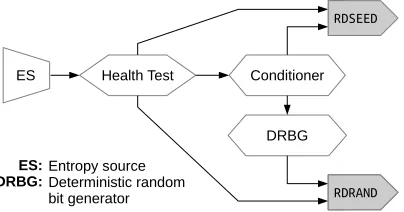
Conditioner Health Test
DRBG ES
Entropy source Deterministic random bit generator
ES: DRBG:
RDRAND RDRAND RDSEED
Fig. 1.Overview of Intel’s hardware PRNG.
Our abstract model for the ISK-RNG is that of a PRNG-with-input (PWI), established by Barak and Halevi [1] and extended by Dodis et al. [5]. To better capture important design features of the ISK-RNG we make several improvements to the PWI abstrac-tion, which have significant knock-on effects for the associated security notions. Our results establish the security of the ISK-RNG relative to these notions. Our findings are mixed, suggesting that in some cases RDSEEDmay not be as secure as one might hope, but with stronger results forRDRAND.
The ISK-RNG architecture. A detailed description
of the ISK-RNG can be found in Section 3, but we’ll provide a short sketch here. At a high-level, the ISK-RNG consists of four main components, as shown in Figure 1. At the heart is the hardware
entropy source, which uses thermal noise to generate random bits and then writes them into a 256-bit raw-sample buffer. This buffer is subjected to a battery of heuristic health tests, which try to determine if the buffer contents are sufficiently random. The raw entropy bits are not assumed to be
uniformly random — they may be biased or correlated. So aconditioner (i.e. an entropy extractor), repeatedly reads from this buffer, combining multiple 256-bit samples and compressing them into a single 128-bit string, hopefully one that is close to uniformly random.
These uniform bit strings then periodically reseed a deterministic PRNG (based on CTR-AES), providing a high-speed source of pseudorandom bits. Calls to the RDRAND instruction read from these bits, whereas calls to RDSEEDwill read directly from the conditioner output.
1.1 Security findings for the ISK-RNG
We consider security of the ISK-RNG relative to four PWI-security notions, adopted (with modifi-cations) from Dodis, Pointcheval, Ruhault, Vergniaud and Wichs [5] (hereafter DPRVW):resilience, the apparent randomness of RDRANDand RDSEED outputs; forward security, the apparent random-ness of previous RDRAND and RDSEED outputs once the PWI state is revealed; backward security, the apparent randomness of futureRDRAND and RDSEEDoutputs from a corrupted PWI state; and
Using estimates for the quality of the entropy source derived from the findings of [8], we are able to show the following results (in a random permutation model):
1. As far as the resilience of RDRAND and RDSEED is concerned, RDRAND delivers pseudorandom bits with a comfortable security margin. On the other hand, RDSEEDdelivers truly random bits but with a security margin that becomes worrisome if an adversary can see a large number of outputs from either interface. If he controls an unprivileged process on the same physical machine, this could happen very quickly.
2. For forward security,RDRANDandRDSEEDalso provide these respective security margins, as long as one is willing to make some reasonable assumptions about the adversary’s limitations. 3. The ISK-RNG does not provide backward security because the hardware indefinitely retains
stale state when the ISK-RNG is not in active use. However, we are able to quantify the lifespan of this information when the ISK-RNGis in active use, thus proving backwards security and a read-only form of robustness against a class of “slow” adversaries.
Interpretation. In this context, forward security, backward security, and robustness are only relevant to those concerned about attackers who (1) are able to obtain physical access to the machine and (2) sophisticated enough to read or tamper with registers directly (the registers in question are not accessible through software, even by the operating system). Moreover, the window of opportunity for an attacker trying to compromise forward security (i.e., trying to reconstruct past random values given current access to the machine) is under a millisecond, barring pathological failures of the entropy source. Hence we suspect most practitioners will be concerned only with resilience.
As far as resilience, then, we prove RDRAND to be secure under a reasonable set of assumptions regarding the quality of the entropy source and a reasonable but heuristic assumption regarding AES-128: namely that it can be modeled as a random permutation when used with a specific fixed, publicly known key. We provide concrete, quantitative analysis in Section 7.3; the results are encouraging.
The situation with RDSEED is more complicated, because the security bounds become quan-titatively quite weak in this context. We believe, but cannot prove, that this weakness does not correspond to a practical attack. Our suspicion is that an actual attack would require the adver-sary to have a precise physical model of the entropy source (the exact parameters of which appear to change from chip to chip [8]), and compute, by brute force, the distribution induced by pro-cessing streams from this entropy source using CBC-MAC under the previously mentioned AES key. Such an attack would clearly be computationally infeasible as long as the number of possible streams is large, but the relevant portion of the security bound is for computationally unbounded adversaries. (Recall that RDSEED is designed to provide truly random bits, rather than “merely” cryptographically pseudorandom ones.)
The stronger RDRANDresults hold even if an attacker can access both interfaces.
Analyzing the ISK-RNG entropy extractor. The core technical results of the paper are concerned with analyzing the ISK-RNG entropy extractor, which employs CBC-MAC over AES-128, using the fixed stringAES0(1) as the AES key. Although Intel documents [16] appeal to a CRYPTO’02 paper
CRI report [8], on the other hand, ignores the issue entirely by making an implicit assumption that applying CBC-MAC-AES to an arbitrary input with 128 bits of min-entropy will produce an output close to a uniformly random 128-bit string, an assumption known to be false with respect to
any entropy extractor (not just CBC-MAC) [15]. We discuss and resolve these issues in Section 4.
1.2 Improvements to the PWI model
For our abstract model, we take the pseudorandom number generator with input (PWI) primitive, formalized by DPRVW as a model for /dev/[u]random. At a high level, a PWI surfaces three algorithms: one to initialize the internal state of the primitive, one that produces an output for use by calling applications (updating the state in the process), and one that updates the state as a function of an externally provided input. Exposing an external input captures the practical situation in which PRNG outputs may depend upon external sources of (assumed) entropy.
One contribution of this paper is to generalize the PWI abstraction in ways that better capture not only the ISK-RNG, but also, we hope, other real-world PWIs. These include allowances for:
1. Non-uniform PWI state: Real-world PRNGs like ISK-RNG have internal state that is not properly modeled as being uniformly random; for example, because they contain counters or fixed strings. DPRVW make progress in abandoning the restrictions of prior works, whose security notions man-date that the internal state be indistinguishable from a uniformly random one. However, they do not go far enough, as they still assume the PWI is initialized with a uniform random state. This leads to problems: one can construct a PWI that is provably “forward-secure” in the sense defined by DPRVW, but is clearly not forward-secure in the commonly accepted sense. Conversely, there are PWIs that seemingly should be considered forward-secure, but are not under the DPRVW definition. We provide examples in Appendix A.
2. Realistic initialization: Relatedly, the current PWI formalism cannot model setup procedures, such as those used by the ISK-RNG. Addressing this shortcoming is particularly important since weak initialization has led to attacks on real-world PWIs [9,6]; security definitions should expose these vulnerabilities.
3. Multiple external interfaces: the ISK-RNG API exposes two interfaces that depend on the same state, namely RDRAND and RDSEED. Hence the model should reflect this. We note that ISK-RNG isn’t unique in this regard: /dev/random and /dev/urandom also share some state [13], and so generalizing the PWI model to allow multiple interfaces is a necessary prerequisite to establishing any positive results there.
4. Blocking behavior: the ISK-RNG and other real-world RNGs (e.g. /dev/random) block when their tests suggest that they have not accumulated sufficient entropy to generate random numbers securely. Capturing this behavior allows us to ensure that this mechanism cannot inadvertently compromise security. We briefly discuss the related issue of availability in Appendix D.
To deal with non-uniform state, we introduce an analytical tool called a masking function. Loosely speaking, a masking function M is a tool for specifying what the “ideal” versionM(S) of any given PWI state S would be. This allows us to give general results about PWI security (e.g. what can be achieved when the state is ideal), yet admits per-scheme specification of what “ideal” means. We define masking functions, and incorporate them into the DPRVW’s security notions in such a way that their results can be quickly lifted to our setting. Masking functions also allow us to frame an appropriate definition for secure initialization: i.e. does the setup procedure produce a stateS that is indistinguishable fromM(S)?
2 Preliminaries
Notation. We denote the set of all n-bit strings as{0,1}n, and the set of all (finite) binary strings as{0,1}∗. Givenx, y∈ {0,1}∗, both xy andxkydenote their concatenation, and|x|is the length ofx. If|x|=|y|,x⊕y is the bitwise XOR ofxand y. The symbolεdenotes the empty string. The set Perm (n) denotes the set of permutations on {0,1}n.
When S is a finite set, we assume that it is equipped with the uniform distribution unless otherwise specified. For any distribution S, the notationX←− S$ indicatesX is a random variable sampled from S. Similarly, if F is a randomized algorithm, X←−$ F(x1, . . . , xn) means that X is
sampled from the distribution induced by providingFwith the indicated arguments. An adversaryA
is a randomized algorithm, and we adopt the shorthand A⇒y to mean that when its execution halts, it outputs y. When an algorithm P is provided oracle (black-box, unit-time) access to an algorithm Q, we writePQ.
Entropy and Sources. If X and X0 are random variables, their statistical distance is ∆(X, X0) =
1 2
P
x|Pr [X =x]−Pr [X0 =x]|, where the sum is over the union of the supports of X and X0.
The min-entropy of X is H∞(X) = −maxx(log Pr [X =x]), and the worst-case min-entropy of X given X0 isH∞(X |X0) =−log maxx,x0Pr [X=x|X0 =x0].When X is a random variable
and E is some event, we denote by X|E the random variableX conditioned on E; i.e., for any xin the support ofX, Pr [X|E =x] = Pr [X=x| E].
An entropy source D is a randomized algorithm that, given a state string σ∈ {0,1}∗, samples a tuple (σ0, I, γ, z) ∈ {0,1}∗ × {0,1}p×R≥0 × {0,1}∗. Let (σi, Ii, γi, zi)
$
←− D(σi−1) be a sequence
of samples, where σ0 =ε, andi= 1, . . . , qD for some integer qD. We say that entropy sourceD is legitimateifH∞(Ij |(Ii, zi, γi)i6=j)≥γj. In this paper, we assume all entropy sources are legitimate.
In this definition, σ, σ0 ∈ {0,1}∗ represent the current and new states for D, respectively. The string I ∈ {0,1}p is what will be to be fed as input to the PWI, and should provide fresh entropy. The quantity γ ∈ R≥0 is an estimate for the amount of entropy contained in I. We note that γ
is strictly a convenient book-keeping device in the PWI model, and is not intended to reflect an actual output of the entropy source being modeled. Our security notions will formalize attacker capabilities of interest, but we also allow for side-information (about I) that an attacker might obtain through means not otherwise explicit in the model (e.g. timing or power side-channels). This side information will be encoded in the stringz.
Cryptographic building blocks. A blockcipher is a functionE :{0,1}κ× {0,1}n→ {0,1}n such that for each keyK ∈ {0,1}κ, E(K,·), writtenEK(·), is a permutation on{0,1}n. Given IV ∈ {0,1}n, K ∈ {0,1}κ, and Xi∈ {0,1}nfor i∈[0..ν], define
ES Shift Register
256 bits
OSTE Queue
2x 256 bits
CE Buffer
256 bits
Condition (CBCMAC)
Health Test
Output Buffers
8x 64 bits
(K, IV) Reseed
(CTR-AES)
DRBG (CTR-AES)
RDSEED RDRAND
0x00...000
ES Entropy sourceOnline self-tested entropy Conditioned entropy
Deterministic random bit generator
ES: OSTE: CE: DRBG:
Health History
256 bits
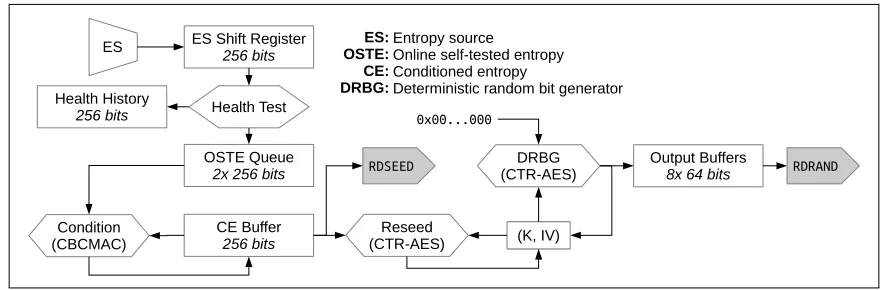
Fig. 2. Block diagram for Intel’sRDRAND implementation. TheCBCMACcomputation uses AES-128 with the fixed keyK0=AES0(1). The DRBG runs AES-128 in counter mode to produce{0,1}128·3 bits of output; the first 256 bits
are used to update the keyK and IV; the final 128 bits are sent to the output buffer, which is read by theRDRAND
instruction.
(We define the + operator on {0,1}n as addition modulo 2n on the unsigned integers encoded by the operands.) Further define
CBCMACIVK(X0· · ·Xν) =CBCMACEK(IV ⊕X0)
K (X1· · ·Xν),
and CBCMACIVK(ε) = IV. Describing the standard CBCMAC algorithm in this manner simplifies descriptions of programs that compute CBCMAC online. We omit an explicitIVfrom the notation when IV= 0n. In this paper, the implicit blockcipherE will always be AES-128 (κ=n= 128).
The pseudorandom-permutation (PRP) advantage of an adversaryAattacking a blockcipherE:
{0,1}κ× {0,1}n → {0,1}n is defined asAdvprpE (A) = PrAEK ⇒1−Pr [Aπ ⇒1 ], with
proba-bilities over the coins of Aand the random variables K←− {$ 0,1}κ and π←−$ Perm (n).
3 The ISK-RNG architecture
This section describes the design of the ISK-RNG. Unless otherwise noted, this information comes from the CRI report [8]. The design can be divided roughly into three phases: entropy generation, entropy extraction, and expansion. Raw bits from the generation phase are fed into an entropy extractor, which is tasked with turning biased or correlated bits into uniform random strings. The expansion step uses these strings to seed a deterministic PRNG, which can produce cryptographi-cally pseudorandom outputs at high speeds.
The design is shown in Figure 2. In this figure, rectangular boxes indicate values we consider part of the ISK-RNG state, hexagons indicate procedures that read and modify the state, and the shaded arrows indicate assembly instructions that allow (unprivileged) processes to read from the indicated buffer.
Every 256 writes, the contents of the register are subjected to a series of health tests. These count how many times certain specified bit strings appear, and verify that the results are within normal limits. For example, the substring010may occur between 9 and 57 times, inclusive. These substrings and the corresponding numbers of allowable occurrences are intended to catch pathologically bad failures while keeping the false-positive rate low. (For reference, a uniformly random 256-bit string would be flagged as unhealthy approximately 1% of the time.) If the current ES register fails one of the tests, that 256-bit source-sample is flagged as unhealthy. We refer interested readers to the CRI report [8] for a more detailed description; for our purposes, it suffices to say there is some fixed set H ⊆ {0,1}256 of strings that pass the health tests. The health-history register tracks how many of the last 256 samples passed the health test. This is a first-in first-out buffer, where a 1-bit means that a sample was deemed healthy, and a 0-bit mean that a sample was deemed unhealthy. The global health of the ISK-RNG is captured by a property callswellness.
Definition 1 (Swell ISK-RNG).The ISK-RNG is said to be swellif at least 128 of the last 256 samples were healthy, i.e. if the health-history register contains at least 128 1s. ut
Whether or not the current sample passes the health test, it is appended to the Online Self-Tested Entropy (OSTE) queue, and it is the OSTE queue that provides input to the extraction phase.
Extraction. Strings in the OSTE queue are not assumed to be uniformly random. Instead, each 256-bit entry is assumed to have a certain amount of min-entropy. TheCBCMACconstruction, over AES with key K0 = AES0(1) [12], is employed as an entropy extractor, in order to turn strings
in the OSTE queue into two 128-bit conditioned entropy (CE) strings. These are held in the CE buffer, which is initially all zeros, and are used to service RDSEED instructions and to reseed the DRBG. An important property of the CE buffer is itsavailability.
Definition 2 (CE buffer availability). The CE buffer is available if (1) the ISK-RNG is swell, and (2) both 128-bit halves of the CE buffer (CE0andCE1) have been updated usingmhealthy OSTE
values since the most recentRDSEEDcall and the most recent DRBG reseeding. For Ivy Bridge chips,
m= 2; for Broadwell chips, m= 3 [12]. ut
When the CE buffer is not available, the hardware will replenish the OSTE buffers with fresh entropy and feed them into a running CBCMAC calculation until a sufficient number of healthy samples have been conditioned. So if at some point CE0 = X and then the CE buffer is used to
service aRDSEEDinstruction (making the CE buffer unavailable), the hardware will collect entropy stringsI1, I2, I3, . . .∈ {0,1}256 and reassignCE0 ←CBCMAC0(XI1I2I3· · ·) online until there exist
i1 < i2 <· · ·< im such that Iij ∈ H forj∈[1..m] and the ISK-RNG is swell. Then the processes
will repeat forCE1.
The particulars of the way CBCMAC is used in the ISK-RNG extractor, along with the notions of swellness and availability, play a large role in Section 4.
Expansion. To reseed the DRBG, the contents of CE0 and CE1 are used to generate a key and IV
(respectively) for counter mode encryption over AES. This reseeding process only happens when the CE buffer is available. It takes the current key and IV, (K,IV), and updates them by computing
KkIV ← CTRIVK(CE1kCE2). Initially, K =IV = 0128. However, using CTR with this non-random
A pseudorandom valueRis generated by computingRkKkIV ←CTRIVK(03·128). (Note that this process also irreversibly updates K and IV, which helps provide forward security.) The ISK-RNG writesR to an output buffer, which is read byRDRAND. This FIFO output buffer [10] can contain up to eight 64-bit values. ISK-RNG allows a maximum of 511 64-bit values to be generated between reseeding operations; after this, it will only return 0s and will clear the carry bit to signal an error.
Setup. When the ISK-RNG powers on, the ISK-RNG performs a series of known-answer, built-in self-tests. Then the conditioned entropy (CE) buffer is cleared and the deterministic random bit generator (DRBG) is reseeded four times [12]. Each reseeding operation requires reconditioning the CE buffer until it is available. Finally, the system populates the eight output buffers using the DRBG.
Standards compliance. Intel states [14] that ISK-RNG is compliant with NIST’s SP800-90B & C draft standards. WhereasRDRANDcan provide bit strings with “only” a 128-bit security level (since it uses AES-128 in CTR mode),RDSEEDhas no such limitation.
4 Analysis of the ISK-RNG extractor
As we will see, some of the PWI-security results for the ISK-RNG are not as strong as one might hope. Much of this is due to weak concrete bounds on its CBCMAC entropy extractor, which is tasked with turning the presumably biased and correlated bits from the entropy source into uniformly distributed strings. Let us explain.
Previous CBC-MAC results are not (directly) helpful. A paper by Dodis, Gennaro, H˚astad, Kraw-cyzk and Rabin [4] analyzes the security of CBC-MAC as an entropy extractor, and their results are cited by Intel documents [16] to support the ISK-RNG design. Because generic PRFs-as-entropy-extractors results [3] are too weak to be useful, the analysis of [4] takes place in the random permutation model. That is, instead of considering CBC-MAC over a blockcipher with a random key, they consider CBC-MAC over a random permutation. This model is a heuristic: even, say, AES equipped with a random key would not be a random permutation. In fact, CBC-MAC within the ISK-RNG uses AES with the fixed key K0 = AES0(1) (on all chips). This fact may strike
one as alarming. But we believe that a “nothing-up-my-sleeve” value for the extractor seed is a reasonable choice. (Generating the seed from the entropy source would be highly suspect from a theoretical perspective, because one requires that the extractor seed be “independent” of the entropy distribution.)
Anyway, our primary goal here is to identify what we can say about ISK, even if we’re forced to use a heuristic model. Dodis et al.[4] provide the following theorem:
Theorem 1 (CBCMAC entropy extractor [4]). Fix positive integers k and L. Let I ∈ {0,1}Lk be a random variable, R←− {$ 0,1}k be a uniform random string, and let π←−$ Perm(k) be a random permutation. Then∆((π, R),(π,CBCMACπ(I))≤ 12
q
2k−H∞(I)+O(L2)
2k .
Unfortunately, one cannot simply apply this theorem to the CBC-MAC-based extractor used in ISK-RNG, without attending to the following two significant obstacles:
seed. This pushes leftover-hash-lemma style results like Theorem 1 out of scope, and furthermore prevents us from employing a black-box hybrid argument to lift the results to the multiple-query setting.
(2) The O(L2) term is problematic, contributing a O(L/2k/2) term to bound.1 We note that this is significantly worse than the familiar O(L2/2k) “birthday bound” — although the two both become vacuous when L ≈ 2k/2, the former violates a desired security level 1 much sooner (hidden constants being equal). The weak bound is exacerbated by the fact thatL may grow very quickly in the ISK-RNG during periods of time when the CE buffer is not available.
Analyzing the CBC-MAC extractor. In this section we present results that allow us to overcome these hurdles, bringing Theorem 1 into scope. In particular, the main technical result of this section is the following theorem. Loosely, it says that we can still obtain a hybrid-like bound, even though a black-box hybrid argument isn’t possible. Moreover, we can avoid the problem of “runaway” input strings (resulting in large L) by, in effect, only counting a fixed-length prefix of such strings.
Theorem 2. Fix positive integersL,k,qandnwithq≤n. Fori∈[1..n], letIi ∈ {0,1}∗ be random variables with lengths divisible byk, and sampleRi
$
←− {0,1}k. Fixπ←−$ Perm(k). DefineIiL and IiR to be the unique strings such thatIiL
= min{|Ii|, Lk}andIi=IiLIiR. LetCi=CBCMACπ(Ci−1kIi),
where C0 is a random variable independent ofπ and each Ii and Ri. Then:
∆((π, C1, . . . , Cq, I>q),(π, R1, . . . , Rq, I>q))≤
1 2 q X i=1 r
2k−H∞(IiL|I>i,IiR) + O((L+ 1)
2)
2k ,
where I>m = (Im+1, . . . , In) for integer m.
Proof. Setting R0 =C0 (our applications will use eitherC0
$
←− {0,1}k orC0
$ ←−
0k ), define: δi =∆((π, R1, . . . , Ri−1, Cii, Cii+1, . . . , Cqi),(π, R1, . . . , Ri−1, Ri, Cii+1, . . . , Cqi)).
whereCji =CBCMACπ(Ri−1kIi) ifj=i, andCji =CBCMACπ(Cji−1kIj) ifj > i. As a consequence,
we have ∆((π, C1, . . . , Cq, I>q),(π, R1, . . . , Rq, I>q)) ≤
Pq
i=1δi. Since each Ri is independent and
uniform andCji can be computed fromπ,Ri−1, and I>i+ = (I>i, IiR) whenever j > i, δi ≤∆((π, Ri−1, Ri, I>i+),(π, Ri−1, Cii, I>i+))
≤X
r,s
∆((π, r, Ri, s),(π, r, Cii
(Ri−1,I+>i)=(r,s), s))
·Pr [Ri−1 =r] Pr
I>i+ =s.
LetP be the event (Ri−1 =r)∧(I>i+ =s); then Cii
P =CBCMACπ(rk IiL
P kcR), where cR is the
first component of s, corresponding to the (now fixed) value of IR
i . Note that Ii|P is distributed
identically to Ii|I+
>i=s. DefineR 0
i=CBCMACπ(rk IiL
P). This now brings the results of Theorem 1
into scope:
∆((π, r, Ri, s),(π, r, R0i, s))≤
1 2
r
2k−H∞(IiL|I>i) + O((L+ 1)
2)
2k . 1
A set of slides published by Intel [16] claims a much stronger result based on Theorem 1. However, in addition to failing to account for point (1) above, the difference appears to stem from a mistake in translating notation. Specifically, the above theorem from [4] writes the second term under the radical asK·(L, K), where(L, K) =
O(L2/K2) and in our notationK = 2k. The Intel slides, however, appear to have mistranscribed this term as
Now, CiiP = CBCMAC
R0i
π (cR). However, given that cR is fixed, τπ,cR(·) = CBCMAC( ·)
π (cR) is a
permutation for every possible π. Therefore since Ri is uniformly distributed,
∆((π, r, Ri, s),(π, r, Cii
P, s)) =
1 2
X
(ρ,x)
Pr [ (π, Ri) = (ρ, x) ]−Pr
(π, CiiP) = (ρ, x)
= 1 2
X
(ρ,x)
1 2k −Pr
CiiP =x|π=ρ
Pr [π=ρ]
= 1 2
X
(ρ,x)
1 2k −Pr
h
R0i =τρ,c−1R(x)|π =ρ
i
Pr [π =ρ]
= 1 2
X
(ρ,x)
Pr [ (π, Ri) = (ρ, x) ]−Pr
(π, R0i) = (ρ, x)
=∆((π, r, Ri, s),(π, r, R0i, s)),
with summations over (ρ, x)∈Perm (k)× {0,1}k. This completes the proof. ut
It remains to show that, with high probability, the (potentially) truncated extractor input contains sufficient min-entropy. Note that making reasonable min-entropy assumptions regarding the entropy source is not sufficient; for example, the approximate 1% false-positive rate of the health tests on uniformly random 256-bit strings implies that there are at least 2249 unhealthy strings. Therefore the entropy source could produce only unhealthy samples, resulting in unbounded L, and still have high min-entropy. In order to avoid such pathological behavior, we will later (in Section 7.2) need to introduce additional assumptions regarding the rate at which the entropy source produces healthy samples. Ultimately, we will chooseLsuch that we have a high probability of never needing more thatL/2 samples, but such that L/2k/2 is small, as this term will dominate our security bounds.
5 Modeling the ISK-RNG as a PWI
Building upon DPRVW, here we define the syntax of a PWI. We give the syntax first, and then discuss what it captures, pointing out where our definition differs from DPRVW.
5.1 The PWI model
Definition 3 (PWI). Let p, and ` be non-negative integers, and let IFace,Seed,State be non-empty sets. A PRNG with input (PWI) with interface set IFace, seed space Seed, and state space State is a tuple of deterministic algorithms G= (setup,refresh,next,tick), where
– setup takes no input, and generates an initial PWI state S0 ∈ State. Although setup itself is
deterministic, it may be provided oracle access to an entropy source D, in which case its output S0 will be a random variable determined by the coins of D.
– refresh: Seed×State×{0,1}p →Statetakes a seedseed∈Seed, the current PWI stateS∈State, and string I ∈ {0,1}p as input, and a returns new state.
– tick : Seed×State → State takes a seed and the current state as input, and returns a new
state. ut
We will typically omit explicit mention of the the seed argument torefresh,nextandtick, unless it is needed for clarity
Thesetupalgorithm captures the initialization of the PWI, in particular its internal state. Unlike DPRVW, whose syntax requires setup to generate the PWI seed, we view the seed as something generated externally and provided to the PWI. Permitting an explicit setup procedure is necessary to correctly model ISK-RNG and, more generally, allows us to formulate an appropriate security definition for PWI initialization.
The refresh algorithm captures the incorporation of new entropy into the PWI state. Like DPRVW, we treat the entropy source as external. This provides a clean and general way to model the source as untrusted to provide consistent, high-entropy outputs.
Our next algorithm captures the interface exposed to (potentially adversarial) parties that request PWI outputs. By embellishing the DPRVW syntax fornextwith the interface setinterface, we model APIs that expose multiple functionalities that access PWI state. This is certainly the case for the ISK-RNG, via the RDRAND and RDSEED instructions, as well as /dev/[u]random. We also model blocking by lettingnext return⊥.
The tick algorithm is entirely new, and requires some explanation. In the security notions formalized by DPRVW, the passage of “time” is implicitly driven by adversarial queries. (This is typical for security notions, in general.) But real PRNGs like the ISK-RNG may have behaviors that update the state in ways that are not cleanly captured by an execution model that is driven by entropy-input events (refresh calls), or output-request events (next calls). The tick algorithm handles this, while allowing our upcoming security notions to retain the tradition of being driven by adversarial queries: the adversary will be allowed to “query” the tick oracle, causing one unit of time to pass and state changes to occur.
5.2 Mapping ISK-RNG into the PWI model
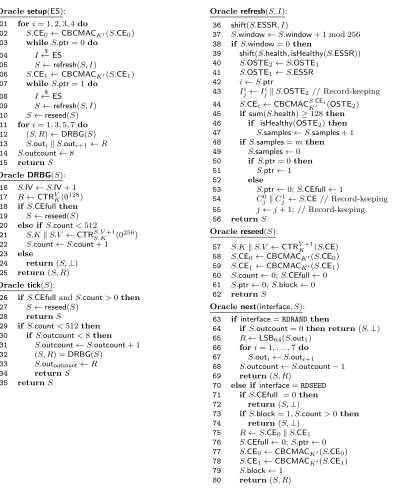
We now turn our attention to mapping the ISK-RNG specification into the PWI model. Figure 3 summarizes the state that our model tracks. Figure 4 provides our model for the PWIsetup,refresh, next, and tick oracles. Two additional procedures,DRBG andreseed, are used internally.
6 PWI Security
Having defined the syntax for PWIs, we can now introduce corresponding security notions. The basic notions are those of DPRVW, with a few notable alterations. To handle issues of non-uniform state and (more) realistic initialization procedures, we introduce a new technical tool, masking functions, that allows us to cleanly address these issues.
6.1 Basic notions
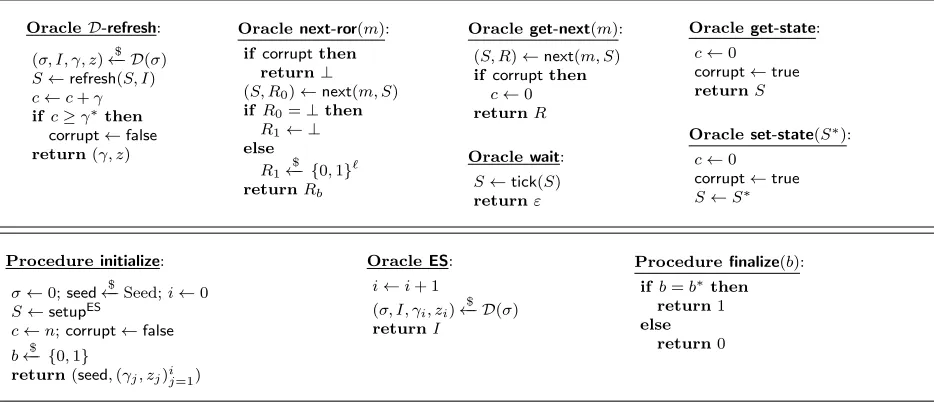
Here we define four PWI-security notions, in the game-playing framework [2]. In each there is a (potentially adversarial) entropy sourceD, and an adversaryA. The latter is provided access to the oracles detailed in Figure 5 (top), and what distinguishes the four notions are restrictions applied to the queries of the adversaryA. In particular, we consider the following games:
Variable Bits Description
ESSR 256 Entropy source shift register window 8 Counts new bits in the ESSR OSTE1 256
Online self-tested entropy buffers OSTE2 256
CE0 128
Conditioned entropy buffers
CE1 128
ptr 1 Tracks CE buffer to condition next health 256 Tracks health of last 256 ES samples
K 128 DRBG key (For AES-CTR) IV 128 DRBG IV (For AES-CTR) out1,...,8 512 Eight 64-bit output buffers
outcount ≥4 Counts number of full output buffers count ≥9 Counts DRBG calls since reseeding CEfull 1 Set if CE buffers are available block 1 Set if reseed has priority overRDSEED
Fig. 3.State variables of the ISK-RNG
Forward security (FWD): no queries toset-state are allowed; and a single query to get-state is allowed, and this must be the final query.
Backward security (BWD): no queries to get-state are allowed; a single query to set-state is allowed, and this must be the first query.
Resilience (RES): no queries to get-stateorset-state are allowed.
See DPRVW for additional discussion. We note that all games share commoninitialize and finalize procedures, shown in Figure 5 (bottom). Thus, the robustness-advantage of A in attacking G is defined to be AdvrobG,D(A) = 2 Pr [ROBG,D(A) = 1 ]−1. The forward security, backward security,
and resilience advantagesAdvfwdG,D(A),AdvbwdG,D(A), andAdvresG,D(A) are similarly defined. It is clear that robustness implies forwards and backwards security, and both of these independently imply resilience.
We note that, because the PRNG cannot reasonably be expected to produce random-looking outputs without sufficient entropy or with a known or corrupted state, the various security experi-ments track (1) a boolean variable corruptand (2) a value γ measuring the total entropy that has been fed into the PRNG since corruptwas last set. These serve as book-keeping devices to prevent trivial wins. Thecorrupt flag is cleared wheneverγ exceeds some specified threshold γ∗.
6.2 Masking functions and updated security notions
As noted earlier, the DPRVW security definitions assume the PWI state is initially uniformly random. However, this does not realistically model the behavior of real-world PWIs, notably ISK-RNG, which do not attempt to reach a pseudorandom state; for example, they may maintain counters. (Indeed one can construct PWIs that would be deemed secure when starting from a uniformly random state, but that would not be secure in actuality; the reverse is also true. See Appendix A for examples.) Yet, clearly, some portion of the PWI state must be unpredictable to an attacker, as otherwise one cannot expect PWI outputs to look random.
Oraclesetup(ES):
01 fori= 1,2,3,4do
02 S.CE0←CBCMACK0(S.CE0)
03 whileS.ptr= 0do
04 I←−$ ES
05 S←refresh(S, I)
06 S.CE1←CBCMACK0(S.CE1)
07 whileS.ptr= 1do
08 I←−$ ES
09 S←refresh(S, I) 10 S←reseed(S) 11 fori= 1,3,5,7do
12 (S, R)←DRBG(S) 13 S.outikS.outi+1←R
14 S.outcount←8 15 returnS
OracleDRBG(S):
16 S.IV←S.IV+ 1 17 R←CTRVK(0128)
18 ifS.CEfullthen
19 S←reseed(S) 20 else ifS.count<512
21 S.KkS.V ←CTRS.V+1S.K (0256) 22 S.count←S.count+ 1 23 else
24 return(S,⊥) 25 return(S, R)
Oracletick(S):
26 ifS.CEfullandS.count>0then
27 S←reseed(S) 28 returnS
29 ifS.count<512then
30 ifS.outcount<8then
31 S.outcount←S.outcount+ 1 32 (S, R) =DRBG(S)
33 S.outoutcount←R
34 returnS
35 returnS
Oracle refresh(S, I):
36 shift(S.ESSR, I)
37 S.window←S.window+ 1 mod 256 38 ifS.window= 0then
39 shift(S.health,isHealthy(S.ESSR)) 40 S.OSTE2←S.OSTE1
41 S.OSTE1←S.ESSR
42 i←S.ptr 43 Ii
j←IjikS.OSTE2 // Record-keeping
44 S.CEi←CBCMACS.KCE0 i(OSTE2)
45 ifsum(S.health)≥128then
46 if isHealthy(OSTE2)then
47 S.samples←S.samples+ 1 48 ifS.samples=mthen
49 S.samples←0 50 if S.ptr= 0then
51 S.ptr←1
52 else
53 S.ptr←0;S.CEfull←1
54 Cj0kCj1←S.CE// Record-keeping 55 j←j+ 1; // Record-keeping 56 returnS
Oracle reseed(S):
57 S.KkS.V ←CTRVK+1(S.CE) 58 S.CE0←CBCMACK0(S.CE0)
59 S.CE1←CBCMACK0(S.CE1)
60 S.count←0;S.CEfull←0 61 S.ptr←0;S.block←0 62 returnS
Oracle next(interface, S):
63 ifinterface=RDRANDthen
64 ifS.outcount= 0then return(S,⊥) 65 R←LSB64(S.out1)
66 fori= 1, . . . ,7do
67 S.outi←S.outi+1
68 S.outcount←S.outcount−1 69 return(S, R)
70 else ifinterface=RDSEED 71 ifS.CEfull = 0then
72 return(S,⊥)
73 ifS.block= 1, S.count>0then
74 return(S,⊥) 75 R←S.CE0kS.CE1
76 S.CEfull←0;S.ptr←0 77 S.CE0←CBCMACK0(S.CE0)
78 S.CE1←CBCMACK0(S.CE1)
79 S.block←1 80 return(S, R)
Fig. 4.The above oracles describe the behavior of ISK-RNG from within the PWI model. See Table 3 for a description of the state variablesS.∗. All bits are initially zero. For Ivy Bridge chips,m= 2, and for Broadwell chipsm= 3. The keyK0=AES0(1) is fixed across all chips. The functionshift(x, y) sets value ofxto the right-most|x|bits ofxky.
OracleD-refresh:
(σ, I, γ, z)←$− D(σ)
S←refresh(S, I)
c←c+γ if c≥γ∗then
corrupt←false
return(γ, z)
Oraclenext-ror(m):
ifcorruptthen return⊥
(S, R0)←next(m, S) ifR0=⊥then
R1← ⊥ else
R1←− {$ 0,1}` returnRb
Oracle get-next(m):
(S, R)←next(m, S)
ifcorruptthen c←0
returnR
Oracle wait:
S←tick(S)
returnε
Oracleget-state:
c←0 corrupt←true
returnS
Oracleset-state(S∗):
c←0 corrupt←true S←S∗
Procedureinitialize:
σ←0;seed←−$ Seed;i←0
S←setupES
c←n;corrupt←false
b←− {$ 0,1}
return(seed,(γj, zj)ij=1)
OracleES:
i←i+ 1 (σ, I, γi, zi)
$ ←− D(σ)
returnI
Procedurefinalize(b):
ifb=b∗then return1
else return0
Fig. 5. Top:Oracles for the PWI security games.Bottom:the sharedintializeandfinalizeprocedures for the PWI security games. Recall that the output ofinitialize is provided to adversaryAas input, and the output offinalizeis the output of the game.
to itself. As an example, if states consist of a counter c, a fixed identifier id, and a buffer B
of (supposedly) entropic bits, then M(c,id, B) might be defined to return (c,id, B0) where B0 is sampled byM from some distribution.
A masked state is meant to capture whatever characterizes a “good” state of a PWI, i.e. after it has accumulated a sufficient amount of externally provided entropy. Informally, for any stateS, we want that (1) a PWI with stateM(S) should produce pseudorandom outputs, and (2) after the PWI has gathered sufficient entropy, its stateS should be indistinguishable fromM(S).
To the second point, the initial PWI stateS0 is of particular importance. In the following
defini-tion, we characterize masking functionsM such that the initialS0 andM(S0) are indistinguishable.
Definition 4 (Honest-initialization masking functions). Let D be an entropy source, G = (setup,refresh,next) be a PWI with state space State, A be an adversary, and M : State → State be a masking function. Let (seed, Z) be the random variable returned by running the initialize() (Figure 5) usingG andD, and letS0 be the state produced by this procedure. SetAdvinitG,D,M(A) =
Pr [A(S0,seed, Z)⇒1 ]−Pr [A(M(S0),seed, Z)⇒1 ]. If AdvinitG,D,M(A) ≤ for any adversary A
running in timet, then M is a (G,D, t, )-honest-initialization masking function. ut
Note that the above definition is made with respect to a specific D. The assumptions required of D (e.g., that it will provide a certain amount of entropy within a specified number of queries) will depend on the PWI in question, but should be as weak as possible.
We now define “bootstrapped” versions of the PWI security goals, which always begin from a masked state. This will allow us to reason about security when the PWI starts from an “ideal” state, i.e. what we expect after an secure initialization of the system.
Definition 5 (Bootstrapped security). Let G be a PWI and M be a masking function. For x ∈ {fwd,bwd,res,rob}, let Advx/MG,D (A) be defined as AdvxG,D(A), except with line 02 of the
6.3 PWI-Security Theorems
Bootstrapped security notions are useful, because they allow the analysis to begin with an idealized state. However, this comes at a cost: we need to ensure that the masking function is honest in the sense that it accurately reflects the result of running the setup procedure. The following theorem states the intuitive result that if the masking function is secure (and honest), then security when the PWI begins in a masked stateM(S) implies security when the PWI begins in stateS. We omit the simple proof, which follows from a standard reduction argument.
Theorem 3. Let G be a PWI, Dbe an entropy source, and M be a masking function. SupposeM is a (G,D, t, )-honest initialization mask. Then for any x∈ {fwd,bwd,res,rob} there exists some adversary B(·) such that for any adversary A, AdvxG,D(A) ≤ Advx/MG,D (B(A)) +. Further, if it takes time t0 to computeM, andA makes q queries and runs in timet, thenB(A) makes q queries and runs in timeO(t) +t0.
For a second general result, we revisit a nice theorem by DPRVW and adapt it to our model. The theorem states that if a PWI possesses two weaker security properties — roughly, the ability to randomize a corrupted state after harvesting sufficient entropy and the ability to keep its state pseudorandom in the presence of adversarial entropy — then it is robust. These definitions, however, again assume that a state “should” appear uniformly random. We present modified definitions that instead use masking functions, and prove an analogous theorem. While the transition involves a couple subtleties — in particular, we require an idempotence property of the masking function — the proof is essential identical to the one in [5]; therefore we make an informal statement here and defer the formal treatment to Appendix B.
Theorem 4 (Informal). Let G be a PWI. Suppose there exists a mask M such that: (1) When starting from an arbitrary initial state S of the adversary’s choosing, the final PWI state S0 is indistinguishable from M(S0) provided the PWI obtains sufficient entropy; (2) When starting from an initial state M(S) (for adversarially chosen S), the final PWI state S0 is indistinguishable from M(S0), even if the adversary controls the intervening entropy input strings; (3) G produces pseudorandom outputs when in a masked state. Then G is robust.
7 Security of the ISK-RNG as a PWI
We are now positioned to analyze the security of ISK-RNG. To begin, we demonstrate some simple attacks that violate both forwards and backwards security (hence robustness, too). Next, we show that by placing a few additional restrictions on adversaries — restrictions that are well-motivated by the hardware — we can recover forward security. As we said in our introduction, the concrete security bounds we prove are not as strong as one might hope, due to some limitations of CBCMAC’s effectiveness as an entropy extractor in the ISK-RNG. However, we are able to prove somewhat better results when legitimate parties use only theRDRANDinterface, even when attackers also have access to RDSEED. This means that, e.g., a hostile process can’t use its access to RDSEED to learn information aboutRDRANDreturn values used by a would-be victim; the result also implies stronger results for Ivy Bridge chips, where RDSEEDis not available.
required by Ivy Bridge and Broadwell, respectively, before the CE buffer is available; and `= 64 is the length of the PWI outputs. Although RDRANDalso allows programs to request 16 or 32 bits, this is implemented by fetching then truncating a 64-bit output, and similarly with RDSEED [12]. Therefore we assume without loss of generality that the adversary only requests the full 64 bits.
Recall that in the PWI model, the entropy source leaks information γ about each input string. We assume that every 256th such string (each one a single bit, p = 1) leaks the health of the corresponding 256 bit string (as determined by the online health test). Hence the adversary will always know the health of theOSTEbuffers and the value of thehealthbuffer. This is not simply a convenience: because the CE buffer is not available until it has been reconditioned with mhealthy samples, RDSEEDmay leak health information through a timing side channel.
When the CE buffer is available, it can be used to reseed the DRBG or to service a RDSEED instruction. Priority is given to whichever was not last used [12]. However, because the PWI model cannot describe pending RDSEED instructions, the adversary must explicitly use its wait oracle to yield when it has priority: a wait invocation uses the CE to reseed, while a RDSEED invocation returns its contents.
The adversary’swait oracle also allows us to account for the fact that updating the eight 64-bit output buffers is not an atomic operation. By using the tickfunction (invoked by wait) to only fill one at a time, we conservatively allow the adversary to control if a reseeding operation intervenes. Note that tickwill reseed rather than fill an output buffer if reseeding is desired (S.count>0) and possible (S.CEfull= 1). This reflects the priorities of the hardware [12].
In order to save power, the entropy source goes to sleep if all the output buffers are full, the CE buffer is available, and no RDRANDinstructions have been processed since the last reseed [12]. The PWI model, however, requires that we continue to provide D-refresh access to the adversary. Our decision to leak health information to the adversary allows us to avoid any problems here: the adversary knows when the entropy source sleeps, so we can restrict the adversary to not make
D-refreshcalls when it does.
To make this power-saving hardware constraint “work” with the PWI model, we assume that each healthy 256-bit block produced by the entropy source contains at leastγ bits of min-entropy. Formally, define (σi, bi, γi, zi) = D(σi−1) for i ≥ 1 (where σ0 = ε), and let Ii = b256ib256i+1· · ·
b256i+255. We assume H∞(Ii |(σj, Ij, γj, zj)j6=i, Ii∈ H) ≥ γ, for some γ > 0, and require that
P256i+255
j=256i γi ≥γ whenever Ii ∈ H. We set γ∗ =mγ to demand, in effect, that ISK-RNG delivers
on its implicit promise that m healthy entropy samples are sufficient. At the end of this section, we will draw from the CRI report’s analysis to find reasonable estimates for γ and discuss the implications.
7.1 Negative Results
We begin with some quick negative results, showing that the ISK-RNG achieves neither forward nor backwards security. This immediately rules out robustness, too. We again emphasize that these negative results will be followed by positive results for realistic classes of restricted adversaries; we present them primarily to motivate the coming restrictions.
Theorem 5 (ISK-RNG lacks forward security). There exists an adversary A making one
next-rorquery and one get-statequery such that for any entropy sourceD,AdvfwdISK,D(A) = 1−2−128. Theorem 6 (ISK-RNG lacks backward security). There exists an adversary A making one
In the case of backwards security, the adversary sets some initial state S with S.samples = 0, makes a sequence of D-refresh calls to clear the corrupt flag (which, by our previously state assumptions, will happen as soon as the CE buffer becomes available), and finally assigns X ←
next-ror(RDRAND). The adversary then checks ifX = S.out1, and outputs 0 if this is the case and
1 otherwise. For forward security, the adversary assigns X ← next-ror(RDSEED), then learns the resulting stateS using get-state(). IfX =AES−01(S.CE0)kAES−01(S.CE1), the adversary outputs 0;
otherwise, the it outputs 1. (Here, 0= 0128.)
However, these results are very conservative. In the case of forward security, the hardware will quickly recondition the CE buffer and refill the output buffers, effectively erasing all state that could be used to compute previous outputs. Backwards security is more complicated because not only do future outputs persist in the output buffer indefinitely, but future DRBG keys are leaked via the ESSR, OSTE, and CE buffers. Once the output buffers are flushed, though, these other buffers will quickly be overwritten with fresh entropy.
7.2 Positive results
We now turn our attention to restricted, but still conservative, classes of adversary in order to produce positive results.
Additional assumptions. We further assume that in the forward-security game, adversaries do not make theirget-statequery until they have allowed the output buffers to be refilled. This assumption is motivated by the speed with which the hardware will automatically accomplish this: at the reportedRDRAND throughput of 500 MB/s, all eight 64-bit buffers can be refilled around 8 million times per second. Formally:
Definition 6 (Delayed adversaries).An adversaryAattacking ISK-RNG in the forward-security game is delayed if after making its lastget-nextandnext-rorqueries,A callsD-refreshuntil the CE buffer is available, then calls wait nine times before making its get-state query. ut
This will trigger a reseed and then refill any empty output buffers.
Moreover, we will assume there is some positive probabilityβsuch that each 256-bit block of bits from the entropy source is healthy with probability at leastβ. Formally (recall that H ⊆ {0,1}256
is the set of strings deemed healthy by ISK-RNG’s online health tests):
Definition 7 (β-healthy). Let D be an entropy source and fix β > 0. Let H ⊆ {0,1}256 be the set of strings deemed healthy by the ISK-RNG. For i = 1,2,3, . . . define (σi, bi, γi, zi) = D(σi−1)
(where σ0 = ε), and for j = 0,1,2, . . ., define Bj =b256j kb256j+1k · · · kb256j+255. Let Hj = 1 if Bj ∈ H, and set Hj = 0, otherwise. Then D is β-healthy if for all such j and all H ∈ {0,1}j−1,
Pr [Bj ∈ H |(H`)`<j =H]≥β. ut
So for any positive integers ` and Lm, we can upper bound the probability that the sequence (Bi)`i+=`Lm−1contains fewer thanmhealthy values using: Pr [|{j : Bj ∈ H, `≤j < `+Lm}|< m]≤
Pm−1
i=0
Lm i
βi(1−β)Lm−i.
k CBCMAC blocksize (128 bits)
m Number of “healthy” 2k-bit strings that need to be conditioned before the CE buffer becomes available (m= 2,3 for Ivy Bridge and Broadwell chips, respectively).
Lm Parameter we can freely choose to keep both ˆ(Lm) and(Lm) small. γ An assumed lower bound on the conditional min-entropy of healthy strings.
Fig. 6.Summary of values used for theorem statements.
assume the probabilities of samples being healthy are constant or even independent, just that the conditional probabilities don’t dip below the β threshold. Moreover, we later show that the “unhealthy sample rate” could easily be fifty times the ideal 1% false-positive base rate without significantly damaging our bounds. Finally, even the β-healthy assumption is more than we need. We require an upperbound on the probability on the left-hand side of the above equation, and the
β-healthy assumption provides a natural, concrete way to think about this probability.
Rigorously testing the β-healthy assumptiton without access to the entropy source is prob-lematic. That being said, barring such access, we doubt it would be possible to do significantly better.
With these assumptions, we are ready to continue on to our positive results. Our first step is to define an appropriate masking function that describes an “ideal” state, and then to prove that setup creates such a state. This lets later proofs simply assume we begin in an idealized state (see Theorem 3).
ISK-RNG masking function. Fix the masking function M : {0,1}n → {0,1}n that on input S, overwrites S.CE, S.K, S.IV, and S.out1,...,8 with independent, uniformly random strings of the
appropriate lengths, leaves all other portions of the state untouched, and returns the result (refer back to Fig. 3 for a listing of the components of the ISK-RNG state S). This is the ISK-RNG masking function.
Recall the results of Theorem 2. For convenience, we define
(Lm) =O(Lm+ 1)/2k/2 and ˆ(Lm) =
m−1 X
i=0
Lm i
βi(1−β)Lm−i,
where(Lm) is from Theorem 2 and ˆ(Lm) is the above bound on the probability of obtaining fewer thanmhealthy samples from aβ-healthy entropy source withinLm trials. Our theorem statements refer to various previously defined values, summarized in Figure 6
The following lemma says that if AESis a secure PRP (against adversaries making three queries) and each healthy sample from the entropy source has sufficiently large min-entropy, then the ISK-RNG masking function is honest. That is, that the ISK-ISK-RNG setup procedure successfully places the hardware in a state where (we will show) it can begin producing pseudorandom outputs.
Lemma 1 (ISK-RNG masking function is honest). Fix positive integers k and m, and fix
0 < β ≤ 1. Let Lm be a positive integer. Let M be the ISK-RNG masking function. Let D be a β-healthy entropy source. Then for any adversary A, there exists an adversary B running in the same time and making three queries such that AdvinitISK,D,M(A)≤2(k−mγ)/2+2+ 4(Lm) + 8ˆ(Lm) +
5 AdvprpAES(B) +23k
The proof is deferred to Appendix E. Using reasonable estimates for the big-O constant and γ
(discussed in Section 7.3) provides us with an upper bound of roughly 2−60for the first three terms
of the security bound for bothm= 2,3.
Remark 2. The PRP term may be problematic if one takes the view that RDSEED should offer information-theoretic security. That is, Lemma 2 says that the ISK-RNG initialization procedure yields state — which includes the CEbuffers — that is only computationally indistinguishable from “ideal”. However, we observe that if one adjusts the masking function to leave the output buffers unchanged, and demands a post-setup reconditioning (which the hardware endeavors to provide, anyway), one could indeed use the result to prove information-theoreticRDSEEDsecurity. However, this would be at the expense of not being able to prove security of the RDRAND interface, a task which necessarily requires computational assumptions.
Forward security. Our exploration of forward security proceeds in two steps. To begin, we introduce a new game, M-RDRAND, which differs from M-FWD in that thenext-ror oracle always returns the “real” valueR0 when queried on the RDSEEDinterface, but behaves normally during queries to the
RDRANDinterface. Define
AdvfwdG,D−RDRAND/M(A) = 2 Pr [M-RDRAND(A)⇒1 ]−1.
Proving the security of this game is not only a useful intermediate step in proving the security of
M-FWD, but also can be interpreted as measuring the strength ofRDRAND return values when an adversary also has access to theRDSEEDinstruction (which can be used to learn information about the ISK-RNG state, but that we do not require to return pseudorandom values). This distinction is valuable, because the concrete bounds on theM-FWD experiment are not as strong as one would hope.
Theorem 7 (M-RDRAND). Let A be a delayed adversary making q queries to RDRANDand running in time t. Then there exists an adversary B making three queries and running in time O(t) such thatAdvfwdISK−,DRDRAND/M(A)≤2(q+ 4) AdvprpAES(B) +23k
.
The proof appears in Appendix E. Barring an efficient attack on AES (that only uses three queries!) this bound is quite strong. Ifq were to grow quite large, say on the order ofq ≈280, then the bound might begin to approach 2−40, which seems a reasonable safety margin. However, even at the reported rate of around 500 MB/s, ISK-RNG would take over 70 years to reach this point. Moreover, the hybrid factor ofq is likely a conservative artifact of the proof.
Note, however, that this bound applies to ISK-RNG when starting in an “ideal” masked state; one needs to add in the bound from Lemma 1 to account for initialization. As we mentioned earlier, reasonable estimates for the big-Oconstant andγ (see Section 7.3) place this term at roughly 2−60. We now proceed to the “full” forward-security result, where both the RDRANDand the RDSEED interfaces are required to produce indistinguishable-from-random outputs. Since RDSEED reads di-rectly from the CE buffer, this bound relies more heavily on the entropy source and CBCMAC extractor (and less on the computational security of AES). Again, see Appendix E for a proof.
queries toget-nextandnext-ror. Then ifDisβ-healthy, there exists some adversaryB making three queries and running in the same time asA such that
AdvfwdISK,/MD (A)≤(q+ 1)
2(k−mγ)/2+(Lm) + 2ˆ(Lm)
+ 2(q+ 4)
AdvprpAES(B) + 3 2k
.
Corollary 1. LetAbe a delayed adversary making a combinedqqueries to itsget-nextandnext-ror
oracles. If D is β-healthy, then there exists and adversary B making three queries and running in the same time as A such that
AdvfwdISK,D(A)≤(q+ 5)
2(k−mγ)/2+(Lm) + 2ˆ(Lm)
+ (2q+ 13)
AdvprpAES(B) + 3 2k
,
where the remaining quantities are defined as in Theorem 8.
The corollary follows from applying Theorem 3 to Theorem 8 and Lemma 1. We defer our discussion of this bound to Section 7.3. First, we briefly turn our attention to the questions of backwards security and robustness.
Backwards security and Robustness. The issue with obtaining backwards security (and hence ro-bustness) is that future outputs can linger in the output buffers indefinitely: the hardware will shutdown the entropy source after all the buffers are full and the CE buffer is available. Hence, state remains compromised until fresh entropy filters through theESSR→OSTE1 →OSTE2 →CE
buffers and is used to reseed the DRBG, without first being siphoned off byRDSEED.
Consider the worst-case scenario for Ivy Bridge chips, where only the RDRANDinterface is avail-able. Following a state compromise, the next eight outputs are revealed by the output buffers, the next 511 may be computed using the compromised DRBG seed, the next 511 may be computed using a DRBG seed determined by the compromised CE buffer, and the next 511 may be computed using a DRBG key determined by the compromised OSTE and ESSR buffers. This amounts to slightly more than 12 KB of outputs that an adversary could potentially predict.
However, we show in Appendix C that if one restricts the model to “read-only” adversaries (by denying adversaries access to set-state but permitting access to get-state) and one discounts wins based on the above attacks (by denying adversaries access to next-ror until after the “corrupted” values have already been replaced) then ISK-RNG is secure. The concrete bounds we obtain are essentially identical to those provided by Theorems 7 and 8, depending on whether or not one requires the RDSEED interface to be secure. See the appendix for further discussion of how these restrictions can be interpreted along with a formal theorem statement and proof.
7.3 Discussion of results
Let us examine the bound of Corollary 1 in detail. We specialize to the parameters used by Intel:
model with 12 bits of state, they estimate the entropy source produces approximately 0.65 bits of min-entropy per bit of output. However, this was an average (some states of the Markov model resulted in more predictable bits), and a 12-bit state, though perhaps necessary to collect enough samples for a meaningful empirical analysis, is not enough for our purposes. Therefore let us suppose a more conservative rate of 0.5, leading to γ = 128.
This sets the (q+5)2(k−mγ)/2term of our bound to (q+5)2−64for Ivy Bridge (wherem= 2) and (q+ 5)2−128for Broadwell (wherem= 3). The latter bound is quite strong, but, given how quickly
qcan grow, the former may be worrisome if one wishes to maintain strong security guarantees (e.g., one wishes to cap an adversary’s advantage at 2−40). But this is not the dominate term.
We next consider the term (q+ 5)((Lm) + 2ˆ(Lm)). If we set the big-O constant of toc (so
(Lm) = cL/264) then we can choose Lm to optimize this expression. Taking β = 1/2, c =√10, which we believe to be conservative,2gives an upper bound of (q+5)2−56; a more generousβ = 0.99,
c= 1 improves the upper bound to about (q+ 5)2−60. (These bounds are accurate for bothm= 2 and m= 3, although the corresponding values for Lm differ considerably.)
At this point, limiting an adversary’s advantage to 2−40 is difficult — an adversarial process
gathering random bits at the benchmarked rate of 500 MB/s could issue the maximum allowable number of queries in under one millisecond. Or at least, this is the case if we demand thatRDSEED produces uniform random outputs. On the other hand, if one only needs RDRAND to be secure, then Theorem 7 suggests that limiting an adversary’s advantage to 2−40 is entirely reasonable; in this setting, we only pick up a single 4((Lm) + 2ˆ(Lm)) term even after moving to the unmasked
forward-security setting, with no troublesome multiplicative factor ofq.
The remaining term, (2q+ 13)(AdvprpAES(B) + 3/2128), is likely to be negligible (recall thatB is permitted only three queries).
Our analysis does not point to any obvious, practical attacks (aside from the trivial ones that exploit the output buffers, though it seems a stretch to deem those practical). However, it exposes the CBCMAC extraction process as the likely weakest link, and quantifies the extent of that weak-ness. An actual attack would need to exploit how the specific output distribution of the entropy source interacts with CBCMAC under the fixed keyK0.
Acknowledgements
The authors wish to thank DJ Johnston and Jesse Walker of Intel for answering our questions regarding the design and implementation details of ISK-RNG. Both Terashima and Shrimpton were supported by NSF grants CNS-0845610 and CNS-1319061.
References
1. Boaz Barak and Shai Halevi. A model and architecture for pseudo-random generation with applications to
/dev/random. In Proceedings of the 12th ACM conference on Computer and communications security, pages 203–212. ACM, 2005.
2. Mihir Bellare and Phillip Rogaway. The security of triple encryption and a framework for code-based game-playing proofs. InAdvances in Cryptology—EUROCRYPT 2006, pages 409–426. Springer, 2006.
3. Olivier Chevassut, Pierre-Alain Fouque, Pierrick Gaudry, and David Pointcheval. The twist-AUgmented technique for key exchange. InPublic Key Cryptography, pages 410–426. Springer, 2006.
4. Yevgeniy Dodis, Rosario Gennaro, Johan H˚astad, Hugo Krawczyk, and Tal Rabin. Randomness extraction and key derivation using the CBC, cascade and HMAC modes. InAdvances in Cryptology—CRYPTO 2004, pages 494–510. Springer, 2004.
5. Yevgeniy Dodis, David Pointcheval, Sylvain Ruhault, Damien Vergniaud, and Daniel Wichs. Security analysis of pseudo-random number generators with input:/dev/randomis not robust. In Proceedings of the 2013 ACM SIGSAC conference on Computer & communications security, pages 647–658. ACM, 2013.
6. Adam Everspaugh, Yan Zhai, Robert Jellinek, Thomas Ristenpart, and Michael Swift. Not-so-random numbers in virtualized linux and the Whirlwind RNG. IEEE Symposium on Security And Privacy, 2014.
7. Zvi Gutterman, Benny Pinkas, and Tzachy Reinman. Analysis of the Linux random number generator. In
Security and Privacy, 2006 IEEE Symposium on, pages 15–pp. IEEE, 2006.
8. Mike Hamburg, Paul Kocher, and Mark E Marson. Analysis of Intel’s Ivy Bridge digital random number generator.
Online: http://www. cryptography. com/public/pdf/Intel TRN G Report 20120312. pdf, 2012.
9. Nadia Heninger, Zakir Durumeric, Eric Wustrow, and J Alex Halderman. Mining your ps and qs: Detection of widespread weak keys in network devices. InUSENIX Security Symposium, pages 205–220, 2012.
10. Gael Hofemeier. Intel Digital Random Number Generator (DRNG) software implementation guide. https://software.intel.com/en-us/articles/intel-digital-random-number-generator-drng-software-implementation-guide, August 2012. Accessed May 2014.
11. Gael Hofemeier and Robert Chesebrough. Introduction to Intel AES-NI and Intel Secure Key instruc-tions. https://software.intel.com/en-us/articles/introduction-to-intel-aes-ni-and-intel-secure-key-instructions, July 2012. Accessed May 2014.
12. JD Johnston (Intel). Personal communication, May 2014.
13. Patrick Lacharme, Andrea R¨ock, Vincent Strubel, and Marion Videau. The Linux pseudorandom number gen-erator revisited. IACR Cryptology ePrint Archive, 2012:251, 2012.
14. John Mechalas. The difference between RDRAND and RDSEED. https://software.intel.com/en-us/blogs/2012/11/17/the-difference-between-rdrand-and-rdseed, November 2012. Accessed April 2014.
15. Jaikumar Radhakrishnan and Amnon Ta-Shma. Bounds for dispersers, extractors, and depth-two superconcen-trators. SIAM Journal on Discrete Mathematics, 13(1):2–24, 2000.
16. Jesse Walker. Conceptual foundations of the Ivy Bridge random number generator. http://www.ists.dartmouth.edu/docs/walker ivy-bridge.pdf, November 2011.
A PWIs with non-pseudo-uniformly random state
We contend the security definitions of [5] are flawed. Recall that in [5], the experiments defining FWD, BWD, RES, and ROB security begin by sampling a uniform random state. The advantage of an adversary in, for example, the FWD security definition is equivalent to our definition for
Adv$−fwd, where $(·) returns a fresh random string on each invocation.
Consider following PWI G = (setup,refresh,next) with 2n bits of state. Define setup to return 02n, refresh(S, I) = S, and next(S0 kS1) = (S00 kS1, R), where |S0| = |S1| = |S00| = |R| = n,
S00 kR=fS0(0 m)kf
S0(1
m), andf is a PRF. It isn’t hard to show that for anyAmaking q queries,
there exists some B making 2q queries such that AdvfwdG /$(A) ≤ Advprff (B). However, G cannot reasonably be said to have forward security because using $(·) to create the initial state does not reflect anything approximating the behavior ofsetup.
One could argue that this is simply an artifact of G’s lack of backward security. After all, it is the adversary’s knowledge concerning the initial state that is problematic here. But this flaw should not be surfaced in the definition offorward security. Granted, we do need forward security to start from a “healthy” state. Using an explicit setupprocedure allows us to neatly avoid dictating what that state should be without requiring the security definitions themselves to handle the issue on an
ad-hoc basis.
Further consider the (admittedly pathological) example G0 = (setup0,refresh,next0), where
next0(S0kS1) =
next(S0, S1) IfS1 = 0n,
(fS0(0 m)kS
0, fS0(1
and setup0(seed,D) uses an entropy extractor (e.g., the one described in [5]) to produce a random valueR∈ {0,1}n, then outputsRk0n. Now the state leaks the PRF key used to generate the most
recent next value —unless the right n-bits of state are 0n. Here, starting with a uniform random state can artificially “break” a PWI that would otherwise have forward security.
B On proving robustness
When Dodis et al. introduced their PWI model [5], they presented a theorem showing that any PWI possessing two relatively weak security properties, preserving and recovering security, is also robust. However, both of these security definitions assume that state should ideally be uniformly random. The theorem therefore isn’t useful for PWIs like ISK-RNG, for which this assumption is false (see Appendix A). In this section we present analogous definitions that instead use masking functions, and prove a corresponding theorem. Although this result cannot be applied to ISK-RNG, which lacks even backwards security, we offer it as a contribution towards developing a theory for PWIs.
First we define idempotent masking functions. This property will be a mathematical convenience in the coming proof. It allows an adversary in a reduction argument to blindly apply a masking function to a state that may or may not already be masked without worrying that doing so will cause the simulated environment and the “expected” environment to diverge.
Definition 8 (Idempotent masking functions). A masking functionM :{0,1}n → {0,1}n is
idempotent if for any state S ∈ {0,1}n, M(S) and M(M(S)) are identically distributed random
variables. ut
Both the masking function we use for our analysis of the ISK-RNG (pg. 19) and the masking function implicitly used by DPRVW for their construction [5] (which returns a uniform random string) are idempotent. More generally, a masking function is idempotent if it “hides” some secret portion of the state using a random value from a distribution that depends only on the non-secret part of the state. That is, fix some masking functionM and suppose the state space can be decomposed into a productPublic×Secret such that for eachC∈Public, there exists a distribution
MC with the property that when (C0, R0) $
←−M(C, R), Pr [C=C0] = 1 and R0 is distributed according to MC. Then M is idempotent. This follows immediately from the definition.
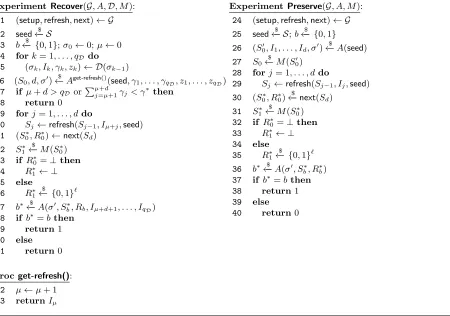
The security experiments for Recovering security and Preserving security are shown in Figure 7. We refer to the two games asRecover and Preserve, respectively. Our definitions are equivalent to those of [5] if one specializes to aM that returns a string sampled from{0,1}n and considers only non-blocking PWIs.
Roughly, a PWI has recovering security if even when starting in a compromised state, it will, after harvesting sufficient entropy, eventually return to a pseudo-random state (as described by the masking function) and begin producing pseudo-random outputs. It has preserving security if it can continue to maintain a pseudo-random state and produce pseudo-random outputs even if given arbitrary, adversarially controlled inputs from the entropy source. Intuitively, these properties should suffice to ensure robustness, and indeed, this is the case.
Definition 9 ((Witnessed) Recovering-Security). A PWI G = (setup,refresh,next,tick) has
(t, qD, γ∗, )-recovering security, witnessed by the masking function M, if, for any attacker A and legitimate sampler D, both running in timet, the recovering advantage