PRACTICAL APPLICATION TO INCREASE THE ADDITIONAL
VALUE FOR THE WHITE SAND AS ENVERONMENTAL SAFE
PRODUCT OF THE WADI EL-DAKHL, EASTERN DESERT, EGYPT
Nabil A. Abd EL Hafez1, Gamal El-Din A. Ibrahim2, Atef M. Abu Khatita1, Tarek Y. M. A. El-hariri2, Ahmed S. Mousa2, Nadia I. Mohamed2, Ahmed M. Arafat 3
1 Department of Geology, Faculty of Science, Al Azhar University, Cairo Egypt.
2 Exploration department, Egyptian Petroleum Research Institute (E.P.R.I.), Nasr City, Egypt. 3 Consultants engineering office.
Abstract: The present study is focused on the geology, distribution, reserves, economic importance, uses and new practical applications of the Egyptian White Sands to increase its additional value. The term white Sand was given to very white sand beds related to Carboniferous up to Early Cretaceous age composed mainly of pure quartz grains with some kaolinite intercalations. Improved silica products match with international Codes, Standers, industrial requirements and environmental friendly products, by using local raw materials. The controlling of chemical and physical properties of the product passes into laboratory tests and practical production of such silicates, special silicate solutions prepared by Egyptian Petroleum Research Institute, Provides continuous film on the concrete surface and retain moisture or promote proper cement hydration in freshly placed concrete; this led the compound acts as a good concrete curing compound, the water absorption, the volume of solid content and spreading rate allowed for concrete curing and achieved the same compressive strength of oil base curing material. (EPRI) silicate is water base and not causes any hazard for applicator and friendly environmental. (EPRI) silicate solution is the same specification, but cheaper in price comparing with that of oil base. In additional to that using of such solid and liquid silicates as additives to the concrete mix which designed by (EPRI) led to improve some of concrete properties comparing with the normal designed mix ratios.
Keywords: White sands, Silicates, concrete treatment.
1. Introduction.
White sand is a type of natural materials, constitutes essentially of quartz. It is characterized by high purity, white color and a low percent of coloring oxides well sorted, rounded to sub rounded with medium to fine grains. Ranges in age from Carboniferous up to Early Cretaceous age (Klitzsch et al., 1990). White sands are used in many purposes and industries such as abrasive, grinding and polishing materials, building materials, glassmaking, and refractory manufacture and in miscellaneous industrial uses depending on silica products. By manufacturing the Egyptian white sand yield for special type of silicate compound which used to many purpose as abrasive Wheels, detergent formulations, dishwashing, silicate base muds, cements (acid-proof, chimney, furnace, refractory, spark plug and stove) and coatings. In the present work the silicate compounds used as additives to concrete mixes to treatment some problems in concrete as voids and cracks and produce new types of concrete as the following.
2. Geology.
White sands in Wadi El Dakhl area are one from the best white sands quality in Egypt because the high percent silica, huge reserve exceed billions of tons, loose or friable raw material without rock cover composed mainly of pure quartz grains (99.6 % to 99.8 %) with trace of immature intercalations at Wadi EL Dakhl area.
2.1 Study area.
The study area is located in Wadi El Dakhl, Eastern Desert, Egypt between latitudes 28˚ 30' and 28˚ 55' N and between longitudes 32˚ 20' and 32˚ 50' E, covering an area of about 2880 km2, found in El Galala El Qiblia plateau between Ras Gharib and El Zafarana. About 60 km
North Ras Gharib and extend about 70 Km in valley. It is accessible through El Sokhna – Hurgada highway about 60 km from El Sokhna. Run parallel to the Gulf of Suez at the extremely part of Northern of the Eastern Desert, (Fig.1).
2.2 Lithostratigraphy.
Malha Formation in Wadi El-Dakhl area represented by 100 m thickness from pure white sands in horizontal beds mutual with some intercalation of kaolinite and sandstones, it overlies the Qaseeb Formation of Jurassic age and underlies the Cenomanian Shales of Galala Formation of Early Cretaceous age (Bendel and Kuss, 1987). It consists of very white sequence of stratified, cross-bedded and graded bedded of sandstones,friable stone in most sites in Wadi El Dakhl area. (Fig. 2) as described after Gamal et al (2016).
(Fig. 2): Lithostratigraphic column of study area at Wadi El-Dakhl, Eastern Desert. (After Gamal et al. 2016)with modified.
Age Form a ti on . Thickness
(m) Lithology. Description.
L a te Cre ta ce o us . G a la la .
Shale, clay, limestone and dolomites with interceded of glauconitic sandstone.
Ea
rly
Cret
a
ceou
s.
M
a
lha
.
100 m et erSandstone: white, fine grains,
friable, non fossiliferous, cross
bedded
and
some
kaolenitic
intercalations
.0
20 m.
Sandstone: white, fine to medium
grains, friable, non fossiliferous,
cross bedding, and rare kaolenitic
intercalations.
Sandstone: white, medium to coarse
grains, friable, non fossiliferous and
cross bedding
.Jurassic.
Q
as
ee
b. Interceded continental ferruginous, red bed of sandstone and variegated –colored shale
2.3. Occurrence of the white sand in Egypt
.
White sand forms an important part of recent industries. The importance of white sand as a raw material has increased in last year's due to the importance of the silicon compounds in our daily life activities, white sands represented in many different areas in Egypt and its purities, locations, geologic age, chemical composition, and reserves are summarized in (fig. 3 and Table 1). (As performed by Industrial Development Authority of Egypt, 2006)
Table (1):Summarized the locations, reserves and the chemical composition of white sands in Egypt Industrial Development Authority of Egypt in (2006).
Gabal EL
Mensherh Gabalyeleg Wadi Felly G.Halal GabalMnzor
Khaboba
Abo ZenemaAboZnema El. Gona W. DakhlZafrana Abou Darag Wadi Qena Marsa
Edfo-Alam Maady
Wadi EL.
Natrown N. Fayom GadeedWadi
3 20 1.3 1.9 understudy 1000
Billions
not
determined
4.1 240 determined 7.5Not 1.7
Silicon
oxide 90.9 - 98.8 …… 91.4-99.6 96.3-98.2 92.5 98.5-99.5 …… 90.32-96.46 99.3-99.8 98.4 90.65-94.9 >99 95.41 92.43-95.47 90.47-97.96 93.6-96
Aluminum
oxide 0.016-0.37 …… 6.25 0.2-0.8 0.2-0.8 >0.1 …… 1.85-6.00 0.11-0.04 0.23 3.2-6.82 0.2 2.05 1.34-2.6 2.24-3.03 0.1-2.01
Iron
oxide 0.13-0.9 …… 0.027-0.26 0.7-1.8 0.76 0.035-0.065 …… 0.026-0.03 0.018-0.01 0.03 0.025-0.06 …… 0.28 0.37-0.54 0.163-1.14 0.28-1.02
Magnesium
oxide 0.002-0.022 …… 0-0.035 0-0.034 …… …… …… 0.006-0.03 0.14 0.11-1 0.01-0.013 …… 0.57 0.78-1.19 0.71
Calcium
oxide 0.04-0.26 …… 0-0.88 0.35-0.68 …… …… …… 0.004-0.312 0.6 0.11-1.5 0.04-0.16 …… 1.01 0.55-0.7 >0.86 0.8-1.02
Others 0.0006-0.0029 …… 0.006-0.019 …… …… …… …… 0.003-0.213 …… 0.36 …… 0.2-0.3 …… …… …… 0.36-0.58
In use Not inuse Not inuse Not in use In use Not inuse Not in use Not in use In use Not in use Not in use Not in use
Not determined
North Sinai South Sinai Eastern Desert Western Desert
Locations
In use
P
e
rc
e
n
ta
g
e
%
Reserves By million tons
Using situation
3. Special type of sodium silicates manufactured by using the Egyptian white
sands.
Sodium Silicates chemistry and its uses was the main subject of many studies(e.g., Ming, 2003; S. Lucas, 2011; Seka, 2011; X.C.Shi,et al., 2006; xiaokaih., et al. 2010; yoshida, A.,
1994). Pure white sand (Sio2 ranging from 99.6% to 99.8) was collected from some localities
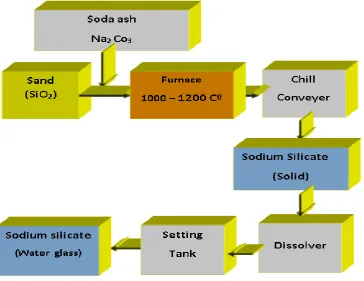
of El-Dakhl area and manufactured to prepare special type of sodium silicates of special physical and chemical properties by the Egyptian Company for Chemicals (E.C.C.). (Fig. 4).
Fig. (4).Diagram illustrates the perpetration of sodium silicates from white sand (after Gamal et al., 2016)
4. Environmental impact.
By revision the previous works for many authors as Nausha, A. et al. (1998) and Yuan
et al; (2010), Gamal et al., (2012), Henno et al (2004), HERA (2005), Ismail et al (2009) and
make comparison between sodium silicates and other substances which used in concrete manufacture as rubber and fly ash noted that Based on their chemical and physical properties, their Ecotoxicological behavior and harmful effects can be seen that sodium silicates are in general low risk products and friendly environmental more than other substances which used in concrete manufacture as rubber and fly ash.
5. Methodology.
5.1. Petrographicaly analysis.
5.2. Engineering tests
.
The engineering tests were carried out for 135 cubes at the Laboratories of Cemex, Al Amana Company for ready mix, in spite of the Wadi El Nile hospital extension and in Medicom Company Alex Bank – 90 St
6. Petrographicaly characteristics.
Simply the petrographic study carried out in the present work is based on the examination of 15 thin sections representing the previously chosen samples to be subjected to manufacturing as raw materials. Those samples represent the friable white sands collected from Wadi EL Dakhl area related to Malha Formation of early cretaceous age. The aim of this study is to illustrate the mineralogical composition, the sand grains shapsand sizes, the petrographic description of the rock follows the classical classifications of Folk (1959, 1962, 1974) and Tucker (1981).
Description.
Petrographicaly, the sandstones of Malha Formation studied samples are composed of quartz arenites more than 99% of Quartz with very rare impurity (mainly clays) less than 1%. (Figs. 5 & 6 and 7). Quartz grains are of medium to fine (Fig. 5) and occasionally of coarse sand sized they are sub-angular to sub-rounded (Fig. 6), moderately well sorted. And occasionally rounded (Fig. 7). Most of the quartz grains are simple (monocrysalline).
7. Results and dissuasion.
7.1. Engineering results
.
The main purpose of these tests is using silicate compound to producing special type of concrete as follow.
1- Additives to Improve the concrete characteristics
2- Additives to increase the ability to casting concrete under water
(Fig. 5): Photomicrographs showing Quartz arenites Malha Formation Wadi EL Dakhl area (Sample No9 C.N.X20).
(Fig. 6): Photomicrographs showing quartz arenites Malha Formation Wadi EL Dakhl area (Sample No1 C.N.X20).
The concrete samples were prepared according to Egyptianstandards NO. 1658 (1991): part five method for making test cubes, B.S. (1881-1983) part 108 and ASTM C- 192 (1988):
method for making test cubes from fresh concrete, BS EN 12350-2 (2000): Testing fresh
concrete D Part 2: Slump test. By mixing a specified weight of aggregate, sand, cement and
water as follow.
A- The samples was molded at the 15x15x15 cm and divided in to three layers all layer 50 mm in thickness then compacting the samples by using stander compaction rod its weight 1.8 Kg, long 380 mm and square cross 25 mm.
B- Each layer of three layers receive spread blows over the surface of each layer not less than 30 strike as it showing in (figs. 8 A & B).
C- Samples maintained in mold for 24 hours.
D- The samples was removed from the mold, and cured in water for a specified period 7 and 28 days as it showing in (fig. 8. C).
E- The Samples was testing by crushing machine ELE International Machine Certificate 1500 kn. ADR compression machine from ELE-118 Issue 1,September 2012 , to select the compressive strength as it showing in (figs. 8. D).
Fig. (8). Stags and methods for preparing concert cubes and testing it according to standards specification.
A
B
7.1.1. Excremental procedures.
1-Tests to improve the concrete properties by using of silicates compound. 1. A. Mixing by liquid silicates as different ratio from water weight.
(Table. 2): cumulative results for the compressive strength tests of concrete after 7, 28
days and water absorption
(Fig. 9):the relationship between the compressive strength and the replacement ratio. Test types
Compressive strength
(Kg/cm2) Water absorption 7 Day 28 Day
10% Replacement liquid silicates instead of
10 % of water content 399.7 486.2 0.9 % 5% Replacement ( liquid silicates ) instead
of 5% of water content 390 488.8 1.2 % 3% Replacement ( liquid silicates ) instead
of 3 % of water content 427.6 513.5 1 % 1% Replacement ( liquid silicates ) instead
of 1 % of water content 464.5 612.7 1.2 % General
mix General mix 379.5 456.4 1.3 % Add as
20%
add liquid silicates as 20 % of water
content 379.1 538.8 1 %
(Fig. 10):The relationship between water absorption results and the replacement ratio %.
1. B. Mixing by solid silicates instead of different ratio from (aggregate one, aggregate two and sand)
(Table. 3): Cumulative results for the compressive strength tests after 7 days & 28 days and water absorption.
Mix types.
Compressive strength
Water absorption 7 days 28 days
1 Replacement solid silicates instead 5% of
Agg1,2 and Sand 221 526.3 1.03
2 Replacement solid silicates instead 5% of
Sand 433.4 541.3 1.1
3 Replacement solid silicates instead 5% of (
Agg1 & 2) 449 561.3 0.8
4 General mix 379.5 456.4 1.3
W
ater
a
bsorption %
Replacement of liquid silicates %
Wa
ter
a
bso
rpt
ion
(Fig. 11): the relationship between the compressive strength and the type of tests
7.1.2. Using special type of silicates to increase the ability of casting concrete under
water.
2. A. Using solid silicates as different ratio from sand weight.
(Table. 4): Cumulative results for the compressive strength tests of concrete after 7 and 28 days for solid silicates
Solid silicates
7 DAYS 28 DAYS
Compressive strength (kg/cm2)
Compressive strength (kg/cm2)
5% 381.3 468.2
3% 383.5 468.4
1% 433.8 543
(Fig. 13): The relationship between the compressive strength and the additional ratio of solid silicates
Compre
ssive
stre
ng
th
2. B. Using liquid silicates as different ratio from water weight.
(Table. 5): Cumulative results for the compressive strength tests of concrete after 7 and 28 days for liquid silicates
Liquid silicates
7 DAYS 28 DAYS
Compressive strength (kg/cm2)
Compressive strength (kg/cm2)
10% 355.8 451.2
5% 305.8 403.4
3% 303.4 385.26
(Fig. 14): Relationship between the compressive strength and the additional ratio of liquid silicates
7.2. Engineering Discussion.
7.2.1. Tests to improve the concrete properties by using of silicates compound.
1. A. Mixing by liquid silicates as different ratio from water weight.By monitoring results of the tested concrete cubes and compare the concrete compressive strength and water absorption results which optioned from concrete treatment by addition the silicates compound with the general mix showing the next.
A.1. Mix by using liquid silicates instead of 10% from water content. After 28 days noted that the compressive strength increase as 6.2 % and water absorption decrease as 30% for the general mix.
250 300 350 400 450 500
10
% %5 %3
7 DAYS
28 DAYS
addation ratio
C
om
pr
es
si
ve
st
rengt
A.2 Mix by using liquid silicates instead of 5% from water content. After 28 days noted that the compressive strength increase as 6.6% and water absorption decrease as 7.7% for the general mix.
A.3 Mix by using liquid silicates instead of 3% from water content. After 28 days noted that the compressive strength increase as 11% and the water absorption decrease as 23% for the general mix.
A.4 Mix by using liquid silicates instead of 1% from water content. After 28 days noted that the compressive strength increase as 25% and the water absorption decrease as 7.7% for the general mix.
A.5 Mix by using liquid silicates with admixture as 20% from water content. After 28 days noted that the compressive strength increase as 15% and the water absorption decrease as 23% for the general mix.
1. B. Mixing by solid Silicates instead of different ratio from (Aggregate one, Aggregate two and Sand).
By monitoring results of the tested concrete cubes and compare the concrete compressive strength and water absorption results which optioned from concrete treatment by addition the silicates compound with the general mix showing the next
B.1 mix by using solid silicates instead of 5% from Agg1, Agg2 and sand contents. After 28 days noted that the compressive strength increase as 13% and water absorption equal the general mix.
B.2 mix by using solid silicates instead of 5% from sand contents. After 28 days noted that the compressive strength increase as 15.5% and water absorption decrease as 15% for the general mix.
B.3 mix by using solid silicates instead of 5% from Agg1, Agg2 contents. After 28 days noted that the compressive strength increase as 18.5% and water absorption decrease as 35% for the general mix.
7.2.2. Using special type of silicates to increase the ability of casting concrete under water.
By monitoring results of the tested concrete cubes and compare the concrete compressive strength results which optioned from concrete treatment by addition the silicates compound with the concrete order after 28 days as it showing in the next details.
2. A. Using solid silicates as different ratio from sand weight.
A.1 Mix by using solid silicates as 5 % from sand weight. After concrete mixed by solid silicates the slump test change from 16 to 10 cm. and the compressive strength after 28 days increase 14.5 % for the concrete order.
A.2 Mix by using solid silicates as 3 % from sand weight. After the concrete mixed by solid silicates the slump test change from 16 to 13 cm. and the compressive strength after 28 days increase 14.5 % for the concrete order.
A.3 Mix by using solid silicates as 1%. from sand weight. After the concrete mixed by solid silicates the slump test change from 16 to 15 cm. and the compressive strength after 28 days increase 24.5 %. for the concrete order.
2. B. Using liquid silicates as different ratio from water weight.
B.1 Mix by using liquid silicates as 10 % from water weight. After the concrete mixed by liquid silicates the slump test change from 15 to 10 cm. and temperature from 28 to 32 Cº and the compressive strength after 28 days increase 11.3 % for the concrete order.
B.2 Mix by using liquid silicates as 5 % from water weight. After the concrete mixed by liquid silicates the slump test change from 15 to 12 cm. and temperature from 28 to 30 Cº and the compressive strength after 28 days equal the concrete order.
B.3 Mix by using liquid silicates as 3% from water weight. After the concrete mixed by liquid silicates the slump test change from 16 to 13 cm. and temperature from 28 to 29 Cº and the compressive strength after 28 days less than the concrete order with 3.75 %.
From these results showing that the additives ratio is directly proportional with the compressive strength, two admixtures achieved the required concrete order and only one less than the concrete order with simple different.
10. Summary, conclusion and recommendations
.
White sand is one of non-metallic ores that forms an important part of recent industries. The importance of white sand as a raw material has increased in last year’s due to the importance of the silicon compounds in our daily life activities. The white quartz sand has special importance in lot of industries as it forms the major parts of the raw materials used. The work presented focused on the geology, distribution, reserves, economic importance, uses and new practical applications of the Egyptian White sand to increase its additional value.
The term white sand was given to very white sand beds related to Carboniferous up to Early Cretaceous age Malha formation composed mainly of pure quartz grains with some kolinitic intercalations about 100m thickness at Wadi EL Dakhl area.
The sandstones of Malha Formation studied samples are composed of quartz arenites more than 99 % of quartz with very rare kaolinite less than 1%.
The sand purity about 99.5 to 99.8 % SiO2 chemically and mineralogical quartz the main
minerals in the white sand in Malha formation in Wadi EL Dakhl. Eastern desert.
Improved silica products match with international codes, standers, industrial requirements and environmental friendly products,
Consequently, the comparison between sodium silicates and other substances used in concrete manufacture (e.g. rubber and fly ash) illustrates that, sodium silicates are in general characterized by low environmental risk than other substances based on their chemical and physical properties, their Eco toxicological behavior and harmful effects.
Using liquid and solid silicates as additives to improve the concrete properties achieved the best result from compressive strength and water absorption at 3% replacement from water weight at liquid silicates, and best result at replacement solid silicates instead 5% from aggregates size one and two.
Using liquid and solid silicates as additives to increase the ability casting concrete under water shows that five admixtures achieved the required concrete order and only one admixture less than concrete order with simple different.
So it's recommended to perform more applied research to increase the additional value of white sands and to improve the chemical and physical properties of silicate products that match with the international cods, standers and industrial requirements instead of the imported. Also export and bad use of such pure sands is not recommended.
References
American Standard for Testing Materials (A.S.T.M) – C- 128 (1979): standard test method for specific gravity and absorption of fin aggregate.
American Standard for Testing Materials (A.S.T.M) – C- 192 (1988): standard testing of making and curing concrete test specimens in the laboratory.
American Standard for Testing Materials (A.S.T.M) – C- 642 (1982): standard testing of specific gravity, absorption and voids in hardened development concrete.
Bandel, K. and Kuss, J. (1987): Depositional environment of the pre-rift sediments - Galala Rights (Gulf of Suez, Egypt). Berliner geowiss. Abh. A, 78, 1-78 pp.
BS 1881: part 108 (1983): method for making test cubes from fresh concrete.
BS 1881: part 115 (1986): Testing concrete. Specification for compression testing machines for concrete. BS EN 12390-4:2000, 14p.
BS EN 12350-2 (2000): Testing fresh concrete D Part 2: Slump test, The European Standard EN 12350-2:1999 has the status of a British Standard 9 p.
Egyptian Geological Survey and Mining Authority (1994): report on Glass sand of Sinai
Folk, R.L. (1959): Practical Petrographic Classification of limestones, Bull Amer. Ass. Petrol. Geol. 43, 111 p.
Folk, R.L. (1962): Spectral Subdivision of Limestone types. Amer. Ass. Petrol. Geol. Mem., 1, 62 p.
Folk, R.L. (1974): Petrology of Sedimentary Rocks. Hemphill Publ. CO. Austin, Taxes, 159 p.
Gamal, A. I.; Ahmed, S. M.; Tarek, Y. M. A. El-Hariri and Ibrahim M. H. (2016): New industrial use of White Sands from Wadi EL Dakhl area, Eastern Desert, Egypt international Journal of Innovative science, Engineering & Technology, Vol. 3-Issue 1. 516-524pp .
Gamal, A. I.; Tarek Y. M. A. El-hariri. Ahmed S. Mousa and Gaber M. AW. (2012b).
Gamal, A.I. Ahmed S. Mousa, Tarek Y. M. A. El-hariri and Gaber M. AW., (2012a).
Appraise the influence of sodium silicates as abrasive materials in petroleum
Henno P. van Dokkum , Jan H. J. Hulskotte , Kees J. M. Kramer , and Joël Wilmot (2004):
Emission, Fate and Effects of Soluble Silicates (Waterglass) in the Aquatic Environment. Environ. Sci. Technol. 38, 515-521pp.
HERA (2005): Risk Assessment on ingredients of European household cleaning products 64 p.
Industrial Development Authority of Egypt (I.D.A.E). (2006): The investation map for basics chemicals - Silicon and its compounds. Pap. No. 136 (E-1)
Ismail G A, Magda M. Abd El-Salam, Anwar K. Arafa (2009). Wastewater Reuse in Liquid Sodium Silicate Manufacturing in Alexandria, Egypt. J Egypt Public Health Assoc Vol. 84 No. 1 & 2. 34-49pp
klitzsch, E.; Groeschke, M. and Herrmann-Degen, W. (1990): Wadi Qena: Paleozoic and pre-Campanian Cretaceous strata. In: Geology of Egypt (Ed. by R. Said), 321- 327 pp.
Ming-Shyong tasai, (2003): Surface modification of nanocolloidal silica for use as polishing abrasive particles, Materials Science
Nausha, A., Anees U. M. and Shahreer, A. (1998). Corrosion prevention with sodium Corporation, Technical report no. TR 3804 / EVP 95013, Kingdom of Saudi Arabia.
S. Lucas, M.T. Tognonvi, J-L. Gelet, J. Soro, S. Rossignol, (2011): Interactions between silica sand and sodium silicate solution during consolidation process, Journal of Non-Crystalline Solids, V. 357, 1310-1318pp.
Séka S. K., Monique T. T., Julien S and Sylvie R., (2011): Consolidation mechanism of materials obtained from sodium silicate solution and silica-based aggregates. Journal of Non-Crystalline Solids, V. 357, pp. 3013 – 3021.
Tucker, M. E. (1981): Sedimentary Petrography An introduction. Blackwell Scientific Publications, Oxford, 252 p.
X.C. Shi, G. Jarjoura and G.J. Kipouros. (2006): Conversion coating treatment for AZ31 alloy in a permanganate-phosphate solution, TMS 2006 Annual Meeting – Magnesium Technology, 273 pp.
Xiaokai H; Zhitang S.; Haibo W.; Weili L., Zefang Z., (2010): Investigation on the controllable growth of monodisperse silica colloidal abrasives for the chemical polishing application. Microelectronic Engineering, (87), 1751 – 1755 pp.
Yuan M R, M Jin-tang Lu and Gang Kong (2010): Effect ofSiO2:Na2o molar ratio of sodium
silicate on the corrosion resistance of silicate conversion coatings. Surf and Coat. Tech.; V. 204, pp.1229-1235.
Yuan M R, M Jin-tang Lu and Gang Kong (2010): Effect ofSiO2:Na2o molar ratio of sodium