JOURNAL OF
RANGE
MANAGEMENT
PublIshed bimonthly-January, March, May, July, September, November-by the Society for Range Management 2760 West Fifth Avenue Denver, Colorado 80204 Copyright 1979 by the Society for Range Management Managing Editor
LORENZ F. BREDEMEIER 2760 West Fifth Avenue Denver, Colo. 80204 Editor
REX D. PIEPER
Dep Animal and Range Science New Mexico State Unlvensty Las Cruces, N Mex 88003 Book Review Editor PAT 0. CURRIE
Science & Education Admin. Livestock and Range Research Station Route 1, Box 3
Miles City, Montana 59301 Copy Editor
PATRICIA G. SMITH 2760 West Fifth Avenue Denver, Co10 80204 Editorial Board 1977-79
JAMES 0. KLEMMEDSON, Tucson, Anz GEORGE W. SCOTTER, Edmonton, Alta M. JOE TRLICA, Fort Colllns, Cola. J. ROSS WIGHT, Logan, Utah 1978-80
DONALD A. KLEBENOW, Reno, Nev JAMES T. NICHOLS, North Platte, Neb. MICHAEL D PITT, Vancouver, B.C RONALD E. SOSEBEE, Lubbock, Tex
1979-81
ROD BOVEY, College Statdon, TX NEIL FRISCHKNECHT, Provo, UT MARTIN VAVRA, Union, OR HAROLD GRELEN, PinewIle, LA
INDIVIDUAL SUBSCRIPTION IS by membership In the Society for Range Management
LIBRARY or other INSTITUTIONAL SUBSCRIPTIONS, on a calendar year basis, are $22.00 postpald to all countries. Payment from outslde the United States should be remitted In US dollars by rnternational money order or draft on a New York bank
CHANGE OF ADDRESS notices should be sent to the Managing Editor, 2760 West Fifth Ave., Denver, CO 80204, no later than the first day of the month of issue. Copies lost due to a change of address cannot be replaced unless adequate notice IS given. To assure uninterrupted service, provide your local postmaster with a Change of Address Order (POD Form 3575), indicating thereon to guarantee forwarding postage for second class mail. POSTOFFICE: Please return entire journal with address change. BUSINESS CORRESPONDENCE, concerning subscrtp- tons, advertising, reprints, back issues, and related mat- ters, should be addressed to the Managing Editor, 2760 West Fifth Ave., Denver, CO 80204
EDITORIAL CORRESPONDENCE, concerning manu- scripts or other editorial matters, should be addressed to the Editor, Dep. Animal and Range Sciences, New Mexico State Univ., Las Cruces 88003.
INSTRUCTIONS FOR AUTHORS appear each year in the March Issue, copies of these instructions are available from the editor
SECOND CLASS POSTAGE paid at Denver, Colorado
TABLE OF CONTENTS: Vol. 32, No. 4, July 1979
ARTICLES
Low-Level Aerial Photography as a Management and Research Tool for Range Inventory by T.W. Heintz, J.K. Lewis, and S.S. Wailer
Herbage Response to Grazing Systems and Stocking Intensities by H. Walt Van Poolen and John R. Lacey
Fertilizing and Burning Flint Hills Bluestem by Clenton E. Owensby and Ed F. Smith
Vegetation Stagnation in Three-Phase Big Game Exclosures by Paul T. Tueller and Jerald D. Tower
Grazing and Overstory Effects on Rotationally Burned Slash Pine Plantation Ranges by Warren P. Clary
Prescribed Burning: Vegetative Change, Forage Production, Cost, and Returns on Six Demonstration Burns in Utah by Michael H. Ralphs and Frank E. Busby Control of Common Goldenweed with Herbicides and Associated Forage Release by H.S. Mayeux, Jr., D.L. Drawe, and C.J. Scifres
Comparison of Fecal, Rumen and Utilization Methods for Ascertaining Prong- horn Diets by A.D. Smith and L.J. Shandruk
Factors Affecting Root of Stem Cuttings of Salt Desert Shrubs by Steven G. Richardson, Jerry R. Barker, Kent A. Crofts and Gordon A. Van Epps
Emergence and Survival of Honey Mesquite Seedlings on Several Soils in West Texas by Darrell N. Ueckert, Lynne L. Smith, and B.L. Allen
Control of Saltcedar by Subsurface Placement of Herbicides by E.B. Hollings- worth. P.C. Quimby, Jr., and D.C. Jaramillo
Response of Native Grassland Legumes to Water and Nitrogen Treatments by W.K. Lauenroth and J.L. Dodd
Response of Blue-winged Teal to Range blanagement on Waterfowl Production .4reas in Southeastern South Dakota by Patrick H. Kaiser, Stephen S. Bet-linger, and Leigh H. Fredrickson
Interactions Between Mule Deer and Cattle on Big Sagebrush Range in British Columbia by W. Willms, A. McLean, R. Tucker, and R. Ritcey
Production Response of Native and Introduced Grasses to Mechanical Brush Manipulation, Seeding, and Fertilization by C.L. Gonzalez and J.D. Dodd Effect of Grazing by Cattle on the Abundance of Grasshoppers on Fescue Grass- land by N.D. Holmes. D.S. Smith. and A. Johnston
Potential Evapotranspiration and Surface-mine Rehabilitation in the Powder River Basin, Wyoming and Montana by Ten-ence J. Toy
The Economics of Sheep Predation in South-western Utah by R.G. Taylor, John P. Workman, and James E. Browns
Alkaloid Levels in Reed Canarygrass Grown on Wet Meadows in British Columbia by W. Majak, R.E. McDiarmid, A.L. van Ryswyk, K. Broersma. and S.G. Bonin
Tt-.c‘tiNICAL NOTES
,320 Southern Wax-myrtle Response Following Winter Prescribed Burning in South Florida by Steve W. Terry and Larry D. White
Low-Level Aerial Photography as a Manage-
ment and Research Tool for Range Inventory
‘T.U. HEINTZ, .l.K. l.EWIS, AND S.S. WA,.,,ER
Abstract
,111 inexpensive technique i? reviewed fix using low-level aerial
photography as a management and research toal fi,r range.
Iloditications of a previously documented camera mount are
reported that allow greater tlexihility in the use of aerial photo- graphy for range evaluation. This technique involves the use af color infrared film with a 135mm telephoto lens double filtered with orange and magenta filters.
As increasing demands are placed on our private and public
rangclands. care “1”~ be taken to manage these valuable
resources in such a way as to maintain them in a productive
condition. To manage rangelands properly. record\ <,f annual
vegetative changes should be maintained and evaluated. Vege-
tation samples are usually clipped to provide records for
documenting changes in vegetation. This requires a substantial
i~~~i~unt of labor. time. and money. Collecting information
alxwt chanses in vegetation utilizing low-level aerial photw
graph! can reduce time. labor. and exlxns.
Aerial photographs from a light plane can be obtained rapidly
with a minimum amount of labor. These photo+vaph> contain
valuable information that can be used for managing private and
lpublic lands. and for range research purposes. Many agencies
,lll-ds~d) 1~3~ the rnece\\ary equipment at thiir dispoul lir
collecting aerial photographs. The Bureau of Land Management
m Montana has used a P-mm aerial photography system fw
wve~-al years (Meyer and Gerbig 1973). This method of data
collection enabled them to inventory study plots more rapidly
than tl-oni the ground. Small format (35.mm) aerial lphoto-
~v,q’l~y I’rom light ail-craft Iha great potential a\ pan of a z
uxvd~nated system of range inventory. Aerial photograph\ of
11~ wne area at different times during the yearand fn)m year LO yeal- can provide information on patterns of growth and utilize-
tion of range vegetation. vegetative change. range condition.
operator
to
view the tli_eht line from the rear seat of the airplane.However. direct observation through the viewfinder was found
to be the most foolproof sighting method available for use with
the removable outside mount. Goggles were neccswy to />rotect the photographer‘s eyes.
Use of Imagery
Inx~~,eiery from this system was used to delineate soil and
ve+at~on patterns and to stratify clip-plot locations in range
research projects. Stratification of clip-plot locations on a
\olodizzd-solonetr soil complex near Rapid City using Iow-
level aerial photography reduced the number of sample5 needed
liv sampling weight of western wheatgrass (Agwpyon .smirlGi:
Beetle iY70. Van Brugeen IY76)’ to within IO’/ of the mean nit11 Y5(h probability from 430 to 30 plot\ (Weller et al. 1978).
Tbi\ resulted in a great saving of time, labor. and money.
AIM). pictures were taken alone permanent tlight lines
located in the experimental pastures at Cottonwood. These
l’lisht lines ranfed from 181 m to Yl4 m in length and were
located on hey LI\C area\ in low. medium. and high range
condition. Pictura were taken monthly during the growing
wnwn in 1Y7h and 15277 in conjunction with color infrnred
rtcrwgrams taken from a height of about I m supplcmcnted
M ith clipplot inftxmation. This imagery was tdken a\ pan of a
range ecosystem tnventory method which is being developed.
Costs
The cost of this method of data collection was relatively low after the initial purchase of the camera system. About $900 was tn\e\ted in the camera. lens. and motor drive, with the mount
awing 360 and developing equipment S60. Airplane expense
ua\ $3 I per hour. film $2.75 perroll. and proccssinf chemicals ahout $1 .10 per roll. Labor costs must also be included for the
photo$rapber and film processor. When comparing these costs
to those incurred when u\ins larger format (small-scale photo-
gphy) aerial photography, such as that from ii remote sensinp
asency, the method described in this article is a very economical
method of data collection. One routine photo mission flown
over the Ranee and Livestock Experiment Station by the nearest remote sensing agency would have cost over $I, 100. The cash
CM of one mission with nearby light aircraft was only $70.
rhu\. the saving derived from the first mission was sufficient to ~more than offset the cost of all the photographic equipment. Not only is this system economical, but it also possesses outstanding tlexibility with regard to tlight time and film processing. which
15 cxtrcmely important in a region with variable weather.
Summary
Land manager\ need a fast, reliable, inexpensive method of
@ering information to wisely manage their resource. Photo-
“raphy l’rom light aircraft can partially replace traditional labor- L_
IIIICII\I\C information eathering methods and hold\ great
prom,\c for the future.
Herbage Response to
Stocking Intensities
H. WALT VAN POOLLEN AND JOHN R. LACEY
Abstract
A review of pertinent literature shows that grazing systems and grazing intensities both influence herbage production on Western ranges. Mean annual herbage production increased by 13% when grazing systems were implemented at a moderate stocking inten- sity. Increases were larger (35% and 27%) when continuous livestock use was reduced from heavy to moderate, and moderate to light, respectively. This suggests that adjustments in livestock numbers have a greater effect on herbage production than do grazing systems.
Grazing systems are bein g implemented on Western ranges by land management agencies. These agencies use studies by Hormay and Talbot 193 I, Hormay and Evanko 1958, Merrill I PG. Reardon and Merrill I Y 70, Martin 197.3, and Hickey and Ciarcia 196-l. among others, to support this action. These trrazing system studies report better livestock distribution, c‘
Irreater herbage and livestock production, and improved range bondition. However, literature reviews (Hickey 1968; Heady 1% I : Herbel I97 I ; and Shitlet and Heady I97 I ) also sum- marize grazing system studies which report nonsignificant &tge responses. reductions in livestock production, and cost increases. Some researchers (Heady 1% I ; Mathis and Koth- mann I9h8; Cook l9hh; and McMeekan 1956) feel that vegetation is affected more by grazing intensity than by grazing systems.
One objective of this paper is to review and analyze data from CTrazIng
2 system and grazing intensity studies. The second objective is to determine whether livestock adjustments have a crrcater effect on herbage production than do grazing systems. t
Met hods
We havt: compared specialized grazing systems to continuous grazing. Heady (19hl) treated rotation, deferred, rest rotation, and deferred rotation systems as specialized systems and considered seasonlong and yearlong grazing to be continuous use. This approach is logical because differences between vegetative types and periods of use and nonuse make it difficult to compare one specialized system to another.
Herbage production data are the most reliable measure of grazing management procedures (Klipple 1964). Consequently, grazing studies were reviewed to find those which compared herbage pro- duction data under continuous use and specialized grazing systems. Rchults were used only from studies describing use at a moderate level (-iO-hO(% ). Herbage production under the respective systems was
I IIC ,1uthor\ N 141 to thanh Dr Rohcrt I’ C;~hhtxs and Dr P,tt 0 Currle tor their helptul :c\ ,c\\ \
Grazing Systems and
tabulated from each of 18 studies and the difference in productive- nesb between the grazing systems and continuous are determined. An average difference for all studies was calculated. An average dif- ference was also calculated for the four geographic regions. These means were compared by an analysis of variance. We have used these average differences as a measure of the vegetal response that can be expected when a specialized grazing system is implemented.
Differences in herbage production under light, moderate, and heavy IiLcstock use were also tabulated from I3 studies. Results were used only from studies describin g use at a comparable level as follows: heavy. hO-8O’k ; moderate, 40-60%; and light JO-40%. Average differences between production at the three use levels were calculated. An average difference was also calculated for two geographic regions. Thc\e means were compared by an analysis of variance. We have used
these average differences as a measure of the vegetal response which can be expected when livestock use is reduced from heavy to moderate. and from moderate to light, respectively.
Results and Discussion
Hcrbage Response to Grazing Systems
Herbage production averaged 13% higher when livestock use \\;I\ controlled by a specialized grazing system. rather than bcillg continuous (Table I ). Two of the studies (Hamilton et al.
:
!
7 L
T
__i_
....‘.“.” GRAZING SYSTEM
--- MODERATE TO LIGHT - HEAVY TO MODERATE
NORTHERN FLINT WESTERN
GREAT HILLS RANGES
PLAINS
Table 1. Herbage production (lb/acre) under grazing systems and con- tinuous use, and mean differences in production for 18 studies in 6 geographical areas.
Production Grazing Continuous
Author Geographic Area System Use Percentage difference Northern Great Plains
Black et al. 1937 Blacketal. lY4Z Campbell I96 I Hubbard I95 I Lodge 1970 Smoliak I960
Flint Hills
Herbel et al. 1959 Ordinary upland Limestone breaks Clay upland Ouen\by et al. I973
Loamy upland Breaks Clay upland Smithetal.. 1978
Texas
Kothmann et al. I Y75 Deep upland Deep upland Rolling hills Rolling hills Kcng et al. I YhO Rcardon et al. I Y70
Southwest hlartin I970 Martin I973 Martin el al. IY7h
Site I Site II Site III
f’ac~l IC Northwest Hamilton lY45 Shoclln et al. lY70
Grassland Forest
Ai crags for Western Range4
_
-No difference- 0
-No difference- 0
1350 -301 489 1952 I996 I346 45’1 3564 431 I 2759 1532 I227 1287 I054 Higher I I88 3’0 -s9 551 I95 357 Higher +51 -108 -2YX I163 Higher
-161 I 465 I 6 -I.! -I3 c J s=-.7%.S=1 l,S.I-=4*
I 744 12
1499 33
I II6 71
4318 3898 3657 3604 ‘3 I8 h ,?- I ;.s= 1(~.ss=4:‘~
1’33 955 723 788 481 24 ‘8 39 34 ‘5 147*:r s=zo. S=h..s.?3”
550 -hO
64 3Y
394 I75 387
47 I I -8 \-;I.J=(,l*s.\=~7-, Y f’l -13-l -35 14.; I y.”
-750 .’
IO ,_5: and Camf~bell 1% 1 ) investigated tame pastures, the rcllGnder native ranges. Reardon and Merrill’s ( 1976) study \\;I\ omitted from the analysis because the continuous use f)asture was grazed at a higher stocking intensity. The study of She\ tin et al. ( 1976) was omitted because utilization averaged _ 1 I(,( t‘or the t‘icc key species. Klipple’s ( 1964) datum was onl~tted because it was a statistical outlier (Li 1963).
I krbqe response to grazing systems differed by geographi- cal area (Table I. Fig. 1). For example, when herbage response
Table 1. Herbage Production (lb/acre) under two grazing intensities and mean differences in production for 14 studies in 9 geographic areas.
Author
Northern Great Plains Hanson et al. I970 Johnson et al. I95 I Lewisetal. 1956
Ridges South slopes North slopes Draw Rauzi 1963 Reedetal. 1961
Flint Hills
Herbel et al. I959 Ord. upland Limestone break Clay upland Launchbaugh I957
Colorado Seeded Range Currie et al. 1970
Agrop.‘,vrorl cristtrtutn Bromus irlerrnis Agcr and Brin Agrop~ron
irltertnediutn
New Mexico Valentine 1970
Oklahoma Hazel1 I967 Colorado
Smith I YO7 Wyoming
Pond lY6l Granitic soil Sedimentary soil Utah
cool\ I97 I Pacific Northwest
Shovlin et al.. I Y76 Grassland Forest Averac7e for Western 2
Ranges I752 I762 1069 1098 I188 ‘509 727 314 1318 1528 505 IO96 1082 555 I l8Y 477 49 3172
- 203
.48 1.18 -45% +9 -121 Production
Heavy Moderate % Change
3093 I9
1571 25
I009 -6
I300 I9
1343 I3
‘33 I
--_ -II
1574 II7
381 21
X=25%, s=40, X%14***
1749 33
1499 1
1116 1%
1245 14
X=43%,s=55,s.~=38***
1770 I7
755 36
1578 33
894 87
,T=_lJCd .S=_q)*SS= 15:‘::‘:::’
77 57
3767 19
+85 143*
.74 5;
I .48 _>
-1 IQ 7h
+57 _ . 5;;
-1’8 -5
X=35% .s=37,s.i=8”“*
under specialized grazing systems was compared to that under co~~t~nuous use. mean herbage production decreased 0.7?9%. Inc:cascd I7t7’/;. and increased 30+~~~/( in the Northern Great i’lairt5. f;lint Hills. and Texas. respectively. The three studies (hl,lrtin 1970: Martin 1973: Martin and Ward 1976) from ~~rthcrn Arizona suggest that mean herbage response wi I I irlcrca\e blj o+-4 I ‘/( when grazing systems are implemented in tl\c’ Southwest. It is unrealistic to predict mean herbage rc- \l)onscs in the shortgrass prairie ot‘ Colorado or the f’acit‘ic
Northwest because of the restricted number of studies. The .Inalysis of variance showed the means were not significantly dit‘t’ercnt. However, Table I suggests that responses in the Flint Hills and Texas regions are similar, and that these are different Irom the responses in the Northern Great Plains. The data also suggest that additional research is needed in the Southwest before geographic differences can be fully analyzed.
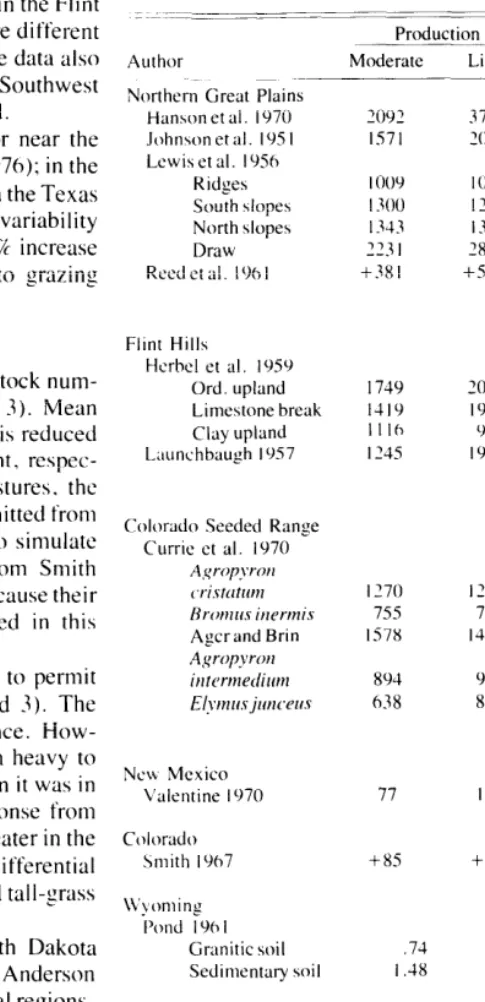
Table 3. Herbage production (lb/acre) under two grazing intensities and mean differences in production for 12 studies in 8 geographic areas.
Author
Production Moderate Light
__.___
7c Change
Variation measured on different range sites at or near the Santa Rita Experimental Range (Martin and Ward 1976); in the f-lint Hills region (Herbel and Anderson 1959); and in the Texas rugion (Kothmann et al. 1975) is similar to the variability hetic een geographical regions. Therefore, the I 3 2 8% increase I\ a realistic estimate of mean herbage response to grazing \yslcms on Western ranges.
Northern Great Plains Hanson et al. IO70 Johnson et al. I95 I Lewisetal. 19%
Ridges South \lopes North slopes Draw Reed et al. I% I
2092 IS71 IO09 I300 I343 “11 a__ t281
3700 77
2043 30
I059 5
I289 -I
I389 3
2885 29
f5M 4x
x= - ‘7% 3 SE -, 78 s.T_= 1 I***
Herbage Response to Grazing Intensity
I-Ieibage responses are fairly consistent when livestock num- ber\ are reduced on Western ranges (Tables 2 and 3). Mean herbage production increases 35 and 28% when use is reduced t’rom heavy to moderate. and from moderate to light, respec- ri\cly. Currie and Smith ( 1970) studied seeded pastures, the rcnlainder native ranges. Cook’s ( I97 I ) study was omitted from the analysis because he used a clipping technique to simulate li\cstock ? tTrazin<r Z on seven plant species. Data from Smith ( i 007) and Sko~ lin et al. ( 1976) were not analyzed because their uriliLation levels were lighter than those considered in this anaIysi4.
Flint Hills
Hcrbcl et al. 1959 (3rd. upland Limestone break Clay upland Launchbaugh I957
1739 1319 I I Ih I245
Only two geographic regions had enough studies to permit conlparison on native ranges (Fig. I, Tables 2 and 3). The :,nalysis of variance showed no significant difference. How- L’L~X. the response from reducin g livestock use from heavy to modcrate in the Flint Hills (42+65%) was higher than it was in the Northern Great Plains (3f17%). But the response from reducing livestock use from moderate to light was greater in the YIUorthcrn Great Plains than in the Flint Hills. The differential rcsponsc may retlect the interplay
of
short-. mid-. and tall-grass 4pccics.Colorado Seeded Range Currie ct al. 1970
Agropyrort c~risfatiitn Rrotnus irwrrnis Agcr and Brin Agropyrott itlrcrtnetliirrn Elytnus juncwts
1770 755 1578 894 h38
I2h4 0
787 4
1479 -6
907 3
885 3;
j;c=S%,S= 18,S.i=8*** NW Mexico
Valentine I970 77 I59 I 06
Colorado
Smith I%7 +8S +I8 -79
Variation between range sites measured in South Dakota (Lewis et al. 1950) and in the Flint Hills (Herbel and Anderson
1050) is similar to the variability between geographical regions. Thcrct’ore. the .;5? l-154. and the 282 1.1% increases are realis- tic estimates of mean herbage response to livestock adjustments that reduce use from heavy to moderate. and moderate to light, respectively.
\I’\ om i ng Pond 1% I
Granitic soil Sedimentary \oil
Management Implications
Tables I .‘. and 3 can be interpreted to predict herbage response ;o (Trazing management c‘ procedures on Western ranges. Herbage production can be expected to increase an .ILcracLt: of 13+-8’/ when grazing systems are implemented. t~ccler~l land management agencies could also use the 13?8% increase as a basis for associated livestock and socio-economic predictions in their environmental impact statements.
kit ic Northwest Shoblin et al. 1976
Grassland Forest A~eragc for Western
Ranges
.7-I I .A8
- 11%
+s7 -12X
+33 _ 15 9:
- I08 Ih”
,?=28c/( ,S=33,s_jz8”‘K’
Geographically. herbage response to grazing systems was most Lariable in the Southwest. This variation (ok4 I c/c) makes it dit‘t‘icult. if not impossible to predict consistent herbage rc~ponse. Therefore. it appears that livestock adjustments beionic increasingly important as a management tool in this region. In contrast. herbage response to grazing system imple- mentation is less variable in Texas. Thus. it becomes a more tb,rsiblc management tool in this region.
It is not possible to evaluate grazing system implementation at ;I light stocking intensity. Gibbens and Fisser’s (1975) study
c,n a big sagebrush range is most applicable. They felt that a light stocking rate was the reason vegetal cover did not show dit‘t’erences between rest rotation, deferred, or seasonlong crrazing.
c‘
It is possible to compare the alternatives of implementing trruring system at moderate use or of reducing livestock Z
other factors before they decide to adjust livestock from ment system for bunchgrass ranges. Calif. Forest and Range Exp. Sta. Misc. moderate to light, implement grazing systems, or do a combi- Pap. 27. I I p.
nation of both alternatives.
Hormay A L . and M.W. Talbot. 1961. Rest-rotation grazing-a new managkmentyystem for perennial bunchgrass ranges. U.S. Dep. Agr., Prod. Land managers are also confronted with the situation of Res. Rep. 5 1. 43 p.
implementing-grazing systems and simultaneously reducing Hubbard,-William A. 1951. Rotational grazing studies in western Canada. J. livestock use from a heavy to moderate level. Tables 1, 2, and 3 Range Manage. 4:25-29.
can be used to evaluate the alternatives. For example, livestock Johnson, Leslie E., Leslie A. Albee, R.O. Smith, and Alvin L. Moxon. adjustments result in a 35% and grazing systems a I 3% increase
i95l. Cows. calves and grass. So. Dakota Agr. Exp. Sta. Bull. 412. 39 p.
Keng, E.B., and L.B. Merrill. 1960. Deferred rotation grazing does pay in herbage production. These values can be adjusted pro- dividends. Sheep and Goat Raiser. 40: I?- 14. Extracted from Hickey, Wayne portionately to account for the total herbage response. It is C.. Jr. 1969. U.S. Dep. Agr., Forest Serv.
assumed this would be an additive effect, resulting in the total Klipple, Graydon E. 1964. Early- and late-season grazing versus season- nqonse. Thus. livestock adjustments. from heavy to moderate long grazing of short-grass vegetation on the Central Great Plains. U.S. Dep. Aer.. Forest Serv. Res. Pap. RM-I I, Rocky Mountain Forest and Range use. would account for 73%, and grazing systems for 27% of the Eip. Sta., Fort Collins. Coio. I6 p.
total herbage response when both are implemented simul- Klipple, G.E., and R.E. Bement. 1961. Light grazing-is it economically taneously . Kothmann, feasible as a range-improvement M.M., W.S. Rawlins, and Jim Bluntzer. 1975. practice. J. Range Manage. Vegetation and 14:57-67.
Conclusions
Results from a number of controlled grazing studies show that mean herbage production will increase by I3 + 8% when grazing systems are implemented, at a moderate use level on Western ranges. This is a smaller response than is obtained when livestock use is reduced from heavy to moderate, or from moderate to light. These livestock adjustments cause herbage production to increase by 352 14% and 28+- 13%, respectively. This suggests that land managers should place more emphasis on proper stocking intensity, and less on grazing system
implementation.
Literature Cited
Black, W.H., A.L. Baker, V.I. Clark, and D.R. Mathews. 1937. Effect of different methods of grazing on native vegetation and gains of steers in North- ern Great Plains. U.S. Dep. Agr., Tech. Bull. 547. I9 p. Extracted from Hickey. Wayne C., Jr. 1969. U.S. Dep. Agr.. Forest Serv.
livestock responses to grazing management on the Texas Experimental Ranch. Texas Agr. Exp. Sta.. PR-3310. 4 p.
Launchbaugh, J.L. 1957. The effect of stocking rate on cattle gains and on native shortgrass vegetation in west-central Kansas. Kans. Agr. Exp. Sta. Bull. 394. 29 p. Extracted from Klipple, G.E., and R.E. Bement. 1961. J. Range Manage. 14:57-61.
Lewis, James K., George M. Van Dyne, Leslie R. Albee, and Frank W. Whetzal. 1956. Intensity of grazing-its effect on livestock and forage production. So. Dakota Agr. Exp. Sta. Bull. 459. 44 p.
Li, Jerome C.R. 1964. Statistical Inference I. Edwards Brothers, Inc. Ann Arbor. Mich. 658 p.
Lodge, R.W. 1970. Complementary grazin, ~7 systems for the Northern Great Plains. J. Range Manage. 33268-27 I.
Martin, S. Clark. 1973. Responses of semi-desert grasses to seasonal rest. J. Range Manage. 26:165-170.
Martin, Clark. 1970. Vegetation changes on semi-desert ranges during IO years of summer, winter and year-long grazing by cattle. Int. Grassl. Congr. Proc. I I 23-26.
Martin, S. Clark, and Donald E. Ward. 1976. Perennial grasses respond
Black, W.H., and V.I. Clark. 1942. Yearlong grazing of steers in the inconsistently to alternate year seasonal rest. J. Range Manage. 39:346. Northern Great Plains. U.S. Dep. Agr., Circ. 642. I6 p. Extracted from Mathis, G.W., and M.M. Kothmann. 1968. Responseof native range grasses Hickey. Wayne C.. Jr. 1969. U.S. Dep. Agr., Forest Serv. to systems of grazing and grazing intensity. Progr. Rep. 1626. In: Agro-
Campbell, J.B. 1961. Continuous versus repeated-seasonal grazing of grass- nomic Research in the Texas rolling plains. Tex. Agr. Exp. Sta. Consoli- altalfa mixtures at Swift Current, Saskatchewan. J. Range Manage. 14:-
77-77.
Cook, C.W. 1966. Carbohydrate reserves in plants. Utah Agr. Exp. Sta. Resources Ser. 3 I. 47 p.
Cook, C. Wayne. 1971. Effects of season and intensity of use on desert vegetation. Utah Agr. Exp. Sta., Bull. 483. 57 p.
Currie, Pat O., and Dwight R. Smith. 1970. Response of seeded ranges to different grazing intensities. U.S. Dep. Agr., Prod. Res. Rep. I I?. 41 p.
Gibbens, R.P., and H.G. Fisser, 1975. Influence of grazing systems on vege- tation in the Red Desert region of Wyoming. Wyo. Agr. Exp. Sta. Sci. Monog. 29. 23 p.
Hamilton, J.G., Grover F. Brown, Harold E. Tower, and Wilkie Collins,
dated Progr. Rep. 26 16-1626. p. 7 I-33. Extracted from Shiflet, Thomas N., and Harold F. Heady. 1971. U.S. Dep. Agr., Soil Conserv. Serv. SCS- TP-152. I3 p.
McMeekan, C.P. 1956. Grazing management and animal production, Proc. 7th Intern. Grassland Congr. 146-156. Extracted from Heady. H.F. 1961. J. Range Manage. 14:182-193.
Merrill, L.B. 1954. A variation of deferred-rotation grazing for use under Southwest range conditions. J. Range Manage. 7: 151-154.
Pond, Floyd W. 1961. Vigor of Idaho fescue in relation to different grazing intensities. J. Range Manage. l4:28-30.
Rauzi, Frank. 1963. Water intake and plant composition as affected by dif- lbrential grazing on rangeland. J. Soil and Water Conserv. 18:35-37.
Jr. 1945. Irrigated pastures for forage production and soil conservation. U.S. Reardon, P&rick O., and Leo B. Merrill. 1976. Vegetative response under Dep. Agr.. Farmers Bull. 1973. 30 p. Extracted from Hickey, Wayne C., various grazing management systems in the Edwards Plateau of Texas. J. Jr. 1969. U.S. Dep. Agr.. Forest Serv. Range Manage. 29: I95- 198.
Hanson, Clayton L., Armine R. Kuhlman, Carl J. Erickson, and James K. Reed, Merton J., and Roald A. Peterson. 1961. Vegetation. soil. and cattle
Lewis. 1970. Grazing effects on runoff and vegetation on western South responses to grazing on Northern Great Plains Range. U.S. Dep. Agr.. Dakota rangeland. J. Range Manage. 23:418-420. Forc\t Serv. Tech. Bull. 1252. 79 p.
Hazell, Don B. 1967. Effect of grazing intensity on plant composition, vigor, Shiflet, Thomas N., and Harold F. Heady. 1971. Specialized grazing and production. J. Range Manage. 20249-252. \y\tcms: their place in range management. U.S. Dep. Agr.. Soil Conserv.
Heady, H.F. 1961. Continuous vs. specialized grazing systems: a review and Serv. SCS-TP-152. I3 p.
application to the California annual type. J. Range Manage. 14:181-193. Skotlin, Jon M., Rohert W. Harris, Gerald S. Strickler, and George A. Herbel, C.H. i971. A review of research related to development of grazing Garrison. 1976. Effect\ of cattle grazing method\ on ponderosa pine- systems on native ranges of the western United States. Jornada Exp. bunchgrass rang’ in the Pacific Northwest. U.S. Dep. Agr.. Forest Serv. Range, Rep. 3. New Mex. State Univ. 32 p. Tech. Bull. 153 I. -to p.
Herbel, C.H., and K.L. Anderson. 1959. Response of true prairie vegeta- Smith, Dwight R. 1967. Effect\ of cattle grazing on a ponderosa pinc- tion on major Flint Hills range sites to grazing treatment. Ecol. Monogr. bunchgras\ range in Colorado. U.S. Dep. Agr.. Forest Serv. Tech. Bull.
‘9: I7 I - I Xh. I .;7 I 00 I’.
Hickey, Wayne C., Jr. 1969. A discussion of grazing management systems Smith, Ed I;., and Clenton E. Owensby. 1978. Intensive-early stoching and and some pertinent literature (abstracts and excerpts) 1895-1966. U.S. Dep. \eason-Ions \toching of Kansas Flint Hills range. J. Range Manage. 3 I : II- Agr.. Forest Serv. Regional Office, Denver, Colo. I. I unnumbered. 17.
Hickey, Wayne C., Jr., and George Garcia. 1964. Changes in perennial Smoliak, S. 1960. Effects of deferred-rotation and continuous grazing on gra\s cover following conversion from yearlong to summer-deferred grazing yearling steer gains and \hortgra\\ prairie vegetation of southeastern Alberta. in west central New Mexico. U.S. Dep. Agr.. Forest Serv. Res. Note RM-33, J. Range Manage. Ii:239-132.
Rocky Mountain Forest and Range Exp. Sta.. Fort Collins, Colo. 3 p. \ alentine, K.A. i 970. lntlucnce of grazing intensity on Improvclncnt of
Hormay, A.L., and A.B. Evanko. 1958. Rest-rotation grazing-a manage- detcrlorated blach grama range. New Mexico Agr. Exp. Sta.. Bull. 553. 7 I p.
Fertilizing and
Burning Flint Hills
Bluestem
CLENTON E. OWENSBY AND ED F. SMITH
Abstract
Burned and unburned Kansas Flint Hills range was fertilized in early May with 0,40, and 80 lb N/acre/year and grazed from May
1 to October 1. Fertilizing with 40 lb N/acre increased carrying capacity per pound of nitrogen applied more than 80 lb N/acre did. Maintenance of good quality range was favored by burning and 0 and 40 lb N/acre compared to not burning and the same fertilizer rates. Eighty lb N/acre produced poor quality range whether burned or not. Individual steer gains were highest on burned pastures with 0 and JO lb N/acre compared to unburned pasture at those same rates or pastures with 80 lb N/acre whether burned or not. Increased carrying capacity on fertilized pastures compared to unfertilized gave higher gains/acre.
Nitrogen is apparently the most limiting factor in herbage production of Kansas Flint Hills range (Owensby et al. 1970). Range fertilized at 50 lb/acre of nitrogen has produced twice the herbage of unfertilized plots (Mader 1956; Moser and Anderson
196-C). Changes in stand composition toward cool-season ‘7rasses and weedy forbs have been the major deterrent to 2
nitrogen fertilization of Flint Hills grasslands.
Anderson et al. ( 1970) indicated that cool-season grasses and weedy forbs were reduced by late spring burning. Gay and Dwyer ( 1965) in a one-year study on ungrazed Oklahoma True Prairie found that fire and nitrogen in combination produced 0.8 ton/acre and I .O ton/acre more herbage at SO and 100 lb N/acre, respectively, than burned, unfertilized True Prairie. No fertili- zer response was obtained from unburned, fertilized areas. We studied the effects of no burning and late spring burning with 0. 40, and 80 lb N/acre on herbage production, stand composition, basai cover, and steer gains on bluestem range.
Study Area
Materials and Methods
The study area was four 60-acre and two 44-acre pastures on the Kansas State University Experimental Range Unit (Donaldson Pas- tures) in the northern Kansas Flint Hills near Manhattan, Kans. Big bluestem (Amlropgm gerurdi Vitman), little bluestem (Andropogon sc~~puri~s Michx.), and Indiangrass [Sorghastrum rzuruns (L.) Nash] were the major dominants. Kentucky bluegrass (Poaprurensis L.) and sideoats grama [Boutelouu c’urtipemlulu (Michx.) Torr.], along with numerous perennial grasses, forbs, and woody species, constituted the remainder of the plant community. Soils were transitional udic ustolls to udolls. Range sites varied from deep, well-drained sites to rocky to clayey areas. Principal range sites common to all pastures were loamy upland and breaks (Anderson and Fly 1955).
Treatments
Nitrogen was aerially applied as urea in 1972 and as ammonium
nitrate in 1973, 1974, and 1975 during early May to burned and unburned pastures stocked at various rates with yearling steers (Table I). Burning was the last week in April.
Table 1. Nitrogen and burning treatments and stocking rates on six Flint Hills bluestem pastures, 1972-1975.
~__ Burned (late April)
Not burned
N-rate (lb/acre)
0 40 80 0 40 80
Stocking rates, steers (acres/animal unit) I972 1973 I974 I975
5.0 5.0 5.0 5.0 3.3 3.3 3.3 3.3 2.2 2.2 2.8 2.8
5.0 5.0 5.0 5.0 3.3 3.3 3.3 3.3 2.2 2.2 2.8 2.8
Plant Census
Basal cover and % composition were determined by the modified step-point system (Owensby 1973). Three sets of 500 points were taken in each pasture along lines forming a grid of the entire pasture. Analysis of variance was run on the change in basal cover and composition from pretreatment levels by certain species and groups of species for loamy upland and breaks range sites.
Herbage Production
Herbage remaining at growing season’s end was harvested from fifteen I / I O,OOOth-acre plots randomly located on loamy upland and breaks range sites m each pasture. Herbage was separated into perennial grass and forb-brush components, dried, and reported as pounds of dry matter per acre. Because cages tend to distort total herbage yield estimates (Owensby 1969), steer days per acre plus the herbage remaining after grazing were used to estimate total herbage production in each pasture.
Cattle
Steers. approximately I4 months old and individually identified, grazed the pastures from May 2 to October 3, I54 days. All were gathered the first of each month, penned overnight without feed or water, and weighed the next morning.
Statistical Analyses
Analyses of variance were run using subsamples to estimate the error variance since the experiment was not replicated. Though not completely valid statistically, those analyses indicate probable dif- ferences.
Herbage Yield
Results and Discussion
Perennial Grass Component
Table 2. Perennial grass (lb D.M./acre) remaining on grazed loamy upland and breaks range sites at season’s end (1972-74 avg.).
Not burned loam) upland breaks Burned
loam) upland brcahs I \I) (,i ;\:
0
2067 2910
1489 1177
N, lb/A 40
1567 2499
1836 1751
80
1.509 2382
I069 1121
On unburned pastures less perennial grass remained on fertiii- Led pastures than on the unfertilized; on the burned pastures 0 and 80 lb/acre of nitrogen left comparable amounts, both less than u,here -40 lb/acre was applied.
k‘or-h-brush Component
Forb-brush herbage remaining at growing season’s end on CrraLed loamy upland and breaks range sites was the same c‘
regardless of N-rate on unburned pastures, but less remained on burned pastures at the 0 and 10 lb N-rates than on unburned pastures at the salne N-rates (Table 3). Forb-brush amounts remaining on the 80-lb, N-rate, burned pasture were com- parable to those of the unburned pastures. The 80-lb N-rate pasture did not burn well, which likely accounted for its similarity with unburned pastures in amount of forb-brush remaining.
Table -3. Forb-brush (lb D.M./acre) remaining at season’s end on grazed loamy upland and breaks range sites (1972-74 avg.).
Not burned loarn~ upland hreahs 13 umed
loamy upland brtxhx I \I) ,: -->
0
581 462
289 IS5
N. lb/A 40
533 584
‘h8 3-13
Steer- Lktys Plus Rernuining Herbage
Higher stocking rates on fertilized pastures produced more steer days/acre (Table 1). After the first 2 years of the study, stocking rates on the 80-lb, N rate pastures were reduced because too little herbage remained at season’s end to maintain vigor of the dominants. A combination of steer days/acre and hcrbage production indicated that the 80-lb N-rate was not desirable since the 10 lb N/acre gave results nearly as good.
Burning and 40 lb/A of nitrogen appeared to be the best for increasing stocking rate and maintaining herbage production.
f’ltrt1t Ccws11.s
Plant census is reported as the change in percentage compo- sition and basal cover of the major components of loamy upland
Table 1. Steer days/acre on burned and not burned pastures with indicated nitrogen rates (I97L-1975).
N. lb/A 1972-73 1971-7s
0 15.5 15.5
40 68.2 68.2
x0 107. I x3.3
and breaks range site from pretreatment ( I97 I ) to posttreatment (1975).
Bawl Cover
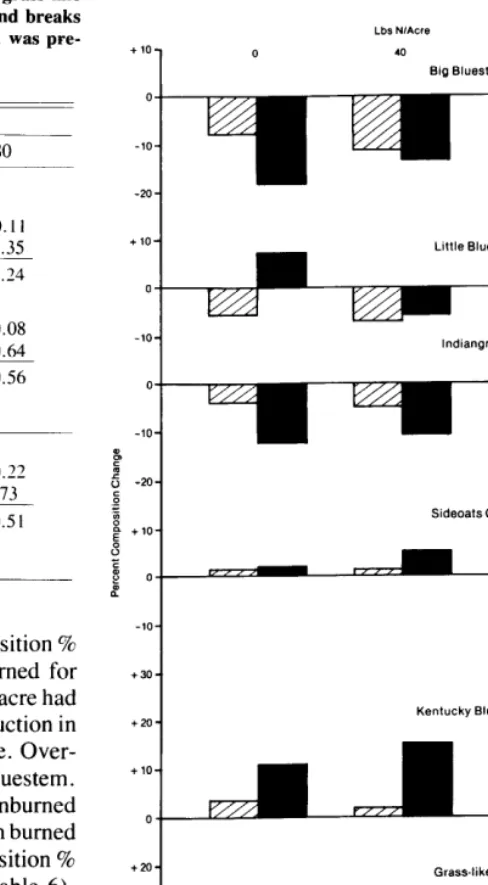
Big bluestem, Indiangrass, and Kentucky bluegrass exhibited greatest differences in basal cover changes among treatments (Fig. I ). Big biuesrem and Indiangrass basal cover increased on burned pastures with 0 and 40 lb N/acre during the +year period, but decreased on the unburned pastures with the same fertilization rates. On pastures with 80 lb N/acre big biuestem and Indiangrass basal cover decreased whether burned or unburned. Apparently, burning favored those warm-season. sod-forming grasses. The 80 lb N-rate pastures were probably stocked too heavily, which likely reduced vigor of palatable, preferred species.
Lbs N/Acre +15
1
0 4080 m burned
+10- BIQ Bluestem
+05-
lndmngrass
Kentucky Bluegrass
Kentucky biuegass basal cover increased as nitrogen rate increased on unburned pastures (Fig. I ). On burned pastures the basal cover changes were less and decreased as fertilizer rate increased. Greatest increases in Kentucky bluegrass basal cover came on loamy upland range sites (Table 5).
Basal cover of grass-like plants (mostly sedges) increased more as nitrogen rate increased (Table 5). Like Kentucky bluegrass. grass-iihe plants were mostly cool-season and began ;gro\\ th earlier than the warm-season perennial grass dominants and thus wet-c favored by nitrogen application.
Cotnpositioti Percetitqes
1 he major walm-season perennial grass dominants (big biucstcm. Indiangrass. and little bluestem) decreased in relative amount of the total basal cover from I97 1- I975 regardless 01‘
Table 5. Changes in basal cover (%) Kentucky bluegrass and grass-like plants for indicated nitrogen treatments on loamy upland and breaks range sites (avg. of burned and unburned treatments). 1971 was pre-
treatment level. + 10
0 N, lb/A
0 40 80 -10
Kentucky bluegrass
loamy upland -20
1971 0.16 0 3’ .__ 0.11
1975 1.26 1.47 2.35 + 10
Change +1.10 + I .25 +2.24
0 breaks
1971 0.07 0.06 0.08
1975 0.37 0.33 0.64 -10
Change +0.30 +0.27 +0.56
0 LSD,05=0.30*
-10
+Grass-like plants 8
1971 0.22 0.18 0.22 f
1975 0.84 1.03 0.73 0 5 -20
Change +0.62 +0.85 +0.5 I f 8 +
10
LSD ,05+0.20* 0 g
E g 0
LSD applies only to the change in basal cover. p”
-10 treatment (Fig. 2). Big bluestem and Indiangrass composition %
were reduced more on unburned pastures than on burned for +30 pastures with 0 and 40 lb N/acre. Pastures with 80 lb N/acre had
more reduction in big bluestem basal cover and less reduction in + 20 Indiangrass basal cover on unburned than burned range. Over- all burning was detrimental to composition % of little bluestem. + 10
Kentucky bluegrass composition % increased on unburned
pastures as nitrogen rate increased, but did not change on burned 0 pastures. Loamy upland had greater increases in composition % +20 of Kentucky bluegrass than did breaks range sites (Table 6).
Plant Census Summary + 10
Basal cover of the desirable warm-season perennial grasses generally increased under burning and fertilizing with 0 and 40 0 lb N/acre more than under unburned treatments. At the 80 lb N-rate desirable warm-season species decreased in basal cover +10 on both burned and unburned pastures, and remained relatively 0 constant on unburned pastures at the 0 and 40 lb N-rate. Basal cover of less desirable grasses and forbs increased much more at
all nitrogen rates on unburned pastures than burned. Apparent- Fig. 2. jerent grassesjrom Changes in composition percentages (70 oj total basal cover) of dij- pretreatment levels (1971) to post-treatment levels (1975) ly, without fire, fertilizing at the 40 lb N-rate did not maintain a under indicated nitrogen and burning treatments (avg. oj loamy upland and high quality stand. Fertilizing with 80 lb N/acre did not maintain breaks range sites).
Table 6. Changes in percent composition (% of total basal cover) of Kentucky bluegrass under indicated nitrogen treatments on loamy upland and breaks range sites (avg. of burned and unburned (treat- ments). 1971 was the pretreatment level.
0
N, lb/A
40 80
Kentucky bluegrass loamy upland
1971 1975
Change
breaks 1971 1975
Change
4.3 5.2 2.9
15.6 16.0 25.6
+11.3 + 10.8 +22.7
1.7 1.3 1.8
4.2 6.6 9.8
+2.5 +5.3 +8.0
LSD.O5 =2.7*
*LSD applies only to the change in % composition
a burned
Lbs N/Acre
40 SO - u”b”r”ed Btg Bluestem
1 I
LSD 05
Llttle Bluestem
lndtangrass
I I LSD 05
Sldeoats Grama
Grass-like Plants
Perennial Forbs
r t LSD .05
high quality stands whether burned or unburned.
Composition percentages of desirable species in the stand decreased more on unburned pastures, particularly at the 80 lb N-rate, than on burned ones. On burned pastures undesirable species increased slightly in composition %, but on unburned pastures increases were large. Burning and fertilizing with 40 lb N/acre seemed to improve maintenance of good quality range. Fertilizing with 80 lb N/acre failed to maintain good quality range whether burned or not.
forbs were favored by adding nitrogen. and warm-season peren- Since pastures receiving additional nitrogen were stocked at a nial grasses were reduced compared to unfertilized areas
(Owensby et al. 1970; Mader 1956; Moser and Anderson 1964). Results agree with the findings in this study.
Steer Performance
Gtiirl per Steer
Individual steer gain was generally greater on burned pastures than on unburned, probably because forage quality was higher. Allen et al. (1970) reported that nitrogen free extract was increased and cell wall constituents decreased for big and little bluestem on burned pastures compared with unburned ones. Anderson et al. ( 1970) reported higher gain per steer on late spring burned Flint Hills bluestem range than unburned. On unfertilized pastures, gain per steer was greater on burned pastures than on unburned 2 of the 4 years and the same the other 2 years (Table 7).
Table 7. Average steer gains (lb/steer) from late spring-burned burned bluestem pasture fertilized as indicated.
and un-
Pounds ofgainiateer, May Z-Oct. 3. I S-l days Nitrown C’- lb/A ~~~~~~
\r’car Treatment 0 -IO 80
1072 Burned I8_P ’ 2 I 7” I w
Unburned 135”“” I SF I I h”
I072 Burned I txYv I S-l”f 1 2 ghrd
Unburned 1 _J 7rr/<~f IX”” 101”
I v7-1 Burned 261” 2XY I 8Sh
Unburned I ‘)7h’ 15-l”’ IS”’
1075 Burned lXIVh I78”h , ~(f”‘f
Unburned I 7Qh I~7”“’ , _J 7”h’f h k \IC,III\ \\ llh tllllcrt2nr sutwvrlpl\ ditter ~ignltkmtlj (1’2 OS).
On pastures fertilized with 40 lb N/acre gain per steer was higher on burned pastures than unburned each year. Individual steer gain on the unfertilized, burned pastures was lower in
Io‘;L. greater in 197-C. and similar in 1973 and 1075 to gains on pastures fertilized with 30 lb N/acre. Individual steer gain was greater in the unburned, unfertilized pasture than on unburned pastures with 40 lb N/acre in I973 and I975 and similar in I971 and I 97 3 .
Steers gained less on the unburned pasture with 80 lb N/acre than on burned ones fertilized at the same rate every year except 1975. Three of the four years, steers gained less on burned pastures with 80 lb N/acre than they did on pastures with 0 and 40 lb N/acre. In i972, individual steer gain was similar for burned pastures with 0 and 80 lb N/acre, and less than that on the burned pastures with 30 lb N/acre. During the first 1 years of the study. steers on the unburned pasture with 80 lb N/acre gained less individually than those on pastures with 0 and 10 lb N/acre. The last 1 years, the unburned pasture with 80 lb N/acre had gain per steer simiiar to that on the unburned pasture wth 10 lb N/acre: both were less than gain per steer on the unburned pasture without niu-ogen.
Apparently, failure of steers to gain as well on pastures with SO lb N/acre was due partly to overstocking and reduced forage selectivity by steers. Table 2 shows less forage remained on pastures with 80 lb N/acre at the end of the growing season than on other pastures.
Gtrirl per Acre
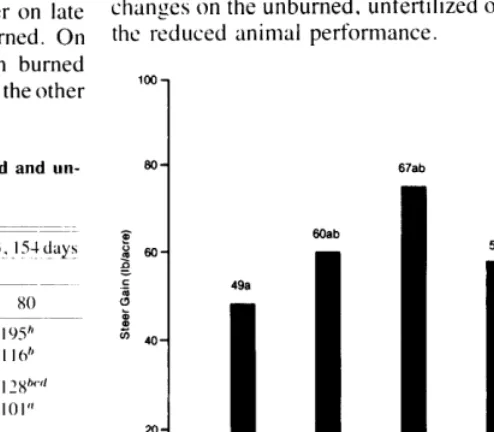
Gain per acre on fertilized, unburned pastures was not significantly greater than on the unburned, unfertilized one.
higher-rate (Table I ) to use additional forage, more gain per acre would be expected unless individual steer gain was greatly reduced. That happened on the unburned pasture with 80 lb N/acre. where in each of the 1 years individual animal gains were reduced. In Z of the 1 years , gain per steer was lower on the unburned pasture with 10 lb N/acre than on the unburned, unfertilized pasture (Fig. 3). Allen et al. ( 1976) reported big and little bluestem were similar in most nutritive components whether on an unburned pasture with 10 lb N/acre or on an unburned, unfertilized pasture. Possibly, changes in botanical composition in the fertilized, unburned pastures compared to changes on the unburned, unfertilized one were responsible for the reduced animal performance.
100
1
93b86b
Not burned
Not Not burned burned
4&b 8&b N/A NIA
Burned Burned 4&b
N/A
Burned 8&b
N/A
On burned pastures, Z (Tain per acre was greater on fertilized than on the unfertiiized one. Pastures with 10 and 80 lb N/acre had similar gain per acre even though stocking rate was greater on the X0 lb N-rate pasture than the 40 lb N-rate one. Again, the rcduccd gain per head on pastures with 80 lb N/acre was responsible for the similarity in gain per acre between pastures uith 40 and X0 lb N/acre.
Conclusions
I. Fertilizing with 40 lb N/acre increased carrying capacity per pound of nitrogen applied more than did fertilizing with 80 lb N,acre. both compared with no fertilization.
’ Maintenance of good quality range was favored by burning -.
and 0 and 40 lb N/acre compared with not burning and the same fertilizer rates. Eighty lb N/acre produced poor quality range uhether burned or not.
_;. Kentucky bluegrass and perennial forbs increased more on unburned pastures than on burned, with the greatest increases under nitrogen fenilization.
-4. Individual steer gains were highest on burned pastures with 0 and 40 lb N/acre compared to unburned pastures at those same rates or pastures with 80 lb N/acre whether burned or not. 5. Forty lb N/acre applied to late spring-burned bluestem pa~turc seems to represent the best combination of the treat- mcnts tested.
0. Even though stocking rate and nitrogen fertilization rates are confounded, making it difficult to determine cause and effect relationships, the research does indicate which of the treatments applied gave the most favorable results.
Literature Cited
Aldous, A.E. 1934. Etfect of burning on Kansas bluestem pastures. Kansas Agr. Exp. Sta. Bull. 38. 65 p.
Allen, Leland J., Ed F. Smith, Robert R. Schalles, Benny E. Brent, Leniel H. Hat-bet-s, and Clenton E. Owensby. 1976. Effects of range burning and nitrogen fertilization on the nutritive value of bluestem. J. Range Manage. 29:306-308. i
Anderson, Kling L., and C.L. Fly. 1955. Vegetation-soil relationships in Flint Hills bluestem pastures. J. Range Manage. 8:163-169.
Anderson, Kling L., Ed F. Smith, and Clenton E. Owensby. 1970. Burning
Gay, Charles W., and Don D. Dwyer. 1965. Effect of one year’s nitro- gen fertilization on native vegetation under clipping and burning. J. Range Manage. 18273-376.
Mader, E.L. 1956. The influence of certain fertilizer treatments on the native vegetation of Kansas prairie. PhD Diss. Univ. of Nebraska, Lincoln. II6 p.
Moser, L.E., and K.L. Anderson. 1964. Nitrogen and phosphorus fertiliza- tion of bluestem range. Trans. Kansas Acad. Sci. 67:613-616.
Owensby, Clenton E. 1969. Effect of cages on herbage yield in True Prairie vegetation. J. Range Manage. ??:I3 I-133.
Owensby, Clenton E. 1973. Modified step-point system for botanical compo- sition and basal cover estimates. J. Range Manage. 76:302-303.
Owensby, Clenton E., Robert M. Hyde, and Kling L. Anderson. 1970.
Effect of clipping and supplemental nitrogen and water on loamy upland blue- tern range. J. Range Manage. X:341-346.
Vegetation
Stagnation
in Three-Phase
Big
Game Exclosures
PAUL T. TUELLER AND JERALD D. TOWER
Abstract
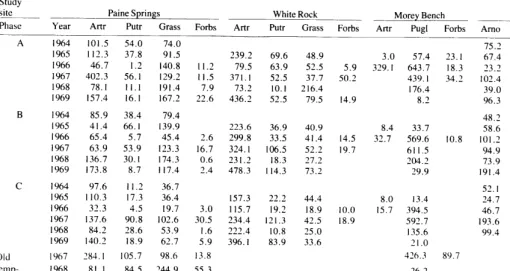
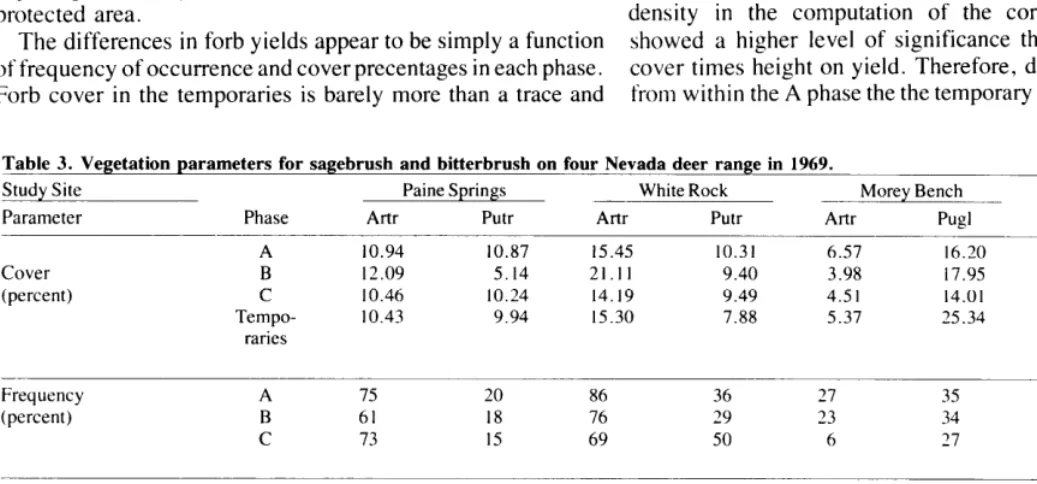
The allocation of range forage for deer and livestock is an important range management problem. Utilization of the three- phase exclosure technique for such evaluations is complicated by the response of plants to nonuse. Protection from browsing can cause “stagnation” to occur as early as the second year after the exclosure is established. Nonuse of bitterbush resulted in an average reduction in production of 70%. Temporary exclosures moved each year are required for accurately determining annual forage production.
Resource managers lack methods that will give reliable estimates of site productivity and its relationship to carrying capacity for either livestock or big game. One procedure often tijllowed for partitioning forage has been the use of three-phase cxclosures.
This paper reports a 6 year study to determine site pro- ductivity (i.e.. pounds of vegetation produced per hectare) through the use of three-phase exclosures and temporarily erected movable exclosures. Production refers to the total annual dry matter increment of grasses, forbs, and browse. El ti’cts of different species, plant density and dispersion charac- teristics. vegetation stagnation caused by lack of grazing, and site differences within three-phase exclosure all tend to con- t’ound range production and utilization data. Factors considered to intluence these results are precipitation, past utilization, condition and trend of the vegetation, and the period of pr.cHec t ion from grazing. Stugrutim can be defined as the
‘! 30
reduction in productivity of range plants resulting from a lack of Crazing.
c Use of exclosures for rangeland evaluation has received wide acceptance. Daubenmire ( 1940) defined the exclosure as any experimental area which is protected from the activities of a particular class of animal by a barrier such as a fence or screen. They have some drawbacks, such as the barrier effect which will intluence wind movement, precipitation, and seed collection. Three-phase exclosures were used as early as 1932, to discover and demonstrate the food preferences of animals (Young 1955). Each phase should be 1 acre (.405 hectare) or larger to have the least effect on the probability that deer will enter and should be located so that all phases are located on a single vegetatively homogeneous and representative part of the rangeland (Young
1958). Jones ( 1965) and McMahon ( 1966) have used the exclosure technique to study relative utilization, cover and compositional changes, and other effects.
Methods
Four important Nevada deer ranges and corresponding exclosure sites were selected for this study. Paine Springs, White Rock, Morey Bench. and the Fort Ruby sites were selected on the basis of vegetal homogeneity among exclosure phases and because they represent important deer winter range habitat-types.
The Paine Springs exclosure, built in 1962, is located in the Duck Creek Basin, near McGill in White Pine County within an Artemisiu fl.illc’rlfufLIIPlrr.~}~iu tridentutu/Poa secunda plant community at 2,073- m elevation. The White Rock exclosure, near White Rock Peak in Lincoln County, is situated in an Artemisia tridentuta/Purshia tri- dcrlttrtcl/Pou secwndu plant community at approximately 2,190-m elevation and was constructed in 1965. Morey Bench is in Hot Creek Valley east of Tonopah in Nye County. A three-phase exclosure was built there in 1965 situated in an Artemisia tridentatu/Purshia ~~l~rrltllrloscr/Pn~~~~~s urzdersorzii plant community at the base of Morey