Transactions of the 17th International Conference on Structural Mechanics in Reactor Technology (SMiRT 17)
Prague, Czech Republic, August 17 –22, 2003
Paper # S01-5
Progress of HTR-M Projects for the HTR
D. Buckthorpe1), R. Couturier2), J. van der Laan 3), H. Hegeman 3), A. Vreeling 3), B. Riou 4)
H. Rantala 5), P. Ennis 6), G. Haag 6), K. Kühn 6), A. Buenaventura 7), B-C. Friedrich 8)
1) NNC Ltd., Knutsford, UK
2) Commissariat à l’ Energie Atomique (CEA.), Grenoble, France 3) Nuclear Research and Consultancy Group (NRG), Petten, Netherlands 4) Framatome ANP, Lyon, France
5) European Commission, Joint Research Centre (JRC), Institute for Energy, Petten, Netherlands 6) Forschungszentrum Juelich GmbH (FZJ.ISR), Germany
7) Empresarios Agrupados Internacional S A (EASA.MD), Spain 8) Framatome ANP (GmbH), Erlangen, Germany
ABSTRACT
This paper considers the mid term results from the project HTR-M that looks at the materials requirements for key components of the HTR. The programme of work extends beyond that previously reported to include intermediate creep testing of turbine materials and irradiation testing of graphite materials. The project involves a technological survey and development of a database for structural integrity plus programmes of testing under irradiated and non-irradiated conditions. The current status of the programme is presented plus some mid term results and future implications with respect to structural integrity.
KEY WORDS: high Temperature Reactor, nuclear, power plant, fatigue, material, vessel, turbine, graphite, properties, test programme, synthesis, creep, helium, irradiation
INTRODUCTION
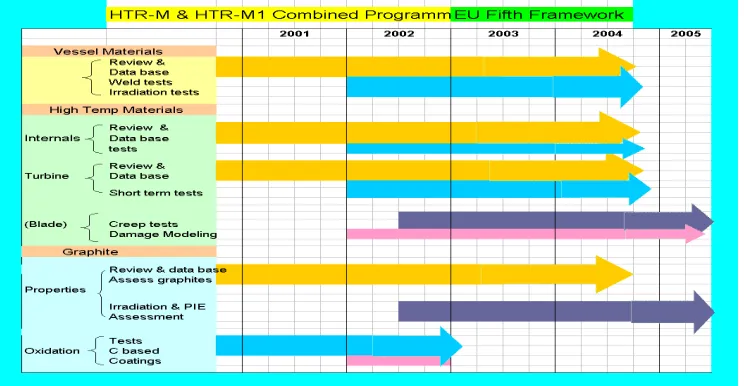
Issues concerning material selection and behaviour are being investigated for the main reactor circuit components of the High Temperature Reactor (HTR). The work is being performed as part of a European development initiative supported by the European Union Fifth Framework programme [1] and under the review of the Network HTR-TN (established in March 2000). This paper considers the progress and mid term results from the HTR project on materials (denoted HTR-M & M1), which deal with the selection and development of materials for the reactor pressure vessel, high temperature resistant alloys for the internal structures and turbine and graphite for the reactor core. The work started in November 2000 and involves eight partners from five European countries. The programme of work extends beyond that previously presented [2] to include intermediate creep testing of turbine materials and irradiation testing of graphite materials. The main elements of the work are summarised below in Fig. 1. This paper gives a brief outline of the HTR-M programme and presents and discusses some of the initial results and ongoing actions.
HTR M & M1 PROJECTS
The work and summary of key issues and results from each of these key components is as follows:
Vessel:
• Review existing materials used in gas-cooled reactors and previous high temperature reactors
• Set up a materials database on design properties (which will lead to identification of data omissions for future R& D testing)
• Carry out specific tests on welded joints under irradiated and non-irradiated conditions. Fabrication and effects of irradiation/environment on the vessel weld behaviour are seen as crucial issues in determining the structural viability of the material for future RPV application. Results are presented on the technological survey and investigations and the progress of tests.
Turbine (disc & blade):
• Review existing materials used in gas-cooled reactors and previous high temperature reactors
• Set up a materials database on design properties (which covers a few potential materials for each component)
• Perform specific tests on selected materials (carbon/carbon (C/C) composites, high alloy steels) at temperature and under short and intermediate times in air, vacuum and helium.
Main concern is the ability of the material to withstand the temperatures and conditions in the direct cycle environment. Creep and effects of helium on properties and strength are seen as crucial issues. Progress and results are presented on the work done to investigate these aspects.
Graphite core:
• Review of graphite materials data identifying new graphites suitable for HTR plus formulating a database of available information.
• Selection of and performing of irradiation testing on a few new graphites.
• Graphite oxidation and the investigation of consequences of severe air ingress with core burning including the development of HTR models and data, protective coatings and C-based materials.
The graphite actions are seen as crucial and an important first step in establishing new materials for future HTR’s given that almost all the graphites previously irradiated are no longer manufactured. Note that of the test results that do exist, most use irradiation temperatures <550oC and are not representative. Progress and results are presented on the
status of the tests and results of the oxidation work.
The projects therefore consider two main areas of investigation: the review of past experience plus assembly of available properties and tests on key materials where necessary information is lacking or scarce.
TECHNOLOGICAL SURVEY & DATABASE FOR STRUCTURAL INTEGRITY
This activity is performed in all three areas with the objective of assembling a single source of past property information on HTR relevant materials.
Materials For The Reactor Pressure Vessel
Vessel materials can operate at temperatures as high as 450oC and information on manufacture, environment
(neutron-irradiation fluence, operational temperature, and helium environment) and welding are needed for assurance of integrity and design development. Most designs of future plant make use of either the LWR type steel or modified 9Cr 1Mo. These materials have similar strength levels at temperatures up to 370°C and up to 450°C modified 9Cr1Mo steel gives only a gradual reduction in design strength. Above 450°C allowable stresses for all materials fall off rapidly.
The ‘cold’ vessel design concept adopted for the PBMR reactor pressure vessel leads to the choice of Mn-Ni-Mo or C-Mn steel with grades similar to SA 508 Class 2 as prime candidates. Advantage can be taken of PWR vessel technology and design rules.
The ‘warm’ vessel concept adopted for the GT-MHR reactor pressure vessel leads to the choice of Cr-Mo steels with modified 9Cr1Mo steel grades similar to ASME Grade 91 as prime candidates.
350°C
-6 -4 -2 0 2 4 6
-50 -40 -30 -20
log(pO2)
lo
g(
ac
)
Dragon Direct cycle Oldbury B
JAERI B GT-MHR AGR
p*(CO)
Fe3O4
Fe Fe3C
I II
III IV
V
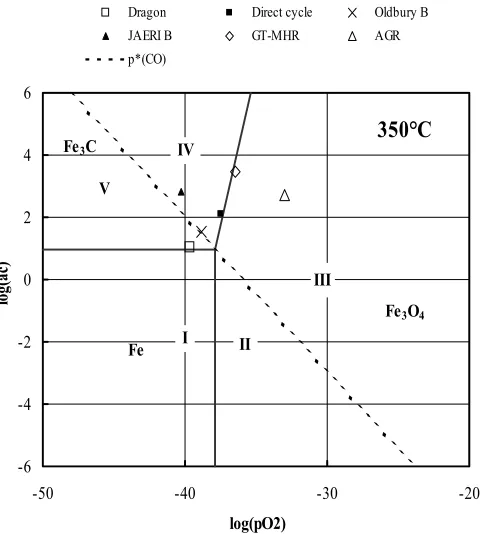
Regions I and II: Severe decarburisation
Region III: Protective oxidation plus slight carburisation Region IV: Carburisation
Region V: Severe carburisation
temperature) are the main damage mechanisms and degradation mechanisms (irradiation, thermal ageing, temper embrittlement and corrosion effects arising from interactions between the pressure vessel steel and impurities in the He) can contribute to threaten vessel integrity. Fatigue and corrosion processes may lead to crack growth and the fracture toughness may be reduced by irradiation, aging and temper embrittlement.
The effects of irradiation on the toughness of LWR steels have been studied extensively, the major effect is an increase in the ductile brittle transition temperature (DBTT) due to the combined effects of matrix hardening and grain boundary weakening. This is often associated with the residual elements phosphorus (P) and copper (Cu). For LWR this threat is generally considered to be significant when irradiation causes a change from ductile to brittle fracture at temperatures within the operational envelope. For the warm vessel option, no data were available for modified 9Cr1Mo steel irradiated under conditions expected for the HTR. However information at much higher doses (≥1dpa) showed that there is a strong effect of irradiation temperature in the range 250-450°C. Effects may be small on ∆DBTT at 400-440°C but measurable at 350°C. There was no information on the behaviour of modified 9Cr-1Mo steel welds.
With regard to thermal aging embrittlement (TAE) the base materials and weld metals of both cold and warm HTR vessel steels normally have very fine grain sizes. The most likely embrittlement location is therefore the coarse-grained heat affected zone, which is a narrow region adjacent to the fusion boundary where temperatures of 1100-1300°C are reached during welding. Cold vessels operate at temperatures below the embrittlement range (350-550°C) so such thermal ageing embrittlement is only possible during transients involving exposure to higher temperatures for tens or hundreds of hours. Warm vessels on the other hand operate in the TAE temperature range throughout their lifetime and therefore are of greater concern with regard to vessel integrity.
For corrosion, the main concerns are with respect to metal loss/ carburisation/ decarburisation due to actions of the impurities in the helium coolant. For the HTR vessel, metal losses will be either by controlled carburisation in cold wall vessels and decarburisation combined with internal oxidation in warm wall vessels. The kinetics of these processes will determine any effective metal loss. Figure 2 shows the phase diagram, plot of carbon activity verses oxygen potential (notional partial pressure of oxygen), for Fe at a temperature of 350oC together with the regions
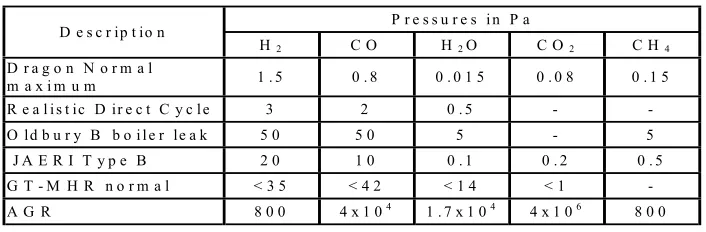
that are likely to give corrosion concerns. The atmospheres indicated in figure 2 are summarised in table 2. It should be noted that given a beltline wall thickness in the range 140-200 mm metal loss is only likely to become significant if breakaway corrosion or metal dusting can occur which is considered unlikely in HTR Helium.
The vessel materials database includes C-Mn steels (as used in the UK Magnox and AGR types), SA 508 Grade 3 Class 1 (LWR) or its European equivalent, 2¼ Cr-1Mo steel as used on HTTR and modified 9Cr1Mo. The potential for 12Cr steels will also be investigated. Aspects such as composition, manufacturing information, test and design data plus environment are covered.
The materials property database includes code data where available, and raw data for analysis. Modified 9Cr1Mo steel showed the most uncertainty on data and fabrication experience with respect to HTR characteristics and potentially has the wider applicability hence this materials was selected for the for the irradiation test programme. Significant amounts of a data exist for all these steels and the main focus is on comparisons and assembling relevant design data.
Management of the database is to be done through a web based system to allow remote partner access and to maintain secure transfer of information between the different partners and different countries.
Materials For The Turbine
Turbine materials operate at temperatures of 850-900°C and metals and ceramic materials are being considered for the blades and disc and for the reactor control rod.
For the turbine, high temperatures and long-term endurance are key issues. The criteria for material selection are to be based on a safe operation period of up to 60,000 h. The main criteria are creep and the influence of environment. Manufacturing considerations are especially important for the disc and blades. Candidate alloys for the disc have to be capable of production of large defect free ingots with good forging properties and proven thermal stability. For the blades cast material is not sufficient and directionally solidified or single crystal alloys have to be considered. The review suggested that a move to single crystal alloys should not be necessary. The need for cooling is an important issue for both disc and blades. For the former the review of available materials showed temperature limits for suitable disc materials to be below 750oC suggesting that a cooled disc would be necessary for operation in 850 - 900oC gas.
For the turbine discs and blades susceptibility to corrosion is also an important selection criterion. The helium coolant gas used in an HTR contains small levels of impurities (H2, H2O, CO, CO2) at low partial pressures that can interact with the core graphite and metallic components and cause some loss or damage to their properties. Low concentrations of H2O and H2 are produced by leakage and/or desorption from both metal surfaces and graphite. CO, CO2, and CH4 may be produced by coolant/graphite reactions at high temperatures. Depending on the partial pressure of the impurities the resulting atmosphere can either be oxidizing or carburising for the materials selected. The following table gives some information on He impurity levels from various sources
Table 1 Typical Gas Reactor Impurity levels
P r e s s u r e s i n P a D e s c r ip t io n
H2 C O H2O C O2 C H4
D r a g o n N o r m a l
m a x i m u m 1 . 5 0 . 8 0 . 0 1 5 0 . 0 8 0 . 1 5
R e a l i s t ic D ir e c t C y c l e 3 2 0 . 5 -
-O ld b u r y B b o i l e r le a k 5 0 5 0 5 - 5
J A E R I T y p e B 2 0 1 0 0 . 1 0 . 2 0 . 5
G T - M H R n o r m a l < 3 5 < 4 2 < 1 4 < 1
-A G R 8 0 0 4 x 1 04 1 . 7 x 1 04 4 x 1 06 8 0 0
Damage may be either at the surface (formation of surface films involving oxides or carbides) or diffuse to significant depths into the metallic matrices (internal oxidation or carburisation or decarburisation) resulting in loss of mechanical properties over a significant thickness of the material. This may lead to either loss of strength or local embrittlement and increase the likelihood of initiation of cracks. As with the RPV phase diagrams are used to determine the neutrality of the chemical activity and to determine whether compatibility issues are likely to have a strong impact on materials selection. For Ni based alloys phase diagrams are constructed based on Cr. Typical zones for carburisation and de-carburisation and formation of protective oxidation are identified at different temperatures and used to aid materials selection.
Helium atmospheres from decomposition of methane under extremely low oxygen partial pressures are heavily carburising and can cause a significant shortening of the material creep life and accelerated creep crack growth rates. The presence of alloying elements such as cobalt (which is in most of the currently available turbine disc and blade materials) is difficult to avoid. The main issues are the potential for plate out and lift off of particles and their activation and prevention of them flowing through the core.
The review and data base work identified some potential materials to be considered for the experiments. Investigation of turbine disc materials revealed Udimet 720 to be the best currently available candidate that would not require significant manufacturing development. For the perceived endurance this is thought to have a temperature ceiling of around 700-750oC and is likely to require cooling. Two DS grades of material were selected for the blade tests (CM 247
that any blades may have to be coated for long life. The choice of coating remains to be made and tested in a future Framework. Adoption of a cobalt free material was not considered a priority.
For the reactor internals material selection is based on ability to resist the effects of irradiation at the highest gas temperatures. Such materials (e.g. AISI type 316 steel, Alloy 800H (control rod) and Hastalloy XR) have to cope with high thermal strains arising from power changes and load following requirements. AISI type 316 steel is normally used for components operating at temperatures up to 550-600oC and the last two, which have been extensively investigated
for the HTTR, for higher temperatures (750oC). For the control rod, which compensates for fuel burn-up and power
variation reactivity effects and is used to control the reactor operation under normal operation modes and to shutdown the reactor system, available metallic materials (such as alloy 800H) are considered to be at their operating limit, and new carbon based materials are being considered as alternatives. Such materials are expected to give potential for improved reactivity control during shutdown and for allowing the normal operating temperatures of future reactors to be increased .
A synthesis of possible carbon based materials was carried out to aid selection and to provide information for a build-up of irradiated and non-irradiated properties for assessment and data base purposes. The findings show that properties are largely an-isotropic and are severely degraded by neutron irradiation, the level of degradation being dependent on irradiation condition and temperature. From the references studied limited irradiation induced properties were available although some general trends in behaviour were seen in properties such as thermal conductivity and thermal resistivity. Also the high cost and limited supply of suitably manufactured material was prohibitive.
Graphite
Graphite acts as a moderator and structural component and has important safety implications because of structural and property changes that occur when it is irradiated. Information on all these is crucial and design / material property data under HTR relevant conditions are required and need to be compiled for candidate materials of different HTR concepts, in relation to both normal and accident conditions. The most important considerations are component integrity and changes in core geometry, both of which are affected by the dimensional change. Many of the graphites used in previous core designs are no longer available and there has been a serious decline in ability to manufacture nuclear grade graphite in large quantities, the main questions concern the availability of the coke and manufacturing procedure. Today's HTGR projects - HTTR (Japan) and HTR-10 (China) - use a Japanese graphite (IG-110) which, with its high strength, is suitable for exchangeable core components where low fast neutron fluences and hence low total doses are applicable.
In the past, only a small number of irradiation programmes were aimed at determining the irradiation behaviour of graphites at high temperatures, i.e. >600°C. Two of the most significant were for the European Dragon HTR programme, and the German HTR programme. Unfortunately most of the data obtained by other countries are confidential and cannot therefore be published in open literature. The work on the review and collection of graphite properties considers the accessible information on the IAEA database, internal information and published information at seminars and conferences. The IAEA database was established to help the development of International programmes on graphite-moderated reactors, assist safety authorities in assessment of safety aspects and serve as a source of scientific information for nuclear and non-nuclear technology. The data relevant to the irradiation temperature and neutron fluence domains for new HTR’s will largely come from the new tests, be built up for each graphite grade and sample orientation, and contain the appropriate details of the graphite i.e. grade, manufacturer, coke source, grain size and manufacturing method.
For the HTR-M programme three main graphite manufacturers were approached to see which graphites could be offered for the next generations of reactors. Five graphites were selected and identified for the programme, two iso-moulded and two extruded graphites, manufactured from pitch coke and petroleum coke. A range of grain sizes (1mm down to 10 µm) was also selected. IG100 (HTTR graphite) was also chosen (iso-moulded graphite made using a petroleum coke) since this has previously been irradiated at high temperature, although only to a small/medium fluence. Nevertheless, the available data will provide a useful comparison with the data obtained from the new graphites. The selected graphites, test conditions and programme are discussed in more detail in the next chapter.
TESTING UNDER IRRADIATED AND NON-IRRADIATED CONDITIONS
Materials For The Reactor Pressure Vessel
The test programme for the vessel steel concentrates on qualification of Mod 9Cr 1 Mo. For this purpose an irradiation test of thick welded joints is being prepared. The tests involve the use of a special purpose (Lyra) rig (Fig. 2) developed at Petten, which gives accurate control of the temperatures and use of a helium atmosphere. Heaters in the rig are used to correct the temperature levels obtained from gamma heating.
LO WE R HE ATE R 4 IN D EPE N D EN T HE ATE RS UP P E R H E A TE R SS D OU B LE CO NTAI NM E N T CE NTE R LI NE C O R E EX P ER IM EN T B O X
SPECIMEN STACK ~64x59x354
C C P B B AA
Figure 2 Lyra test rig used for Irradiation of vessel material within the HFR
Post irradiation tests include tensile, creep, Charpy and CT toughness tests. The fabrication and characterisation of the welded specimens involves tests on 40 and 150mm thick plates. The thinner plate specimens provide a means for trials using different weld bead lengths and different weld parameters before producing the final weld specimens with the thicker plate. The conditions used will simulate an upper bound to the expected accumulated dose at the end of life (between 10-20mdpa). The maximum dose rate per cycle in HFR at the available positions is 5mdpa, which suggests up to two to four cycles. This relatively low dose irradiation takes place in the Pool Side Facility of the High Flux Reactor (in contrast to the graphite irradiation which is an in core irradiation). It is possible to irradiate to higher levels, which will require more cycles and a longer irradiation time. The expected lowest temperature conditions are being considered for the current tests, as only one test temperature is possible. Higher temperatures act to anneal out any irradiation damage effects.
Work is in progress to define the tests for post-irradiation and reference properties and final test selections and boundary conditions. The procurement of the material and the fabrication of the thick section welded test pieces is near completion and inspection and cutting plans for the range of different test conditions are being drawn up. Characterisation tests are to start shortly following machining with the irradiation of the specimens expected to start mid to late 2003.
High Temperature materials
Experiments on these materials will involve short and intermediate term tests. High temperature short-term mechanical/ creep tests are planned for turbine disc and blade materials in simulated environments. For the blade material 2 grades are being examined (IN 792 DS & CM 247 LC DS), for the disc 1 grade (Udimet 720). Udimet 720 is considered to have a potential for operation up to 700°C and to be the best available for this application using established manufacturing techniques. Manufacturing considerations are a key factor and producing large ingots without porosity and segregation is a major challenge for the size of disc being considered. The tests on the disc material will be carried out at 700 and 750°C. For the turbine blade materials the current view is to avoid single crystal materials for the blades and test two grades of directionally solidified materials (Cr- and Al-oxide formers) under tensile and creep conditions, at temperatures up to 850°C. Procurement of suitable quantities of the materials is being made, and characterization tests on the disc material have started. The duration of the intermediate creep tests is expected to be around 3000h and will be performed on both of the turbine material grades and include aged samples.
Graphite
The irradiation experiment will use a test rig that allows distinct temperature levels to be obtained. Irradiation temperatures are higher than 10 years ago and there are three temperatures of major interest (600°C, 750°C and 900°C). A temperature of 750°C, was considered to be most relevant for new designs. The rig design will require the stacking of up to 150 samples, 8mm diameter (either 6 or 12mm in height), covering two main directions (15 samples per grade per direction). Pre and post irradiation measurements will include dimensional changes, Young’s modulus, coefficient of thermal expansion (CTE) and thermal conductivity.
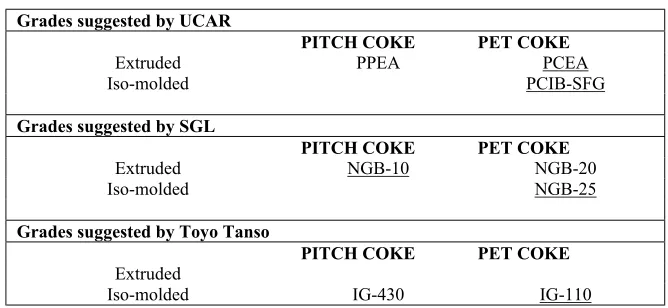
The programme uses currently available graphites since the development of a new material would take 3-5 years. The graphites proposed by the manufacturers are as follows:
Table 3 Graphites proposed for irradiation tests
Grades suggested by UCAR
PITCH COKE PET COKE
Extruded PPEA PCEA
Iso-molded PCIB-SFG
Grades suggested by SGL
PITCH COKE PET COKE
Extruded NGB-10 NGB-20
Iso-molded NGB-25
Grades suggested by Toyo Tanso
PITCH COKE PET COKE
Extruded
Iso-molded IG-430 IG-110
Although five (major) grades of graphite have been selected for full testing in the experiment (see table 3), it was decided that it would be useful to have an early indication of the irradiation behaviour of some of the other proposed graphites. These could be included as ‘piggy-back’ samples in the irradiation capsule. The (minor) graphites selected are UCAR grade PPEA, SGL grade NBG-20 and Toyo Tanso grade IG-430.
The irradiation test will provide a number of data points by using the flux (buckling) distribution available in the HFR capsule. A third order polynomial can describe the behaviour and a sufficient number of points should be obtained from the test to describe the distribution.
Ideally the test conditions for the experiment would be those that give data for candidate graphites up the peak end of life fluence. However this requires a significant effort over a long time scale, typically 10 years. The target flux in the current four-year programme will be as high as possible. The current available locations in the HFR suggest an irradiation for 1-1.5 year to EDN fluence ~6-7 1025 m-2 (approx. 8 dpa). This is not expected to yield properties up to
turn round behaviour but will provide information on whether the graphite is useful or not. The current frame is for a first sorting and as the experiment progresses possibly replacing those that are unsuitable with alternatives. For the highest flux position in HFR a total of 3 years will be needed for the irradiation.
Irradiation will start in the first half of 2003 with first PIE in the fall of 2004 with a view to completing and continuing the test within the context of the 6th Framework.
The graphite oxidation work involves two principal tasks relevant to safety analysis and licensing of HTR’s for normal operation:
• improvement of experimental data base for advanced graphite oxidation models
• experimental investigation of innovative C-based materials with respect to their application on HTR’s.
inner bore hole of the tube with flow rates sufficiently high to suppress the influence of boundary layer mass transfer on kinetics. Long-term (regime I) experiments at low temperature in air were done in an annealing furnace.
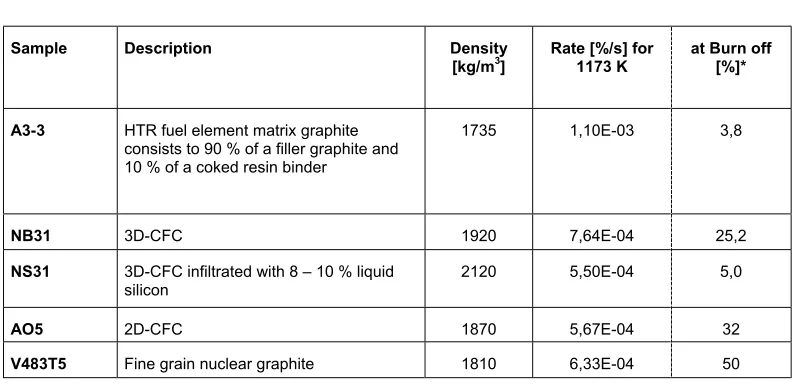
The second series of experiments looked at the performance of CFC materials under accident typical temperatures (about 1000 oC) in steam and in air. Oxidation effects were measured by weight loss of the sample. Experiments were
also performed to determine properties of CFC materials irradiated and non-irradiated (up to 1dpa). These include measurements of strength, dimensional change, thermal diffusivity and heat capacity. The thermal diffusivity of NB31 and NS31 decrease by irradiation (1 dpa, 200 °C) by factors of 3 (800 °C) to 10 (100 °C).
Table 2 Graphite Corrosion Tests – Investigated materials in steam
Sample Description Density
[kg/m3] Rate [%/s] for1173 K at Burn off[%]*
A3-3 HTR fuel element matrix graphite
consists to 90 % of a filler graphite and 10 % of a coked resin binder
1735 1,10E-03 3,8
NB31 3D-CFC 1920 7,64E-04 25,2
NS31 3D-CFC infiltrated with 8 – 10 % liquid
silicon
2120 5,50E-04 5,0
AO5 2D-CFC 1870 5,67E-04 32
V483T5 Fine grain nuclear graphite 1810 6,33E-04 50
* (rate maximum)
SUMMARY AND CONCLUSIONS
This paper reviews research activities on the HTR-Materials projects in support of the modular HTR technology development within Europe. Overall the projects are progressing well with review and data base investigations maturing and planning and preparations for the experiments well advanced. The graphite oxidation experiments are concluding and results are available. The irradiation-testing phase of the work on vessel steel and graphites is expected to start shortly and post irradiation examination of specimens planned for the fall of 2004. The high temperature short and medium testing phase will occupy much of 2003 and 2004 with reporting planned for the end of next year.
ACKNOWLEDGEMENTS
The projects HTR-M & HTR-M1 are being co-sponsored under the Fifth Framework programme of the European Atomic Energy Community (“Euratom”), contracts FIKI-CT-2000-0032 and FIKI-CT-2001-20135. The information provided herein is the sole responsibility of the authors and does not reflect the Community’s opinion. The Community is not responsible for any use that might be made of the data appearing in this publication.
REFERENCES
1. J Martin-Bermejo, M. Hugon, G. Van Goethem, “Research activities on High Temperature Gas-cooled Reactors (HTRs) in the 5th EURATOM RTD, Framework Programme”, Paper No.1560, SMiRT 16, Washington DC, USA, August 12-17, 2001
2. Buckthorpe D.E., Couturier R., van der Schaaf B, Riou B., Rantala H., Moormann R., Alonso C., Friedrich B-C., “Materials for the High Temperature Reactor (HTR)”, paper 1941, Smirt 16, Washington D.C, USA, August 2001. 2. Buckthorpe D.E., Couturier R., van der Schaaf B., van der Laan, J, Riou, B., Rantala H., Kühn K., Roedig M., Haag