ISSN(Online) : 2319 - 8753
ISSN (Print) : 2347 - 6710
International Journal of Innovative Research in Science,
Engineering and Technology
(An ISO 3297: 2007 Certified Organization)
Vol. 4, Issue 4, April 2015
Image Denoising using Wavelet Transform
Based Patch Wise Wiener Filter
S.Brintha Rajakumari
1,M.Beema Mehraj
2,C.Nalini
3,Sundararajan.M
4, Arulselvi S
51Assistant Professor, Department of CSE, Bharath University,Chennai, India
2Assistant Professor, Department of CSE, Bharath University,Chennai, India
3Professor, Department of CSE, Bharath University,Chennai, India
4
Director, Research Center for Computing And Communication, Bharath University, Chennai, India
5
Co-Director, Research Center for Computing And Communication, Bharath University, Chennai, India
ABSTRACT:A denoising technique is the analysis of the performance bounds for image denoising. Unit of measurement used here to derive a superior wise denoising rule and patch based Wiener filter that exploits patch redundancy for image denoising. The framework uses every geometrically and photometrical similar patch to estimate the variance filter parameters. The geometric and photometric parameters square measure is accurately computable directly from the input screaky image. The proposed denoising approach, designed for near-optimal performance, encompasses a sound applied math foundation that is analyzed fine. The presentation of this approach is through an experiment verified on a diffusion of images and noise levels.
KEYWORDS: Image denoising, Geometric, Photometric, Plow. Wavelet Transform.
I. INTRODUCTION
In Recent Years, footage and videos became integral components of our lives. Applications presently vary from the casual documentation of events and communication to be lots of significant police investigation and medical fields. This has a crystal rectifier to academic degree ever-increasing demand for proper and visually pleasing footage. However, the pictures captured by a modern Cameras unit of measurement invariably corrupted by noise [3][4]. With increasing pixel resolution, but lots of or less the same aperture size, noise suppression has become lots of relevant.
In [1] and [2], it is intended to study the matter from academic degree estimation theory perspective to quantify the basic limits of denoising. The insights gained from that study unit of measurement applied to develop on paper sound denoising methodology throughout this paper. The challenge of any image denoising algorithm is to suppress noise while producing sharp images without loss of finer details. The modern adaptive method to successfully address these contradictory goals can be attributed to Tomasi et al. [3][4] proposed a generalization of the SUSAN filter [5][6], which itself was an extension of the Yaroslavky filter [6][7]. The authors there proposed denoising by weighted averaging using pixels similar in intensity within a local neighborhood. Under strong noise, identifying such similar pixels can be challenging.
ISSN(Online) : 2319 - 8753
ISSN (Print) : 2347 - 6710
International Journal of Innovative Research in Science,
Engineering and Technology
(An ISO 3297: 2007 Certified Organization)
Vol. 4, Issue 4, April 2015
Copyright to IJIRSET DOI: 10.15680/IJIRSET.2015.0404001 2244
The motivation there was that similar patches shared similar sub dictionaries, and such sub dictionaries could be used for better image modeling. A similar study was exploited in the form of a non local sparse model. NLM filter [8], [9] is an approximation of the optimal filter (in the MSE sense) obtained if one ignores the geometric structure of image patches. The Wiener filter is usually used in conjunction with some transform basis.
The bounds expression [3] thus takes into account the complexity of the image patches present in the image as well as the redundancy level and the noise variance corrupting the image. In [1], the bound was shown to characterize the performance of the optimal fine-biased denoising method. In particular, for WGN, the right-hand side of [3] is the performance achieved by the optimal linear minimum mean squared-error estimator, with Ji and Cz are the parameters of the estimator. Thus, in a patch-based Wiener filter, where the parameters are estimated accurately, can lead to near-optimal denoising performance.
II.RELATED WORK
In paper [1], they estimated denoising bounds directly from the droning image. This showed that even for sizable droning footage, the denoising bounds square measure usually computable quite accurately. A boot is given in any theoretical analysis of the bounds formulation by relating it to the final entropy of the image. For droning footage, it is established that the bounds formulation is claimed to the mutual knowledge between the droning academic degrees to the corresponding noise-free image. In the limiting case where there is no noise, the mutual knowledge reduces to the human entropy of the image. The predominant devises support the theoretical analysis of the bounds formulation experiment purpose to some useful wise applications of the entropy measures by exploiting the link.
The performance bounds on denoising are studied in paper [2]. They developed some way of shrewd lower bounds on the MSE that accounts for the strength of the corrupting noise, the amount of observations that unit of measurement typically accessible to estimate a denoised patch, furthermore as a result of the variability of the geometric structures inside the image. It was completely derived taking into thought the results of previous knowledge. The formulation is on a per cluster basis, where each cluster consists of patches of comparable geometric structure. The result showed that there is space for improvement in denoising a class of sufficiently straightforward footage.
In paper [3], the image unit of measurement captured in modern cameras unit of measurement is invariably corrupted by noise. They compared their results to others victimization Middlebury’s second version stereo analysis information set, next with demonstration, it is identified that noise is supplemental to the images, moreover as once the gain and offset between footage is varied. Finally, it indicates some interpolation results between several stereo pairs. Several visible errors occur attributable to incorrect segmentation.
In paper [4], Bilateral filtering smoothes images while reserving edges, by means of a nonlinear combination of nearby image values. It combines gray levels or colors based on both Geometric closeness and photometric similarity, and prefers near values to distant values in both domain and range.
In paper [5], a complete new structure protecting noise later, closely related to the SUSAN feature detectors, has been painted, whereas not having to formulate a rigid model of the image, alone those sections of the native image structure that unit of measurement a vicinity of an equivalent region" as each pixel unit of measurement accustomed sort academic degree estimate of that pixel's original brightness. Quantitative and qualitative results show the SUSAN noise later to be higher at reducing. The notion of image, self-similarity itself has been explored and quantified in where it is noted that ―block unit of measurement well approximated by type of totally different blocks at the same or different scales.
ISSN(Online) : 2319 - 8753
ISSN (Print) : 2347 - 6710
International Journal of Innovative Research in Science,
Engineering and Technology
(An ISO 3297: 2007 Certified Organization)
Vol. 4, Issue 4, April 2015
just like the entire variation or the movement thresholding has been wide accepted. The maneuver noise methodology to visualize the denoising performance has been adopted ever since. The noise-to-noise criterion introduced in tackles the prospect that, starting from pure noise, a denoising rule creates structured options. This may well build a case for the interest for NLmeans in scientific or medical imaging, where the neutrality of algorithms is crucial. Enhancements or variations of NL-means square measure planned in crayon analysis fluorescence research resonance imaging (MRI) Multispectral Imaging and Diffusion Tensor Imaging (DT-MRI).
In paper [7], the search for efficient image denoising methods is still a valid challenge at the crossing of functional analysis and statistics. In spite of the sophistication of the recently proposed methods, most algorithms have not yet attained a desirable level of applicability. All show an outstanding performance when the image model corresponds to the algorithm assumptions but fail in general and create artifacts or remove image fine structures.
In paper [8], Image restoration is an important and widely studied problem in computer vision and image processing. Various image filtering strategies have been effective, but invariably make strong assumptions about the properties of the signal and/or degradation. Hence, these methods lack the generality to be easily applied to new applications or diverse image collections.
In paper [9], a novel adaptive and patch-based approach is proposed for image denoising and representation. The method is based on a point wise selection of small image patches of fixed size in the variable neighborhood of each pixel. In paper [10], a novel adaptive and exemplar-based approach is proposed for image restoration and representation. It is based on a point wise selection of similar image patches of fixed size in the variable neighborhood of each pixel.
A novel image denoising strategy is proposed based on an enhanced sparse representation in transform domain [11]. The enhancement of the sparsity is achieved by grouping similar 2-D image fragments (e.g., blocks) into 3-D data array groups. Collaborative filtering is a special procedure developed to deal with these 3-D groups.
The image denoising problem is addressed, where zero-mean white and homogeneous Gaussian additive noise is to be removed from image [12]. The approach taken is based on sparse and redundant representations over trained dictionaries. Using the K-SVD algorithm, a dictionary that describes the image content effectively is obtained.
In recent years there has been a growing interest in the study of sparse representation of signals[13]. In [14], a hybrid approach (K-LLD) is proposed that bridged such dictionary-based approaches with the regression-based frameworks [4], [7], [8], [10].The motivation there was that similar patches shared common sub dictionaries, which is used for better image modeling. A nonlocal sparse model (NLSM) [15] improves performance of the K-SVD [13] framework. The dictionary-based methods provide implicit modeling for natural images.
III.IMPLEMENTATION OF IMAGE DENOISING
ISSN(Online) : 2319 - 8753
ISSN (Print) : 2347 - 6710
International Journal of Innovative Research in Science,
Engineering and Technology
(An ISO 3297: 2007 Certified Organization)
Vol. 4, Issue 4, April 2015
Copyright to IJIRSET DOI: 10.15680/IJIRSET.2015.0404001 2246
signal/noise ratio) is obtained through academic degree initial filtering of the image. In earlier framework, they developed a domestically optimum Wiener filter wherever geometric and photometric patch area unit similar. For this, the droning image is 1st segmental into regions of the comparable geometric structure. The mean and then the variance of the patches among each cluster area unit then calculated. Next, for every patch, establish photometrical similar patches and calculate weights supported their similarity to the reference patch. These parameters area unit then accustomed to perform denoising patch wise. To chop back artifacts, image patches area unit elite to possess some extent of overlap (shared pixels) with their neighbors. A final aggregation step is then accustomed optimally fuse the multiple estimates for pixels lying on the patch overlaps to form the denoised image in Figure1. The image denoising steps are: Add Noise, Discrete Wavelet Transform (DWT), Geometric K-means Algorithm, Photometric Similarity, Plow, Inverse Discrete Wavelet Transform (IDWT), and Performance Analysis.
Figure1. Architectural Design Specification
A. Add Noise
Additive White Gaussian Noise (AWGN) is common to every communication channel, that the statistical random noise characterized by an oversized frequency vary with regards to an emblem inside the communications channel. This assignment describes two aspects of telecommunications engineering: The essential understanding of MATLAB and The results of Additive White Gaussian Noise (AWGN) on the transmitted information victimization based-band simulation beneath entirely totally different values of Signal to Noise quantitative Relation (SNR) ratio with this tool. In my experiment, profit of MATLAB tools to urge the noise sequence, the data sequence, the every information and noise sequence and add them to recover the signal. From droning received information, calculate noise power, calculate SNR and BER then plot them with entirely totally different SNR values.
B. Discrete Wavelet Transform
ISSN(Online) : 2319 - 8753
ISSN (Print) : 2347 - 6710
International Journal of Innovative Research in Science,
Engineering and Technology
(An ISO 3297: 2007 Certified Organization)
Vol. 4, Issue 4, April 2015
measurement is obtained from one paradigm wave y (t) stated as mother wave by dilations and shifting. DWT is the discrete variant of the wavelet transform. Wavelet transform represents a valid alternative to the cosine transform used in standard JPEG. The DWT of images is a transform based on the tree structure with D levels that can be implemented by using an appropriate bank of filters is in figure2. Essentially, it is possible to follow two strategies that differ from each other basically because of the criterion used to extract strings of image samples to be elaborated by the bank of filters. The first solution, definitely not very used, consists of generating the string by queuing image lines and then executing decomposition on D levels; after this operation, D strings are generated by queuing the columns from the found sub-images and other decomposition for each string is applied.
Figure2. Process of DWT
1) Theory of WT
The wavelet transform is computed on personal basis segments of the time-domain signal at totally different frequencies. Multi-resolution analysis: Analyzes the signal at frequencies giving totally different resolutions MRA is intended to supply blast resolution and poor frequency resolution at high frequencies and wise, frequency resolution and poor time resolution at low frequencies wise for signal having high frequency components for temporary lengths and low frequency components for a long. E.g. footage and video frames wave remodel decomposes an emblem into a group of basic functions. These basis performs unit of measurement stated as Wavelets unit of measurement obtained from one paradigm, moving wave y (t) stated as mother wave by dilations and shifting: wherever a is that the scaling parameter and b is that the shifting parameter. The wavelet transform is similar to the Fourier transform with a completely different merit function. The main difference is this: Fourier transform decomposes the signal into sine’s and cosines, i.e. the functions localized in Fourier space; in contrary to the wavelet transform uses functions that are localized in both the real and Fourier space. Generally, the wavelet transform can be expressed by the following equation:
∞
F(a,b)=∫ - ∞ f(x) ψ * (a,b) (x) dx (1)
Where the * is the complex conjugate symbol and function ψ is some function. This function can be chosen arbitrarily provided that obeys certain rules.
C. Geometric-Means Algorithm
The K-Means rule clusters information by trying to separate samples in n groups of equal variance. This rule wants the amount of clusters to be such as, it scales well to sizable quantity of samples and has been used across an outsize variety of application areas in many different fields. It's to boot like the expectation-maximization rule once setting the variance matrix to be diagonal, equal and small.
D. Photometric Similarity
ISSN(Online) : 2319 - 8753
ISSN (Print) : 2347 - 6710
International Journal of Innovative Research in Science,
Engineering and Technology
(An ISO 3297: 2007 Certified Organization)
Vol. 4, Issue 4, April 2015
Copyright to IJIRSET DOI: 10.15680/IJIRSET.2015.0404001 2248
then optimally collective to urge the last word American state noised image. Photometrical similarity is also a lot of restrictive condition compared to structural similarity as patches need to have similar intensities furthermore.
E. Plow Rule
The plow rule is the motivation to understand a regionally optimum denoising. A proposed methodology is also a patch-based Wiener filter that takes advantage of every geometrically and photometrical similar patch. The resultant approach encompasses a pleasant applied math foundation, whereas producing denoising results that unit of measurement resembling the current progressive, visually and quantitatively.
F. Inverse Discrete Wavelet Transform (Idwt)
The mathematical manipulation that affects synthesis is termed the IDWT. A method by that components square measure usually assembled back to the initial signal, whereas not loss of knowledge is in figure3. This technique is termed as reconstruction. IDWT reconstructs an emblem from the approximation and detail coefficients derived from decomposition. The IDWT differs from the Discrete Wavelet Transform spelled out the definition (DWT) during this it wants up sampling and filtering. In figure3, a separate wavelet transform coefficients is succeeded, then an initial signal is reconstructed by inverse discrete wavelet transform. Much like the DWT square measure usually explained by the victimization filter bank theory, thus can the reconstruction of the IDWT. The tactic is simply reversed. The DWT constants, unit of measurement first up sampled by inserting zeros in between every constant, effectively doubling the lengths. These units of measurement then convolved with the reconstruction scaling filter for approximation coefficients (the reconstruction scaling filter is simply the initial scaling filter that has been flipped left to right) and conjointly their construction wiener filter for the detail coefficients.
Figure3. Process of IDWT IV.PERFORMANCE MEASURES
The Performance measures include the following: Mean Square Error: In statistics, MSE of the academic degree calculator is some ways to quantify the excellence between values understood by the academic degree calculator. Verity values of the quantity being computable. MSE measures the coming of the squares of the "errors."
When the two footage unit of measurement identical, then MSE square measure zero. Peak Signal to Noise Ratio: The quantitative relation between the foremost getable power of an emblem and conjointly the ability of noise that affects the illustration. Several signals have a wide dynamic variety; PSNR is usually expressed in terms of the exponent unit of measurement scale. Typical values for the PSNR in loss image and video compression unit of measurement between thirty and fifty unit of measurement, where higher is best. Acceptable values for wireless transmission quality loss unit of measurement thought of to be regarding twenty units of measurement to twenty five units of measurement. Structural
Similarity Index Measure is that the methodology for measuring the similarity between two pictures. The SSIM metric is
ISSN(Online) : 2319 - 8753
ISSN (Print) : 2347 - 6710
International Journal of Innovative Research in Science,
Engineering and Technology
(An ISO 3297: 2007 Certified Organization)
Vol. 4, Issue 4, April 2015
V.EXPERIMENTAL SETUP AND RESULTS
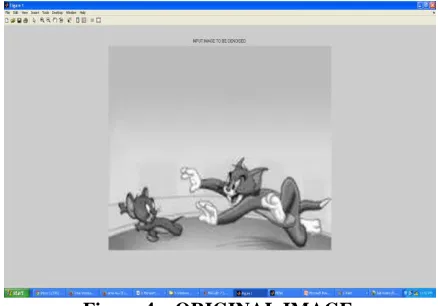
A hardware requirements needed to run Mat lab tool are Pentium IV 2.4 GHz system with 40Mb Hard disk, 1.44MB Floppy Drive, 15 VGA Color monitor, 1 GB RAM. In a similar way, software requirements used in this paper are Windows XP Operating system, C Programming, coding language, and Mat lab tool version 7.5. Figure 4a is the original image. In Figure 4b, additive Gaussian white noise is applied to a noisy image and a PSNR ratio of 16.65 (dB) obtained. In this paper, two types of filtering methods are used. First, the Gaussian filter method is applied is in figure 4c and which obtains an PSNR value of 23.30 (dB). Second, a Wiener filter is used in figure 4d ,a noisy image to get a dense image and a PSNR Ratio of 22.77 (dB) is obtained.
Figure.4a ORIGINAL IMAGE
ISSN(Online) : 2319 - 8753
ISSN (Print) : 2347 - 6710
International Journal of Innovative Research in Science,
Engineering and Technology
(An ISO 3297: 2007 Certified Organization)
Vol. 4, Issue 4, April 2015
Copyright to IJIRSET DOI: 10.15680/IJIRSET.2015.0404001 2250
Figure.4c DISCRETE WAVELET TRANSFORM
ISSN(Online) : 2319 - 8753
ISSN (Print) : 2347 - 6710
International Journal of Innovative Research in Science,
Engineering and Technology
(An ISO 3297: 2007 Certified Organization)
Vol. 4, Issue 4, April 2015
Figure.4e DENOISED IMAGE
Figure4. Original image, Noised image, Denoised images. VI.CONCLUSION
In this paper, a denoising technique gives a clear filtered image based on the performance analysis of the measure. An optimum wavelet transform-based methodology is developed and has extended it to take advantage of patch redundancy to improve the denoising performance. In denoising approach, parameter standardization is obtained with the extra advantage of a clean applied math motivation and analytical formulation. Image denoising analyzed the framework comprehensive to signify its relevance nonlocal means and residual filtering ways in which through experimental validation, the results are quite comparable to the state of the art. This approach is mainly developed for grayscale footage, with trivial modification, this methodology achieves near progressive performance in denoising color footage furthermore. The denoising performance square measure can be expected to develop further by taking into thought the correlation across color components and video in the future. A patch redundancy is improved for denoising performance; parameter tuning is used to increase brightness in images, so that clarity will be better than previous performance analysis of image denoising. The noise in each cluster is assumed to be homogeneous and the proposed wiener filter can be applied independently in each cluster.
REFERENCES
1. P. Chatterjee and P. Milanfar, ―Practical bounds on image denoising: From estimation to info,‖ IEEE Trans. Image process, vol. 20, no. 5, pp. 1221– 1233, May 2011.
2.Jayalakshmi T., Krishnamoorthy P., Kumar G.R., Sivamani P., "The microbiological quality of fruit containing soft drinks from Chennai", Journal of Chemical and Pharmaceutical Research, ISSN : 0975 – 7384, 3(6) (2011) pp. 626-630.
3. P. Chatterjee and P. Milanfar, ―Is denoising dead?‖ IEEE Trans. Image process. vol. 19, no. 4, pp. 895–911, Apr. 2010.
4. Kulanthaivel L., Srinivasan P., Shanmugam V., Periyasamy B.M., "Therapeutic efficacy of kaempferol against AFB1 induced experimental hepatocarcinogenesis with reference to lipid peroxidation, antioxidants and biotransformation enzymes", Biomedicine and Preventive Nutrition, ISSN : 2210-5239, 2(4) (2012) pp.252-259.
5. G. E. Healey and R. Kondepudy, ―Radiometric CCD camera calibration and noise estimation,‖ IEEE Trans. Pattern Anal. Mach. In tell. vol. 16, no. 3, pp. 267–276, Mar. 1994.
ISSN(Online) : 2319 - 8753
ISSN (Print) : 2347 - 6710
International Journal of Innovative Research in Science,
Engineering and Technology
(An ISO 3297: 2007 Certified Organization)
Vol. 4, Issue 4, April 2015
Copyright to IJIRSET DOI: 10.15680/IJIRSET.2015.0404001 2252
7. C. Tomasi and R. Manduchi, ―Bilateral is filtering for grey and color pictures,‖ in Proc. Int. Conf. Comput. Vis., Washington, DC, Jan. 1998, pp. 839– 846.
8. Vijayaprakash S., Langeswaran K., Gowtham Kumar S., Revathy R., Balasubramanian M.P., "Nephro-protective significance of kaempferol on mercuric chloride induced toxicity in Wistar albino rats", Biomedicine and Aging Pathology, ISSN : 2210-5220, 3(3) (2013) pp.119-124.
9. S. M. Smith and J. M. Brady, ―SUSAN—A new approach to low level image processing,‖ Int. J. Comput. Vis., vol. 23, no. 1, pp. 45–L. P. Yaroslavsky, Digital picture processing. Secaucus, NJ: Springer-Verlag, 1985.
10. Sundar Raj M., Arkin V.H., Adalarasu, Jagannath M., "Nanocomposites based on polymer and hydroxyapatite for drug delivery application", Indian Journal of Science and Technology, ISSN : 0974-6846, 6(S5) (2013) pp.4653-4658.
11. H. Takeda, S. Farsiu, and P. Milanfar, ―Kernel regression for image processing and reconstruction,‖ IEEE Trans. Image process, vol. 16,no. 2, pp. 349–366, Feb. 2007.
12. A. Buades, B. Coll, and J. M. Morel, ―A review of image denoising methods, with a new one,‖ Multiscale Model. Simul. vol. 4, no. 2, pp.490–530, 2005.
13. S.P.Awate and R. T. Whitaker,―Unsupervised, information-theoretic, adaptive image filtering for image restoration,‖ IEEE Trans. Pattern Anal. Mach. In tell vol. 28, no. 3, pp. 364–376, Mar. 2006.
14. C. Kervrann and J. Boulanger,―Optimal spatial adaptation for patch based image denoising,‖ IEEE Trans. Image Process., vol. 15, no. 10, pp. 2866– 2878, Oct. 2006.
15. C. Kervrann and J. Boulanger, ―Local adaptivity to variable smooth-ness for exemplar-based image denoising and representation,‖Int. J. Comput. Vis., vol. 79, no. 1, pp. 45–69, Aug. 2008.
16. K. Dabov, A. Foi, V. Katkovnik, and K. O. Egiazarian, ―Image denoising by sparse 3-D transform-domain collaborative filtering,‖ IEEE Trans. Image Process., vol. 16, no. 8, pp. 2080–2095, Aug. 2007.
17. M. Elad and M. Aharon, ―Image denoising via sparse and redundant representations over learned dictionaries,‖ IEEE Trans. Image Process., vol. 15, no. 12, pp. 3736–3745, Dec. 2006.
18. M. Aharon, M. Elad, and A. Bruckstein, ―K-SVD: An algorithm for designing overcomplete dictionaries for sparse representation,‖ IEEE Trans. Signal Process., vol. 54, no. 11, pp. 4311–4322, Nov. 2006.
19. P. Chatterjee and P. Milanfar, ―Clustering-based denoising with locally learned dictionaries,‖ IEEE Trans. Image Process., vol. 18, no. 7, pp.1438– 1451, Jul. 2009.
20. J. Mairal, F. Bach, J. Ponce, G. Sapiro, and A. isserman, ―Non-local sparse models for image restoration,‖ in Proc. IEEE Int. Conf. Comput.Vis., Kyoto, Japan, Sep./Oct. 2009, pp. 2272–2279.
21. Jemima Daniel,The world of illusion in Tennessee William’s ―The Glass Menagerie‖,International Journal of Innovative Research in Science, Engineering and Technology,ISSN: 2319-8753,pp 6183-6185 ,Vol. 2, Issue 11, November 2013.
22. Jemima Daniel,Themes of Violence, Horror, Death in Hemingway,International Journal of Innovative Research in Science, Engineering and Technology,ISSN: 2319-8753,pp 4500-4503,Vol. 2, Issue 9, September 2013.
23. Jemima Daniel,Role of Technology in Teaching Language,International Journal of Innovative Research in Science, Engineering and Technology,ISSN: 2319-8753, pp 2287-2283,Vol. 2, Issue 6, June 2013.
24. Jemima Daniel,Optimism in Samuel Beckett’s Waiting for Godot,International Journal of Innovative Research in Science, Engineering and Technology,ISSN: 2319-8753,pp 5467-5470,Vol. 2, Issue 10, October 2013.
25. Jemima Daniel,Treatment of Myth in Girish Karnad`S Play the Fire and the Rain,International Journal of Innovative Research in Science, Engineering and Technology ,ISSN: 2319-8753, pp 1115-1117 ,Vol. 2, Issue 4, April 2013.