T-H. Hubert Chan1, Kartik Nayak2,3, and Elaine Shi4 1
The University of Hong Kong,[email protected] 2 University of Maryland,
3
VMware Research,[email protected] 4 Cornell University,[email protected]
Abstract. We show that PRAMs can be obliviously simulated with perfect security, incurring only O(logNlog logN) blowup in par-allel runtime, O(log3N) blowup in total work, and O(1) blowup in space relative to the original PRAM. Our results advance the theoretical understanding of Oblivious (Parallel) RAM in several respects. First, prior to our work, no perfectly secure Oblivious Parallel RAM (OPRAM) construction was known; and we are the first in this respect. Second, even for the sequential special case of our algorithm (i.e., perfectly secure ORAM), we not only achieve logarithmic improvement in terms of space consumption relative to the state-of-the-art, but also significantly simplify perfectly secure ORAM constructions. Third, our perfectly secure OPRAM scheme matches the parallel runtime of earlier statistically secure schemes with negligible failure probability. Since we remove the dependence (in performance) on the security parameter, our perfectly secure OPRAM scheme in fact asymptotically outperforms known statis-tically secure ones if (sub-)exponentially small failure probability is desired. Our techniques for achieving small parallel runtime are novel and we employ special expander graphs to derandomize ear-lier statistically secure OPRAM techniques — this is the first time such techniques are used in the constructions of ORAMs/OPRAMs.
1
Introduction
practical applications such as cloud outsourcing [13, 40, 43], and secure processor design [16, 17, 31, 33, 38].
Henceforth in this paper,we consider ORAMs to be a special case of OPRAMs, i.e., when both the original PRAM and the OPRAM have only one CPU. To characterize an OPRAM scheme’s overhead, we will use the standard terminol-ogytotal work blowupto mean the multiplicative increase in total computation comparing the OPRAM and the original PRAM; and we use the term depth blowup to mean the multiplicative increase in parallel runtime comparing the OPRAM and the original PRAM — assuming that the OPRAM may employ more CPUs than the original PRAM to help parallelize its computation [7]. Note that for the case of sequential ORAMs, total work blowup is equivalent to the standard notion of simulation overhead [21, 22], i.e., the multiplicative increase in runtime comparing the ORAM and the original RAM. Finally, we use the term space blowup to mean the multiplicative blowup in space when comparing the OPRAM (or ORAM) and that of the original PRAM (or RAM). The original ORAM schemes, proposed by Goldreich and Ostrovsky [21, 22], achieved poly-logarithmic overheads but required the usage of pseudo-random functions (PRFs); thus they defend only against computationally bounded ad-versaries. Various subsequent works [2, 9, 11, 12, 39, 41, 42], starting from Aj-tai [2] and Damg˚ard et al. [12] investigated information-theoretically secure ORAM/OPRAM schemes, i.e., schemes that do not rely on computational as-sumptions and defend against even unbounded adversaries. As earlier works point out [2, 12], the existence of efficient ORAM schemes without computa-tional assumptions is not only theoretically intriguing, but also has various ap-plications in cryptography. For example, information-theoretically secure ORAM schemes can be applied to the construction of efficient RAM-model, information-theoretically secure multi-party computation (MPC) protocols [4]. Among known information-theoretically secure ORAM/OPRAM schemes [2, 6, 9–12, 39, 41, 42], almost all of them achieve onlystatisticalsecurity [2,6,9–11,39,41,42], i.e., there is still some non-zero failure probability — either correctness or security failure — but the failure probability can be made negligibly small inN whereN is the RAM/PRAM’s memory size. Damg˚ard et al. [12] came up with the firstperfectly
secure ORAM construction — they achieve zero failure probability against com-putationally unbounded adversaries. Although recent works have constructed statistically secure OPRAMs [6, 9, 10], there is no known (non-trivial)perfectly
secure OPRAM scheme to date.
Motivation for perfect security. Perfectly secure ORAMs/OPRAMs are theoret-ically intriguing for various reasons:
2. Second, perfectly secure ORAM schemes have been used as a building block in recent results on oblivious algorithms [3, 39] and searchable encryption schemes [14]. Typically these algorithmic constructions rely on divide-and-conquer to break down a problem into smaller sizes and then apply ORAM to a small instance — since the instance sizeN is small (e.g., logarithmic in the security parameter), negligible in N failure probability is not sufficient and thus these works demand perfectly secure ORAMs/OPRAMs and existing statistically secure schemes result in asymptotically poorer performance. 3. Third, understanding the boundary of perfect and statistical security has
been an important theoretical question in cryptography. For example, a long-standing open problem in cryptography is to separate the classes of languages that admit perfect ZK and statistical ZK proofs. For ORAMs/OPRAMs too, it remains open whether there are any separations between statistical and perfect security (and we believe that this is an exciting future direction). Perfect security is also useful in other contexts such as multi-party computa-tion (MPC). For example, Ishai et al. [28] and Genkin et al. [19] show that perfectly secure MPC is required to achieve their respective goals match-ing the “circuit complexity” of the underlymatch-ing application. Perfectly secure ORAMs/OPRAMs can enable perfectly secure RAM-model MPC, and thus we believe that they can be an important building block in other areas of theoretical cryptography.
1.1 Our Results and Contributions
In this paper, we prove the following result which significantly advances our theoretical understanding ofperfectlysecure ORAMs and OPRAMs in multiple respects. We present the informal theorem statement below and then discuss its theoretical significance.
Theorem 1 (Informal statement of main theorem).Any PRAM that con-sumes N memory blocks each of which is at least logN-bits long 5 can be
sim-ulated by a perfectly oblivious PRAM, incurring O(log3N) total work blowup,
O(logNlog logN)depth blowup, andO(1)space blowup.
The above theorem improves the theoretical state of the art on perfectly secure ORAMs/OPRAMs in multiple dimensions:
1. First, our work gives rise to the first perfectly secure (non-trivial) OPRAM construction. No such construction was known before and it is not clear how to directly parallelize the perfectly secure ORAM scheme by Damg˚ard et al. [12].
2. Second, even for the sequential special case, we improve Damg˚ard et al. [12] asymptotically by reducing a logN factor in the ORAM’s space consumption. 3. Third, our perfectly secure OPRAM’s parallel runtime matches the best known statistically secure construction [7, 9] for negligibly small in N fail-ure probabilities;
5
4. Finally, when (sub-)exponentially small (in N) failure probabilities are re-quired, our perfectly secure OPRAM scheme asymptotically outperforms all known statistically secure constructions both in terms of total work blowup and depth blowup. For example, suppose that we require 2−κ failure proba-bility and N =poly(κ) — then all known statistically secure OPRAM con-structions [6, 9, 10] would incur at leastNctotal work blowup andΩ(log2
N) depth blowup and thus our new perfectly secure OPRAM construction is asymptotically better for this scenario.
Theorem 1 applies to general block sizes. We additionally show that for suf-ficiently large block sizes, there exists a perfectly secure OPRAM construction withO(log2N) total work blowup andO(logm+ log logN) depth blowup where mdenotes the number of CPUs of the original PRAM (Corollary 2). Finally, we point out that this work focuses mostly on the theoretical understanding of per-fect security in ORAMs/OPRAMs, and we leave it as a future research direction to investigate their practical performance (see also Section 8).
Technical highlights. Our most novel and non-trivial technical contribution is the use ofexpander graphstechniques, allowing our OPRAM to achieve as small as O(logNlog logN) depth blowup. To the best of our knowledge, this is the first time such techniques have been used in the construction of ORAM/OPRAM schemes. Besides this novel technique, our scheme requires carefully weaving together many algorithmic tricks that have been used in earlier works [7,9,21,22]
1.2 Related Work
Oblivious RAM (ORAM) was first proposed in a ground-breaking work by Gol-dreich and Ostrovsky [21, 22]. GolGol-dreich and Ostrovsky first showed a com-putationally secure ORAM scheme with poly-logarithmic simulation overhead. Therefore, one interesting question is whether ORAMs can be constructed with-out relying on computational assumptions. Ajtai [2] answered this question and showed that statistically secure ORAMs with poly-logarithmic simulation over-head exist. Although Ajtai removed computational assumptions from ORAMs, his construction has a (negligibly small) statistical failure probability, i.e., with some negligibly small probability, the ORAM construction can leak information. Subsequently, Shi et al. [39] proposed the tree-based paradigm for constructing statistically secure ORAMs. Tree-based constructions were later improved fur-ther in several works [9,11,20,41,42], and this line of works improve the practical performance of ORAM by several orders of magnitude in comparison with ear-lier constructions. It was also later understood that the tree-based paradigm can be used to construct computationally secure ORAMs saving yet another log log factor in cost in comparison with statistical security [9, 15].
Their construction achieves O(log3N) simulation overhead andO(logN) space blowup relative to the original RAM program. Their construction is a Las Vegas algorithm and there is a negligibly small failure probability that the algorithm exceeds the stated runtime. Raskin et al. [37] and Demertzis et al. [14] achieve a worst-case bandwidth of O(√Nlog loglogNN) andO(N1/3), respectively. As men-tioned, even for the sequential case, our paper asymptotically improves Damg˚ard et al.’s result [12] by avoiding theO(logN) blowup in space; and moreover, our ORAM construction is conceptually simpler than that of Damg˚ard et al.’s.
Oblivious Parallel ORAM (OPRAM) was first proposed in an elegant work by Boyle, Chung, and Pass [6], and subsequently improved in several followup works [7–10, 35]. All known results on OPRAM focus on the statistically secure or the computationally secure setting. To the best of our knowledge, until this paper, we know of no efficient OPRAM scheme that is perfectly secure. Chen, Lin and Tessaro [10] introduced a generic method to transform any ORAM into an OPRAM at the cost of a logN blowup. Their techniques achievestatistical
security since security (or correctness) is only guaranteed with high probability (specifically, when some queue does not become overloaded in their scheme).
Defining a good performance metric for OPRAMs turned out to be more interesting and non-trivial than for ORAMs. Boyle et al. [6] were the first to define a notion of simulation overhead for OPRAM: if an OPRAM’s simulation overhead is X, it means that if the original PRAM consumes m CPUs and completes in parallel runtime T, then the oblivious counterpart must complete withinX·T time also consumingmCPUs. The recent work of Chan, Chung, and Shi [7] observes that if the OPRAM could consume more CPUs than the original PRAM, then the oblivious simulation can benefit from the additional parallelism and be additionally sped up by asymptotic factors. Under the assumption that the OPRAM can consume more CPUs than the original PRAM, Chan, Chung, and Shi [7, 9] show that statistically secure OPRAM schemes can be constructed withO(log2N) blowup in total work and onlyOe(logN) blowup in depth (where
depth characterizes the parallel runtime of a program assuming ample number of CPUs). Our paper is the first to construct an OPRAM scheme with perfect security, and our OPRAM’s depth matches existing schemes with statistical security assuming negligible inN security failure; however, if (sub-)exponentially small failure probability is required, our new OPRAM scheme can asymptotically outperform all known statistically secure OPRAMs!
2
Technical Roadmap
In this section, we present an informal roadmap of our technical approach to aid understanding.
2.1 Simplified Perfectly Secure ORAM with Asymptotically Smaller Space
factor in space. Our construction is inspired by the hierarchical ORAM paradigm originally proposed by Goldreich and Ostrovsky [21, 22]. However, most existing hierarchical ORAMs achieve only computational security since they rely on a pseudorandom function (PRF) for looking up hash tables in the hierarchical data structure. Thus our focus is how to get rid of this PRF and achieve perfect security.
Background: hierarchical ORAM. The recent work by Chan et al. [8] gave a clean and modular exposition of the hierarchical paradigm. A hierarchical ORAM con-sists ofO(logN) levels that are geometrically increasing in size. Specifically, level i is capable of storing 2i memory blocks. One could think of this hierarchical data structure as a hierarchy of stashes where smaller levels act as stashes for larger levels. In existing schemes with computational security, each level is an
oblivious hash-table [8]. To access a block at logical addressaddr, the CPU se-quentially looks up every level of the hierarchy (from small to large) for the logical address addr. The physical location of a logical addressaddr within the oblivious hash-table is determined using a PRF whose secret key is known only to the CPU but not to the adversary. Once the block has already been found in some level, for all subsequent levels the CPU would just look for a dummy element, denoted by⊥. When a requested block has been found, it is marked as deleted in the corresponding level where it is found. Every 2i memory requests, we perform a rebuild operation and merge all levels smaller than i (including the block just fetched and possibly updated if this is a write request) into level i — at this moment, the oblivious hash-table in level i is rebuilt, where every block’s location in the hash table is determined using a PRF.
As Chan et al. [8] point out, the hierarchical ORAM paradigm effectively re-duces the problem of constructing ORAM to constructing an oblivious hash-table supporting two operations: 1)rebuildtakes in a set of blocks each tagged with its logical address, and constructs a hash-table data structure that facilitates lookups later; and 2) lookup takes a request that is either a logical address
addr or dummy (denoted ⊥), and returns the corresponding block requested. Obliviousness (defined w.r.t. the joint access patterns of the rebuild and lookup phases) is guaranteed as long as during the life-time of the oblivious hash-table, the sequence of lookup requests never ask for the same real element twice — and this invariant is guaranteed by the specific way the hierarchical ORAM frame-work uses the oblivious hash-table as a building block (more specifically, the fact that once a block is found, it is moved to a smaller level and a dummy block is requested from all subsequent levels).
most once for every level (in between rebuilds)6. Using techniques from earlier works [7, 9], it is possible to obliviously perform such a random permutation without disclosing the permutation; however, difficulty arises when one wishes to perform a look up — if blocks are randomly permuted within a level during rebuild, lookup must know where each block resides to proceed successfully. Thus if the CPU could hold a position map for free to remember where each block is in the hierarchical data structure, the problem would have been resolved: during every lookup, the CPU could first look up the physical location of the logical address requested, and then proceed accordingly.
Actually storing such a position map, however, would consume too much CPU space. To avoid storing this position map, we are inspired by the recur-sion technique that is commonly adopted by tree-based ORAM schemes [39] — however, as we point out soon, making the recursion idea work for the hierarchi-cal ORAM paradigm is more sophisticated. The high-level idea is to recursively store the position map in a smaller ORAM rather than storing it on the CPU side; we could then recurse and store the position map of the position map in an even smaller ORAM, and so on — until the ORAM’s size becomesO(1) at which point we would have the CPU store the entire ORAM. Henceforth, we use the notation ORAMD to denote the ORAM that stores the actual data blocks where D =O(logN); and we use ORAMd to denote the ORAM at depthd of this recursion whered∈[0..D−1]. Thus, the largerdis, the larger the ORAM. Although this recursion idea was very simple in the tree-based paradigm, it is not immediately clear how to make the same recursion idea work in the hier-archical ORAM paradigm. One trickiness arises since in a hierhier-archical ORAM, every 2i requests, the ORAM would reshuffle and merge all levels smaller than i into level i — this is called a rebuild of level i. When a level-i rebuild hap-pens, the position labels in the position-map ORAM must be updated as well to reflect the blocks’ new locations. In a similar fashion, the position labels in all ofORAM0,ORAM1, . . . ,ORAMD−1must be updated. We make the following crucial observation that will enable acoordinated rebuildtechnique which we will shortly explain:
(Invariant necessary for coordinated rebuild:) If a data block resides at level i of ORAMD, then its position labels in all recursion depths must reside in leveli or smaller7.
This invariant enables acoordinated rebuildtechnique: when the data ORAM (i.e.,ORAMD) merges all levels smaller thaniinto leveli, all smaller recursion depths would do the same (unless the recursion depth is too small and does not have leveli, in which case the entire ORAM would be rebuilt). During this coordinated rebuild,ORAMDwould first perform its rebuild, and propagate the position labels of all blocks involved in the rebuild to recursion depth D−1;
6
As we point out later, randomly permuting real blocks is in fact not sufficient; we also need to allow dummy lookups by introducing an oblivious dummy linked list. 7
then ORAMD−1 would perform its rebuild based on the position labels learned fromORAMD, and propagate the new position labels involved to recursion depth D−2, and so on. As we shall discuss in the technical sections, rebuilding a level (in any recursion depth) can be accomplished through the help ofO(1) oblivious sorts and an oblivious random permutation.
Handling dummy blocks with oblivious linked lists. The above idea almost works, but not quite so. There is an additional technical subtlety regarding how to handle and use dummy blocks. Recall that during a memory access, if a block requested actually resides in a hierarchical level, we would read the memory location that contains the block (and this memory location could be retrieved through a special recursive position map technique). If a block does not reside in a level (or has been found in a smaller level), we still need to read a dummy location within the level to hide the fact that the block does not reside within the current level.
Recall that thei-th level must support up to 2i lookups before the level is rebuilt. Thus, one idea is to introduce 2i dummy blocks, and obliviously and randomly permute all blocks, real and dummy alike, during the rebuild. All dummy blocks may be indexed by a dummy counter, and every time one needs to look up a dummy block in a level, we will visit a new dummy block. In this way, we can retain obliviousness by making sure that every real block and every dummy block is visited at most once before the level is rebuilt again.
To make this idea fully work, there must be a mechanism for finding out where the next dummy block is every time a dummy lookup must be performed. One na¨ıve idea would be to use the same recursion technique to store position maps for dummy blocks too — however, since each memory request might involve readingO(logN) dummy blocks, one per level, doing so would incur extra blowup in runtime and space. Instead, we use anoblivious dummy linked listto resolve this problem — this oblivious dummy linked list is inspired by technical ideas in the Damg˚ard et al. construction [12]. In essence, each dummy block stores the pointer to the next dummy block, and the head pointer of the linked list is stored at a designated memory location and updated upon each read of the linked list. In the subsequent technical sections, we will describe how to rely on oblivious sorting to rebuild such an oblivious dummy linked list to support dummy lookups.
Putting it altogether. Putting all the above ideas together, the formal presenta-tion of our perfectly secure ORAM scheme adopts a modular approach8. First, we define and construct an abstraction called an “oblivious one-time memory”. An oblivious one-time memory allows one to obliviously create a data structure given a list of input blocks. Once created, one can look up real or dummy blocks in the data structure, and to look up a real block one must provide a correct po-sition label indicating where the block resides (imagine for now that the popo-sition
8
label comes from an “oracle” but in the full ORAM scheme the position label comes from the recursion). An oblivious one-time memory retains obliviousness as long as every real block is looked up at most once and moreover, dummy blocks are looked up at most n times where n is a predetermined parameter (that the scheme is parametrized with).
Once we have this “oblivious one-time memory” abstraction, we show how to use it to construct an intermediate abstraction referred to as a “position-based ORAM”. A position-based ORAM contains a hierarchy of oblivious one-time memory instances, of geometrically growing sizes. A position-based ORAM is almost a fully functional ORAM except that we assume that upon every memory request, an “oracle” will somehow provide a correct position label indicating where the requested block resides in the hierarchy.
Finally, we go from such a “position-based ORAM” to a fully functional ORAM using the special recursive position-map technique as explained. At this point, we have constructed a perfectly secure ORAM scheme with O(log3N) simulation overhead. Specifically, one logN factor arises from the logN depths of recursion, the remaining log2N factor arises from the cost of the ORAM at each recursion depth. Intuitively, our perfectly secure ORAM is a logarithmic factor more expensive than existing computationally-secure counterparts in the hierarchical framework [8, 23, 30] since the computationally-secure schemes [8, 23, 30] avoid the recursion by adopting a PRF to compute the pseudorandom position labels of blocks.
2.2 Making Our ORAM Scheme Parallel
Our next goal is to make our ORAM scheme parallel. Instead of compiling a sequential RAM program to a sequential ORAM, we are now interested in com-piling a PRAM program to an OPRAM.
We stress that thesimplicity of our sequential ORAM construction makes it easy to parallelize—in comparison, we are not aware how to parallelize Damg˚ard et al. [12]’s construction9.
When the OPRAM May Consume Unbounded Number of CPUs. The more interesting question is the following:if the OPRAM is allowed to consume more CPUs than the original PRAM, can we further reduce its parallel runtime?
If so, it intuitively means that the overheads arising due to obliviousness are parallelizable in nature. This model was first considered by Chan et al. [7] and can be considered as a generalization of the case when the OPRAM must consume the same number of CPUs as the original PRAM.
So far, in our OPRAM scheme, although within each recursion depth, up to mrequests can be served concurrently, the operations over allO(logN) recursion depths must be performed sequentially. There are two reasons that necessitate this sequentiality:
1. Fetch phase: first, to fetch from recursion depth d, one must wait for the appropriate position labels to be fetched from recursion depth d−1 and routed to recursion depthd;
2. Maintain phase: recall that coordinated rebuilding (see Section 2.1) is per-formed across all recursion depths in the reverse direction: recursion depthd must rebuild first and then propagate the new positions labels back to recur-sion depthd−1 befored−1 can rebuild (recall that recursion depthd−1 must store the position labels for blocks in depth d).
Note that for the fetch phase, oblivious routing between any two adjacent recursion depths would consume O(logm) depth; for the maintain phase, re-building a hierarchical level can consume up toO(logN) depth (due to oblivious sorting of up to O(N) blocks). Thus, the current OPRAM algorithm incurs a depth blowup ofO(log2N) for moderate sizes ofm, e.g., when logm=Θ(logN). Our next goal is to reduce the depth blowup toOe(logN), and this turns out to
be highly non-trivial.
for tree-based OPRAMs [7]. Their idea is to construct an offline/online routing algorithm. Although the offline phase incursO(logN) depth per recursion depth, the offline work of all recursion depths can be performed concurrently rather than sequentially. On the other hand, the online phase of their routing algorithm must be performed sequentially among the recursion depths, but happily the online routing phase incurs only O(1) depth per recursion depth. Unfortunately, the offline/online routing algorithm of Chan et al. [7] is a randomized algorithm that leverages some form of statistical “load balancing”, and such load balancing can fail with negligibly small probability — this makes their algorithm unsuitable for the perfect security setting.
We propose a novel offline/online routing algorithm that achieves perfect
security using special expander graphs — our techniques can be viewed as a method for derandomizing a new variant of the offline/online routing techniques described by Chan et al. [7]. Like Chan et al. [7], our offline/online routing al-gorithm achieves O(logN) depth for each recursion depth in the offline stage but the work in all recursion depths can be performed in parallel in the offline stage. By contrast, the online phase must traverse the recursion depths sequen-tially, but the online stage of routing can be accomplished in O(1) depth per recursion depth. To achieve this, we rely on a core building block called a “loose compactor”. Leveraging special expander graphs, we show how to build a loose compactor with small online depth — since this part of our techniques are novel, we present a more expanded overview in Section 2.3 while deferring a detailed, formal description to later technical sections (Sections 6 and 7).
Reducing the depth of the maintain phase. We also must reduce the depth of the maintain phase. Although a na¨ıve implementation ofcoordinated rebuildis to do it sequentially from recursion depth D down to recursion depth 0, we devise a method for performing the coordinated rebuild in parallel among all recursion depths. Recall that in the na¨ıve solution, recursion depth d−1 must wait for recursion depth d to relocate its blocks and be informed of the new position labels chosen before it starts reshuffling.
contents will be routed to the corresponding block and all blocks will maintain their chosen positions.
Using this idea, although each recursion depth incurs O(logN) depth for the maintain phase, all recursion depths can now perform the maintain-phase operations in parallel.
Additional techniques. Besides the above, additional tricks are needed to achieve
e
O(logN) depth. For example, within each recursion depth, all the hierarchical levels must be read in parallel during the fetch phase rather than sequentially like in existing hierarchical ORAMs [21, 22], and the result of these fetches can be aggregated using an oblivious select operation incurringO(log logN) depth (see Section 3.3). It is possible for us to read all the hierarchical levels in parallel since each recursion depth must have received the position labels of all real blocks requested before its fetch phase starts — and thus we know for each requested block which level to look for a real element and which level to visit dummies. We defer additional algorithmic details and tricks to the later technical sections.
2.3 Offline/Online Routing with Special Expander Graphs
Informal problem statement. Without going into excessive details, consider the following abstract problem: imagine thatmCPUs at a parent depth have fetched m real or dummy blocks, and each real block contains two position labels for the next depth — thus in total up to 2m position labels have been fetched. Meanwhile,mCPUs at the next depth are waiting to receive mposition labels before they can start their fetch. Our task is to obliviously route the (up to) 2m position labels at the parent depth to the m CPUs at the child depth. Using oblivious routing directly would incurΩ(logm) depth and thus is too expensive.
A blueprint: using an offline/online algorithm. As mentioned earlier, our high-level idea is to leverage an offline-online paradigm such that the online phase, which must be performed sequentially for all recursion depths, should have small parallel runtime for each recursion depth.
Here is another idea: suppose that we are somehow able to compress the 2m position labels down to m, removing the ones that are not needed by the next recursion depth — this is in fact non-trivial but for now, suppose that somehow it can be accomplished.
Our plan is then the following: in the offline phase, we obliviously and ran-domly permute them position labels to be routed (without leaking the permu-tation), and we obliviously compute the routing permutation πpreserving the following invariant: the CPU at position π(i) (in the child depth) is waiting for thei-th position label in the permuted array. In other words, thei-th position label wants to be routed to the CPU in position π(i); and in the offline phase, we want to route down this π.
as we can perform the operations in parallel across all recursion depths, we are allowed to incur logmdepth.
Informally, obliviousness holds because of the following: recall that the m labels to be routed have been obliviously and randomly permuted. Now, al-though the routing permutationπ is revealed in the online phase, the revealed permutation is uniform at random to an observer.
Technical challenges: compaction (and more). The above blueprint seems promis-ing, but there are multiple technical challenges. One critical ingredient that is missing is how to perform compaction from 2melements down to m, removing the labels not needed by the next recursion depth — in fact, even if we can solve this compaction problem, additional challenges remain in putting these techniques together. However, for the time being, let us focus on the compaction problem alone, leaving the remaining challenges to Sections 6 and 7. The most na¨ıve method is again to leverage oblivious sorting but unfortunately that takes Ω(logm) depth and thus is too expensive for our purpose.
Pippenger’s factory-facility problem. Our approach is inspired by the elegant techniques described by Pippenger in constructing a self-routing super-concentrator [36]. Pippenger’s elegant construction can be used to solve a “factory-facility” prob-lem described as follows. Suppose that 2mfactories andmfacilities form a special bipartite expander graph: each factory is connected tod facilities and each fa-cility is connected to 2d factories, whered is a constant. Among the factories, m/64 of them areproductiveand actually end up manufacturing products. Each productive factory produces d/2 products; these products must be routed to a facility to be stored, and each facility has a storage capacity of d/2. Now, the question is: given the set of productive factories (and assuming that the bipartite graph is known), can we find asatisfying assignmentfor routing products to fa-cilities, such that 1) every edge in the bipartite graph routes carries at most one unit of flow; 2) all products manufactured are routed; and 3) no facility exceeds its storage capacity.
In his ingenious work [36], Pippenger described a distributed protocol for find-ing such an assignment: imagine that the factories and facilities are Interactive Turing Machines. Now the factories and facilities exchange messages over edges in the bipartite graph. Pippenger’s protocol completes afterO(logm) rounds of interaction and a total ofO(m) number of messages. Pippenger proved that as long as the underlying bipartite graph satisfies certain expansion properties, his protocol is guaranteed to find a satisfying assignment.
productive by appropriately adding a constant factor of dummy elements (i.e., dummy factories and facilities). Now, when routed to the facilities, the storage amount is compressed down by a factor of 2 since each facility can store up to d/2 products and the number of facilities is half that of factories. Further, for any satisfying assignment, we guarantee that no real element is lost during the routing, and that is why the compaction algorithm satisfies correctness. Note that such compaction isloose, i.e., we do not completely remove dummies dur-ing compaction although we do cut down total storage by a half while preservdur-ing all real elements. In our OPRAM algorithm, it turns out that suchloose com-paction is sufficient, since CPUs who have received dummy position labels can always perform dummy fetch operations.
Pippenger’s protocol can be easily simulated on a PRAM incurring O(m) total work andO(logm) parallel runtime — however, a straightforward PRAM simulation of their protocol is not oblivious. In particular, the communication patterns between the factories and facilities (which translate to memory access patterns when simulated on a PRAM) leak information about which factories are productive. Thus it remains for us to show how to obliviously simulate his protocol on a PRAM. We show that this can be done incurringO(mlogm) total work andO(logm) parallel runtime — note that the extra logmoverhead arises from the obliviousness requirement.
Finally, we apply the loose compaction algorithm in an offline/online fashion too. In the offline phase, we execute Pippenger’s protocol obliviously on a PRAM to compute the satisfying assignment — the offline phase can be parallelized over all recursion depths, thus incurring O(logm) parallel runtime overall. In the online phase, we only have to carry out the satisfying assignment that has already been recorded in the offline phase to perform the actual routing of the fetched position labels, and this can be accomplished in O(1) online parallel runtime.
We defer a detailed description of the techniques to the formal technical sections.
3
Definitions
3.1 Parallel Random-Access Machines
We review the concepts of a parallel random-access machine (PRAM) and an oblivious parallel random-access machine (OPRAM). Some of the definitions in this section are borrowed verbatim from Boyle et al. [6] or Chan and Shi [9].
Although we give definitions only for the parallel case, we point out that this is without loss of generality, since a sequential RAM can be thought of as a special case PRAM with one CPU.
Parallel Random-Access Machine (PRAM). A parallel random-access machine
In a PRAM, each step of the execution can employ multiple CPUs, and henceforth we usemt to denote the number of CPUs involved in executing the t-th step fort∈N. In each step, each CPU executes a next instruction circuit denoted Π, updates its CPU state; and further, CPUs interact with memory through request instructionsI(t):= (I(t)
i :i∈[mt]). Specifically, at time stept, CPUi’s instruction is of the formIi(t):= (read,addr), orIi(t):= (write,addr,data) where the operation is performed on the memory block with address addr and the block contentdata.
IfIi(t)= (read,addr) then the CPUishould receive the contents ofmem[addr] at the beginning of time step t. Else if Ii(t) = (write,addr,data), CPU ishould still receive the contents of mem[addr] at the beginning of time stept; further, at the end of stept, the contents ofmem[addr] should be updated todata.
Write conflict resolution. By definition, multiple read operations can be exe-cuted concurrently with other operations even if they visit the same address. However, if multiple concurrentwrite operations visit the same address, a con-flict resolution rule will be necessary for our PRAM to be well-defined. In this paper, we assume the following:
– The original PRAM supports concurrent reads and concurrent writes (CRCW) with an arbitrary, parametrizable rule for write conflict resolution. In other words, there exists some priority rule to determine which write operation takes effect if there are multiple concurrent writes in some time step t. – Our compiled, oblivious PRAM (defined below) is a “concurrent read,
exclu-sive write” PRAM (CREW). In other words, our OPRAM algorithm must ensure that there are no concurrent writes at any time.
We note that a CRCW-PRAM with a parametrizable conflict resolution rule is among the most powerful CRCW-PRAM model, whereas CREW is a much weaker model. Our results are stronger if we allow the underlying PRAM to be more powerful but our compiled OPRAM uses a weaker PRAM model. For a detailed explanation on how stronger PRAM models can emulate weaker ones, we refer the reader to the work by Hagerup [26].
Additional assumptions and notations. Henceforth, we assume that each CPU can only store O(1) memory blocks. Further, we assume for simplicity that the runtimeT of the PRAM isfixeda priori and publicly known. Therefore, we can consider a PRAM to be parametrized by the following tuple
PRAM:= (Π, N, T, m1, m2, . . . , mT),
where Π denotes the next instruction circuit, N denotes the total memory size (in terms of number of blocks),T denotes the PRAM’s total runtime, and mt denotes the number of CPUs in the t-th step fort∈[T].
Finally, in this paper, we consider PRAMs that arestatefuland can evaluate a sequence of inputs, carrying state in between. Without loss of generality, we assume each input can be stored in a single memory block.
3.2 Oblivious Parallel Random-Access Machines
An OPRAM is a (randomized) PRAM with certain security properties, i.e., its access patterns leak no information about the inputs to the PRAM.
Randomized PRAM. A randomized PRAM is a PRAM where the CPUs are allowed to generate private random numbers. For simplicity, we assume that a randomized PRAM has a priori known, deterministic runtime, and that the CPU activation pattern in each time step is also fixed a priori and publicly known.
Memory access patterns. Given a PRAM program denotedPRAMand a sequence
inpof inputs, we define the notationAddresses[PRAM](inp) as follows:
– Let T be the total number of parallel steps that PRAM takes to evaluate inputsinp.
– LetAt:= (addrt1,addr t
2, . . . ,addr t
mt) be the list of addresses such that theith
CPU accesses memory addressaddrti in time stept.
– We defineAddresses[PRAM](inp) to be the random object [At]t∈[T].
Oblivious PRAM (OPRAM). We say that a PRAM is perfectly oblivious, iff for any two input sequences inp0 and inp1 of equal length, it holds that the following distributions are identically distributed (where ≡ denotes identically distributed):
Addresses[PRAM](inp0)≡Addresses[PRAM](inp1)
We say thatOPRAMis aperfectly oblivious simulationofPRAMiffOPRAM
is perfectly oblivious, and moreover OPRAM(inp) is identically distributed as
PRAM(inp) for any inputinp. In the remainder of the paper, we always assume that the original PRAM has a fixed number of CPUs (denotedm) in all steps of execution. For the compiled OPRAM, we consider two models 1) when the OPRAM always consumes exactlymCPUs in every step (i.e., the same number of CPUs as the original PRAM); and 2) when the OPRAM can consume an unbounded number of CPUs in every step; in this case, the actual number of CPUs consumed in each step may vary. We leave it as an open problem how to obliviously simulate a PRAM with a varying number of CPUs (without na¨ıvely padding the number of CPUs to the maximum which can incur large overhead).
Oblivious simulation metrics. We adopt the following metrics to characterize the overhead of (parallel) oblivious simulation of a PRAM. In the following, when we say that an OPRAM scheme consumes T parallel steps (or W total work), we mean that the OPRAM scheme consumesT parallel steps (orW total work) except with negligible inN probability. In other words, the definition of our metrics allows the OPRAM to sometimes, but with negligibly small (inN) probability, exceed the desired runtime or total work bound; however, note that the security or correctness failure probability must be 010.
– Simulation overhead (when the OPRAM consumes the same number of CPUs as the PRAM).If aPRAMthat consumesmCPUs and completes inT parallel steps can be obliviously simulated by anOPRAMthat completes inγ·Tsteps also with m CPUs (i.e., the same number of CPUs as the original PRAM), then we say that the simulation overhead is γ. Note that this means that every PRAM step is simulated byon averageγOPRAM steps.
– Total work blowup (when the OPRAM may consume unbounded number of CPUs). A PRAM’s total work is the number of steps necessary to simulate thePRAMunder a single CPU, and is equal to the sumP
t∈[T]mt. If aPRAM of total work W can be obliviously simulated by anOPRAM of total work γ·W we say that the total work blowup of the oblivious simulation isγ. – Depth blowup (when the OPRAM may consume unbounded number of CPUs).
A PRAM’s depth is defined to be its parallel runtime when there are an un-bounded number of CPUs. If aPRAMof depthDcan be obliviously simulated by anOPRAMof depth γ·D we say that the depth blowup of the oblivious simulation isγ.
preserves parallelism; and depth blowup alone does not capture the extent to which the OPRAM preserves total work.
Finally, the following simple fact is useful for understanding the complexity of (oblivious) parallel algorithms.
Fact 2 Let C >1. If an (oblivious) parallel algorithm can complete in T steps consuming mCPUs, then it can complete in CT steps consumingdm
CeCPUs.
3.3 Building Blocks
We now introduce several useful oblivious building blocks. With the exception of oblivious random permutation, we assume that all remaining building blocks are deterministic: for a deterministic algorithm, obliviousness means that the algorithm’s memory access pattern is independent of its input.
Oblivious sort. Ajtai, Koml´os, and Szemer´edi [1] show how to construct a circuit withnlogncomparators that can correctly sort any input sequence containingn comparable elements. This immediately gives rise to a parallel oblivious sorting algorithm withO(nlogn) total work andO(logn) depth.
Oblivious routing. Oblivious routing solves the following problem. Suppose n source CPUs each holds a data block with a distinct key (or a dummy block). Further,ndestination CPUs each holds a key and requests a data block identified by its key — multiple destination CPUs can possibly request the same key. An oblivious routing algorithm routes the requested data block to the destination CPU in an oblivious manner. We may assume that the destination CPUs are represented by an ordered arrayX. Initially the payload of each entry of X is left empty. After the routing, each entry ofX receives a data block (the received data block is dummy if no source CPUs hold the same key as requested). The ordering of elements inX is preserved between the input and output.
Boyle et al. [6] showed that through a combination of oblivious sorts and oblivious aggregation, oblivious routing can be achieved inO(logn) parallel run-time withO(n) CPUs.
Oblivious select. Consider the following problem: given a set ofnelements among which at most one element is distinguishing, output the distinguishing element (and if no element is distinguishing, output⊥). It is not difficult to see that by building an aggregation tree over thenelements, one can accomplish oblivious select withnCPUs in lognparallel steps.
Oblivious prefix sum. Given an array X of length n, every i ∈ [n] wants to compute the sum of the prefixX[1..i]. There exists a parallel oblivious algorithm to achieve this inO(logn) steps consuming nCPUs [27].
Oblivious random permutation. Let ORP be an algorithm that upon receiving an input arrayX, outputs a permutation ofX. LetFpermdenote an ideal func-tionality that upon receiving the input array X, outputs a perfectly random permutation ofX.
We say thatORPis aperfectly obliviousrandom permutation, iff there exists a simulatorSimsuch that the joint distribution (Fperm(X),Sim(|X|)) is identically distributed as the joint distribution of the output and the addresses incurred by runningORPonX. Note that the simulatorSimis given only the input length |X|but not the contents ofX.
Chan, Chung, and Shi [7] recently describe a perfectly oblivious random permutation algorithm, which, except with negligible inλprobability, completes inO(logn) parallel steps consumingnCPUs assuming each block is large enough to store logλbits. We summarize their construction in the following theorem: Theorem 3 (Perfectly oblivious random permutation [7]). Assume that each memory block is large enough to store at least logλbits and thatn≤λ≤ 2O(n2). Then, there exists a perfectly oblivious random permutation algorithm
that consumes n CPUs. Except with negligible in λ probability, the algorithm completes inO(logn) parallel steps andO(nlogn)work.
We note that the failure is in terms of the algorithm’s runtime — there is a negligibly small probability that the algorithm will run for longer, but the algorithm guarantees perfect security regardless.
4
Parallel One-Time Oblivious Memory
4.1 Definition: One-Time Oblivious Memory
Intuition. We describe the intuition using the sequential special case but our formal presentation later will directly describe the parallel version. An oblivious one-time memory supports three operations: 1)Build, 2)Lookup, and 3)Getall.
Build is called once upfront to create the data structure: it takes in a set of
real blocks (each tagged with its logical address) and creates a data structure that facilitates lookup. After this data structure is created, a sequence of lookup operations can be performed: each lookup can request a real block identified by its logical address or a dummy block denoted⊥— if the requested block is a real block, we assume that the correct position label is supplied to indicate where in the data structure the requested block is. Finally, when the data structure is no longer needed, one may call a Getall operation to obtain a list of blocks (tagged with their logical addresses) that have not been looked up yet — in our OPRAM scheme later, this is the set of blocks that need to be preserved during rebuilding.
We require that our oblivious one-time memory data structure retain obliv-iousness as long as 1) the sequence of real blocks looked up all exist in the data structure (i.e., it appeared as part of the input to Build), and moreover, each logical address is looked up at most once; and 2) at mostne number of dummy lookups may be made wherene is a predetermined parameter (that the scheme is parametrized with).
Formal Definition Our formal presentation will directly describe the parallel case. In the parallel version, lookup requests come in batches of sizem >1.
A (parallel) one-time memory scheme denotedOTM[n,m,t] is parametrized by three parameters:n denotes the upper bound on the number of real elements; m is the batch size for lookups; t is the upper bound on the number of batch lookups supported. We use three parameters because we use different versions of OTM. For the basic version in Section 5, we have t = mn number of batch lookups, whereas in Section 7, the number of batch lookups is larger (which means that some of the lookup addresses must be dummy).
The (parallel) one-time memory schemeOTM[n,m,t] is comprised of the fol-lowing possibly randomized, stateful algorithms to be executed on a Concurrent-Read, Exclusive-WritePRAM — note that since the algorithms are stateful, ev-ery invocation will update an implicit data structure in memory. Henceforth we use the terminology key and value in the formal description but in our OPRAM scheme later, a real key will be a logical memory address and its value is the block’s content.
does not include the valuesvi’s. Later in our scheme, this key-position listU will be propagated back to the parent recursion depth during a coordinated rebuild11.
– (vi :i∈[m])←Lookup({(ki,posi) :i∈[m]}): there aremconcurrentLookup operations in a single batch, where we allow each keykirequested to be either real or ⊥. Moreover, in each batch, at most n/tof the keys are real.
– R ←Getall: theGetall algorithm returns an arrayR of lengthn where each
entry is either ⊥or real and of the form (k, v). The array Rshould contain all real entries that have been inserted duringBuildbut have not been looked up yet, padded with⊥to a length ofn.
Valid request sequence. Our oblivious one-time memory ensures obliviousness only if lookups are non-recurrent (i.e., never look for the same real key twice); and moreover the number of lookups requests must be upper bounded by a predetermined parameter. More formally, a sequence of operations is valid, iff the following holds:
– The sequence begins with a single call toBuildupfront; followed by a sequence of at mosttbatchLookupcalls, each of which supplies a batch ofmkeys and the corresponding position labels; and finally the sequence ends with a single call toGetall.
– TheBuildcall is supplied with an input array S:={(ki, vi)}i∈[n], such that any two real entries inS must have distinct keys.
– For every Lookup({(ki,posi) :i∈[m]}) query in the sequence, if each ki is a real key, then ki must be contained inS that was input to Buildearlier. In other words, Lookup requests are not supposed to ask for real keys that do not exist in the data structure12; moreover, each (k
i,posi) pair supplied to
Lookupmust exist in theU array returned by the earlier invocation ofBuild,
i.e., posi must be a correct position label forki; and
– Finally, in allLookuprequests in the sequence, no two keys requested (either in the same or different batches) are the same.
Correctness. Correctness requires that
1. for any valid request sequence, with probability 1, for everyLookup({(ki,posi) : i∈[m]}) request, thei-th answer returned must be⊥ifki=⊥; else ifki6=⊥,
Lookupmust return the correct valueviassociated withki that was input to
the earlier invocation ofBuild. 11
Note that we do not explicitly denote the implicit data structure in the output of Build, since the implicit data structure is needed only internally by the current oblivious one-time memory instance. In comparison,U is explicitly output sinceU will later on be (externally) needed by the parent recursion depth in our OPRAM construction.
2. for any valid request sequence, with probability 1,Getallmust return an array R containing every (k, v) pair that was supplied to Buildbut has not been looked up; moreover the remaining entries inR must all be⊥.
Perfect obliviousness. We say that two valid request sequences arelength-equivalent, if the input sets to Build have equal size, and the number of Lookup requests (where each request asks for a batch of m keys) in the two sequences are the same.
We say that a (parallel) one-time memory scheme is perfectly oblivious, iff for any two length-equivalent request sequences that are valid, the distribution of access patterns resulting from the algorithms areidentically distributed.
4.2 Construction
Intuition. We first explain the intuition for the sequential case, i.e., m = 1. The intuition is simply to permute all elements received as input duringBuild. However, since subsequent lookup requests may be dummy (also denoted ⊥), we also need to pad the array with sufficiently many dummies to support these lookup requests. The important invariant is that each real element as well as each dummy will be accessed at most onceduring lookup requests. For reals, this is guaranteed since the definition of a valid request sequence requires that each real key be requested no more than once, and that each real key requested must exist in the data structure. For dummies, every time a⊥-request is received, we always look for an unvisited dummy. To implement this idea, one tricky detail is that unlike real lookup requests, dummy requests do not carry the position label of the next dummy to be read — thus our data structure itself must maintain an
oblivious linked listof dummies such that we can easily find out where the next dummy is. Since all real and dummies are randomly permuted duringBuild, and due to the aforementioned invariant, every lookup visits a completely random location of the data structure thus maintaining perfect obliviousness.
It is not too difficult to make the above algorithm parallel (i.e., for the case m >1). To achieve this, one necessary modification is that instead of maintaining a single dummy linked list, we now must maintainmdummy linked lists. These mdummy linked lists are created duringBuildand consumed during Lookup.
Detailed Construction. At the end of Build, our algorithm creates an in-memory data structure consisting of the following:
1. An arrayAof lengthn+ne, where en:=tmdenotes the number of dummies and ndenotes the number of real elements. Each entry of the arrayA (real or dummy alike) has four fields (key,val,next,pos) where
– key is a key that is either real or dummy; and valis a value that is either real or dummy.
– the fieldpos∈[0..n+ne) denotes where in the array an entry finally wants to be — at the end of theBuildalgorithm it must be thatA[i].pos=i. How-ever, during the algorithm, entries of A will be permuted transiently; but as soon as each elementi has decided where it wants to be (i.e.,A[i].pos), it will always carry its desired position around during the remainder of the algorithm.
2. An array that stores the head pointers of all mdummy linked lists. Specif-ically, we denote the m head pointers as {dposi : i ∈ [m]} where each
dposi ∈[0..n+en) is the head pointer of one dummy linked list.
These in-memory data structures, includingAand the dummy pointers will then be updated duringLookup.
Build. Our obliviousBuild({(ki, vi)}i∈[n]) algorithm proceeds as follows. 1. Initialize.Construct an arrayAof lengthn+newhose entries are of the form
described above. Specifically, the keys and values for the firstnentries of A are copied from the input. Recall that the input may contain dummies too, and we use⊥to denote a dummy key from the input.
The lastenentries ofAcontainspecialdummy keys that are numbered. Specif-ically, for eachi∈[1..en], we denoteAn[i] :=A[n−1 +i], and the entry stored at An[i] has key⊥i and value⊥.
2. Every element decides at random its desired final position.Specifically, per-form a perfectly oblivious random permutation on the entries of A — this random permutation decides where each element finally wants to be. Now, for eachi∈[0..n+ne), letA[i].pos:=i. At this moment,A[i].posdenotes where the element A[i] finally wants to be. Henceforth in the algorithm, the entries ofAwill be moved around but each element always carries around its desired final position.
3. Construct the key-position map U.Perform oblivious sorting onAusing the field key. We assume that real keys have the highest priority followed by ⊥<⊥1<· · ·<⊥ne(where smaller keys come earlier).
At this moment, we can construct the key-position map U from the first n entries ofA— recall that each entry ofU is of the form (k,pos).
4. Construct m dummy linked lists. Observe that the lastne entries of A con-tain special dummy keys, on which we perform the following to build m disjoint singly-linked lists (each of which has lengtht). For eachi∈[1..ne], ifi modt6= 0 we update the entryAn[i].next:=An[i+ 1].pos, i.e., each dummy entry (except the last entry of each linked list) records its next pointer. We next record the positions of the heads of themlists. For eachi∈[m], we set dposi:=An[t(i−1)].pos.
5. Move entries to their desired positions.Perform an oblivious sort onA, using the fourth field pos. (This restores the ordering according to the previous random permutation.)
Fact 4 Consuming O(en+n) CPUs and setting (ne +n)2 ≤ λ ≤ 2en+n, the
Buildalgorithm completes inO(log(en+n))parallel steps, except with probability
negligible in λ.
Proof. Observe that the algorithm’s cost is dominated byO(1) number of obliv-ious sorts which can be realized with the AKS sorting network [1].
Moreover, the algorithm incurs one application of oblivious random permu-tation, whose performance is stated in Theorem 3.
Lookup. We implement a batch ofmconcurrent lookup operations{Lookup({(ki,posi) : i∈[m]}) as follows. For eachi∈[m], we perform the followingin parallel.
1. Decide position to fetch from. If ki 6= ⊥ is real, set pos := posi, i.e., we want to use the position label supplied from the input. Else if ki = ⊥, set
pos := dposi, i.e., the position to fetch from is the next dummy in the i -th dummy linked lists. (To ensure obliviousness, -the algori-thm can always pretend to execute both branches of the if-statement.)
At this moment,posis the position to fetch from (for thei-th request out of m concurrent requests).
2. Read and remove. Read the value fromA[pos] and markA[pos] :=⊥. 3. Update dummy head pointer if necessary. Ifpos=dposi, update the dummy
head pointer dposi:=next. (To ensure obliviousness, the algorithm can pre-tend to modifydposi in any case.)
4. Return. Return the value read in the above Step 2.
The following fact is straightforward from the description of the algorithm. Fact 5 TheLookupalgorithm completes inO(1)parallel steps withO(m)CPUs. Getall. Getallis implemented by the following simple procedure: obliviously sort A by the key such that all real entries are packed in front. Return the first n entries of the resulting array (and removing the metadata entries nextand pos
in the result).
Fact 6 The Getall algorithm completes in log(ne+n) parallel steps consuming
O(en+n)CPUs.
Proof. Straightforward by observing that the algorithm’s cost is dominated by O(1) number of oblivious sorts which can be realized with the AKS sorting network [1].
Lemma 1 (Perfect obliviousness of the one-time memory scheme).The above (parallel) one-time memory scheme satisfies perfect obliviousness.
First, almost all parts ofBuildare deterministic and data oblivious and thus the algorithm’s access patterns can be simulated in the most straightforward fashion. The only randomized part of access patterns for Build is due to the oblivious random permutation. To simulate this part, the simulator calls the oblivious random permutation’s simulator algorithm.
Second, to simulate the access patterns ofLookup, the simulator would read the memory location storing dposi for every i ∈[m]. Then, it reads a random unread index of the arrayAand writes to it once too. Finally, it writes todposi
for everyi∈[m].
Third, simulating the access patterns of Getall is done in the most natural manner sinceGetallis deterministic.
It is not difficult to see that the real-world access patterns are identically distributed as the simulated ones due to the definition of oblivious random per-mutation (see Section 3.3) Particularly, observe that the above way of simulating the access patterns of Buildis the same in nature as if we randomly permuted the data structureAupfront by a random permutation, (that is chosen indepen-dently from the simulated access patterns), then every real element and⊥i will be in a random location. Note also that as long as no two real keys requested collide and every real key requested exists in the data structure A, then the real-world algorithm accesses each real or ⊥i element at most once, and thus every real-world access visits a random position of the arrayA(besides reading and writing{dposi:i∈[m]}).
Summarizing the above, we conclude with the following theorem.
Theorem 7 (One-time oblivious memory). Let λ∈ Nbe a parameter
re-lated to the probability that the algorithm’s runtime exceeds a desired bound. Assume that each memory block can store at least logn+ logλ bits. There ex-ists a perfectly oblivious one-time scheme such that Buildtakes O(logn)parallel steps (except with negligible in λ probability) consuming n CPUs, Lookup for a batch of m requests takesO(1) parallel steps consuming m CPUs, and Getall
takes O(logn) parallel steps consumingn CPUs.
5
Basic OPRAM with
O(log
3N
) Simulation Overhead
Recall that N denotes the number of logical memory blocks consumed by the original PRAM, and each memory block can store at least Ω(logN) bits. For clarity, in this section, we will first describe an OPRAM construction such that each batch ofmmemory requests takesO(log3N) parallel steps to satisfy with m CPUs. Later in Section 7, we will describe how to further parallelize the OPRAM when the OPRAM can consume more CPUs than the original PRAM.
Roadmap. We briefly explain the technical roadmap of this section:
fully functional OPRAM scheme except that every real lookup request must supply a correct position label. In our OPRAM construction, these position labels will have been fetched from small recursion depths and therefore will be ready when looking up the position-based OPRAM.
Our position-based OPRAM relies on the hierarcial structure proposed by Goldreich and Ostrovsky [21,22], as well as techniques by Chan et al. [8] that showed how to parallelize such a hierarchical framework.
– In Section 5.2, we explain how to leverage “coordinated rebuild” and recur-sion techniques to build a recursive OPRAM scheme that composes loga-rithmically many instances of our position-based OPRAM, of geometrically decreasing sizes.
5.1 Position-Based OPRAM
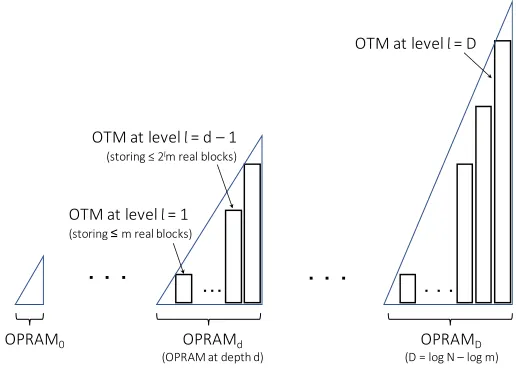
Our basic OPRAM scheme (Section 5.2) will consist of logarithmically many position-based OPRAMs of geometrically increasing sizes, henceforth denoted
OPRAM0, OPRAM1, OPRAM2, . . ., OPRAMD where D := log2N −log2m.
Specifically,OPRAMd storesΘ(2d·m) blocks whered∈ {0,1, . . . , D}. The last
oneOPRAMDstores the actual data blocks whereas every otherOPRAMdwhere
d < D recursively stores the position labels for the next depthd+ 1.
Data Structure. As we shall see, the case OPRAM0 is trivial and is treated specially at the end of this section (Section 5.1). Below we focus on describing
OPRAMd for some 1 ≤ d ≤ D = logN −logm. For d 6= 0, each OPRAMd
consists of d+ 1levels geometrically growing in size, where each level is a one-time oblivious memory schemeas defined and described in Section 4. We specify this data structure more formally below.
Hierarchical levels. The position-basedOPRAMd consists ofd+ 1 levels hence-forth denoted as (OTMj : j = 0, . . . , d) where level j is a one-time oblivious memory scheme,
OTMj :=OTM[2
j·m,m,2j]
with at most n = 2j ·m real blocks and m concurrent lookups in each batch (which can all be real). This means that for every OPRAMd, the smallest level is capable of storing up tomreal blocks. Every subsequent level can store twice as many real blocks as the previous level. For the largest OPRAMD, its largest level is capable of storing N real blocks given that D = logN −logm — this means that the total space consumed isO(N).
Every levelj is marked as eitherempty(when the correspondingOTMj has not been rebuilt) or full (whenOTMj is ready and in operation). Initially, all levels are marked as empty, i.e., the OPRAM initially is empty.
Additional assumption. We assume that each block is of the form (logical ad-dress, payload), i.e., each block carries its own logical address.
Operations. Each position-based OPRAM supports two operations, Lookup
andShuffle. For everyOPRAMdconsisting ofd+1 levels, we rely on the following
algorithms forLookupandShuffle.
Lookup. Every batch lookup operation, denotedLookup({(addri,posi) :i∈[m]}) receives as input the logical addresses ofm blocks as well as a correct position label for each requested block. To complete the batch lookup request, we perform the following.
1. For each levelj= 0, . . . , din parallel, perform the following:
– For eachi∈[m] in parallel, first check the supplied position label posi to see if the requested block resides in the current levelj: if so, let addr0i:=
addri and let pos0i :=posi (and specifically the part of the position label denoting the offset within levelj); else, setaddr0i :=⊥and pos0i :=⊥to indicate that this should be a dummy request.
– (vij:i∈[m])←OTMj.Lookup({addr0i,pos0i:i∈[m]}).
2. At this point, each of themCPUs hasdanswers from thedlevels respectively, and only one of them is the valid answer. Now each of themCPUs chooses the correct answer as follows.
For each i∈ [m] in parallel: set vali to be the only non-dummy element in (vij : j = 0, . . . , d), if it exists; otherwise set vali := ⊥. This step can be accomplished using an oblivious select operation (see Section 3.3) in logd parallel steps consumingdCPUs.
3. Return (vali:i∈[m]).
We remark that in Goldreich and Ostrovsky’s original hierarchical ORAM [21, 22], the hierarchical levels must be visited sequentially — for obliviousness, if the block is found in some smaller level, all subsequent levels must perform a dummy lookup. Here we can visit all levels in parallel since the position label already tells us which level it is in. Now the following fact is straightforward to observe:
Fact 8 ForOPRAMd,Lookupconsumes O(logd)parallel steps consumingm·d
CPUs where mis the batch size.
Shuffle. Similar to earlier hierarchical ORAMs [21,22] and OPRAMs [8], a shuffle operation merges consecutively full levels into the next empty level (or the largest level). However, in ourShuffleabstraction, there is an inputUthat contains some logical addresses together with new values to be updated. Moreover, the shuffle operation is associated with an update function that determines how the new values inU should be incorporated into the OTM during the rebuild.
OPRAMd+1 has chosen for recently accessed logical addresses. These position labels must then be recorded byOPRAMd appropriately.
More formally, each position-based OPRAMd supports a shuffle operation, denoted Shuffle(U, `;update), where the parameters are explained as follows:
1. An update array U in which each (non-dummy) entry contains a logical address that needs to be updated, and a new value for this block. (Strictly speaking, we allow a block to be partially updated.)
We will define additional constraints onU subsequently. 2. The level`to be rebuilt during this shuffle.
3. Anupdatefunction that specifies how the information inUis used to compute the new value of a block in the OTM.
The reason we make this rule explicit in the notation is that a block whose address that appears in U may only be partially modified; hence, we later need to specify this update function carefully. However, to avoid cumbersome notation, we may omit the parameter update, and just write Shuffle(U, `), when the context is clear.
For eachOPRAMd, whenShuffle(U, `;update) is called, it must be guaranteed that`≤d; and moreover, either level`must either be empty or`=d(i.e., this is the largest level in OPRAMd). Moreover, there is an extra OTM00; jumping ahead, we shall see thatOTM00 contains the blocks that are freshly fetched.
TheShufflealgorithm then combines levels 0,1, . . . , `(ofOPRAMd), together with the extraOTM00, into level`, updating some blocks’ contents as instructed by the update arrayU and the update functionupdate. At the end of the shuffle operation, all levels 0,1, . . . , `−1 are now marked as empty and level `is now marked as full.
We now explain the assumptions we make on the update array U and how we want the update procedure to happen:
– We require that each logical address appears at most once inU.
– LetAbe all logical addresses remaining in levels 0 to`in OPRAMd: it must hold that the set of logical addresses in U is a subset of those inA. In other words, a subset of the logical addresses inAwill be updated before rebuilding level`.
– If some logical address addr exists only in A but not inU, after rebuilding level `, the block’s value from the current OPRAMd should be preserved. If some logical address addr exists in both A and in U, we use the update
function to modify its value: update takes a pair of blocks (addr,data) and (addr,data0) with the same address but possibly different contents (the first of which coming from the currentOPRAMd and the second coming fromU), and computes the new block contentdata∗ appropriately.
We remark that the new valuedata∗ might depend on both data anddata0. Later, we will describe how the updaterule is implemented.
1. Let A := ∪`
i=0OTMi.Getall∪OTM00.Getall, where the operator ∪ denotes
concatenation. Moreover, for an entry in A that comes fromOTMi, then it also carries a labeli.
At this moment, the old OTM0, . . . ,OTM` instances may be destroyed. 2. We obliviously sortA∪U in increasing order of logical addresses, and
more-over, placing all dummy entries at the end. If two blocks have the same logical address, place the entry coming from Ain front of the one coming fromU. At this moment, in one linear scan, we can operate on every adjacent pair of entries using the aforementionedupdateoperation, such that if they share the same logical address, the first entry is preserved and updated to a new value, and the second entry is set to dummy.
We now obliviously sort the resulting array moving all dummies to the end. We truncate the resulting array preserving only the first 2`·melements and let A0 denote the outcome (note that only dummies and no real blocks will truncated in the above step).
3. Next, we call U0 ←Build(A0) that builds a new OTM0 and U0 contains the positions of blocks inOTM0.
4. OTM0 is now the new level`and henceforth it will be denoted OTM`. Mark level ` as full and levels 0,1, . . . , `−1 as empty. Finally, output U0 (in our full OPRAM construction later, U0 will be passed to the next (i.e., immedi-ately smaller) position-based OPRAM as the update array for performing its shuffle).
If we realize the oblivious sort with the AKS network [1] that sortsnitems in O(logn) parallel steps consuming n CPUs, we easily obtain the following fact — note that there is a negligible in N probability that the algorithm runs longer than the stated asymptotic time due to the oblivious random permutation building block (see Section 3.3).
Fact 9 Suppose that the update function can be evaluated by a single CPU in
O(1)steps. ForOPRAMd, let`≤d, then except with negligible inN probability,
Shuffle(U, `)takes O(log(m·2`))parallel steps consumingm·2` CPUs.
Observe that in the above fact, the randomness comes from the oblivious random permutation subroutine used in building the one-time oblivious memory data structure.
Trivial case:OPRAM0. In this case,OPRAM0simply stores its entries in an array A[0..m) of size mand we assume that the entries are indexed by a (log2m)-bit string. Moreover, each address is also a (log2m)-bit string, whose block is stored at the corresponding entry inA.
– Lookup.Upon receiving a batch ofmdepth-mtruncated addresses where all the real addresses are distinct, use oblivious routing to route A[0..m) to the requested addresses. This can be accomplished inO(mlogm) total work and O(logm) depth. Note thatOPRAM0’s lookup does not receive any position labels.