Non-committing encryption from Φ-hiding
Brett Hemenway
Rafail Ostrovsky
∗Alon Rosen
†January 22, 2015
Abstract
A multiparty computation protocol is said to be adaptively secure if it retains its security even in the presence of an adversary who can corrupt participants as the protocol proceeds. This is in contrast to the static corruption model where the adversary is forced to choose which participants to corrupt before the protocol begins.
A central tool for constructing adaptively secure protocols is non-committing encryption (Canetti, Feige, Goldreich and Naor, STOC ’96). The original protocol of Canetti et al. had ciphertext expansion that was quadratic in the security parameter, and prior to this work, the best known constructions had ciphertext expansion that was linear in the security parameter.
In this work, we present the first non-committing encryption scheme that achieves ciphertext ex-pansion that is logarithmic in the message length. Our construction has optimal round complexity (2-rounds), where (just as in all previous constructions) the first message consists of a public-key of size
˜
O(nλ) wherenis the message length andλis the security parameter. The second message consists of a ciphertext of sizeO(nlogn+λ). The security of our scheme is proved based on the Φ-hiding problem.
∗The work of R. Ostrovsky was supported in part by NSF grants CCF-0916574, IIS-1065276, CCF-1016540, CNS-1118126,
CNS-1136174; US-Israel BSF grant 2008411; OKAWA Foundation Research Award; IBM Faculty Research Award; Xerox Faculty Research Award; B. John Garrick Foundation Award; Teradata Re- search Award; and Lockheed-Martin Corporation Research Award. This material is also based upon work supported by the Defense Advanced Research Projects Agency through the U.S. Office of Naval Research under Contract N00014-11-1-0392.
†Work supported by ISF grant no. 1255/12 and by the European Research Council under the European Union’s Seventh
1
Introduction
Secure multiparty computation (MPC) allows a group of players to compute any joint function of their inputs while maintaining the privacy of each individual player’s input. When defining security of an MPC protocol, it is important to consider how and when players are corrupted. Traditionally security has been considered in two adversarial models, static and adaptive. In the static model, the corrupted players are fixed before the protocol begins, while in the adaptive model players may become corrupted at any point in the protocol. In particular, the adversary may choose to corrupt players adaptively (up to a certain threshold) based on messages sent in earlier rounds of the protocol. The adaptive security model, which more accurately reflects conditions in the real-world, is widely recognized to be “the right” model for security in the MPC setting. Unfortunately, analysis of protocols in the adaptive model can be difficult, and many protocols are only proven secure in the weaker static corruption model.
The Goldreich, Micali, Wigderson protocol [14] provides computational security in the static model, and it was observed in [11] that the original GMW proof of security does not hold in the adaptive corruption model. The works of Ben-Or, Goldwasser and Wigderson [3] and Chaum, Cr´epeau and Damg˚ard [7] take an alternate approach to MPC and create protocols with information theoretic security. These protocols rely on a majority on private channels between the players, and require a majority of players to be honest. Like the GMW protocol, the BGW and CCD protocols were only proven secure in the static corruption model.
1.1
Non-Committing Encryption
In [5], Canetti, Feige, Goldreich and Naor introduced the notion ofnon-committing encryption, and showed that if the private channels in the BGW and CCD protocols are replaced by non-committing encryption, then the MPC protocols can achieve adaptive security. Subsequent work has made similar use of non-committing encryption in order to construct cryptographic protocols achieving security against adaptive adversaries [1, 6].
Despite its utility, previous constructions of non-committing encryption have been much less efficient than standard (IND-CPA secure) cryptosystems. The original construction of Canetti et. al. created non-committing encryption fromcommon-domain trapdoor permutations, which in turn could be realized from either the CDH or RSA assumption. The resulting scheme requires O(λ) ciphertexts (each of bit length
O(λ)) to encrypt a single bit plaintext with security parameterλ.
Beaver [1] constructed a non-committing key-exchange protocol based on the DDH assumption, but his protocol requires 3 rounds. Beaver’s construction provided aninteractiveencryption protocol with ciphertext expansion O(λ). Damg˚ard and Nielsen [11] demonstrated a generalization of Beaver’s scheme that could be implemented under general assumptions. The protocol of Damg˚ard and Nielsen, like that of Beaver, requires three rounds and has ciphertext expansion O(λ). The construction of Damg˚ard and Nielsen was later improved, reducing the round complexity to two rounds, by Choi, Dachman-Soled, Malkin and Wee [8]. The construction of [8] gives a two-round protocol with ciphertext expansion O(λ) and public keys of sizeO(nλ) forn-bit messages. Achieving non-interactive (2-round) non-committing encryption with optimal rate (i.e.,O(1) ciphertext expansion) remained an open question.
1.2
Our Contributions
We construct the first non-committing encryption scheme with logarithmic ciphertext expansion. Our scheme is 2-round, which is optimal in terms of round complexity. The security of our construction rests on the Φ-hiding assumption [4]. Our construction improves on the ciphertext size of previous constructions, with only a modest cost in key size (our public key sizes are ˜O(nλ), compared toO(nλ) in [8]).
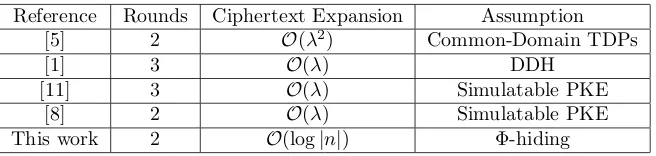
Reference Rounds Ciphertext Expansion Assumption
[5] 2 O(λ2) Common-Domain TDPs
[1] 3 O(λ) DDH
[11] 3 O(λ) Simulatable PKE
[8] 2 O(λ) Simulatable PKE
This work 2 O(log|n|) Φ-hiding
Figure 1: Comparison to prior work. The parameterλdenotes the security parameter, and|n|denotes the message length. Notice that λ log|n| since by assumption super-polynomial time calculations inλ are infeasible, while exponential-time calculation in log|n| are feasible.
for all public-keys, and encryption randomness for all ciphertexts) should be able to find a subset of secret keys, and a subset of encryption randomness, such that the ciphertexts in their intersection decode to any target message.
In these schemes, each of the underlying encryptions encrypts one symbol from an error-correcting en-coding of the sender’s message. Let Σ denote the alphabet of the error-correcting code. Then, even if the simulator knows decryptions for every one of thenciphertexts, decryptions will only agree with a random vector in Σn in a 1
|Σ|fraction of coordinates. Thus if Σ is large, the simulator’s job of finding an intersection
IR∩IS that matches the target message will be impossible. On the other hand, if Σ is small then the scheme suffers from large ciphertext expansion because each codeword symbol is encrypted separately, and the semantic security of the underlying cryptosystem puts a lower bound on the size of each ciphertext. This has been a fundamental barrier to achieving non-committing encryption with good rate.
In order to overcome this barrier, we design a cryptosystem where randomness can be re-used across keys. Cryptosystems with this property are easy to construct, and even El-Gamal has this property. In fact, cryptosystems coming from smooth hash proof systems [10] have this property, as do cryptosystems based on the extended decisional diffie-hellman assumption [16]. This notion of randomness re-use across keys was a necessary ingredient in constructing lossy trapdoor functions [20] and multi-recipient cryptosystems [2].
Now, if we havenciphertexts, but each uses the same randomness, the total length could be as small as
O(n+λ) instead ofO(nλ). Unfortunately, reusing randomness across ciphertexts makes the simulator’s job much harder. Now, when the simulator generates encryption randomness, it must efficiently generate asingle
random element that is simultaneously valid randomness for allnciphertexts. For a given cryptosystem, it can be difficult to determine whether such randomness exists, and more difficult still to devise anefficient
scheme for finding it.
Although we can build randomness-reusable cryptosystems from almost all standard hardness assump-tions, (e.g. DDH, DCR, QR) in order to achieve the efficient randomness sampling required by the simulator, we rely on the Φ-hiding assumption [4].
At a high level, our non-committing encryption behaves as follows. The receiver generates npublic-keys for a randomness-reusable cryptosystem based on the Φ-hiding assumption, in such a way that he only knows the decryption keys for a small subsetIR. The sender encodes his message using a binary error-correcting code of block-length n, and chooses a subset of keys IS ⊂ [n]. The sender generates a single piece of randomness and encodes the symbols of his codeword using this single random value for i ∈ IS, and the sender samples ciphertexts obliviously otherwise.
Encryption under our scheme is conceptually similar to all previous constructions of non-committing encryption, but re-using randomness makes creating an efficient simulator significantly more difficult. On the positive side re-using randomness allows us to decrease the ciphertext size beyond the bounds achieved compared to all previously known constructions.
2
Preliminaries
2.1
Notation
IfAis a Probabilistic Polynomial Time (PPT) machine, then we usea←$ Ato denote running the machine
we user←$ R to denote sampling uniformly fromR. We use the notation
Pr[A(x, r) =c:r←$ R, x←$ X],
to denote the probability thatAoutputscwhenxis sampled uniformly fromX andris sampled uniformly fromR. We define the statistical distance between two distributionsX, Y to be
∆(X, Y) = 1 2
X
x
|Pr[X =x]−Pr[Y =x]|
If X and Y are families of distributions indexed by a security parameter λ, we use X ≈s Y to mean the distributions X and Y are statistically close, i.e., for all polynomials p and sufficiently large λ, we have ∆(X, Y)<p(1λ). We useX≈cY to mean X andY are computationally close,i.e., for all PPT adversaries
A, for all polynomialsp, then for all sufficiently largeλ, we have|Pr[AX = 1]−Pr[AY = 1]|<1/p(λ).
2.2
Non-Committing Encryption
In this section, we review the notion of non-committing encryption [5]. Essentially, a non-committing encryption scheme is one where there is an efficient simulator, that can generate public keys and ciphertexts, such that, at a later point, a corresponding secret key and encryption randomness can be generated which “opens” the ciphertext to any given message. For security, we require that the distribution on simulated keys and ciphertexts is computationally indistinguishable from the distribution on keys and ciphertexts generated by the real encryption protocol. The formal definition is given in Definition 1.
Definition 1 (Non-Committing Encryption).
A cryptosystem PKE = (Gen,Enc,Dec) is called non-committing, if there exists a simulator Simsuch that the following properties hold:
1. Efficiency: The algorithmsGen,Enc,DecandSimare all probabilistic polynomial time.
2. Correctness: For any messagem∈ M
Pr[Dec(sk, c) =m: (pk, sk)←$ Gen(1λ), c←$ Enc(pk, m)] = 1
3. Simulatability: The simulatorSim= (Sim1,Sim2) For any messagem∈ M, define the distributions:
ΛSimm ={(m, pk, sk, r1, r2) : (pk, c, t) $
←Sim1(1λ),(sk, r1, r2) $
←Sim2(m, t)}
and
ΛRealm ={(m, pk, sk, r1, r2) : (pk, sk) $
←Gen(1λ;r1), c $
←Enc(pk, m;r2)}
We require that ΛSimm ≈c ΛRealm .
We do not explicitly require that the system be semantically secure, this is implied by the simulatability of the system.
2.3
The
Φ
-hiding Assumption
The security of our construction rests on the Φ-hiding assumption [4]. Informally, the Φ-hiding assumption asserts that it is hard to determine whether a given integer,e, divides the size of the groupZ∗N whenN =pq
is an RSA modulus.
Let PRIMES(λ) denote the set of primes of bit-lengthλ, and letRSA(λ) denote the set of RSA moduli of bit-lengthλ, i.e.,
RSA(λ) ={N :N =pq, p, q∈PRIMES(λ/2),gcd(p−1, q−1) = 2}
LetRSAe(λ) denote the set of RSA moduli of lengthλthat Φ-hide e.
RSAe(λ) ={N ∈RSA(λ) :edividesp−1}
Definition 2 (The Φ-hiding assumption).
For all >0, and for alle∈Zsuch that 3< e <2blog(λ/4)c− and for all PPT distinguishers,A
Pr[A(N, e) :N
$
←RSA(λ)]−Pr[A(N, e) :N ←$ RSAe(λ)] < ν(λ)
For some negligble functionν(·).
The original Φ-hiding assumption stated thatRSAe(λ) andRSAe0(λ) are indistinguishable for all 3< e≤ e0 <2λ/5. For simplicity, we use a slightly modified assumption (i.e., that RSAe(λ)≈c RSA(λ)). All of our constructions go through essentially unchanged under the original Φ-hiding assumption, except that the key generator would have to choose aneto sample fromRSAe(λ) and then ignoreethroughout the protocol.
The bound e < 2blog(λ/4)c− is necessary to avoid Coppersmith’s attack [9]. The Φ-hiding assumption was originally used to build efficient Private Information Retrieval (PIR) protocols [4, 13]. In [17] it was observed that the Φ-hiding assumption turns the RSA mapx7→xe modN into a lossy trapdoor function (LTF) [20]. Kiltz, O’Neill and Smith leveraged the lossiness to remove the random oracle from the proof of security of RSA-OAEP. More recently, the regularity of the lossy RSA map has been explored [18].
3
Smooth Hash Proofs from
Φ
-hiding
Our work builds on the notion of smooth hash proof systems as defined by Cramer and Shoup [10]. A hash proof system for a language,L, is a set of keyed hash functionsHk, along with “public” and “private” evaluation algorithms forHk. A hash function Hk (fork∈K) takesX→Π.
The public algorithm takes x∈ L, along with a witnessw, and the “projected key” α(k), and outputs
Hk(x). The private evaluation algorithm simply takesx, kand outputsHk(x). While the public and private evaluations must match on x ∈ L, if x 6∈ L, the smoothness property says that Hk(x) should be almost uniformly distributed (even conditioned onα(k)). Formally, we have
Definition 3 (Hash Proof Systems [10]). The set (H, K, X, L,Π, S, α) is a hash proof system if, for all
k∈K, the action ofHk on the subsetLis completely determined byα(k).
Thus for a hash proof system the projection keyα(k) determines the action ofHk onL. We also require that given x∈L, and a witness w, along with the projection keyα(k) then the hash value Hk(x) can be
efficiently computed. This is called thepublic evaluation algorithm.
A hash proof system issmooth if the projected keyα(k) encodes almost no information about the action ofHk(·) outsideL.
Definition 4 (Smooth Hash Proof Systems [10]). Let (H, K, X, L,Π, S, α) be a hash proof system, and define two distributionsZ1, Z2taking values on the setX\L×S×Π. ForZ1, we samplek←K,x←X\L,
and sets=α(k),π=Hk(x), forZ2we samplek←K,x←X\L, andπ←Π, and sets=α(k). The hash
proof system is calledν-smooth if ∆(Z1, Z2)< ν.
We will call an infinite family of hash proof systems smooth if the family isν-smooth for some negligible functionν. For a language,Lwith no polynomial-time distinguisher, smooth hash proof systems immediately imply IND-CPA secure encryption by letting kbe the secret key,α(k) be the public key, and to encrypt a message m∈Π you sample x∈Lalong with a witness and use the public evaluation algorithm to output
E(m) = (x, Hk(x) +m).
We begin by describing a simple smooth hash proof system from the Φ-hiding assumption. Building a hash proof system based on Φ-hiding is straightforward, because Φ-hiding essentially implies that the discrete-log problem is hard1, and then we can used the framework for the original discrete-log based hash
proof systems from [10].
1Supposegis a generator for the largest cyclic component of
Z∗N and leth =g
p modN. IfN Φ-hidesp, thenhmost
elements of Z∗N willnot be powers of h. On the other hand, if gcd(p, ϕ(N)) = 1, thenh will generate the largest cyclic
component ofZ∗N. If we had an oracle that could find the discrete-logarithm (with baseh) inZ ∗
N, then we could distinguish
• Key Generation: Choose a strong (τ,2−λ)-extractor2Ext :{0,1}d×
ZN → {0,1}Fix a primepwith 2τ< p < N14. SampleN ←$ RSAp(λ) Sampler←$ ZN. Setg=rp∈ZN.
Sample an extractor seed,s← {$ 0,1}d.
The language will be the set ofpth powers inZN.3
Sample k←$ ZN Set the projection key, α(k) =gk modN.
• Public Evaluation: Givenx=gw modN, and a witness,w,
Hk(x) = Exts (gk)w modN
• Private Evaluation: Given the secret key, k, and a pointx,
Hk(x) = Exts xk modN
Correctness is easy to verify. To see smoothness, supposeN Φ-hidesp. Then,Z∗N has a subgroup of order
p, butg=rp modN has no component in that subgroup. In particular,h=gk modN, only depends on
k modϕ(N)/p.
Now, ifxhas full order in the largest cyclic subgroup4of
Z∗N then, assuming gcd(p, w) = 1, the value (xw)k modN depends on all ofk, and in particular has logpbits of entropy even conditioned onk modϕ(N)/p
(and hence the same holds conditioned ongx). Thus the extractor produces an almost uniform value, even conditioned on the projected keygk modN.
3.1
A compact hash proof system from the
Φ
-hiding assumption
In this section, we build a simple IND-CPA secure cryptosystem that will be the foundation of our full non-committing construction.
• Key Generation: Let ` be the (bit) length of messages that will be encrypted. Choose a strong (τ,2−λ)-extractor5 Ext :{0,1}d×
ZN → {0,1} Letpi= (i+ 2)nd prime,
(p1, p2, p3, . . .) = (5,7,11, . . .)
Letei=dτlogpi2efori= 1, . . . , `. Letqi=p
ei
i , thusqi>2τ.
Sample N←$ RSA(λ).
Sample an extractor seed,s← {$ 0,1}d. Samplea
1, . . . , a`
$
←ZN. Set
hi=
gQj6=iqi
ai
modN
fori= 1, . . . , `.
• Encryption: Given a messagem~ = (m1, . . . , m`)∈ {0,1}`
Pick w←$ ZN
~c= (gw modN,s, c1, . . . , c`)
where
ci= Exts((hi) w
)⊕mi
2 In other words, Ext, if X is a random variable supported on
ZN with min-entropy at leastτ, then if s
$
← {0,1}dthe
statistical distance between (s,Exts(X)) and (s, U{0,1}) is less than 2−λ.
3Note that ifN Φ-hidespthen
Z∗N has a cyclic subgroup of orderp, and so at mostϕ(N)/presidues inZ ∗
N that arepth
powers, otherwise all elements inZ∗Nwill bepth powers.
4If we chooseN to be the product of two primes,N
1, N2 and gcd(N1−1, N2−1) = 2, then we have thatZ∗N has a cyclic
subgroup of orderϕ(N)/2 = (N1−1)(N2−1)/2, and we can work in this group.
• Decryption: Notice that
(hi)w=(gw)Πj6=iqjai
Thus the receiver, who hasai, can recovermi by setting
mi= Exts
(gw)Πj6=iqj
ai
⊕ci
The IND-CPA security of this scheme follows immediately from the security of the underlying hash proof system.
Remark 1: Since messages must be polynomial in the security parameter, λ, we have that `log` < 5
√
N ≈2λ/5, so the conditions of the Φ-hiding assumption are satisfied.
Remark 2: Although the security follows from the Φ-hiding assumption, the honest receiver does not need to choose a modulus that Φ-hides anything.
Remark 3: Notice that the factorization ofN is never used, and need not be known for decryption.
4
Non-committing encryption from
Φ
-hiding
The high level idea is as follows: to encrypt a messagemthe sender encodes the messagemusing a standard binary error correcting code. The sender will then flip a small number of bits of the codeword. The sender then encrypts each bit of this corrupted codeword separately (using different public-keys, but the same encryption randomness).
The receiver will know only a subset of the total set of possible secret keys. The receiver will decode only the bits corresponding to the keys he knows. With high probability, the overlap between the receiver’s decryption keys and the bits of the codeword flipped by the sender will be small enough to be handled by the error correcting code. The formal scheme is given in Figure 2.
4.1
Probability of Decryption Error
First, we examine the probability of decryption error. It is a simple calculation to verify that the bits in
IR∩IS ⊂[n] will be decrypted correctly. SinceIR is uniformly chosen, and the bits inIR∩IS are decrypted correctly while the others will be in error with probability 12, we can bound the probability of decryption error.
Lemma 1. The probability the receiver decrypts more thanδnbits incorrectly is bounded by
Pr[ more than δnbits are decrypted incorrectly]≤e−12c 2
rcsn+e−2(cr cs2 +δ− 1 2)
2
n/(1−cr cs 2 )
Proof. First, we lower-bound|IR∩IS|(recall these bits are always decrypted correctly).
Since IR and IS are both chosen uniformly at random, we can imagine fixing IR and choosing IS at random. Now, let Xi be the indicator variable indicating whether the ith element of IS is in IR. Let
X =P|IS|
i=1Xi. ThusX =|IR∩IS|. Then Pr[Xi= 1] =cr, so E(X) =cr|IS|=crcsn.
Since theXi are negatively correlated we can apply a Chernoff bound ([12] Thms 1.1 and 4.3) to obtain
Pr[X < E(X)−t]≤e−2t2/|IS|
takingt=E(2X)= crcsn
2 we have
PrhX < crcsn
2 i
< e−12c 2 rcsn
Now, for the elements in [n]\IR∩IS, these have a half chance of decrypting correctly. Let Yi be the indicator random variable that indicates whether the ith element of [n]\IR∩IS decrypts correctly. Thus
E(Yi) = 12. If we letY =P
n−|IR∩IS|
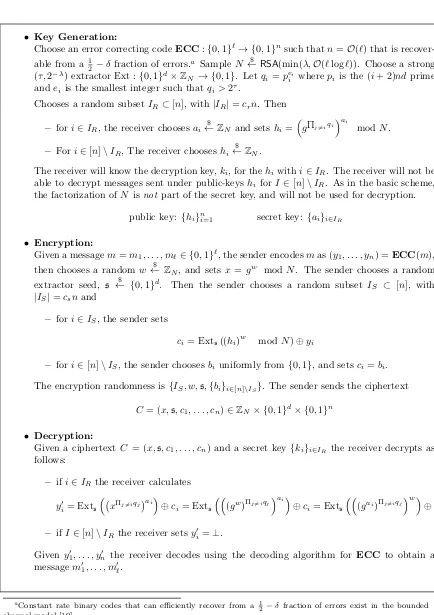
• Key Generation:
Choose an error correcting codeECC:{0,1}`→ {0,1}nsuch thatn=O(`) that is
recover-able from a 12−δ fraction of errors.a Sample N ←$ RSA(min(λ,O(`log`)). Choose a strong
(τ,2−λ) extractor Ext :{0,1}d×
ZN → {0,1}. Let qi=peii where pi is the (i+ 2)ndprime andei is the smallest integer such thatqi>2τ.
Chooses a random subsetIR⊂[n], with|IR|=crn. Then
– fori∈IR, the receiver choosesai
$
←ZN and setshi =
gQj6=iqi
ai
modN.
– Fori∈[n]\IR, The receiver chooseshi
$
←ZN.
The receiver will know the decryption key,ki, for thehiwithi∈IR. The receiver will not be able to decrypt messages sent under public-keyshi forI ∈[n]\IR. As in the basic scheme, the factorization ofN isnot part of the secret key, and will not be used for decryption.
public key: {hi}ni=1 secret key: {ai}i∈IR
• Encryption:
Given a messagem=m1, . . . , m`∈ {0,1}`, the sender encodesmas (y1, . . . , yn) =ECC(m),
then chooses a randomw ←$ ZN, and sets x=gw modN. The sender chooses a random
extractor seed, s ← {$ 0,1}d. Then the sender chooses a random subset I
S ⊂ [n], with
|IS|=csnand
– fori∈IS, the sender sets
ci= Exts((hi)
w
modN)⊕yi
– fori∈[n]\IS, the sender choosesbi uniformly from{0,1}, and setsci =bi.
The encryption randomness is{IS, w,s,{bi}i∈[n]\IS}. The sender sends the ciphertext
C= (x,s, c1, . . . , cn)∈ZN× {0,1}d× {0,1}n
• Decryption:
Given a ciphertext C = (x,s, c1, . . . , cn) and a secret key {ki}i∈IR the receiver decrypts as
follows:
– ifi∈IR the receiver calculates
y0i= Exts
xΠj6=iqjai⊕c
i= Exts
(gw)Πj6=iqj
ai
⊕ci= Exts
(gai)Πj6=iqj
w
⊕ci
– ifI∈[n]\IR the receiver setsyi0=⊥.
Given y01, . . . , yn0 the receiver decodes using the decoding algorithm for ECC to obtain a messagem01, . . . , m0`.
aConstant rate binary codes that can efficiently recover from a 1
2 −δ fraction of errors exist in the bounded channel model [19].
NowX is the size of|IR∩IS|andY is the number of bits outside ofIR∩IS that are decrypted correctly. So the probability that more thanδnof the bits are decrypted incorrectly is
Pr [X+Y <(1−δ)n]
= Pr [Y <(1−δ)n−X]
= Pr [Y < E(Y)−(E(Y)−(1−δ)n+X)]
= Pr
Y < E(Y)−
n
−X
2 −(1−δ)n+X
= Pr
Y < E(Y)−
X
2 −
1
2−δ
n
= Pr
Y < E(Y)−
X
2 −
1
2 −δ n
X < crcsn
2
PrhX < crcsn
2 i
+ Pr
Y < E(Y)−
X
2 −
1
2−δ n
X ≥ crcsn
2
PrhX ≥ crcsn
2 i
≤e−12c 2
rcsn+ Pr
Y < E(Y)−
X
2 −
1
2 −δ n
X ≥crcsn
2
≤e−12c 2
rcsn+ Pr
Y < E(Y)−
crcs
2 +δ−
1 2 n
X ≥ crcsn
2
≤e−12c 2
rcsn+e−2((cr cs2 +δ− 1 2)n)
2
/((1−cr cs2 )n) (X≥ crcsn
2 and Chernoff)
≤e−12c 2
rcsn+e−2(cr cs2 +δ− 1 2)
2
n/(1−cr cs 2 )
In the second to last line, recall that X is the number of summands in Y so the Chernoff bound for Y
gets better asX increases.
Note that to apply Chernoff, we need crcs
2 +δ− 1
2 >0, in other wordsδ > 1 2−
crcs
2 . Thus we will need a
code ECCthat can correct from an error-rate of 12−crcs
2 . This can be achieved, and in fact constant-rate
codes that can recover from aδfraction of errors exist for any δ <12 in the bounded channel model [19].
5
The Simulator
The simulation game in a non-committing encryption proceeds as follows: the simulator generates a public-key and a ciphertext. The adversary then chooses a target message, and the simulator must produce a secret key and encryption randomness such that the entire ensemble of public-key, secret key, ciphertext, encryption randomness and target message is indistinguishable from a valid run of the key-generation and encryption algorithms encrypting the target message.
• Key Generation: As in the real scheme the simulator makes use of an error correcting codeECC:
{0,1}`→ {0,1}n, and an extractor Ext :{0,1}d×
ZN → {0,1}.
Note that unlike the valid sender and receiver, the simulator will need the factorization of the RSA modulus N (details below).
– The simulator chooses a random extractor seed s← {$ 0,1}d.
– The simulator uniformly chooses a subsetIgood⊂[n] of sizecgn, and setsIbad= [n]\Igood. Let
cb=| Ibad|
n = 1−cg.
– The simulator generates an Φ-hiding modulus,N, such thatN Φ-hidesqj forj∈Ibad.6
6 This means thatN ≥Q j∈Ibadqj
5
to avoid Coppersmith’s attack. Since|Ibad|=O(n), and the pi ≈ilogi by the
– The simulator choosesr←$ ZN and setsg=r
Q
j∈Ibadqj modN.
– The simulator then chooses keysai
$
←ZN fori= 1, . . . , n.
– The simulator then outputs:
public parameters: N, g Public key:{hi}ni=1
The public-key will be the collection{hi}ni=1. A crucial point of our scheme is that the simulator knows
the decryption keys for all hi for alli, and will be able to decrypt for all i∈Igood, unlike in the real
scheme, where the receiver only knows the keys for some smaller subset IR.
• Ciphertext Generation:
– The simulator generatesw←$ Zn
– The simulator partitionsIgoodinto two random disjoint setsA1andA0, with|A1| ≈ |A0| ≈cgn/2, andA1∪A0=Igood.
– For i ∈ A1, the simulator sets ci = Exts(hwi modN)⊕1 and for i ∈ A0, the simulator sets
ci= Exts(hwi modN).
– Fori∈Ibad the simulator chooses a random bitbi and setsci=bi.
The simulator outputs the ciphertext
C= (x,s, c1, . . . , cn)∈ZN × {0,1}d× {0,1}n
• Simulating Encryption Randomness: After generating a public-key and a ciphertext, the simulator is given a target messagem∗. The simulator calculatesy∗=ECC(m∗).
The receiver chooses the setIS as follows: LetM1={i:yi∗= 1}, and M0={i:yi∗= 0}. If|M1∩A1∪M0∩A0|< csnthe simulator outputs⊥.
We show in Section 5.1 that this happens with negligible probability.
Otherwise, the simulator samples csnelements uniformly fromM1∩A1∪M0∩A0 and calls this set
IS.
• Generating the Secret Key: If|M1∩A1∪M0∩A0|< crnthe simulator outputs⊥.
We show in Section 5.1 that this happens with negligible probability.
Otherwise, the simulator samples crnelements uniformly from|M1∩A1∪M0∩A0|and calls this set
IR. SinceA1∪A0=Igood, and the receiver knows all the secret keys corresponding to the indices in
Igood the simulator can outputai fori∈IR.
5.1
Good randomness and secret keys exists with overwhelming probability
The simulator outputs⊥if|M1∩A1∪M0∩A0|<max(cr, cs)n, thus we need to show that this happens with only negligible probability. Recall thatMi is the set of indices where the (encoded) target message has value
i, whereasAi is the set of indices where the ciphertext encrypts valuei. The setsAi were chosen uniformly at random, and the setsMi were adversarially chosen (since they are determined by the adversary’s choice of message).
We begin by showing that |M1∩A1∪M0∩A0| will be large if M0, M1 were chosen independently of
A0, A1. Then we will argue that the adversary cannot do much better than choosingM0, M1independently.
IfM0 andM1were chosen independently ofA0, andA1, then the probability that the simulator outputs
⊥can be bounded by Chernoff.
In particular, we have E(|Mi∩Ai|) =|Ai||nMi|= cg|2Mi| (since|Ai|=c2gn).
Pr
|Mi∩Ai|<
cg|Mi|
2 −
cg|Mi| 4
< e−2cg |Mi|2
Since|M0|+|M1|=n, at least one of the|Mi|will have|Mi| ≥ n2, thus
Prh|M1∩A1∪M0∩A0|<
cgn 8
i
< e−2cg n32
which is negligible inn. Thus we have the desired result whenever max(cr, cs)<c8g.
Now, the sets M0, M1 are not independent of A0, A1 because they were generated adversarially after
seeing the ciphertextC (which encodesA0, A1). Since the adversary is polynomially-bounded, and the sets
A0 and A1 are hidden by the semantic security of the underlying Φ-hiding based encryption, a standard
argument shows that if the adversary could cause |M1∩A1∪M0∩A0| > min(cr, cs)n with non-neglible probability, then this adversary could be used to break the Φ hiding assumption. (Note that the simulator doesnot need the factorization of N to determine the size|M1∩A1∪M0∩A0|.)
5.2
Simulating the Choice of
w
5.2.1 Simulating w
Most of the technical difficulty in this construction lies in finding a suitablew∗ for the simulator to output. Sincegw modN is part of the ciphertext,gw∗=gw modN.
Sincegis a power ofqjfor allj∈Ibad this meansw=w∗ modϕ(N)/(Qj∈Ibadqj). If we simply output w∗=w, the adversary can distinguish the simulator’s output from a true output.
In a valid encryption for i∈[n]\Isabout half of theci should equal Exts(hwi modN) +yi, but if the simulator simply outputs w∗ =w, by using w∗ to “decrypt” ci fori ∈[n]\IS and the adversary will find that many fewer than half the locationsi∈[n]\Ismatch the encoded message. In the next section we will provide an algorithm for choosingw∗.
5.2.2 Finding a target setT
The simulator will have revealed secret keys for all i ∈IR ⊂M1∩A1∪M0∩A0 ⊂ Igood. The simulator
cannot lie about values whose indices are inIgood.
From the adversary’s view, for i ∈ [n]\IS the encryptions ci will be encryptions of y∗. In an honest execution of the encryption algorithm, for i6∈[n]\IS, the encryptions,ci should be uniformly random (in particular, they should be independent ofy∗).
Thus the simulator needs to choose values inIbad so that the ci for i∈[n]\IS encrypt values that are uniformly distributed on{0,1}. This is because the honest encrypter will chooseci at random fori6∈IS.
Letαb ={i∈Igood\IS : Exts(gw modN)⊕b=ci}. Thusαb denotes the number of indices that are encryptions ofb (that the simulator cannot change).
In an honest execution, the number of encryptions of 0 that an adversary sees in [n]\IS is binomially distributed with parametersn− |IS|= (1−cs)nand 12.
The simulator will sample a random variable,X, whose distribution is a binomial, shifted by α1.
Pr[X =j] =
(1−cs)n
j+α1
1 2
(1−cs)n
forj =−α1, . . . ,(1−csn)−α1
IfX > cbnorX <0 then the simulator will return⊥.7
Otherwise, the simulator will choose a random subset ofIbad of sizeX, and set thoseX elements 1, and
the remainingcb−X elements to 0.
7Chernoff says that this happens with negligible probability. In particular, by Chernoff
Pr[X <0]< e−2
(1−cs)n 2 −α1
2
(1−cs)n
and
Pr[X < cbn]< e −2
cb−(1−cs)n 2
2
(1−cs)n
If we denoteIbad={i1, . . . , icbn}, then the simulator has chosen{tij}
cbn
j=1 so that exactlyX of thetij are
1, andcbn−X of thetij are 0.
Now, consider the distribution of encryptions of 1 in the set [n]\IS. There are exactly α1+X ones
in that set, and assuming the simulator does not output ⊥, the probability of this occurring is exactly
(1−cs)n
α1+X
1
2
(1−cs)n
which is exactly the binomial distribution.
5.2.3 Calculating w∗
DenoteIbad={i1, . . . , icbn}. Fori∈Ibadthe simulator has sethi=
gQj6=iqj
ai
=
r
Q
j∈Ibadqj Q
j6=iqjai
modN. For the bad setIbad the ciphertexts are “lossy”, so the smoothness of the hash proof system makes
the ciphertexts non-binding. Suppose the simulator has chosen target values{ti}i∈cbn⊂ {0,1}
cbn (using the
methods in the previous section). The simulator’s goal is forcij to be an encryption oftj forj= 1, . . . , cbn.
We will show how the simulator can choose aw∗so that cij looks like an encryption oftj forj= 1, . . . , cbn.
In particular, this means
Exts
hwi∗
j modN
=cij ⊕tj forj = 1, . . . , cbn
Now, w∗ = w modϕ(N)/Q
j∈Ibadqj
. The simulator then runs the following iterative algorithm
(Algorithm 1) to findw∗. (Recall: Ibad={i1, . . . , icbn}.)
Algorithm 1Calculatingw∗
w∗=w
forj= 1, . . . , cbndo
whileExts gw
∗
modN
6
=cij ⊕tj do w∗=w∗+ϕ(N)/qij modϕ(N)
end while end for
First, notice that at every step w∗ = w modϕ(N)/Q
j∈Ibadqj. Second, notice that when processing
target indexij ∈Ibad, the value ofw∗does change moduloqij, but not for any other primesqk ∈Ibad\ {ij}.
Sinceg is not a qijth power, the valueg
w∗ changes asw∗ changes modulo q
ij. Thus the expected running
time of the while loop is only 2.
6
Efficiency and Parameters
A codeword in our cryptosystem is given by
C= (x,s, c1, . . . , cn)∈ZN × {0,1}d× {0,1}n
Sincex∈ZN, s∈ {0,1}d, andci ∈ {0,1}, the length of the codeword is logN +d+n. Using the explicit extractors of [15], we can set the seed lengthdto beO(log logN+ log 1/), so setting= 2−λ, we can choose
d=O(λ), and extract bits that are negligibly close to uniform.
Now, the element x ∈ ZN, so |x| = logN. Since the modulus, N, generated by the simulator must be able to Φ-hide all qj for j ∈ Ibad ⊂[n]. Thus 5
√
N ≥Q
j∈Ibadqj to avoid Coppersmith’s attack. Since |Ibad|=O(n), and thepi≈ilogi by the Prime Number Theorem soN ≈(nlogn)O(n), which means that logN =O(nlogn). This means the codewords are of lengthO(nlogn+λ+n) =O(nlogn). In our scheme, the plaintext messages are of length `, and n =|ECC(m)| =O(`), soO(nlogn) = O(`log`). Thus our scheme achieves a logarithmic ciphertext expansion. By contrast, the best previously known schemes have a ciphertext expansion ofλ[8]. By assumption, super-polynomial-time calculations inλare infeasible while polynomial-time calculations in ` (and hence exponential-time calculations in log(`)) are efficient. Thus
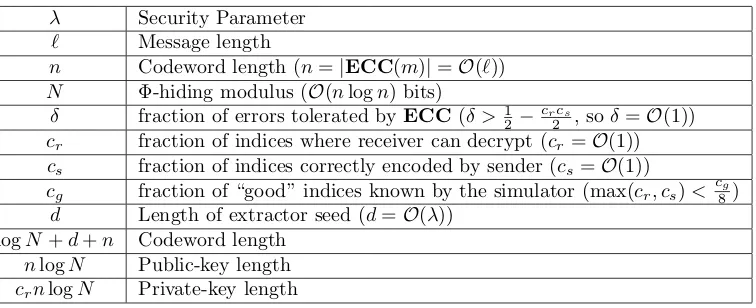
λ Security Parameter
` Message length
n Codeword length (n=|ECC(m)|=O(`))
N Φ-hiding modulus (O(nlogn) bits)
δ fraction of errors tolerated byECC(δ > 12−crcs
2 , so δ=O(1))
cr fraction of indices where receiver can decrypt (cr=O(1))
cs fraction of indices correctly encoded by sender (cs=O(1))
cg fraction of “good” indices known by the simulator (max(cr, cs)< cg
8)
d Length of extractor seed (d=O(λ))
logN+d+n Codeword length
nlogN Public-key length
crnlogN Private-key length
Table 1: Summary of the parameters in our scheme
7
Conclusion
In this work, we constructed the first non-committing encryption scheme with messages of length |m| and ciphertexts of lengthO(|m|log|m|). This improves on the best prior constructions which had ciphertexts of lengthO(|m|λ) [8]. Like most previous protocols, a public key in our system consists ofn public-keys for which the receiver has decryption keys for only a small subset. The sender then encodes the message using an error-correcting code, and encrypts each bit of the encoded message using a different key. Since each bit of the encoded message is encrypted as a separate ciphertext, a blowup ofO(λ) seems unavoidable. The main technical contribution of our work is to show that by using the Φ-hiding assumption, we can encode each bit of the encoded message using a different key, but the same randomness, thus eliminating the factorO(λ) ciphertext blowup. Many cryptosystems allow randomness re-use across different keys, (indeed El-Gamal has this property, and this is the basis of most Lossy-trapdoor function constructions [20, 16]). The difficulty arises in generating a system where false randomness can beefficiently generated when the randomness is re-used across multiple keys. To achieve this, we turn to the Φ-hiding assumption [4].
It remains an interesting open question whether this protocol can be generalized, e.g. implemented with any smooth projective hash proof system, or whether the ciphertext blowup can be reduced to O(1). It is also open to construct a non-committing encryption scheme with n-bit messages and public-keys of size
O(n+λ).
References
[1] Donald Beaver. Plug and Play Encryption. In Crypto ’97, pages 75–89, London, UK, 1997. Springer-Verlag.
[2] Mihir Bellare, Alexandra Boldyreva, Kaoru Kurosawa, and Jessica Staddon. Multirecipient Encryption
Schemes: How to Save on Bandwidth and Computation Without Sacrificing Security. IEEE
Transac-tions on Information Theory, 53(11):3927–3943, November 2007.
[3] Michael Ben-Or, Shafi Goldwasser, and Avi Wigderson. Completeness theorems for non-cryptographic fault-tolerant distributed computation. InSTOC, STOC ’88, pages 1–10, New York, NY, USA, 1988. ACM.
[4] Christian Cachin, Silvio Micali, and Markus Stadler. Computationally Private Information Retrieval
with Polylogarithmic Communication. InAdvances in Cryptology: EUROCRYPT ‘99, volume 1592 of
[5] Ran Canetti, Uri Feige, Oded Goldreich, and Moni Naor. Adaptively secure multi-party computation. InSTOC ’96: Proceedings of the twenty-eighth annual ACM symposium on Theory of computing, pages 639–648, New York, NY, USA, 1996. ACM.
[6] Ran Canetti, Yehuda Lindell, Rafail Ostrovsky, and Amit Sahai. Universally Composable Two-Party and Multi-Party Secure Computation. InSTOC ’02, 2002.
[7] David Chaum, Claude Cr´epeau, and Ivan Damg˚ard. Multiparty Unconditionally Secure Protocols. In
STOC, pages 11–19, 1988.
[8] Seung G. Choi, Dana Dachman-Soled, Tal Malkin, and Hoeteck Wee. Improved Non-committing En-cryption with Applications to Adaptively Secure Protocols. InASIACRYPT ’09, 2009.
[9] Don Coppersmith. Small Solutions to Polynomial Equations, and Low Exponent RSA Vulnerabilities.
Journal of Cryptology, 10(4):233–260, 1997.
[10] Ronald Cramer and Victor Shoup. Universal Hash Proofs and a Paradigm for Adaptive Chosen Cipher-text Secure Public-Key Encryption. In- Eurocrypt 2002, volume 2332 of Lecture Notes in Computer Science, pages 45–64, 2002.
[11] Ivan Damg˚ard and Jesper B. Nielsen. Improved Non-committing Encryption Schemes Based on a Gen-eral Complexity Assumption. InCrypto ’00: Proceedings of the 20th Annual International Cryptology Conference on Advances in Cryptology, pages 432–450, London, UK, 2000. Springer-Verlag.
[12] Devdatt P. Dubhashi and Alessandro Panconesi. Concentration of Measure for the Analysis of Ran-domized Algorithms. Cambridge University Press, March 2012.
[13] Craig Gentry and Zulfikar Ramzan. Single-Database Private Information Retrieval with Constant Com-munication Rate. InAutomata, Languages and Programming, volume 3580 ofLecture Notes in Computer Science, pages 803–815. Springer Berlin / Heidelberg, 2005.
[14] Oded Goldreich, Sylvio Micali, and Avi Wigderson. How to Play any Mental Game. In STOC ’87,
pages 218–229, 1987.
[15] Venkatesan Guruswami, Christopher Umans, and Salil Vadhan. Unbalanced Expanders and Randomness Extractors from Parvaresh–Vardy Codes. J. ACM, 56(4), July 2009.
[16] Brett Hemenway and Rafail Ostrovsky. Extended-DDH and Lossy Trapdoor Functions. InPKC 2012, 2012.
[17] Eike Kiltz, Adam O’Neill, and Adam Smith. Instantiability of RSA-OAEP under chosen-plaintext attack. In Proceedings of the 30th annual conference on Advances in cryptology, CRYPTO’10, pages 295–313, Berlin, Heidelberg, 2010. Springer-Verlag.
[18] Mark Lewko, Adam O’Neill, and Adam Smith. Regularity of Lossy RSA on Subdomains and Its
Appli-cations. In Thomas Johansson and PhongQ Nguyen, editors, Advances in Cryptology EUROCRYPT
2013, volume 7881 of Lecture Notes in Computer Science, pages 55–75. Springer Berlin Heidelberg, 2013.
[19] Silvio Micali, Chris Peikert, Madhu Sudan, and David A. Wilson. Optimal Error Correction Against Computationally Bounded Noise. InTCC ’05, pages 1–16, 2005.