Attacks to a proxy-mediated key agreement protocol based on
symmetric encryption
David Nu˜nez, Isaac Agudo, and Javier Lopez
Network, Information and Computer Security Laboratory (NICS Lab) Universidad de M´alaga, Spain
{dnunez, isaac, jlm}@lcc.uma.es
Abstract
In this paper, we describe several attacks to the protocol by Nguyen et al. presented at ESORICS 2016, an authenticated key agreement protocol mediated by a proxy entity, restricted to only symmetric encryption primitives and intended for IoT environments. This protocol uses long-term weak secrets as intermediate values during encryption and decryption procedures, which implies that these can be used to encrypt and decrypt messages without knowing the corresponding secret keys. In our work, we show how access to weak secrets can break forward security and lead to key compromise impersonation attacks. Moreover, we demonstrate that this problem cannot be solved even if the affected user revokes his previous secret key and updates it to a new one. In addition, we explain how the choice of a keyed hash as part of the protocol makes it potentially vulnerable to length-extension attacks, depending on the choice of hash function. We illustrate this latter problem experimentally. Finally, we show how a combination of these exploits can be used to set up elaborate attack scenarios.
1
Introduction
Nguyen, Oualha, and Laurent presented at ESORICS 2016 an authenticated key agreement protocol based on an ad-hoc variant of symmetric proxy re-encryption [22], called AKAPR. This protocol is intended for highly-constrained IoT devices, and therefore, deliberately excludes the use of asymmetric primitives such as Diffie-Hellman key exchange due to its reliance on modular exponentiations. The proposed protocol is implemented on top of block ciphers, MACs, and simple modular arithmetic.
weak secrets makes this procedure potentially vulnerable to length-extension attacks, depending on the choice of hash function (e.g., SHA-1, SHA-256); we illustrate this problem with an actual experiment that exploits the length-extension vulnerability. We also show how a combination of the latter vulnerability with the previous ones can be used to construct more complex and sophisticated attacks, such as spear phishing and sybil attacks.
Related work Proxy re-encryption (PRE) is a research topic with increasing popularity, with new use cases arising in different contexts (e.g, data sharing in the cloud, key management, etc.). Although the vast majority of PRE schemes are based on public-key cryptography [1, 3, 6], there have been some proposals based on symmetric cryptography. Syalim et al. [26] propose a symmetric PRE scheme based on the All-Or-Nothing Transform, although it assumes that both sender and receiver share a common secret. Cook and Keromytis [9] present a solution based on a double-encryption approach, but as in the previous case, a priori shared keys are needed. The key-homomorphic PRF primitive by Boneh et al. [4] can be used to construct symmetric PRE schemes without the shared key requirement, although as noted by Garrison et al. [15], its computational cost is comparable or greater than traditional public-key cryptography. Sakazaki et al. [24] propose a symmetric PRE scheme that is essentially equivalent to the one of this paper; this is discussed further in Section 2.1.
The protocol we analyze in this paper is an example of authenticated key exchange (AKE), one of the most recurring topics in the literature when it comes to security protocols. It is also the basis for most Internet applications that relay on secure channels, as it is embedded in TLS and IPSEC. We can clearly distinguish two research trends in this area, one based on public-key cryptography, where Diffie-Hellman [11] is the current “standard”, and the other on secret key cryptography. With respect to the latter, most proposals rely on a Key Distribution Center (KDC) that shares a secret key with all users in the system and supports them on agreeing on a session key. Since 1978, when the Needham-Schroeder symmetric protocol [20] was proposed, several authors have attempted to propose better symmetric AKE protocols, usually showing how previous ones can be attacked and fixing their weaknesses. For example, one of the weaknesses of the original Needham-Schroeder protocol was the inability to prove the freshness of the session key. Denning and Sacco [10] proposed the use of Timestamps as a way fix this problem. Later, the Kerberos protocol [21], also built on the idea of using timestamps, was proposed as the current “standard” AKE solution in the symmetric set-up. In the last years, new assumptions on the capabilities of the attackers have been defined as well as new application scenarios, security requirements and constrains that make this problem still an interesting research topic, particularly in those environment where public-key cryptography is not viable. Some recent works show that Elliptic Curve Cryptography (ECC) can be run in most wireless sensor platforms [18], although there are still some highly-constrained of devices, such as passive RFID, that are not yet capable of using PKC and would then require the use of symmetric AKE protocols.
2
Description of the Authenticated Key Agreement Protocol
In this section we briefly describe the protocol AKAPR (Authenticated Key Agreement medi-ated by a Proxy Re-Encryptor). The goal of this protocol is to provide an authenticmedi-ated key exchange between two entities, using a proxy entity as a mediator. As in the general case of proxy re-encryption, although the proxy entity assists in the process, it should not learn any information. A critical restriction that guides the design of this protocol is that it assumes that the authenticating entities may not be capable of using common public-key cryptography primitives, such as Diffie-Hellman key exchange and digital signatures, due to the its reliance on modular exponentiations. Instead, AKAPR is designed solely on top of block ciphers, MACs, and simple modular arithmetic.In the remaining of this section we first briefly explain the underlying symmetric proxy re-encryption primitive. Next, we describe the general setting of the protocol, which includes the description of actors, network architecture and trust assumptions. Finally, we detail the protocol flow.
2.1 Symmetric proxy re-encryption primitive
The authors propose a symmetric proxy re-encryption algorithm, which is composed of the following five functions:
• KeyGen(λ): On input the security parameter λ, the key generation algorithm KeyGen
outputs the secret key sk and identity id. As an example, for user A, these are skA and idA.
• ReKeyGen(skA, idA, skB, idB): On input the secret keys skA and skB, and identities idA andidB, the re-encryption key generation algorithmReKeyGencomputes the re-encryption key between usersAandBasrkA→B =h(skAkidB)−1·h(skBkidA)−1, whereh:{0,1}∗ →
Zp is a hash function.
• Enc(skA, idB, M): On input the secret keyskA, the identifier ofB, and a messageM, the encryption algorithm Enc samples t from Zp, derives a fresh key K from t using a key derivation function (KDF), and outputs ciphertext CA = (SymEncK(M), t·h(skAkidB)), whereSymEnc is a symmetric encryption algorithm.
• ReEnc(rkA→B, CA): On input a re-encryption keyrkA→Band a ciphertextCA= (CA,1, CA,2),
the re-encryption algorithmReEnc outputs ciphertext CB= (CA,1, CA,2·rkA→B).
• Dec(skB, idA, CB): On input the secret key skB, the identity of the original recipient A, and a ciphertext CB = (CB,1, CB,2), the decryption algorithm Dec computes t ←
h(skBkidA)·CB,2, derives keyK fromtusing the KDF and decrypts the messageM from
CB,1 using symmetric decryption algorithmSymDec.
Additionally, we also remark that this symmetric proxy re-encryption scheme is not consistent with the prevalent idea of proxy re-encryption, where the sender does not need to know a priori the identity of the intended recipient. In this scheme, the sender fixes the recipient identity during encryption, and therefore, the resulting ciphertext can only be re-encrypted to this identity. In contrast, in the traditional idea of proxy re-encryption (regardless if it is public-key or symmetric), ciphertexts can be re-encrypted for any possible recipient, as long the corresponding re-encryption key exists. Although, for simplicity, we will continue to refer to this scheme as symmetric proxy re-encryption, we believe that it is actually some kind of multiparty encryption, where the sender and the proxy jointly create a ciphertext decryptable by an a priori fixed recipient.
2.2 Protocol setting
There are three main types of actors in the AKAPR protocol, which are the following:
• The Initiator (I) and the Responder (R), which are two entities located in separate sub-networks and that want to establish an authenticated session between them. It is assumed that these entities may lack the capacity to use asymmetric primitives such as Diffie-Hellman, which requires modular exponentiation, and therefore will only use symmetric techniques. Note, however, that a regular device can also participate in this protocol.
• The Delegatee1 (D), which mediates in the key agreement protocol between the Initiator and the Responder, without being able to learn the negotiated session keys.
• The Key Distribution Center (KDC), which initially generates all the secret keys and nec-essary re-encryption keys, and distributes them (secret keys to entities, and re-encryption keys to the delegatee).
Figure 1 depicts the network setting assumed by this protocol, as well as its main actors.
2.3 Trust assumptions
The protocol has the following trust assumptions:
• The Delegatee is assumed to be honest-but-curious, which means it behaves correctly with respect to the protocol, but at the same time, it has an interest in reading the underlying information. We will latter show that if this assumption is relaxed (e.g., an attacker gains control of the delegatee, or simply, the delegatee cooperates with him), it makes several attacks possible.
• The Key Distribution Center is fully trusted. It is clear that, given that the KDC knows all the keys involved, it can gain full control of the network. The existence of an omniscient KDC can be seen as a single point of failure, precisely for this reason [19, Remark 13.3].
1
Key Distribution Center (KDC) Delegatee (D)
Initiator (I)
Responder (R)
Figure 1: Network architecture (adapted from [22])
2.4 AKAPR Protocol Flow
We begin this subsection by defining some of the notation used in the protocol. Recall that one of the principal requirements is to use only symmetric encryption primitives. In particular, the protocol requires an authenticated encryption scheme, denoted by AEnc, and a message authentication code MAC. The protocol assumes that each principal X has a shared key with the delegatee D, namely KXD. This key is used to provide authenticity and integrity of com-munications between the principal and the delegatee. In addition, it also assumes that both initiator and responder maintain two counters for the communication between them, in order to protect against replay attacks. These counters are labeled CTIR and CTRI, respectively. Additionally, nonces NI and NR are used to ensure freshness of messages; a session identifier SID also contributes towards this goal. Table 1 summarizes the notation used in this paper.
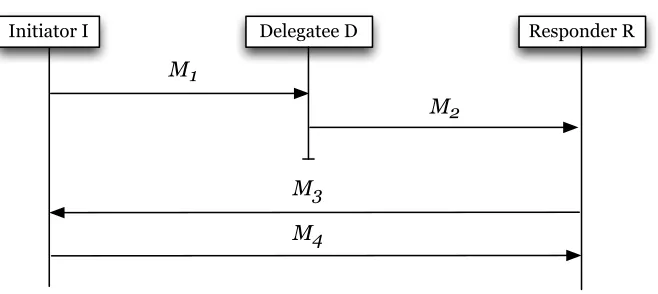
The AKAPR protocol is composed of 4 messages. In the the first two messages, the delegatee acts as intermediary between the initiator and responder, while the third and fourth messages are directly between them. Figure 2 shows the flow of messages of the protocol. Next, we describe these messages in detail.
Message 1 (I → D). The first message of the protocol, M1, is created by an initiator I
and sent to the responderR, via the delegatee D. The initiator performs the following steps:
1. CTIR ←CTIR+ 1
2. SID←H(idIkidRkw), for a randomw
3. NI R
←−Zp, t←R−Zp
4. AK ←KDF(idI, idR, t)
5. AE1 ←AEncAK(SIDkidIkidRkNIkCTIR)
6. C1←t·h(skIkidR)
Table 1: Notation
I Initiator
R Responder
D Delegatee
KDC Key Distribution Center CTIR, CTRI Counters
SID Session identifier NI, NR Nonces
H Hash function
KDF Key derivation function
AEnc,ADec Authenticated encryp-tion/decryption primitives
MAC Message authentication code KID, KRD Pre-shared keys with the delegatee
Zp Multiplicative group of integers modulop (i.e.,{1, ..., p−1})
Initiator I Delegatee D Responder R
M1
M2
M3
M4
8. M1←M¯1kMACKID( ¯M1)
Message 2 (D → R). Once the delegatee D receives a message from an initiatior I, he performs the following procedure in order to verify the validity of the message and to generate the message for responderR, namely M2.
1. Verify that SID is not repeated and that MAC inM1 with key KID; if failed, abort the protocol.
2. C2←rkI→R·C1
3. ¯M2←SIDkidIkidRkAE1kC2
4. M2←M¯2kMACKRD( ¯M2)
Note that after the re-encryption performed by the delegatee, the value ofC2ist·h(skRkidI)−1.
Message 3 (R→I). When the responderRreceives the previous message from the delega-teeD, he also verifies its validity, proceeds to decrypt it and extract the necessary information, as described below. Finally, he produces a new messageM3 that is sent directly to the initiator
I, without intermediaries. Note that at the end of this process, the responder already knows the agreed session key KS.
1. VerifyMAC inM2 with key KRD; if failed, abort the protocol.
2. t←h(skRkidI)·C2
3. AK ←KDF(idI, idR, t)
4. SIDkidIkidRkNIkCTIR←ADecAK(AE1)
5. Check thatCTIR≥CTRI; if failed, abort the protocol.
6. CTRI ←CTIR+ 1
7. NR R ←−Zp
8. KS←KDF(CTRI, idI, idR, NI, NR)
9. M3←AEncAK(SIDkidRkidIkNIktkNRkCTRI)
Message 4 (I → R). When the initiator I receives the response from the responder R, he follows the procedure below to verify its validity and extract the necessary information. He produces a final message M4 that is sent directly to the responder R, who verifies its validity
using the previously generated session keyKS.
1. SIDkidRkidIkNIktkNRkCTRI ←ADecAK(M3)
2. Check that SID, NI and t correspond to the original ones sent inM1, and that CTRI =
CTIR+ 1; if failed, abort the protocol.
3. KS←KDF(CTRI, idI, idR, NI, NR)
4. M4←SIDkMACKS(SIDkidIkidRkNIkNR)
3
Attacks to the AKAPR Protocol
In this section we describe several attacks and weaknesses of the AKAPR protocol. Most of them stem from the use of weak secrets as intermediate values for encryption and decryption, as well as the possibility of obtaining a weak secret associated to another user by means of the delegatee or analysis of past protocol traffic. This is particularly problematic in the event of compromise of long-term secret keys, to the point that even key revocation and update does not allow the affected user to recover the guarantees of secrecy and authentication with respect to other users. In addition, we also show how the choice of an insecure keyed-hash construction can lead to length-extension attacks, which combined with our previous attacks, can be used to mount complex attack scenarios.
3.1 Breaking Forward Secrecy
A first and simple attack to this protocol is to recover previous session keys from past traffic, once the long-term secret of a user is leaked. The security goal we are breaking in this case is
forward secrecy, formally defined as follows:
Definition 1 (Forward secrecy [5]) A protocol provides forward secrecy if compromise of the long-term keys of a set of principals does not compromise the session keys established in previous protocol runs involving those principals
Definition 2 (Partial forward secrecy [5]) A protocol provides partial forward secrecy if compromise of the long-term keys of one or more specific principals does not compromise the session keys established in previous protocol runs involving those principals
For this type of attack, we assume that an attacker has collected the messages of the protocol for one or several runs, and that, at a latter stage, he is able to get access to the secret key of the responder. The goal is to recover previous session keys. In the case of the AKAPR, the attacker proceeds as follows:
1. The attacker stores the protocol messages for one or several rounds. For simplicity, let us assume he stores the traffic for only the run he wants to extract its session key.
2. At some point, the attacker compromises the responderRand obtains his long-term secret keyskR.
3. From message M2 of the stored protocol run, he parses t·h(skRkidI)−1 and extracts t, since he can compute h(skRkidI). The value t is used to compute the encryption key AK ←KDF(idI, idR, t)
4. From message M3, the attacker can decrypt the values NR, NI and CTIR using the key AK computed in the previous step.
5. The attacker computes the session key KS used during the stores run as described in the protocol:
Therefore, it can be seen this protocol does not fulfill forward secrecy and partial forward secrecy. We note that if the attacker compromises the initiatorI instead, then the attack is the same except for step 3, where he usesskI to extracttfrom t·h(skIkidR), contained in message M1.
Countermeasure The messages M1 and M2 are transmitted over an authenticated channel
using MACs, with pre-shared MAC keysKIDandKRD, respectively. A possible countermeasure to the previous attack is to assume additional encryption keys for securing the confidentiality of the channel, given that the assumption of pre-shared keys already exists. However, if at-tackers were able to compromise the secret key of one user, it is reasonable to assume that the corresponding MAC key is potentially leaked too.
3.2 Key Compromise Impersonation Attacks
The previous subsection was devoted to attacking forward secrecy, a common concern of protocol designers. There are, however, other kinds of attacks that are not that well known, but can be potentially more hazardous. Key compromise impersonation (KCI) attacks occur when an adversary gains access to the secret key of a principal, and uses it to establish a session with him impersonating a different user. The attacker may use this session to actively gain new knowledge about the victim or causing him harm (e.g., by sending him malware), as the victim believes he is communicating with a legitimate user [8]. Therefore, KCI attacks can be more dangerous than breaking forward secrecy, which is limited to passive eavesdropping of past and future traffic. The following is a more formal definition of KCI, adapted from [25].
Definition 3 (Key compromise impersonation) A key agreement protocol is vulnerable to key compromise impersonation (KCI) if compromise of the long-term key of a specific user allows the adversary to establish a session key with that user by masquerading as a different user.
In this subsection we describe three types of KCI attacks, although it may be possible that other variations exist. For the first two KCI attacks, we assume that the attacker compromises the secret key of one user and tries to impersonate an initiator I (which may be any user in the system chosen by the attacker); therefore, the victim acts as the responderR. Since the attacker needs to direct the attack via the delegatee, he needs at least one of the pre-shared MAC keys: either the keyKRD between the delegateeDand the responderR, or the keyKID between the delegatee and the impersonated user I. The two first KCI attacks differ on which MAC key is compromised. Finally, we also identify a third KCI attack that occurs in the opposite situation, when the attacker tries to impersonate a responder. Although in this case the attacker has to wait for a key agreement request from the victim (which can be forced by an out-of-band action), this attack is much easier to achieve, since it does not require any MAC key.
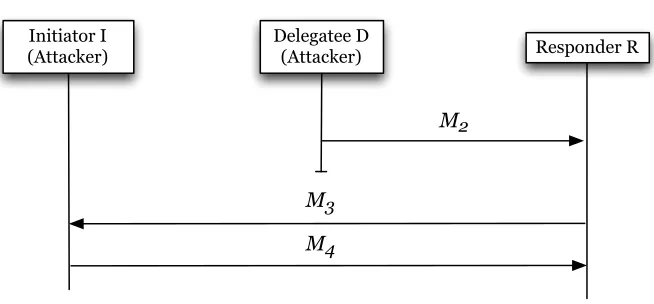
KCI Attack 1 If the attacker knows skR and KRD then the strategy to impersonate an initiatorI is to produce a messageM2 (i.e., the second message of the AKAPR protocol, which
Initiator I
(Attacker) Responder R
Delegatee D (Attacker)
M2
M3
M4
Figure 3: Flow of the KCI Attack 1
establish a session key between him and R, although R thinks the session is between him and I. This attack works even in the attacker does not know skR, but onlyh(skRkidI). The initial assumption of the attacker knowingKRD is reasonable given he has access toskR.
KCI Attack 2 If the attacker knows skR and KID then the attacker needs to know also h(skIkidR) in order to impersonate an initiatorI. There are different ways to achieve this:
• A first option is to use past protocol traffic between R and I in order to extract this value, following a strategy similar to the forward secrecy attack: KnowingskRenables the attacker to compute the t value from the messages of a protocol run, which in turn, can be used to extracth(skIkidR) from messageM1.
• A second option is to trick the delegatee into delivering this value by means of the re-encryption function, basically using it as a re-re-encryption oracle2. In order to do this, the attacker initiates a key agreement protocol betweenRandI, whereC1is the component of
messageM1 with valuet·h(skRkidI). Next, he captures the response M2 of the delegatee
and parses the re-encrypted componentC2. Finally, he computes h(skIkidR) =t·(C2)−1.
• A third option is to assume that the attacker colludes with the delegatee (or even that the attackeristhe delegatee). In this case,h(skIkidR) can be computed from the re-encryption keys since rkI→R = h(skIkidR)−1 ·h(skRkidI)−1. With this option, the assumption of knowing the keyKID is natural.
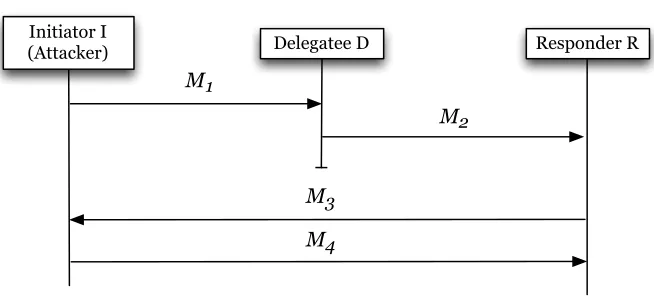
Once the attacker knows h(skIkidR), he initiates a normal key agreement protocol with R via the delegatee, as shown in Figure 4, using KID for computing the MAC for the first message. Note that the attacker can participate successfully in this key agreement since he does not need to know the secret skI, but the weak secret h(skIkidR). As a final comment on this attack, note that it works even if the attacker initially does not know skR, but only the weak secret h(skRkidI).
2
Initiator I
(Attacker) Delegatee D Responder R M1
M2
M3
M4
Figure 4: Flow of the KCI Attack 2
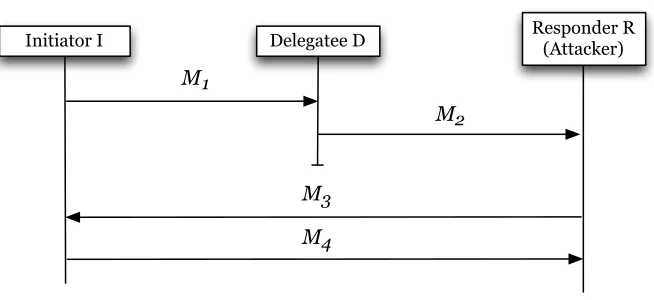
KCI Attack 3 Previous KCI attacks supposed that the leaked secret was of a user who later acted as the responder. Suppose now that the secret key of an initiator I is leaked. Figure 5 shows the protocol flow of this attack, where the attacker acts as the responder R. An attacker that knows the secret keyskI of the initiator can impersonate any userR if he is able to obtain h(skRkidI). As in the KCI attack 2, there are several ways to do this:
• Previous traffic betweenI andR. KnowingskIenables the attacker to compute thetvalue from the messages of a protocol run, which in turn, can be used to compute h(skRkidI) from messageM2.
• Using the delegatee as a re-encryption oracle. This requires knowledge of KID.
• Assuming that the attacker controls the delegatee, colludes with it, or the corresponding re-encryption key is leaked somehow.
Once the attacker knowsh(skRkidI), he can respond to normal key agreement requests from I. As in previous KCI attacks, the attacker succeeds without actually knowing the secret skR, but the weak secret h(skRkidI); similarly, this attack works even if the attacker only knows the weak secreth(skIkidR) at the beginning.
As a final remark, KCI attacks 1 and 2 required the additional knowledge of one of the pre-shared MAC keys, since in both of them the attacker impersonated an initiator, whose messages are required to be validated, and therefore, is performing a proactive impersonation. On the contrary, in this KCI attack the attacker impersonates a responder, which implies that the impersonation is reactive in this case (i.e., it requires that the initiator I starts the key agreement). This can be achieved either by waiting for a key agreement request to occur or by forcing it using some out-of-band mechanism (e.g., hard-resetting the initiator’s device, social engineering, etc.).
3.3 Limited Scope of Key Revocation and Update
Initiator I Delegatee D
M1
M2
M3
M4
Responder R (Attacker)
Figure 5: Flow of the KCI Attack 3
other through valid protocol messages. These issues are problematic when long-term secret keys are compromised, as illustrated by the attacks we identified.
A natural action that the affected principal performs once he becomes aware of the compro-mise of his secret key, is to initiate some kind of key revocation/update procedure. In principle, one can believe that key revocation is an effective countermeasure against a long-term key com-promise event. However, we show next that this is not the case: once the long-term key of a user is compromised, and even after key revocation and update is realized, the protocol still remains vulnerable with respect to forward secrecy and key compromise impersonation, for all users whom the affected user communicated before. This is a consequence of the two undesired properties described above.
Breaking forward secrecy As an illustration, suppose that the responderR updates his se-cret key tosk0Rafter his previous long-term secretskRis exposed, revokes previous re-encryption keys and asks for their update. In order for the protocol to be correct, the new re-encryption keys should be of the form rk0I→R =h(skIkidR)−1·h(skR0 kidI)−1, for all possible initiators I. Note that the term h(skIkidR) does not change with respect to the previous re-encryption key, and therefore, the initiatorI still uses this same weak secret when participating in a key agreement with the responderR. The consequence of this is that an attacker that was able to break forward secrecy before can extract h(skIkidR) from previous rounds of the protocol, since h(skIkidR) has not changed. Using this weak secret, the attacker can compute the corresponding t value from the first message of the protocol (i.e.,M1) of any future round, and break forward secrecy
again.
Key Compromise Impersonation Suppose now that it is an initiator I who updates his secret key toskI0. Analogously to the previous case, it is still possible for an attacker to recover h(skRkidI) from previous traffic between I and any other user R. However, in this case, the attacker does not limit himself to passively eavesdrop protocol messages as above (i.e., breaking forward secrecy), but can actively impersonate the responderR, given that he knows the value h(skRkidI) necessary to decrypt messageM2. Notice how updating the secret key ofI does not
Countermeasures The only possible countermeasures against this problem are either to issue a new identity for the affected user or to revoke also the users that established communications with him previously. Both options does not seem adequate nor practical.
3.4 Length-extension attacks
We now describe a completely different attack strategy, based on a potentially dangerous design choice in the AKAPR protocol. The symmetric proxy re-encryption primitive that underlies the key agreement protocol (see Section 2.1), uses a keyed hash function to derive the weak secrets. Specifically, these values are of the formh(skAkidB), where the identity of the recipient is used as the message of a keyed hash, with h : {0,1}∗ → Zp as the hash function3. The authors state that the hash function is required to behave as a random oracle, which can be a rather strong assumption. However, it is known that real instantiations of hash functions do not necessarily behave as random oracles. In fact, widely used hash functions such as SHA-1 and SHA-256 (as well as others based on the Merkle-Damg˚ard construction) suffer from length-extension vulnerabilities [27] that make possible to create new weak secrets without knowing skA, under the assumption that identifiers can have variable length.
First, let us recall the idea of length-extension attacks. In this type of attacks, knowledge of the hash value h(m1) and the length of m1 can be used to computeh(m1kpadkm2), for any
message m2 chosen by the attacker and some required internal padding pad. It is known that
hash functions based on the Merkle-Damg˚ard construction (e.g, MD5, SHA-1, SHA-256) are vulnerable to this type of attacks. This problem has been shown to permeate to real systems, such as the Flickr’s API signature forgery vulnerability [14].
In the AKAPR protocol, if we assume that identifiers can have different lengths (i.e., id∈ {0,1}∗), then it may be possible that, for some identityid
B, there exists an identityidBX where idB is a prefix. For example, let us assume that idB = “Bob” and that the attacker knows h(skAkidB), but that skA remains secret. Then, by the length-extension vulnerability he can produceh(skAkidBE), whereidBE = “Bob Esponja”4. For the sake of illustration, let us ignore the internal paddingpad for the moment.
As discussed in Section 3.2, an attacker that knowsh(skAkidBE) can impersonateAin a key agreement with BE without knowingskA, regardless if he acts as an initiator or a responder. The length-extension attack is particularly worrisome when the attacker has access to previous traffic, or the delegatee is compromised or deceived by the attacker; in this case, the delegatee can be used in combination with the attack strategies presented in previous sections in order to compromise the security of non-involved users. For example, let us suppose that an attacker gains access to the private key of userB. Figure 6 shows a combination of some of the attacks described in this paper that eventually compromise the security of key agreements between users A and BE. An attacker that knows skB can trivially generate weak secretsh(skAkidB) associated to any other user A; knowing this, he can compute the opposite weak secrets us-ing strategies discussed in previous attacks (e.g., usus-ing the delegatee as an encryption oracle, compromising the delegatee, analyzing previous traffic between A and B). The resulting weak
3
Note that when we assume that his implemented with a traditional hash function, it is also necessary an additional encoding from its output domain toZp, as required in Section 2.1; usual encodings of this type (e.g,
taking modulop) are easily invertible, so we will omit this for simplicity.
4“Bob Esponja” is the Spanish name for “SpongeBob SquarePants” [28]. Not associated with the sponge-based
secrets can be used as input to length-extension attacks, undermining this way the security of other users. The output of the length-extension attacks are also weak secrets, which in turn, can be used again to obtain more weak secrets. Therefore, it can be seen how the initial leakage of B’s secret can potentially affect key agreements between other users, since once the attacker obtainsh(skAkidBE) and h(skBEkidA), he can potentially control all their past and future key agreements. Note that, although BE is some user whose identity has idB as prefix (i.e., the choice of BE is not completely free), A is an arbitrary user, which is a serious threat to the application of this protocol in a real setting.
skB
h(skBkidA)
h(skAkidB)
h(skAkidBE)
h(skBEkidA) Trivial
Using the delegatee, analysis of previous traffic, ...
Length-extension attack
Using the delegatee, analysis of previous traffic, ...
Figure 6: Abstract flow of a length-extension attack
We next describe some possible attack scenarios that apply this strategy in combination with others of the previously identified attacks. In particular, we illustrate two scenarios: the first is reminiscent of sybil attacks in distributed networks [13], where a malicious entity gains control of multiple identities in order to increase its control over a system or network; the second is similar to a spear phishing attack [16], where the attacker targets specific victims aided by relevant, yet fake, contextual information that gains the trust of the victim.
against this hash value, by appending random ivalues to the end of idB, obtaining as a result hashes of the form h(skAkidBkpadki). Therefore, fresh pseudonyms will be identities of the formidBi =idBkpadki. Note that in this case the internal paddingpad that is necessary for the length-extension attack is not necessarily a problem (e.g., if identities have a numerical format); the only important requirement from the point of view of the sybil attack is that identitiesidBi are different from each other.
Finally, using once again the techniques for obtaining the opposite weak secret, the attacker eventually obtains a set of weak secrets of the form h(skBikidA), for different i values, which enable him to mount a sybil-like attack against entity A. The attacker can now start multiple key agreements with the victimA, making him believe that there are several independent entities Bi, which in fact are controlled uniquely by the attacker.
skB
h(skBkidA)
h(skAkidB)
h(skAkidB1) h(skAkidBn) ...
h(skB1kidA) h(skBnkidA)
...
Figure 7: Abstract flow of a sybil attack
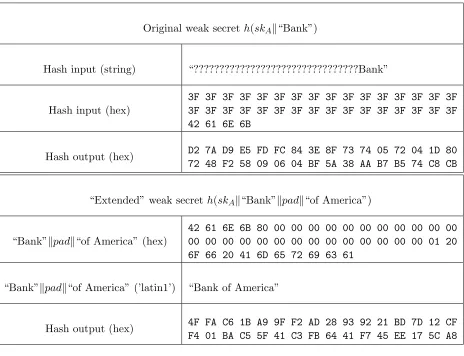
Spear phishing scenario Suppose that an attacker gains access to skB, where idB is a common but dangerous prefix (e.g., “Bank”). Once again, following the previously discussed strategies, the attacker can obtain the weak secrets between a victim A and user B, namely h(skAkidB), and later use this hash value to derive new weak secrets involving a tailored bait whose name starts with “Bank” (e.g., “Bank of America”). Recall that the attacker does not need to know the secret of “Bank of America”, but uses instead our attack strategies to obtain a weak secret that compromises the security with respect to the victimA. This type of attack also works if, instead of compromising user B, we suppose B does not initially exist and the attacker is capable of registering it with the KDC as a new user.
There is, however, a small problem with the internal padding pad in this case. Following our example, the length-extension attack would allow the attacker to compute the weak secret
h(skAk“Bank”kpadk“of America”). Therefore, the forged identity is actually “Bank”kpadk“of America”, which can be problematic if the padding allows the victim to detect the attack. We will,
how-ever, illustrate with a real example how this problem can be overcome, and experimentally demonstrate the viability of the attack.
Table 2: Spear phishing based on a length-extension attack
Original weak secreth(skAk“Bank”)
Hash input (string) “????????????????????????????????Bank”
Hash input (hex)
3F 3F 3F 3F 3F 3F 3F 3F 3F 3F 3F 3F 3F 3F 3F 3F 3F 3F 3F 3F 3F 3F 3F 3F 3F 3F 3F 3F 3F 3F 3F 3F 42 61 6E 6B
Hash output (hex) D2 7A D9 E5 FD FC 84 3E 8F 73 74 05 72 04 1D 80
72 48 F2 58 09 06 04 BF 5A 38 AA B7 B5 74 C8 CB
“Extended” weak secreth(skAk“Bank”kpadk“of America”)
“Bank”kpadk“of America” (hex)
42 61 6E 6B 80 00 00 00 00 00 00 00 00 00 00 00 00 00 00 00 00 00 00 00 00 00 00 00 00 00 01 20 6F 66 20 41 6D 65 72 69 63 61
“Bank”kpadk“of America” (’latin1’) “Bank of America”
Hash output (hex) 4F FA C6 1B A9 9F F2 AD 28 93 92 21 BD 7D 12 CF
F4 01 BA C5 5F 41 C3 FB 64 41 F7 45 EE 17 5C A8
irrelevant for the attack and that it always remains unknown to the attacker. Table 2 shows the concatenation of the secret key and the identity “Bank”, represented both as text and as hexadecimal strings, as well as the output of the hash function for this input. We suppose now that the attacker knows this output value (i.e., the weak secret h(skAk“Bank”)); knowing this, the attacker can use the length-extension vulnerability of SHA-256 to compute the weak secret h(skAk“Bank”kpadk“of America”).
NUL characters (00) and invalid codes (80). This is the case of Python 2.7.10 implementation, which we used for reproducing the length-extension attack, and that displays “Bank of America” as the extended identity when ‘latin1’ encoding is selected. This can be used to deceive users into believing they are interacting with the real Bank of America, since the only difference between the legitimate identity and the displayed extended identity are non-printable characters (i.e., the user cannot visually distinguish one string from another). This also can be reproduced with UTF-8 encoding if errors are ignored when printing UTF-8 encoded strings (in Python this is achieved by specifying the option ‘ignore’).
We note that this example, although somewhat artificial, only makes relatively common assumptions, such as the use of SHA256, secret keys of 256 bits, ‘latin1’ encoding of strings, variable-size identities, etc.
Countermeasures As a simple and effective countermeasure to the length-extension attack, the protocol can require the use of a hash function resistant to length-extension attacks (e.g., SHA3), or even better, use an HMAC or a key derivation function (e.g., HKDF [17]). HMACs and KDFs are specifically designed to take a secret as input, and to be secure against length-extension attacks.
4
Discussion
The previous attacks demonstrated that the main weaknesses of the AKAPR protocol is that the weak secrets are, in fact, long-term secrets, just as the secret keys, and that the weak secrets between two users can be linked to each other. These problems make it possible for an attacker to perpetually threaten the security goals of the protocol once he gains control of a weak secret. In this section we informally discuss some possible amendments to this protocol.
First, we note that if we assume that the initiator I is also capable of reading Message 2 (from the delegatee D to the responder R), then this means he can extract the weak secret h(skRkidI). This is a plausible assumption in several settings compatible with this protocol (e.g., wireless environments), and it is also consistent with the philosophy of the Dolev-Yao model [12], by which one can consider the network to be open and all its messages public and subject to scrutiny by other entities. Therefore, it can be seen that this is functionally equivalent to the initiatorI knowing this weak secret. Given that this weak secret is implicitly known by the responder (since he can generate it), then it acts as a sort of shared key between them. Therefore, a possible variation of the protocol is to simply distribute this weak secret to the initiator when he wants to commence a key agreement with responderR. This can be realized by transforming the delegatee D into a mere key server that distributes these weak secrets to initiators. Therefore, instead of the delegatee re-encrypting Message 1 into Message 2, which requires it to know a re-encryption key linking two weak secrets, he stores the “shared weak secrets”.
quadratic order (since it is necessary to store a key between each pair of users of the system), dominated by the number of users. This new type of keys eliminates the link between weak secrets, reducing this way the applicability of some of the attacks we propose (although not completely). An interesting insight about this variation is that it is extremely similar to the traditional Needham-Schroeder symmetric key agreement protocol [20], with the main difference that in this case the key server (i.e., the delegatee) does not know the session keys because these are encrypted by a separate key server (i.e., the KDC).
However, it is important to note that this variant still suffers from the long-term nature of weak secrets. An improvement to this respect could be to include a timestamp in the weak secret generation, in a similar way than Kerberos [21] improves over Needham-Schroeder protocol. Thus, weak secrets would be of the form h(skAkidBkTi), where Ti represents a time period. Although this could mitigate the attacks to a certain extent (since compromised weak secrets would only be useful for a given time period), it also implies that the re-encryption keys should be recomputed by the KDC and distributed to the delegatee on each time period. This can represent a great inconvenience in some settings.
5
Conclusions
Proxy re-encryption (PRE) is a hot research topic nowadays, with new use cases arising in different contexts. Most PRE schemes are based on public-key cryptography, mostly because public key cryptography has become omnipresent in most environments. PRE schemes using symmetric cryptography would make an excellent contribution for IoT scenarios where devices are highly constrained, but it is true that properly capturing the essence of PRE and providing secure solutions in the same sense as in the public-key world is challenging.
In this paper we show how difficult is to properly define and implement PRE in the symmetric world by exploring the weaknesses of a particular scheme proposed at ESORICS 2016. This protocol tries to adapt previous proposals for symmetric key PRE to the IoT scenario, focusing not only on providing a lighter solution (not involving public-key cryptography) but also trying to avoid redundant messages that are needed in well-know and deeply-studied authentication and key exchange protocols (e.g., Needham-Schroeder).
Unfortunately the paper fails to accomplish its goals, mainly because of the use of two weak secrets for every pair of communicating parties that are immutable and depend only on the secret keys of the initiator and the identity of the responder (and vice versa). The way the protocol is designed implies that compromising the secrets of one party helps the compromising the weak secret of the other party. Moreover, revocation of compromised keys turns out to be impractical, which makes the protocol unusable in it present form.
References
[1] G. Ateniese, K. Fu, M. Green, and S. Hohenberger. Improved proxy re-encryption schemes with applications to secure distributed storage. ACM Transactions on Information and System Security, 9(1):1–30, 2006.
[2] G. Bertoni, J. Daemen, M. Peeters, and G. Van Assche. The Keccak SHA-3 submission.
[3] M. Blaze, G. Bleumer, and M. Strauss. Divertible protocols and atomic proxy cryptography.
Advances in Cryptology—EUROCRYPT’98, pages 127–144, 1998.
[4] D. Boneh, K. Lewi, H. Montgomery, and A. Raghunathan. Key homomorphic prfs and their applications. InAdvances in Cryptology–CRYPTO 2013, pages 410–428. Springer, 2013.
[5] C. Boyd and A. Mathuria. Protocols for authentication and key establishment. Springer Science & Business Media, 2013.
[6] R. Canetti and S. Hohenberger. Chosen-ciphertext secure proxy re-encryption. In Pro-ceedings of the 14th ACM conference on Computer and communications security, pages 185–194. ACM, 2007.
[7] CELLOS Consortium. Evaluation report: Symmetric key re-encryption scheme with proxy (SK-REP). Technical report, CELLOS consortium, 2014.
[8] K. Chalkias, F. Baldimtsi, D. Hristu-Varsakelis, and G. Stephanides. Two types of key-compromise impersonation attacks against one-pass key establishment protocols. In In-ternational Conference on E-Business and Telecommunications, pages 227–238. Springer, 2007.
[9] D. L. Cook and A. D. Keromytis. Conversion functions for symmetric key ciphers. Journal of Information Assurance and Security, 1(2):119–128, 2006.
[10] D. E. Denning and G. M. Sacco. Timestamps in key distribution protocols. Commun. ACM, 24(8):533–536, Aug. 1981.
[11] W. Diffie and M. E. Hellman. New directions in cryptography. Information Theory, IEEE Transactions on, 22(6):644–654, 1976.
[12] D. Dolev and A. Yao. On the security of public key protocols. IEEE Transactions on information theory, 29(2):198–208, 1983.
[13] J. R. Douceur. The sybil attack. InInternational Workshop on Peer-to-Peer Systems, pages 251–260. Springer, 2002.
[14] T. Duong and J. Rizzo. Flickr’s api signature forgery vulnerability, 2009.
[15] W. C. Garrison, A. Shull, S. Myers, and A. J. Lee. On the practicality of cryptographically enforcing dynamic access control policies in the cloud. In2016 IEEE Symposium on Security and Privacy (SP), pages 819–838, May 2016.
[16] J. Hong. The state of phishing attacks. Communications of the ACM, 55(1):74–81, 2012.
[17] D. H. Krawczyk and P. Eronen. HMAC-based Extract-and-Expand Key Derivation Func-tion (HKDF). RFC 5869, Oct. 2015.
[19] A. J. Menezes, P. C. Van Oorschot, and S. A. Vanstone. Handbook of applied cryptography. CRC press, 1996.
[20] R. M. Needham and M. D. Schroeder. Using encryption for authentication in large networks of computers. Communications of the ACM, 21(12):993–999, 1978.
[21] B. C. Neuman and T. Ts’o. Kerberos: An authentication service for computer networks.
IEEE Communications magazine, 32(9):33–38, 1994.
[22] K. T. Nguyen, N. Oualha, and M. Laurent. Authenticated key agreement mediated by a proxy re-encryptor for the internet of things. In European Symposium on Research in Computer Security, pages 339–358. Springer, 2016.
[23] D. Nu˜nez, I. Agudo, and J. Lopez. A parametric family of attack models for proxy re-encryption. In Proceedings of the 28th IEEE Computer Security Foundations Symposium, CSF’15, pages 290–301. IEEE Computer Society, 2015.
[24] H. Sakazaki, K. Anzai, and J. Hosoya. Study of re-encryption scheme based on symmetric-key cryptography. In 31st Symposium on Cryptography and Information Security (SCIS 2014), 2014.
[25] M. A. Strangio. On the resilience of key agreement protocols to key compromise imperson-ation. InEuropean Public Key Infrastructure Workshop, pages 233–247. Springer, 2006.
[26] A. Syalim, T. Nishide, and K. Sakurai. Realizing proxy re-encryption in the symmetric world. In International Conference on Informatics Engineering and Information Science, pages 259–274. Springer, 2011.
[27] G. Tsudik. Message authentication with one-way hash functions. ACM SIGCOMM Com-puter Communication Review, 22(5):29–38, 1992.
![Figure 1: Network architecture (adapted from [22])](https://thumb-us.123doks.com/thumbv2/123dok_us/7953243.1319783/5.612.184.412.92.282/figure-network-architecture-adapted-from.webp)