Devri¸s ˙I¸sler and Alptekin K¨up¸c¨u
Ko¸c University, ˙Istanbul, Turkey {disler15,akupcu}@ku.edu.tr
Abstract. Passwords are the most widely used form of online user authentication. In a traditional setup, the user, who has a human-memorable low entropy password, wants to authenticate with a login server. Unfortunately, existing solutions in this setting are either non-portable or insecure against many attacks, including phishing, man-in-the-middle, honeypot, and offline dictionary attacks. Three previous studies (Acar et al. 2013, Bicakci et al. 2011, and Jarecki et al. 2016) provide solutions secure against offline dictionary attacks by addition-ally employing a storage provider (either a cloud storage or a mobile device for portability). These works provide solutions where offline dic-tionary attacks are impossible as long as the adversary does not corrupt boththe login server and the storage provider. For the first time, improv-ing these previous works, we provide a more secure generalized solution employingmultiplestorage providers, where our solution is proven secure against offline dictionary attacks as long as the adversary does not cor-rupt the login server and threshold-many storage providers. We define ideal and real world indistinguishability for threshold single password authentication (Threshold SPA) schemes, and formally prove security of our solution via ideal-real simulation. Our solution provides security against all the above-mentioned attacks, includingphishing, man-in-the-middle, honeypot, and offline dictionary attacks, and requiresnochange on the server side. Thus, our solution can immediately be deployed via a browser extension (or a mobile application) and support from some storage providers. We further argue that our protocol is efficient and scalable, and provide performance numbers where the user and storage load are only a few milliseconds.
Keywords: Password based authentication, threshold secret sharing, dictionary attack, phishing
1
Introduction
Passwords are the most widely used form of online user authentication. In a tra-ditional password based authentication, there are two parties: theuser who has a human-memorable low entropy password and thelogin server that creates an
account for the user and keeps the user’s account information (e.g.<username, hash(password)>) to authenticate the user later when she wants to login. An-other related field includes password authenticated key exchange (PAKE) pro-tocols, where a user and a server desire to establish a secure and authenticated channel via a shared secret password [3,6,7,19,20]. Passwords are also employed in password-protected secret sharing (PPSS) techniques, where the user stores her credential(s) on a server or among multiple servers [5,8,9,16]. The server(s) verify that the user is legitimate before giving an access to the stored secret, and this authentication is done via passwords.
The existence of servers’ adversarial behaviors such asphishing, man-in-the-middle, and honeypot attacks, where the adversarial server tries to trick the user to willingly reveal her password (unaware of the attack), as well asoffline dictionary attacks that can be mounted by the server or hackers obtaining the server database are commonly known and powerful attacks on users’ passwords. Unfortunately, all the above-cited constructions, where the server stores the user’s password as plain text or the hash of the password, lose security against such attacks. Indeed, such attacks are very prevalent, and recent studies even propose improved offline dictionary attacks [24]. The damage of the successful attack is increased dramatically if the user reuses the same password to register with more than one login server, which is a common practice [13].
Our focus in this paper is on password based authentication secure against those attacks. Consider the following approaches:
◦ Traditional insecure approach: Store the output of a deterministic (hash) function of the password at the login server. The user’s password is easily compromised in the current traditional approach against adversarial servers (e.g. phishing, man-in-the-middle, honeypot). Moreover, it is directly vulnerable to offline dictionary attacks by hackers obtaining the login server database, since recomputing the output of the deterministic function and comparing against the database enables such offline dictionary attacks.
◦ Secure but non-portable approach:Store a verification key at the login server, where the corresponding secret key is blinded by the user’s password and stored on the user’s machine or USB device. When the keys are generated independent of the password, such an approach will protect the user against the mentioned attacks. Unfortunately, this approach is not user friendly in the contemporary setting where each user owns multiple devices or employs public terminals, as this incurs portability issues (even with USB storage employed, note that not all devices have USB ports).1
◦ Secure and usable approach: Store the verification key at the login server and securely store the corresponding secret key blinded by some function of user password at storage provider(s)different from the login server. Such a storage provider can be a cloud storage or mobile device (as opposed to a non-portable location above). This was first observed and the first solution
1
was constructed by Acar et al. [1] (with their patent application dating 2010 [2]), and later also used by Jarecki et al. [17] and also Bicakci et al. [4].2
The only known provably secure (against offline dictionary attacks) and usable password based authentication or PAKE systems are the Acar et al. [1] (with their patent application dating 2010 [2]) and Jarecki et al. [17] solutions (Bicakci et al. [4] present a solution idea briefly, but without a formal security proof). They include a single storage provider (which is either a cloud storage or a mobile device) for the secret storage. The underlying assumption is that the protocol is secure unless the login server and the storage provider are corrupted by the same adversary. Thus, when the same adversary corrupts both the login server and the storage provider, or they simply collude, they can mount an offline dictionary attack to find the user password. Any weaker adversary can always perform an online attack; however, online attacks are not big threats due to several reasons. Firstly, they are inherently many orders of magnitude slower compared to offline attacks due to network delays. Secondly, the honest login servers and storage providers will block the adversary after several unsuccessful attempts, or limit the rate of such attempts.
For the first time, we present asingle password authentication (SPA) protocol that can employ possibly more than one storage provider (any combi-nation of cloud or mobile devices). In ourThreshold SPAsolution, we employ a total of n storage providers, and a threshold 1 ≤t ≤n. This setting serves two purposes. Firstly, for an adversary to be able to successfully mount an of-fline dictionary attack, he must corrupt the login serverin addition to tstorage providers. Secondly, to login, the user must accesst storage providers out ofn; thus availability can be balanced against security easily by setting these param-eters. While the underlying techniques are different, in terms of security, the previous solutions correspond to setting t=n= 1.
Delving deeper, Acar et al. [1] discuss in one paragraph that it is possible to convert their solution to employ more than one storage provider using secret sharing. Unfortunately, when done in a straightforward manner, this results in an insecure solution in the sense that corrupting the login server and only one storage provider will still enable the adversary to perform an offline dictionary attack. As mentioned earlier, they employ the storage provider to store the secret key needed for authentication. This secret key is protected by the password. When this secret is simply shared among multiple storage providers, there needs to be a mechanism to prevent the login server to obtain these shares from the storage providers, as otherwise the adversarial login server can simply request these shares and perform an offline dictionary attack. To prevent this, only the entity knowing the password should be able to retrieve these shares, meaning that there needs to be another password based authentication mechanism also done at the storage provider side, creating a recursive problem, needing further storage providers indefinitely. If traditional password based authentication approaches
2
are employed instead, then this password based authentication subprotocol will enable the login server to collude with only one storage provider to mount the offline dictionary attack, since the user only has a single password and hence the same authentication is employed at every storage provider. Moreover, their one paragraph extension idea lacks any formal proof where we give a formal proof for Threshold SPA for the first time.
In our solution, while the user still has only a single password,our protocol provably ensures that the following adversaries will be completely unsuccessful:
◦ An adversary that controls threshold-many the storage providers (but not the login server).
◦ An adversary that controls less than threshold-many storage providers in addition to the login server.
◦ An adversary who successfully mounts a phishing, man-in-the-middle, or honeypot attack.
We assume that if any party is corrupted by an adversary once, it remains corrupted (which is realistic, since the adversary can install backdoors on a system once corrupted). Our solution only fails against a local adversary (such as a keylogger on the user’s computer), since it can sniff the password. Our contributionsare as follows:
1. We define a general structure of threshold single password authentication (Threshold SPA) systems and propose thefirst constructionwith a formal proof.
2. We formally presentideal and real worlddefinitions for security of Thresh-old SPA protocols, for the first time in the literature.
3. Weformally provethe security of our Threshold SPA solution via ideal-real simulation, showing impossibility ofoffline dictionary attacks.
4. Our Threshold SPA method is also secure againstphishing and man-in-the-middle attacksduring authentication, after a secure registration, and honeypot attacksduring registration and authentication.
5. We present performance evaluation numerically, showing that our tech-niques are easily applicable with today’s hardware.
6. Our construction doesnot require any changeat the login server side and can work with a variety of storage providers (e.g. mobile devices and cloud providers).
Overview:Our solution achieves full threshold security as follows: We create a random value rnd as the secret independent of the password pwd and com-pute verification information as the hash of rnd,and login server domain name ls (Hash(rnd||ls)). Then, the verification information is shared with the login server whereas therndis secret shared. But, these shares are not directly sent to the storage providers. We employ a layer of encryption to hide each share, and this encryption employs an oblivious pseudorandom function (OPRF) F
output over the password pwd as its key. Moreover, each storage provider will use a different keykifor the OPRF, and thus each share will be encrypted with
hold essentially no information regarding the password. This is true because as first observed by Acar et al. [1] (for this discussion simply assume one time pad is employed for encryption, though they discuss in further detail how a block cipher can be employed), when a random value (such as the secret key or shares) is encrypted with the password or any deterministic value derived from the pass-word (such as hash or OPRF over the passpass-word), an offline dictionary attack is impossible without knowing what the decryption needs to reveal since any password in the dictionary would yield a valid plaintext.
Later, for authentication, the user interacts with threshold-many servers us-ing the OPRF protocol, reconstructs the original secret rnd after decryption with her correct password, and then computes the verification information as
Hash(rnd||ls) and sends it along with her username to the login server. Only when the login server and at least threshold-many storage providers collude they can reconstruct the secret rndby trying different passwords, and calculate the hashes offline. Otherwise, offline dictionary attacks are impossible. Consider, for example, the adversarial login server potentially colluding with t−1 storage providers. He needs to interact online through the OPRF protocol with at least one honest storage provider to be able to reconstruct the secretrnd, which can be rate/attempt limited. Moreover, consider that threshold-many storage providers are colluding while the login server is honest. Even though they can reconstruct a secret rnd, since all passwords yield to a valid (in terms of format) secret, they can only try to authenticate online with the login server to verify whether or not the secret they constructed is the correct one. Again, this can easily be rate/attempt limited.
2
Related Work
Traditional password-based authentication takes place between two parties (a user and a login server). However, Boyen [5] showed that any password-based authentication between a user and a login server is vulnerable to anoffline dic-tionary attack by the login server (or hackers obtaining its database). Tatlı [24] improved offline dictionary attacks on password hashes to find some additional passwords assumed to be strong and complex.
password file storing false passwords calledhoneywordsper user account. In case the adversary steals the password file, and mistakenly employs a honeyword, the system is alerted.
Mannan et al. [21] propose to secure user’s password from untrusted user computer (malicious browser) assuming the server holds the user password. Camenish et al. [10] distribute the password verification over multiple servers to secure the password against server compromise where the server keeps the hash of username and passwordhash(username||password). PwdHash [22] pro-duce a different password for each login server by simply computing the hash of the password and login server domain where the hash is a pseuodorandom function of the domain keyed with the user passwordH(password, domain) =
P RFpassword(domain) and the server stores the hash value. The discussed
solu-tions do not provide security against offline dictionary attack in case the server database is compromised. Increasing the number of parties by adding storage provider(s) is one way to help prevent offline dictionary attacks.
Acar et al. [1] (with their patent application dating 2010 [2]) present the first provably secure single password authentication protocols where the user employs a cloud or mobile storage provider to keep her secret to prevent offline dictionary attacks. The user’s password is secure against offline dictionary attacks unless the storage provider and the server are colluding. Their mobile device based solution inputs the password to the device, and hence provides security againstmalware on the public terminal. They provide security againstphishing indirectly because the user identifier used at the storage provider depends on the server name. Since the phishing site name isdifferentfrom the actual login server name, the retrieval of the user secret fails. Our main differences are to enable a fully secure threshold construction for the first time, without requiring any changes at the login server, making our solution much easier to deploy.
Following Acar et al. [1], Jarecki et al. [17] provided a device enhanced pass-word authenticated key exchange protocol employing a mobile device storage. Similar to [1], their protocol is secure against offline dictionary attacks assuming the login server and the mobile device are not colluding. They provide a recov-ery procedure in case the device is lost. They leave threshold authentication as future work, which is what we achieve.
Bicakci et al. [4] discuss briefly a single password solution employing a storage provider for unique blind signatures (similar to Acar et al. [1]), but they neither delve into the details of their solution nor present a security proof. Nevertheless, we are influenced by their work in terms of requiring no change at the login server, and achieve to distribute the storage provider for the first time.
3
Preliminaries
Letλ∈N be security parameter. A probabilistic polynomial time (PPT) algo-rithmAis a probabilistic algorithm taking 1λas an input and has running time
for every positive polynomial poly(λ) there exists a λ0 ∈N such that∀λ > λ0 negl(λ)<1/poly(λ).
Hash Function: A hash function H is a deterministic function from an arbitrary size input to a fixed size output, denoted H : {0,1}∗ → {0,1}l. The
hash function is assumed to becollision resistantif it is hard to find two different inputsx6=y that hash to the same outputH(x) =H(y).
Oblivious Pseudorandom Function (OPRF):A psuedorandom function (PRF)Fis a function that takes two inputs: a secret function keykand an input
xto compute on, and outputsFk(x). A function chosen randomly from a PRF
family (a PRF with random keyk) is secure if it is distinguishable from a random function with the same domain and range with only negligible probability for all PPT distinguishers given oracle access. An Oblivious PRF (OPRF) [15] is a protocol between two parties (sender andreceiver) that securely computesFk(x)
where thekandxare the inputs of sender andreceiver, respectively, such that the sender learnsnothing from the interaction and the receiver learnsFk(x).
Symmetric Encryption Scheme: consists of three PPT algorithms:
KeyGen(1λ) generates a secret keysk,Encsk(msg) encrypts the message using
the secret key and outputs the ciphertextc. The decryption algorithm Decsk(c)
uses the secretskto decrypt the ciphertextc, and outputs the original message
msg. The encryption scheme we use need to be semantically secure.
Threshold Secret Sharing (TSS): consists of two PPT algorithms < s1, ..., sn>←T SS(S) to create thenshares of the secretS, and for a threshold
twe useS←T SSRecon(s1, ..., st) to reconstruct the original secret. We employ
the methodology of Shamir [23]. The security is that less than threshold many shares provide theoretically no information regarding the original secret.
4
Threshold Single Password Authentication
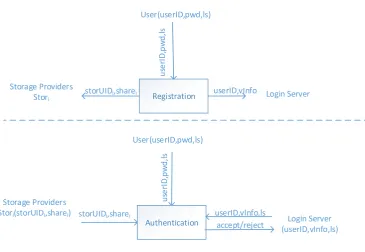
In a Threshold SPA protocol, there are three types of players. There are users who register with one or morelogin serversusing (possibly) the same password, and later on authenticate with these login servers. For this purpose, the users store some secret information (that is needed for authentication with the login servers) at one or morestorage providers. The main objective of a Threshold SPA solution is to protect the user’s password against offline dictionary attacks by the storage providers, the login servers, and many other adversaries (including phishing sites). Figure 1 shows an overview of theregistrationand authentica-tionphases of a Threshold SPA protocol, considering a single user who registers with a login server and stores the secret at n storage providers. Threshold in this context refers to the fact that the user must communicate with some subset (defined by the threshold) of storage providers to facilitate authentication with the login server. It furthermore refers to the security of the solution: An offline dictionary attack is possible only when the adversary controls the login server and at least threshold many storage providers.
Registration User(userID,pwd,ls)
Login Server Storage Providers
Stori storUIDi,sharei
u
se
rI
D
,p
w
d
,ls
userID,vInfo
Authentication Storage Providers
Stori(storUIDi,sharei)
User(userID,pwd,ls)
u
se
rI
D
,p
w
d
,ls
storUIDi,sharei userID,vInfo,ls Login Server
(userID,vInfo,ls) accept/reject
Fig. 1. Threshold-SPA Overview. The registration and authentication protocols are separated by the dashed line.
whose domain islsusing a low-entropy passwordpwd(only secure against online attacks). The login server obtains the user’s verification informationvInf oand identifieruserIDsuch that the login server can authenticate the legitimate user whenever the user wants to login. The user further stores some secret informa-tionsharei with the storage providers, in a distributed manner. Some identifier
storU IDiis associated with this secret to facilitate later retrieval. More formally
we have the following multi-party protocol: Registration:
1. The user’s inputs are a user name userID for the login server whose domain isls, and a password pwd.
2. Each storage provider receives as outputan identifier storU IDi and
a sharesharei and stores the data received in the database. This share is
what the user wants to store among the storage providers depending on the DiSPP protocol. The identifier is employed for later retrieval of the stored share.
them in his database. The verification informationvInfois used by the login server to verify the user during the authentication phase.
The authentication phase is for the user who remembers the user name userID and the password pwd to authenticate herself to the login server with domain ls by interacting withthreshold-many (t) storage providers to retrieve and reconstruct the secret needed for authentication. Of course, in general it is possible thatt=nand hence all storage providers may need to be contacted.
Authentication:
1. The user’s inputsare as before: the user nameuserID, the passwordpwd, and the domainlsof the login server to authenticate with.
2. The login server’s inputsinclude the user identifieruserID, as well as the verification informationvInfo corresponding to the user, and its domainls. 3. Each storage provider’s inputsare the share sharei that they hold for
that user and the identifierstorU IDi of that user.
4. The login server outputs accept or reject. The domain name ls is em-ployed to prevent phishing/man-in-the-middle attacks.
5
Security Definition
We define the ideal world and the real world for a DiSPP protocol (based on Figure 1), in the spirit of [11].
Ideal World:The ideal world consists of a userU, a login serverLS,n-many storage providers SP = (Stor1, Stor2, . . . , Storn) (realize that SP denotes the
set of storage providers), and the universal trusted partyT P (which is not a real entity, and only exists in the ideal world).
Registration :
1. U sends< userID,pwd > toT P.
2. T Pcomputes the necessary steps to obtain the sharesshareiand identifiers
storU IDi, and the verification informationvInf o.
3. T P sends < userID, vInf o > to LS and < storU IDi, sharei > to each
storage provider inSP. Authentication:
1. U sends< userID,pwd > toT P.
2. T P sendsuserIDto LS for login request.
3. T P sends storU IDi to at least threshold-many storage providers in SP
for retrieving the secret shares (wlog. assume all storage providers are em-ployed).
4. SPsend their sharesshare={share1, share2, . . . , sharet}.
5. T P calculates the verification information vInfo using the shares from the
SPand thepwdfrom U, and sendsvInfo toLS.
Real World: The real world consists of a user U, a login server LS, and storage providersSP = (Stor1, Stor2, . . . , Storn). There is no universal trusted
Definition 1 (Secure Distributed Single Password Protocol). Let π be a probabilistic polynomial time (PPT) protocol for a threshold single password authentication. We say thatπis secure if for every non-uniform PPT real world adversaryAattackingπ, there exists a non-uniform PPT ideal world simulator
S such that for both registration and authentication phases, the real and ideal world interactions and outputs are computationally indistinguishable;
{IDEALS(aux)(userID, pwd, ls, λ)} ≡c{REALπ,A(aux)(userID, pwd, ls, λ)}
whereaux∈ {0,1}∗denotes the auxiliary input, and λis the security
param-eter.
Note that such an ideal world definition assumes secure and authenticated channels between parties. Furthermore, as there is only a single login server in the ideal world, it does not include phishing (this is why lsdomain is not part of the ideal world). But it provides security against offline dictionary attacks. In Section 6.2 we discuss the security of our solution for attacks like phishing not covered by this ideal model definition.
6
Threshold SPA Construction
Our Threshold SPA construction is represented visually in Figure 2 (registration phase) and Figure 3 (authentication phase). It is also described below.
Storage Providers User(userID,pwd,ls) Login Server Stori
𝑢𝑠𝑒𝑟𝐼𝐷,𝑣𝐼𝑛𝑓𝑜 𝑠𝑡𝑜𝑟𝑈𝐼𝐷𝑖,𝑠ℎ𝑎𝑟𝑒𝑖=<𝑐𝑖,𝑘𝑖>
<𝑠1,𝑠2,…,𝑠𝑛>← 𝑇𝑆𝑆(𝑟𝑛𝑑)
𝑠𝑖
,…,
𝑠𝑖
𝑠𝑡𝑜𝑟𝑈𝐼𝐷𝑖← 𝐻 𝑢𝑠𝑒𝑟𝐼𝐷 || 𝑙𝑠
𝑐𝑖← 𝐸𝑛𝑐𝐹𝑘𝑖(𝑝𝑤𝑑) 𝑠𝑖
𝑟𝑛𝑑 ←{0,1}𝜆
𝑘𝑖← 𝑂𝑃𝑅𝐹𝐾𝑒𝑦𝐺𝑒𝑛 1𝜆
𝑣𝐼𝑛𝑓𝑜 ← 𝐻 𝑟𝑛𝑑|| 𝑙𝑠
Fig. 2.Threshold SPA construction registration phase
1. The user
(a) generates a randomrndasrnd← {0,1}λ
(b) generates one OPRF key per storage provider as ki ←
OP RF KeyGen(1λ).
(c) runs threshold secret sharing construction scheme on rndto create the secret share for each storage provider< s1, s2, ..., sn >←T SS(rnd).
(d) encrypts each share usingoblivious pseudorandom functionof the pass-wordpwd using generatedOPRF key of each storage provider obtaining
ci ←EncFki(pwd)(si).
Remark:Since the secret shares are random bitstrings, offline dictionary attacks on these encryptions are impossible. Therefore, in our solution, even all the storage providers,without the help of the login server, they cannot break the security.
(e) computes verification information for the login server via a collusion-resistant hash function asvInf o=H(rnd||ls)
Remark: rnd is a randomstring with size of security parameter. For that reason, the login server, without colluding at leastt-many storage provider, cannot perform a successful dictionary attack.
(f) computes the same identifier for all storage providers via a collusion-resistant hash function asstorU IDi←H(userID||ls).
Remark:This identifier is only used to retrieve the correct values from the storage providers that serve multiple clients. Remember that ls is the domain name of the server the user is registering/connected to (e.g.
ls=paypal.com).
(g) sends < userID, vInf o = H(rnd||ls) > to the login server, and
< storU IDi,
sharei= (ci, ki)>to each storage provider.
(h) can forget all the data she computed that are cumbersome for her to remember (e.g.K,ki=1,..,n).
2. The login server receives < userID, vInf o = H(rnd||ls) >, and stores the pair in his database.
3. Each storage providerreceives< storU IDi, sharei= (ci, ki)>and stores
in the database. Authentication:
1. The userwho is trying to authenticate with the login server with domainls
computes the same storage identifierstorU IDi←H(userID||ls) and sends
it to at leastt-many storage providers, and sendsuserIDto login server. 2. Each storage provider finds the associated < sharei = (ki, ci) > with
storU IDi.
3. The user and each storage provider jointly execute the oblivious pseudorandom function (OPRF) protocol. Each storage provider acts the sender and the user acts as the receiver in these protocol executions. The user obtains the OPRF value (with key ki) of the password Fki(pwd) ←
OP RF(pwd, ki) as the output.
Storage Providers User(userID,pwd,ls) Login Server(userID,vInfo,ls) Stori (storUIDi,sharei=<ci,ki>)
𝑂𝑃𝑅𝐹
𝑐𝑖
𝑠𝑡𝑜𝑟𝑈𝐼𝐷𝑖
𝑢𝑠𝑒𝑟𝐼𝐷,𝑣𝐼𝑛𝑓𝑜
𝑟𝑛𝑑 ← 𝑇𝑆𝑆𝑅𝑒𝑐𝑜𝑛(𝑠1,𝑠2,…,𝑠𝑡)
𝑠𝑖 𝐹𝑘𝑖(𝑝𝑤𝑑)
𝑝𝑤𝑑 𝑘𝑖
𝑠𝑡𝑜𝑟𝑈𝐼𝐷𝑖← 𝐻 𝑢𝑠𝑒𝑟𝐼𝐷 || 𝑙𝑠
𝑠𝑖← 𝐷𝑒𝑐𝐹𝑘𝑖(𝑝𝑤𝑑) 𝑐𝑖
𝑣𝐼𝑛𝑓𝑜 ← 𝐻 𝑟𝑛𝑑||𝑙𝑠
Fig. 3.Threshold SPA construction authentication phase
4. Each storage providersendsci to the user.
5. The userdecrypts each ciphertext ci using the corresponding OPRF
out-put already received to obtain the secret sharessi ← DecFki(pwd)(ci) and
computes threshold secret sharing reconstruction algorithm to reconstruct the secretrnd←T SSRecon(s1, s2, ..., st).
Remark:Even when at least threshold-many storage providers collude and reconstruct the ciphertextrnd of the original secret rnd by trying different passwords in the dictionary, they still need to try the resulting rndsonline against the login server, since each password in the dictionary would result in a validrndwhen decrypting shares S.
6. The usercomputes the verification information asvInf o=H(rnd||ls) and sends< userID, vInf o=H(rnd||ls)>to the login server.
7. The login server looks up the verification information vInfo associated withuserID, and it accepts the response if and only if thevInfo sent by the user same as thevInfo in the database.3
Remark:The domain name of the login serverlsin the hash is to prevent a phishing/man-in-the-middle attacks. This attack prevention is discussed in Section 5.2 in details.
6.1 Security Proof
Theorem 1. Our Threshold SPA protocol is secure according to Definition 1 against any non-uniform PPT adversary A corrupting the login server LS
and (t-1) many storage providers SPc, assuming that the threshold secret
sharing construction is secure, encryption scheme is semantically-secure, the oblivious pseudorandom function is secure, and the hash function is collision resistant.
Proof. The simulator S simulates honest parties in the real world (which are the user U and n-t+1 storage providers denoted by SPh ={Storih} where
ih=t, ..., n wlog. since all storage providers in our solution are identical) and
corrupted parties in the ideal world (which are the login serverLS andt-1 stor-age providers denoted by SPc ={Storic} where ic= 1, ..., t−1). S behaves as
follows:
Registration Phase:
1. The user U in the ideal world sends<userID,pwd>toT P
2. The universal trusted partyT P:
(a) generates a randomrndasrnd← {0,1}λ
(b) generates one OPRF key per storage provider as ki ←
OP RF KeyGen(1λ).
(c) runs threshold secret sharing construction scheme on rndto create the secret share for each storage provider< s1, s2, ..., sn >←T SS(rnd).
(d) encrypts each share usingoblivious pseudorandom functionof the pass-wordpwd using generatedOPRF key of each storage provider obtaining
ci ←EncFki(pwd)(si).
(e) computes verification information for the login server via a collusion-resistant hash function asvInf o=H(rnd||ls)
(f) computes the same identifier for all storage providers via a collusion-resistant hash function asstorU IDi←H(userID||ls).
(g) sends < userID, vInf o = H(rnd||ls) > to the login server (which is the simulator S), and< storU IDi, sharei = (ci, ki)> to each storage
provider.
3. S receives < userID, vInf o = H(rnd||ls),{storU IDi, sharei =
(ci, ki)}i=1,...,t−1>fromT P.
Remark: SinceS simulatesLS andSPc={Storic}ic=1,...,t−1 in the ideal world,S receives whatever they receive fromT P. Because of the symmetry of the actions of the storage providers in our construction, which ones are corrupted by the adversary does not change anything in the proof as long as the number of corrupted storage providers is below the threshold.
4. S sends< userID, vInf o=H(rnd||ls)>to the adversarialLS in the real world.
5. S follows the protocol as a user choosing a random passwordpwd0 from the dictionary and a secret sharesi0c for each corrupted storage provider, and
sends< storU IDic, shareic = (c 0
ic, kic)>where ci 0
c =EncFki(pwd0)(si0c) to
each adversarial storage provider{Storic}ic=t,...,n.
6. S stores all the data in its database.
Authentication Phase:
1. The userwho is trying to authenticate with the login server with domain
ls in the ideal world computes the same storage identifier storU IDi ←
H(userID||ls) and sends it to at leastt-many storage providers, and sends
userIDto login server.
2. S receives<{storU IDi}i=1,...,t−1>from T P.
Remark:In general, sinceT P may pick any (threshold size) subset of stor-age providers to work with, and so not all adversarial storstor-age providers may need to be contacted. We are assuming the most powerful adversary here, therefore suppose that all adversarial storage providers are contacted. 3. S sendsstorU IDic to each storage providerStoric whereic = 1, ..., t−1.
Remark: While S could already contact the T P regarding the storage providers at this point (since it already possesses the necessary shares), this may be distinguishable by the adversary. It is possible that the adversarial storage providers will not provide correct values in the real world, and hence the real authentication may fail. The simulator must ensure in that case that the ideal authentication also fails. The following steps are hence necessary for indistinguishability.
4. S executes the OPRF protocol with each{Storic}ic=1,...,t−1 using the pass-wordpwd0, and receivesp
ic=Fkic(pwd
0) and alsoc
ic from each realStoric.
5. S checks whether or not each {Storic}ic=1,...,t−1 used the correct corre-sponding shareic = (cic, kic) values. S already possesses the correct
val-ues obtained fromT P during registration in the database. For eachpic, cic
received fromStoric, S does the following: Using the corresponding c0ic, ki
stored in its database during registration, it computespi=Fki(pwd
0) locally
and checks whether or notpic =pi and cic = c 0
ic. There are two cases for
eachStoric:
(a) Case 1: Correctshareic= (cic, kic)employed by the adversary in
the real protocol. S detects this by verifying that pic =pi andcic =
c0ic. Therefore, S sends (ci, ki) in its database to T P where ci, ki was
sent byT P during the registration.
(b) Case 2: Incorrect shareic = (cic, kic) employed by the adversary
in the real protocol.S detects this by verifying thatpic6=pi orcic6=
c0 ic.
i. Ifpic =pi and cic 6=c0ic,S sends (cic, ki) to T P, where ki was in its
database.
ii. If pic 6= pi, S generates a random OPRF key ki0 6= ki, and sends
(ci, ki0) toT P whereci sent byT P during registration.
Remark: Even thoughS does not have any knowledge about kic used by
Storic, he can easily understand if eachStoric used the correct inputki by
computing the OPRF locally usingkiin the database. Then, if incorrectkic
orcicare employed in the real protocol,Salso sends incorrect values toT P,
6. T P calculates and sends the verification informationvInfo anduserID toS
based on the{ci, ki}i=1,...,t−1 received fromS, together with (at least) one (ci, ki) pair from one of the remaining n-t+1 honest storage providers to
reach the thresholdt.
Remark:T P employs the ideal user provided password in the ideal world. Therefore, if the adversarial storage providers in the real world acted honestly meaning that the simulator provided correctci, ki pairs, then the calculated
verification information will be valid, since it is computed using the actual password. On the other hand, if the storage providers acted maliciously in the real world,S would have detected this in the previous step, and would have provided wrong pairs toT P in the ideal world, so in both worlds the response will be invalid.
7. S forwards< userID, vInf o > to the adversarialLS in the real world.
Claim. The view of adversaryA, controlling the login serverLS and(t-1) stor-age providers SPc, in his interaction with the simulatorS is indistinguishable
from the view of his interaction with a real honest party.
Proof. S acts differently while sending sharesc0i calculated based on randomly chosenpwd0instead of sending actualci(sent byT P) calculated based on actual
password pwd and executing the OPRF with the Storic using the password
pwd0 chosen randomly becauseS does not have the correct password. IfAcan distinguish these behaviors, then we can construct another adversary A0 which
breaks either the OPRF construction or TSS construction. We skip this relatively straightforward reductions for the sake of space, but intuitively;
1. Reduction 1:The OPRF security ensures that the sender (the adversarial storage providers) cannot distinguish the receiver (the simulated user) input, whether it is the actual passwordpwdor another randomly chosen password
pwd0. Such a reduction will be a hybrid proof, where if at least one adversarial
storage provider distinguishes the simulator from the real user, that can be used to distinguish the OPRF receiver input.
2. Reduction 2: The TSS security ensures that less than threshold many providers cannot reconstruct the secret and also cannot check if the shares are indeed related to the same secret. Intuitively, if adversarial storage providers can distinguish the simulator, who employs random secret shares during the registration, from the real user, then that can be used to break the security of the underlying threshold secret sharing scheme.
Moreover, even thoughAknows the verification informationvInf o=H(rnd||ls) and {ci, ki}i=1,...,t−1 from the registration,A cannot perform an offline dictio-nary attack on the password because he needs one more (ci, ki) to reach the
Theorem 2. Our DiSPP instantiation is secure according to Definition 1 against any non-uniform PPT adversary A corrupting t many storage providers SPc, assuming that the threshold secret sharing construction is
secure, encryption scheme is semantically-secure, the oblivious pseudorandom function is secure, and the hash function is collision resistant.
Proof. The simulatorS simulates honest parties (which are the login serverLS
and the user U) in the real world and corrupted parties (which are n storage providers denoted bySPc ={Storic}ic=1,...,n) in the ideal world.S behaves as
follows:
Registration Phase:
1. S receives < storU IDi, sharei= (ci, ki)>, where i = 1, ..., n from T P. S
follows the protocol as a user choosing a random password pwd0 from the dictionary and a secret sharesic for each corrupted storage provider, and sends< storU IDic, shareic = (ci0c, kic)>whereci
0
c=EncFkipwd0(si0c) to`
-manyadversarial storage providers{Storic}ic=1,...,`and for the rest, it sends
< storU IDic,
shareic = (ci, ki)>in the real world
2. S stores the all the data in its database. Authentication Phase:
1. S receives{storU IDi}i=1,...,n fromT P.
Remark:AsT P may choose a (threshold size) subset of storage providers, we assume the worst case to give the maximum power to the adversary controlling all storage providers and all their values are employed in the protocol.
2. S sendsstorU IDic to eachStoric whereic= 1, ..., n.
3. S executes OPRF protocol with each{Storic}ic=1,...,n using the password
pwd0, and receivespic←OP RF(pwd0, kic) andcic from eachStoric in real.
4. Schecks whether or not each{Storic}ic=1,...,nused the correct corresponding
shareic = (cic, kic) values.S already holds the correct corresponding values
during registration in the database. For each (pic, cic) received fromStoric,
S does the following: Using the correspondingci, ki stored in its database
during registration, it computespi=Fki(pwd0) locally and checks whether
or notpic =pi, cic =ci for correspondingn−` Storic and cic =c 0 ic for `
manyStoric. There are two cases for eachStoric:
(a) Case 1: Correct shareic = (cic, kic) employed by the adversary
in the real protocol. S detects this by verifying that pic = pi and
cic=c 0
ic for`-manyStoric andcic=ci forn-`-manyStoric. Therefore,
S sends (ci, ki) in its database toT P.
(b) Case 2: Incorrect shareic = (cic, kic) employed by the adversary
in the real protocol. S detects this by verifying that pic 6= pi or
cic6=c 0
ic for`-manyStoric andcic 6=ci forn-`-manyStoric.
i. Ifpic =piandcic 6=ciare sent byα−many Storic andpic=piand
cic 6=c0icare sent byβ−many Storic,Ssendsα+β many (cic, ki) to
meaning that α+β < n−t+ 1, S sends α+β many (ci, ki) and
n−(α+β) many (cic, ki) toT P.
ii. If pic 6= pi, S generates a random OPRF key k 0
i 6= ki, and sends
(cic, k 0
i) toT P.
Remark: Even thoughS does not have any knowledge about kic used by
Storic, he can easily understand if eachStoricused correct inputkiby
com-puting the OPRF locally usingki in the database. Assumeα+βadversarial
storage providers employed incorrect values. Then,Salso sends exactlyα+β
incorrect values toT P. Ifα+β≥n−t+ 1 meaning that less than threshold-many correct values were employed, the response will be invalid in the ideal world to the ideal login server, as well as the real response. On the other hand, if at leasttvalues were correct in the real protocol (α+β < n−t+ 1), responses in ideal and real worlds will both be valid.
5. S will not receive anything fromT P, and hence halts.
Claim. The view of adversary A, controlling t-many storage providers SPc, in
his interaction with the simulator S is indistinguishable from the view of his interaction with a real honest party.
Proof. S acts differently while sending `-many shares c0i calculated based on randomly chosenpwd0instead of sending actualci(sent byT P) calculated based
on actual password pwd and executing the OPRF with the Storic using the
passwordpwd0 chosen randomly becauseS does not have the correct password. IfAcan distinguish this behavior, then we can construct another adversary A0
which breaks either the OPRF construction (as inTheorem 1) or password based encryption scheme.
If adversarial storage providers can distinguish the simulator, who employs
`random secret shares andn−`actual shares during the registration, from the real user, than it can distinguish actual secret sharecibased onpwdfrom chosen
random sharec0ic based onpwd0, that can be used to break the security of the un-derlying encryption scheme. Moreover,Acan computesic ←DecFkic(pwd∗)(cic)
for eachpwd∗in the dictionary, then compute the threshold secret sharing recon-struction algorithm to reconstruct the rnd∗ ←T SSRecon(s1, s2, ..., sn). For A
to verify ifrnd∗(and hencepwd∗) is correct, he needs to have actual verification informationvInf o=H(rnd||ls) to compare, which he does not have, since only the login server has that information.
6.2 Further Analysis
Phishing protection: We consider a strong phishing attack with man-in-the-middle between the user and the login server during authentication (not reg-istration). This means, the user registered with a legitimate server with ls
(e.g. ls = paypal.com), but now is trying to authenticate with an attacker with ls0 (e.g. ls0=paypat.com). Therefore, during registration, the user com-puted storU IDi ← H(userID||ls), but now for authentication, storU IDi0 ←
not proceed with the OPRF protocol if a phishing domainls0is used. Even when all storage providers are corrupted by the phishing attacker and the correct rnd is obtained, remember that the original registeredvInf o←H(rnd||ls), whereas during attack, the user will send vInf o0 ← H(rnd||ls0) to the attacker. This means the phishing/man-in-the-middle attacker cannot authenticate with the original login server on the user’s behalf. Furthermore, because of the security of rnd, the adversary cannot obtain any information about the user password, unless threshold-many storage providers are also corrupted.
Handling different domains of the same login server: [22] suggest an approach that enables recognizing that amazon.com.de and amazon.co.uk accounts belong to the same login server and one registration is indeed enough. Using the same approach for setting ls values, we can also enable the user to authenticate with any one of the valid domains of the login server.
Remembering the storage providers:The human user is not required to remember the storage providers. There are several easy solutions. As addressed by Camenisch et al. [9], the user can remember only a few storage providers who can help direct to other storage providers. Alternatively, a browser extension or a mobile device may remember the list of storage providers employed. Finally, if all storage providers in the whole system are employed by all users, such a public list can be employed, andt of them may be contacted by the user for any given authentication attempt. Observe that publicly listing storage providers does not affect cryptographic security. Our ideal model allows the adversary to know all the storage providers. Therefore, their identities are not hidden when protecting against offline dictionary attacks.
7
Performance Evaluation
In this section, we discuss performance evaluation for the user and storage providers. Since the login server acts the same as current servers, we did not discuss its efficiency. Performance measurement is processed on a standard lap-top machine with Intel Core(TM) i7-5600U CPU 2.60 GHz, 8.00 GB RAM, and 64-bit OS. For our implementation, we choose HMAC [25], AES[12], OPRF in [17], and TSS [23] with various thresholds. Table 2 shows the computational per-formance of the authentication and registration phases. For the registration, the storage providersdo not compute anything, only receive and store some value. Finally, the user can communicate with the storage providers in parallel, which decreases the network round trip to 1.5 rounds per authentication, which should be added to the login total time in practice.
8
Conclusion
Table 1.Performance evaluation of Threshold SPA (in milliseconds). User (Reg.) User(Auth.) Storage Provider Login Total
2-5 Threshold 3.6 4.0 3.3 7.3
3-6 Threshold 4.6 5.5 3.9 9.4
5-10 Threshold 7.8 8.4 6.5 14.9
Table 2.Performance evaluation of DiSPP instantiation (in milliseconds).
as the adversary does not corrupt the login server and the storage provider to-gether, offline dictionary attacks will be prevented. For the first time, in this paper, we provide novel techniques to ensure that multiple storage providers can be employed, and the adversary now must corrupt the login server and threshold-many storage providers to be able to mount an offline dictionary at-tack. We provided an ideal and real world security definition and presented an ideal-real simulation proof. We further ensure phishing, man-in-the-middle, and honeypot attacks are also thwarted. Lastly, our construction employs efficient symmetric key primitives and can easily work with today’s hardware, even on mobile devices.
Acknowledgements
We acknowledge the support of T ¨UB˙ITAK (the Scientific and Technological Research Council of Turkey) under project numbers 114E487 and 115E766, Eu-ropean Union COST Action IC1306, and the Royal Society of UK Newton Ad-vanced Fellowship NA140464.
References
1. T. Acar, M. Belenkiy, and A. K¨up¸c¨u. Single password authentication. Computer Networks, 57(13):2597–2614, 2013.
2. M. Belenkiy, T. Acar, H. Morales, and A. K¨up¸c¨u. Securing passwords against dictionary attacks. 2015. US Patent 9,015,489.
3. S. M. Bellovin and M. Merritt. Encrypted key exchange: Password-based protocols secure against dictionary attacks. In Research in Security and Privacy, 1992. Proceedings., 1992 IEEE Computer Society Symposium on, pages 72–84. IEEE, 1992.
4. K. Bicakci, N. B. Atalay, M. Yuceel, and P. C. van Oorschot. Exploration and field study of a browser-based password manager using icon-based passwords. In Workshop on Real-Life Cryptographic Protocols and Standardization, 2011. 5. X. Boyen. Hidden credential retrieval from a reusable password. InProceedings of
the 4th International Symposium on Information, Computer, and Communications Security, pages 228–238. ACM, 2009.
7. V. Boyko, P. MacKenzie, and S. Patel. Provably secure password-authenticated key exchange using diffie-hellman. In Advances in Cryptology—Eurocrypt 2000, pages 156–171. Springer, 2000.
8. J. Camenisch, R. R. Enderlein, and G. Neven. Two-server password-authenticated secret sharing uc-secure against transient corruptions. Public-Key Cryptography– PKC 2015, 2015.
9. J. Camenisch, A. Lehmann, A. Lysyanskaya, and G. Neven. Memento: How to re-construct your secrets from a single password in a hostile environment. InAdvances in Cryptology–CRYPTO 2014, pages 256–275. Springer, 2014.
10. J. Camenisch, A. Lehmann, and G. Neven. Optimal distributed password verifi-cation. In Proceedings of the 22nd ACM SIGSAC Conference on Computer and Communications Security, pages 182–194. ACM, 2015.
11. R. Canetti. Security and composition of multiparty cryptographic protocols. Jour-nal of CRYPTOLOGY, 13(1):143–202, 2000.
12. J. Daemen and V. Rijmen. The design of Rijndael: AES-the advanced encryption standard. Springer Science & Business Media, 2013.
13. D. Florencio and C. Herley. A large-scale study of web password habits. In Pro-ceedings of the 16th international conference on World Wide Web, pages 657–666. ACM, 2007.
14. W. Ford and B. S. Kaliski. Server-assisted generation of a strong secret from a password. InEnabling Technologies: Infrastructure for Collaborative Enterprises, 2000.(WET ICE 2000). Proeedings. IEEE 9th International Workshops on, pages 176–180. IEEE, 2000.
15. M. J. Freedman, Y. Ishai, B. Pinkas, and O. Reingold. Keyword search and obliv-ious pseudorandom functions. In Theory of Cryptography Conference, pages 303– 324. Springer, 2005.
16. S. Jarecki, A. Kiayias, and H. Krawczyk. Round-Optimal Password-Protected Se-cret Sharing and T-PAKE in the Password-Only Model. In Advances in Cryptology - ASIACRYPT 2014. Springer Berlin Heidelberg, 2014., 2014.
17. S. Jarecki, H. Krawczyk, M. Shirvanian, and N. Saxena. Device-enhanced password protocols with optimal online-offline protection. InProceedings of the 11th ACM on Asia Conference on Computer and Communications Security, pages 177–188. ACM, 2016.
18. A. Juels and R. L. Rivest. Honeywords: Making password-cracking detectable. In Proceedings of the 2013 ACM SIGSAC conference on Computer & communications security, pages 145–160. ACM, 2013.
19. J. Katz, R. Ostrovsky, and M. Yung. Efficient password-authenticated key exchange using human-memorable passwords. In Advances in Cryptol-ogy—EUROCRYPT 2001, pages 475–494. Springer, 2001.
20. P. MacKenzie, T. Shrimpton, and M. Jakobsson. Threshold password-authenticated key exchange. In Advances in Cryptology—CRYPTO 2002, pages 385–400. Springer, 2002.
21. M. Mannan and P. C. van Oorschot. Using a personal device to strengthen pass-word authentication from an untrusted computer. InFinancial Cryptography and Data Security, pages 88–103. Springer, 2007.
22. B. Ross, C. Jackson, N. Miyake, D. Boneh, and J. C. Mitchell. Stronger pass-word authentication using browser extensions. In Usenix security, pages 17–32. Baltimore, MD, USA, 2005.
24. E. I. Tatli. Cracking more password hashes with patterns. Information Forensics and Security, IEEE Transactions on, 10(8):1656–1665, 2015.