Joint Acoustic and Modulation Frequency
Les Atlas
Department of Electrical Engineering, Box 352500, Seattle, WA 98195-2500, USA Email:[email protected]
Shihab A. Shamma
Department of Electrical and Computer Engineering and Center for Auditory and Acoustic Research, Institute for Systems Research, University of Maryland, College Park, MD 20742, USA
Email:[email protected]
Received 30 August 2002 and in revised form 5 February 2003
There is a considerable evidence that our perception of sound uses important features which are related to underlying signal modulations. This topic has been studied extensively via perceptual experiments, yet there are few, if any, well-developed signal processing methods which capitalize on or model these effects. We begin by summarizing evidence of the importance of mod-ulation representations from psychophysical, physiological, and other sources. The concept of a two-dimensional joint acoustic and modulation frequency representation is proposed. A simple single sinusoidal amplitude modulator of a sinusoidal carrier is then used to illustrate properties of an unconstrained and ideal joint representation. Added constraints are required to remove or reduce undesired interference terms and to provide invertibility. It is then noted that the constraints would be also applied to more general and complex cases of broader modulation and carriers. Applications in single-channel speaker separation and in audio coding are used to illustrate the applicability of this joint representation. Other applications in signal analysis and filtering are suggested.
Keywords and phrases:Digital signal processing, acoustics, audition, talker separation, modulation spectrum.
1. INTRODUCTION
Over the last decade, human interfaces with computers have passed through a transition where images, video, and sounds are now fundamental parts of man/machine communica-tions. In the future, machine recognition of images, video, and sound will likely be even more integral to computing. Much progress has been made in the fundamental scientific understanding of human perception and why it is so ro-bust. Our current knowledge of perception has greatly im-proved the usefulness of information technology. For exam-ple, image and music compression techniques owe much of
their efficiency to perceptual coding. However, it is easy to
see from the large bandwidth gaps between waveform- and
structural-based (synthesized) models [1] that there is still
room for significant improvement in perceptual understand-ing and modelunderstand-ing.
This paper’s aim is a step in this direction. It proposes to integrate a concept of sensory perception with signal process-ing methodology to achieve a significant improvement in the representation and coding of acoustic signals. Specifically, we will explore how the auditory perception of very low-frequency modulations of acoustic energy can be abstracted and mathematically formulated as invertible transforms that
will prove to be extremely effective in the coding,
modifica-tion, and automatic classification of speech and music.
2. THE IMPORTANCE OF MODULATION SPECTRA Very low-frequency modulations of sound are the funda-mental carrier of information in speech and of timbre in music. In this section, we review the psychophysical, phys-iological, and other sources of evidence for this perceptual role of modulations. We also justify the need for a theory of and general analysis/synthesis tools for a transform dimen-sion approach often called “modulation spectra.”
In 1939, Dudley concluded his now famous paper [2]
on speech analysis with “. . . the basic nature of speech as composed of audible sound streams on which the intelli-gence content is impressed of the true message-bearing waves which, however, by themselves are inaudible.”
In other words, Dudley observed that speech and other audio signals such as music are actually low-bandwidth pro-cesses that modulate higher-bandwidth carriers. The sug-gestion is that the mismatch between the physical nature of the acoustic media (air) and the size of our head and vocal tract has resulted in this clever mechanism: lower-frequency “message-bearing waves” hypothetically
modu-late our more efficiently produced higher-frequency acoustic
energy.
Eleven years later, in a seemingly unrelated paper on
time-varying systems [3], Zadeh first proposed that a
the standard concept of system function frequency anal-ysis. His proposed two-dimensional system function had two separate frequency dimensions—one for standard fre-quency and the other a transform of the time variation. This two-dimensional bi-frequency system function was not
analyzed but only defined. Kailath [4] followed up nine
years later with the first analysis of this joint system func-tion.
2.1. Motivation from auditory physiology
In 1971, Møller [5] first observed that the mammalian
audi-tory system has a specialized sensitivity to amplitude
modu-lation of narrowband acoustic signals. Suga [6] showed that
for bats, amplitude modulation information was maintained
for different cochlear frequency channels. Schreiner and
Ur-bas [7] then showed that this neural representation of
am-plitude modulation was even seen at higher levels of mam-malian audition such as the auditory cortex and was hence preserved up through all levels of our auditory system.
Con-tinued work by others showed that these effects were not only
observable; they were instead potentially fundamental to the encoding used by mammalian auditory systems. For
exam-ple, as shown by Langner [8], “. . . experiments using signals
with temporal envelope variations or amplitude modulation . . . a mere place model of frequency representation in the cen-tral nervous system cannot account for many aspects of au-ditory signal analysis and that for complex signal processing, in particular, temporal patterns of neuronal discharges are important.”
In recent years the physiological evidence has only
got-ten stronger. Kowalski et al. [9,10,11] have shown that cells
in the auditory cortex—the highest processing stage along the primary auditory pathway—are best driven by sounds that combine both spectral and temporal modulations. They used specially designed stimuli (called ripples) which have dynamic broadband spectra that are amplitude modulated
with drifting sinusoidal envelopes at different speeds and
spectral peak densities. By manipulating the ripple param-eters and correlating them with the responses, they were able to estimate the spectrotemporal modulation transfer func-tions of cortical cells and, equivalently, their spectrotempo-ral receptive fields (or impulse responses). Based on such data, they have postulated that the auditory system performs
effectively a multiscale spectrotemporal analysis which
re-encodes the acoustic spectrum in terms of its spectral and temporal modulations. As we will elaborate below, the per-ceptual relevance of these findings and formulations was investigated psychoacoustically and applied in the assess-ment of speech intelligibility and communication channel fidelity.
Finally, Schulze and Langner [12] have demonstrated
that pitch and rhythm encoding are potentially separately explained by convolutional and multiplicative (modulation)
models and, most importantly, Langner et al. [13] have
ob-served through magnetoencephalography (MEG) that fre-quency and periodicity are represented via orthogonal maps in the human auditory cortex.
2.2. Motivation from psychoacoustics
The psychoacoustic evidence in support of the perceptual saliency of signal modulations is also very strong. For
ex-ample, Viemeister [14] thoroughly studied human
percep-tion of amplitude-modulated tones and showed it to be a separate window into the analysis of auditory perception.
Houtgast [15] then showed that the perception of amplitude
modulation at one frequency masks the perception of other nearby modulation frequencies. Bacon’s and Grantham’s
ex-periments [16] further support this point and they directly
conclude that “These modulation-masking data suggest that there are channels in the auditory system which are tuned for the detection of modulation frequency, much like there are channels (critical bands or auditory filters) tuned for the detection of spectral frequency.”
The most recent psychoacoustic experiments have con-tinued to refine the information available about human per-ception of modulation frequency. For example, Sheft and
Yost [17] have shown that our perception of consistent
temporal dynamics corresponds to our perceptual filtering into modulation frequency channels. Also, Ewert and Dau
[18] have recently shown dependencies between
modula-tion frequency masking and carrier bandwidth. It is also
worth noting from their study and from [13] that
modu-lation frequency masking effects are indicative that much
unneeded redundancy might still be unnecessarily main-tained in today’s state-of-the-art speech and audio coding systems.
Finally, Chi et al. [19, 20] have extended the findings
above to include combined spectral and temporal modula-tions. Specifically, they measured human sensitivity to
rip-ples of different temporal modulation rates and spectral
den-sities. A remarkable finding of the experiments is the close correspondence between the most sensitive range of mod-ulations, and the spectrotemporal modulation content of
speech. This result suggested that the integrity of speech
modulations might be used as a barometer of its intelligibil-ity, as we will briefly describe next.
2.3. Motivation from speech perception
Further evidence for the value of modulations in the percep-tion of speech quality and in speech intelligibility has come from a variety of experiments by the speech community. For example, the concept of an acoustic modulation
trans-fer function [21], which arose out of optical transfer
func-tions (e.g., [22]), has also been successfully applied to the
measurement of speech transmission quality (speech
trans-mission index, STI) [23]. For these measurements,
modulat-ing sine waves range in frequency from 0.63 Hz to 12.7 Hz in
1/3-octave steps. These stimuli were designed to simulate
in-tensity distributions found in running speech and were used
to test the noise and reverberant effects in acoustic enclosures
such as auditoria. More direct studies on speech perception
[24] demonstrated that the most important perceptual
in-formation lies at modulation frequencies below 16 Hz. More
recently, Greenberg and Kingsbury [25] showed that a
automatic recognition in reverberant environments. This modulation spectrogram provided a time-frequency repre-sentation that maintained only the 0- to 8-Hz range of mod-ulation frequencies (uniformly for all acoustic frequencies) and emphasized the 4-Hz range of modulations.
Based on the premise that faithful representation of these
modulations is critical for the perception of speech [17,21], a
new intelligibility index, the spectrotemporal modulation
in-dex (STMI), was derived [19,20] which quantifies the
degra-dation in the encoding ofbothspectral and temporal
mod-ulations due to noise regardless of its exact nature. The STI,
unlike the STMI, can best describe the effects of
spectrotem-poral distortions that areseparablealong these two
dimen-sions, for example, static noise (purely spectral) or reverber-ation (mostly temporal). The STMI, which is based on rip-ple modulations, is an elaboration on the STI in that it
in-corporates explicitly the joint spectrotemporal dimensions
of the speech signal. As such, we expect it to be consistent with the STI in its estimates of speech intelligibility in noise
and reverberations, but also to be applicable to cases ofjoint
(or inseparable) spectrotemporal distortions that are unsuit-able for STI measurements (as with certain kinds of channel-phase distortions) or severely nonlinear distortions of the speech signal due to channel-phase jitter and amplitude
clip-ping. Finally, like the STI, the STMI effectively applies
spe-cific weighting functions on the signal spectrum and its mod-ulations; these assumptions arise naturally from the proper-ties of the auditory system and hence can be ascribed a bio-logical interpretation.
2.4. Motivations from signal analysis and synthesis
It is important to note that joint acoustic andtemporal
mod-ulation frequency analysis has not yet been put into an anal-ysis/synthesis framework. The previously mentioned papers
by Zadeh [3] and Kailath [4] did propose a joint analysis
and, more recently, Gardner (e.g., [26,27]) greatly extended
the concept of bi-frequency analysis for cyclostationary sys-tems. These cyclostationary approaches have been widely applied for parameter estimation and detection. However, transforms that are used in compression and for many pat-tern recognition applications usually have a need for invert-ibility, like the Fourier or wavelet transform. Cyclostationary analysis does not provide an analysis-synthesis framework. Furthermore, the foundation that assumes infinite time lim-its in cyclostationary time averages is not directly appropriate for many speech and audio applications.
Higher-order spectral analysis also has a common
for-mulation called the “bispectrum,” which is an efficient way
of capturing non-Gaussian correlations via two-dimensional Fourier transforms of third-order cumulant sequences of
dis-crete time signals (e.g., [28]). There is no direct connection
between bispectra and the joint acoustic and modulation fre-quency analysis we discuss.
There have been other examples of analysis that esti-mated and/or formulated joint estimates of acoustic and modulation frequency. Some recent examples are Scheirer’s
tempo analysis of music [29] and Haykin-Thomson [30]
linking of a joint spectrum to a Wigner-Ville distribution.
AM and FM (amplitude modulation—frequency modula-tion) and related energy detection, and separation techniques
are also directed at estimation problems [31, 32, 33, 34].
These techniques require assumptions of single-component or a small number of multicomponent carriers and are hence not general enough for arbitrary sounds and images. All of these examples also lack general invertibility.
Many examples of current sound synthesis based upon modulation grew out of Chowning’s frequency modulation
technique for sound synthesis [35], as summarized by more
recent suggestions of general applicability to structured
au-dio [1]: “Although FM techniques provide a large variety of
musically useful timbres, the sounds tend to have an “FM quality” that is readily identified. Also, there are no straight-forward methods to determine a synthesis algorithm from an analysis of a desired sound; therefore, the algorithm designs are largely empirical.”
Amplitude and frequency modulation-based analy-sis/synthesis techniques have been previously developed
(e.g., [34]), but they are based upon a small number of
crete carrier components. Even with a larger number of dis-crete narrowband carriers, noise-like sounds cannot be ac-curately analyzed or produced. Thus, discrete sinusoidal or other summed narrowband carrier models are not general enough for arbitrary sounds and images. For example, while these techniques provide intelligible speech, they could not be applied to high- or even medium-quality audio coding. We are, nevertheless, highly influenced by these models. Sim-ply put, our upcoming formulation is a generalization of pre-vious work on sinusoidal models. As will be justified in the following sections, a more general amplitude modulation or, equivalently, multiplicative model can be empirically verified to be very close to invertible, even after significant
compres-sion [36].
In the remainder of this paper, we will illustrate how an analysis/synthesis theory of modulation frequencies can be
formulated and applied to the problem of efficient coding
and representation of speech and music signals. The focus in
this paper will be exclusively on the use oftemporal
modula-tions,leaving the spectral dimension unchanged. This is mostly
done to simplify the initial analysis and to explore the con-tribution of purely temporal modulations to the encoding of sound.
3. A MODULATION SPECTRAL MODEL
For further progress to be made, understanding and apply-ing modulation spectra, a well-defined foundation for the concept of modulation frequency needs to be established. In this section, we will propose a foundation that is based upon a set of necessary conditions for a two-dimensional acous-tic frequency versus modulation frequency representation. By “acoustic frequency” we mean an exact or approximate conventional Fourier decomposition of a signal. “Modula-tion frequency” is the dimension that this sec“Modula-tion will begin to strictly define.
ω
ωc
−2ωm−ωm ωm 2ωm 2ωc
η
Figure1: Two-dimensional representation of cosinusoidal amplitude modulation. The solid lines represent the support regions of both
S(ω−η/2) andS∗(ω+η/2). Thicker lines represent the double area under the carrier-only terms relative to the modulated terms. The small dots, including the one hidden under the large dot at (η=0, ω=ωc), represent the support region of the productS(ω−η/2)S∗(ω+η/2).
The three large dots represent the ideal representationPideal(η, ω) of modulation frequency versus acoustic frequency.
of an amplitude-modulated fixed frequency carrier
s1(t)=m(t) cosωct, (1)
where the modulating signalm(t) is nonnegative and has an
upper frequency band limit suitable for its perfect and easy
recovery froms1(t). It is straightforward that the modulation
frequency for this signal should be the Fourier transform of the modulating signal only:
Mejω=Fm(t)=
∞
−∞m(t)e
−jωtdt. (2)
But what is a two-dimensional distribution of acoustic ver-sus modulation frequency? Namely, how would this signal
be represented as the two-dimensional distributionP(η, ω),
where η is modulation frequency and ω is acoustic
fre-quency?
To begin answering this question, we can further simplify the model signal to have a narrowband cosinusoidal modu-lator
s(t)=1 + cosωmt
cosωct. (3)
In order to allow unique recovery of the modulating signal,
the modulation frequencyωmis constrained to be less than
the carrier frequencyωc. The additive offset allows for a
non-negative modulating signal. Without loss of generality, we as-sume that the modulating signal is normalized to have peak
values of±1 allowing the additive offset to be 1.
The process of amplitude demodulation, whether it is by magnitude, square law, Hilbert envelope, cepstral or syn-chronous detection, or other techniques, is most gener-ally expressed as a frequency shift operation. Thus, a
gen-eral two-dimensional representation ofs(t) has the
dimen-sions acoustic frequency versus frequency translation. For example, much as in the bilinear formulation seen in time-frequency analysis, one dimension can simply express
acous-tic frequencyωand the other dimension can express a
sym-metric translation of that frequency via the variableη:
S
tion is similar to the denominator of the spectral correlation
function described by Gardner [27].
Note that there is a loss of sign information in the above bilinear formulation. For analysis/synthesis applications, such as in the approaches discussed later in this paper, phase information needs to be maintained separately.
In the same spirit as previous uses and discussions of modulation frequency, an ideal two-dimensional
represen-tationPideal(η, ω) fors(t) should have only significant energy
that is, jointly at the carrier and modulation frequencies only with added terms at the carrier frequency for DC
modula-tion, to reflect the above additive offset of the modulating
signal. However, going strictly by the definitions above, the Fourier transform of the narrowband cosinusoidal
8000 7000 6000 5000 4000 3000 2000 1000 0
A
coustic
fr
equency
(Hz)
0 0.1 0.2 0.3 0.4 0.5 Time (s)
8000 7000 6000 5000 4000 3000 2000 1000 0
A
coustic
fr
equency
(Hz)
0 50 100 150 200 250
Modulation frequency (Hz)
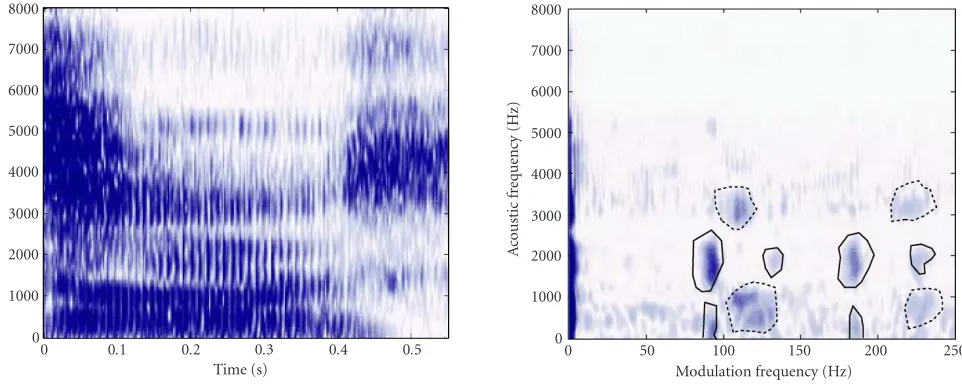
Figure2: Spectrogram (left panel) and joint acoustic/modulation frequency representation (right panel) of the central 450 milliseconds of “two” (speaker 1) and “dos” (speaker 2) spoken simultaneously by two speakers. They-axis of both representations is standard acoustic frequency. Thex-axis of the right panel representation is modulation frequency, with an assumption of Fourier basis decomposition. Solid and dashed lines surround speaker 1’s and speaker 2’s respective pitch information.
This transform when expressed as a bilinear formulation
S(ω−η/2)S∗(ω+η/2) has much more extent in bothηand
ωthan desired. A comparison between the ideal and actual
two-dimensional representation is schematized inFigure 1.
It can be observed fromFigure 1that the representation
S2(ω+η)S∗2(ω−η) has more impulsive terms than the ideal
representation. Namely, the productS2(ω+η)S∗2(ω−η) is
underconstrained. To approach the ideal representation, two conditions need to be added: (1) a kernel which is
convolu-tional inωand (2) a kernel which is multiplicative inη. Thus,
a sufficient condition for the ideal modulation frequency
ver-sus acoustic frequency distribution is
Pideal(η, ω)=
S
ω−η
2
S∗
ω+η 2
φm(η) ∗φc(ω). (8)
It is important to note that the above condition does not require the signal to be simple cosinusoidal modulation. In principal, any signal
s(t)=m(t)c(t), (9)
wherem(t) is nonnegative and band limited to frequencyω <
|ωm|andc(t) has no frequency content belowωm, can have a
modulation frequency versus acoustic frequency distribution in the form of the above ideal modulation frequency versus acoustic frequency distribution. No regions will overlap in
frequency and, assuming separate preservation of phase,s(t)
will be recoverable fromPideal(η, ω).
An example of an implicitly convolutional effect ofφc(ω)
is the limited frequency resolution that arises from a trans-form of a finite duration of data, for example, the windowed time analysis used before conventional short-time
trans-forms and filter banks. The multiplicative effect ofφm(η) is
less obvious. Commonly applied time envelope smoothing
has, as a frequency counterpart, lowpass behavior inφm(η).
Other efficient approaches can arise from decimation
al-ready present in critically sampled filterbanks. Note that the
nonzero terms centered around η = ±2ωc, which are well
above the typical passband of φm(η), are less troublesome
than the typically much lower-frequency quadratic
distor-tion term(s) atη= ±2ωm. Thus, broad frequency ranges in
modulation will be potentially subject to these quadratic dis-tortion term(s).
4. EXAMPLES OF APPLICATIONS
4.1. An adjunct to the spectrogram
Figure 2shows a joint acoustic/modulation frequency trans-form as applied to two simultaneous speakers. Speaker 1 is saying “two” in English while Speaker 2 is saying “dos”
in Spanish. This data is from (http://www.cnl.salk.edu/
∼tewon/Blind/blind audio.html.)
As expected, the spectrogram on the left side ofFigure 2
offers little to discriminate the two simultaneous speakers.
However, the right side ofFigure 2shows isolated regions of
acoustic information associated with the fundamental pitch and its first and aliased harmonics of each of the two speak-ers. These pitch label locations in acoustic frequency also sep-arately segment each of the two speaker’s resonance informa-tion.
4.2. Applications to audio coding
When applied to signals, such as speech or audio, that are ef-fectively stationary over relatively long periods, a modulation dimension projects most of the signal energy onto a few low
2m 2m+ 1
n
Base transform
k
(fr
eq
u
ency)
m(time)
2nd
T
ra
nsfor
m
k
(fr
eq
u
ency)
h(modulation frequency)
Figure3: Simplified structure of the two-dimensional transform used in the new approach to audio coding [36]. The left matrix represents a magnitude of a perfect reconstruction and critically sampled filterbank. The detection operation previously mentioned was inherent in the magnitude operation. Signal phase was encoded separately and did not undergo the second transform.
auditory physiology studies have shown that physiological
importance of modulation effects decreases with
modula-tion frequency [19, 20]. While these traits suggest an
ap-proach for ranking the importance of transmitted coeffi
-cients and coding at very low data rates, this past work has provided an energetic yet not invertible transform. We have recently devised a transform, which after modification to a lower bit rate is invertible back to a high-fidelity signal
[36].
This result confirms that there are modulation frequency transforms that are indeed invertible after quantization. Moreover, the energy compaction provided by the transform allows significant added compression. Our design, which is
schematized in Figure 3, allows for essentially CD-quality
music coding at 32 kilobits/second/channel and provides a progressive encoding which naturally and easily scales to bit rate changes.
Simple subjective tests were performed [36] and, as seen
in Figure 4, the results suggested that the proposed algo-rithm performed significantly better quality coding at 32 kilobits/second/channel than MPEG-1 layer 3 (MP3) cod-ing at 56 kilobits/second/channel. Furthermore, the pro-posed algorithm was shown to be inherently progressively scalable, lending itself well to the widely increasing range of applications where bandwidth cannot be known prior to coding.
This result represents only a first attempt for using joint acoustic and modulation frequency concepts in anal-ysis/synthesis. The result does not just confirm the ex-pected tolerable quantization of perfect reconstruction, it
100% 75%
50%
25% 0%
U
ser
pr
efer
enc
e
60%
22%
17%
Proposed 32 k MP3 56 k Same Figure4: Listener preferences between the proposed algorithm at 32 kbit/s and MP3 at 56 kbit/s. Note that while the proposed algo-rithm was used at almost 1/2 the bit rate of MP3, a large majority of listeners preferred it to the higher bit rate MP3.
also demonstrates how quickly this approach has been able to come close to state-of-the-art performance in audio cod-ing. We thus expect continuing improvements in quality for these bit rates.
5. OTHER APPLICATIONS
5.1. Analysis/synthesis systems
Both audio and images compression, as suggested by our
preliminary results, could gain efficiency and flexibility (e.g.,
fine-grained scalability) by compaction in modulation fre-quency dimensions. Furthermore, as justified earlier, human perception is less sensitive or insensitive to high modulation frequencies. Also, as demonstrated by previous researches
[12, 13,14,15, 16], psychophysical models indicated
lim-ited resolution and significant masking in modulation fre-quency. Joint acoustic and modulation frequency also pro-vides a framework for investigations into human perception. For example, it cannot necessarily be assumed that psychoa-coustic masking in the two dimensions of joint frequency can be accurately predicted from only the product of one-dimensional functions of standard acoustic frequency mask-ing and modulation frequency maskmask-ing. Thus, a framework for two-dimensional masking studies could provide a new viewpoint.
Analysis/synthesis approaches could also be used to gen-erate other novel realistic sounds and images for psychoa-coustics, hearing and vision science, audiometry and op-tometry, and entertainment. For example, a music modifi-cation system, based upon this form of analysis/synthesis, could generalize the standard notion of an acoustic frequency equalizer to a two-dimensional joint frequency equalizer. This joint equalizer could potentially accentuate, attenuate, or remove musical instruments within ranges of joint fre-quency. Also, polyphonic combinations of instruments with
acoustic frequency overlap but different rhythmic structure
could be separated. This concept of polyphonic separation has interesting generalizations to images and video signals. Thus, we expect that success in joint frequency could help bridge representations of natural sounds and images to the structural modeling proposed in MPEG-7 standards.
5.2. Analysis
Joint frequency features can also be used for novel repre-sentation of signals and images. For an acoustic example,
the work of Kingsbury [37] suggests that modulation
spec-trogram features could be useful for correcting multiplica-tive reverberant distortions in speech. Other acoustic appli-cations include speech recognition in noisy environments, music and speech enhancement, audiology and optometry
testing, and audio fingerprinting [38]. Some image and
vi-sion applications of joint frequency analysis include segmen-tation and classification under nonuniform lighting condi-tions. The segmentation and general conversion of naturally produced material to structural models might also be fa-cilitated, opening up new possible areas for standards like MPEG-7 and MPEG-21.
6. SUMMARY AND CONCLUSIONS
Previous work in modulation spectra justifies the impor-tance of this concept in auditory physiology, psychoacoustics, speech perception, and signal analysis and synthesis. There is a remaining need for analysis/synthesis tools which provide
a transform to and from a modulation spectral
representa-tion. Modifications of this representation can thus affect a
novel and general form of filtering which goes well beyond conventional linear time-invariant filters.
An analysis/synthesis approach ideally requires invert-ibility and perfect reconstruction. A joint acoustic/mod-ulation frequency model was outlined along with a set of minimum attributes for invertibility. This model was
vali-dated via high-quality and efficient performance in audio
coding. It also shows potential for single-channel multiple-talker speech separation. Other applications were suggested for acoustic and multimedia signals.
A key future extension of this theory would involve a combined (or a two-dimensional) spectrotemporal modu-lation transform. This is intuitively analogous to combin-ing the modulation spectrum with the well-known cepstral representation widely used in speech recognition. A more versatile approach might utilize a two-dimensional wavelet
transform of the time-frequency representation [19, 20].
While it is critical that this representation be invertible in coding applications, this restriction may not be necessary in many other applications such as for the recognition of speech where robustness in noise or utility for segregation and streaming of competing speech signals might be more important.
REFERENCES
[1] B. Vercoe, W. Gardner, and E. Scheirer, “Structured audio: creation, transmission, and rendering of parametric sound representations,” Proceedings of the IEEE, vol. 86, no. 5, pp. 922–940, 1998.
[2] H. Dudley, “Remaking speech,” Journal of Acoustical Society of America, vol. 11, no. 2, pp. 169–177, 1939.
[3] L. Zadeh, “Frequency analysis of variable networks,” Proc. IRE, vol. 3A-8, no. 3, pp. 291–299, 1950.
[4] T. Kailath, “Channel characterization: time-variant disper-sive channels,” inLectures on Communication System Theory, E. Baghdady, Ed., pp. 95–123, McGraw-Hill, New York, NY, USA, 1961.
[5] A. Møller, “Unit responses of the rat cochlear nucleus to tones of rapidly varying frequency and amplitude,” Acta Physiol. Scan., vol. 81, pp. 540–556, 1971.
[6] N. Suga, “Analysis of information-bearing elements in com-plex sounds by auditory neurons of bats,” Audiology, vol. 11, pp. 58–72, 1972.
[7] C. Schreiner and J. Urbas, “Representation of amplitude mod-ulation in the auditory cortex of the cat. I. The anterior au-ditory field (AAF),” Hearing Research, vol. 21, pp. 227–241, 1986.
[8] G. Langner, “Periodicity coding in the auditory system,” Hearing Research, vol. 60, no. 2, pp. 115–142, 1992.
[9] N. Kowalski, D. Depireux, and S. Shamma, “Analysis of dy-namic spectra in ferret primary auditory cortex: I. Character-istics of single unit responses to moving ripple spectra,” Jour-nal of Neurophysiology, vol. 76, no. 5, pp. 3503–3523, 1996. [10] D. Depireux, J. Simon, D. Klein, and S. Shamma,
“Spectro-temporal response field characterization with dynamic ripples in ferret primary auditory cortex,”Journal of Neurophysiology, vol. 85, no. 3, pp. 1220–1234, 2001.
Network: Computation in Neural Systems, vol. 7, no. 3, pp. 439–476, 1996.
[12] H. Schulze and G. Langner, “Periodicity coding in the primary auditory cortex of the Mongolian gerbil (Meriones unguicula-tus): two different coding strategies for pitch and rhythm?,” Journal of Comparative Physiology A, vol. 181, no. 6, pp. 651– 663, 1997.
[13] G. Langner, M. Sams, P. Heil, and H. Schulze, “Frequency and periodicity are represented in orthogonal maps in the hu-man auditory cortex: evidence from magnetoencephalogra-phy,”Journal of Comparative Physiology A, vol. 181, no. 6, pp. 665–676, 1997.
[14] N. Viemeister, “Temporal factors in audition: A systems anal-ysis approach,” inPsychophysics and Physiology of Hearing, E. Evans and J. Wilson, Eds., pp. 419–427, Academic Press, London, UK, 1977.
[15] T. Houtgast, “Frequency selectivity in amplitude-modulation detection,”Journal of Acoustical Society of America, vol. 85, pp. 1676–1680, 1989.
[16] S. Bacon and D. Grantham, “Modulation masking: Effects of modulation frequency, depth, and phase,”Journal of Acousti-cal Society of America, vol. 85, pp. 2575–2580, 1989.
[17] S. Sheft and W. Yost, “Temporal integration in amplitude modulation detection,” Journal of Acoustical Society of Amer-ica, vol. 88, pp. 796–805, 1990.
[18] S. Ewert and T. Dau, “Characterizing frequency selectivity for envelope fluctuations,” Journal of Acoustical Society of Amer-ica, vol. 108, pp. 1181–1196, 2000.
[19] T. Chi, Y. Gao, M. Guyton, P. Ru, and S. Shamma, “Spectro-temporal modulation transfer functions and speech intelligi-bility,”Journal of Acoustical Society of America, vol. 106, no. 5, pp. 2719–2732, 1999.
[20] M. Elhilali, T. Chi, and S. Shamma, “A spectro-temporal mod-ulation index (STMI) for assessment of speech intelligibility,” to appear in Speech Communication.
[21] T. Houtgast and H. Steeneken, “The modulation transfer function in room acoustics as a predictor of speech intelligi-bility,”Acustica, vol. 28, pp. 66–73, 1973.
[22] “Special issue of image evaluation by means of optical transfer functions,”Optica Acta, vol. 18, pp. 81–163, 1971.
[23] T. Houtgast and H. Steeneken, “A review of the MTF concept in room acoustics and its use for estimating speech intelligi-bility in auditoria,” Journal of Acoustical Society of America, vol. 77, no. 3, pp. 1069–1077, 1985.
[24] R. Drullman, J. Festen, and R. Plomp, “Effect of temporal envelope smearing on speech reception,”Journal of Acoustical Society of America, vol. 95, no. 2, pp. 1053–1064, 1994. [25] S. Greenberg and B. E. D. Kingsbury, “The modulation
spec-trogram: In pursuit of an invariant representation of speech,” inProc. IEEE Int. Conf. Acoustics, Speech, Signal Processing (ICASSP ’97), pp. 1647–1650, Munich, Germany, April 1997. [26] W. Gardner, Statistical Spectral Analysis: A Non-Probabilistic
Theory, Prentice-Hall, Englewood Cliffs, NJ, USA, 1987. [27] W. Gardner, “Exploitation of spectral redundancy in
cyclosta-tionary signals,” IEEE Signal Processing Magazine, vol. 8, pp. 14–36, 1991.
[28] C. Nikias and M. Raghuveer, “Bispectrum estimation: A digi-tal signal processing framework,”Proceedings of the IEEE, vol. 75, no. 7, pp. 869–891, 1987.
[29] E. Scheirer, “Tempo and beat analysis of acoustic musical sig-nals,” Journal of Acoustical Society of America, vol. 103, no. 1, pp. 588–601, 1998.
[30] S. Haykin and D. Thomson, “Signal detection in a nonstation-ary environment reformulated as an adaptive pattern classifi-cation problem,” Proceedings of the IEEE, vol. 86, no. 11, pp. 2325–2344, 1998.
[31] A. Bovik, P. Maragos, and T. Quatieri, “AM-FM energy de-tection and separation in noise using multiband energy oper-ators,”IEEE Trans. Signal Processing, vol. 41, no. 12, pp. 3254– 3265, 1993.
[32] W. Torres and T. Quatieri, “Estimation of modulation based on FM-to-AM transduction: Two-sinusoid case,”IEEE Trans. Signal Processing, vol. 47, no. 11, pp. 3084–3097, 1999. [33] A. Rao and R. Kumaresan, “On decomposing speech into
modulated components,”IEEE Trans. Speech, and Audio Pro-cessing, vol. 8, no. 3, pp. 240–254, 2000.
[34] R. McAulay and T. Quatieri, “Speech analysis/synthesis based on a sinusoidal representation,”IEEE Trans. Acoustics, Speech, and Signal Processing, vol. 34, no. 4, pp. 744–754, 1986. [35] J. Chowning, “The synthesis of complex audio spectra by
means of frequency modulation,” Journal of the Audio En-gineering Society, vol. 21, no. 7, pp. 526–534, 1973.
[36] M. Vinton and L. Atlas, “A scalable and progressive audio codec,” inProc. IEEE Int. Conf. Acoustics, Speech, Signal Pro-cessing (ICASSP ’01), Salt Lake City, Utah, USA, May 2001. [37] B. Kingsbury, Perceptually inspired signal-processing
strate-gies for robust speech recognition in reverberant environments, Ph.D. thesis, University of California, Berkeley, Calif, USA, 1998.
[38] S. Sukittanon and L. Atlas, “Modulation frequency features for audio fingerprinting,” inProc. IEEE Int. Conf. Acoustics, Speech, Signal Processing (ICASSP ’02), pp. 1773–1776, Or-lando, Fla, USA, May 2002.
Les Atlas received a Ph.D. degree in elec-trical engineering from Stanford University in 1984. He joined the University of Wash-ington in 1984, where he is a Professor of electrical engineering. His research is in dig-ital signal processing, with specializations in acoustic analysis, time-frequency repre-sentations, and signal recognition and cod-ing. His research is supported by DARPA, the Office of Naval Research, the Army
Re-search Lab, and the Washington ReRe-search Foundation. Dr. Atlas re-ceived a National Science Foundation Presidential Young Investiga-tor Award and a Fulbright Research Award. He was General Chair of the 1998 IEEE International Conference on Acoustics, Speech, and Signal Processing, Chair of the IEEE Signal Processing Society Technical Committee on Theory and Methods, and a member of the Signal Processing Society’s Board of Governors.
Shihab A. Shammaobtained his Ph.D. de-gree in electrical engineering from Stanford University in 1980. He joined the Depart-ment of Electrical Engineering at the Uni-versity of Maryland in 1984, where his re-search has dealt with issues in computa-tional neuroscience and the development of microsensor systems for experimental re-search and neural prostheses. Primary focus has been on uncovering the computational