ISSN (Print) : 2320 – 3765
ISSN (Online): 2278 – 8875
I
nternational
J
ournal of
A
dvanced
R
esearch in
E
lectrical,
E
lectronics and
I
nstrumentation
E
ngineering
(A High Impact Factor, Monthly, Peer Reviewed Journal)
Website: www.ijareeie.com
Vol. 8, Issue 3, March 2019
Smart Home Automation Using IoT
S.Aravindan, S.Dharani, V.Gokulakrishnan, D.Jayaseeli, K.Dinakaran
IV ECE, Department of Electronics and Communication Engineering, Jai Shriram Engineering College , Tirupur,
Tamil Nadu, India
1,2,3,4Assistant Professor, Department of Electronics and Communication Engineering, Jai Shriram Engineering College,
Tirupur, Tamil Nadu, India
5ABSTRACT:
In this paper we discuss and create a MQTT based Secured home automation system, by using
temperature sensors and using ESP8266model as the network gateway, here we have implemented MQTT Protocol for
transferring & receiving sensor data and finally getting access to those sensor data, also we have implemented ACL
(access control list) to provide encryption method for the data and finally monitoring those data on webpage or any
network devices. ESP8266 has been used as a gateway or the main server in the whole system, which has various
sensor connected to it via wired or wireless communication.
KEYWORDS:
Message Queuing Telemetry Transport (MQTT), ESP8266, Mosquitto, Home automation
I. INTRODUCTION
Home automation refers to remotely monitoring the condi-tions of home and performing the required actuation.
Through home automation, household devices such as TV, light bulb, fan, etc. are assigned a unique address and are
connected through a common home gateway. These can be remotely accessed and controlled from any PC, mobile or
laptop. This can drastically reduce energy wastage and improve the living conditions besides enhancing the indoor
security.
Owing to the rapid growth in technology, the devices in the recent past are becoming smart. The real world devices are
being equipped with intelligence and computing ability so that they can configure themselves accordingly. Sensors
connected to embedded devices along with the low power wireless connectivity is facilitates to remotely monitor and
control the devices. This forms an integral component of Internet of Things(IoT) network. Internet of Things can be
considered as a network of devices that are wirelessly connected so that they communicate and organize themselves
based on the predefined rules. However these devices are constrained in terms of their resources. Hence light weight
protocols such as MQTT, CoAP etc. are used for the data transmission over wireless connectivity. There are so many
kinds of radio modules out of which GSM, 3G, WiFi, Bluetooth, Zigbee, etc. are common. However, owing to the
surging number of WiFi hotspots and range sufficient to perform the required to control and monitoring, WiFi is
choosen as the mode of communication in the prototype and the devices are controlled through MQTT protocol
implemented using ESP8266.
Organization of the paper is as follows: A brief overview about the MQTT protocol is presented in section II. The
related work that has already been done in this area is discussed in section III. In section IV the implementation details
about the network setup, hardware and software used is briefed. Results from developed prototype are discussed in
section V. Section VI presents the conclusions and future scope of work.
MESSAGE QUEUING TEEMENTARY TRANSPORT
Message Queuing Telemetry Transport (MQTT) is a light weight transport protocol that efficiently uses the network
bandwidth with a 2 byte fixed header [1]. MQTT works on TCP and assures the delivery of messages from node to the
ISSN (Print) : 2320 – 3765
ISSN (Online): 2278 – 8875
I
nternational
J
ournal of
A
dvanced
R
esearch in
E
lectrical,
E
lectronics and
I
nstrumentation
E
ngineering
(A High Impact Factor, Monthly, Peer Reviewed Journal)
Website: www.ijareeie.com
Vol. 8, Issue 3, March 2019
capabilities and resources. MQTT was initially developed by IBM [2] in 1999 and recently has been recognized as standard by Organization for the Advancement of Structured Information Standards (OASIS) [3].
MQTT is a publish/subscribe based protocol. Any MQTT connection typically involves two kinds of agents: MQTT clients and MQTT public broker or MQTT server. Data that is being transported by MQTT is referred to as application message. Any device or program that is connected to the net-work and exchanges application messages through MQTT is called as an MQTT client. MQTT client can be either publisher or subscriber. A publisher publishes application messages and subscriber requests for the application messages. MQTT server is a device or program that interconnects the MQTT clients. It accepts and transmits the application messages among multiple clients connected to it. Devices such as sensors, mobiles etc. are considered as MQTT client. When an MQTT client has certain information to broadcast, it publishes the data to the MQTT broker. MQTT broker is responsible for data collection and organization. The application messages that are published by MQTT client is forwarded to other MQTT clients that subscribe to it. MQTT is designed to simplify the implementation on client by concentrating all the complexities at the broker. Publisher and subscriber are isolated, meaning they need not have to know the existence or application of other.
ISSN (Print) : 2320 – 3765
ISSN (Online): 2278 – 8875
I
nternational
J
ournal of
A
dvanced
R
esearch in
E
lectrical,
E
lectronics and
I
nstrumentation
E
ngineering
(A High Impact Factor, Monthly, Peer Reviewed Journal)
Website: www.ijareeie.com
Vol. 8, Issue 3, March 2019
A. Establishing a connection
Upon the successful establishment of network between the MQTT client and the MQTT server, control packets are exchanged between the client and the server. The client that wishes to connect to the MQTT server sends a CONNECT packet to the server specifying its identifier, flags, protocol level and other fields. The server acknowledges the client with the specified identifier through CONNACK packet with a return code denoting the status of connection.
B. Publishing the application messages
ISSN (Print) : 2320 – 3765
ISSN (Online): 2278 – 8875
I
nternational
J
ournal of
A
dvanced
R
esearch in
E
lectrical,
E
lectronics and
I
nstrumentation
E
ngineering
(A High Impact Factor, Monthly, Peer Reviewed Journal)
Website: www.ijareeie.com
Vol. 8, Issue 3, March 2019
published packet with PUBACK including the packet iden-tifier. However in QoS 2, four packets are exchanged. The server acknowledges the receipt of PUBLISH packet with the PUBREC packet. MQTT client then sends a packet to release publish with a PUBREL packet. The server then sends the fourth packet PUBCOMP, indicating the completion of publishing the application message on the given topic.
C. Subscribing to a topic
If the MQTT client want to subscribe to the application messages published on topic, it sends the SUBSCRIBE packet along with the topic name indicated in UTF-8 encoding. The server acknowledges the subscription with SUBACK packet along with a return code denoting the status of request. Once the subscription is successful, the application messages on the specified topic are forwarded to the client with the maximum QoS. To unsubscribe a topic, the client sends an UNSUBSCRIBE packet to the server which acknowledges it with the UNSUBACK packet.
D. Maintaining the connection alive
After a certain time-out, the connection between the client and the server is terminated. To maintain the connection, the client indicates that it is alive by transmitting a PINGREQ packet to the server. The MQTT server responds to the client with the indicated identifier with a PINGRESP packet and maintains the connection alive.
E. Terminating the connection
To terminate the connection, the MQTT client sends a DISCONNECT packet to the server. The server does not acknowledge this packet. However all the application messages related to the client will be flushed off and the client is disconnected from the server.
RELATED WORK
ISSN (Print) : 2320 – 3765
ISSN (Online): 2278 – 8875
I
nternational
J
ournal of
A
dvanced
R
esearch in
E
lectrical,
E
lectronics and
I
nstrumentation
E
ngineering
(A High Impact Factor, Monthly, Peer Reviewed Journal)
Website: www.ijareeie.com
Vol. 8, Issue 3, March 2019
proposes a secure, reliable and adaptable home automation system. The research work done in [8] proves that MQTT is better than HTTP for the nodes with constrained resources. It has been proven that data transmission through MQTT consumes only about 0.05% of battery/hour by using 3G for network connectivity.
IMPLEMENTATION DETAILS
A. Network setup
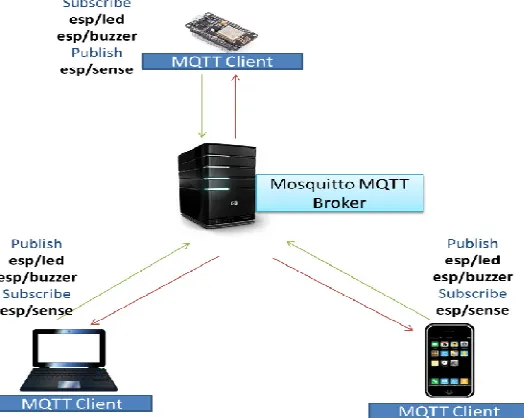
The intensity of light is sensed using LDR sensor connected to ESP8266 development board. ESP8266 development board processes the sensor data and performs actuation. It acts as a gateway for data transmission through WiFi. ESP8266 is configured as MQTT client publishing the sensor data to the MQTT broker and subscribing for the commands to control the actuation. LED and buzzer is used as actuators in the prototype. ESP8266 module publishes the sensor data under the topic ′esp\sense′. It subscribes for the topic ′esp\led′ and ′esp\buzzer′ to receive commands to control LED and
Fig. 4.Message transmission through MQTT
ISSN (Print) : 2320 – 3765
ISSN (Online): 2278 – 8875
I
nternational
J
ournal of
A
dvanced
R
esearch in
E
lectrical,
E
lectronics and
I
nstrumentation
E
ngineering
(A High Impact Factor, Monthly, Peer Reviewed Journal)
Website: www.ijareeie.com
Vol. 8, Issue 3, March 2019
buzzer connected to the GPIOs of ESP8266. MQTT mosquitto broker is set up for ESP8266 to publish and subscribe to
the application messages. Other MQTT clients such as PCs and Mobiles can connect to MQTT server through existing
communication technologies such as Ethernet, 2G, 3G, WiFi etc
Fig. 6. ESP8266 based NodeMCU development board
B.
ESP8266
ESP8266 [9] is a low cost development board that
consol-idates GPIOs, I2C, UART, ADC, PWM and
WiFi for rapid prototyping. Powered by 3.3V supply,
ESP8266 together with voltage regulator and USB to
serial is packaged as ESP-12 module. Applications
can be developed on this board through Arduino IDE
or Lua based ESPlorer.
C. Software setup
Arduino IDE is used to program the ESP8266 module as MQTT client. Mosquitto [10], an open source MQTT
broker is implemented on Windows PC. It uses two services mosquitto
Pub and mosquitto
Sub to publish and subscribe to
ISSN (Print) : 2320 – 3765
ISSN (Online): 2278 – 8875
I
nternational
J
ournal of
A
dvanced
R
esearch in
E
lectrical,
E
lectronics and
I
nstrumentation
E
ngineering
(A High Impact Factor, Monthly, Peer Reviewed Journal)